

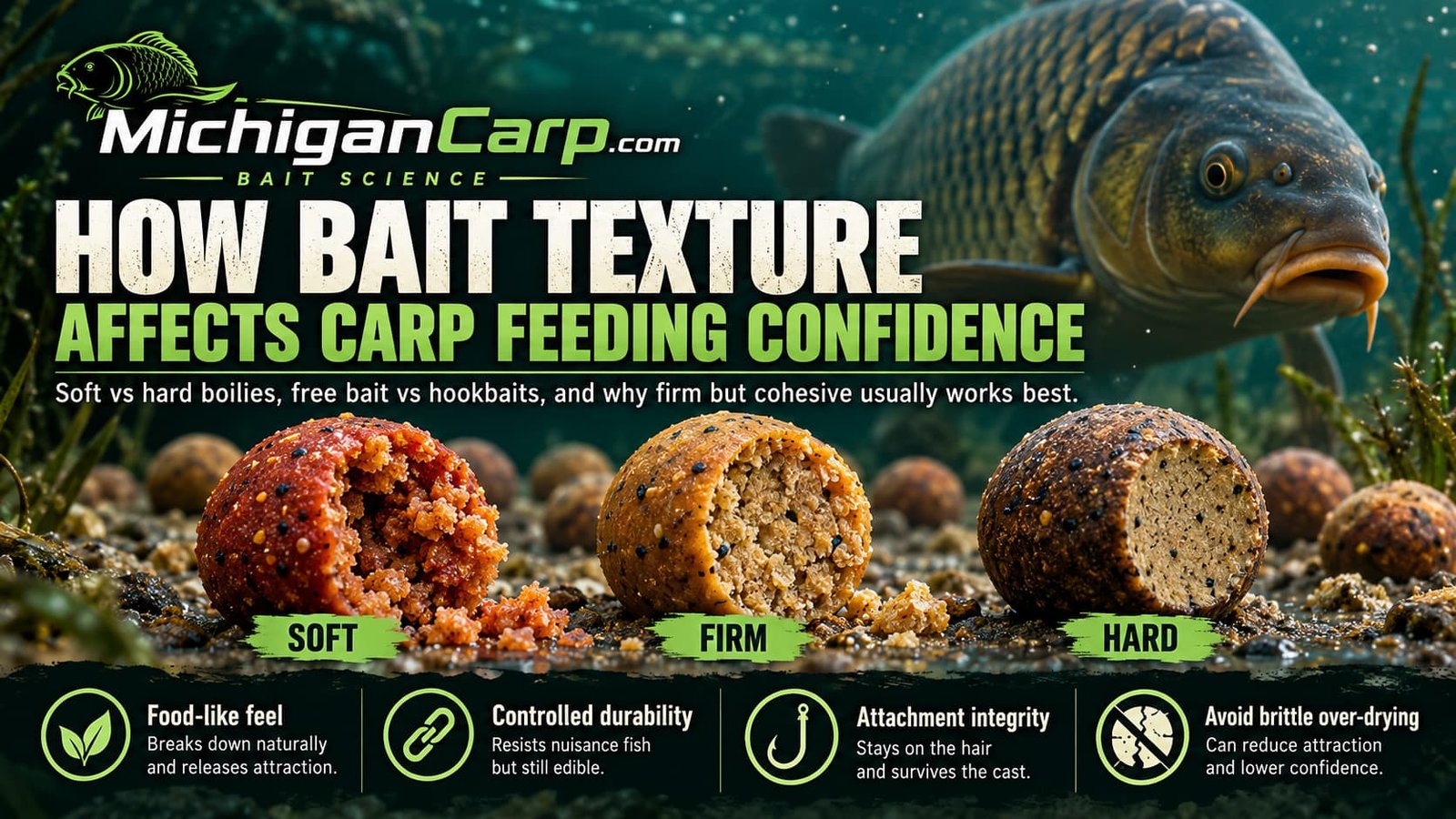
The debate over soft vs hard boilies is often presented as though carp naturally prefer one and reject the other.
That is too simple.
A good boilie needs the right texture for the job it has to perform.
Free bait must survive transport, throwing or baiting, reach the bottom intact and then begin behaving like food.
A hookbait has an additional requirement: it must remain securely attached to the rig for the complete fishing period.
Those jobs do not necessarily require the same texture.
A boilie can be:
soft but cohesive;
firm and yielding;
tough and elastic;
hard and brittle;
rubbery;
pasty in the centre;
or dry and hard outside while retaining substantially more moisture internally.
All of those baits may be described casually as either “soft” or “hard,” but mechanically they are very different.
Carp themselves are capable of processing comparatively hard food. Their pharyngeal teeth and chewing pad are designed to crush and grind material after it has entered the feeding apparatus.
Research using X-ray filming and muscle recordings has documented distinct crushing, grinding, food transport and selection behaviours in common carp.
See Food Handling and Mastication in the Carp and Pharyngeal Mastication and Food Transport in the Carp.
That evidence tells us that carp can mechanically process hard food.
It does not prove that harder boilies are better.
Nor does it prove that softer boilies are automatically easier for carp to accept.
For ordinary free offerings, my own preference is normally a firm but yielding boilie: durable enough to survive handling and fishing, but not dried into an unnecessarily glass-hard or brittle object.
Specialist hookbaits can legitimately be tougher.
The guiding principle for this article is therefore:
Design the texture for the bait’s job—not for the hardest result you can produce.
For the complete production process, use How to Boil and Dry Boilies Properly.
For controlled immersion and rig testing, use How to Test Boilies Before Fishing.
Table of Contents
Quick Start: What Texture Should a Boilie Have?
There is no single correct hardness.
A better starting point is to match texture to bait function.
| Bait type | Useful starting texture | Too hard | Too soft |
|---|---|---|---|
| Free boilie | Firm, cohesive and progressively yielding | Slow hydration, brittleness and unnecessary hardness | Damage during handling or rapid breakdown |
| Bottom hookbait | Firm with strong attachment integrity | Cracking around needle, hair or screw | Pull-off or failure during the soak |
| Hardened hookbait | Tough rather than glass-hard | Brittle splitting and very slow hydration | Insufficient nuisance-fish resistance |
| Wafter | Medium-firm with stable buoyancy | Cracking or inconsistent balance | Liquid uptake may make it too heavy |
| Pop-up | Firm and cohesive | Fracture or skin separation | Weak attachment or buoyancy loss |
For most ordinary free bait, I would rather have controlled firmness and cohesion than maximum hardness.
For hookbaits, durability becomes more important.
But even a specialist hookbait should normally be tough rather than brittle.
What Boilie Texture Really Means
Hardness is only one part of bait texture.
Two boilies may feel similarly hard between the fingers and behave completely differently once they are cut, soaked or attached to a rig.
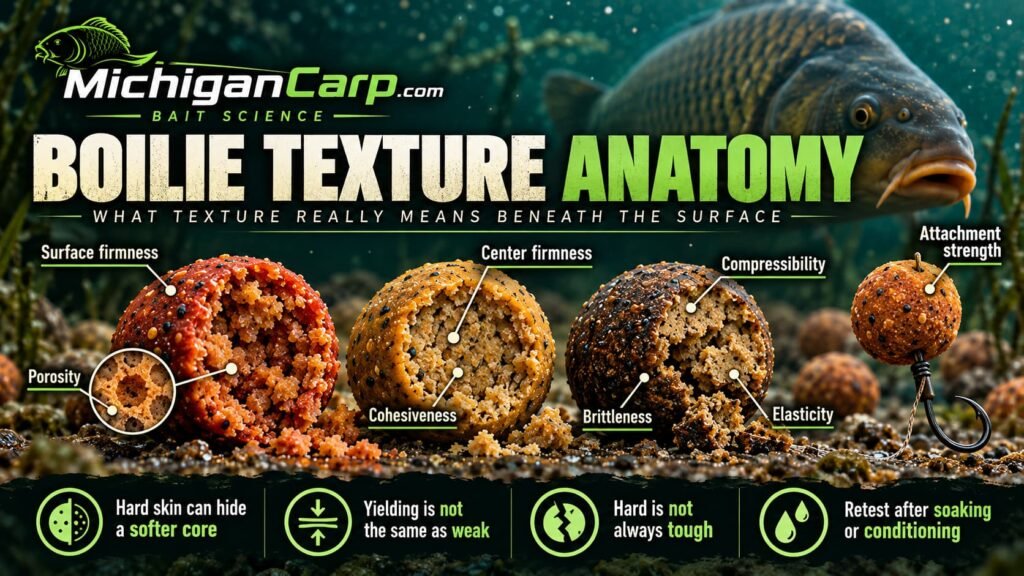
Texture is better understood through several connected properties.
| Property | What it describes | Why it matters |
|---|---|---|
| Surface firmness | Resistance of the outer skin | A hard skin can hide a softer centre |
| Centre firmness | Structure inside the boilie | Large baits may remain much softer internally |
| Compressibility | How far the bait yields | Yield does not automatically mean weakness |
| Cohesiveness | Whether the bait stays together | A soft cohesive bait differs from paste |
| Toughness | Ability to absorb force without failing | Important for casting and hookbaits |
| Brittleness | Sudden fracture | A very hard bait can still be mechanically weak |
| Elasticity | Ability to deform and recover | Too much can create a rubbery bait |
| Porosity | Paths through which water and materials move | Influences hydration and release behaviour |
| Attachment strength | Security around hair, screw or swivel | Critical for hookbait reliability |
Firm Is Not the Same as Brittle
A firm boilie resists deformation.
A tough boilie can resist force while still yielding.
A brittle boilie resists force and then fractures suddenly.
That distinction is important.
A bait can feel impressively hard yet crack immediately when drilled or pushed onto a bait screw.
For a hookbait, that is not strength.
It is failure.
Skin and Centre Can Behave Differently
Boilies normally dry from the outside inward.
The outer layer loses moisture first.
A 20–24 mm bait can therefore develop a dry, firm skin while the centre remains noticeably softer.
This is one reason finger pressure alone tells you very little.
Cut representative baits through the middle.
Look at both the skin and the complete internal structure.
For practical drying checks, use How to Tell When Boilies Are Dry Enough. Physical hardness alone does not prove that a bait is dry enough for its intended use or suitable for room-temperature shelf life.
Soft vs Hard Boilies and Carp Feeding Confidence
The phrase feeding confidence is useful angling language, but it should not be mistaken for something we can directly measure inside a carp’s mind.
When anglers say fish are feeding confidently, they normally mean that carp are:
returning repeatedly;
taking several food items;
remaining in the feeding area;
and feeding with relatively little interruption.
Texture may contribute to that behaviour.
It is only one variable.
Bait placement, familiarity, feeding competition, water temperature, food density, angling pressure, rig presentation and previous captures can all matter.
What the Carp Research Actually Tells Us
Common carp use a highly developed pharyngeal feeding apparatus.
They can transport food, reposition it, separate edible material from unwanted material and crush or grind relatively hard foods.
The classic research even describes the carp feeding system as suited to processing hard items such as seeds and shelled foods.
That makes one point clear:
Hardness alone does not make a bait unnatural to a carp.
The research does not establish an optimum boilie hardness.
It does not show that a softer boilie is always retained longer.
And it does not show that a very hard hookbait will automatically be rejected.
Those are separate fishing questions.
What About Older or Larger Carp?
Through many years of carp fishing, my own feeling is that some older or larger carp may respond well to a bait that is firm but yielding rather than extremely hard.
I treat that as a field hypothesis, not established science.
It is plausible that individual fish develop feeding preferences through natural-food availability, previous captures and long feeding histories.
But there is no good basis for claiming that old carp need soft boilies because they lose their teeth in the same way as an elderly human.
That comparison does not fit carp anatomy.
If the idea is worth testing, the useful experiment is simple:
keep the base mix, size, flavour, colour and presentation the same and alter the texture deliberately.
Free Bait and Hookbaits Need Different Textures
A free boilie and a hookbait perform different jobs.
That is probably the most useful practical lesson in the entire subject.
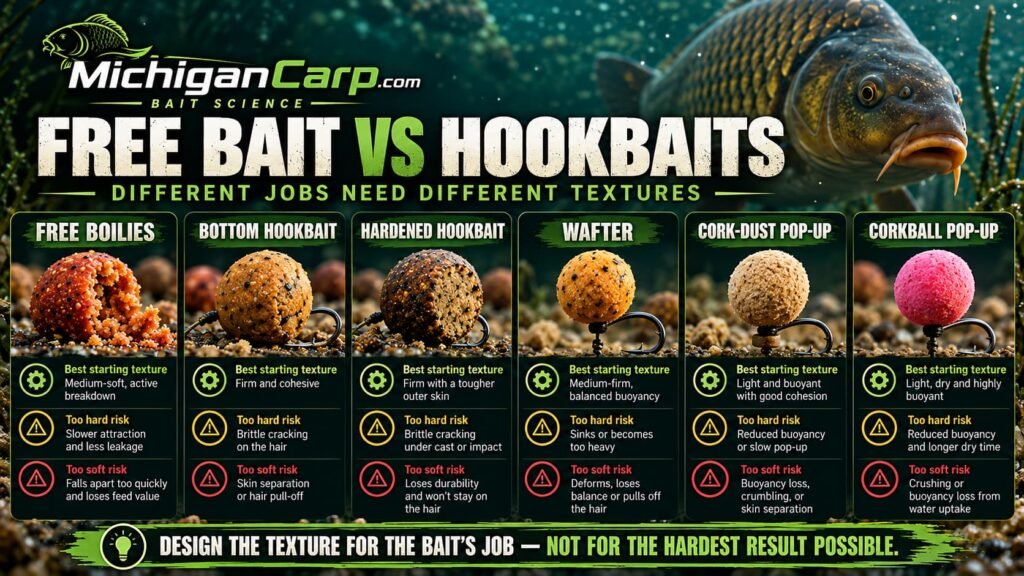
Free Boilies
Free offerings are intended to be eaten.
For most of my own free bait, I want:
firmness during handling;
good cohesion;
progressive water uptake;
gradual softening;
and enough internal structure to remain recognisable as food.
I do not normally want every free boilie dried to the same hardness as a long-soak hookbait.
The free bait has already done its mechanical job once it reaches the feeding area intact.
After that, controlled hydration and food-signal release become useful.
For the relationship between structure and release, see Carp Bait Solubility and Leakage.
Bottom Hookbaits
A bottom hookbait must do more.
It may need to survive:
a hard cast;
hours on the bottom;
crayfish;
bluegills or other small fish;
catfish;
turtles;
and repeated contact with debris.
That justifies a firmer or tougher version of the same bait.
The hookbait can still match the free bait in flavour, colour and basic formulation without having exactly the same physical structure.
Wafters and Pop-Ups
Balanced and buoyant hookbaits create an additional complication.
Texture changes can alter buoyancy.
Long drying can change mass.
Liquid treatment can add mass.
A softening skin can affect attachment.
Water uptake may eventually turn a marginal wafter into a bottom bait.
For that reason, every balanced bait must be tested using the actual hook, screw, swivel, putty and hooklink that will be used when fishing.
How to Make Wafters and Pop-Ups From a Boilie Base Mix owns the specialist buoyant-hookbait formulas and should remain separate from this article.
What Controls Boilie Texture?
No single ingredient controls finished texture.
It is produced by the whole bait-making system.
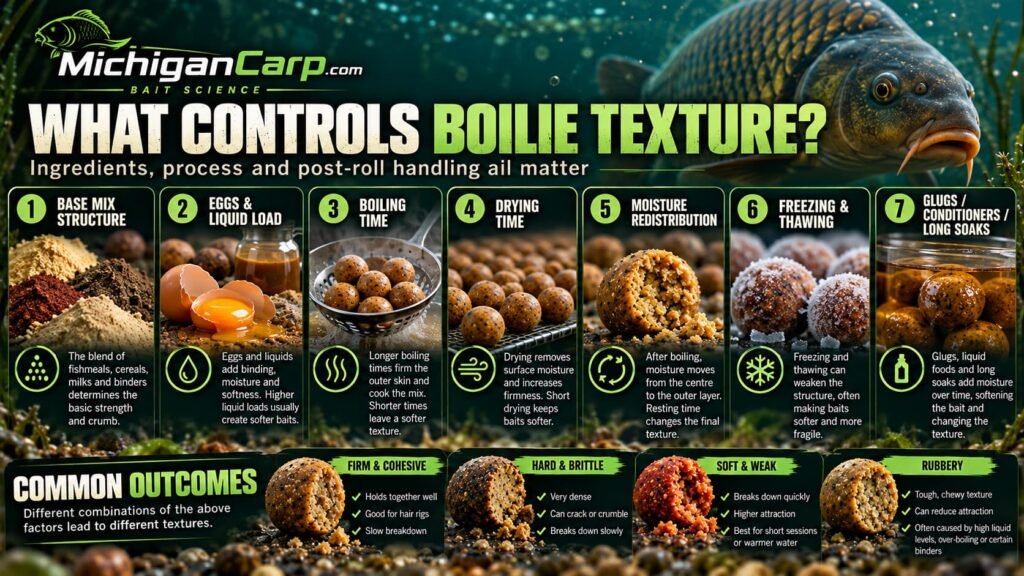
| Factor | Main texture effect | Common mistake |
|---|---|---|
| Base-mix structure | Determines the starting matrix | Trying to repair a weak formula through drying |
| Eggs and wet phase | Supply water, protein, fat and binding | Changing egg/liquid level without recording it |
| Albumen | Adds heat-set firmness | Excess can contribute to brittle or rubbery bait |
| Casein family | Can increase density and toughness | Assuming more protein always means better structure |
| Gluten | Adds elasticity and binding | Too much may produce rubberiness |
| Semolina and cereal starch | Supports rolling and cooked structure | Excess processing can create dense bait |
| Birdfood and coarse meals | Open texture and create variation | Excess can create weak attachment points |
| Nut and seed meals | Add food texture and fat | Too much may create greasy or crumbly bait |
| Cooking | Sets the matrix | Trying to fix weak paste by over-boiling |
| Drying | Increases firmness | Drying beyond the functional requirement |
| Freezing and thawing | May alter moisture distribution | Repeated freeze-thaw cycles |
| Glugs and conditioners | Change surface and water uptake | Assuming treated bait has the original texture |
Protein Structure
Albumen, gluten, caseins and other structural proteins can strengthen a boilie.
They can also be overused.
A bait containing large quantities of albumen, casein and gluten can become extremely firm but also dense, rubbery or brittle.
Choose structural ingredients because the bait needs them.
For the casein family, use Casein in Boilies.
Cooking
Heat converts paste into a stable boilie matrix.
Egg proteins set.
Starches change.
Proteins interact.
The outer structure becomes more resistant.
Additional cooking may increase firmness, but extended cooking is not a substitute for a correctly balanced formula.
The full heat-treatment discussion belongs in What Boiling Does to Carp Bait.
Drying
Drying increases firmness because water leaves the bait.
That process does not happen uniformly.
Surface change occurs first.
The centre follows later.
A useful session bait may therefore move through a progression from freshly cooked, to surface dry, to firm and functional, and eventually to unnecessarily hard or brittle.
Drying time by itself is not a specification.
Humidity, airflow, bait diameter, fat content and formula all matter.
Freezing, Glugging and Conditioning
A boilie is not mechanically frozen in time once it leaves the drying tray.
Freezing, thawing, rehydration and liquid treatment can all change its behaviour.
For the full freezer-bait discussion, use Freezing, Drying and Rehydration of Boilies.
For hookbait treatment, use How to Prepare Boilies for Carp Fishing.
A treatment should always be judged on the finished treated bait, not the untreated starting point.
Testing and Troubleshooting Boilie Texture
The best way to improve texture is not to argue about whether a boilie feels soft or hard.
Compare it consistently.
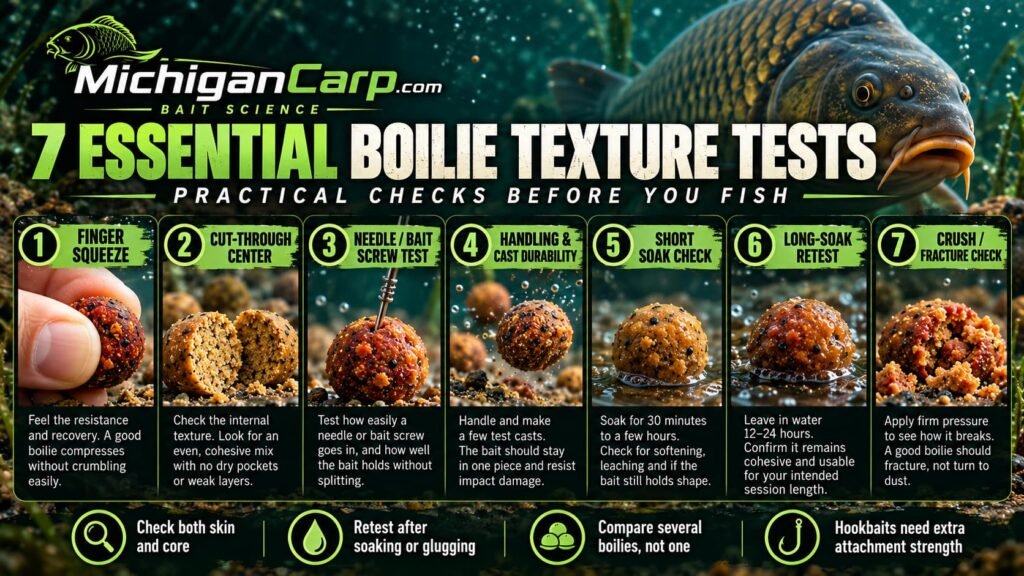
| Test | What to check |
|---|---|
| 1. Finger compression | Does it yield gradually or crack suddenly? |
| 2. Cut-through centre | Is the centre even, wet, pasty, cracked or hollow? |
| 3. Needle or screw test | Does the attachment enter cleanly without splitting? |
| 4. Handling and cast test | Does it survive normal use without damage? |
| 5. Short soak | How does the skin change during the first few hours? |
| 6. Full-session soak | Is it still functional after the intended fishing period? |
| 7. Fracture test | Does it crush progressively or explode into dry brittle pieces? |
These checks are intentionally simple.
The complete controlled-testing protocol—including batch records, water uptake, weight change and repeatable comparison methods—belongs in How to Test Boilies Before Fishing.
A Useful 24 mm Comparison
My 24 mm milk-nut boilies provide a useful practical example because different batches can be produced from the same underlying bait while changing only processing or hookbait structure.
A useful comparison would be:
| Version | Purpose |
|---|---|
| Normal freezer bait | Free-bait control |
| Firm session bait | Additional handling and throwing durability |
| Specialist hookbait | Longer soak and nuisance-fish resistance |
| Lightly conditioned hookbait | Test whether a hard bait benefits from a more yielding surface |
| Deliberately over-dried control | Show what excessive hardness and brittleness look like |
The important part is not the specific bait.
It is the method.
If texture is the variable being tested, do not simultaneously change flavour, colour, size and rig.
Otherwise a caught fish tells you very little about the texture question.
Common Texture Problems
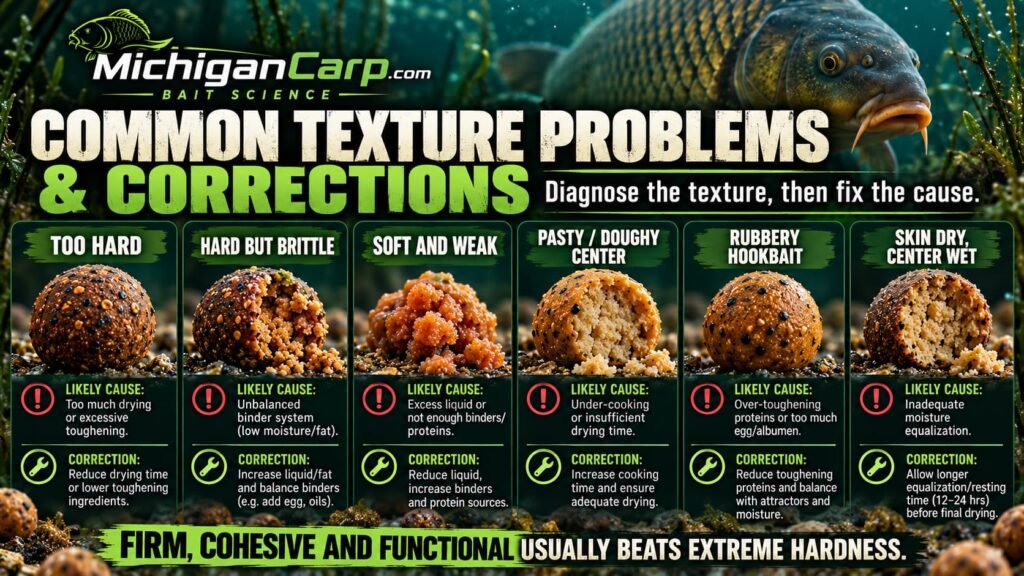
| Problem | Likely causes | Controlled correction |
|---|---|---|
| Hard outside, soft centre | Large bait or aggressive surface drying | Slow the drying process and inspect the centre |
| Hard and brittle | Excess drying or excessive structural proteins | Reduce drying or reformulate the next test batch |
| Rubbery | Too much elastic binder, albumen or gluten | Reduce the elastic structural fraction |
| Soft and weak | Excess liquid or inadequate structure | Correct the formula rather than simply drying harder |
| Pasty centre | Inadequate setting or wet paste | Review liquid level and cooking |
| Cracks when needled | Brittleness or coarse weak points | Reduce over-drying and improve hookbait structure |
| Bait screw pulls out | Soft skin, voids or poor cohesion | Strengthen attachment zone or change attachment method |
| Wafter becomes heavy | Excess liquid uptake | Reduce conditioning and retest complete rig |
| Free bait barely changes | Dense matrix or severe processing | Reduce cooking/drying intensity or open the structure |
For wider troubleshooting beyond texture, use Boilie Problems: Real Causes and Practical Fixes.
My Practical View
After decades of carp fishing and making bait, I do not think the goal should be to produce the hardest boilie possible.
I also do not think all boilies should be soft.
For ordinary free bait, I want a boilie that is:
firm enough to handle;
cohesive rather than crumbly;
stable enough to reach the lakebed intact;
and capable of progressively changing once submerged.
I do not want it unnecessarily rubbery.
I do not want it glass-hard.
And I do not want a dry skin disguising a wet, weak centre.
For hookbaits, I want greater durability.
That can justify harder drying, additional structural protein or a specialist hookbait formula.
But I still prefer toughness over brittleness.
A hookbait that survives 24 hours in a bucket but breaks when the bait screw is inserted is not a good hookbait.
Likewise, a free boilie that survives for three days underwater but barely hydrates during the actual fishing session may be mechanically impressive without being particularly useful.
The texture question is therefore not:
Soft or hard?
It is:
What must this bait survive, and how should it change while it is fishing?
That is the standard I would use.
Firm, cohesive and functional usually beats extreme hardness.
FAQ
Do carp prefer soft or hard boilies?
There is no universal soft-versus-hard preference established for all carp or fishing situations. Carp can mechanically process hard food. For ordinary free bait, a firm but progressively yielding texture is a useful practical target.
Are very hard boilies unattractive to carp?
Not automatically. Carp are physically capable of crushing and grinding hard food. The relevant questions are whether the bait remains food-like, hydrates appropriately and performs the intended fishing job.
Can boilies be too hard?
Yes. Excessive drying or excessive structural protein can create bait that is brittle, rubbery, slow to hydrate or difficult to attach.
Can boilies be too soft?
Yes. A very soft boilie may fail during casting, break down too quickly or tear around a hair or bait screw.
Should hookbaits be harder than free bait?
Usually they should be more durable. I prefer to describe that as tougher, because maximum hardness can create brittle hookbaits.
Why are my boilies hard outside but soft inside?
Moisture normally leaves the surface first. Larger boilies can develop a firm outer layer while the centre remains substantially softer.
What makes boilies rubbery?
Excessive elastic binders such as gluten, heavy albumen use or an overly dense protein system can contribute to a springy, rubbery structure.
What makes boilies brittle?
Over-drying, overly dry paste, heavy structural-protein inclusion and weak points from coarse particles can all contribute.
Can glugging soften hard boilies?
Yes. Liquid treatment can soften the surface and increase water uptake. Too much treatment can weaken attachment, alter wafter balance or create storage problems.
Do older carp prefer softer boilies?
That is a reasonable field question but not an established scientific fact. I would test it by comparing different textures of the same bait while keeping the other variables as consistent as possible.
Next Steps
Continue with How to Boil and Dry Boilies Properly for the production process.
Use What Boiling Does to Carp Bait for the deeper heat and structure explanation.
Use How to Test Boilies Before Fishing for controlled water and rig testing.
Read Freezing, Drying and Rehydration of Boilies for post-production texture changes.
Use How to Prepare Boilies for Carp Fishing for glugs, soaks and hookbait conditioning.
Read Carp Bait Solubility and Leakage for the relationship between structure, water entry and food-signal release.
Use How to Store Homemade Boilies to protect texture after production.
How to Tell When Boilies Are Dry Enough — use practical checks to judge drying progress for freezer bait, session bait and hookbaits.
How to Make Wafters and Pop-Ups From a Boilie Base Mix owns the specialist buoyant-hookbait formulas.
Return to Bait Science for the technical library or Boilie School for the complete boilie-making route.