

This Plum Scopex Vanilla boilie has become the control flavor direction in my milk, nut and birdfood bait development.
That position was not earned because Plum sounds attractive on a bottle label or because Scopex has some mystical reputation in carp fishing.
It was earned because closely related versions of the bait continued producing carp while the underlying milk, nut and liquid systems were being refined.
The bait combines cereal structure, full-fat soy, birdfood, tiger-nut flour, dairy ingredients, yeast and a restrained support layer. Plum, Scopex and Vanilla then give that food system a recognizable fruit-and-cream identity.
The development record is important because this was not one frozen recipe that appeared fully formed.
There was an earlier recorded formula that totaled 1,019 g. A later reference mix was deliberately simplified to an exact 1,000 g. Supporting liquids also changed as my bait making became more controlled.
The field results therefore belong to the wider Plum, Scopex and Vanilla milk-nut bait direction, not automatically to every ingredient and gram printed in the latest reference formula.
This is not a miracle-flavor story. It is the development record of a bait identity that survived formulation changes and continued producing carp.
For the philosophy behind this bait family, read Milk, Nut and Birdfood Boilies for Michigan Carp. For the percentage-based formulation method, use How to Formulate a Milk, Nut and Birdfood Boilie Base Mix.
Table of Contents
Quick Answer: What This Case Study Records
This article records a developing bait rather than presenting one recipe as though it had never changed.
| Development point | What the record shows |
|---|---|
| Early recorded dry mix | 1,019 g formula including salt and fenugreek |
| The Later Exact 1,000 g Reference Mix | Exact 1,000 g dry mix with a cleaner support layer |
| Core flavor identity | 4 ml Plum, 3 ml Scopex and 2 ml Vanilla |
| Optional butyric support | Up to 0.5 ml of the same known pre-diluted bait product used during development |
| Main production sizes | 18 mm, 20 mm and 24 mm |
| Storage control | Dry sufficiently for handling, then freeze unless a separate shelf-life system has been validated |
| Field interpretation | Captures came on closely related Plum versions, not automatically the exact latest formula |
What I Wanted This Bait to Do
The objective was never to create the highest-protein, richest or strongest-smelling bait possible.
I wanted a practical non-marine food bait that could be built largely from ingredients available in the United States, rolled reliably and used during real public-water sessions.
The bait needed enough cereal structure to process properly, a recognizable nut-and-dairy character, birdfood texture, controlled richness and a flavor identity that remained coherent after cooking.
It also needed to fit the way I actually fish.
That can include whole boilies, matching crumb, maize, hemp, pigeon feed, tiger nuts, peanuts, packbait, method mixes and specialist hookbaits.
The boilie therefore had to function as a genuine part of a feeding system rather than being designed only as an intensely flavored hookbait.
Food bait first, flavor identity second
Semolina and maize provide important structure, but they do not define the complete bait.
Tiger-nut flour and full-fat soy help establish the nut direction. Ultra 24, WPC80, cream powder and lactose build the dairy side. Birdfood adds varied texture. Yeast and the smaller supporting ingredients give another layer of food complexity.
Plum, Scopex and Vanilla sit on top of that base.
The flavors provide a recognizable identity. They are not substitutes for a functional formula, correct location, suitable baiting or safe presentation.
The Historical 1,019 g Field-Development Formula
One saved development record was described at the time as a one-kilogram mix, but the ingredients actually total 1,019 g.
I do not want to rewrite that history by silently scaling it.
| Ingredient | Recorded amount | Main role |
|---|---|---|
| Semolina | 250 g | Main cereal and rolling structure |
| Maize meal | 180 g | Cereal structure, texture and carbohydrate |
| Full-fat soy flour | 120 g | Protein, fat, binding and food value |
| CLO or suitable birdfood | 120 g | Texture, cereal/seed content and matrix variation |
| Tiger-nut flour | 80 g | Nut-style identity and food value |
| Fine biscuit crumb | 40 g | Texture and bakery background |
| Sav-A-Caf Ultra 24 | 70 g | Milk-replacer component |
| WPC80 | 50 g | Concentrated whey-protein component |
| Cream powder | 25 g | Dairy richness |
| Lactose | 20 g | Dairy carbohydrate and soluble milk component |
| Brewer’s yeast or suitable yeast ingredient | 20 g | Yeast-derived food character |
| Molasses powder | 10 g | Dark carbohydrate background |
| Hydrolyzed beef-liver powder | 5 g | Low-level savory support |
| Betaine | 5 g | Small soluble support ingredient |
| Glycine | 3 g | Free amino-acid support |
| MSG | 2 g | Low-level glutamate support |
| Fine salt | 12 g | Seasoning and ionic contribution |
| Fenugreek powder | 7 g | Warm spice background |
| Total | 1,019 g | Historical development record |
This formula matters because it shows where the Plum bait came from.
It should not, however, be confused with the later exact 1,000 g reference mix .
The Later Exact 1,000 g Reference Mix
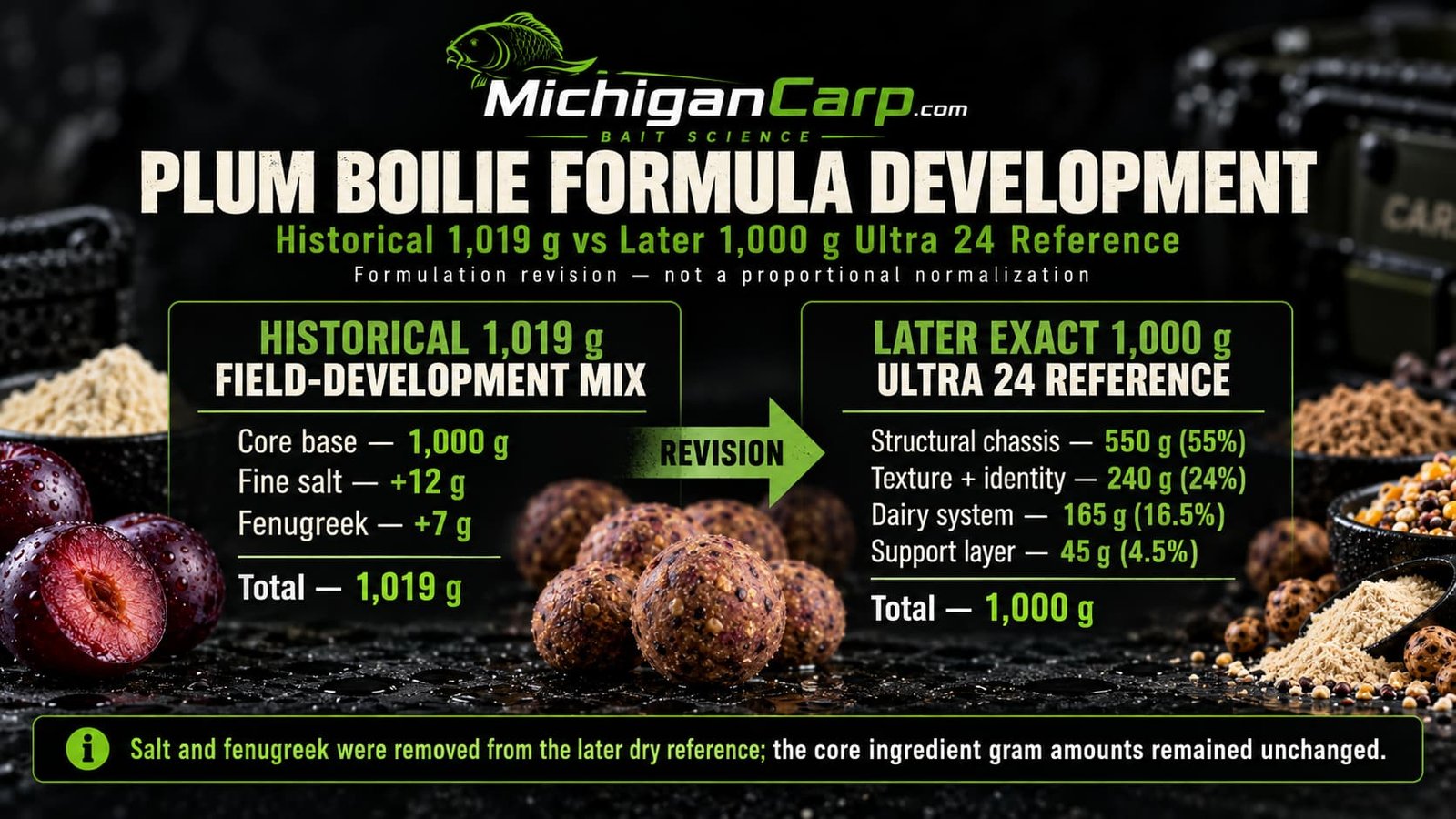
A later version simplified the dry formula by removing the separate salt and fenugreek additions from the dry mix.
The remaining ingredients total exactly 1,000 g.
| Functional section | Ingredient | Amount |
|---|---|---|
| Structural chassis | Semolina | 250 g |
| Structural chassis | Maize meal | 180 g |
| Structural chassis | Full-fat soy flour | 120 g |
| Texture and identity | CLO or suitable birdfood | 120 g |
| Texture and identity | Tiger-nut flour | 80 g |
| Texture and identity | Fine biscuit crumb | 40 g |
| Dairy system | Sav-A-Caf Ultra 24 | 70 g |
| Dairy system | WPC80 | 50 g |
| Dairy system | Cream powder | 25 g |
| Dairy system | Lactose | 20 g |
| Support layer | Brewer’s yeast or suitable yeast ingredient | 20 g |
| Support layer | Molasses powder | 10 g |
| Support layer | Hydrolyzed beef-liver powder | 5 g |
| Support layer | Betaine | 5 g |
| Support layer | Glycine | 3 g |
| Support layer | MSG | 2 g |
| Total dry mix | — | 1,000 g |
Expressed as broad functional sections, that later reference contains:
| Section | Amount | Percentage |
|---|---|---|
| Structural chassis | 550 g | 55% |
| Texture and identity | 240 g | 24% |
| Dairy system | 165 g | 16.5% |
| Support layer | 45 g | 4.5% |
| Total | 1,000 g | 100% |
The important lesson is not that every reader should copy those gram amounts.
It is that the richer dairy, birdfood, nut and specialist ingredients sit on top of a strong practical chassis rather than being expected to perform every structural job themselves.
In hindsight, I do not regard the exact 1,000 g version as automatically superior simply because the arithmetic is cleaner. My recollection is that the earlier bait had particularly good physical character, held together well during long soaks and was less prone to the lighter, cracking behaviour I encountered with some later development batches. For that reason, the historical 1,019 g record remains an important reference rather than being treated as a rough draft that should simply be normalized to one kilogram.
What Changed Between the Two Dry Mixes
The change from 1,019 g to the later 1,000 g reference was not a mathematical normalization of every ingredient.
It was a formulation revision.
The main cereal, birdfood, tiger-nut, dairy, yeast and support ingredients remained at their previous amounts. The separate 12 g salt and 7 g fenugreek additions were no longer part of the later dry reference.
That distinction matters.
If I had simply reduced every ingredient proportionally until the table reached 1,000 g, I would have created a neat spreadsheet but not preserved the actual development record.
Record the bait that actually existed. Do not rewrite history just to make the arithmetic look tidy.
The formulation principles behind both versions are explained in How to Formulate a Milk, Nut and Birdfood Boilie Base Mix.
What the Working Nutritional Estimate Tells Me
The Later Exact 1,000 g Reference Mix has also been estimated nutritionally from supplier specifications and typical values.
These are working formulation estimates, not laboratory analysis. Natural meals vary, birdfoods differ, and manufactured products can change specification.
| Estimated dry-mix characteristic | Working range | What it tells me |
|---|---|---|
| Crude protein | Approximately 19–21% | This is a practical mixed food bait rather than a maximum-protein casein bait |
| Total lipid | Approximately 9.5–11.5% | There is already meaningful fat before bottled oil is considered |
| Carbohydrate including fiber | Approximately 54–60% | Cereal and other carbohydrate ingredients perform major structural and energy roles |
| Fiber / structural carbohydrate | Approximately 5–7% | Part of the broader carbohydrate fraction rather than a separate attraction claim |
| Separate bottled oil | None required by the dry formula | The bait is not oil-free because several ingredients naturally contain lipid |
The estimate reinforces one of the most useful lessons from this bait.
I do not need to keep increasing concentrated protein or automatically pour nut oil into the mix simply because the bait contains milk and tiger nut.
Full-fat soy, tiger-nut flour, Ultra 24, cream powder, birdfood and eggs can already make the complete bait significantly richer than the ingredient list first appears.
The detailed calculation method is covered in How to Balance Fat in Boilies: Milk, Nut and Seed Mixes.
The Plum, Scopex and Vanilla Flavor System
The flavor ratio that became the control direction is:
| Flavor component | Recorded level | Role in the profile |
|---|---|---|
| Plum | 4 ml | Main fruit identity |
| Scopex | 3 ml | Connects the fruit note with the cream, cereal and dairy background |
| Vanilla | 2 ml | Rounds and softens the complete profile |
| Known pre-diluted butyric bait product | Up to 0.5 ml | Optional low-level acidic/butyric accent |
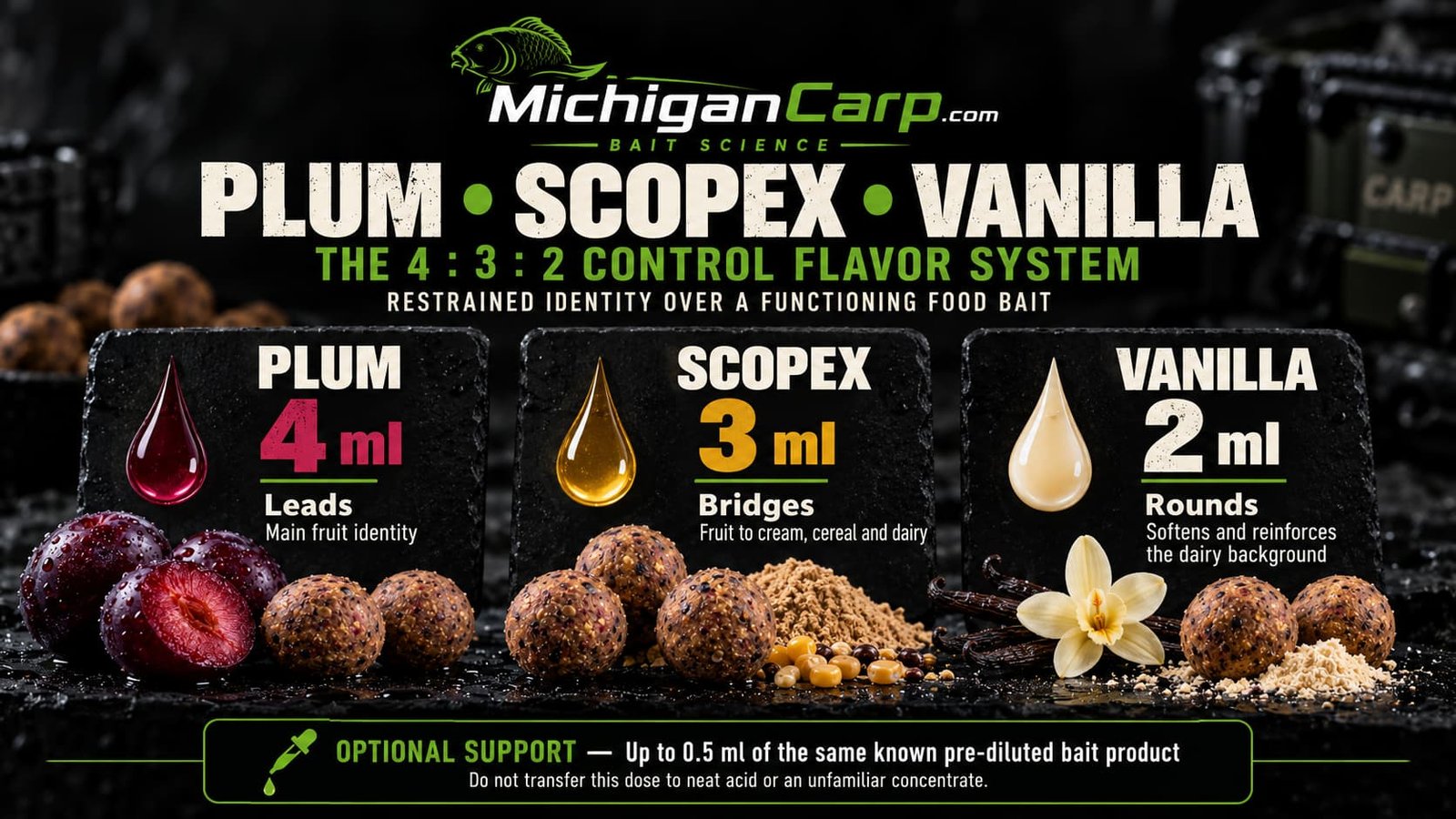
The 4:3:2 ratio is useful because each part has a different job.
Plum leads
Plum provides the recognizable fruit character.
Scopex joins fruit to the food base
Scopex fits naturally against the creamy, cereal, biscuit and milk background rather than making the bait smell like two unrelated flavor bottles mixed together.
Vanilla rounds the edges
Vanilla reinforces the softer dairy character and helps keep the complete package coherent.
The target is a clearly identifiable bait, not the strongest possible smell in the bucket.
Restrained flavor does not mean weak flavor. It means enough flavor to establish identity without allowing the flavor system to dominate everything underneath it.
A warning about the butyric figure
The recorded 0.5 ml level applies to the same known pre-diluted bait product used during development.
Do not transfer that dose directly to neat butyric acid, an unfamiliar concentrate or a product whose strength is unknown.
If the product cannot be identified confidently, omit it.
The Recorded Liquid Phase and Later Development
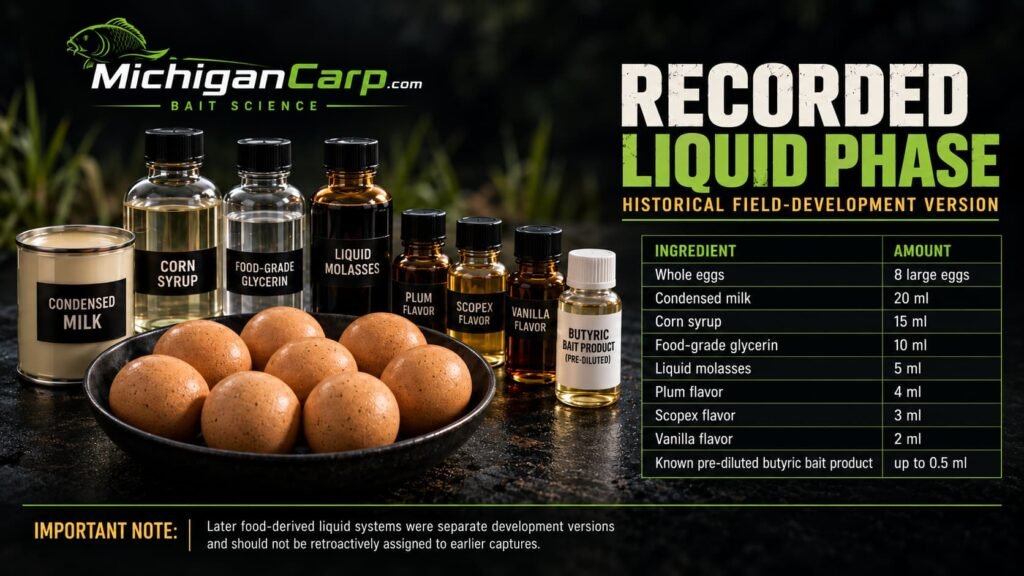
The earlier saved field-development version used eight whole eggs with a relatively simple sweet supporting liquid package.
| Liquid component | Recorded amount |
|---|---|
| Whole eggs | 8 large eggs |
| Condensed milk | 20 ml |
| Corn syrup | 15 ml |
| Food-grade glycerin | 10 ml |
| Liquid molasses | 5 ml |
| Plum flavor | 4 ml |
| Scopex flavor | 3 ml |
| Vanilla flavor | 2 ml |
| Known pre-diluted butyric bait product | Up to 0.5 ml |
I would record that liquid phase more carefully now.
Eight eggs are not an exact liquid measurement because egg size varies. Future batches should record the shell-free egg weight as well as the exact supporting-liquid package and the actual amount of dry blend accepted by the paste.
Later development also moved toward alternative food-derived liquid combinations using ingredients such as propylene glycol, honey, molasses, tiger-nut extract and liquid yeast.
Those later liquid systems should be treated as separate development versions. I do not want to retroactively assign them to fish caught on earlier bait.
That is one of the main lessons from documenting this bait properly: when the liquid phase changes materially, give the bait another version number.
How I Process the Bait
1. Blend the dry ingredients thoroughly
Weigh every dry ingredient accurately.
Mix the fine powders particularly carefully so concentrated milk proteins and low-dose support ingredients do not remain in isolated pockets. Add the coarser birdfood and textured materials after the fine fraction is reasonably uniform, then tumble the complete dry blend again.
2. Record the wet phase
Crack the eggs and record their shell-free weight rather than relying only on egg count.
Mix the other liquid foods and flavor system into the eggs until the wet phase is reasonably uniform.
3. Add the dry mix gradually
Do not force the complete kilogram into the wet phase immediately.
Ingredient moisture, grind and egg weight change how much dry material the paste will accept.
Retain some of the complete dry blend for final correction rather than correcting a soft paste only with extra semolina and silently changing the recipe.
4. Rest the paste before final correction
Cover the paste and allow approximately ten to fifteen minutes for hydration.
Soy, WPC80, milk replacer, tiger-nut flour, birdfood and cereals continue taking up moisture during the rest.
Knead again before deciding whether the paste is too soft or too dry.
5. Roll the chosen bait size
The recorded development sizes were 18 mm, 20 mm and 24 mm.
Smaller boilies provide more exposed surface per kilogram. Twenty-millimeter bait is a useful general size. The 24 mm version is particularly useful for longer public-water sessions and substantial hookbaits where durability matters.
6. Cook consistently
The historical starting points were approximately:
| Bait diameter | Recorded cooking starting point |
|---|---|
| 18 mm | 90–100 seconds |
| 20 mm | About 2 minutes |
| 24 mm | About 2 minutes 30 seconds |
Those are starting points, not laws.
For the 24 mm version of this bait, my recorded working boil time was about 2 minutes 30 seconds. Treat that as a historical starting point for this particular mix and bait size rather than a universal rule; pan load, water recovery, ingredient changes and desired finished hardness can all affect the result. Test for yourself what you prefer there are lots of factors that may be different . Pan size, batch size, water-temperature recovery, bait diameter and the exact formula can all change the required cook.
For the standardized process, use How to Boil and Dry Boilies Properly.
7. Dry for the job, then store correctly
Drain the cooked bait, cool it in a shallow layer and move it onto clean mesh trays with adequate airflow.
Do not assume a fixed drying time is correct for every batch.
Inspect representative boilies, especially larger 24 mm bait, and freeze the clean control version in labeled session-sized bags.
For storage and thawing, use How to Store Homemade Boilies.
Freezer Bait and Shelf-Life Bait Are Different Products
The clean reference version of this bait should be treated as freezer bait.
That allows the formulation, texture, flavor and fishing performance to be evaluated without confusing them with an unvalidated shelf-life claim.
Hard bait is not automatically shelf-stable bait.
A 24 mm boilie can develop a dry, hard skin while retaining considerably more moisture in the center.
A deliberate shelf-life version requires separate work on preservative dose, pH, water activity, drying, hygiene, packaging and retained samples.
For the underlying food-science distinction between total moisture and available water, see FDA: Water Activity (aw) in Foods. The boilie-specific measurement framework is treated separately in Water Activity in Boilies.
How I Fish the Plum Milk-Nut Bait
One reason this bait direction suits my Michigan fishing is that it works naturally alongside the particle systems I already use.
Maize, hemp, pigeon feed, tiger nuts and peanuts can form the wider food area while Plum milk-nut boilies provide a durable and recognizable food item within it.
The wider feeding area and the immediate hookbait area do not have to be identical.
I may use particles as much of the quantity feed, then add chopped boilies, crumb or whole Plum boilies to keep the milk-nut bait identity present around the rig.
For particle preparation, read How to Prepare Particles for Carp Fishing.
Matching hookbaits
The hookbait can retain the same Plum, Scopex and Vanilla identity while being mechanically different from the free offerings.
A long-session bottom bait may need additional durability. A wafter may use cork dust to reduce effective weight. A pop-up needs a separate buoyancy design.
Matching does not have to mean physically identical.
Field Results From the Plum–Scopex–Vanilla Development
The most important evidence for this bait is not that one frozen recipe caught one good carp. It is that closely related Plum–Scopex–Vanilla milk-nut versions continued producing fish while the underlying dry mix, liquid phase and processing were being refined.
| Development period | Recorded result | What it tells me |
|---|---|---|
| Earlier Michigan development | Carp to 29 lb 6 oz and 29 lb 12 oz on related Plum milk-nut versions | The Plum direction was already producing good Michigan carp before the later refinements |
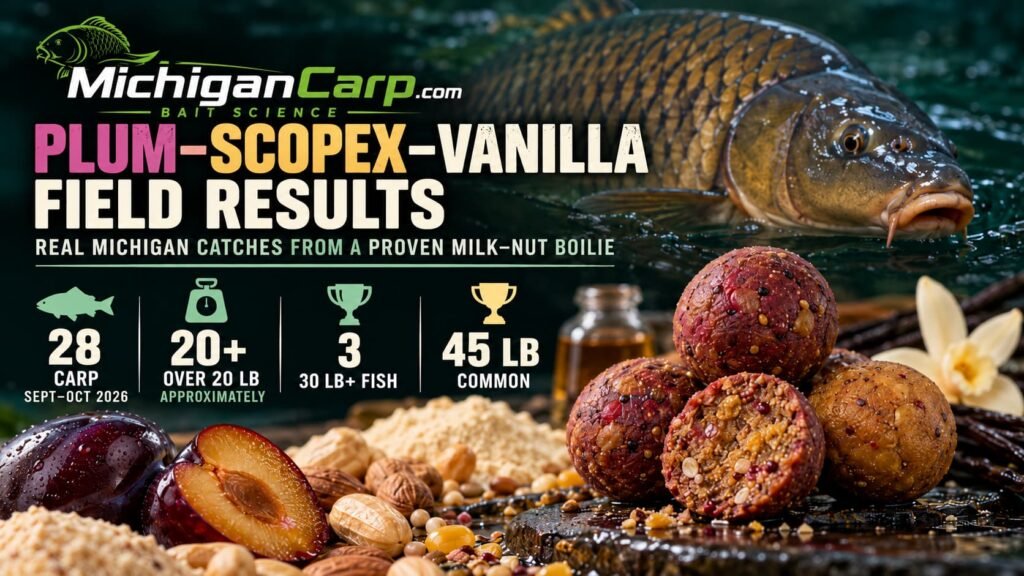
| September–October 2026 development | Approximately 28 carp across the two months—about 20 of them over 20 lb—including three 30 lb-plus fish and a 45 lb common | The later bait family produced both numbers and a notably strong size profile, including genuinely large wild Michigan carp |
| September 2026 | Approximately 20 carp during the month | Shows sustained production through repeated sessions rather than one isolated result |
| October 2026 | A further eight carp during October | The bait continued producing into colder fall conditions |
| Dale Hollow comparison | Four bites during a comparison, all four on the Plum boilie | A useful comparative result away from the Michigan development waters, although not a controlled scientific trial |
The 45 lb common is particularly important to the development record, but I do not disclose the capture location publicly.
The overall size profile is also worth recording. Of approximately 28 carp caught across September and October 2026, around 20 were over 20 lb. That included three fish over 30 lb plus the 45 lb common.
Those results should not be interpreted as proof that one exact dry formula or one exact liquid package was responsible for every fish. Several closely related versions were being tested during the development period.
What remained consistent was the broader bait identity:
- a milk, nut, cereal and birdfood food base;
- Plum as the main fruit direction;
- Scopex connecting the fruit profile to the creamy cereal background;
- Vanilla rounding the profile;
- controlled processing and repeated field use.
That is why I regard the Plum–Scopex–Vanilla direction as a bait-development family rather than one sacred recipe.
The later results are more valuable to me than a single isolated capture because they show that the bait continued producing while the formulation was being refined across repeated sessions, changing waters and changing fall conditions.
What the Results Do and Do Not Tell Me
What they do tell me
Carp have repeatedly eaten closely related versions of this bait across different sessions and changing conditions.
The Plum–Scopex–Vanilla identity has worked beyond one isolated capture or one exact recipe.
Across September and October 2026, the later development family produced approximately 28 carp, with about 20 of them over 20 lb, including three 30 lb-plus fish and a 45 lb common.
That size profile matters. It does not prove the bait selectively catches larger carp, but it shows that the bait was readily accepted by a substantial number of mature fish.
The underlying milk, nut, cereal and birdfood food system also continued producing while the formulation was being refined rather than collapsing as soon as one ingredient or liquid phase changed.
For me, that repeated production is much more useful evidence than one standout fish or one perfect session.
What they do not tell me
They do not establish that Plum will always outperform Peach, Maple, Mulberry, Strawberry or another flavor.
They do not prove that Scopex acts as a universal feeding trigger.
They do not prove that every ingredient in the dry mix is necessary.
And they certainly do not prove that flavor caused each capture independently of fish location, bait quantity, feeding behavior and rig presentation.
Field confidence is earned through repeated results. Authority depends on being equally clear about what those results cannot prove.
What This Bait Has Taught Me
The most useful lesson is that a successful bait does not have to be dominated by its most expensive ingredients.
The Later Exact 1,000 g Reference Mix still contains a large structural chassis.
Birdfood has a meaningful place rather than a token inclusion.
The dairy system is layered but remains only 16.5% of the dry mix.
Tiger-nut flour contributes to the identity without turning the bait into a block of high-fat nut meal.
The specialist support ingredients total only 4.5%.
That balance also makes later changes easier to interpret.
If I change the flavor, I can leave the structural base alone. If the birdfood changes, I can reassess its fat level and grind. If a milk-replacer specification changes, I can reconsider the dairy section rather than treating the brand name as sacred.
This is also a more useful way of publishing a recipe.
Instead of declaring one version “ultimate,” I can show where the bait started, what caught fish, what changed and what still needs testing.
Do not copy ingredients. Learn to build and use the system.
What I Would Control More Carefully Now
Give important recipe changes a version number
If the dairy section, dry support layer or liquid phase changes significantly, the bait should receive a new version identifier.
That makes future catch records far more useful.
Record actual egg weight
“Eight eggs” is convenient recipe language, but shell-free egg weight is the more useful production record.
Keep the Plum ratio fixed when testing structural changes
If I am testing a new milk product, altered liquid system or different cooking method, I want the 4:3:2 Plum–Scopex–Vanilla package to stay fixed.
Otherwise the structural test and flavor test become mixed together.
Calculate the complete fat contribution
Do not automatically add nut oil because the bait contains tiger nut flour.
Calculate the fat coming from soy, tiger nut, dairy ingredients, birdfood and eggs first.
Standardize water testing
Test representative boilies over the periods that matter to the actual fishing situation and record surface softening, swelling, center texture, cracking and breakdown separately.
Use How to Test Boilies Before Fishing for the controlled method.
Common Mistakes With This Recipe
| Mistake | Why it causes a problem | Better approach |
|---|---|---|
| Calling the old formula exactly 1 kg | The recorded ingredients total 1,019 g | Call it the historical 1,019 g development formula |
| Calling the later 1 kg mix a scaled version | It is actually a formulation revision with salt and fenugreek removed | Keep the two development records separate |
| Using eight eggs without weighing them | Egg size changes hydration | Record shell-free egg weight |
| Forcing all the dry mix into the wet phase immediately | Ingredient moisture and absorption vary | Add gradually, rest and record actual use |
| Correcting only with extra semolina | That changes the formula ratios | Retain complete dry blend for correction |
| Adding nut oil automatically | The recipe already has several fat sources | Calculate the fat budget first |
| Replacing Ultra 24 gram-for-gram with another milk powder | Milk products differ in protein, fat, lactose and minerals | Replace according to function |
| Replacing WPC80 with ordinary whey powder | The composition is very different | Rebalance the dairy system |
| Using 0.5 ml of an unknown butyric product | Concentration can vary enormously | Use the known product or omit it |
| Increasing Plum, Scopex and Vanilla together | Stronger can become harsher rather than better | Keep the components controlled separately |
| Overboiling to rescue bad paste | Cooking does not repair poor formulation | Correct the raw paste first |
| Assuming hard bait is shelf-stable | A dry surface can hide a wetter center | Freeze the control bait or validate shelf life separately |
| Claiming every capture for the latest formula | The bait evolved through several related versions | Attribute results to the wider Plum direction unless the exact version is known |
For wider production troubleshooting, use Boilie Problems: Real Causes and Practical Fixes.
My Practical View
The strongest part of this bait is not Ultra 24.
It is not WPC80.
It is not tiger-nut flour.
And it is not the Plum bottle.
It is the coherence of the complete bait.
The cereal chassis makes the bait practical. Tiger nut and soy help create the nut direction. Ultra 24, WPC80, cream powder and lactose create the dairy layer. Birdfood adds texture. Yeast and low-level liver add food complexity. Plum, Scopex and Vanilla provide a stable recognizable flavor identity.
The bait has produced enough fish for me to keep developing it rather than abandoning it whenever another interesting ingredient appears.
That is the role of the Plum version now.
It is the control.
Peach, Maple, Mulberry or another flavor should have to beat a bait with an existing field record rather than simply replace it because the new flavor smells interesting.
The bait earned confidence through captures. The recipe earns authority through accurate records, honest version history and controlled testing.
FAQ
What is the Plum Scopex Vanilla boilie?
It is a non-marine milk, nut, cereal and birdfood boilie developed around ingredients including semolina, maize, full-fat soy, tiger-nut flour, birdfood, Ultra 24, WPC80, cream powder, lactose and yeast with a Plum, Scopex and Vanilla flavor identity.
Is the original recipe exactly one kilogram?
No. One historical development record totals 1,019 g because it also contains 12 g salt and 7 g fenugreek.
What is the later exact 1 kg reference version?
It is a later exact 1,000 g dry-mix version of the same development family. Sav-A-Caf Ultra 24 remains one ingredient in the formula; “Ultra 24” is not the name of a separate bait version.
Did the latest 1 kg formula catch every fish in the field record?
No. Captures came on closely related Plum, Scopex and Vanilla versions developed over time.
How much Plum, Scopex and Vanilla is used?
The established ratio is 4 ml Plum, 3 ml Scopex and 2 ml Vanilla per approximately one kilogram of dry mix using the same known flavor products.
Does the recipe need butyric acid?
No. A related development version used up to 0.5 ml of one known pre-diluted bait product. Do not transfer that dose to neat acid or an unfamiliar concentrate.
Does the bait need added nut oil?
Not automatically. Full-fat soy, tiger-nut flour, birdfood, Ultra 24, cream powder and eggs already contribute lipid. Calculate the complete fat contribution before adding bottled oil.
Why use eight eggs?
Eight large eggs produced workable paste in the recorded field-development version, but future batches should record actual shell-free egg weight because egg size varies.
Did both 29 lb carp come from Muskegon Channel?
Yes. The recorded Plum development history includes Muskegon Channel commons of 29 lb 6 oz and 29 lb 12 oz.
What did the later 2026 Plum–Scopex–Vanilla development produce?
Across September and October 2026, closely related development versions produced approximately 28 carp, with about 20 over 20 lb, including three 30 lb-plus fish and a 45 lb common. These results came from the wider bait-development family rather than one unchanged exact formula, and the location of the 45 lb fish is not disclosed publicly.
What happened at Dale Hollow?
A friend fishing a comparison recorded four bites, all of them on the Plum version. That is useful practical evidence, but the sample is far too small and uncontrolled to prove Plum is universally superior.
Does the field record prove Plum is the best carp flavor?
No. It gives me a strong reason to keep Plum as the control flavor while alternatives are tested against it.
Next Steps
- Milk, Nut and Birdfood Boilies for Michigan Carp — understand why this bait family makes sense as a complete Michigan food-bait system.
- How to Formulate a Milk, Nut and Birdfood Boilie Base Mix — learn how to design the dry formula rather than simply copy this one.
- How to Balance Fat in Boilies: Milk, Nut and Seed Mixes — calculate the hidden lipid before adding oil.
- Milk Powders in Boilie Making — understand Ultra 24, WPC and other dairy ingredients by function.
- Birdfood for Carp Boilies — understand why birdfood composition matters.
- Liver Hydrolysate for Carp Bait — understand the restrained beef-liver support used in this non-marine bait.
- How to Boil and Dry Boilies Properly — standardize processing.
- How to Test Boilies Before Fishing — compare later bait versions properly.
- How to Store Homemade Boilies — handle the freezer-bait control safely.
- Return to Boilie School — continue through the complete bait-making system.