

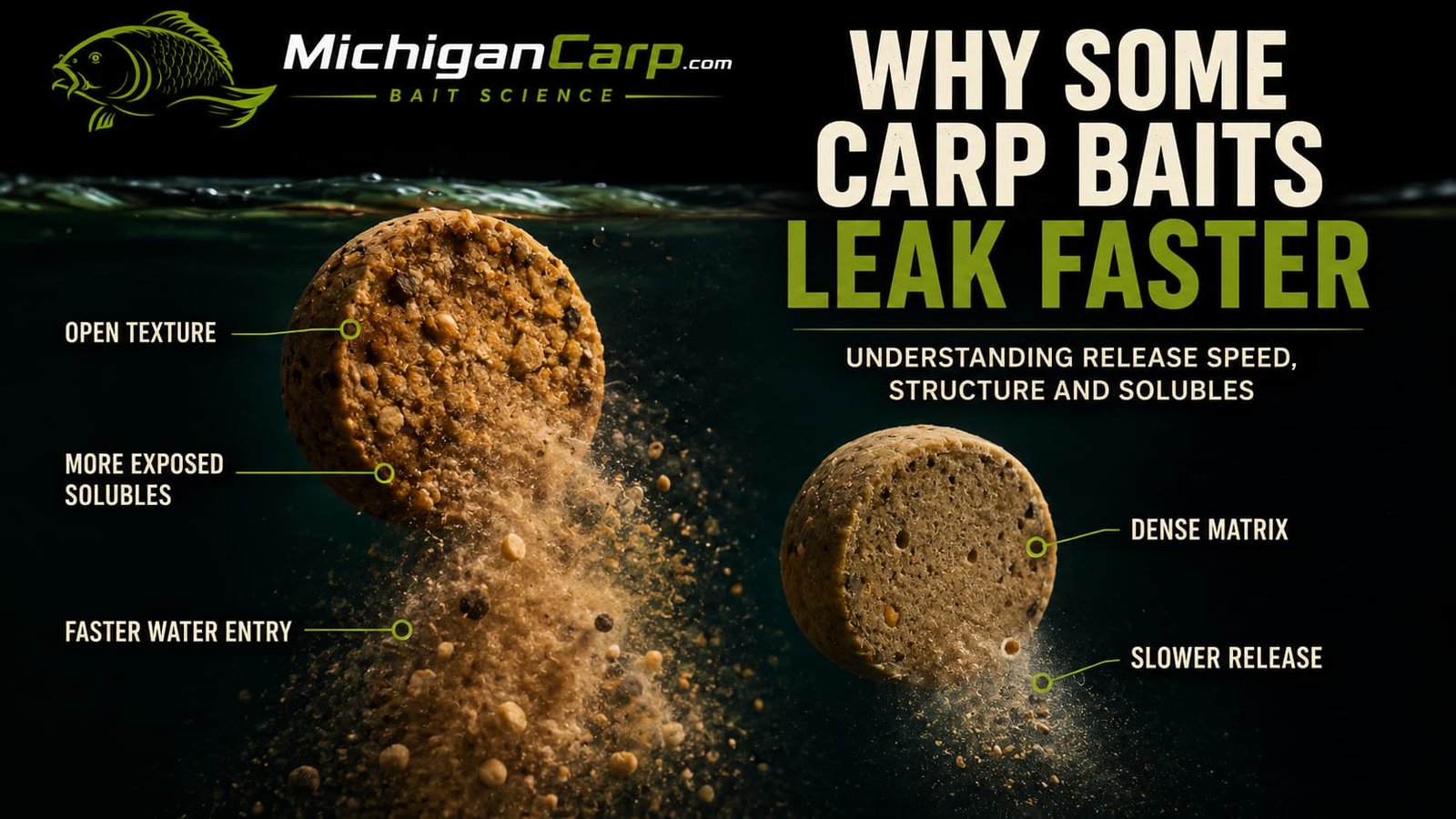
Why some carp baits leak faster than others is not explained by one ingredient, one glug, one oil level or one simple idea such as making the bait softer.
Two boilies can be the same diameter, the same colour and similar firmness in the hand, yet behave very differently underwater.
One may hydrate quickly, allow water into accessible parts of the bait, and start releasing soluble and dispersible material early. Another may remain just as fishable, but hydrate more slowly and release its available food signal over a longer period.
Neither bait is automatically better.
The important question is whether the release profile matches the fishing job.
Faster leakage is useful only when the baiting situation needs faster leakage. The best bait is not always the fastest-leaking bait.
This article is the practical control guide. The core science of water entry, dissolution, diffusion and dispersion is covered in Carp Bait Solubility and Leakage. Surface area, chops, crumb and paste are covered in Why Surface Area Matters in Carp Bait. This page explains why two finished baits that look similar can still leak at different speeds.
It also links closely with How to Use Hydrolysates in Carp Bait, Proteins, Peptides and Hydrolysates in Carp Bait, What Boiling Does to Carp Bait, How to Tell When Boilies Are Dry Enough, How Bait Texture Affects Carp Feeding Confidence and the main Bait Science hub.
For external technical background, see OpenStax: The Dissolution Process, Elucidating the Role of Compositional and Processing Variables in Plant Protein Ingredients and AOCS: Emulsions — Making Oil and Water Mix.
Table of Contents
Quick Start: Why Some Carp Baits Leak Faster
Some carp baits leak faster because useful soluble or dispersible material is easier for water to reach, dissolve, move through the bait and carry into the surrounding swim.
A bait tends to release faster when it has a meaningful soluble fraction, an accessible surface, a less restrictive internal matrix, shorter movement distances, moderate drying, suitable cooking and a bait format matched to the session.
A bait tends to release more slowly when it is heavily dried, highly bound, large in diameter, low in accessible soluble material, high in restrictive structure, or treated in a way that slows water access.
| Control | What it asks | Practical meaning |
|---|---|---|
| Availability | What useful material can enter water? | Soluble ingredients, fine particles, hydrolysates and food liquids must actually be present. |
| Access | Can water reach that material? | A useful ingredient buried in a dense bait may release slowly. |
| Matrix | How open or restrictive is the structure? | Protein, starch, egg, fibre, fat, grinding and cooking all affect the finished bait. |
| Distance | How far must material travel? | Surface coatings, cuts, crumb and smaller baits shorten the path. |
| Time | How long does the bait need to work? | Short sessions and campaigns need different release profiles. |
The main rule is:
Leakage rate comes from the complete bait system. A soluble liquid added to a badly matched physical structure does not automatically create a fast-release bait.
The Five Controls of Carp Bait Leakage
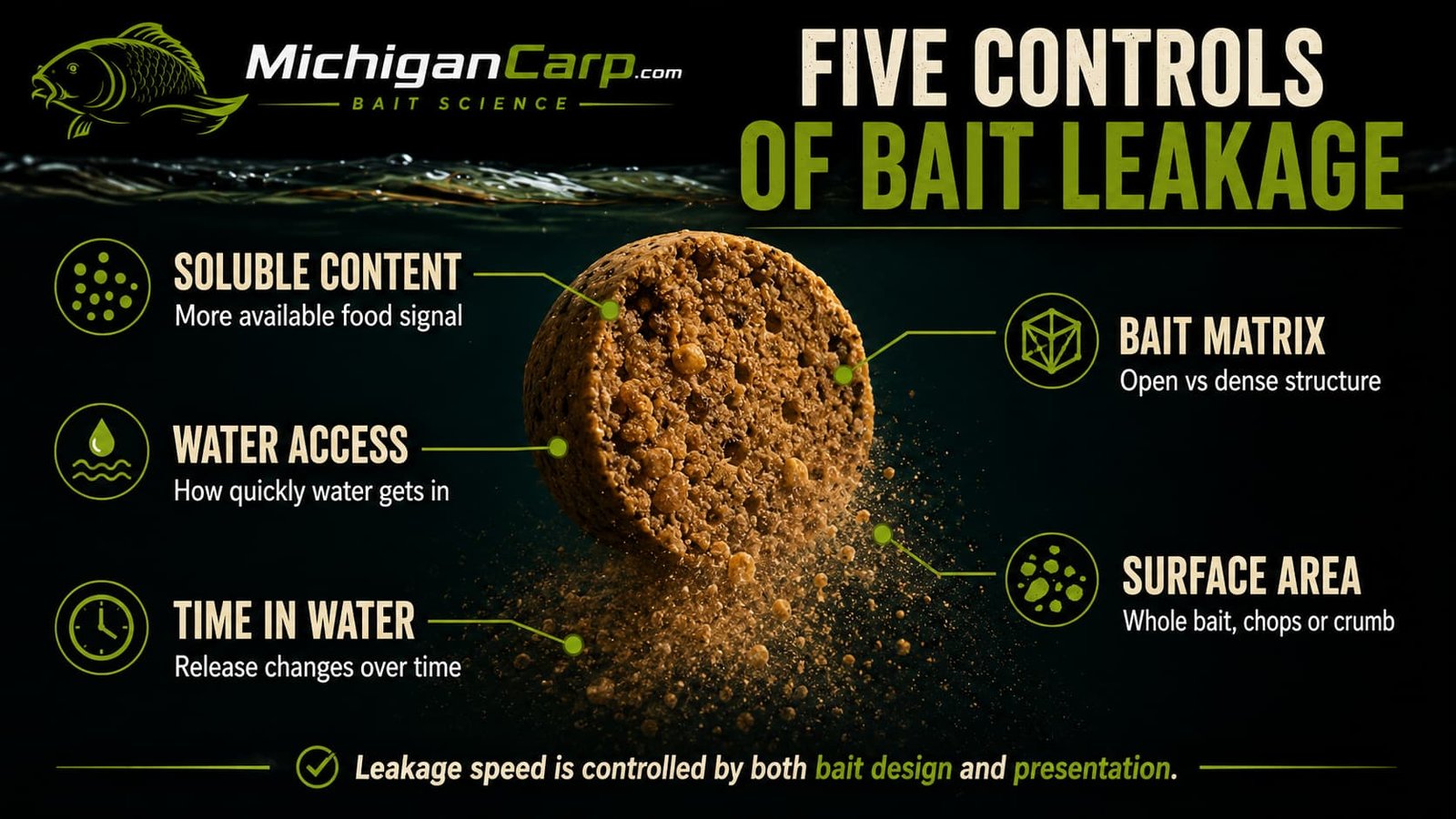
The easiest way to understand bait leakage is to separate the problem into five controls: availability, access, matrix, distance and time.
Availability means the bait must contain something that water can dissolve, carry, disperse or expose. Salt, sugars, organic acids, some free amino acids, soluble food liquids, hydrolysate fractions, yeast-derived material, fine crumb and suspended particles all behave differently, but each can contribute to the local bait signal.
Access means water must be able to reach the material. A useful fraction buried in the centre of a large dense bait does not behave like the same material positioned on a cut surface or in a powder coating.
Matrix means the finished bait structure controls movement. A boilie is not just an ingredient list. It is a cooked, dried food matrix made from proteins, starches, fibres, fats, egg components, particles and liquids.
Distance means the route matters. Material close to the surface has a shorter path to the water than material deep inside a 24 mm bait.
Time means the fishing job matters. A four-hour spring trap, an overnight hookbait and a five-day campaign bait do not need identical release speed.
This is why the fastest bait in a jar test is not automatically the best bait to fish.
Ingredient Availability: What Can Actually Leave the Bait?
The first question is not how strong the bait smells. It is what useful material can actually enter the surrounding water.
Different ingredient groups behave differently.
| Ingredient or fraction | How it may contribute | Main warning |
|---|---|---|
| Salt, sugars and organic acids | Fast water-active material | Useful at sensible levels, but not a complete bait system. |
| Free amino acids | Small water-active compounds | Specific response depends on compound, concentration and context. |
| Hydrolysates | Protein-derived soluble and peptide-rich fractions | Product, dose and placement matter. |
| Yeast extracts and soluble yeast | Savoury soluble food character | Can become salty or overpowering if pushed too hard. |
| Milk proteins | Food value, structure and variable solubility | Do not judge by crude protein alone. |
| Birdfood, seeds and coarse meals | Texture, particles, physical activity and exposed surfaces | Too much can weaken bait or change rolling. |
| Oils and fats | Energy, texture and separate-phase movement | Not the same as water-soluble leakage. |
A common mistake is adding a strong soluble ingredient and assuming the bait will automatically leak faster. That only happens if water can reach the ingredient and carry useful fractions away from the bait.
That is why hydrolysates, liquid foods and soluble powders often work best when they are placed intelligently: in the liquid phase, crumb, chops, powder coatings, hookbait treatments, paste wraps or controlled outer layers. For practical hydrolysate use, read How to Use Hydrolysates in Carp Bait.
Water Access: The First Physical Bottleneck
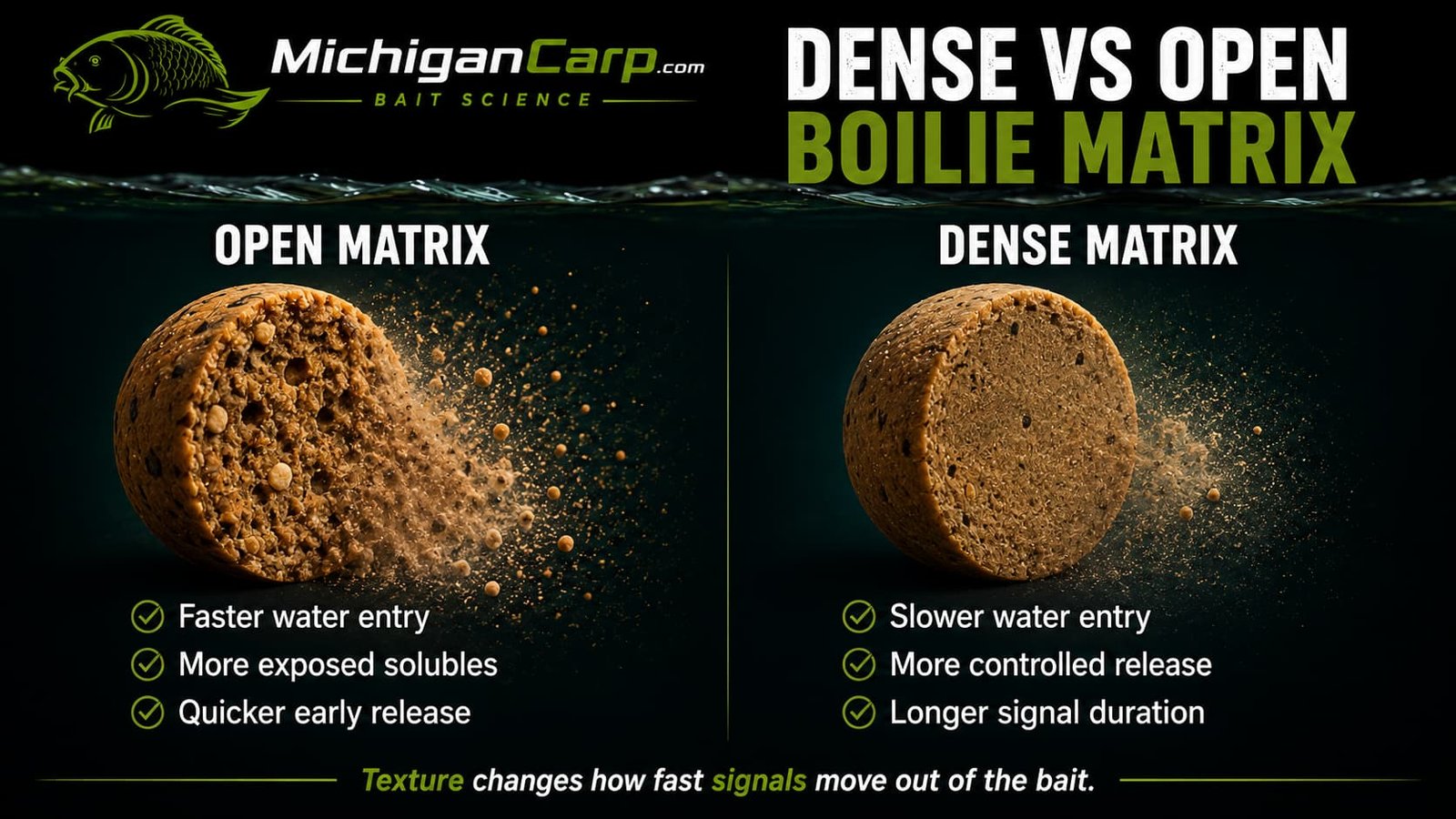
Water access is the first physical bottleneck in bait release.
Before an internal soluble fraction can leave a bait, water normally has to contact the surface, enter accessible spaces, hydrate the surrounding structure, dissolve the available material and provide a route outward.
This explains why two baits can remain physically intact but behave differently.
A bait with connected pores, moderate drying, exposed particles or small cracks may allow quicker hydration than a dense bait with a hard outer region and tightly packed interior. A smoother bait is not always slow, and a rough bait is not always fast. Appearance alone is not enough.
| Feature | Can speed release when | Can slow or complicate release when |
|---|---|---|
| Open structure | Pores are connected and water can enter | The bait becomes too weak or breaks down too quickly |
| Hard outer skin | Still allows controlled hydration | It becomes more resistant than the session needs |
| Cracks and cuts | They expose internal material | They damage hookbait durability |
| Coarse particles | They create texture and exposed food surfaces | They make paste fragile or inconsistent |
| Heavy drying | Long water life is required | Fast local signal is the real goal |
The objective is not to make the most porous bait possible. The objective is to create enough water access for the baiting job while keeping the bait mechanically useful.
The Finished Matrix Matters More Than the Ingredient List
A boilie matrix is created by the whole production process: dry ingredients, wet phase, mixing, resting, rolling, boiling or steaming, drying and storage.
That matrix can be dense, open, elastic, brittle, sticky, hard, crumbly, rubbery or layered. Each state changes how the bait hydrates and releases material.
Proteins affect water binding, heat setting, firmness and texture. Starches affect paste behaviour, gelatinization, binding and internal structure. Fibres, birdfoods, meals and coarse ingredients affect texture and particle release. Fats and oils can affect water access, mouthfeel, energy level and physical behaviour. Eggs help create structure, but egg level also changes firmness and set.
This is why changing one ingredient can change more than nutrition.
Replacing one protein source with another may change liquid demand, rolling behaviour, cooking response, drying curve, hardness, cracking and water uptake. Replacing fine flour with coarse meal may change the bait’s texture and release behaviour even if the recipe still looks similar on paper.
For ingredient processing, use How to Process Carp Bait Ingredients. For bait texture, use How Bait Texture Affects Carp Feeding Confidence.
Cooking, Drying and Diameter Change the Timing
Cooking and drying are not just production chores. They change the release system.
Heat can set proteins, alter starch behaviour, firm the bait, create a different outer region, change water distribution and affect how quickly water enters later. Longer cooking is not simply a hardness setting. It changes the physical bait system.
Drying changes starting moisture, surface hardness, water activity, storage behaviour and rehydration rate. A bait dried for storage may behave differently from the same formula used as a fresh freezer bait or short-session bait.
Diameter also changes timing. Larger boilies create longer internal distances and lower external surface area per unit of bait mass. Smaller boilies, halves, chops and crumb expose more surface and shorten transport distances.
| Production choice | Likely effect | Practical decision |
|---|---|---|
| Shorter cook | Softer, potentially more open bait | Useful when fast activity matters, but test durability. |
| Longer cook | Firmer structure and stronger outer region | Useful for water life, but may slow early release. |
| Light drying | Faster rehydration and softer bait | Useful for short sessions and freezer bait. |
| Heavy drying | Harder bait and slower rehydration | Useful for storage, nuisance resistance or long water time. |
| Larger diameter | Longer internal path | Useful for selectivity and durability. |
| Smaller/chopped bait | More exposed surface | Useful for faster local activity. |
For the heat side, read What Boiling Does to Carp Bait. For drying and storage, read Water Activity in Boilies and How to Store Homemade Boilies.
Liquids, Oils and Coatings Need a Clear Job
Surface treatments can create a fast outer phase, but more liquid does not automatically mean better leakage.
A liquid treatment should have a defined job. It may add fast surface activity, hydrate a powder coating, carry hydrolysate fractions, condition hookbaits, dampen crumb or match a boilie to a loose-feed mix.
The mistake is drowning every bait in strong liquid and assuming the result is better.
| Treatment | Best use | Main warning |
|---|---|---|
| Light hydrolysate glug | Outer soluble food signal | Too much can make bait sticky, bitter or wet. |
| Powder coating | Fast surface activity | Heavy coating can become messy or overpowering. |
| Spray treatment | Controlled hookbait or crumb preparation | Needs testing for buoyancy and texture. |
| Paste wrap | Very active short-term outer layer | Lower durability and more nuisance risk. |
| Heavy oil treatment | Energy/profile where appropriate | Oil is not water-soluble leakage. |
Oils deserve especially careful language. Oil can leave bait, form droplets, smear, float, bind to particles or be carried in an emulsion, but it does not behave like salt, sugar, amino acids or soluble hydrolysate fractions in the water phase.
That does not make oil bad. It means oil should be used for the right reason: energy, texture, profile, conditioning or a specific formulation role. It should not be treated as a simple shortcut to water-soluble food signal.
For liquid systems, use Boilie Liquids and Additives. For fat balance, use How to Balance Fat in Boilies. For lecithin and emulsifier logic, use Lecithin in Carp Bait.
Faster Release, Slower Release and Session Length
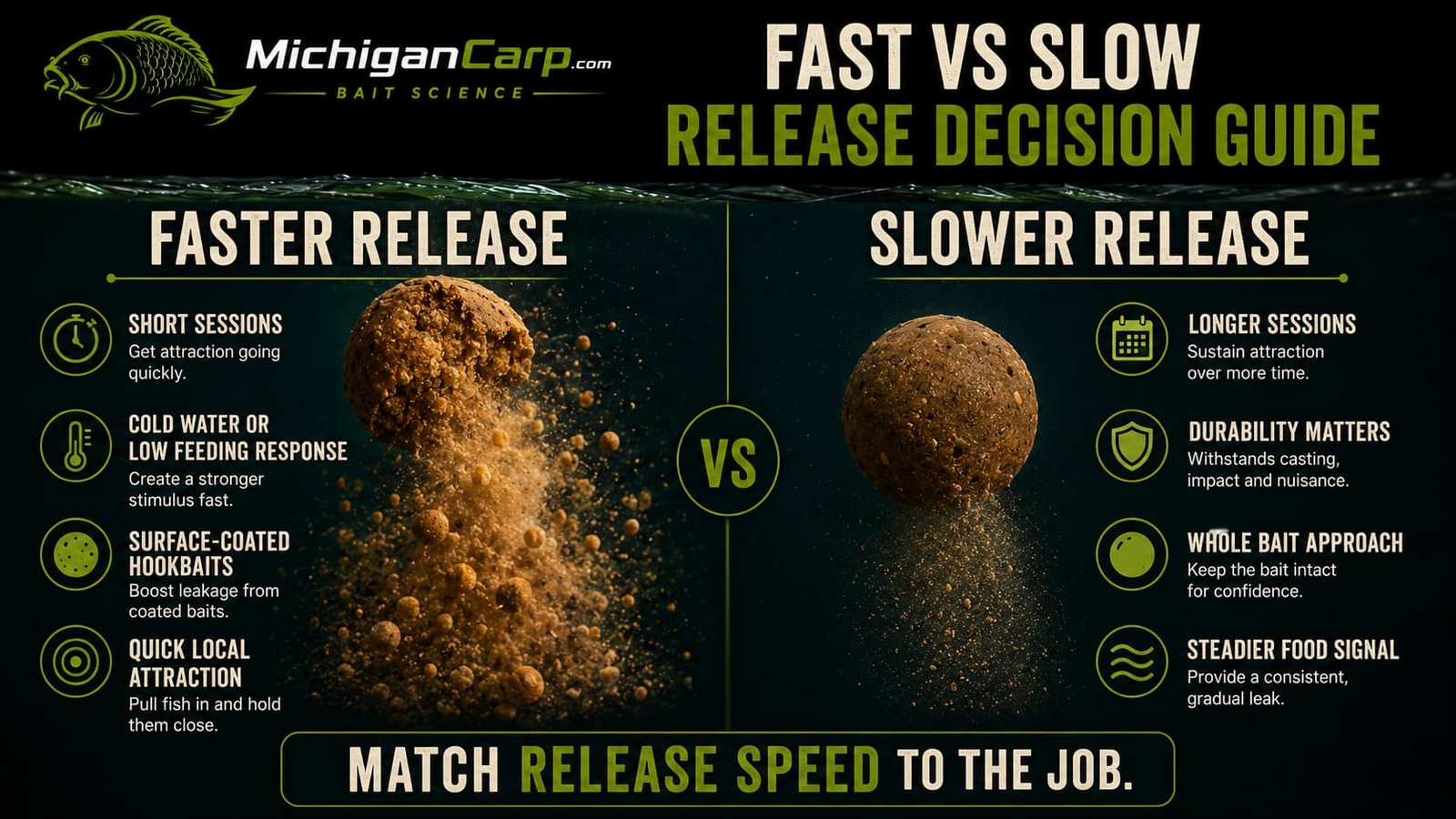
Faster release is useful when the fishing situation rewards quick local activity.
That may include short sessions, cool-water traps, brief feeding windows, travelling fish, small bait quantities, single-hookbait approaches, PVA traps, method feeders, crumb patches and situations where you want the rig area working quickly.
Slower release is useful when the bait needs to remain present and useful for longer. That may include overnight fishing, nuisance-species pressure, crayfish, long hookbait soak times, multi-day sessions, campaign baiting and situations where carp may return repeatedly.
The best system often uses both.
For my own fishing, especially on Michigan waters, I often prefer a durable hookbait with a more active surrounding bait zone. The hookbait does not have to be the fastest-releasing object in the swim. Crumb, chops, small particles, powder coatings and controlled liquids can create the early activity while the hookbait remains mechanically reliable.
| Fishing situation | Better release emphasis | Practical setup |
|---|---|---|
| Short spring session | Faster local signal | Durable hookbait, crumb, chops, light coating or small PVA trap |
| Overnight session | Mixed release | Whole bait plus smaller active material around the rig |
| Long summer session | Sustained food with early activity | Food bait, particles, chops and controlled liquid support |
| Crayfish or nuisance pressure | Hookbait durability | Harder hookbait with surrounding active feed |
| Big natural lake | Location first, release second | Find fish, then tune bait format and signal |
| Channel or moving water | Controlled release plus transport awareness | Position bait relative to flow, travel route and rig placement |
This approach separates hookbait reliability from swim activity, which is often more practical than trying to make every bait item behave the same way.
How to Make a Bait System More Active
You do not always need to rebuild a good boilie recipe to create more activity.
If the base bait is sound, the first changes I would test are usually physical format, placement and light surface treatment.
| Adjustment | What it changes | When to use it |
|---|---|---|
| Add crumb | More exposed surface and fine food particles | Short sessions, cold water, rig-area activity |
| Add chops | Exposes internal bait structure | When you want more activity without full crumb |
| Use powder coating | Creates fast outer release | Hookbaits, PVA traps and short sessions |
| Use light liquid treatment | Adds targeted soluble surface signal | When the liquid has a clear job |
| Reduce drying | Speeds rehydration | Freezer bait or short-session bait |
| Test smaller diameter | Increases surface area per bait mass | When selectivity is less important than activity |
| Use paste wrap | Creates very fast outer activity | Short windows where durability is less important |
Change one major variable at a time. If you change boil time, drying time, liquid level and bait size together, you will not know what caused the result.
For structured testing, use How to Test Boilies Before Fishing.
How to Compare Two Baits Fairly
A jar test will not tell you everything about dissolved chemistry, but it can show useful differences in hydration, softening, swelling, cracking, clouding, particle release and breakdown.
For fair comparison, use equal bait weights, equal water volumes, identical containers, the same water source, the same water temperature and fixed observation times.
Compare one variable at a time. Useful tests include shorter cook versus longer cook, one-day drying versus five-day drying, whole bait versus chop, untreated bait versus powder-coated bait, and light glug versus heavy glug.
Record what actually happens. Do not simply choose the cloudiest jar. Visible clouding can be useful, but it may represent dispersed particles rather than dissolved food signal.
| What to record | Why it matters |
|---|---|
| Water uptake | Shows how quickly the bait starts hydrating |
| Surface softening | Shows early outer change |
| Core softening | Shows deeper water penetration |
| Cracking | Shows structure changing under hydration |
| Particle release | Shows physical dispersion |
| Water clouding | Shows visual activity, but not complete chemistry |
| Hookbait durability | Shows whether the bait still fishes correctly |
The finished bait is what matters. A recipe that looks good on paper still has to work in water.
Common Mistakes With Carp Bait Leakage
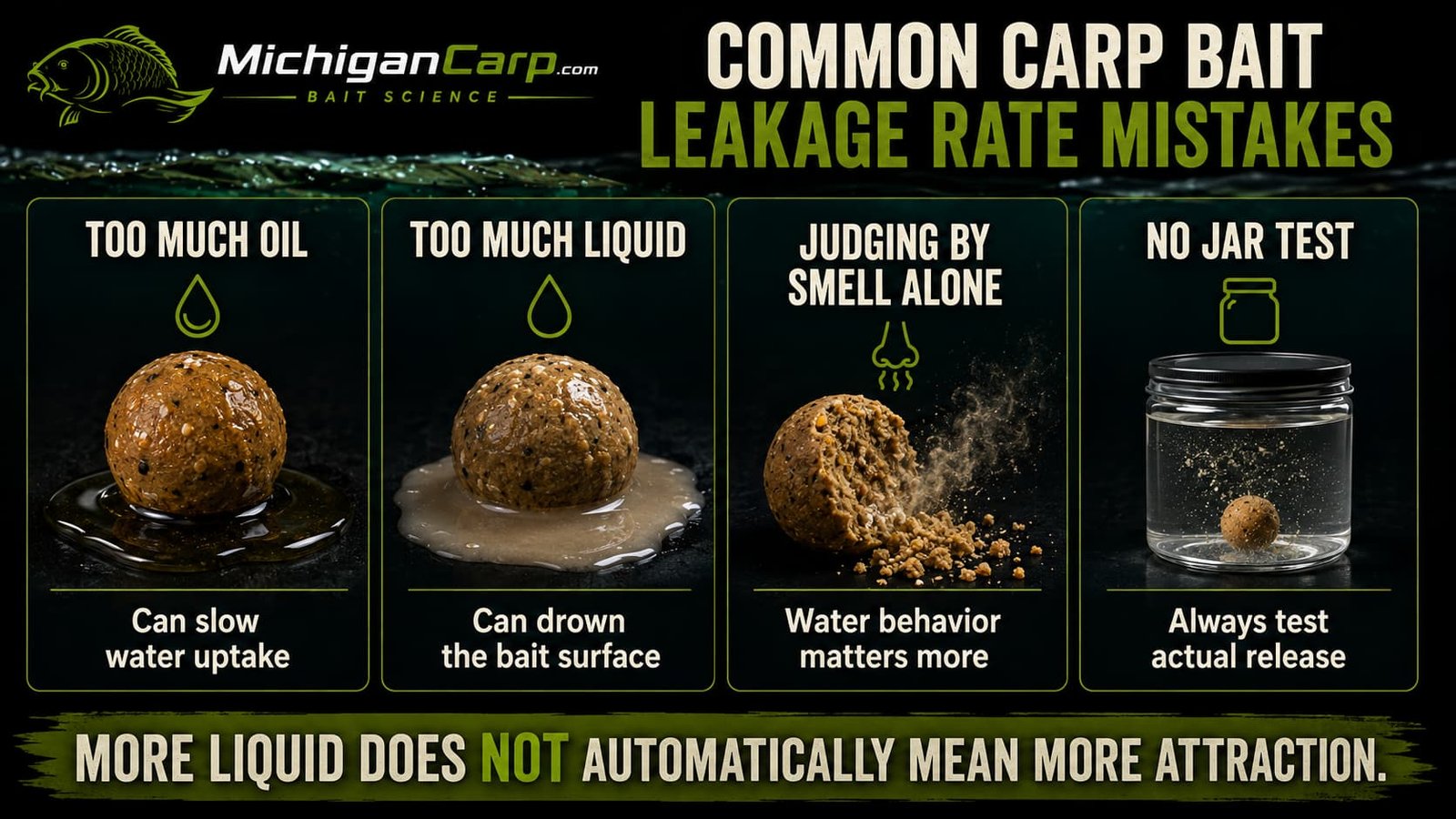
| Mistake | Why it causes problems | Better practice |
|---|---|---|
| Judging leakage by bucket smell | Air aroma does not measure underwater release | Test bait in water |
| Judging only by clouding | Clouding may be particles, not dissolved signal | Record several forms of release |
| Assuming soft bait always leaks faster | Softness and useful release are not identical | Check water uptake, solubles and durability |
| Assuming hard bait is inactive | An intact bait can still hydrate and release | Test over the real fishing time |
| Overusing liquid | Can make bait sticky, unstable or overpowering | Use liquid with a clear job |
| Ignoring drying history | Drying changes rehydration and water life | Match drying to storage and fishing purpose |
| Adding oil as a leakage shortcut | Oil is not water-soluble food signal | Use oil for energy/profile only when needed |
| Changing too many variables | You cannot tell what improved or damaged the bait | Test one variable at a time |
| Making every bait item fast acting | Can reduce durability and long-term food value | Use layered release speeds |
Simple Rules for Faster and Slower Bait Release
Start with what material can actually enter water. Then ask whether water can reach it, how restrictive the matrix is, how far the material must travel, and how long the bait needs to work.
Do not confuse physical breakdown with dissolved release. Do not judge release from smell alone. Do not assume that clouding proves complete food-signal release. Do not treat oil like salt, sugar or soluble hydrolysate.
Use cooking and drying for a defined purpose. Match diameter and structure to the session. Keep hookbait mechanics separate from swim activity when useful. Use outer treatments only when they have a clear job.
Most importantly, test the actual finished bait.
My Practical View
Why some carp baits leak faster comes down to transport.
The bait must contain useful material. Water must reach that material. The matrix must allow hydration and movement. The distance to the outside matters. Cooking, drying, oil level, diameter and surface treatment all influence the timescale.
For my own Michigan fishing, I do not usually want every part of the baited area working at the same speed.
On short sessions, I may create faster local activity with crumb, chops, soluble powders, light glugs or paste near the rig. On longer sessions, I want a durable food bait that still leaks enough to remain interesting but does not burn out immediately.
With crayfish, nuisance fish or overnight fishing, hookbait durability matters. In those cases, I would rather keep the hookbait reliable and create the faster signal through the surrounding bait system.
Carp bait leakage is a transport system. Good ingredients matter, but water must be able to reach them, dissolve or disperse the useful fractions, and carry them out on the timescale your fishing requires.
FAQ
Why do some carp baits leak faster than others?
Some carp baits leak faster because they contain more accessible soluble or dispersible material and have a structure that allows water to enter, dissolve useful fractions and move them outward more easily.
Does a softer boilie always leak faster?
No. Softness and leakage are related only indirectly. A soft bait may still contain little useful soluble material, while a firmer bait can release dissolved fractions while staying intact.
Does a boilie have to break down to release food signal?
No. A boilie can remain physically intact while water enters the bait, dissolves suitable compounds and allows material to move outward.
Do hydrolysates make every bait leak faster?
No. Hydrolysates can help when they are accessible and used correctly, but their effect depends on product type, dose, placement, bait structure and water access.
Does longer drying slow bait leakage?
Longer drying can slow rehydration and change release behaviour, but the result depends on recipe, diameter, structure and fishing conditions.
Does overboiling seal a boilie?
Cooking can change the outer and internal matrix, but it is better to talk about changed resistance to water entry rather than a completely sealed bait.
Do oils block carp bait leakage?
Not by one universal rule. Oils and water-soluble compounds behave differently, and high fat levels can affect the bait system, but oil should not be treated as a simple waterproof barrier.
Can a hard hookbait still release signal?
Yes. Mechanical durability does not prove chemical inactivity. A hard hookbait can still take up water and release material over time.
What is the easiest way to create faster local activity?
Often the easiest way is to keep a durable hookbait and make the surrounding bait more active with crumb, chops, powder coating, paste or a light targeted liquid treatment.
Is faster leakage always better?
No. Faster leakage can be useful for short sessions and quick traps, but longer sessions may need sustained release, durability and real food value.
How can I compare two boilies fairly?
Use equal bait weights, equal water volumes, identical containers, the same water temperature and fixed observation times. Compare only one variable at a time.
What is the biggest leakage mistake?
The biggest mistake is judging underwater release from smell, clouding or softness alone instead of considering ingredient availability, water access, bait structure and real testing.
Next Steps
- Carp Bait Solubility and Leakage — understand the core release mechanism.
- Why Surface Area Matters in Carp Bait — learn why chops, crumb, paste and exposed surfaces work differently.
- How to Test Boilies Before Fishing — compare hydration, softening, cracking and durability.
- Solubility vs Nutrition in Carp Bait — balance quick signal with food value.
- How to Use Hydrolysates in Carp Bait — use hydrolysates without overpowering bait.
- Boilie Liquids and Additives — fit liquids into the complete bait system.
- What Boiling Does to Carp Bait — understand heat, steaming, leakage and structure.
- Water Activity in Boilies — understand drying, storage and available water.
- How to Balance Fat in Boilies — avoid oil/fat mistakes in milk, nut and seed mixes.
- Bait Science — browse the technical bait library.