

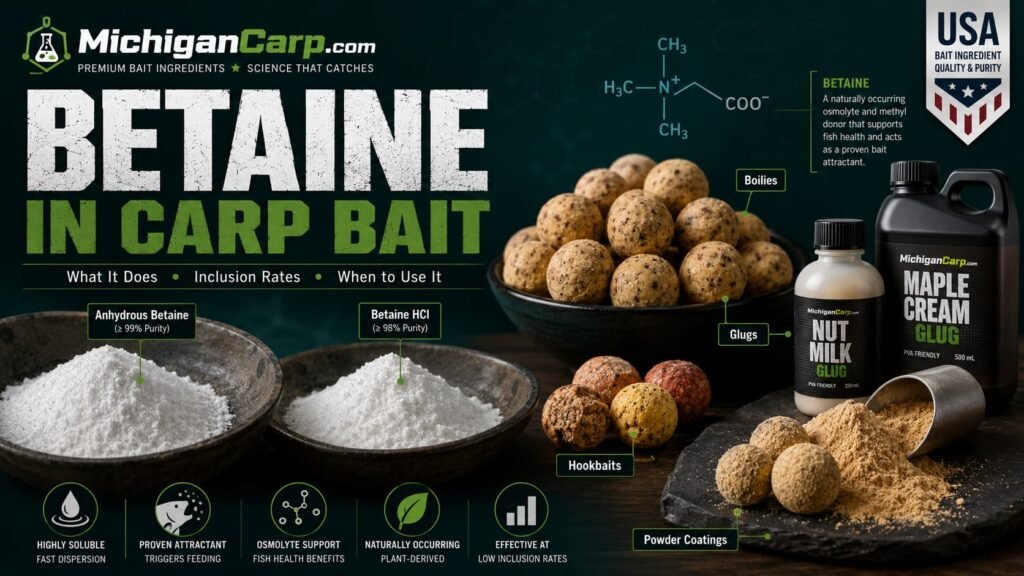
Betaine in carp bait is one of those subjects that gets repeated so often that many anglers stop asking what it actually does.
Betaine is usually described as a feeding trigger, appetite stimulant, taste enhancer or attractor.
Those descriptions are partly useful, but they can also make betaine sound more magical than it really is.
Betaine is not magic.
It does not replace good bait.
It does not fix poor boilie formulation.
It does not overcome bad location.
It does not mean carp will instantly feed just because a bait contains it.
What betaine can do is support a bait’s food signal when it is used at sensible levels.
That is especially useful in:
BOILIES.
HOOKBAITS.
GLUGS.
SPRAYS.
POWDER COATINGS.
MILK/NUT BAITS.
HYDROLYSATE SYSTEMS.
LIVER AND YEAST BAITS.
PACKBAIT AND METHOD MIX.
COLD-WATER HIGH-SIGNAL TRAPS.
The key is restraint.
Betaine is best used as a small supporting additive alongside real food ingredients such as milk proteins, nut meals, yeast, liver hydrolysate, hydrolyzed whey, fish hydrolysate, birdfood, boilie crumb and carefully chosen liquids.
This article explains betaine in carp bait, including what it is, why bait makers use it, anhydrous betaine vs betaine HCl, practical inclusion rates, boilie use, hookbait use, glugs, sprays, powder coatings, packbait, milk/nut boilies, cold-water use, warm-water use, USA sourcing and common mistakes.
For broader soluble food-signal work, read How to Use Hydrolysates in Carp Bait.
For liver-based soluble bait work, read Liver Hydrolysate for Carp Bait.
For yeast, CSL and fermented liquid support, read Yeast and Fermented Additives in Carp Bait.
For practical bait preparation before fishing, read How to Prepare Boilies for Carp Fishing.
The simple rule is:
BETAINE IS A SUPPORTING SIGNAL ADDITIVE.
USE IT CAREFULLY WITH REAL FOOD INGREDIENTS.
DO NOT EXPECT IT TO CARRY THE BAIT BY ITSELF.
Table of Contents
Quick Start: How to Use Betaine in Carp Bait
Use this table first.
| Use | Best Form | Starting Level | Main Benefit | Main Warning |
|---|---|---|---|---|
| Boilie base mix | Anhydrous betaine or betaine HCl | 1–3 g/kg dry mix | Low-level feeding-signal support | Do not overdo it |
| Strong food bait | Anhydrous betaine | 2–5 g/kg dry mix | Supports hydrolysates, liver, yeast, milk proteins | More is not automatically better |
| Hookbaits | Anhydrous betaine or HCl | 3–8 g/kg hookbait mix | Stronger hookbait identity | Test taste, texture and buoyancy |
| Glugs / soaks | Dissolved betaine | 1–5 g per 100 ml liquid | Adds soluble signal to bait liquids | Do not create harsh salty glug |
| Powder coating | Fine betaine powder | 2–5% of dust blend | Fast outer signal | Too much can taste harsh |
| Packbait / method | Betaine in dry add-on | 1–3 g/kg dry carrier | Supports food signal | Do not rely on it alone |
| Cold water | Low-level soluble use | Lower end of range | Signal without heavy feed | Avoid heavy sweet/oily bait |
| Warm water | Moderate support use | Middle of range | Helps richer food bait systems | Still avoid excessive levels |
| Milk/nut boilies | Betaine with whey, yeast, beef liver | 1.5–3 g/kg dry mix | Supports creamy savory food signal | Keep bait identity clean |
| Fishmeal boilies | Betaine with fish/liver/yeast | 2–5 g/kg dry mix | Supports savory hydrolysate profile | Avoid harsh additive stacking |
For most homemade boilies, I would start around:
1.5–3 g betaine per 1 kg dry mixFor stronger hookbaits:
3–8 g per 1 kg hookbait mixFor powder coatings:
2–5 g per 100 g dust blendThose are starting points, not laws.
What Is Betaine?
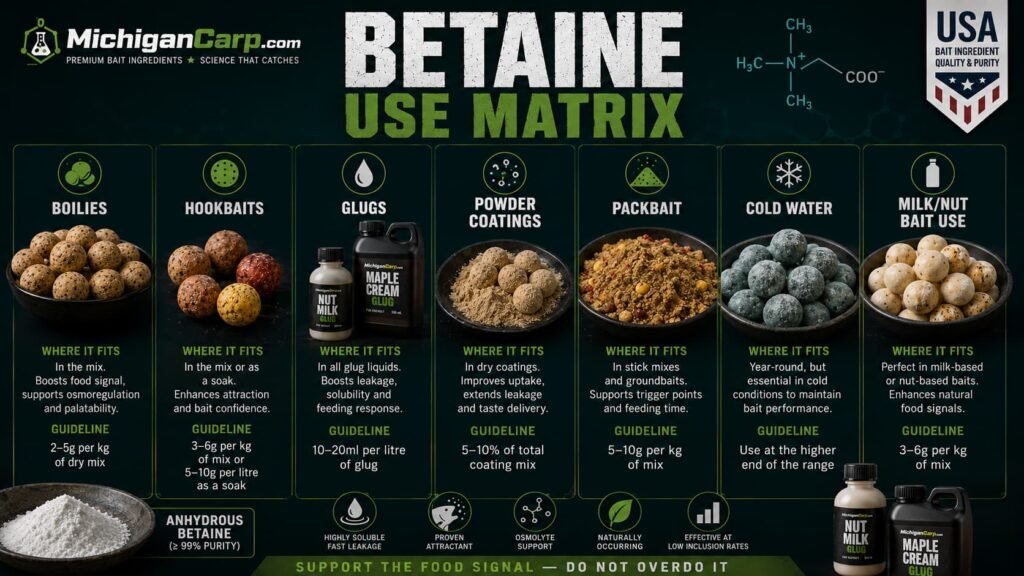
Betaine is also known as trimethylglycine or glycine betaine.
Chemically, betaine is a small quaternary ammonium compound. In animal nutrition and aquaculture, it is commonly discussed as a feed additive, osmolyte, methyl donor and feed attractant. The University of Florida aquaculture feed-attractant review describes betaine as a commonly used feed attractant that can stimulate taste receptors, support osmoregulation, act as a methyl donor and interact with amino acids in feeding response work. University of Florida Feed Attractants Review.
For carp bait, the practical meaning is simple:
Betaine is not a protein hydrolysate.
It is not yeast.
It is not liver.
It is not a flavor.
It is a small, highly soluble additive that can support feeding response and bait acceptance when used sensibly.
Why Anglers Use Betaine
Anglers use betaine because it may help with:
- taste stimulation;
- feed acceptance;
- palatability;
- soluble bait signal;
- hookbait confidence;
- amino/hydrolysate support;
- cold-water high-signal traps;
- bait identity without adding bulk.
What Betaine Does Not Do
Betaine does not:
- make bad bait good;
- replace hydrolysates;
- replace liver or yeast;
- create nutrition by itself;
- overcome poor swim choice;
- guarantee feeding;
- mean more is always better.
Betaine is a small part of a bait system.
It should not be the whole bait idea.
Why Betaine Gets Used in Fish Feed
Betaine is not just a carp-angler invention.
It is widely discussed in aquaculture nutrition and feed-attractant work.
A 2024 open-access meta-analysis in Aquaculture Reports described betaine as one of the most widely used attractants in aquafeed formulations and reported positive effects on growth-performance and feed-utilization measures across aquatic animals, while estimating an aquafeed dietary requirement near 0.99% in that research context. A Meta-Analysis on Dietary Betaine in Aquatic Animals.
That does not mean carp anglers should automatically use 1% betaine in every boilie.
Aquaculture feed trials are designed around complete diets, controlled feeding and production outcomes.
Carp bait is different.
A boilie or hookbait is not the same thing as a balanced pellet diet fed daily in tanks.
For bait making, the practical lesson is more careful:
betaine is credible as a feed-attractant and palatability-support additive, but carp bait levels should still be conservative and tested.
What Carp-Specific Research Suggests
Carp-specific evidence is useful, but it should not be exaggerated.
A common carp feed trial using betaine hydrochloride tested 0.25% and 0.50% dietary inclusion in experimental feeds; the study reported best growth, survival, FCR and protein efficiency in the 0.25% treatment under those trial conditions. Effect of Betaine Hydrochloride as Feed Attractant on Common Carp.
That supports the idea that betaine can be useful at low dietary levels.
It also supports the idea that higher is not automatically better.
Another study on crucian carp feeding stimulants found amino acids were more clearly stimulatory in that test, while betaine alone at the tested level did not significantly increase handling time. Feeding Stimulants in Crucian Carp.
That is important.
It reminds bait makers not to treat betaine as a universal switch.
Carp and related species respond to a whole chemical picture, not one additive in isolation.
Practical Interpretation
The honest bait-making position is:
- betaine is credible;
- low levels make more sense than extreme levels;
- betaine may work better with amino acids, hydrolysates and food signals;
- amino-rich ingredients still matter;
- testing matters more than mythology.
Anhydrous Betaine vs Betaine HCl
This is a major source of confusion.
Most bait makers will see two common forms:
anhydrous betaineand:
betaine hydrochlorideThey are not identical.
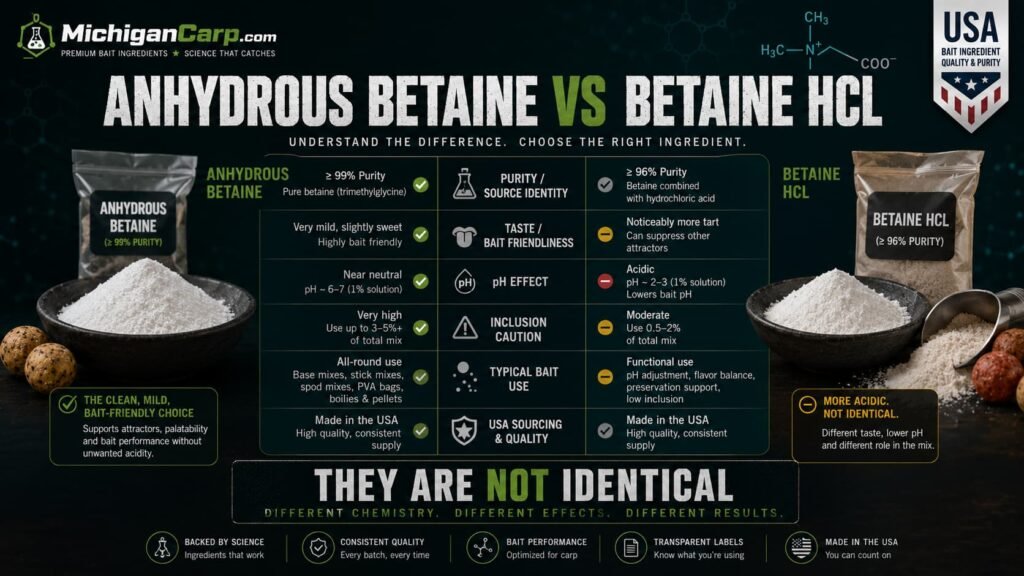
Anhydrous Betaine
Anhydrous betaine is the cleaner betaine form for bait making.
It is often labeled as:
- betaine anhydrous;
- trimethylglycine;
- TMG;
- glycine betaine.
PubChem lists betaine with molecular weight about 117.15 g/mol. PubChem: Betaine.
Betaine HCl
Betaine HCl is betaine hydrochloride.
It includes hydrochloride, so it is not the same as pure anhydrous betaine by weight. NIST lists betaine hydrochloride with molecular weight about 153.607 g/mol. NIST Chemistry WebBook: Betaine Hydrochloride.
In practical bait terms:
- anhydrous betaine is the cleaner choice when you want betaine;
- betaine HCl is acidic and contains less betaine per gram;
- betaine HCl may affect taste and pH more;
- both can work, but they should not be treated exactly the same.
Simple Practical Difference
If a recipe says:
3 g betainethat usually means anhydrous betaine unless stated otherwise.
If you use betaine HCl instead, you are not adding exactly the same amount of betaine molecule.
For most bait makers, that difference is not worth overcomplicating.
Just remember:
ANHYDROUS BETAINE IS THE CLEANER DEFAULT.
BETAINE HCL SHOULD BE USED MORE CAREFULLY.
Which Form Should You Buy?
For most boilie making, I would buy:
anhydrous betainefirst.
It is cleaner, easier to understand and easier to include in bait calculations.
Betaine HCl can still be useful, especially if it is what you can source easily, but I would start lower and test carefully.
Best Form for Boilies
Use:
anhydrous betaine powderBest Form for Hookbaits
Use:
anhydrous betaine or carefully tested betaine HClBest Form for Glugs
Use:
dissolved anhydrous betaineBest Form for Powder Coatings
Use:
fine anhydrous betaine powderBest Form for USA Availability
Look for:
- betaine anhydrous;
- trimethylglycine;
- TMG powder;
- pure betaine powder;
- feed-grade betaine from reputable suppliers;
- human supplement TMG powder with clean labels.
Avoid heavily flavored supplement blends.
How Much Betaine Should You Use?
Betaine should be used low.
It is not a bulk ingredient.
Practical Starting Levels
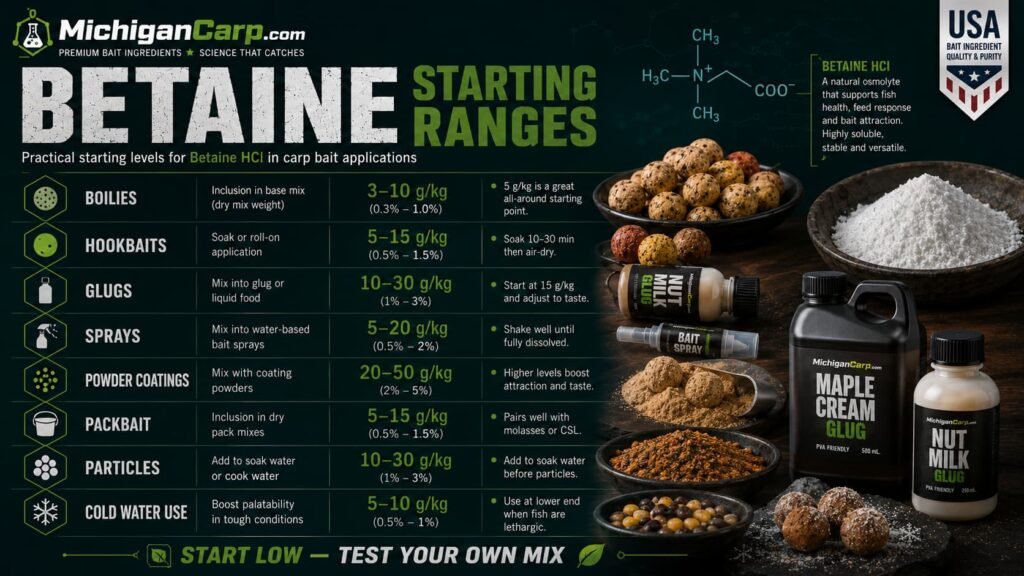
| Use | Starting Level |
| Subtle boilie support | 1–2 g/kg dry mix |
| General boilie use | 1.5–3 g/kg dry mix |
| Stronger food bait | 3–5 g/kg dry mix |
| Hookbait mix | 3–8 g/kg mix |
| Powder coating | 2–5 g per 100 g dust |
| Glug / spray | 1–5 g per 100 ml liquid |
| Packbait dry carrier | 1–3 g/kg dry carrier |
| Particle finishing liquid | 1–3 g per kg prepared particles |
These levels are practical bait-making ranges.
They are deliberately conservative.
Why Not Use More?
Because more is not automatically better.
High levels may create:
- harshness;
- bitterness;
- unnatural taste;
- salty/acidic edge if using HCl;
- additive-heavy bait;
- poor balance;
- false confidence.
Betaine should sit inside a wider food signal.
It should not shout over everything.
Betaine in Boilies
Betaine is easiest to use in boilies as a small dry addition.
Add it to the dry mix and distribute it evenly before adding liquids.
Basic Boilie Use
For 1 kg dry mix:
1.5–3 g anhydrous betaineThat is enough for most home bait.
For stronger hookbait-style or high-signal bait:
3–5 g per 1 kg dry mixFor ordinary free bait, I would not start higher than that.
When Betaine Makes Sense in Boilies
Use betaine when the bait already contains food signals such as:
- hydrolyzed whey;
- beef liver hydrolysate;
- yeast extract;
- brewer’s yeast;
- fish hydrolysate;
- milk proteins;
- birdfood;
- nut meals;
- tiger nut flour;
- boilie crumb;
- amino-style liquids.
Betaine works best as support.
It should not be the only interesting thing in the bait.
When to Leave It Out
Leave betaine out when:
- you are testing a base recipe;
- the bait already has many strong additives;
- you are troubleshooting harsh taste;
- the bait is too salty;
- you are unsure what is causing results;
- the bait is already working well.
Not every bait needs betaine.
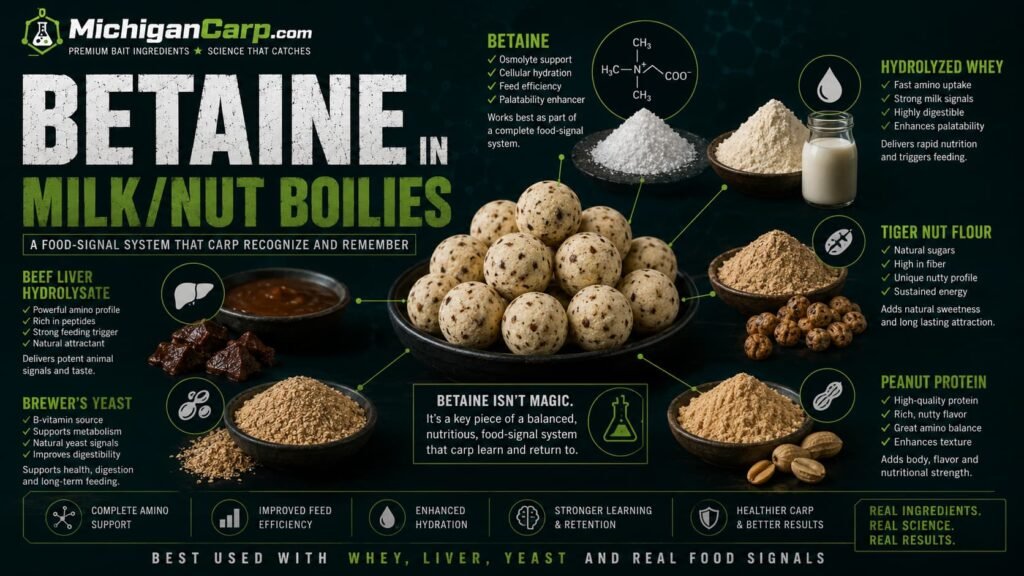
Betaine in Milk/Nut Boilies
Betaine fits milk/nut boilies very well when used carefully.
Milk/nut baits often contain:
- tiger nut flour;
- peanut protein;
- peanut meal;
- milk powder;
- WPC80;
- casein;
- hydrolyzed whey;
- brewer’s yeast;
- beef liver hydrolysate;
- birdfood;
- cream or fruit flavor support.
Betaine can support that profile without changing the whole bait identity.
Practical Milk/Nut Betaine Package
For 1 kg dry mix:
20 g hydrolyzed whey powder
10 g beef liver powder or liver hydrolysate powder
20–30 g brewer’s yeast
1.5–3 g anhydrous betaine
This is a useful soluble-support direction for milk/nut bait.
Liquid Side Support
For 1 kg dry mix:
15–25 ml liquid yeast
10–20 ml tiger nut extract
5–15 ml beef liver hydrolysate
1.5–3 g betaine in the dry mix
What to Avoid
Avoid stacking:
- high betaine;
- high liver;
- high yeast extract;
- high sweetener;
- high hydrolysate;
- high salt.
That can turn a clean milk/nut bait into a harsh additive bait.
Betaine in Fishmeal Boilies
Betaine also fits fishmeal and savory boilies.
In fishmeal bait, it usually supports a stronger animal-food profile.
Good Pairings
Use betaine with:
- fishmeal;
- predigested fishmeal;
- fish hydrolysate;
- liver hydrolysate;
- yeast extract;
- krill;
- spices;
- amino acid blends;
- marine oils used carefully.
Starting Level
For 1 kg dry mix:
2–5 g anhydrous betaineThat is enough for most fishmeal boilies.
Warning
Fishmeal baits are easy to overload.
Fish hydrolysate, liver hydrolysate, yeast extract, betaine, spices and oils can become too much if all pushed hard.
Strong smell is not the same as better bait.
Betaine in Hookbaits
Hookbaits are one of the best places to use betaine.
A hookbait can be slightly stronger than the free bait because it has a different job.
Best Uses
Use betaine in:
- hard bottom bait hookbaits;
- corkball paste;
- wafters;
- pop-ups;
- paste wraps;
- powder coatings;
- sprays;
- glugs;
- long-soak hookbaits.
Hookbait Starting Levels
For 1 kg hookbait mix:
3–8 g anhydrous betaineFor very strong specialist hookbait tests:
8–10 g per kg can be tested, but should not be the defaultWafters
Use caution.
Betaine powder itself is not the main buoyancy issue, but glugs and liquids used with betaine can change balance.
Test wafters with the actual hook.
Pop-Ups
Use lower levels and test buoyancy after soaking.
Do not assume a treated pop-up still performs correctly after 12–24 hours.
Hookbait Rule
Use betaine to support hookbait identity.
Do not make the hookbait harsh just to make it “strong.”
Betaine in Glugs, Sprays and Soaks
Betaine dissolves well enough for practical bait liquids.
It can be used in:
- glugs;
- sprays;
- dips;
- hookbait conditioners;
- powder-coating wetting liquids;
- short-term soaks.
Simple Betaine Glug Base
For 100 ml liquid:
50 ml food-grade propylene glycol
30 ml food-grade glycerin
15 ml liquid yeast or hydrolysate
5 g anhydrous betaine
Shake until dissolved.
Use lightly.
Milk/Nut Betaine Glug
For 250 ml:
90 ml food-grade propylene glycol
60 ml food-grade glycerin
40 ml tiger nut extract
30 ml liquid yeast
20 ml beef liver hydrolysate or hydrolyzed whey liquid
5 g anhydrous betaine
Use lightly on hookbaits or thawed freezer bait.
Same-Session Soluble Glug
For 1 kg boilies:
20 ml liquid yeast
10 ml beef liver hydrolysate
10 ml tiger nut extract
1–2 g betaine
Use same day or keep cool.
Warning
Betaine does not make a wet glug shelf-stable.
If your glug contains water-rich liquids, treat the bait as short-term prepared bait.
For storage, use How to Store Homemade Boilies.
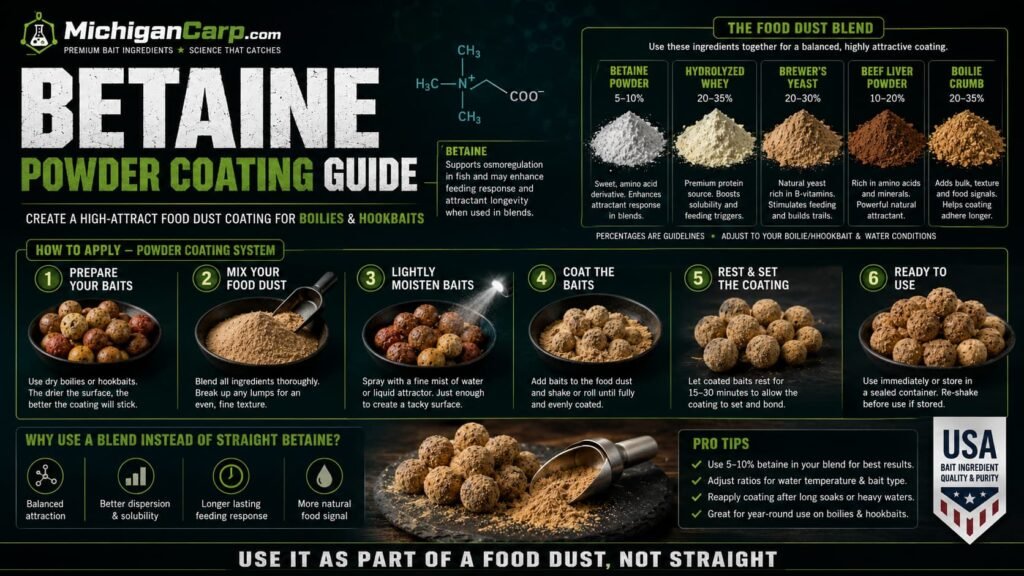
Betaine in Powder Coatings
Powder coatings are one of the cleanest ways to use betaine.
They add a fast outer signal without drowning the bait.
100 g Milk/Nut Betaine Dust
30 g hydrolyzed whey powder
25 g fine boilie crumb
20 g brewer’s yeast
10 g tiger nut flour
10 g beef liver powder
5 g anhydrous betaine
Total:
100 g100 g Savory Betaine Dust
35 g fine boilie crumb
20 g brewer’s yeast
20 g beef liver powder
10 g yeast extract or hydrolyzed whey
10 g fish hydrolysate powder or liver hydrolysate powder
5 g anhydrous betaine
Total:
100 gHow to Use
- Lightly spray boilies or hookbaits.
- Add a small amount of dust.
- Shake gently.
- Let the coating settle.
- Repeat only if needed.
- Use soon or keep cool depending on moisture.
Practical Rule
Do not roll hookbaits in straight betaine.
Use betaine as part of a food dust.
Betaine With Hydrolysates, Liver and Yeast
Betaine usually makes most sense when paired with food signals.
It is not there to replace them.
Good Pairings
Use betaine with:
- hydrolyzed whey;
- beef liver hydrolysate;
- liver powder;
- liquid yeast;
- brewer’s yeast;
- yeast extract;
- fish hydrolysate;
- milk proteins;
- amino acid blends;
- IMP/GMP-style nucleotide support;
- boilie crumb.
Why This Makes Sense
The University of Florida feed-attractant review notes that betaine can interact with amino acids in ways that may enhance feeding response in aquaculture-feed contexts. University of Florida Feed Attractants Review.
For bait making, the practical translation is:
betaine is often better beside amino-rich ingredients than on its own.
That is why it fits well with:
- liver hydrolysate;
- hydrolyzed whey;
- yeast extract;
- liquid yeast;
- fish hydrolysate.
What to Avoid
Avoid stacking every attractor at maximum level.
A bait with high betaine, high liver, high yeast extract, high fish hydrolysate and high flavor can become harsh.
Controlled layering is better than additive overload.
Betaine in Packbait and Method Mix
Betaine can be useful in packbait, but it should not be the main ingredient.
Packbait works because of texture, breakdown, smell, food particles and placement.
Betaine is only a small support tool.
Simple Packbait Add-On
For 1 kg dry carrier:
50 g fine boilie crumb
30 g brewer’s yeast
20 g hydrolyzed whey or milk powder
10 g beef liver powder
2 g anhydrous betaine
Add this to a dry packbait or method mix.
Same-Session Liquid Add-On
20 ml liquid yeast
10 ml molasses
10 ml beef liver hydrolysate
1 g betaine
Add to wetting liquid for same-session use.
Practical Warning
Do not make packbait too wet, sticky or slow to break down.
For the full system, read Packbait for Carp Fishing.
Betaine With Particles
Betaine can be used with particles, but safe particle preparation comes first.
Do not use betaine to cover poor soaking, boiling or storage.
With Maize or Corn
Use:
- 1–2 g betaine per kg prepared particles;
- liquid yeast;
- molasses;
- CSL-style liquid;
- boilie crumb.
With Tiger Nuts
Use:
- 1–2 g betaine per kg prepared tigers;
- tiger nut extract;
- liquid yeast;
- milk/nut boilie crumb;
- small beef liver hydrolysate level.
With Hemp
Use:
- 1–2 g betaine per kg prepared hemp mix;
- yeast;
- savory hydrolysate;
- boilie crumb;
- light hemp oil only when suitable.
Practical Rule
Add betaine after particles are cooked and cooled.
Use it as a finishing additive, not as a cooking solution.
For particle safety, read How to Prepare Particles for Carp Fishing and Particles for Carp Fishing.
Betaine in Cold Water
Cold water is one of the best places to use betaine carefully.
When carp are feeding less, small high-signal baits often make more sense than large piles of feed.
Good Cold-Water Uses
Use betaine in:
- single hookbaits;
- powder coatings;
- small PVA traps;
- low-feed milk/nut baits;
- hydrolyzed whey dusts;
- liver/yeast hookbait prep;
- light sprays.
Cold-Water Starting Levels
Dry mix:
1–2 g per 1 kg dry mixHookbaits:
3–5 g per 1 kg hookbait mixPowder coating:
2–3 g per 100 g dustAvoid
Avoid:
- heavy oils;
- high sweetener levels;
- overfeeding;
- harsh additive stacking;
- strong salty betaine HCl use;
- big glugged bait piles.
In cold water, betaine should be precise.
Betaine in Warm Water
Warm water gives more room for richer bait.
Betaine can support food bait campaigns when carp are feeding properly.
Good Warm-Water Uses
Use betaine in:
- milk/nut boilies;
- fishmeal boilies;
- yeast/liver bait systems;
- packbait;
- method mix;
- particle finishing liquids;
- hookbait conditioners.
Warm-Water Starting Levels
Dry mix:
2–5 g per 1 kg dry mixGlugs:
1–5 g per 100 ml liquidPackbait:
1–3 g per kg dry carrierWarning
Warm weather also increases spoilage risk.
If betaine is used in water-rich glugs with liver, yeast, CSL or dairy liquids, keep treated bait cool and use it sensibly.
Betaine and Shelf-Life Baits
Betaine itself is dry and easy to include in a shelf-life formulation.
But the liquids used with it may not be shelf-stable.
Safer Shelf-Life Use
Use:
- dry anhydrous betaine;
- low-level inclusion;
- dry powder coatings for immediate use;
- stable carrier liquids;
- tested preservative systems;
- proper drying and storage testing.
Riskier Shelf-Life Use
Be careful with:
- water-rich betaine glugs;
- dissolved betaine in water;
- liver/yeast/CSL liquids;
- post-boil wet soaks;
- warm storage;
- wet bait in sealed tubs.
Practical Rule
Dry betaine in the base mix is simple.
Wet betaine glugs are storage-dependent.
Do not confuse the two.
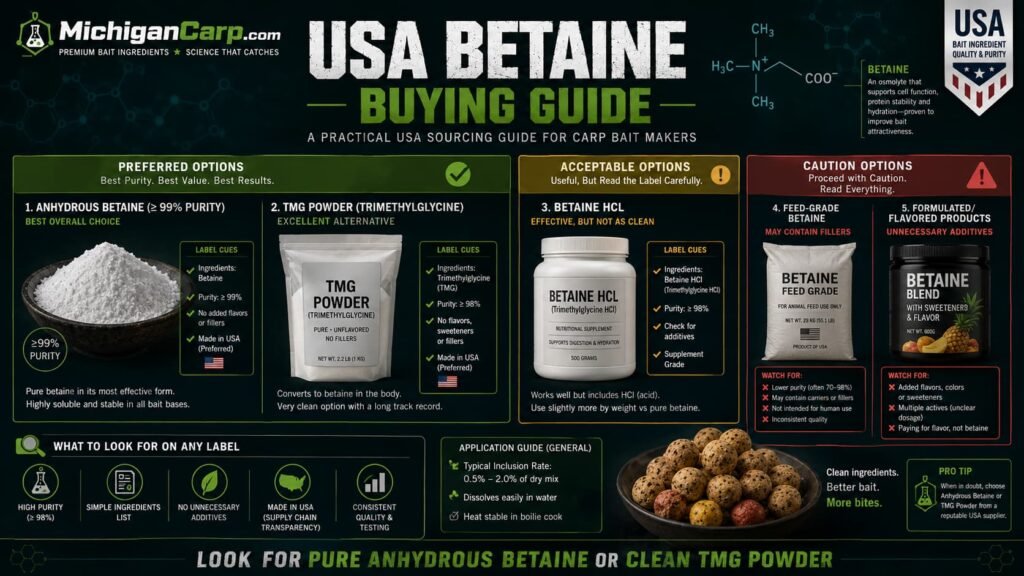
USA Buying Guide for Betaine
Betaine is easy to source in the USA if you search under the right names.
Search For
Look for:
- betaine anhydrous;
- trimethylglycine;
- TMG powder;
- glycine betaine;
- betaine HCl;
- feed-grade betaine;
- food-grade or supplement-grade betaine powder.
Best Practical Choice
For most home bait makers:
pure betaine anhydrous powderor:
plain TMG powder with a clean labelis the easiest starting point.
Read the Label
Check:
- anhydrous or HCl;
- flavoring;
- sweeteners;
- anti-caking agents;
- capsule fillers;
- serving size;
- purity;
- intended use;
- storage instructions.
Avoid
Avoid:
- flavored supplement powders;
- blends with caffeine or stimulants;
- digestive supplements with herbs or enzymes;
- mystery feed additives;
- products with unclear labels;
- industrial chemical sources;
- anything not suitable around bait or water.
Supplement Capsules
Betaine capsules can be opened and tested, but they are usually expensive for bait.
Bulk powder is more practical.
Common Betaine Mistakes
Mistake 1: Using Too Much
Betaine is strong.
More is not automatically better.
Mistake 2: Treating Betaine as Magic
Betaine supports bait.
It does not replace good ingredients or good watercraft.
Mistake 3: Confusing Anhydrous Betaine and Betaine HCl
They are not identical.
Anhydrous betaine is the cleaner default.
Mistake 4: Using Straight Betaine as a Coating
Do not coat hookbaits in straight betaine.
Use it as part of a food dust.
Mistake 5: Adding Betaine to Every Bait
Not every bait needs it.
Mistake 6: Ignoring Taste Balance
High levels can become harsh or unnatural.
Mistake 7: Overloading With Other Additives
Betaine plus high liver plus high yeast extract plus high hydrolysate can become too much.
Mistake 8: Not Adjusting Glugs
If betaine goes into a glug, the glug still needs proper storage and balance.
Mistake 9: Not Testing Wafters and Pop-Ups
Liquids used with betaine can change buoyancy.
Mistake 10: Not Keeping Notes
If you do not record the level, you cannot repeat or improve the bait.
Simple Betaine Test Plan
Before changing a main recipe, test small.
Step 1: Choose One Bait
Use a bait you already understand.
Step 2: Make Three Levels
For 1 kg dry mix equivalent:
Low: 1 g
Medium: 3 g
High: 5 g
For hookbaits:
Low: 3 g
Medium: 5 g
High: 8 g
Step 3: Keep Everything Else the Same
Do not change:
- flavor;
- hydrolysate;
- liver;
- yeast;
- sweetener;
- boil time;
- drying time.
Only change the betaine level.
Step 4: Boil, Dry and Soak Test
Check after:
- 1 hour;
- 6 hours;
- 12 hours;
- 24 hours.
Step 5: Judge Properly
Look for:
- smell;
- taste balance;
- leakage;
- softness;
- texture;
- cracking;
- hookbait durability;
- buoyancy if relevant;
- storage behavior;
- fishing results.
Step 6: Record It
Write down:
- betaine form;
- supplier;
- level used;
- bait recipe;
- boil time;
- drying time;
- soak test result;
- fishing result.
Good bait development needs notes.
My Practical View
Betaine is useful, but it is not a miracle additive.
I like it best as a quiet supporting signal in a bait that already has real food value.
For MichiganCarp-style bait making, that means using betaine alongside ingredients such as:
- hydrolyzed whey;
- beef liver hydrolysate;
- brewer’s yeast;
- yeast extract;
- milk powders;
- WPC80;
- casein;
- tiger nut flour;
- peanut protein;
- boilie crumb;
- liquid yeast.
In my own bait thinking, I would usually start low:
1.5–3 g per 1 kg dry mixThat is enough for most free bait.
I would use more only in hookbaits or specific test batches.
The biggest mistake is treating betaine like the star of the bait.
It should not be the star.
The bait should be the star.
The final rule is:
USE BETAINE AS SUPPORT.
PAIR IT WITH REAL FOOD SIGNALS.
START LOW.
TEST IN WATER.
DO NOT BUILD THE WHOLE BAIT AROUND ONE ADDITIVE.
FAQ
Is betaine good in carp bait?
Yes. Betaine can be useful in carp bait as a low-level feeding-signal and palatability-support additive, especially when paired with hydrolysates, yeast, liver, milk proteins and real food ingredients.
What does betaine do in carp bait?
Betaine may support taste stimulation, feed acceptance and soluble bait signal. It is best used as part of a wider food-bait system.
Is betaine a feeding trigger?
Betaine is often described as a feeding stimulant or attractant in aquaculture contexts, but it should not be treated as a magic trigger in carp bait.
How much betaine should I use in boilies?
A practical starting point is 1.5–3 g of anhydrous betaine per 1 kg dry mix. Stronger hookbait mixes may use 3–8 g per kg.
Can you use too much betaine?
Yes. Too much betaine can make bait harsh, unnatural or unbalanced, especially when combined with high levels of liver, yeast extract or hydrolysates.
What is the difference between anhydrous betaine and betaine HCl?
Anhydrous betaine is the cleaner default bait-making form. Betaine HCl contains hydrochloride, has a different molecular weight and may affect acidity and taste more.
Which betaine is best for carp bait?
For most home bait makers, anhydrous betaine or plain TMG powder is the best starting point.
Can I use betaine HCl in carp bait?
Yes, but use it carefully and start low. It is not identical to anhydrous betaine.
Does betaine work in milk/nut boilies?
Yes. Betaine works well in milk/nut boilies when used with hydrolyzed whey, beef liver hydrolysate, yeast, tiger nut flour, peanut protein and milk powders.
Does betaine work in hookbaits?
Yes. Hookbaits are one of the best places to use betaine, especially in hard bottom baits, paste wraps, sprays, powder coatings and glugs.
Can I add betaine to glugs?
Yes. Betaine can be dissolved into glugs and sprays, but the finished liquid still needs proper storage and balance.
Can I powder-coat boilies with betaine?
Yes, but do not use straight betaine heavily. Add it as a small percentage of a food dust with hydrolyzed whey, yeast, liver powder and boilie crumb.
Is betaine PVA-safe?
Dry betaine powder is fine in dry PVA mixes. Liquids containing dissolved betaine may or may not be PVA-safe depending on the carrier, so test your own PVA.
Where can I buy betaine in the USA?
Search for betaine anhydrous, trimethylglycine, TMG powder, glycine betaine or feed-grade betaine. Plain bulk powder is usually more practical than capsules.
What is the biggest mistake with betaine?
The biggest mistake is using too much and expecting betaine to carry the bait by itself.
Next Steps
Use these supporting guides next:
- How to Use Hydrolysates in Carp Bait
- Liver Hydrolysate for Carp Bait
- Yeast and Fermented Additives in Carp Bait
- Boilie Liquids and Additives
- How to Prepare Boilies for Carp Fishing
- How to Store Homemade Boilies
- Milk Powders in Boilie Making
- Milk Proteins in Carp Bait
- How to Formulate a Milk, Nut and Birdfood Boilie Base Mix
- Nut Boilie Base Mix Recipes
- Packbait for Carp Fishing
- Particles for Carp Fishing
- The Bait Shed
- Boilie School
- Michigan Carp Guide Library