
 BOILIE SCHOOL · RECIPE LIBRARY
Boilie Recipes: Homemade Carp Bait and Base Mix Formulas
Explore homemade boilie recipes, complete dry base mixes, classic 50/50 formulas, nut boilies, milk-protein baits and fishmeal recipes. Find weighed ingredients, practical making advice and links to the detailed guides.
Choose a boilie base mix that suits your ingredients and budget. Every formula is a starting point: test paste handling, cooking and finished-bait behaviour before making a large batch. Field-developed and historical recipes are clearly identified.
Homemade Nut Boilie Recipes: Four 1 kg Base Mixes
Each recipe links to a complete 1 kg dry base mix with exact ingredient weights in the original guide. Choose Sweet Nut Classic for a straightforward start, Milk-Nut for a dairy-rich direction, Birdfood-Nut for texture, or Budget Nut for economical repeat batches. These are starting formulas, not claims of superior catch rates. For the making process, see Boilie School BS-05: Making Boilies.
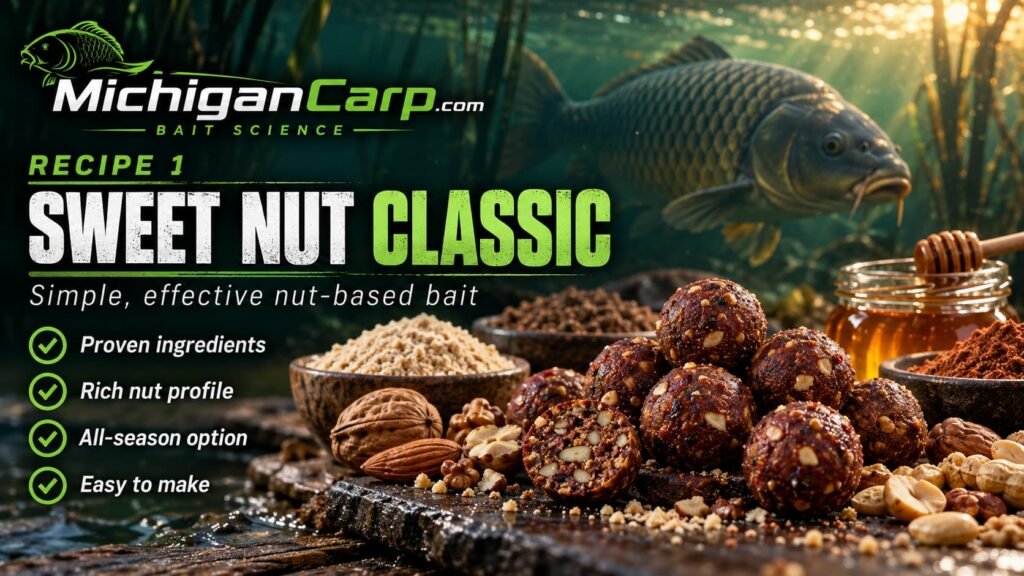
Sweet Nut Classic
A straightforward sweet-nut base mix, designed as a manageable starting point for anglers learning to balance structure and nut ingredients.
View the exact formula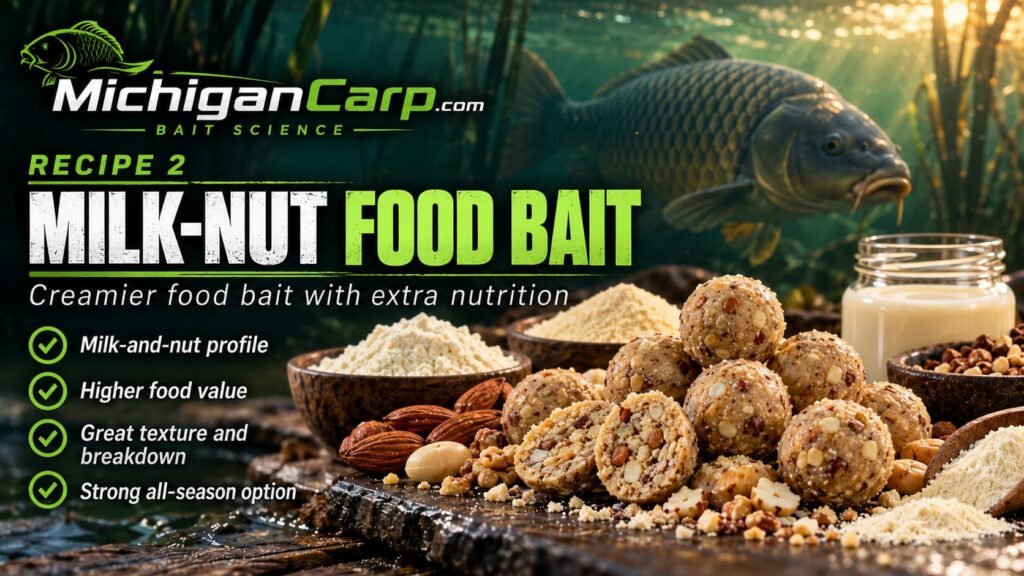
Milk-Nut Food Bait
A richer dairy-and-nut direction. Check the milk product specification and the combined fat contribution before substituting ingredients.
View the exact formula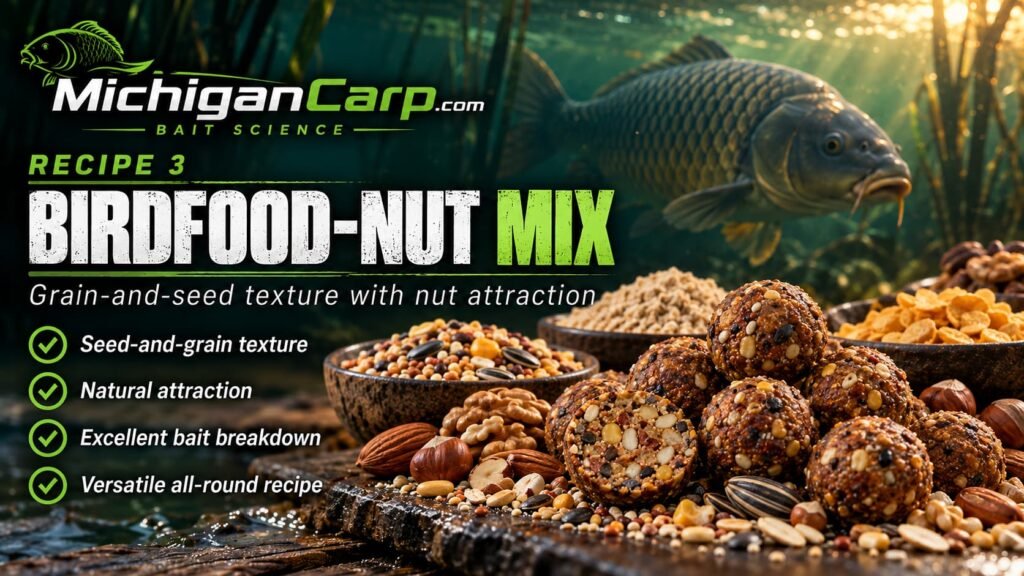
North American Birdfood-Nut Mix
Combines nut ingredients with a textured birdfood approach using ingredients more accessible to North American bait makers.
View the exact formula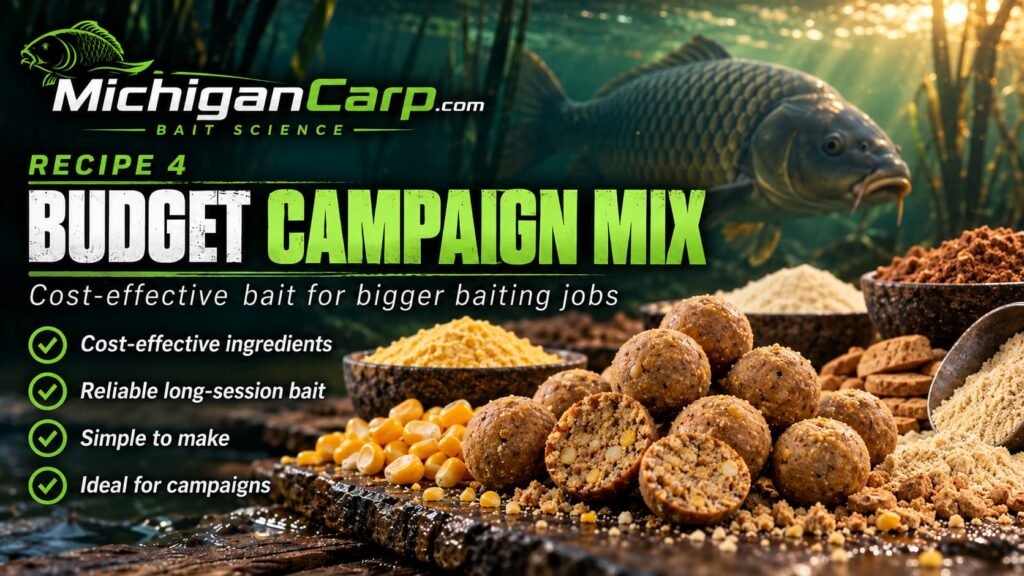
Budget Nut Campaign Mix
A cost-conscious nut mix intended for anglers who want consistency and manageable ingredient costs when preparing repeat batches.
View the exact formulaIngredient warning: peanut flour, defatted peanut protein, tiger nut meal and other nut products are not interchangeable gram for gram. Check fat content, binders and the actual product specification before making substitutions. The original recipe guide explains these differences.
Signature & Development Formulas
These articles show how an angler’s working bait develops over time. They include actual quantities, reasoning and adjustments—without pretending that every revised formula has been independently catch-tested.
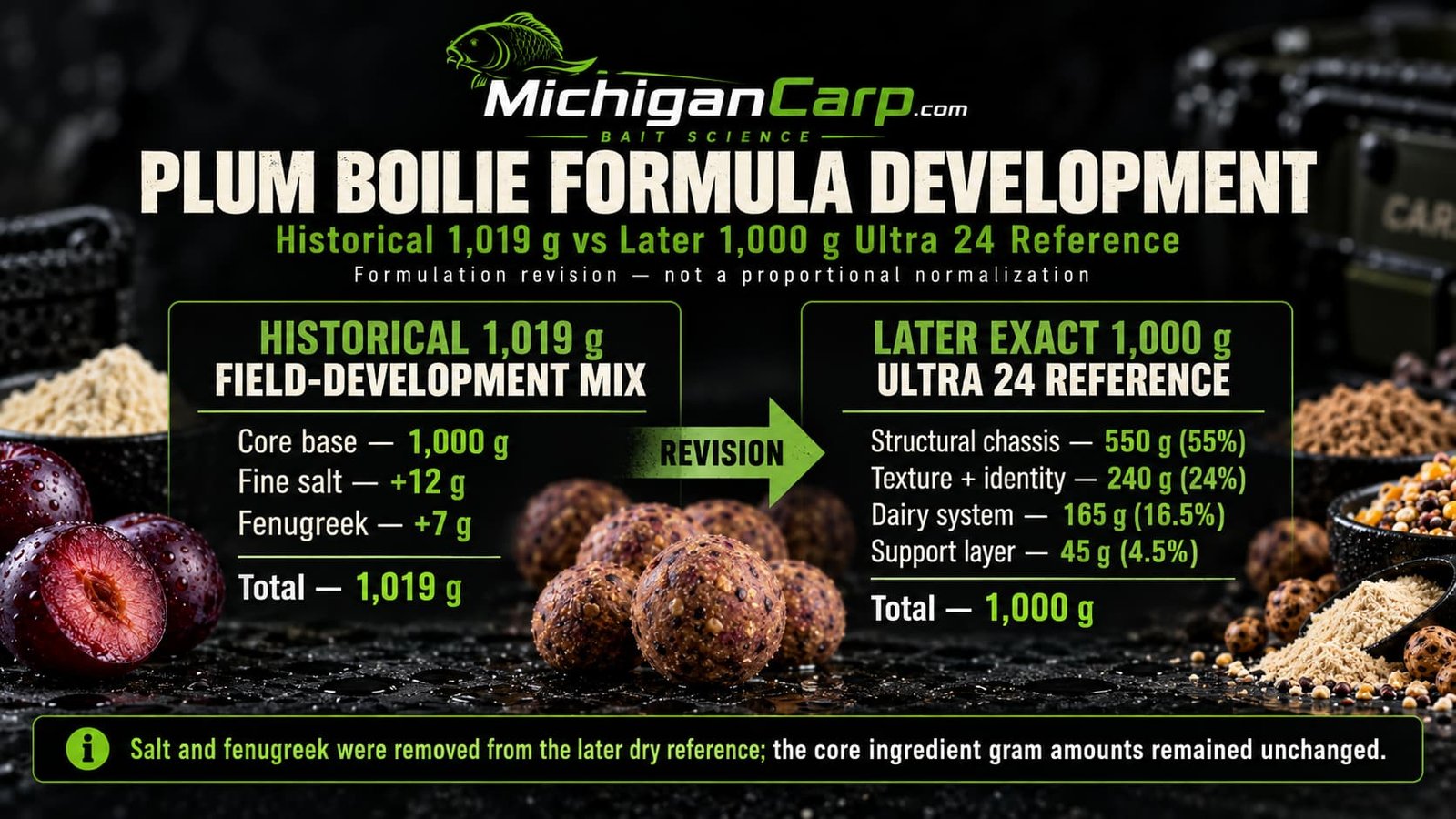
Plum, Scopex & Vanilla Milk-Nut Boilie
Follow the development of a non-marine milk-nut boilie, including the recorded dry mixes, liquid-phase notes, processing choices and fishing observations.
Evidence note: field captures belong to the wider evolving Plum bait family; they do not establish that every gram of the final reference mix was independently validated.
Read the formula and development record →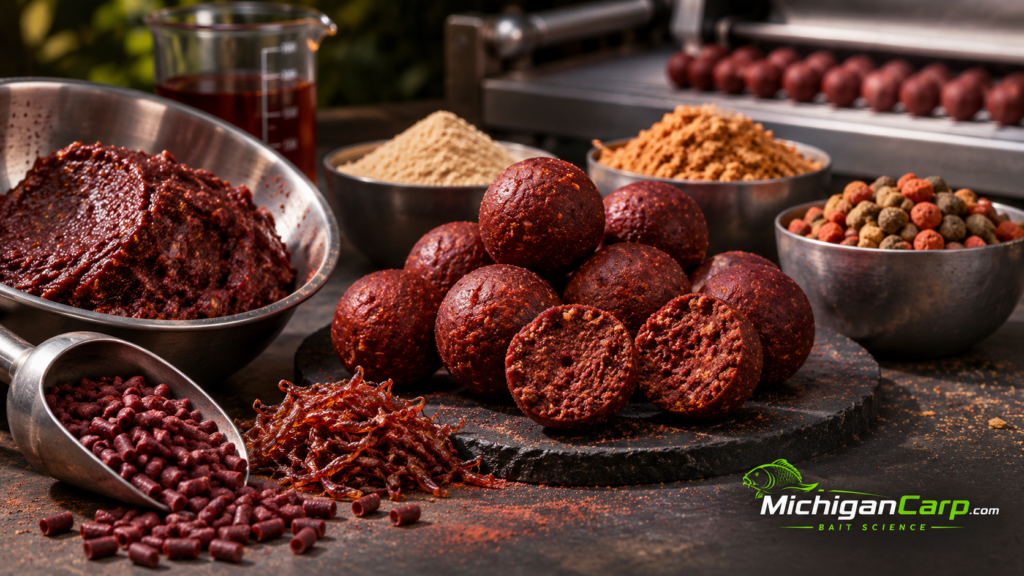
Bloodworm Koi Fusion MkII
A more specialist worked example combining koi-food ingredients, bloodworm pellets, structure, and a supporting food layer. The guide includes a corrected 500 g formula, alternate scenarios and the making process.
Read it as a transparent development formula, not as a guarantee of results or a commercially proven bait.
View the full MkII formula and process →Two Modern Boilie Recipes to Test
These two new, untested development mixes provide contrasting starting points: a moderate-fishmeal food bait and a non-marine, dairy-led birdfood boilie. Both dry recipes total exactly 1 kg; the 250 g columns are exact quarter batches. Neither formula has been independently rolled, cooked, water-tested or field-tested yet. Do not confuse them with the recorded field-development recipes elsewhere on this page.
Modern Fishmeal & Cereal Boilie
A 24% fishmeal mix with semolina, maize and heat-treated soya for an economical structural base. Wheatgerm, prepared birdfood and modest dairy provide secondary food ingredients; a small predigested fishmeal fraction lets the angler assess water behaviour. The initial version contains no added bottled oil or commercial flavour.
| Dry ingredient | 1 kg | 250 g test |
|---|---|---|
| Fresh, specified fishmeal (feed/bait grade) | 240 g | 60 g |
| Fine semolina (durum wheat) | 220 g | 55 g |
| Heat-treated full-fat soya flour | 160 g | 40 g |
| Fine maize flour (not US cornstarch) | 140 g | 35 g |
| Wheatgerm | 80 g | 20 g |
| Prepared birdfood / eggfood, finely milled | 80 g | 20 g |
| Skimmed milk powder | 40 g | 10 g |
| Predigested fishmeal powder | 20 g | 5 g |
| Egg albumen powder | 20 g | 5 g |
| Total dry mix | 1,000 g | 250 g |
Ingredient specification: use fresh fishmeal sold for feed/bait manufacture and check its fat content, particle size and storage condition; do not substitute unspecified fertiliser-grade fishmeal. Fully heat-treated full-fat soya is required. Check the actual ingredient list of any prepared birdfood. Predigested fishmeals differ substantially, so record the product used.
Wet-phase starting point: for the 250 g dry trial, begin with roughly 110–125 g beaten whole egg, added to the dry blend gradually. Rest the dough for 10–15 minutes before deciding whether more liquid is needed. Record the final amount; eggs vary and this is an experimental starting range, not a fixed requirement. Keep the first batch free of added oil or flavour to establish a clean baseline.
Making and testing: roll a small sample at 16–20 mm and cook using a time established for your equipment and boilie size; consult Boilie School BS-05. Compare paste cohesion, cracking, cooked core texture and sinking behaviour. Check firmness after 1, 6 and 12 hours in water. Cool and dry hygienically, then freeze for storage unless a separately validated preservation method is used.
Adjustment to investigate: if this mix rolls poorly, test one ingredient change at a time rather than assuming more egg or fishmeal is the answer. A 250 g batch costs less to correct than a full kilogram.
Milk Protein & Birdfood Boilie
A dairy-led alternative with 30% dry milk-derived ingredients, 20% prepared birdfood and a semolina/defatted-soya/wheatgerm chassis. It deliberately uses no fishmeal, krill, GLM or other marine ingredient. Its character comes from the food base rather than a flavour blend.
| Dry ingredient | 1 kg | 250 g test |
|---|---|---|
| Fine semolina (durum wheat) | 280 g | 70 g |
| Prepared non-marine birdfood / eggfood | 200 g | 50 g |
| Heat-treated defatted soya flour | 140 g | 35 g |
| Skimmed milk powder | 120 g | 30 g |
| Acid casein | 100 g | 25 g |
| WPC80 whey protein concentrate | 80 g | 20 g |
| Wheatgerm | 60 g | 15 g |
| Egg albumen powder | 20 g | 5 g |
| Total dry mix | 1,000 g | 250 g |
Ingredient specification: check that the prepared birdfood is actually non-marine: some commercial eggfoods or birdfoods may contain fishmeal or other animal additives. Choose defatted, heat-treated soya with a known specification. Acid casein and WPC80 are not interchangeable by weight; retain the stated products for the first trial. Avoid adding oil until the birdfood’s fat contribution is known.
Wet-phase starting point: for a 250 g test batch, begin with approximately 115–130 g beaten whole egg, incorporating the powder progressively. Allow 10–15 minutes of resting before judging stiffness; the milk proteins and birdfood can change how the paste feels as it hydrates. Record actual egg weight and any correction rather than relying on an assumed egg count.
Making and testing: start at 16–20 mm, cook consistently and check core texture after cooling. Compare handling, surface integrity, sinking and water softening at 1, 6 and 12 hours against MC-FM-01. Air-dry only as part of a hygienic process; freeze the finished boilies for storage unless their preservation has been validated.
Adjustment to investigate: if the mix is rubbery or hard to roll, evaluate wet-phase quantity and casein/birdfood balance in a new small batch. Do not change several components at once. For ingredient functions, see Milk Proteins and the Birdfood Guide.
Classic 50/50 & Heritage Boilie Recipes
Five additional formulas from established carp-bait writing and angling discussions. We’ve independently converted the original ingredient percentages into weighed dry mixes below and checked that their totals balance. These are historical or independently published recipes, not MichiganCarp field-tested baits. Original authors and source links are provided beside every formula.
50/50 Boilie Base: Birdfood, Fishmeal & Hybrid Variations
There are two related meanings of 50/50. One is the literal equal-weight mixture of semolina and soya flour. The other is the practical approach of making an equal-parts semolina/soya foundation, then changing the other dry ingredients to build a birdfood, fishmeal or combined bait. In that approach, the structural base does not have to be 100% of the final boilie mix.
This is the useful distinction: keep a simple, repeatable chassis, then alter what gives the bait its character. It is not a claim that every carp bait needs to be 50% semolina and 50% soya.
Plain 50/50
| Dry ingredient | Amount |
|---|---|
| Semolina | 500 g |
| Heat-treated soya flour | 500 g |
| Total | 1,000 g |
Equal semolina and soya by dry weight: an economical reference for understanding paste handling, cooking and texture.
50/50 + Birdfood
| Dry ingredient | Amount |
|---|---|
| Semolina | 350 g |
| Heat-treated soya flour | 350 g |
| Prepared birdfood blend | 150 g |
| Fine maize flour | 150 g |
| Total | 1,000 g |
A 700 g neutral chassis plus 150 g suitable birdfood and 150 g maize flour, giving some texture without replacing the entire structural base.
50/50 + Fishmeal
| Dry ingredient | Amount |
|---|---|
| Semolina | 350 g |
| Heat-treated soya flour | 350 g |
| Suitable fishmeal | 300 g |
| Total | 1,000 g |
A 700 g neutral chassis plus 300 g of a specified fishmeal. Check its specification and test how the paste binds and rolls.
50/50 + Birdfood & Fishmeal
| Dry ingredient | Amount |
|---|---|
| Semolina | 350 g |
| Heat-treated soya flour | 350 g |
| Suitable fishmeal | 150 g |
| Prepared birdfood blend | 150 g |
| Total | 1,000 g |
The same 700 g neutral chassis plus equal fishmeal and birdfood fractions. Useful for comparing bait character without rebuilding the whole mix.
Recipe status: the plain 50/50 is a traditional starting mix. The other three are illustrative MichiganCarp bench formulas, not your own archived personal recipes and not field-validated results. Each table weighs exactly 1 kg of dry mix. For a 250 g trial batch, divide every dry ingredient by four.
Practical cautions: use heat-treated soya; do not assume every full-fat and defatted product is interchangeable. Prepared birdfood, ground suitable seeds and whole raw birdseed are not the same thing. Check any chosen birdfood for oil content, particle size and suitability. Fishmeals differ in fat content and water behaviour, so a 30% fishmeal inclusion deserves a small paste and water test before large-batch use.
Wet phase and processing: whisk eggs and other chosen liquids separately; incorporate dry mix gradually to a workable paste. Record the actual liquid quantity, resting time, rolling behaviour, cooking and drying. Don’t assume a fixed egg count will suit every variation.
Original background: A published foundation with fishmeal and birdfood adaptations → · Understand prepared birdfood and birdseed → · How to make and cook boilies →
CarpForum BM1 — Classic HNV Fishmeal
A historic high-protein fishmeal-led formula with maize protein, eggfood and soluble fishmeal. The original BM1 recipe was shared on CarpForum and discussed extensively by the community.
| Dry ingredient | Weight | Share |
|---|---|---|
| LT94 fishmeal | 300 g | 30% |
| Maize protein meal 60% | 150 g | 15% |
| Egg-based birdfood (CeDe-style) | 130 g | 13% |
| Semolina | 100 g | 10% |
| Heat-treated soya flour | 100 g | 10% |
| Predigested fishmeal | 85 g | 8.50% |
| Calf/lamb milk powder (Vitamealo-style) | 85 g | 8.50% |
| Equivite vitamin/mineral premix (historical listed rate) | 50 g | 5% |
| Total dry mix | 1,000 g | 100% |
MichiganCarp assessment: Critical historical caution: the original includes 50 g/kg Equivite vitamin/mineral premix. That quantity is not a general dosing recommendation. Modern premixes may differ substantially in strength; do not substitute or use one at that rate without checking the manufacturer guidance. LT94, maize protein and predigested fishmeal also require suitable ingredient specifications.
Original source: CarpForum community / Smurf (shared in 2011 by Ken Townley) · View original formula →
Source integrity: proportions above are the original BM1 formula; later forum members published different versions using Selenavite and other additions.
Brian Mills — Milk Protein & Birdfood
Brian Mills described this older coarse birdfood-and-casein bait as a way to change texture and release characteristics. It offers a striking contrast with modern ultra-fine base mixes.
| Dry ingredient | Weight | Share |
|---|---|---|
| Nectarblend | 250 g | 25% |
| Red Factor | 200 g | 20% |
| CLO birdfood | 200 g | 20% |
| Lactalbumin | 100 g | 10% |
| Rennet casein | 100 g | 10% |
| Acid casein | 100 g | 10% |
| Crushed hemp | 50 g | 5% |
| Total dry mix | 1,000 g | 100% |
MichiganCarp assessment: A serious traditional dairy recipe, but not a cheap or automatically interchangeable one. Lactalbumin, rennet casein and acid casein have different functionality, and branded birdfoods should not be swapped blindly for plain seed mixes.
Original source: Brian Mills, Haith’s (2015) · View original formula →
US sourcing: some original Haith’s birdfoods may be imported or require carefully documented alternatives. Any substitution creates a new formula that needs testing.
St Ives — Premium Soluble Fishmeal
This documented St Ives Tackle formula originally totals 6 kg; the table presents a convenient 600 g exact 1:10 scale. Its five main ingredients share equal weights, supplemented by soya flour and Robin Red.
| Dry ingredient | Weight | Share |
|---|---|---|
| Capelin meal | 100 g | 16.67% |
| LT fishmeal | 100 g | 16.67% |
| CP70 soluble fish protein | 100 g | 16.67% |
| Sluis CLO birdfood | 100 g | 16.67% |
| Semolina | 100 g | 16.67% |
| Defatted soya flour | 50 g | 8.33% |
| Robin Red | 50 g | 8.33% |
| Total dry mix | 600 g | 100% |
MichiganCarp assessment: A premium marine formulation with a substantial soluble fish-protein component, making price and ingredient form important. The 600 g table is intentionally a scaled version of the historic 6 kg recipe; the original author also discusses later tweaks with oils, extracts and albumen.
Original source: St Ives Tackle, historical recipe · View original formula →
Original batch: 1 kg each capelin meal, LT fishmeal, CP70 soluble fish protein, CLO and semolina, plus 500 g defatted soya and 500 g Robin Red; 6 kg total.
Ken Townley — Super Birdfood
Ken Townley’s four-component Super Bird Food Boilies formula published by Haith’s uses two birdfood products, Robin Red and whey protein.
| Dry ingredient | Weight | Share |
|---|---|---|
| PTX | 300 g | 30% |
| Nectarblend | 300 g | 30% |
| Robin Red | 200 g | 20% |
| Whey protein | 200 g | 20% |
| Total dry mix | 1,000 g | 100% |
MichiganCarp assessment: The published 20% Robin Red inclusion is unusually substantial and should be treated as a historical recipe to evaluate rather than an automatic target. Likewise, unspecified “whey protein” should not be assumed equivalent to every WPC, WPI or whey powder product.
Original source: Ken Townley, Haith’s (2021) · View original formula →
Testing note: confirm paste handling, flavour intensity, ingredient supply and finished bait behaviour before making a large batch.
How to use these recipes responsibly: ingredient percentages describe the dry mix only. Eggs, liquid foods, flavours and cooking procedures are not standardized between these original sources. Use Boilie School BS-05 for the making process, the water-test guide for evaluation and the UK–USA glossary for careful substitutions. Historic catches and claims from the source authors are not MichiganCarp test results.
Birdfood Blends & Ingredient Systems
A birdfood component can be a useful element of a base mix, but a birdfood blend alone is not a finished boilie recipe. These guides show how to use and evaluate such components properly.
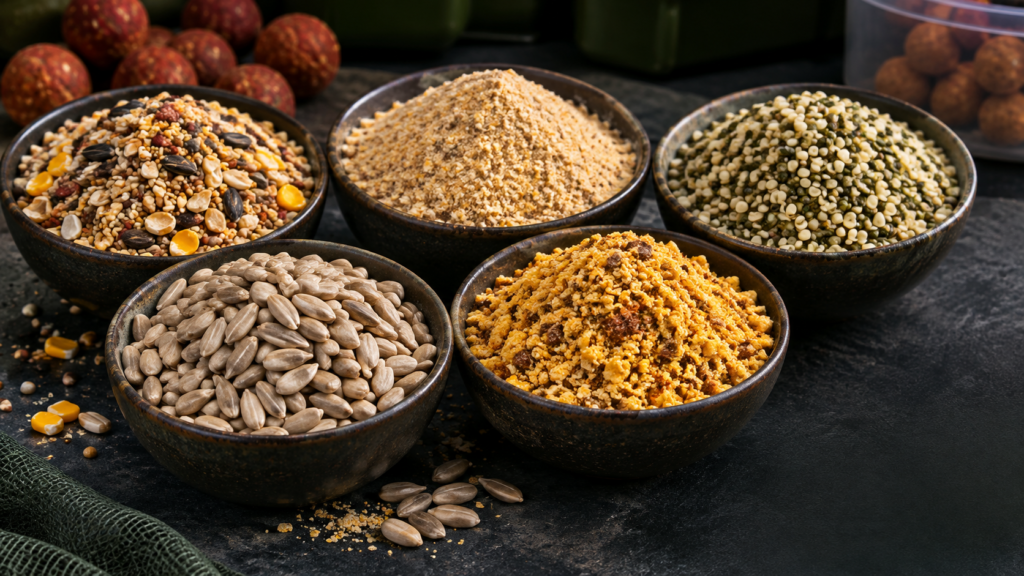
Birdfood Blends for Homemade Boilies
See how seeds, cereals and prepared soft-food ingredients can become useful birdfood components. The full guide contains seven North American blend formulas, complete with ingredient weights, grinding advice and suggestions for using them in a boilie base.
The detailed recipes are in the linked guide, where the tables can be read at full size.
Browse the house birdfood blends →Choose a Recipe, Then Make It Repeatable
A printed formula is only a starting point. Ingredient form, wet phase, processing, storage and actual underwater behaviour can all change the finished bait.
- ChooseSelect one mix that fits your ingredients, budget and intended fishing use.
- CheckVerify exact ingredient specifications, fat content and safe preparation instructions.
- ScaleUse grams. For a 250 g test from a 1 kg formula, divide every dry ingredient by four.
- MakeRecord the liquids, resting, rolling, cooking and drying conditions actually used.
- TestInspect durability, texture and water behaviour. Change one factor at a time where practical.
Scale the Formula
Use the existing free MichiganCarp calculator to plan and compare batch quantities.
Open Bait Calculator →Learn to Formulate
Build a milk, nut and birdfood mix by section rather than blindly copying a recipe.
See the formulation masterclass →Check UK–USA Ingredients
Different names and product types can hide important substitution differences.
Use the UK–USA glossary →Learn the Making Process
Follow the sequence from dry mix and wet phase through rolling and boiling.
Go to Boilie School →Test Before Fishing
Learn to evaluate sinking, softening, cracking, leakage and hookbait durability.
See the testing guide →Fix Common Problems
Sticky paste, cracking and poor texture usually need a methodical diagnosis.
Troubleshoot boilies →Boilie Recipe Questions
Are these all field-proven boilie recipes?
No. The library distinguishes published example formulas, worked development mixes and recorded field-development history. Catch reports for an evolving bait do not prove that every later recipe revision has been tested.
Can I scale a 1 kg boilie mix to 250 g?
Yes. Divide the dry ingredients by four and document the wet phase separately. Small batches often need practical moisture adjustments rather than assuming one exact egg quantity will scale perfectly.
Can I replace UK ingredients with American substitutes?
Often, but check the composition first. A similar label does not guarantee equal fat, protein, grind, moisture or binding behaviour. Use the UK–USA ingredient glossary.
Which bait should a beginner make first?
Choose a simple formula with accessible ingredients, make a small batch and learn how it rolls, cooks and behaves in water. For a full learning path, follow Boilie School.
A Recipe Is a Starting Point. Fishing Is the Test.
We want usable formulas, clear ingredient reasoning and honest observations—not secret-ingredient claims. This library will grow as new recipes are documented and evaluated, while the full science remains in Bait Science and the practical processes remain in The Bait Shed.