
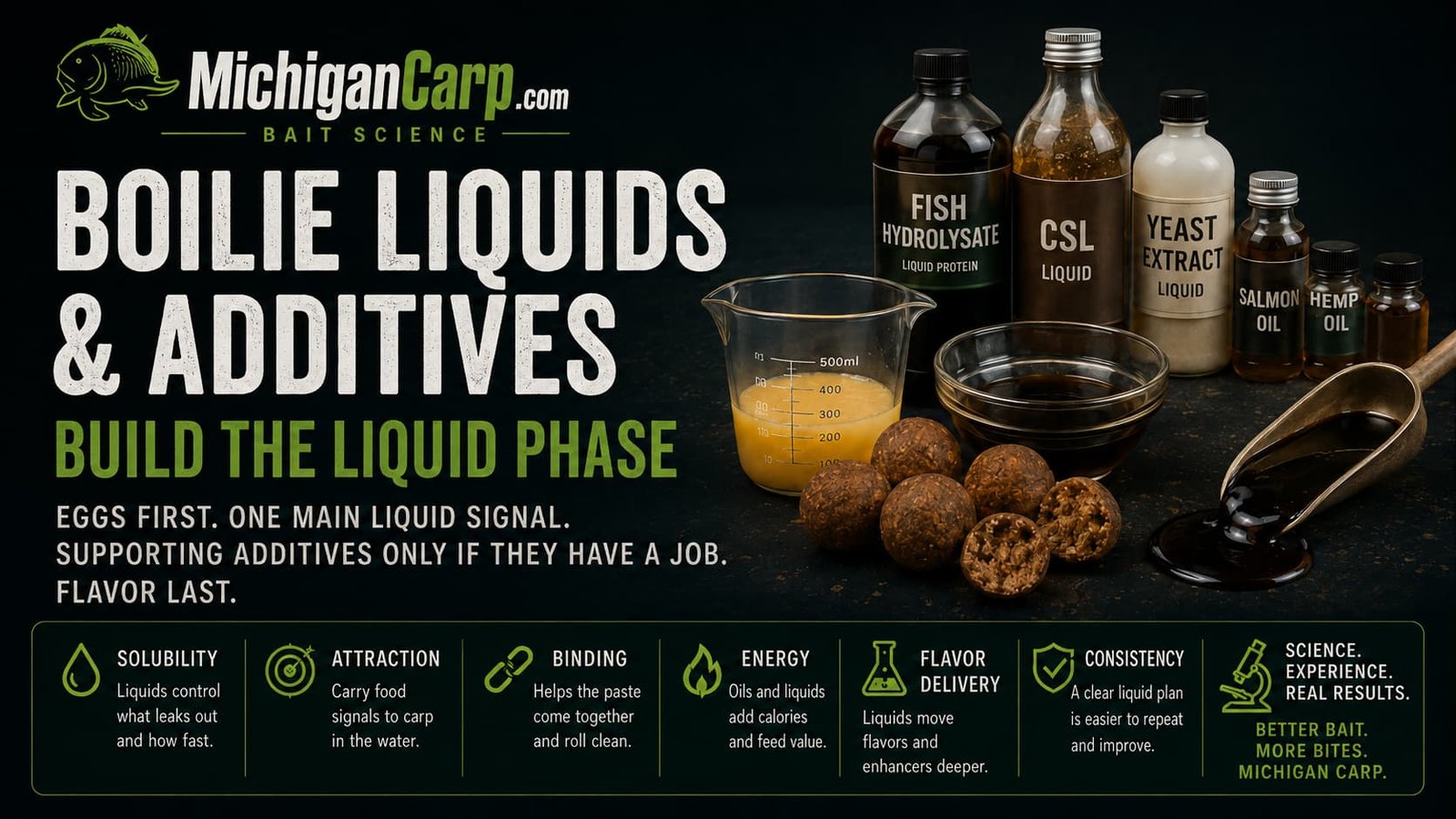
Boilie liquids and additives are where many homemade bait makers lose control.
The dry base mix may be carefully built. The recipe may contain good ingredients. The protein, fat, carbohydrate and structure may all make sense. Then the liquid phase turns into chaos.
A little hydrolysate goes in. Then CSL. Then yeast liquid. Then oil. Then molasses. Then sweetener. Then flavor. Then another flavor. Then a few drops of essential oil.
At that point the bait no longer has a clear message. It has a crowded liquid package. That does not make it more advanced. It makes it harder to understand, harder to repeat and harder to improve.
Boilie School BS-04 is about building the liquid phase properly. This is not meant to replace the deeper MichiganCarp.com bait-science articles on hydrolysates, oils, solubility, sweeteners or fermentation. Its job is simpler: to show how to build a clear, repeatable liquid phase for homemade boilies.
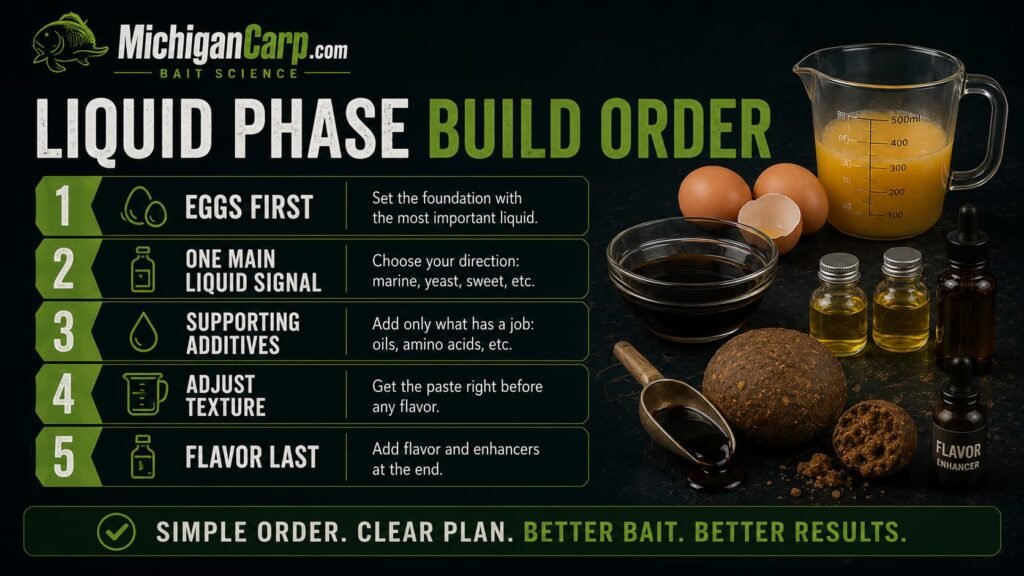
My basic rule is:
Eggs first. One main liquid signal second. Supporting additives only if they have a job. Flavor last.
That order prevents most liquid-phase mistakes.
For deeper liquid selection, read When to Use Each Type of Carp Bait Liquid. For hydrolysates, read What Hydrolysates Really Do in Carp Bait. For oils and fats, read The Science of Oils, Fats and Energy in Carp Bait.
Table of Contents
Boilie School Navigation
Previous Lesson: BS-03 — Boilie Base Mix Families
Next Lesson: BS-05 — Rolling, Boiling/Steaming, Drying and Storage
Quick Start: Boilie Liquids and Additives
A simple boilie liquid phase usually needs fewer things than beginners think.
For a basic home-rolled boilie, think in four sections: eggs, one main liquid signal, optional support additives and flavor. That sounds almost too simple, but it is the cleanest way to learn what a liquid phase is doing.
| Liquid phase section | Main job | Practical note |
|---|---|---|
| Eggs | Binder, moisture, protein, lecithin and cooking structure | The foundation of most home boilies |
| Main liquid signal | Food signal, solubility, taste profile or bait identity | Choose one clear direction first |
| Support additives | Salt, minerals, sweetener, oil or small functional additions | Only include them if they have a job |
| Flavor | Profile definition and recognition | Add last and keep the direction clear |
A beginner-friendly liquid phase might be eggs, one yeast liquid or hydrolysate, a small sweetener or salt addition if needed, and one flavor direction. That is enough. The mistake is trying to make a professional bait by stacking too many bottles at once.
A bait you can explain and repeat is more valuable than a complicated bait you cannot understand.
What the Liquid Phase Actually Does
The liquid phase is not just there to make the dry mix wet. It turns a powder blend into a paste that can be mixed, rested, extruded, rolled, cooked and dried. It also helps carry soluble material, taste profile, aroma, oil, minerals and other small additions through the bait.
That means boilie liquids and additives affect both bait mechanics and bait signals. They influence paste feel, rolling behavior, cooking structure, finished texture, leakage, richness, smell, taste and repeatability.
The dry base mix gives the bait its main structure and ingredient foundation. The liquid phase activates that dry system. If the liquid phase is too wet, too oily, too sticky or too crowded, even a good dry mix can become difficult to roll or inconsistent after cooking.
A good liquid phase should do three things. It should help the bait physically form. It should add one clear food or sensory direction. It should remain simple enough to repeat.
If the liquid phase cannot be repeated, the bait cannot be repeated.
Eggs Come First
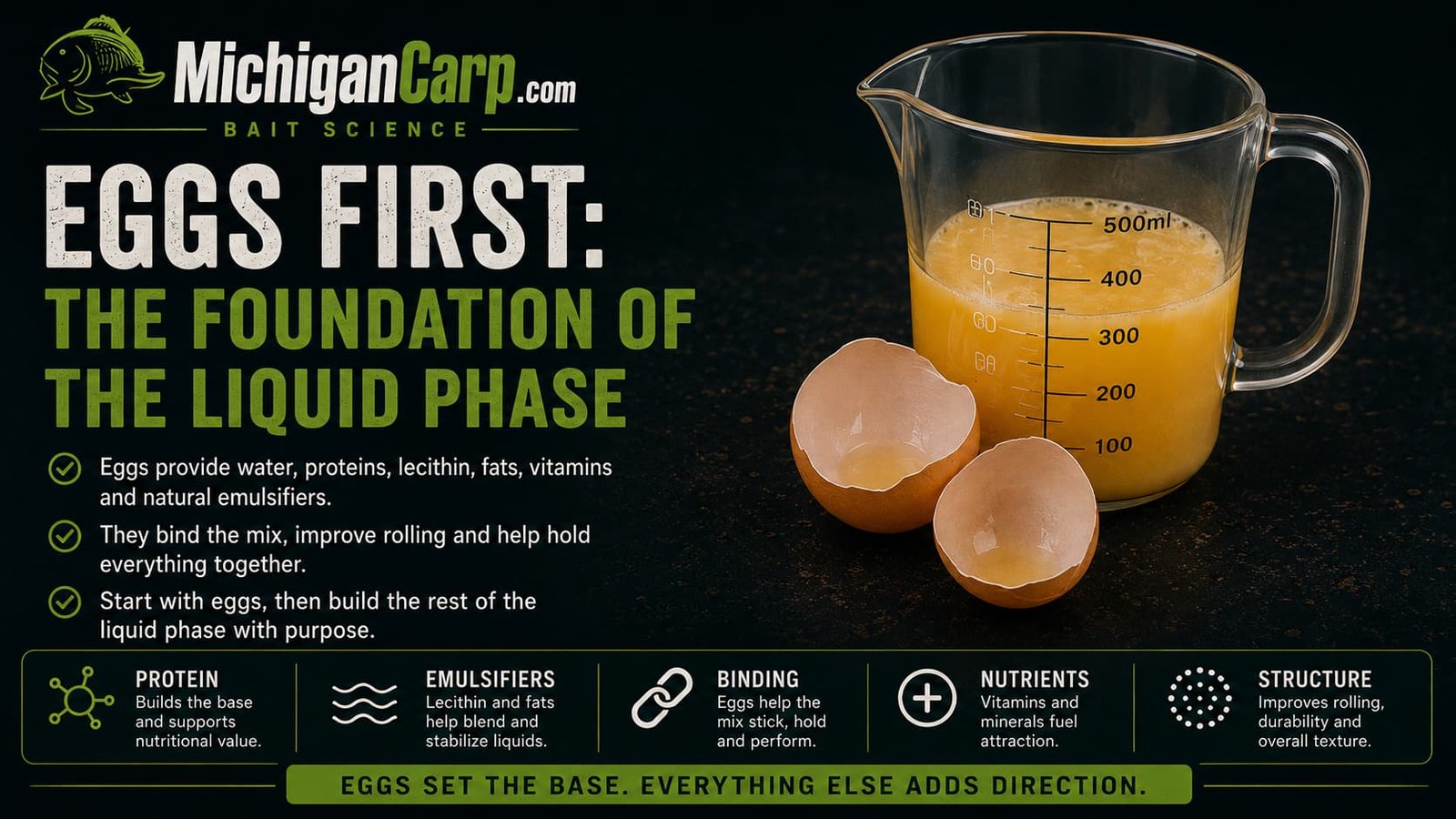
For most home-rolled boilies, eggs are the foundation of the liquid phase. They are not just wet stuff. They contribute water, protein, fat from the yolk, lecithin, emulsifying behavior, cooking structure and paste cohesion.
Eggs help convert dry powder into a paste that can be handled. They bind the mix, help it roll, and contribute to the way the bait sets during boiling or steaming. That is why I do not treat eggs as an afterthought.
Whole eggs work well for most home bait making. Liquid egg can also be useful when consistency and volume production matter. The important thing is to record what you used. Egg size varies, and that alone can change paste behavior.
When recording a recipe, do not write only “eggs” if you are trying to reproduce the bait precisely. Record the number of eggs, approximate egg weight or volume if possible, any extra liquids added, paste rest time and final paste feel.
That level of detail seems fussy until you try to repeat a good batch and cannot work out why the next one feels different.
How Much Liquid Does a Boilie Mix Need?
There is no universal liquid number for boilies. A broad working zone for many home mixes is roughly 350–450 ml total liquid phase per kilogram of dry mix, but that is not a rule. It is only a starting range.
The actual amount depends on egg size, dry ingredient absorption, birdfood level, seed meals, nut flours, milk powders, caseins, wheatgerm, hydrolysate powders, liquid additions and paste resting time.
A milk-heavy bait may behave differently from a coarse birdfood bait. A bait containing tiger nut flour, coconut meal or wheatgerm may absorb liquid differently from a smoother cereal base. A bait with hydrolysate powder may change after resting because the powder continues to hydrate.
The correct method is to prepare the liquid phase, add the dry mix gradually, stop when the paste is right, rest the paste, then reassess before correcting. Do not force every gram of dry mix into a liquid phase that has already reached the correct consistency.
Many bait makers correct too quickly. The paste looks wet, so they add powder. Then the paste rests and becomes too stiff. Then they add more liquid. That cycle creates inconsistency. Give the paste around 10–15 minutes before making major corrections.
Sometimes the paste is not wrong. It is just not finished absorbing liquid yet.
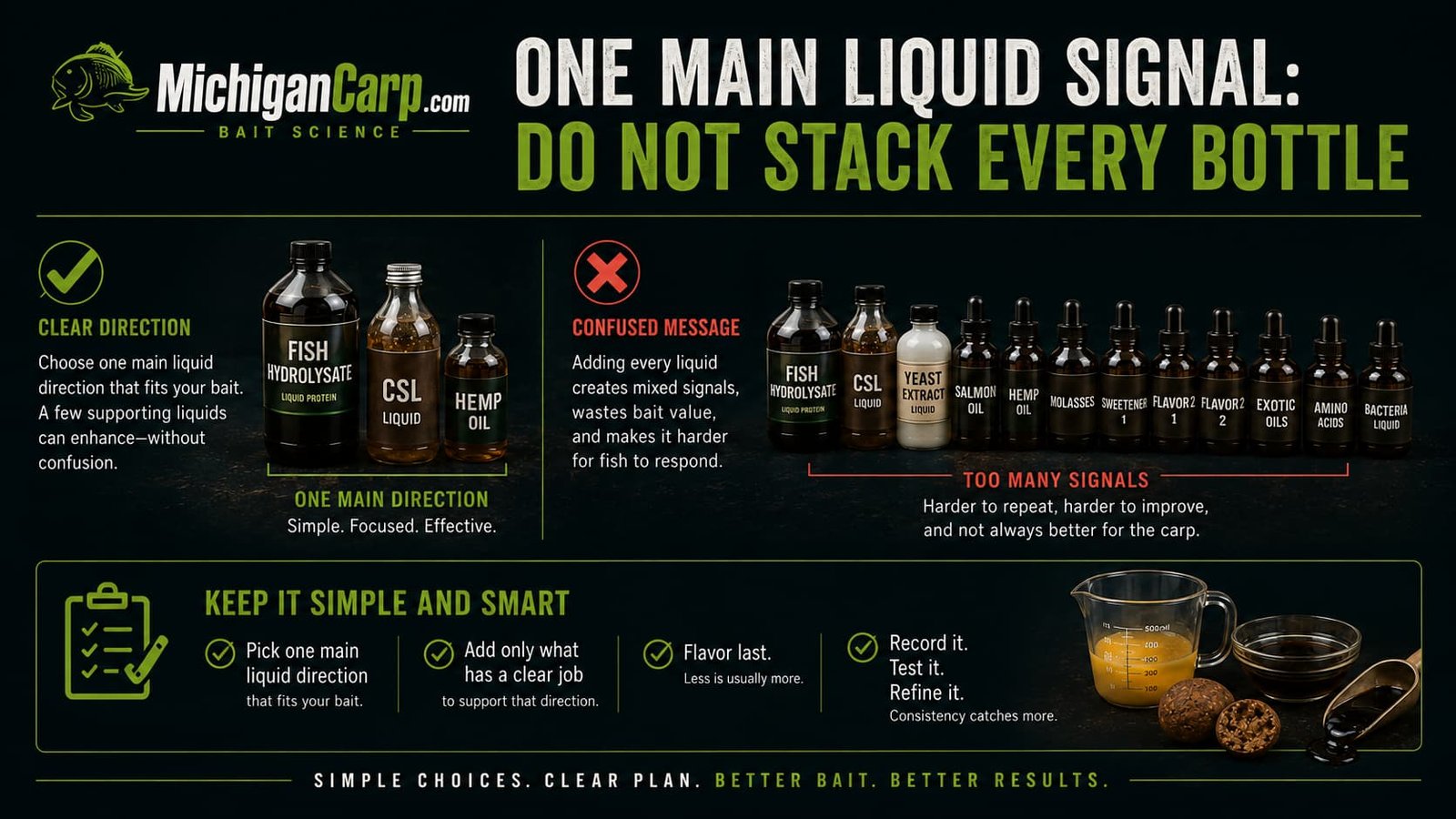
Build One Clear Liquid Direction
The liquid phase should have a clear direction. That direction might be marine, yeast-led, fermented, sweet and creamy, milk/nut, savory non-marine, fruit and cream, or spice and cream.
The mistake is stacking several directions at once. A liquid package like fish hydrolysate, CSL, molasses, Scopex, peach, garlic, salmon oil and sweetener may sound powerful. But what is the actual bait message?
A beginner should normally start with one main liquid food signal and maybe one supporting note. Then stop. You learn more from a simple bait that can be repeated than from a liquid package containing ten unknown interactions.
If you cannot describe the bait profile in one sentence, the liquid package is probably too busy.
Main Liquid Types and When They Fit
Liquid categories are useful only when they help you make better decisions. Do not choose a liquid because the label sounds advanced. Choose it because it fits the bait family and has a clear job.
Marine Liquids
Marine liquids include fish protein hydrolysate, krill hydrolysate, squid-style liquids, fish sauce-style materials, marine solubles and fish oils. They can be useful in fishmeal, krill, squid, liver, savory or marine campaign baits.
A fishmeal bait can naturally accept a fish or krill hydrolysate. A milk/nut bait may not need a heavy marine signal unless the whole formula is deliberately designed that way. The common mistake is using too much because the liquid smells strong. Strong smell to the angler does not automatically mean better bait to carp.
Yeast and Fermented Liquids
Yeast and fermented-style liquids can fit very well in non-marine bait. They often suit birdfood baits, milk/nut baits, cereal-based mixes, particle-compatible boilies and mixed-season fishing where heavy oils may not be needed.
The mistake is treating every dark savory liquid as the same thing. A yeast liquid is not automatically identical to a hydrolysate. A fermented grain liquid is not automatically identical to a sweet syrup. Read the product, know the job and record the amount.
For the broader fermentation and food-signal context, read Fermented and Food-Signal Baits for Carp.
Sweet Liquids
Sweet liquids include molasses, honey, malt extract, syrups, sweet dairy liquids and some sweetener solutions. They can support milk/nut baits, cream profiles, fruit-and-cream baits, birdfood baits, crumb, chops and hookbait treatments.
Sweetness can be useful, but sweet liquid should not become a substitute for bait design. A poor base mix does not become a good food bait because it contains a lot of syrup. Molasses, honey and syrups can also change paste texture, drying, skin formation and water behavior.
For the wider sugar and carbohydrate guide, read Sugars, Sweeteners and Carbohydrates in Carp Bait. For boilie-specific sweetener use, read Sweeteners for Boilies.
Hydrolysates
Hydrolysates are often misunderstood. A hydrolysate is not just a strong smell. Protein hydrolysis breaks larger proteins into smaller peptides and amino-acid-containing fractions to varying degrees. That can make some material more water-active depending on the product and bait matrix.
Hydrolysates can be useful, but they are not automatic magic. Start with one main hydrolysate first. Do not start by combining fish hydrolysate, krill hydrolysate, liver hydrolysate, yeast hydrolysate, amino liquids and multiple powders in the same beginner test.
For practical use, read How to Use Hydrolysates in Carp Bait. For the deeper technical article, read What Hydrolysates Really Do in Carp Bait.
Oils, Sweeteners, Flavors and Strong Additives
Supporting additives can help a bait, but they should not take over the formula. This is where many bait makers accidentally move from formulation into bottle collecting.
Oils Are Optional
Oil is optional. That sentence matters. A bait can already receive fat from whole egg, full-fat soy, fishmeal, tiger nut flour, peanut, almond, hemp, sunflower, sesame, cream powder, milk replacer and commercial birdfood.
Do not automatically add oil just because the bait is nut-based, fishmeal-based, seed-based or intended for summer. First count the fat already present. Then ask what the added oil is supposed to do.
I would be cautious with added oil when the water is cold, bait quantity is low, the dry mix is already rich, the paste feels greasy or the oil is being added only because a recipe said “oil.” For the full technical discussion, read The Science of Oils, Fats and Energy in Carp Bait.
Sweeteners Need Restraint
Sweeteners are not the same thing as sweet liquids. A sweetener may be highly concentrated and used in very small quantities. A milk/nut bait does not need to become candy. A fruit bait does not need five sweeteners.
Use sweeteners to round the bait, not rescue it. If the base mix is poor, if the liquid phase is confused, or if the flavor level is harsh, more sweetener will not fix the real problem.
Flavor Comes Last
Flavor is usually the last layer, not the foundation. A bait is not good because it contains a famous flavor. A bait is good because the base mix, liquid phase, processing, baiting, location and confidence all make sense.
Flavor can help define the profile. It can make the bait more recognizable. It can support a food identity. But it should not be asked to rescue poor formulation.
Good directions include marine savory, fruit and cream, maple/vanilla/butter, spice and cream, or milk/nut/Scopex-style profiles. The mistake is mixing too many of them at once.
Essential Oils and Very Strong Additives
Some additives are extremely concentrated. Essential oils and powerful flavor compounds should be treated with caution. A small amount can be enough. More is not automatically better.
When using concentrated materials, record the exact product, dosage, batch size, bait style, water temperature and results. Do not estimate by shaking the bottle over the eggs. That is not formulation.
Match Liquids to the Base Mix Family
The liquid phase should support the base mix family. It should not fight it.
| Base mix family | Liquid phase that usually fits | Common mistake |
|---|---|---|
| Marine / fishmeal | Fish or krill hydrolysate, squid-style liquids, savory flavors, small salt/mineral support | Adding every fishy bottle at once |
| Birdfood | Yeast liquids, fermented-style liquids, mild sweetness, cream or spice profiles | Making the bait too wet or too busy |
| Milk/nut | Creamy sweet notes, yeast support, milk/nut-compatible flavors, light sweet liquids | Adding unnecessary oil when nuts and dairy already supply fat |
| Cereal / particle-compatible | Fermented liquids, molasses, CSL-style liquids, sweet dairy or yeast support | Turning the bait into syrup dough |
For choosing the base mix family first, use Boilie Base Mix Families: Marine, Birdfood and Milk/Nut Styles Explained.
Simple Liquid-Phase Examples
These are not secret recipes. They are teaching examples. The point is to show how a clean liquid phase can be built around one direction.
Simple Non-Marine Liquid Phase
For a milk/nut or birdfood bait, a simple liquid phase might use eggs as the foundation, one yeast or fermented liquid as the main food signal, a small sweet component if needed, and one clear cream, fruit or nut direction for flavor. Oil is usually omitted unless the formula truly needs it.
You should be able to say: “This bait is milk/nut with a yeast-supported fruit-and-cream profile.” That is clear.
Simple Marine Liquid Phase
For a marine bait, a simple liquid phase might use eggs, one fish or krill hydrolysate, small salt or mineral support, optional oil in warmer conditions, and one marine or savory flavor direction if needed.
This gives a strong marine identity without automatically adding every fishy product available.
Simple Sweet-Cream Liquid Phase
For a milk/nut bait, a sweet-cream liquid phase might use eggs, a small sweet liquid, one milk/nut-compatible flavor and optional yeast support underneath the sweet top note. This can suit vanilla, maple, butter, cream, peach, plum, banana or Scopex-style directions.
The mistake is making the bait excessively sweet. A sweet-cream profile should still be a food bait, not syrup dough.
Testing, Recording and Troubleshooting
Never judge a liquid only by smell. Test it in the bait.
When testing a new liquid, make a small batch first. Use around 250–300 g dry mix, keep the dry mix the same, change only the liquid variable, record the dose, rest the paste, roll, cook, dry and water-test the bait before scaling up.
Watch the paste carefully. Too much water-based liquid can make it sticky. Too much oil can make it greasy. Too much syrup can slow drying. Too much hydrolysate can make the bait soft or hard to interpret.
A good bait notebook should record the dry mix, egg count or volume, added liquids, oil type and level, sweetener dose, flavor dose, paste rest time, rolling quality, cooking time, drying behavior and water-test notes.
Do not write “liquids added until right.” That may describe what happened, but it does not help you repeat the bait.
For physical troubleshooting, use Boilie Problems: Real Causes and Fixes. For water testing, read How to Test Boilies Before Fishing.
Common Liquid-Phase Mistakes
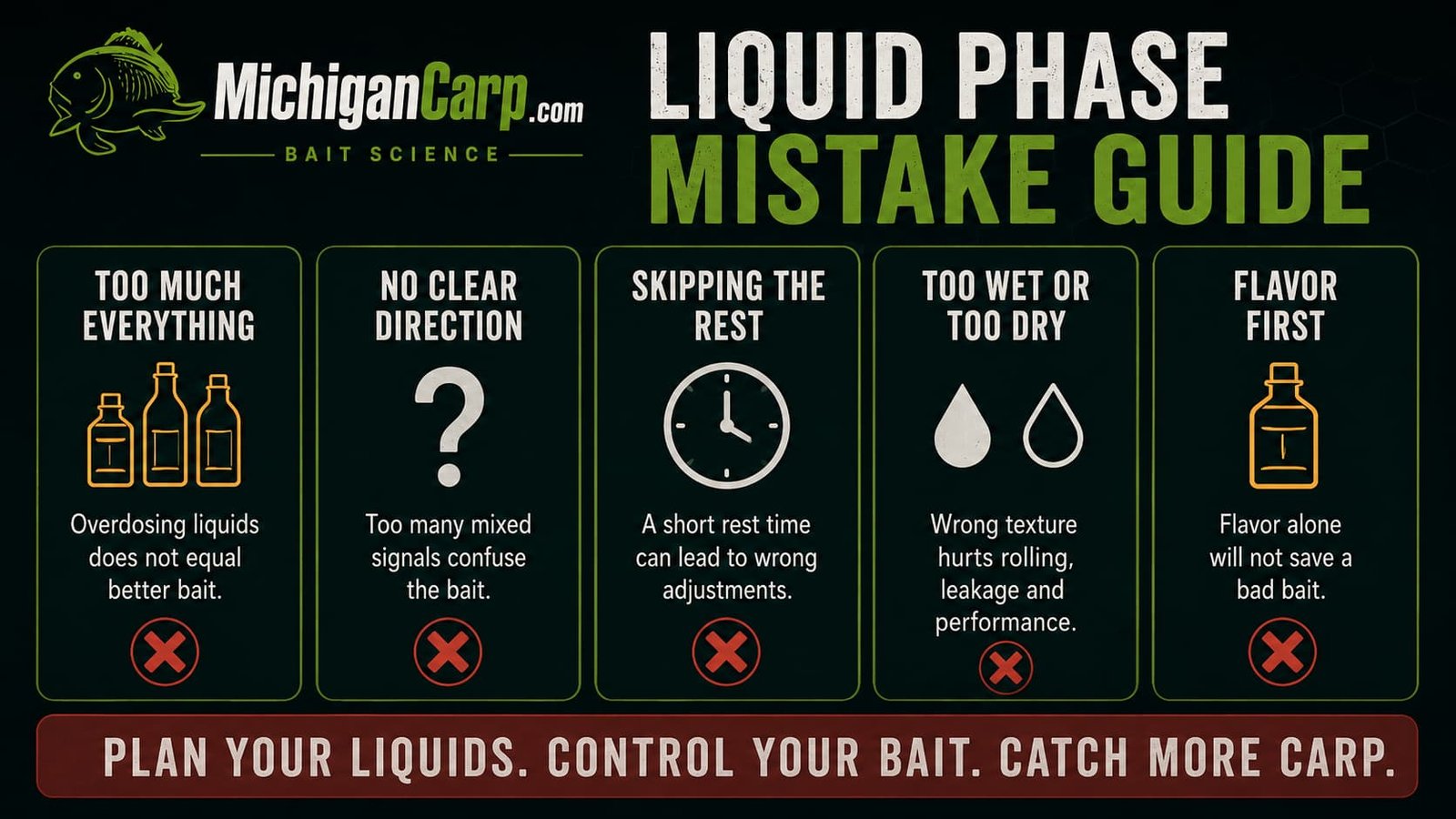
The biggest mistake is adding too many liquids. More bottles do not automatically create better bait. They often create a bait that is harder to understand.
The second mistake is ignoring eggs. Eggs are a major part of the liquid phase, not just a binder. They affect moisture, protein, fat, emulsification and cooking structure.
The third mistake is adding oil automatically. Count the fat already present from eggs, nuts, seeds, dairy, soy and fishmeal before adding bottled oil.
The fourth mistake is confusing hydrolysates with flavor. A hydrolysate is a food-derived liquid or powder, not just a smell. It should be chosen by function, not bottle strength.
The fifth mistake is using sweet liquids too heavily. Molasses, honey and syrup can affect paste texture, rolling, drying and finished bait behavior. They are not invisible extras.
The final mistake is treating flavor as the secret. Flavor supports the bait. It does not replace formulation.
Michigan Notes
My own bait thinking is shaped by practical public-water carp fishing. I may be fishing natural lakes, impoundments, channels, long sessions, particle-supported feeding or waters where carp are not conditioned to commercial boilies.
That makes repeatability extremely important. If I catch on a bait, I want to know what dry mix was used, what liquid signal was used, how much was used, how the bait rolled, how it dried, how it behaved in water and what conditions it was fished in.
That is more valuable than changing liquids after every trip. A simple liquid phase fished with confidence is usually better than a complicated one that changes every batch.
On Michigan waters, I am especially cautious about using liquids as a shortcut. Location, natural food, water temperature, baiting amount, weed, snags, pressure and carp confidence still matter more than bottle choice.
My Practical View
The best boilie liquid phase is usually simpler than beginners expect.
Eggs provide the foundation. One main liquid signal gives direction. Oil is optional. Sweeteners and flavors should be restrained. Hydrolysates and yeast liquids should be chosen by function, not fashion.
The liquid phase should make the bait clearer, not noisier. If I cannot explain why a liquid is in the bait, I leave it out.
That rule has saved me a lot of bad batches.
Build a liquid phase you can explain. Build a liquid phase you can repeat. Then test it before you trust it.
That is how you move from pouring liquids into a bowl to actually formulating bait.
FAQ
What liquids do I need to make boilies?
For most home boilies, eggs are the foundation. Beyond that, use one main water-based food signal, optional oil only when appropriate, and small amounts of sweetener, salt or flavor if they have a clear job.
Are eggs part of the liquid phase?
Yes. Eggs are usually the most important part of the liquid phase because they provide water, protein, fat, lecithin, emulsifying behavior and cooking structure.
How much liquid should I use per kilogram of dry mix?
Many home mixes fall around 350–450 ml total liquid phase per kilogram of dry mix, but this varies with egg size, dry ingredients, birdfood, nut flours, milk proteins and liquid additions.
Should I add oil to every boilie mix?
No. Oil is optional. Count the fat already present from eggs, nuts, seeds, soy, dairy and fishmeal before adding bottled oil.
What is the best liquid for boilies?
There is no universal best liquid. The right choice depends on the bait family, water temperature, season, baiting style and what job the liquid is supposed to perform.
Are hydrolysates worth using in boilies?
They can be useful, especially when you want a water-active food signal, but they are not magic. Start with one hydrolysate and test it properly.
Can I mix hydrolysate, CSL and yeast liquid together?
You can, but beginners usually learn more by testing one main liquid signal at a time. Too many liquids make it difficult to know what is working.
Are sweeteners necessary in boilies?
No. Sweeteners are optional. They can support some bait profiles, but they should not dominate the whole bait.
How much flavor should I use?
Use the manufacturer’s guidance as a starting point and keep the profile simple. One clear flavor direction is usually better than stacking several unrelated flavors.
Can liquids make boilies too soft?
Yes. Excess water-based liquids, syrups, hydrolysates or oils can make paste soft, sticky or difficult to roll.
Should I use different liquids in cold water?
Often, yes. In colder water I usually become more cautious with heavy oils and excessive richness, and I focus more on controlled soluble signals and accurate baiting.
Can I use the same liquids for hookbait glugs?
Sometimes, but internal liquids and external hookbait treatments are different jobs. A glug affects the surface and short-term release, while the internal liquid phase affects the whole paste.
Next Steps
Continue through Boilie School:
- Previous Lesson: BS-03 — Boilie Base Mix Families
- Next Lesson: BS-05 — Rolling, Boiling/Steaming, Drying and Storage
- Back to Boilie School Hub
Then go deeper with these supporting guides:
- When to Use Each Type of Carp Bait Liquid
- Carp Feeding Attractants Explained
- What Hydrolysates Really Do in Carp Bait
- How to Use Hydrolysates in Carp Bait
- The Science of Oils, Fats and Energy in Carp Bait
- The Science of Carp Bait Solubility and Leakage
- Sugars, Sweeteners and Carbohydrates in Carp Bait
- Sweeteners for Boilies
- How to Treat Boilies
- How to Test Boilies Before Fishing
- Boilie Problems: Real Causes and Fixes
External References
For background feed-ingredient and nutrient context, see FAO Feed Ingredients and Fertilizers for Farmed Aquatic Animals and FAO Common Carp Nutrient Requirements Summary. For high-intensity sweetener background, see the FDA guide to high-intensity sweeteners.