

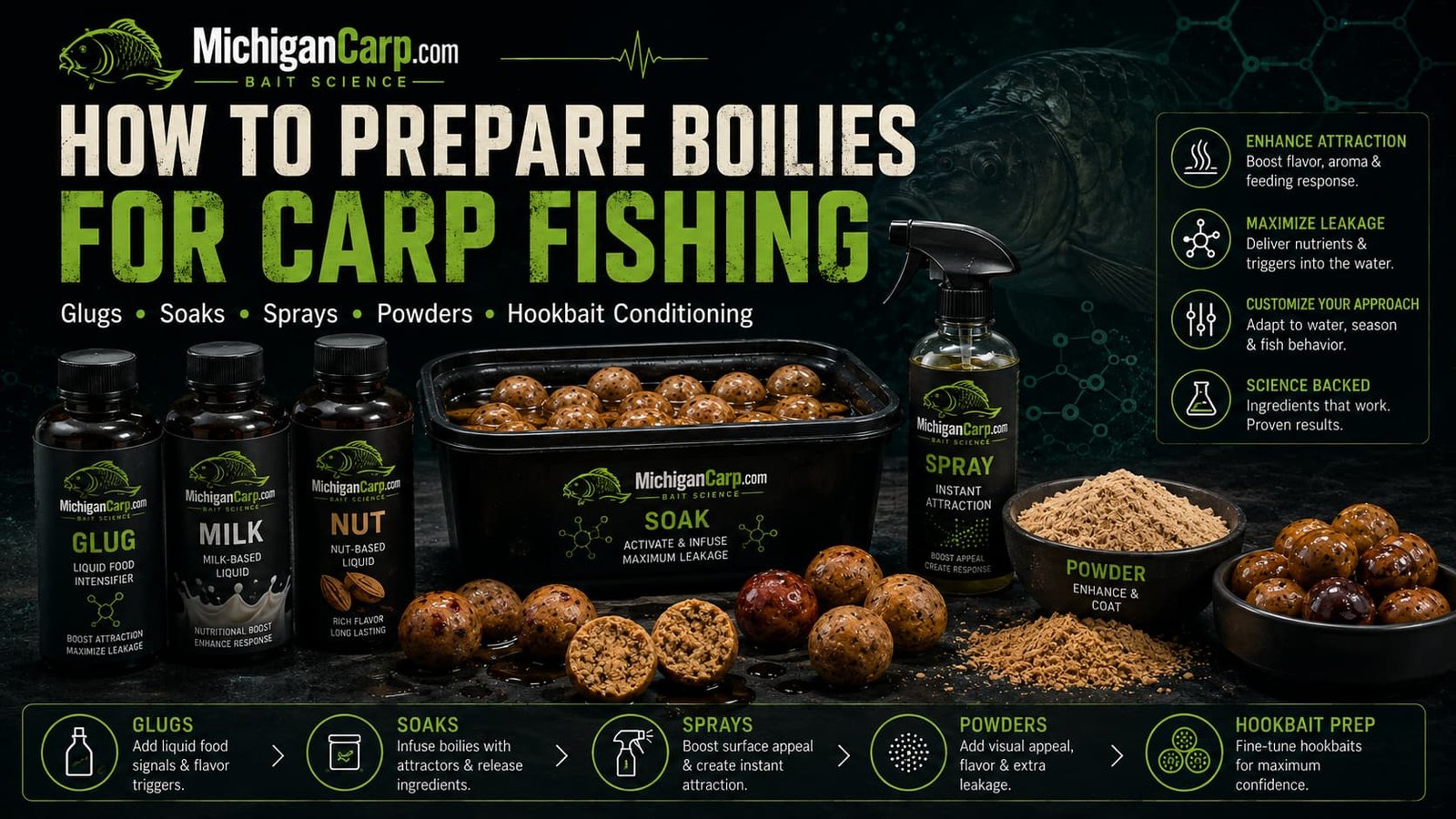
Learning how to prepare boilies for carp fishing is not the same as learning how to pour as much liquid as possible over a bag of bait.
Sometimes a light glug helps. Sometimes a hard, air-dried boilie benefits from a controlled soak. A spray may be the safest choice for a wafter or pop-up. Boilie crumb can create more useful food activity than another layer of liquid. In other situations, the best decision is to leave a good bait alone.
The treatment should solve a defined problem without destroying the bait’s structure, leakage, storage condition or rig presentation. A conditioner has failed if a wafter becomes an ordinary bottom bait, a pop-up loses height, a bait screw tears through a softened skin or a water-rich coating is stored as though it were still a dry shelf-life bait.
Prepare the bait for the session. Condition the hookbait only as far as its physical job allows.
This guide brings free-bait preparation and hookbait conditioning into one system. It covers glugs, sprays, dips, deeper soaks, washed-out baits, crumb, powder coatings, freezer and air-dried boilies, bottom hookbaits, wafters, cork-dust pop-ups and corkball pop-ups.
For storage before and after treatment, use How to Store Homemade Boilies. For the broader liquid-ingredient foundation, read Boilie Liquids and Additives. If the boilie itself still needs structural work, start with How to Boil and Dry Boilies Properly rather than trying to repair it with a glug.
Table of Contents
- Quick Start: Choose the Right Boilie Treatment
- What Boilie Preparation Can—and Cannot—Do
- Glugs, Soaks, Sprays, Dips, Powders, Crumb and Wash-Outs
- Choose the Right Liquid Carrier
- How to Prepare Free Boilies
- How to Condition Hookbaits Without Ruining the Rig
- Practical Milk-and-Nut Preparation Systems
- Match the Treatment to the Session
- Test Treated Boilies Before Fishing
- Storage and Preservation After Treatment
- Common Boilie-Preparation Mistakes
- My Practical View
- FAQ
- Next Steps
Quick Start: Prepare Boilies For Carp Fishing
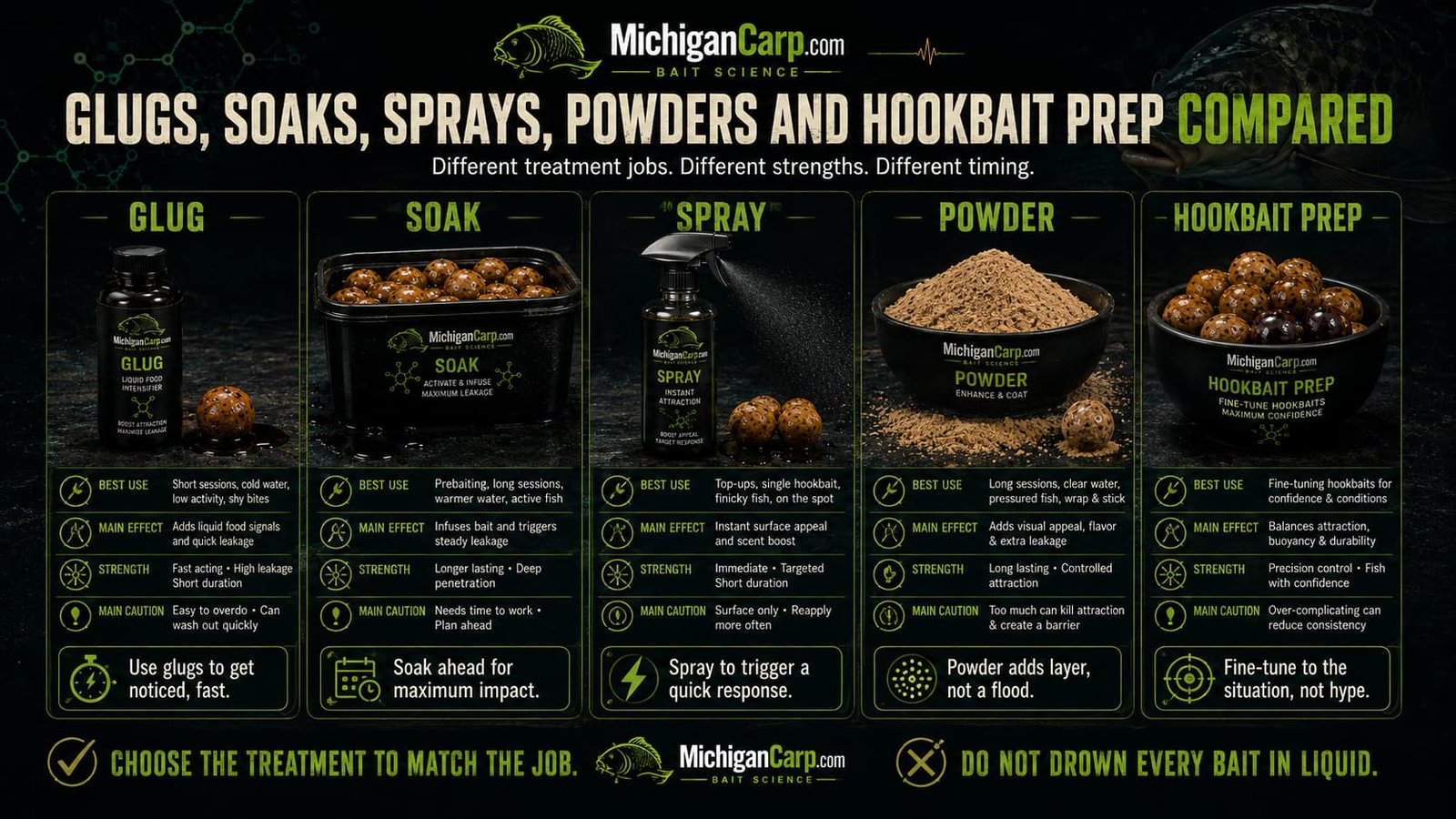
Start with the smallest treatment likely to do the job. These are trial amounts, not targets that every bait must absorb.
| Situation | Best first treatment | Practical starting point | Main risk |
|---|---|---|---|
| Fresh or thawed free boilies | Light glug, crumb or powder | 10–25 ml liquid per 1 kg | Softening already-active bait |
| Dry or air-dried free boilies | Staged glug or controlled soak | 25–50 ml per 1 kg, then reassess | Adding water and then storing warm |
| Very hard free boilies | Deeper planned soak | Up to 50–100 ml per 1 kg only when the bait tolerates it | Pooling liquid, souring and weak skins |
| Hardened bottom hookbaits | Light glug or staged coating | 1–2 ml per twenty 20–24 mm baits | Softness around the hair or bait screw |
| Wafters | Measured surface application | 0.25–0.5 ml per twenty baits | Gaining enough mass to become bottom baits |
| Cork-dust pop-ups | Very light spray or dropper application | Begin below the wafter rate when buoyancy is marginal | Liquid moving through the buoyant paste |
| Corkball pop-ups | Light coating in stages | Begin at the wafter rate and test pop-up height | Soft paste, split seams or separation from the cork |
| PVA presentation | Verified PVA-compatible liquid or dry crumb | Test the finished combination for 5–10 minutes | Premature melting or sticky PVA |
Absorption varies with diameter, porosity, drying, protein structure and the carrier. A 12 mm birdfood bait may change much faster than a dense 24 mm milk-protein hookbait. Apply less than you think you need, let it distribute, and decide from the bait rather than the measuring cup.
What Boilie Preparation Can—and Cannot—Do
Preparation changes the finished bait before it enters the water. A surface treatment may restore a familiar flavor profile, add water-compatible food material, help powder adhere or give the outside of a hard bait a little softness. Deeper conditioning can move liquid further into a dry matrix and change the way the bait takes up lake water.
The same process can add mass, introduce moisture, fill pores, weaken the outer skin, slow drying and change storage stability. The bait that comes out of the treatment pot is no longer physically identical to the bait that went in.
Surface treatment and deep conditioning are different
A spray, brief dip or small measured glug mainly changes the outside at first. This usually offers the best control when the bait has little buoyancy reserve. A longer soak allows more liquid to move inward. That may be useful for an extremely hard bottom bait but can ruin a carefully balanced wafter.
Absorption also continues after the bait stops looking wet. A hookbait that appears lightly coated after five minutes may be softer and heavier the next morning. Judge it after its real preparation time, not only at the moment of application.
Evidence and practical interpretation
There is a sound reason to consider soluble and detectable food signals. The University of Florida review of feed attractants in aquaculture describes olfactory, gustatory and visual roles in feed detection and acceptance, while carp research found several amino acids to be effective gustatory stimuli in Gustatory Specificity for Amino Acids in the Facial Taste System of the Carp.
That supports testing hydrolysates, yeast-derived materials, amino acids, organic acids and nucleotide-style ingredients. It does not prove that every liquid coating improves catches, or that the strongest smell to a human nose is the most attractive underwater. Field performance still depends on location, feeding activity, rig mechanics, dose and whether the finished bait is accepted.
A conditioner is a finishing tool. It cannot repair a poor recipe, rancid fat, inadequate cooking, weak structure or a pop-up that never had enough buoyancy.
Glugs, Soaks, Sprays, Dips, Powders, Crumb and Wash-Outs
| Method | What it does | Best use | Main limitation |
|---|---|---|---|
| Spray or dropper | Adds a very small measured surface layer | Wafters, pop-ups, singles and comparative tests | Limited penetration and possible uneven coverage |
| Brief dip | Gives the bait a fresh coating immediately before casting | Single hookbaits and short trials | Pickup varies unless dip and drain times are repeated |
| Light glug | Rolls a measured quantity over the bait and allows gradual uptake | Freezer boilies, bottom baits and pre-session preparation | Absorption continues during storage |
| Longer soak | Moves liquid deeper into the bait | Very hard free bait or hardened bottom hookbaits | Softness, mass gain, storage risk and buoyancy loss |
| Liquid-and-powder coat | Builds an active outer layer without full saturation | Short sessions, milk-and-nut bait and hard hookbaits | Heavy layers can crack, shed during casting or alter balance |
| Boilie crumb | Creates fine matching food particles and faster exposure | PVA, sticks, method, packbait and small feeding areas | Must remain dry for dry-PVA use |
| Wash-out | Adds water and dulls or softens the bait | Same-session freezer or air-dried bait | Turns the bait into a more perishable product |
Use staged treatment for control
Several small applications provide more information than one heavy addition. Add a measured amount, rotate the bait, allow time for distribution, then check the texture and presentation before adding more. If a puddle remains beneath already-soft bait, the treatment has moved beyond a light glug.
Crumb often does the job better
Before reaching for more liquid, ask whether matching crumb would create the signal you want. Fine and coarse crumb exposes far more bait surface, provides familiar food particles and integrates easily with sticks, packbait, method mixes and particles. Robert generally uses particles as the main feed and brings boilie identity to the rig area through crumb rather than feeding large quantities of whole boilies.
Dry crumb can go directly into PVA. Once water-rich liquid is added, test the finished combination rather than assuming the ingredient list guarantees compatibility.
Choose the Right Liquid Carrier
The carrier controls pouring, spread, penetration, cling, mass gain and moisture behavior. It is not merely empty space around the flavor.
| Carrier or liquid | Practical strength | Main risk |
|---|---|---|
| Water-rich extracts, yeast liquids and hydrolysates | Carry soluble food material and disperse readily | Increase moisture, softness and preservation burden |
| Food-grade propylene glycol | Relatively fluid flavor carrier, solvent, vehicle and humectant | Adds mass and does not guarantee shelf stability |
| Food-grade glycerin | Adds viscosity, sweetness, cling and moisture retention | Can make bait sticky, heavy or over-soft |
| Honey, molasses and other syrups | Provide sweetness, body and powder adhesion | Can remain sticky and make a wet treatment more perishable |
| Oil | Carries oil-compatible flavors and contributes a rich surface profile | Does not disperse like water-soluble material, can become greasy and can oxidize |
Propylene glycol and glycerin
Food-grade propylene glycol is useful when a relatively fluid carrier is required. US food regulations list functions including humectant, solvent or vehicle, flavor agent and formulation aid in 21 CFR §184.1666: Propylene Glycol. Use only clearly labelled food-grade material; it is not ethylene glycol, and automotive or unidentified industrial products have no place in bait.
Glycerin is thicker, sweeter and more persistent. It can help a liquid cling or hold powder, but it should be restrained when buoyancy and mass are critical. The relevant US food listing is 21 CFR §182.1320: Glycerin.
Those food-use references identify legitimate food-grade substances and functions. They do not prove carp attraction, PVA compatibility or the shelf life of a homemade conditioner. The detailed comparison belongs in Propylene Glycol vs Glycerin in Carp Bait
Water-rich food liquids
Tiger-nut extract, beef-liver hydrolysate, liquid yeast, CSL-style liquids, diluted syrups and homemade extracts can provide useful soluble material. They also create a more perishable treatment. Once they make up a meaningful part of the blend, prepare small batches, refrigerate promptly and treat the finished conditioner and bait as short-term unless the complete system has been measured and validated.
Oil needs a defined job
Oil can carry oil-compatible aroma materials and add richness, but it is not a substitute for a water-compatible food signal. Heavy surface oil can make bait greasy and may work against the rapid water contact wanted from a short-session coating. Rich nut, seed and cream baits may already contain enough fat without another external layer. Oxidation matters in warm weather and during storage as much as visible mold does.
Test PVA compatibility
- Place a little of the finished liquid or coated bait in a cup.
- Add a scrap of the exact PVA bag, tape or mesh you intend to use.
- Wait 5–10 minutes.
- Check for weakening, stickiness or premature melting.
- Repeat with the complete presentation, not only the neat carrier.
How to Prepare Free Boilies
Freezer boilies
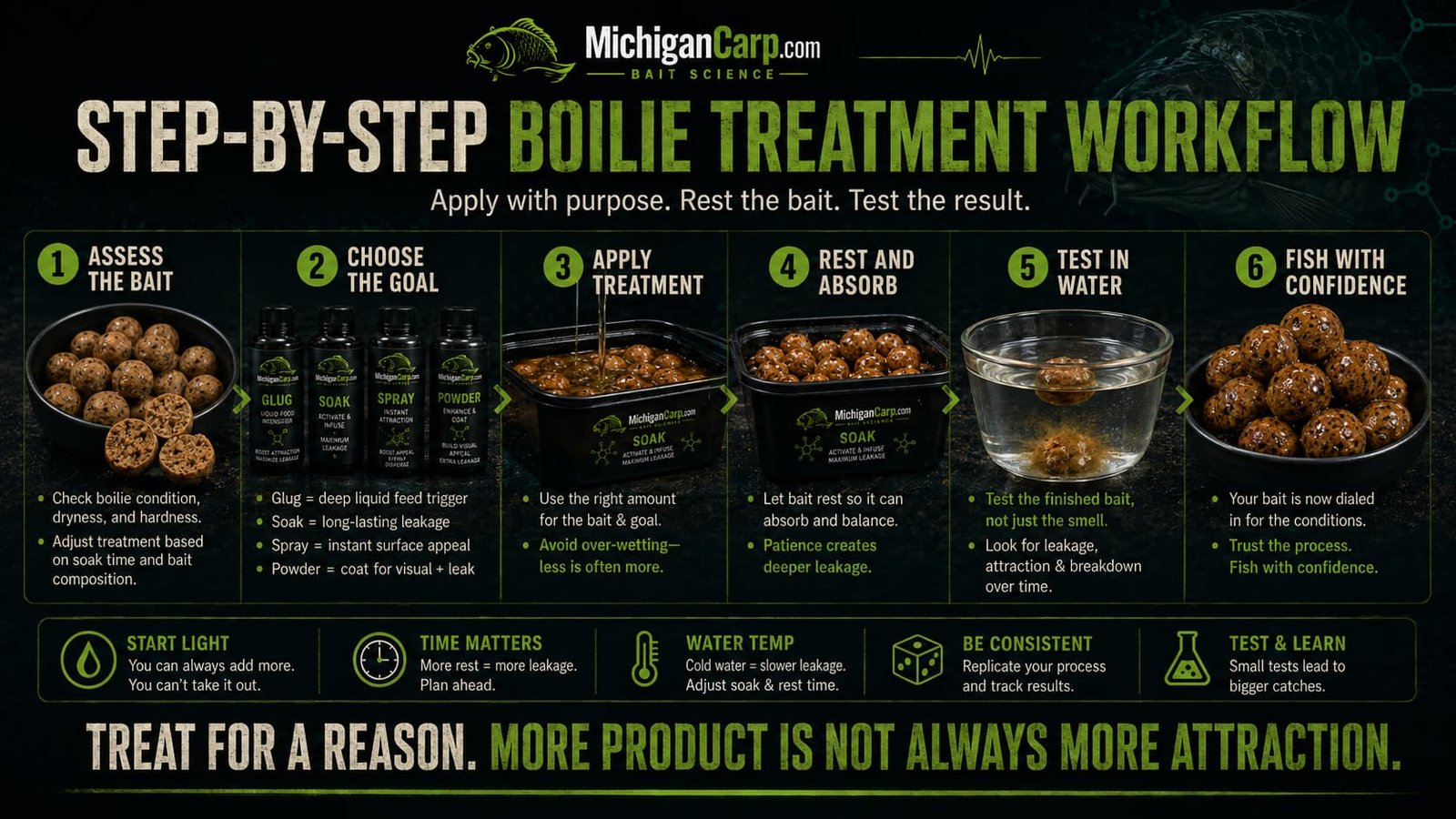
Fresh freezer bait is often active enough without heavy treatment. Thaw it in a clean container, allow surface condensation to escape, then add 10–25 ml per kilogram when a light coating has a purpose. Rotate the tub, wait 30 minutes to two hours and reassess. Use it the same day or keep it cold.
Do not leave sealed frozen bait warming in the sun, and avoid repeated thaw-and-refreeze cycles. A glug cannot reverse rancidity, freezer damage, mold or a genuinely wrong odor.
Air-dried and very hard boilies
Air-dried baits can take more liquid, but stage the treatment. Begin around 25–50 ml per kilogram, roll the bait and let it rest. Add more only after checking the center and outer skin. A deliberately heavy 50–100 ml treatment is for bait proven to need it, not a routine dose for every session.
If water, lake water, diluted molasses, liquid yeast or another water-rich material is used, keep the bait cool and use it promptly. Hardness does not make newly wetted bait shelf-stable.
Powder coating and crumb
A thin liquid layer can hold matching crumb, yeast, hydrolyzed whey, milk powder, tiger-nut flour or liver powder. Keep the coating light enough to survive casting but open once submerged. A thick damp shell may crack, alter the bait’s balance and create a nutrient-rich storage problem.
For general free bait, matching boilie crumb is the safest first powder. It supports the hookbait’s established food identity instead of burying it beneath a completely different liquid.
Washed-out boilies
Soaking bait in clean or lake water can dull its appearance and soften an air-dried surface. It may suit a same-session presentation where you deliberately want bait that appears to have been in the swim. It does not provide proof that pressured carp will prefer it.
Drain washed-out bait and use it the same day or keep it cold. Do not add water and then return the bait to warm room-temperature storage.
Shelf-life and old bait
A light surface refresh can change a shelf-life bait for the session, but it also changes the product that was originally dried and preserved. Keep the treated portion separate from the main supply. Reject old bait with visible mold, slime, gas, package pressure, unintended sour spoilage or a rancid paint-like odor. Do not hide failure beneath stronger flavor.
How to Condition Hookbaits Without Ruining the Rig
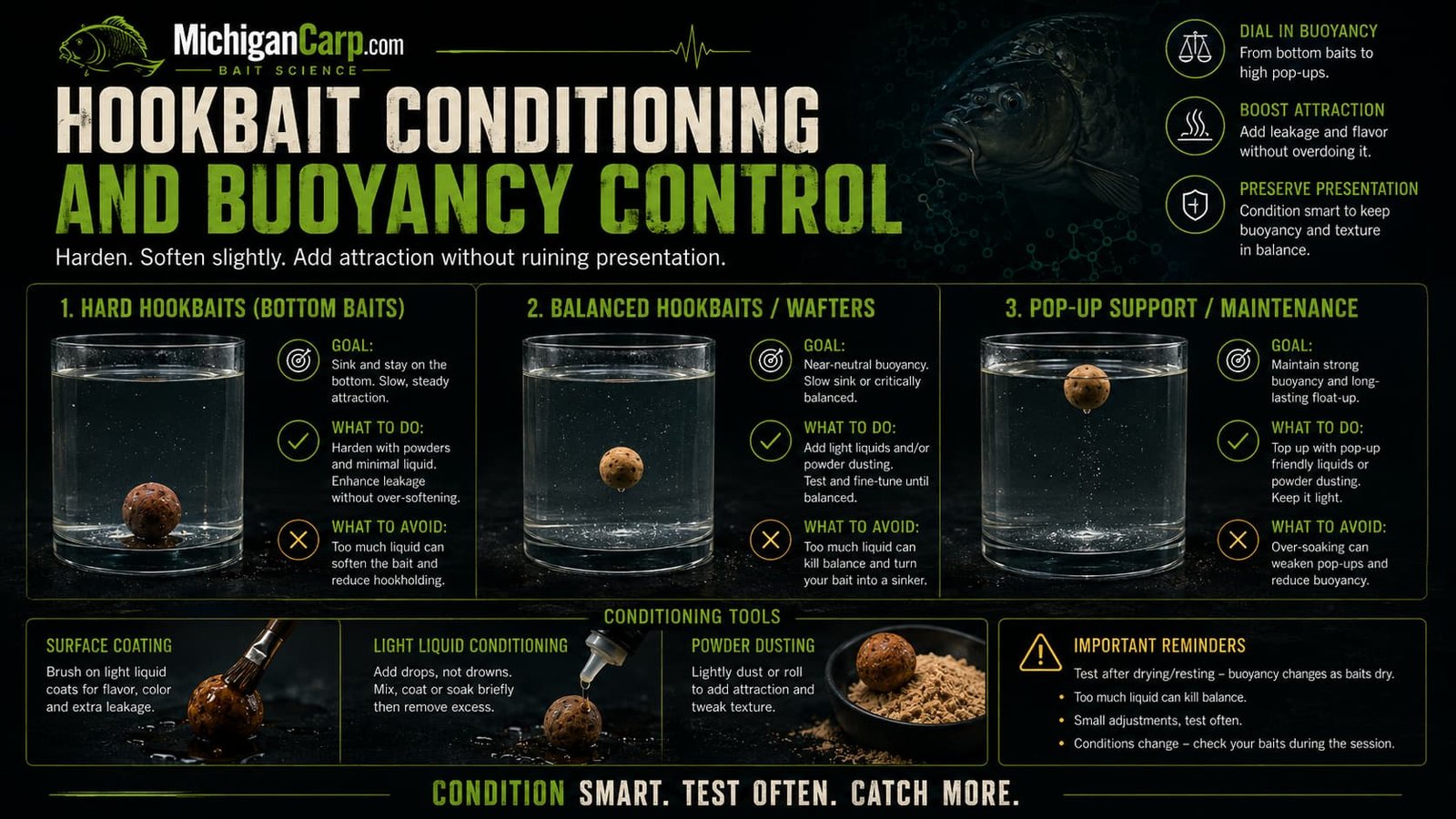
A hookbait conditioner is any controlled liquid or liquid-and-powder treatment applied to a finished hookbait to change its surface signal, texture or water behavior. The term describes the job, not one standardized commercial product.
Test the untreated bait on the complete rig before adding anything. Hook size and pattern, bait screw or hair, hook ring, swivel, hooklink and putty all contribute to the final presentation.
Hardened bottom hookbaits
These provide the widest margin because they are already dense and are not expected to hover or float. For twenty 20–24 mm baits, start with 1–2 ml of conditioner. Roll until the surfaces are coated and rest them for six to twenty-four hours before deciding whether another small application is required.
Check the hair-stop area, needle passage, bait-screw grip and outer skin. The goal is a tough hookbait with controlled softness, not a hard center beneath a paste-like surface.
Wafters
Wafters have the narrowest margin because their behavior depends on a close relationship between bait density and the full terminal arrangement. For twenty baits, begin with only 0.25–0.5 ml of a relatively fluid conditioner spread across the group. A calibrated pipette or dropper is often more repeatable than a spray pump when the blend is viscous.
Retest immediately and after the actual preparation time. A wafter that balances after ten minutes may become a firm bottom bait after absorbing liquid overnight and then taking up lake water for another six hours.
Cork-dust pop-ups
Cork dust distributes buoyancy throughout the paste, and conditioner can also move through that paste. A marginal cork-dust pop-up may therefore lose lift progressively across the complete hookbait. Use a very light surface application, avoid long syrupy soaks and test pop-up height through the intended fishing period.
Corkball pop-ups
The cork core normally provides more buoyancy reserve, but the outer paste can still become heavy, split, soften or separate from the ball. Ask more than whether the bait still floats. Check the height and tension of the complete rig after one, six, twelve and twenty-four hours where relevant.
The deeper design work belongs in How to Make Wafters and Pop-Ups From a Boilie Base Mix. Conditioning should refine a functional hookbait rather than force a poorly balanced bait to work.
Practical Milk-and-Nut Preparation Systems
These are development starting points, not universal attraction formulas. Ingredient brands, dry-bait porosity and flavor strength vary. Treat a small group first and keep untreated controls from the same batch.
Light free-bait treatment
| Ingredient | Amount per 1 kg thawed boilies |
|---|---|
| Liquid yeast or CSL-style liquid | 15–25 ml |
| Tiger-nut extract | 10–20 ml |
| Molasses, honey or maple-style liquid | 5–10 ml |
| Total treatment range | 30–55 ml |
Use the lower end on soft, active bait. Apply in stages, add matching crumb if wanted, and use the batch the same day or keep it cold. This is a water-rich food treatment, not an unrefrigerated shelf-life glug.
Food-rich hard-hookbait conditioner
| Ingredient | Amount |
|---|---|
| Food-grade propylene glycol | 50 ml |
| Food-grade glycerin | 20 ml |
| Tiger-nut extract | 15 ml |
| Beef-liver hydrolysate | 10 ml |
| Liquid yeast | 5 ml |
| Total | 100 ml |
Start with 1–2 ml per twenty hardened 20–24 mm hookbaits. This blend contains water-rich food liquids. Make it cleanly, refrigerate it promptly and treat it as a short-term conditioner. The presence of propylene glycol and glycerin does not make the complete blend automatically shelf-stable.
Beef liver is Robert’s preferred liver direction for adding a restrained savory layer to a milk-and-nut bait without automatically turning it into a conventional fishmeal profile. Use Liver Hydrolysate for Carp Bait for the wider ingredient explanation.
Matching powder coating
| Dry ingredient | Amount |
|---|---|
| Fine matching boilie crumb | 12 g |
| Brewer’s yeast or Springer Reveal | 4 g |
| Skimmed milk powder or WPC80 | 2 g |
| Beef-liver hydrolysate powder | 2 g |
| Total | 20 g |
For twenty hardened hookbaits, apply approximately 0.5–1 ml of the chosen conditioner, rotate until lightly tacky, then add 2–4 g of dry coating. Roll gently and allow it to set for 30–60 minutes. Test casting, attachment and water behavior before building a second layer.
For wafters and pop-ups, begin with less liquid and powder and retest the complete rig. A powder coating has still added mass even when it looks dry.
Match the Treatment to the Session
| Situation | Useful direction | Keep under control |
|---|---|---|
| Cold water or low feeding activity | Lower feed, light spray, crumb and small amounts of water-compatible hydrolysate or yeast material | Heavy oil layers, thick syrup and unnecessary feed volume |
| Warm water | Fresh food-style liquids, crumb and slightly richer treatment when carp are actively feeding | Warm storage of damp bait, oxidation and assuming more liquid fixes poor location |
| Short session | Prepare a small quantity well; use a light hookbait treatment and fast outer signal | Large tubs of heavily soaked bait |
| Long session | Split bait into daily batches, treat free bait lightly and keep stronger hookbaits separate | Letting all prepared bait become warm and wet at once |
| Fishing over particles | Use matching crumb around the rig and a deliberately selected hookbait | Forcing all particles and boilies into one overpowering flavor |
| Packbait or method | Use crumb, milk powder, nut meal and same-session food liquids to connect the feed to the hookbait | Wet dairy-rich mixes stored for later use |
Temperature does not make a poor swim good. Dissolved oxygen, weather, location and actual feeding activity still decide whether carp are likely to respond. The preparation should support the fishing situation, not replace watercraft.
For Robert’s usual particle-led approach, boilie crumb in a stick, method mix or packbait can connect the hookbait to the feed without feeding many whole boilies. Use Packbait for Carp Fishing and Particles for Carp Fishing for the complete feeding systems.
Test Treated Boilies Before Fishing
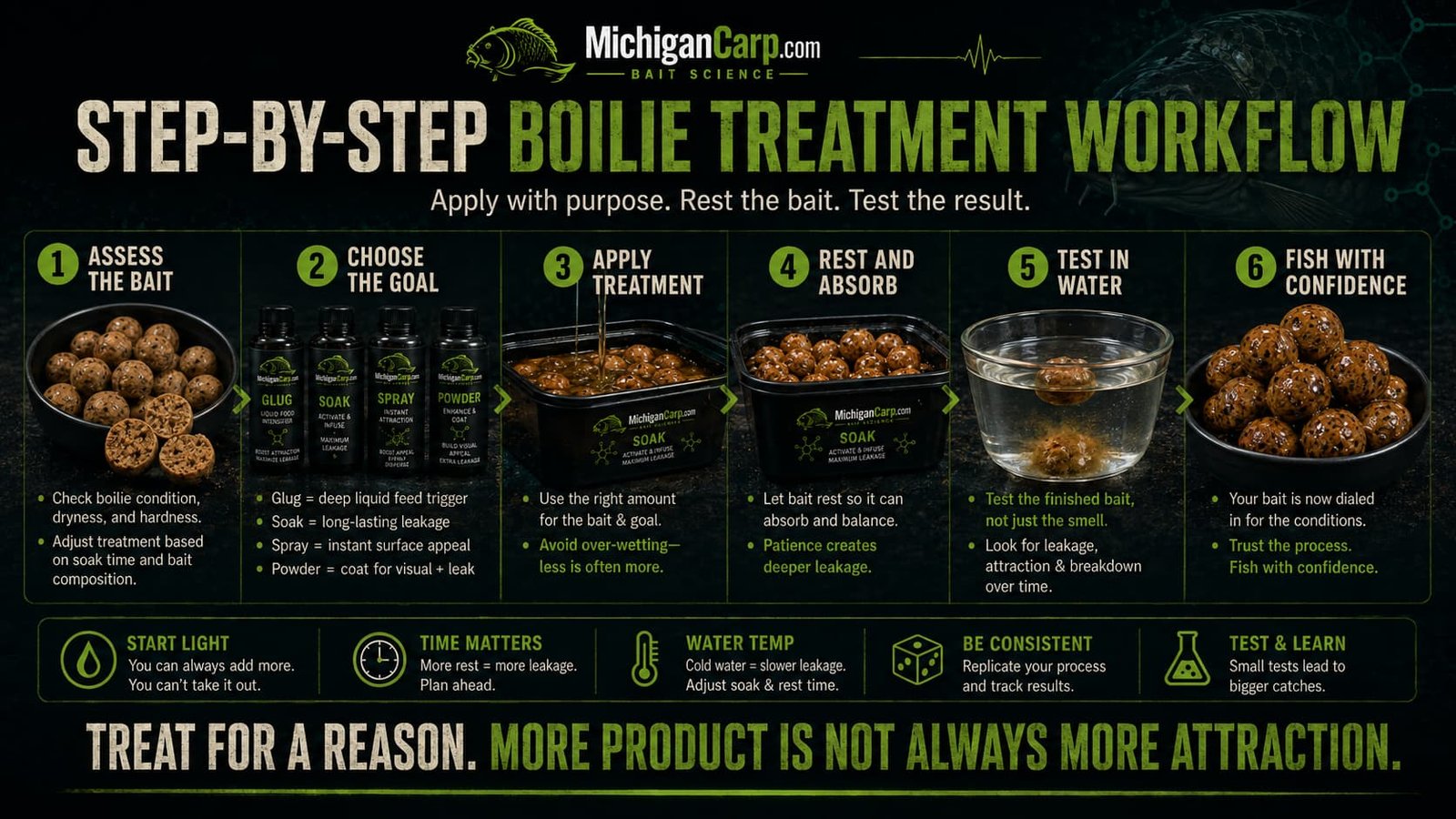
Do not condition the complete supply during the first trial. Five to twenty baits are normally enough to show whether a treatment is moving in the right direction. Keep untreated controls from the same production batch.
- Test the untreated bait on the complete rig.
- Weigh or record a representative untreated group when comparing treatments.
- Apply a measured amount of conditioner.
- Allow it to distribute for the actual preparation period.
- Check the skin, center, cracks, seam and attachment strength.
- Retest the complete rig immediately and through the intended soak.
- Compare it with the untreated control rather than relying on memory.
Measure mass gain where possible
Mass gain (%) = ((conditioned weight − untreated weight) ÷ untreated weight) × 100
Mass gain does not predict rig behavior by itself, but it shows whether one treatment is being taken up more heavily than another. This is especially useful when comparing two carriers or application levels on the same wafter batch.
Test the attachment and the full soak
Mount the bait with the intended screw, hair or swivel, pull and rotate it firmly, then repeat after water testing. Cut a separate bait open to inspect how far the treatment has moved. For overnight fishing, useful checks are one, six, twelve and twenty-four hours. If the bait fails in a controlled container, do not trust it on the rig.
The full testing framework is in How to Test Boilies Before Fishing.
Storage and Preservation After Treatment
A treated boilie is a different product from the untreated bait. Its original drying time, moisture result, preservative system and storage history no longer describe it completely after new liquid and nutrients have been added.
Water activity describes how available water is for microbial growth and chemical reactions; it cannot be judged from hardness alone. The FDA water-activity guide provides the underlying food-science distinction. The boilie-specific measurement and interpretation belong inWater Activity in Boilies: Moisture, Mold and Shelf-Life Control
Low-water carriers do not prove shelf life
A propylene-glycol-led flavor refresher may create a smaller preservation burden than a blend rich in homemade extract, liver liquid and yeast. That does not establish a safe room-temperature life. Small additions of propylene glycol or glycerin do not prove that a required water activity has been reached throughout the conditioner and the treated bait.
Handle water-rich treatments as short-term products
Make them cleanly, refrigerate promptly, label the date and keep treated session baits separate from the main supply. A damp coating of milk powder, yeast, liver and crumb is nutrient-rich; an airtight pot does not make it stable.
Robert’s shelf-life boilie system uses potassium sorbate, sodium benzoate and citric acid together, with each ingredient performing a different role. Even that combined system does not justify a shelf-life claim without pH, water-activity and retained-sample testing. The full explanation belongs in Potassium Sorbate, Sodium Benzoate and Citric Acid in Shelf-Life Boilies
Freezing treated hookbaits
A conditioned bottom bait can be frozen when the formula tolerates it, but test a small batch. Freezing and thawing may change the outer skin, liquid distribution, coating adhesion, cracking and wafter balance.
Common Boilie-Preparation Mistakes
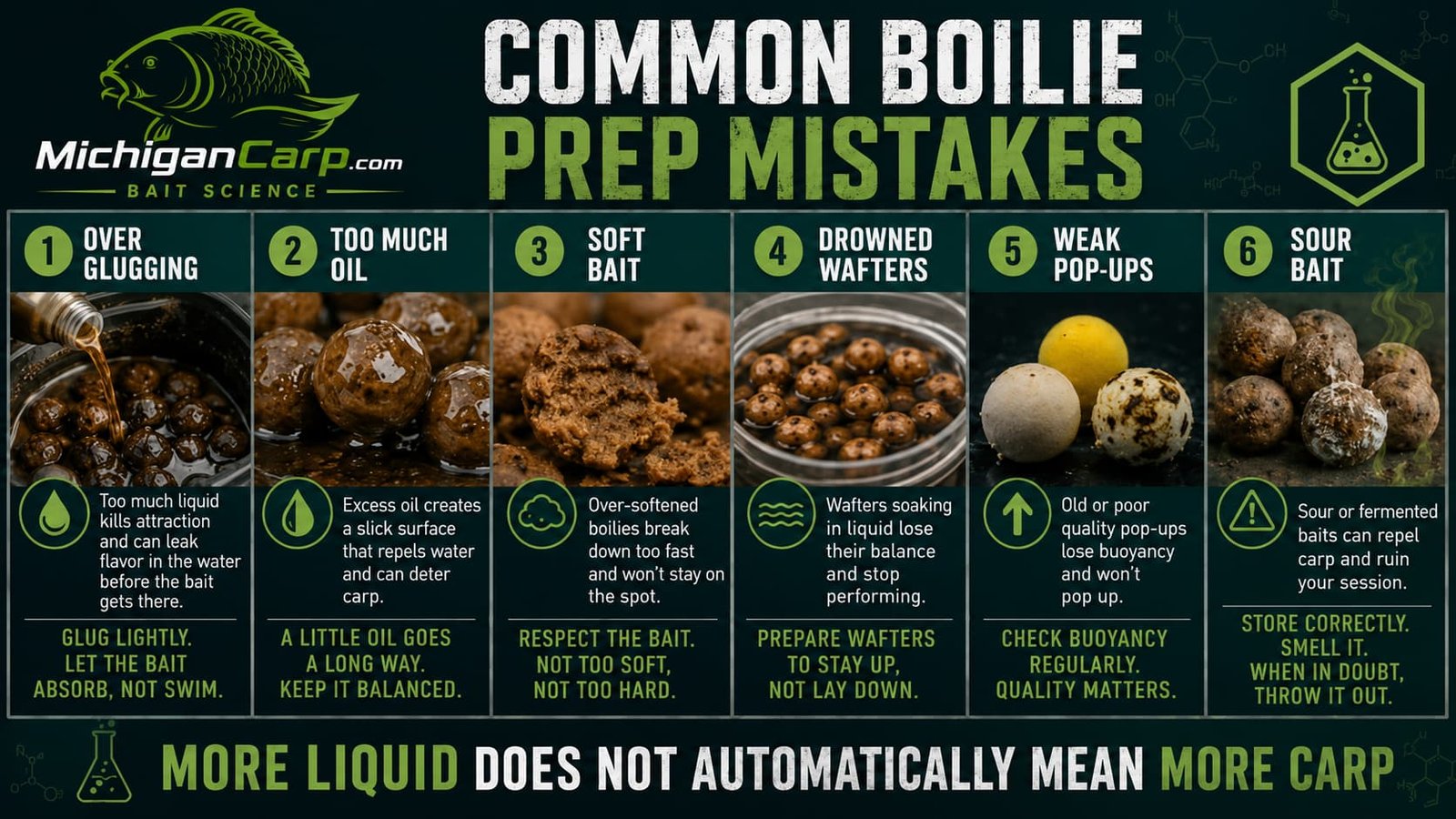
| Mistake | Why it fails | Better approach |
|---|---|---|
| Conditioning the complete supply | A failed treatment ruins every bait and removes the control | Test five to twenty baits and keep untreated samples |
| Submerging wafters and pop-ups | Mass gain changes balance and pop-up height | Use a measured surface application first |
| Testing only the bare bait | The hook, screw, swivel and putty determine presentation | Test the exact complete rig |
| Testing immediately after application | Absorption continues for hours or days | Wait the real preparation time and test through the fishing soak |
| Using too much glycerin or syrup | The bait becomes sticky, heavy and moisture-retentive | Use viscosity only when it has a defined job |
| Assuming PG makes everything shelf-stable | Water-rich foods, hygiene and final water activity still control risk | Refrigerate short-term blends and validate any shelf-life system |
| Ignoring bait-screw or hair strength | A soft skin can tear during casting while the center remains hard | Pull-test before and after timed water exposure |
| Using stronger smell as the success test | Human odor intensity does not prove underwater release or acceptance | Compare controls, mechanics and field results |
| Trying to rescue spoiled bait | Flavor does not reverse mold, rancidity or spoilage | Discard failed bait |
For structural failures such as cracking, softness, weak skins and drying problems, use Boilie Problems: Real Causes and Practical Fixes.
My Practical View
I do not think every boilie needs to be heavily treated. A good bait should already roll, cook, store and release as intended. Preparation is there to adapt that bait to the session.
For free bait, I normally prefer a light treatment and matching crumb. My fishing often uses particles as the main feed, with boilie crumb in a stick, method mix or packbait to carry the same bait identity around the rig.
Hookbaits are different. A heavily dried Plum, Scopex and Vanilla bottom bait may benefit from a little controlled softness and a refreshed surface profile. A wafter normally needs only a light application because I do not want the conditioner turning it into a standard bottom bait. I am similarly cautious with cork-dust pop-ups, while a corkball gives more buoyancy reserve but still requires seam, skin and height testing.
For a savory milk-and-nut bottom hookbait, I like restrained beef liver because it adds depth without forcing the whole bait into a conventional fishmeal identity. I still want the original plum, cream, vanilla and nut character to remain recognizable.
My preferred sequence is simple: test the untreated bait, prepare a small session group, use the lowest practical application, allow it to distribute and retest the exact rig through the intended soak.
Use less liquid, but use it with a reason. Preserve the bait signal instead of trying to overpower it.
FAQ
Should I glug every boilie?
No. Treat boilies only when the glug has a defined job. Fresh, soluble or already-effective bait may be better with matching crumb or no extra treatment.
How much glug should I use per kilogram?
Start around 10–25 ml per kilogram for a light coating on thawed bait. Dry bait may take 25–50 ml in stages. Reserve heavier 50–100 ml treatment for deliberately prepared hard bait that has been tested.
How long should hard hookbaits be conditioned?
Six to twenty-four hours is a useful first window for a staged surface treatment. Very firm boilies may be conditioned longer, including one to two weeks in a deliberately controlled system, but texture, attachment, storage condition and the complete rig must be checked rather than assuming longer is better.
Can conditioner make a wafter sink?
Yes. The wafter gains mass and may continue absorbing conditioner while resting and lake water after casting. Test it with the exact hook and terminal arrangement.
Can I glug pop-ups?
Use a very light measured treatment. Cork-dust pop-ups may absorb liquid through the paste, while corkball baits normally retain more reserve but can still develop a soft or split outer layer.
Does propylene glycol or glycerin make a glug shelf-stable?
Not automatically. Final proportions, water-rich ingredients, hygiene, pH, water activity and storage conditions determine the actual preservation challenge.
Can I prepare boilies to use over particles?
Yes. Matching boilie crumb in a stick, method mix or packbait can connect the hookbait to corn, hemp, tiger nuts or mixed particles without requiring a large feed of whole boilies.
Can glug rescue old or spoiled boilies?
No. A light refresh may help clean but tired freezer bait, but mold, rancidity, slime, gas or unintended sour spoilage means the bait should be discarded.
Next Steps
Continue with the guide that matches the next decision:
- How to Test Boilies Before Fishing — verify texture, leakage, attachment and rig behavior.
- How to Store Homemade Boilies — handle untreated and conditioned bait correctly.
- Liver Hydrolysate for Carp Bait — use beef liver as a controlled soluble food signal.
- How to Boil and Dry Boilies Properly — correct the untreated bait before conditioning.
- Packbait for Carp Fishing — integrate crumb and milk-and-nut signals with practical North American feeding.
- Boilie School — follow the complete boilie-making route.