

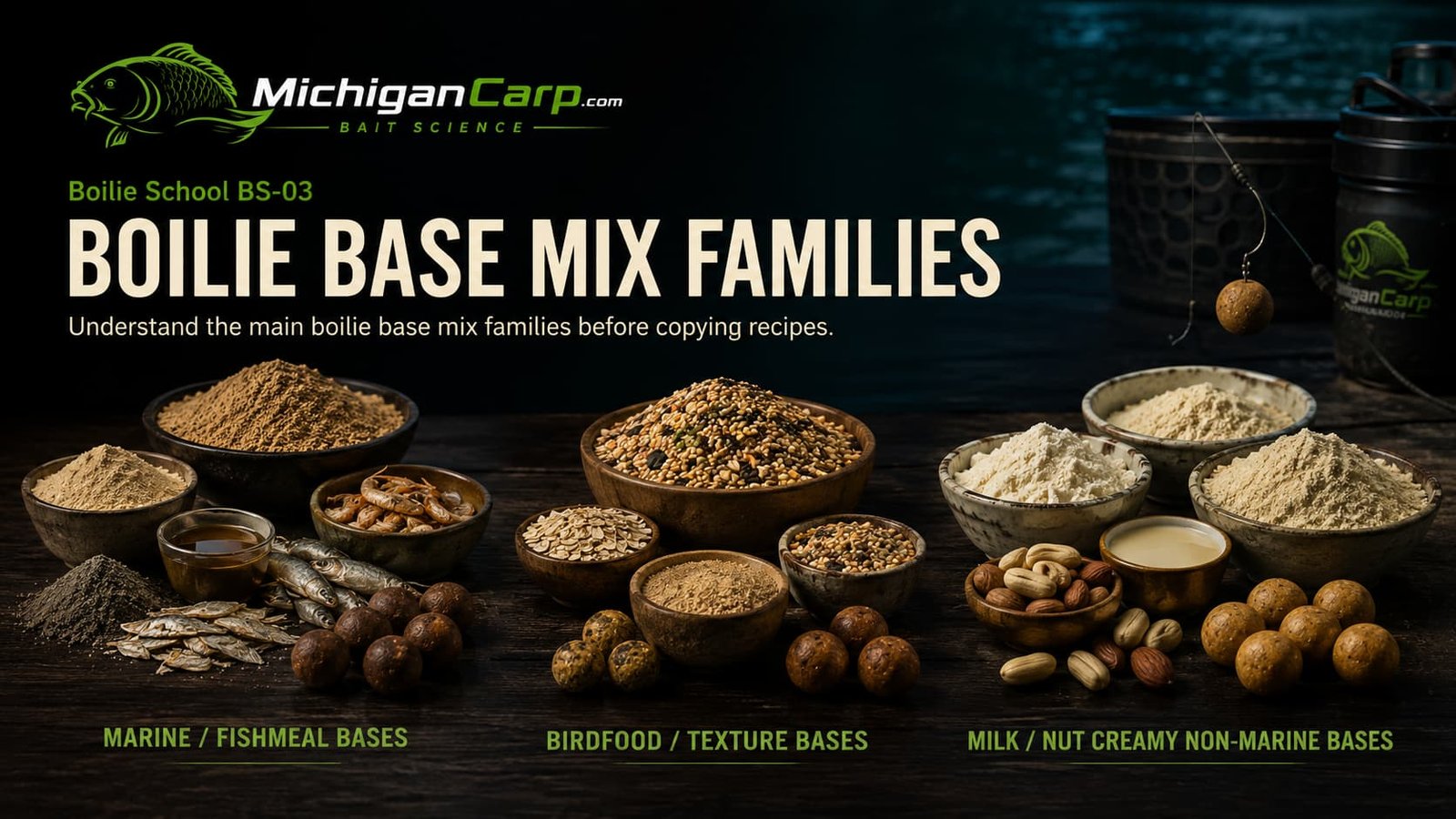
Boilie base mix families are the big-picture bait categories that help homemade bait makers understand what a boilie is trying to do before copying a recipe.
Before you buy expensive ingredients, stack powders into a complicated formula or chase a bait someone else used, it helps to know which bait family you are building.
Most boilies sit somewhere inside four broad groups:
- marine or fishmeal base mixes;
- birdfood base mixes;
- milk/nut base mixes;
- hybrid base mixes that deliberately combine more than one family.
These are learning categories, not strict rules. A fishmeal bait can contain birdfood. A birdfood bait can contain milk powder. A milk/nut bait can contain seed meals, yeast, cereal ingredients or hydrolysates.
The point is not to force every bait into a box. The point is to understand the main direction before you start changing the formula.
Learn the family first. Copy the recipe second. Refine the formula last.
BS-03 follows Boilie School BS-02: Boilie Ingredients Explained and prepares you for Boilie School BS-04: Boilie Liquids and Additives. For full section-based formulation, use How to Formulate a Milk, Nut and Birdfood Boilie Base Mix.
Boilie School navigation: Previous Lesson: BS-02 — Boilie Ingredients Explained | Back to Boilie School Hub | Next Lesson: BS-04 — Boilie Liquids and Additives.
For external technical background, see FAO: Feed Ingredients and Fertilizers for Farmed Aquatic Animals and National Academies: Nutrient Requirements of Fish and Shrimp.
Table of Contents
Quick Start: The Main Boilie Base Mix Families
If you are new to boilie making, start with this simple comparison.
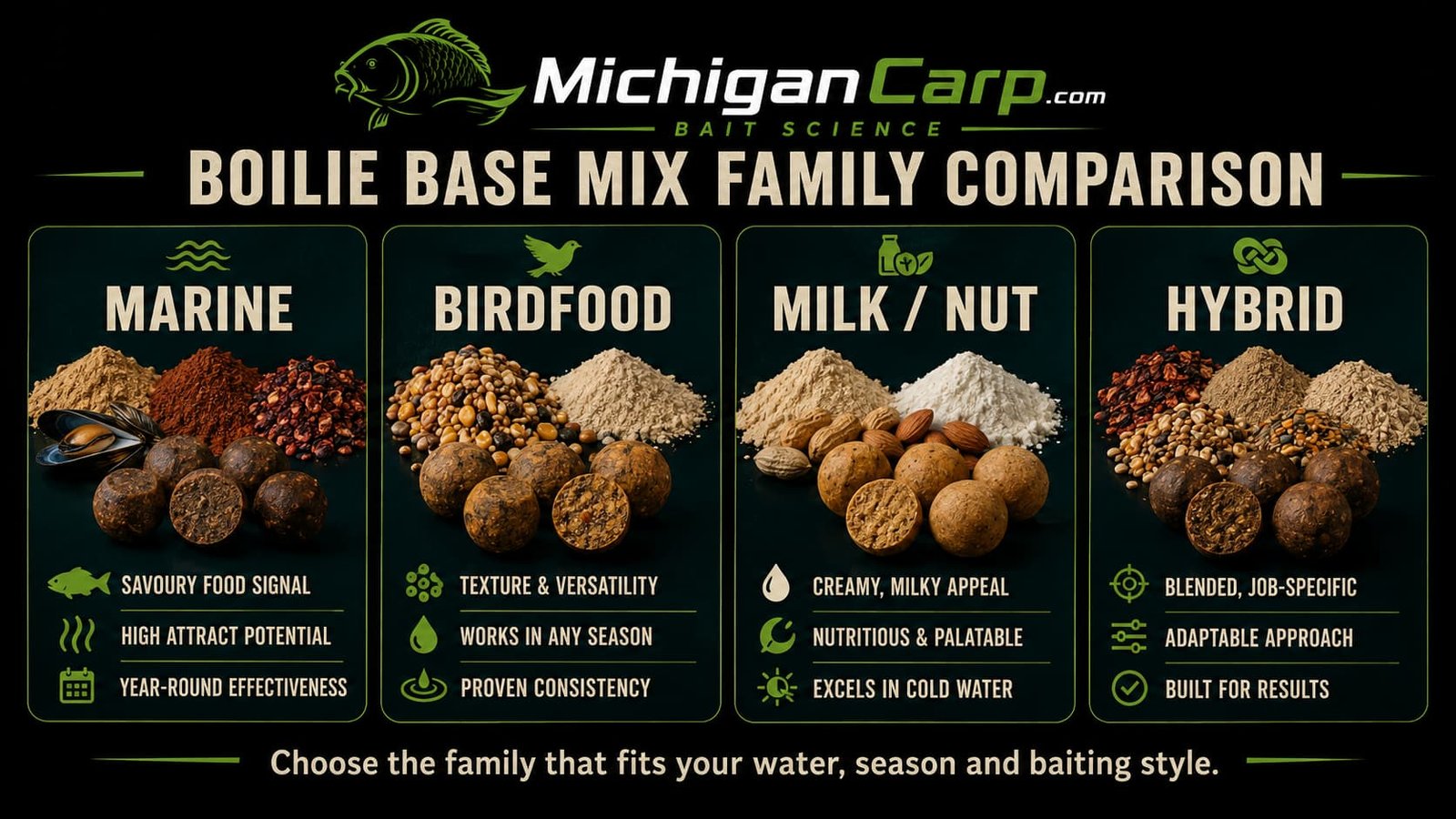
| Base mix family | Basic identity | Best beginner use |
|---|---|---|
| Marine | Fishmeal, marine meals, savoury proteins and marine solubles | Warmer water, food baiting, strong savoury profile |
| Birdfood | Prepared birdfoods, egg foods, seeds, cereals and texture ingredients | Versatile baits, texture, easy learning and hybrid support |
| Milk/nut | Milk powders, milk proteins, tiger nut, peanut, almond and seed meals | Clean non-marine food baits, particles and cooler/mixed conditions |
| Hybrid | A deliberate blend of two or more families | Experienced bait makers who know the main family and support role |
There is no single best family. There is only the family that fits the water, season, budget, baiting style and confidence of the angler.
What a Base Mix Family Does and Does Not Tell You
A base mix family tells you what the bait is built around.
It may tell you whether the bait is mainly savoury and marine, textured and cereal-seed based, creamy and non-marine, or deliberately blended from several directions.
It does not automatically tell you whether the bait is good.
| A base mix family can suggest | It cannot prove |
|---|---|
| Main ingredient direction | That carp will prefer it |
| Broad food profile | Exact digestibility or nutritional value |
| Likely texture direction | Finished leakage or water behaviour |
| Seasonal fit | That it is right for every water |
| Recipe starting point | That every ingredient inside the family is interchangeable |
A high-quality fishmeal is not the same as every marine meal. A prepared birdfood is not the same as raw whole seed. WPC80 is not the same as skim milk powder. Tiger nut flour is not the same as full-fat peanut meal.
That is why BS-03 should not be another recipe page. Its job is to help you choose the right road before you start driving.
Marine Boilie Base Mixes
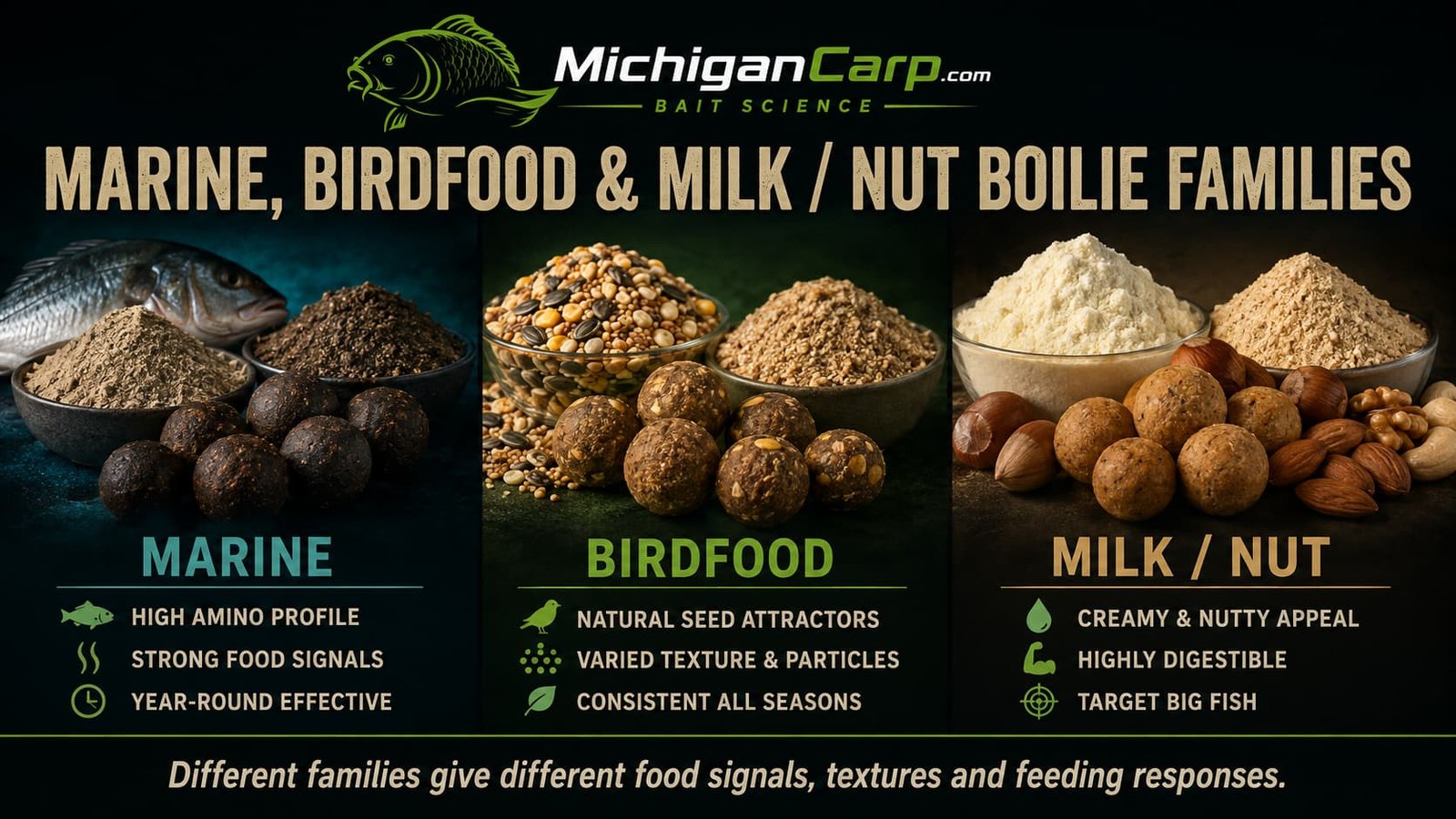
Marine boilies are built around fishmeal and other marine-derived ingredients.
They may include fishmeal, krill meal, squid meal, shrimp meal, marine solubles, fish protein hydrolysate, fish oil, yeast products, binders, cereals and supporting plant ingredients.
The broad identity is:
Savoury + marine + food-bait direction.
Marine ingredients have a long history in carp bait because they can provide strong savoury character, protein, minerals, fat depending on product, and soluble fractions depending on processing.
| Marine baits can do well | Watch for |
|---|---|
| Strong savoury food profile | Assuming fishmeal automatically means premium bait |
| Warmer-water food-baiting | Too much richness or oil |
| Campaign feeding where fish return repeatedly | High cost if used without discipline |
| Compatibility with fish, krill, squid, liver and yeast directions | Poor structure if the base mix is not balanced |
| Traditional high-food-value bait identity | Using strong smell as proof of quality |
I would consider marine first when water is warmer, carp are feeding confidently, the session length allows feeding response to build, and I want a strong savoury food signal.
That does not mean marine is wrong in cooler water. It means I would be more cautious with richness, oil level and bait quantity.
For the deeper marine comparison, use Fishmeal Boilies vs Milk Baits for Wild Michigan Carp. For ingredient-level depth, use Proteins, Peptides and Hydrolysates in Carp Bait and How to Use Hydrolysates in Carp Bait.
Birdfood Boilie Base Mixes
Birdfood boilies are built around prepared birdfoods, seed-and-cereal ingredients, egg foods, CLO-style products, Nectarblend-style products or controlled house blends.
The broad identity is:
Texture + cereal + seed + versatility.
Birdfood is one of the most misunderstood bait families because the word does not describe one standardized ingredient. A fine prepared egg food, a CLO-style product, a cereal birdfood and a coarse ground seed blend can behave very differently.
| Birdfood baits can do well | Watch for |
|---|---|
| Add texture and visible particles | Assuming coarse texture automatically means better leakage |
| Create more open physical structure | Weak rolling if the mix lacks binders |
| Support milk, nut, seed or marine hybrids | Using raw whole seed as if it were prepared birdfood |
| Teach beginners about paste and water behaviour | Cracking, splitting or crumbling if overused |
| Work well with crumb, particles and mixed feeding | Treating every birdfood as nutritionally identical |
I would consider birdfood first when I want a versatile bait, visible food texture, a forgiving learning family, or a bridge between cereal, seed, milk, nut and marine directions.
Birdfood can be a good beginner family because it teaches physical bait behaviour quickly. It still needs formulation discipline.
For seed and birdfood detail, use Birdfood for Carp Boilies and Birdseeds for Boilies.
Milk/Nut Boilie Base Mixes
Milk/nut boilies are built around milk ingredients, milk proteins, nut meals, tiger nut flour, peanut products, almond meal, coconut ingredients, seed meals and supporting cereal structure.
The broad identity is:
Creamy + nutty + non-marine food-bait direction.
This is one of the most interesting bait families for North American wild-water carp because it can produce a confident food-bait identity without relying on fishmeal.
It also needs careful formulation because milk ingredients and nut ingredients vary enormously.
| Milk/nut baits can do well | Watch for |
|---|---|
| Create a clean non-marine food-bait identity | Thinking more milk protein automatically means better bait |
| Pair naturally with tiger nuts, peanuts, maize, hemp and particles | Stacking too many rich ingredients |
| Offer creamy, sweet-nut and dairy profiles | High fat, slow drying or rancidity risk |
| Work across cooler and mixed conditions when balanced | Confusing milk powder, WPC, casein and milk replacer |
| Support long-term confidence feeding | Weak structure if the base lacks a proper chassis |
I would consider milk/nut first when I want a non-marine food bait, particle compatibility, a cleaner bait profile, cooler-water confidence, or a sweet-nut/dairy direction that I can repeat.
Milk/nut does not mean weak. It means a different style of food bait.
For this direction, use How to Formulate a Milk, Nut and Birdfood Boilie Base Mix, How to Balance Fat in Boilies, Milk Replacer for Carp Bait and Nut Boilie Base Mix Recipes.
Hybrid Boilie Base Mixes
Many strong baits are hybrids.
A hybrid bait might be fishmeal birdfood, milk birdfood, nut birdfood, milk/nut birdfood, marine milk, fishmeal yeast cereal, or a practical milk/nut/seed system with birdfood texture.
Hybrids can be excellent, but beginners often create chaos by trying to use every family at once.
Ingredient accumulation is not formulation.
| A good hybrid asks | A poor hybrid does |
|---|---|
| What is the main family? | Adds everything that sounds good |
| What is the supporting family? | Uses three or four identities with no control |
| What job does each ingredient perform? | Duplicates protein, fat, solubles and texture blindly |
| Does it still roll, cook, dry and fish properly? | Creates sticky, greasy, weak or over-complicated bait |
| Can I repeat the formula? | Depends on ingredients the maker cannot source again |
A good hybrid has a main identity and a support role. For example, a milk/nut birdfood bait may use milk and nut ingredients for the food direction, while birdfood adds texture and openness. A fishmeal birdfood bait may use fishmeal for savoury food value while birdfood helps texture and rollability.
Do not choose a hybrid because you are afraid to leave ingredients out. Choose a hybrid because the second family has a clear job.
How to Choose a Base Mix Family
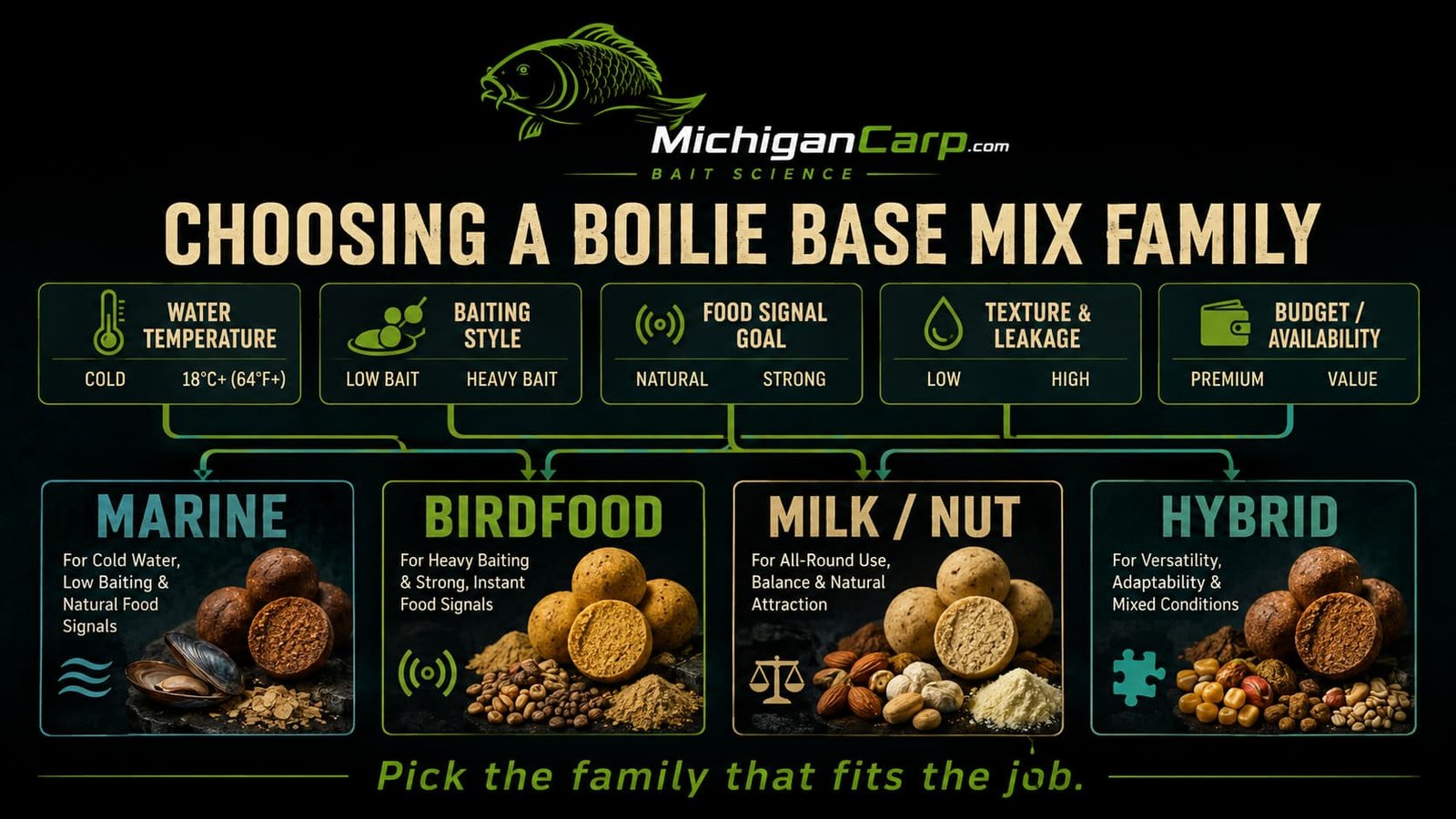
The best family is the one that fits the job in front of you.
| Choose this family | When you want |
|---|---|
| Marine | Strong savoury bait, warmer-water feeding, fishmeal identity and campaign food-bait confidence |
| Birdfood | Texture, visible particles, versatility, beginner learning value and hybrid support |
| Milk/nut | Non-marine food bait, creamy/nutty profile, particle compatibility and controlled confidence feeding |
| Hybrid | A main bait identity supported by a second family for a defined reason |
For most beginners, I would not start with the most complicated marine or milk-protein system possible. I would start with the family I could repeat.
A bait you can make consistently is more useful than a complicated bait you cannot reproduce.
Season, Water Type and Baiting Style
Season does not create fixed rules. It changes risk.
| Situation | Family thinking |
|---|---|
| Spring and cooler water | Lower bait quantity, controlled soluble material, less unnecessary oil, lighter milk/nut or birdfood styles |
| Summer | More confident feeding can open the door to marine, birdfood hybrids or richer milk/nut baits if balanced |
| Fall | Food-bait consistency matters; marine, birdfood and milk/nut can all work when matched to the water |
| Small ponds | Simple birdfood or milk/nut bait may be enough; bait quantity and disturbance matter |
| Large natural lakes | Repeatability, cost, storage and practical feeding become important |
| Channels and current | Density, breakdown, bait placement and feed staying in the zone may matter as much as family |
| Short sessions | Birdfood texture, crumb, chops and controlled soluble signals can help the bait work sooner |
| Multi-day sessions | Food value, storage, repeat feeding and bait cost become more important |
| Prebaiting | Choose a bait you can feed consistently, store properly and apply without waste |
For release behaviour, use Carp Bait Solubility and Leakage, Why Some Carp Baits Leak Faster Than Others and Solubility vs Nutrition in Carp Bait.
Where the Specialist Articles Fit
BS-03 is a map. It should not replace the specialist pages.
| When you need | Use this next |
|---|---|
| Ingredient roles | Boilie Ingredients Explained |
| Liquid phase | Boilie Liquids and Additives |
| Making process | Making Boilies Step by Step |
| Milk/nut/birdfood formulation | How to Formulate a Milk, Nut and Birdfood Boilie Base Mix |
| Boiling and drying | How to Boil and Dry Boilies Properly |
| Testing finished bait | How to Test Boilies Before Fishing |
| Storage | How to Store Homemade Boilies |
This keeps Boilie School clean. BS-03 tells you which road you are on. The specialist pages teach you how to build that road properly.
Michigan Notes
In my own Michigan fishing, I care more about repeatable bait systems than fashionable recipe names.
Many of our waters are large, public, natural, lightly understood for carp, and affected by season, boat traffic, depth, weed, current and natural food.
That changes bait thinking.
A bait has to be something I can make consistently, apply over several sessions, use beside particles, transport, store, and trust when fish are not showing.
On some waters, that may be a milk/nut bait. On others, a birdfood hybrid. In stronger feeding periods, a marine bait may make sense.
The important thing is not defending one family forever. The important thing is choosing deliberately.
Common Base Mix Family Mistakes
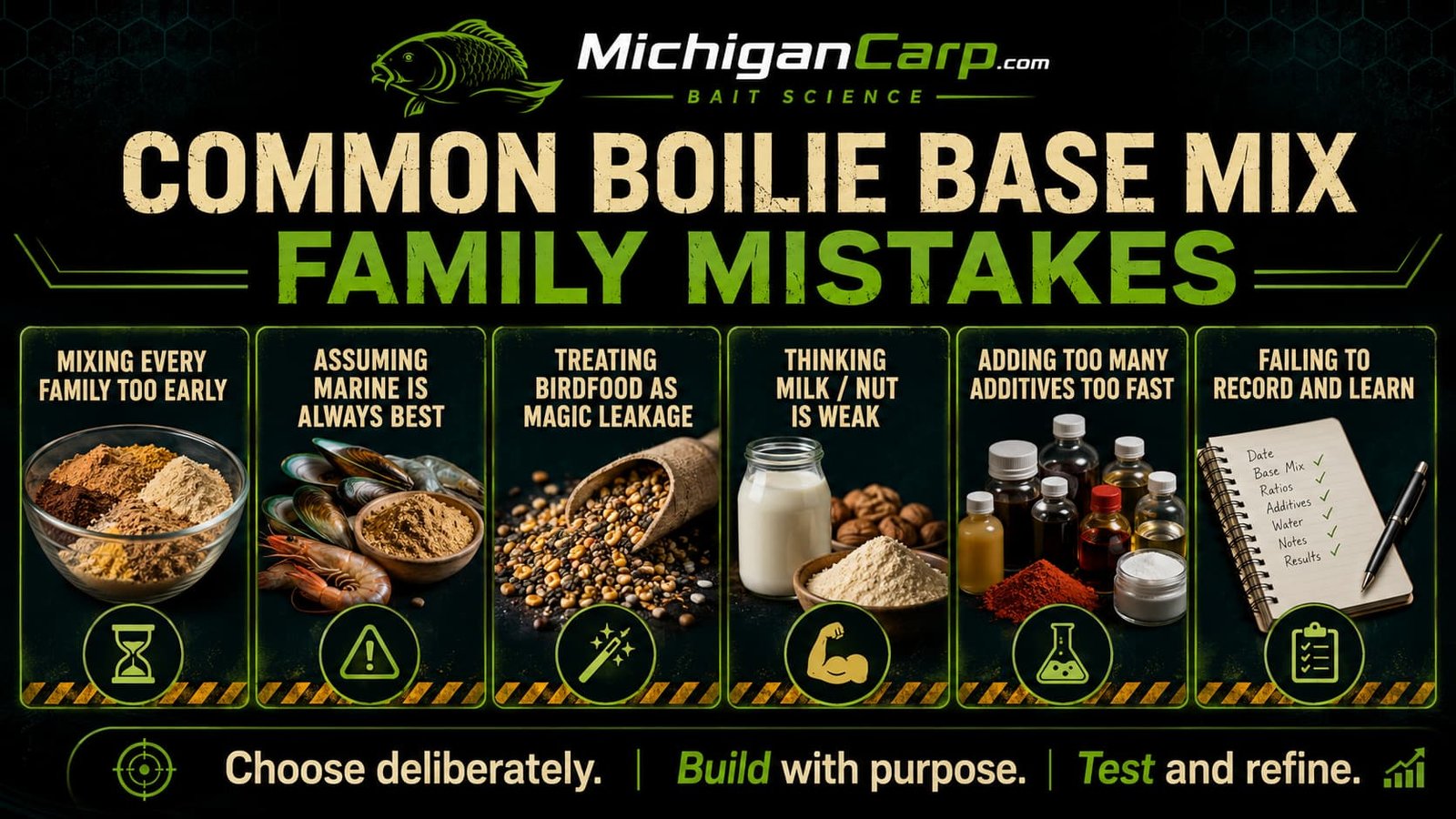
| Mistake | Why it causes problems | Better practice |
|---|---|---|
| Mixing every family too early | The bait becomes complicated before the maker understands one direction | Learn one family first |
| Thinking marine is always best | Marine baits are not automatic winners in every water or season | Choose marine when the job fits |
| Treating birdfood as magic leakage | Texture helps only if the bait still rolls, cooks and fishes properly | Use birdfood for defined physical and bait-family reasons |
| Thinking milk/nut is weak | A well-designed milk/nut bait can be a serious food bait | Control structure, fat, dairy section and nut section |
| Choosing by smell alone | Smell does not prove nutrition, digestibility or water behaviour | Judge the complete bait system |
| Copying percentages blindly | The same percentage of different products can behave very differently | Understand ingredient form and function |
| Ignoring cost and availability | A bait you cannot afford or source repeatedly is hard to develop | Build around ingredients you can repeat |
| Changing family after every blank | One quiet session may be location, timing or conditions | Test bait over enough fishing to learn |
My Practical View
Marine, birdfood and milk/nut are not competing religions.
They are bait-building languages.
Marine speaks in savoury food value and marine identity. Birdfood speaks in texture, cereal, seed and versatility. Milk/nut speaks in creamy, nutty, non-marine food character.
A good bait maker learns what each family does before trying to blend everything together.
That is why BS-03 matters.
Pick the family that fits the job. Build it simply. Fish it properly. Then improve it one decision at a time.
That is how you move from copying bait to understanding bait.
FAQ
What are the main boilie base mix families?
The main boilie base mix families are marine, birdfood, milk/nut and hybrid baits. Many finished boilies blend more than one family, but these categories help beginners understand the bait’s main identity.
Are marine boilies always best?
No. Marine boilies can be excellent, especially in warmer water and food-baiting situations, but they are not automatically best for every season, water or baiting style.
What is a birdfood boilie?
A birdfood boilie uses prepared birdfoods, egg foods, seed meals, cereal ingredients, CLO-style products or related blends to create texture, openness and food character.
What is a milk/nut boilie?
A milk/nut boilie is built around milk powders, milk proteins and nut ingredients such as tiger nut flour, peanut flour, almond meal or coconut ingredients. It is usually a non-marine food-bait style.
Which base mix family is best for beginners?
Birdfood or a simple milk/nut style is often easiest for beginners because these families can teach structure, rolling, texture and water behaviour without immediately requiring complex marine ingredient choices.
Can I mix marine, birdfood and milk ingredients together?
Yes, but do it deliberately. A hybrid bait should have a main identity and clear support roles. Do not combine all families simply because you are afraid to leave ingredients out.
Which family is best for cold water?
There is no automatic winner. In cooler water, I usually prefer controlled richness, lower unnecessary oil, careful bait quantity and lighter milk/nut or birdfood approaches.
Which family is best for summer?
Marine baits, birdfood hybrids and richer milk/nut systems can all work in summer. The choice depends on fish activity, baiting plan, water type and how much feed you intend to use.
Are birdfood boilies just filler?
No. Birdfood ingredients can contribute texture, cereal character, seed material, openness and moderate food value. The actual product matters.
Are milk/nut boilies good food baits?
Yes. A well-designed milk/nut bait can be a serious food bait, especially when the dairy section, nut section, structure and fat level are controlled.
Should I start with a recipe or a bait family?
Start with the bait family. Once you know whether you want marine, birdfood, milk/nut or a hybrid, recipes and formulation choices make more sense.
Why should BS-03 avoid full percentage templates?
Because percentage templates can make very different ingredients look interchangeable. BS-03 is better used as the family-selection lesson, while specialist pages handle detailed formulation.
Next Steps
- Previous Lesson: BS-02 — Boilie Ingredients Explained
- Next Lesson: BS-04 — Boilie Liquids and Additives
- Back to Boilie School Hub
- How to Formulate a Milk, Nut and Birdfood Boilie Base Mix — build a full formula after choosing the family.
- Fishmeal Boilies vs Milk Baits for Wild Michigan Carp — compare two major food-bait directions.
- How to Balance Fat in Boilies — control richness, oil and storage risk.
- Carp Bait Solubility and Leakage — understand bait release and water behaviour.
- How to Boil and Dry Boilies Properly — turn the chosen family into finished bait.
- How to Test Boilies Before Fishing — test the finished bait before trusting it.
- Bait Science — browse the full technical bait library.