

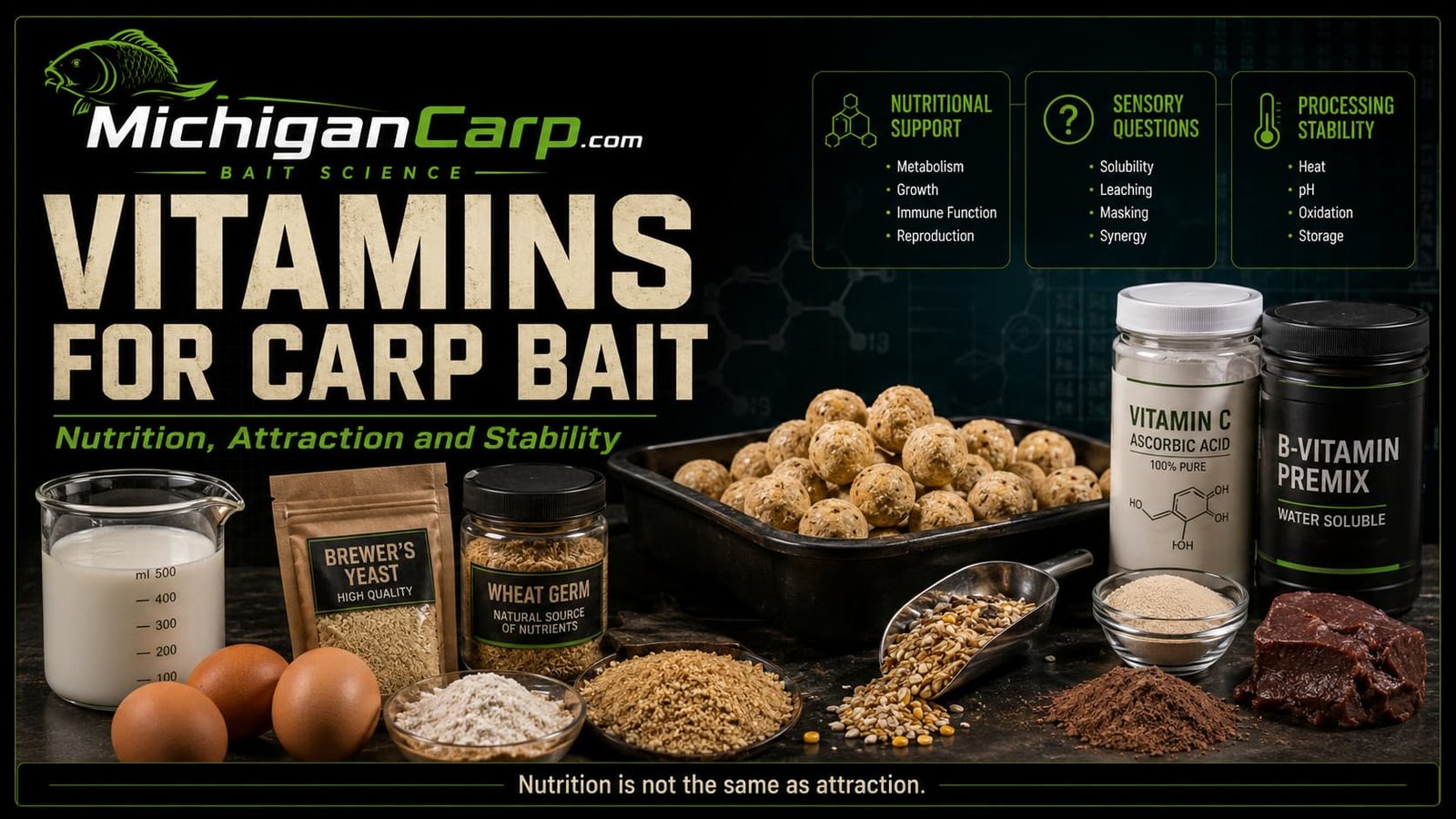
Vitamins for carp bait are easy to oversell because the word vitamin sounds healthy, scientific and valuable.
But a vitamin can be essential in a complete fish diet without being a strong attractor. An ingredient can also help carp detect or accept bait without contributing meaningful vitamin nutrition.
That distinction is the foundation of this guide.
Vitamins can contribute to the nutritional background of a serious food bait. Certain vitamins also raise legitimate sensory questions. Their usefulness, however, depends on the specific compound, chemical form, processing method, storage conditions and the rest of the recipe.
They should not be treated as one universal attraction category.
This article works alongside Carp Bait Science, Carp Feeding Attractants Explained and Proteins, Peptides and Hydrolysates in Carp Bait.
Table of Contents
Quick Start
| Question | Practical Answer |
|---|---|
| Do vitamins attract carp? | Most should be treated primarily as nutrients. Ascorbic acid has direct common-carp taste evidence, while the well-known B1 and B2 olfactory evidence comes from rainbow trout. |
| Does every boilie need a vitamin premix? | No. Diverse food ingredients may already contribute a useful micronutrient background, and most short-session bait does not need to imitate a complete aquaculture diet. |
| Does boiling destroy every vitamin? | No, but retention varies with the vitamin, chemical form, temperature, time, moisture, oxygen, light and storage. |
| Is post-boil application always better? | It avoids the cooking stage but does not prevent oxidation, light damage, storage loss or rapid leaching in water. |
| Does vitamin E preserve shelf-life boilies? | Vitamin E has nutritional antioxidant functions, and some tocopherol products can protect fats. It does not control mould, yeast or bacterial spoilage by itself. |
| Can human multivitamin tablets be crushed into bait? | They should not be used blindly. Their concentrations, minerals, coatings, binders and fat-soluble vitamin levels may be unsuitable for accurate bait formulation. |
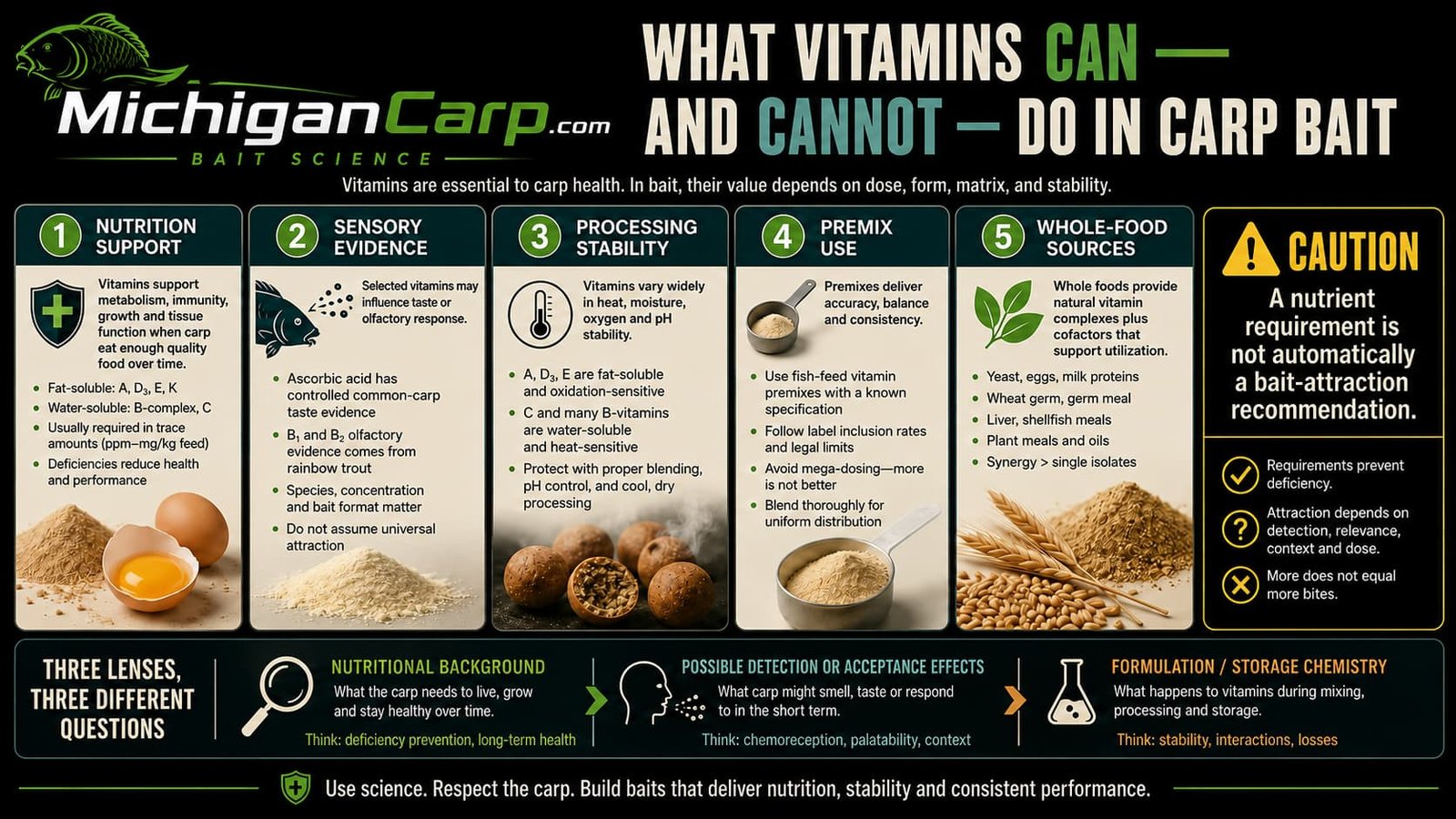
What Vitamins Can and Cannot Do in Carp Bait
Vitamins are organic micronutrients involved in normal metabolism. In aquaculture nutrition, they are studied as parts of complete diets intended to support fish over sustained feeding periods.
Recreational carp bait is a different situation.
A wild Michigan carp may eat boilies during one session and then continue feeding on seeds, insect larvae, snails, mussels, crayfish, plant material and other natural food. A hookbait or short baiting campaign is not the fish’s complete diet.
This means an aquaculture vitamin requirement cannot simply be converted into a universal boilie inclusion rate.
The FAO overview of vitamins in fish nutrition explains that requirement estimates are generally established through controlled feeding trials using purified or semi-purified diets. They can also vary with species, life stage, feeding conditions, processing losses, water exposure and other dietary factors.
A nutrient requirement is not automatically a bait-attraction recommendation, and a complete-feed specification is not automatically a boilie recipe.
Vitamins can contribute to three different discussions:
- Nutritional support: what the fish can use after the bait is eaten and digested.
- Sensory response: whether a particular compound can be detected or affects oral acceptance.
- Ingredient and storage chemistry: how a vitamin form reacts to heat, oxygen, moisture, light, minerals and other ingredients.
Those jobs may overlap, but they should never be assumed to be identical.
Water-Soluble, Fat-Soluble and Vitamin-Like Nutrients
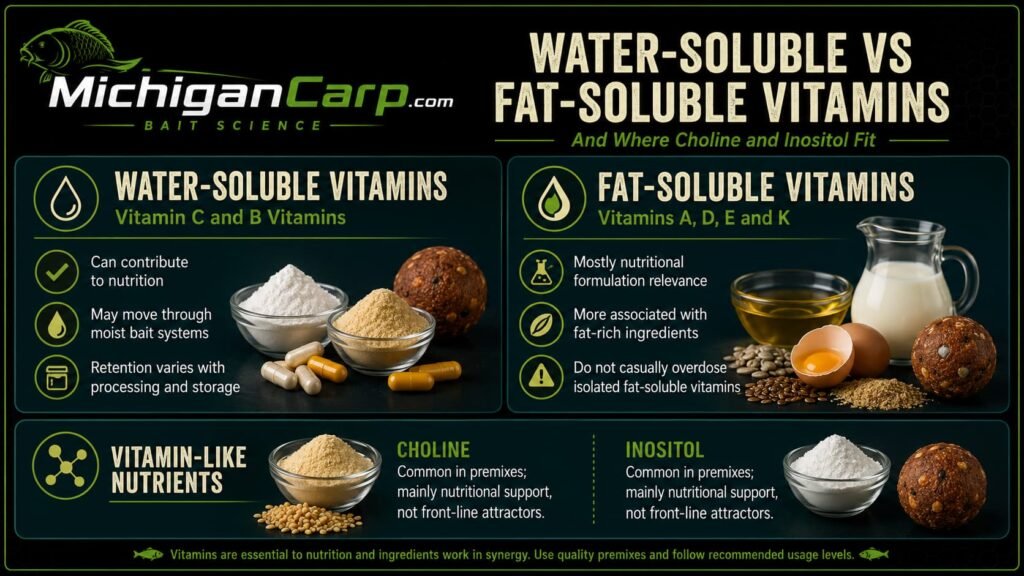
The first useful division is between water-soluble and fat-soluble vitamins.
| Group | Main Examples | Practical Bait Relevance | Main Caution |
|---|---|---|---|
| Water-soluble vitamins | Vitamin C and the B-vitamin group | Can contribute to nutrition and may move through moist or water-exposed bait systems | Retention varies; some forms are vulnerable to processing, oxidation, storage and leaching |
| Fat-soluble vitamins | Vitamins A, D, E and K | Mostly relevant to nutritional formulation and fat-rich ingredients | They can accumulate and should not be casually overdosed |
| Vitamin-like nutrients | Choline and inositol | Often included in fish-feed premixes for nutritional reasons | They should not automatically be described as instant attraction additives |
Water-soluble does not mean instantly attractive, and fat-soluble does not mean stable under every bait-making condition.
Solubility describes how a compound interacts with water or fat. It does not tell us by itself whether carp prefer it, how quickly it escapes from a finished boilie or how much survives storage.
Fat-soluble vitamins deserve particular restraint. I see no practical reason for most home bait makers to dose isolated vitamins A, D or K into boilies. Where those vitamins are genuinely required in a deliberately formulated food bait, a correctly specified fish-feed premix is more sensible than individual dosing.
The Vitamins Most Relevant to Bait Makers
Vitamin C and Ascorbic Acid
Vitamin C deserves more serious discussion than most isolated vitamins because it has nutritional importance, processing challenges and direct common-carp taste evidence.
Controlled tests using agar pellets have reported that ascorbic acid can have an attractive taste for common carp. The important word is taste.
The common-carp carboxylic-acid taste research examined oral responses after fish took experimental pellets. It does not demonstrate long-range attraction, prove that vitamin C pulls carp into a swim or show that adding it to a boilie will increase catches.
It tells us that ascorbic acid can influence palatability under controlled conditions. That makes it worth understanding, but not exaggerating.
Ordinary L-ascorbic acid can also be vulnerable to oxidation, moisture, processing and storage. More stable feed forms include ascorbyl phosphate products, but a stabilized form is not automatically better for every hookbait or boilie application.
Research comparing vitamin C forms in manufactured fish feed has found substantial differences in processing and storage retention. See Stability of Ascorbic Acid and Other Vitamins in Extruded Fish Feeds.
Post-boil use can avoid cooking losses, but it creates different questions:
- How quickly will the ascorbic acid oxidize?
- Will it remain on the bait during storage?
- How much will dissolve before the bait reaches the lakebed?
- How much does it change the coating’s pH?
- Is it compatible with the rest of the preservative system?
For the pH side, read How pH Changes Carp Bait Performance.
Important shelf-life warning
Do not add free ascorbic acid casually to a bait or liquid containing sodium benzoate.
The FDA’s information on benzoate and ascorbic acid explains that trace benzene can form in some beverage systems containing both compounds, particularly when heat and light are involved.
A boilie is not a soft drink, and this evidence does not prove that the same amount forms in every bait matrix. It is still a valid reason not to improvise with ordinary vitamin C inside an untested sodium-benzoate shelf-life system.
Robert’s combined potassium-sorbate, sodium-benzoate and citric-acid system should therefore be treated separately from any experimental ascorbic-acid treatment unless the finished formulation is properly assessed.
Thiamine and Riboflavin — Vitamins B1 and B2
Thiamine and riboflavin are frequently described as fish attractors because both produced strong olfactory responses in rainbow trout.
In the rainbow-trout olfactory study, thiamine and riboflavin were among several compounds that triggered electro-olfactogram responses at low concentrations.
That is legitimate sensory evidence in rainbow trout.
It is not direct proof that common carp detect them at the same concentrations, interpret them in the same way or feed more confidently on a boilie containing them.
For that reason, I would not build a hookbait, liquid or boilie around isolated B1 or B2. They are scientifically interesting, but they remain lower-priority experimental ingredients until better common-carp evidence or controlled field results exist.
Many recipes already contain B-vitamin background through yeast products, grain fractions, eggs, liver ingredients, fortified dairy products or a declared feed premix.
Other B Vitamins, Choline and Inositol
Niacin, pantothenic acid, pyridoxine, folate, biotin and vitamin B12 all have legitimate nutritional functions.
Choline and inositol are also common in aquaculture premixes, although they are better described as vitamin-like nutrients rather than front-line attraction ingredients.
For most home bait makers, there is little value in buying and dosing these compounds individually.
The more logical choices are:
- use a varied base mix with credible food ingredients;
- read the declared vitamin package of fortified ingredients;
- use a correctly specified premix only when deliberate nutritional formulation justifies it;
- avoid adding several overlapping fortified products without calculating the total contribution.
Vitamin E and Tocopherols
Vitamin E belongs mainly in the nutritional and lipid-oxidation discussion.
In fish nutrition, vitamin E supports antioxidant protection within tissues. In bait manufacturing, certain tocopherol products may also be used to slow oxidation in oils and fat-rich ingredients.
Those are related but different jobs.
A feed-grade vitamin E source such as tocopheryl acetate is not automatically identical to mixed tocopherols used to protect an oil. It should also not be confused with an antimicrobial preservative.
Vitamin E does not establish safe shelf life, control mould or replace suitable storage, pH management, water-activity control and retained-sample testing.
It becomes most relevant in baits containing substantial amounts of nuts, seeds, full-fat meals or added oils. For the wider subject, read Oils, Fats and Energy in Carp Bait.
Vitamins A, D and K
I would not recommend dosing these individually into ordinary homemade carp bait.
They are fat-soluble, their appropriate levels depend on the complete diet and excessive supplementation is not a useful form of bait experimentation.
Where they are part of a properly specified fish-feed premix, use the product according to its actual specification and account for fortified ingredients already present in the formula.
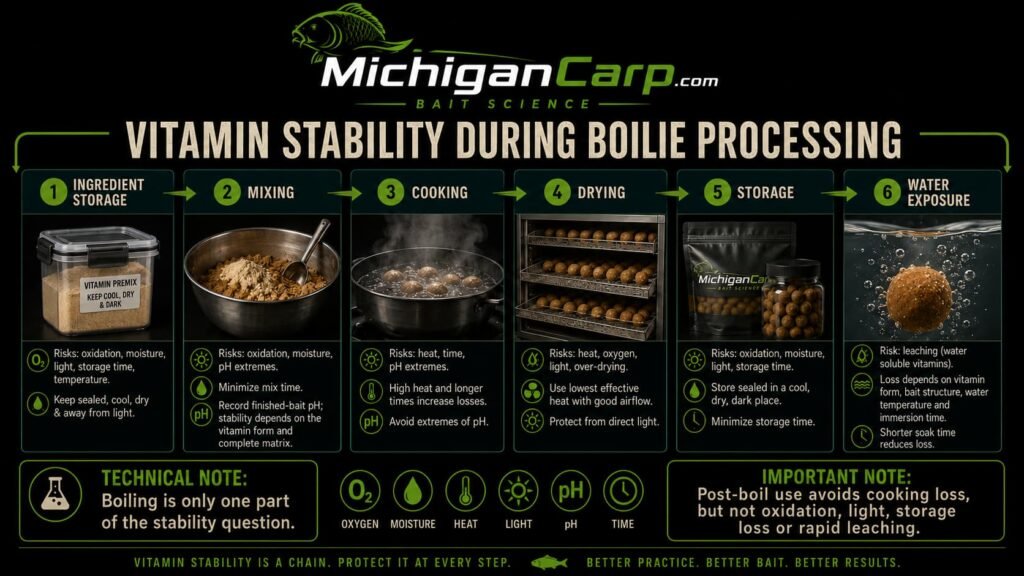
How Mixing, Cooking, Drying and Storage Change Vitamin Value
Vitamin stability is often reduced to one question:
Will boiling destroy it?
The real issue is broader.
Retention can be affected by:
- chemical form;
- temperature and cooking time;
- moisture;
- oxygen exposure;
- light;
- pH;
- trace minerals and other reactive ingredients;
- drying conditions;
- storage temperature and duration;
- leaching after the bait enters water.
| Stage | Main Question | What the Bait Maker Can Control |
|---|---|---|
| Ingredient storage | Was useful vitamin content already lost before mixing? | Buy fresh products, close containers properly and follow label storage instructions |
| Mixing | Does moisture, oxygen or pH create an unstable environment? | Mix consistently and avoid unnecessary holding time before cooking |
| Cooking | How does heat and water exposure affect the selected form? | Use a repeatable cooking process and avoid longer cooking than bait structure requires |
| Drying | Does prolonged warm, bright or oxygen-rich drying accelerate loss? | Dry cleanly with controlled airflow and avoid needless heat or direct sunlight |
| Storage | Does the bait remain stable for weeks or months? | Control moisture, temperature, light and packaging; retain samples |
| Fishing | How much dissolves or leaches before the bait is eaten? | Match placement to the intended job and water time |
A short homemade boil is not identical to industrial extrusion, but that does not mean every vitamin remains unchanged.
It is equally unsafe to assume that everything added after cooking remains intact. A post-boil liquid may avoid heat but still face oxygen, light, storage and rapid water loss.
Smell, colour, pH and jar tests cannot measure actual vitamin retention. Accurate retention data require chemical analysis.
For the wider processing discussion, read What Boiling and Heat Do to Carp Bait Ingredients.
Whole-Food Sources Versus a Vitamin Premix
A useful food ingredient can contribute more than one function at once.
Yeast products, wheat germ, eggs, liver ingredients, milk powders, milk replacers, nuts, seeds and grain fractions can all contribute some micronutrient background while also affecting protein, fat, taste, texture, solubility or bait structure.
That does not mean their vitamin content is fixed or nutritionally complete.
| Ingredient | Why It May Be Useful | What Must Be Checked |
|---|---|---|
| Brewers or nutritional yeast | Food character, protein and potential B-vitamin background | Fortified and unfortified products are different; read the label |
| Wheat germ | Cereal nutrition, oil, texture and micronutrient background | Freshness and fat oxidation |
| Eggs and egg yolk | Protein, lipid, emulsification, structure and micronutrients | Batch size and total fat contribution |
| Liver powder or hydrolysate | Food signal, protein-derived material and broad nutrient complexity | Product concentration, salt and storage |
| Milk powders and milk replacer | Protein, carbohydrate, fat and sometimes declared vitamin fortification | The guaranteed analysis and exact ingredient statement |
| Nuts and seeds | Energy, texture, natural-food character and varied micronutrients | Freshness, rancidity and total fat level |
For ingredient-function comparisons, use Bait Ingredients.
Where a formula uses a fortified calf milk replacer, the declared vitamin package should be assessed before adding another premix. That belongs in the protected draft Milk Replacer for Carp Bait: How to Read the Label.
When a premix may make sense
A fish-feed vitamin premix may be reasonable when:
- the bait is being deliberately formulated as a repeat-fed food bait;
- the recipe uses a narrow range of ingredients;
- the product has a complete specification;
- the intended species and inclusion instructions are clear;
- overlap from fortified ingredients has been calculated;
- the bait maker understands that the premix supports nutrition rather than guaranteeing attraction.
What to read on the premix label
- intended animal or fish species;
- amount of each active vitamin per unit of product;
- recommended inclusion rate;
- chemical form of vitamin C and vitamin E;
- whether choline is included separately;
- carrier ingredients;
- added minerals and trace elements;
- medications or other functional additives;
- manufacture date, expiry date and storage instructions.
Do not assume that a poultry, livestock or human product is suitable simply because it contains vitamins. Its mineral loading, carrier system, medication status and intended inclusion rate may be completely different from the bait-making job.
Where Vitamins Fit in a Practical Carp-Bait System
| Bait Situation | Vitamin Priority | Practical Approach |
|---|---|---|
| Single short session | Low | Prioritize location, presentation, soluble food signal and bait quantity |
| Hookbait or small PVA presentation | Low to experimental | Do not add a full premix; test only a clearly defined compound with a matched control |
| Method mix or packbait | Usually low | Whole-food ingredients and yeast products normally make more sense than isolated vitamins |
| Repeated food-boilie campaign | Moderate | Review the whole formula and consider a specified fish-feed premix only where it solves a defined nutritional gap |
| Fat-rich milk, nut or seed bait | Moderate background relevance | Control ingredient freshness and oxidation; do not assume vitamin E repairs rancid ingredients |
| Shelf-life bait | Specialist | Evaluate vitamin form alongside pH, water activity, preservatives, packaging and retained-sample testing |
When the immediate objective is a detectable food-related signal, amino acids, peptides, hydrolysates, organic acids and soluble food liquids are generally more direct areas to examine.
That does not make every product in those categories attractive. It means their relationship to water-active food signal is more direct than the broad statement that a bait is “vitamin enriched.”
For that distinction, read Carp Feeding Attractants Explained and Proteins, Peptides and Hydrolysates in Carp Bait.
My practical interpretation for a varied milk, nut and birdfood boilie is that eggs, dairy ingredients, yeast, wheat germ, liver products, nuts and seeds already provide a broad nutritional background.
That does not prove the bait is vitamin-complete. It means a separate vitamin premix is not automatically the next improvement.
I would first examine:
- ingredient freshness;
- protein balance;
- fat level and oxidation;
- paste and cooking behaviour;
- water entry and soluble release;
- preservation and storage;
- consistent field performance.
How to Test a Vitamin Addition Properly
There is no responsible universal vitamin-premix dose for homemade boilies because premixes vary enormously in potency, carrier, intended species and recommended inclusion.
Do not copy a gram figure from another product.
Only run a comparison when the product:
- has a complete label;
- is appropriate for fish-feed use;
- contains no unsuitable medication or additive;
- provides enough information to calculate the intended inclusion accurately.
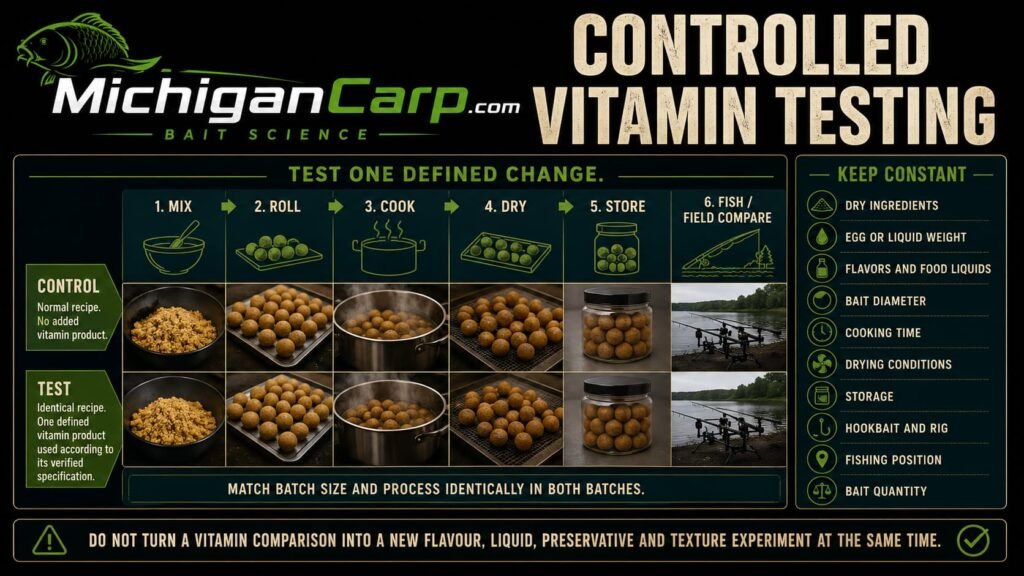
Use two matched batches
| Batch | Treatment |
|---|---|
| Control | Your normal recipe with no additional vitamin product |
| Test | The identical recipe with one defined vitamin product used according to its verified specification |
Keep everything else constant:
- dry ingredients;
- egg or liquid weight;
- flavours and food liquids;
- bait diameter;
- cooking method and time;
- drying conditions;
- storage;
- hookbait and rig;
- fishing position and bait quantity.
Record whether the addition changes:
- paste texture;
- rolling;
- colour or smell;
- cooked structure;
- drying;
- water uptake;
- softening or breakdown;
- storage stability;
- repeat field results.
A vitamin test cannot be judged from one carp, one session or a more colourful bait. Repeat the comparison across similar opportunities and record blanks as well as captures.
Test one defined change. Do not turn a vitamin comparison into a new flavour, liquid, preservative and texture experiment at the same time.
Common Mistakes
- Treating every vitamin as an attractor. Most belong primarily in the nutritional discussion.
- Copying an aquaculture requirement into a boilie recipe. Complete-feed trials and intermittent recreational bait are different feeding situations.
- Assuming more is better. Micronutrients are required in small, controlled amounts.
- Using B1 or B2 as though common-carp attraction were proven. The strongest cited olfactory evidence comes from rainbow trout.
- Calling ascorbic acid a long-range attractor. Direct carp evidence concerns taste and oral acceptance under controlled conditions.
- Assuming post-boil use solves stability. Oxidation, light, moisture, storage and water exposure remain.
- Combining free ascorbic acid and sodium benzoate casually. Their documented interaction in some food systems deserves formulation caution.
- Confusing vitamin E with microbial preservation. Tocopherols do not establish safe shelf life.
- Using human or livestock supplements without reading the complete label. The carrier, minerals, medication and concentration all matter.
- Doubling up fortified ingredients. Milk replacer, yeast, premixes and other products may already overlap.
- Adding a premix before fixing the main bait. Poor location, weak presentation, rancid fat, bad texture or unsuitable storage will not be rescued by vitamins.
Final Verdict
Vitamins have a legitimate place in carp-bait science, but their value depends on assigning them the correct job.
Most vitamins belong mainly in the nutritional background of a food bait. They should not be advertised or used as though they were one powerful attraction package.
Vitamin C is the strongest individual case for further bait discussion because it combines nutritional relevance, controlled common-carp taste evidence and important processing chemistry. Even then, it should not be called a proven long-range attractor, and free ascorbic acid should not be combined casually with sodium benzoate.
Thiamine and riboflavin remain scientifically interesting because of trout olfactory research, but that evidence does not establish their value as common-carp additives.
Vitamin E, choline, inositol and broader vitamin premixes make the most sense when deliberately supporting a repeat-fed food bait—not when trying to force instant attraction into a hookbait.
For most Michigan sessions, the larger priorities remain fish location, timing, presentation, bait condition, water-active food signal and sensible feeding.
Use vitamins where the complete bait genuinely needs them. Do not add them merely because a technical label makes the recipe look more advanced.
FAQ
Do vitamins attract carp?
Most vitamins should be treated primarily as nutrients rather than powerful attractors. Ascorbic acid has produced attractive taste responses in controlled common-carp testing, but that does not prove long-range attraction or improved fishing results.
Is vitamin C useful in carp bait?
It can be relevant nutritionally and may affect oral acceptance. Its usefulness depends on chemical form, processing, storage, pH and compatibility with other ingredients. Ordinary ascorbic acid is less stable than some feed-grade phosphate forms.
Are vitamins B1 and B2 proven carp attractors?
No. Thiamine and riboflavin produced strong olfactory responses in rainbow trout research, but equivalent common-carp attraction has not been established.
Does boiling destroy all the vitamins in boilies?
No. Retention depends on the specific vitamin, its chemical form, cooking time, moisture, oxygen, pH, drying and storage. It is equally incorrect to assume that boiling changes nothing.
Should every homemade boilie contain a vitamin premix?
No. A premix is most defensible when deliberately formulating a repeat-fed food bait and when the product specification, existing ingredient contribution and intended inclusion are understood.
Can vitamin C be used with sodium benzoate?
Do not combine them casually. Benzoate and ascorbic acid can form trace benzene in some food and beverage systems under certain conditions. A boilie matrix is different, but the interaction justifies avoiding an untested combination.
Does vitamin E preserve shelf-life bait?
Not by itself. Vitamin E has nutritional antioxidant functions, and some tocopherol products can help protect fats from oxidation. It does not control mould, yeast or bacteria and does not validate shelf life.
Can I use crushed human multivitamins?
They should not be used blindly. Human tablets may contain unsuitable concentrations, mineral combinations, coatings, sweeteners and binders. A defined fish-feed ingredient is more appropriate when a genuine formulation need exists.