
Boilie School: Learn to Make Carp Boilies Step by Step
Learn the ingredients, make your first batch and understand why your bait behaves as it does. Follow six practical lessons from boilie basics to fishing the finished bait.
New to boilies? Follow the Boilie School beginner route. Already making your own? Jump to the lesson or specialist reference you need—without working through the whole course again.
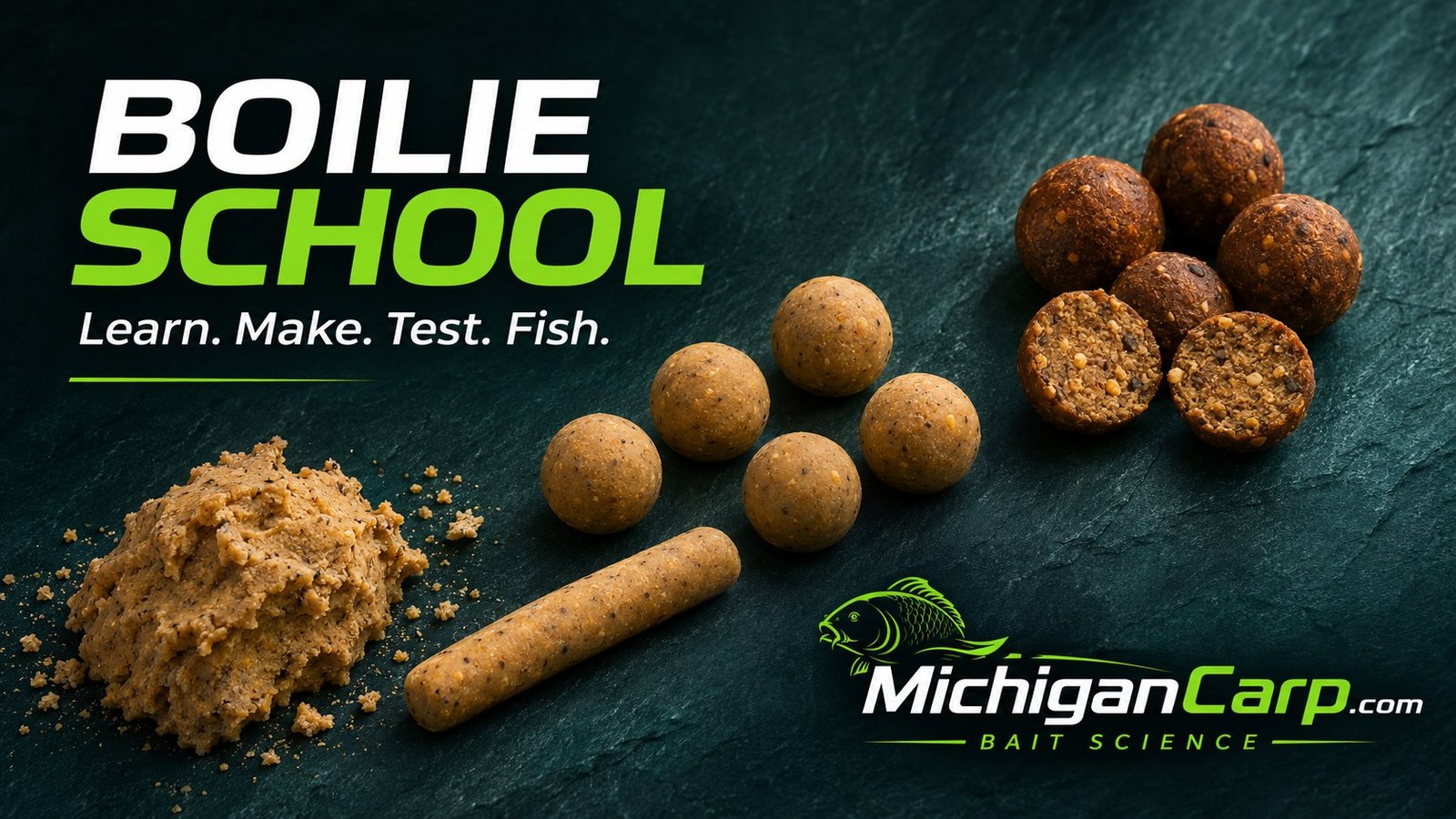
Choose the Right Starting Point
Boilie School is a course and a reference library. Choose the route that matches your experience rather than reading every guide in one sitting.
Make Your First Boilie
Start with the beginner journey, learn the essential equipment and ingredients, and practise on a manageable batch before trying complex formulas.
Follow the beginner journey →Understand Your Base Mix
Learn what different ingredients contribute, then choose a coherent marine, birdfood, milk/nut or hybrid direction.
Start with ingredients (BS-02) →Improve Making and Consistency
Work through mixing, resting, rolling, cooking and drying. Diagnose specific problems rather than adding ingredients at random.
Go to the making lesson (BS-05) →Six Boilie School Lessons, in Order
The six Boilie School lessons build on one another, but every page can also be used as a standalone reference.
Boilie Basics
What boilies are, when to use them, and where they fit alongside maize, particles, packbait and other carp baits.
Read lesson BS-01 →What Goes into a Boilie?
Understand protein, cereals, solubles, fats, texture, binding and cost before choosing powders for a recipe.
Read lesson BS-02 →Choose a Base Mix Family
Compare marine, birdfood, milk/nut and hybrid mixes—and learn to select a bait family before fine-tuning quantities.
Read lesson BS-03 →Liquids and Additives
Make sense of eggs, liquid foods, flavours, oils, sweeteners, salt and other additions without overcomplicating the mix.
Read lesson BS-04 →Making Boilies Step by Step
Mix, rest, roll, cook, dry and test your bait. Record the process so a successful batch can be repeated.
Read lesson BS-05 →Fishing with Boilies
Use whole and chopped boilies, crumb, pop-ups, wafters and sensible baiting patterns alongside sound watercraft.
Read lesson BS-06 →Core principle: a bait you can make, evaluate and repeat is more useful than a complicated recipe whose ingredients and processing you cannot explain.
Build Better Recipes by Understanding the Ingredients
Once the Boilie School basics feel comfortable, explore how a product’s composition and form affect the mix. A concentrate, isolate, meal and whole powder may carry similar names but behave quite differently.
Milk Proteins
Understand caseins, caseinates, whey and dairy powders by function and specification—not marketing claims.
Explore the Milk Proteins Hub →Compare Bait Ingredients
Use the ingredient library for vegetable proteins, marine products, nut and seed meals, and other ingredient groups.
Explore the ingredient guides →Bait Science
Look more closely at texture, solubility, leakage, processing and the limits of what simple water tests can prove.
Open Bait Science →Detailed dairy references: Caseins and caseinates · Whey powders in boilie mixes.
Make, Check and Store Your Boilies
A promising recipe can fail through poor paste handling, cooking, drying or storage. Use these practical guides after the core making lesson.
Scale a Recipe
Use the free calculator to set a test batch, compare ingredient proportions and record the quantities you actually use.
Open the Carp Bait Calculator →Boil and Dry
Understand what happens during cooking and drying, and why surface hardness alone does not establish storage stability.
See the boiling and drying guide →Troubleshoot Problems
Work systematically through cracking, sticky paste, poor rolling, overly hard bait and other process problems.
Find causes and fixes →Test Before Fishing
Check swelling, softening, texture, buoyancy and hookbait behaviour in water before relying on a new batch.
Test your boilies →Store Homemade Bait
Distinguish frozen, air-dried and validated shelf-life products; do not assume a hard or dry-looking bait is shelf stable.
Read the storage guide →Treat the Finished Bait
Explore coatings, soaks and hookbait treatments, then recheck texture and buoyancy after any treatment.
Prepare and treat boilies →A useful test batch: keep an unchanged reference sample, note the exact recipe and process, and change one thing at a time wherever possible.
Where Boilie School Fits on MichiganCarp.com
Boilie School teaches the bait-making course. The related hubs answer different questions once you know the basics.
The Bait Shed
Use the practical workshop for preparing particles, treating bait, storage and bench testing.
Visit The Bait Shed →Carp Bait Guide
Compare boilies with maize, tiger nuts, packbait and other bait options for your fishing situation.
Explore the Carp Bait Guide →Tactics and Watercraft
Bait needs to be in the right place at the right time. Learn to read conditions and plan how to fish it.
Rigs and Presentation
Match the finished hookbait to bottom conditions, rig mechanics and your chosen presentation.
Explore carp rigs →For local restrictions and current requirements, check the official Michigan Fishing Regulations.
Boilie School Questions
I’m completely new to making boilies. Where should I begin?
Start with the Beginner Boilie Journey, then BS-01 through BS-05. Begin with a small, documented batch before attempting an elaborate recipe.
Do I have to read all six lessons?
No. They are organised as a learning sequence, but experienced bait makers can go directly to the lesson that solves a particular problem.
Can I replace one milk protein or meal with another by weight?
Not automatically. Ingredient forms and specifications vary. Compare the product you actually have and test recipe changes in a small batch. The Milk Proteins Hub explains the dairy examples.
How can I tell whether my new boilie is working?
First check the repeatable things: rolling, cooking, water behaviour, storage handling and rig presentation. A visible cloud or a softening bait does not, by itself, prove attractiveness to carp. Reliable conclusions from fishing need repeated comparisons and careful records.
Start Simple. Learn from Each Batch.
The Boilie School approach is to understand the ingredients, make a boilie that holds together, test how it behaves and take what you have learned to the water. Build complexity only when it solves a clear problem.