
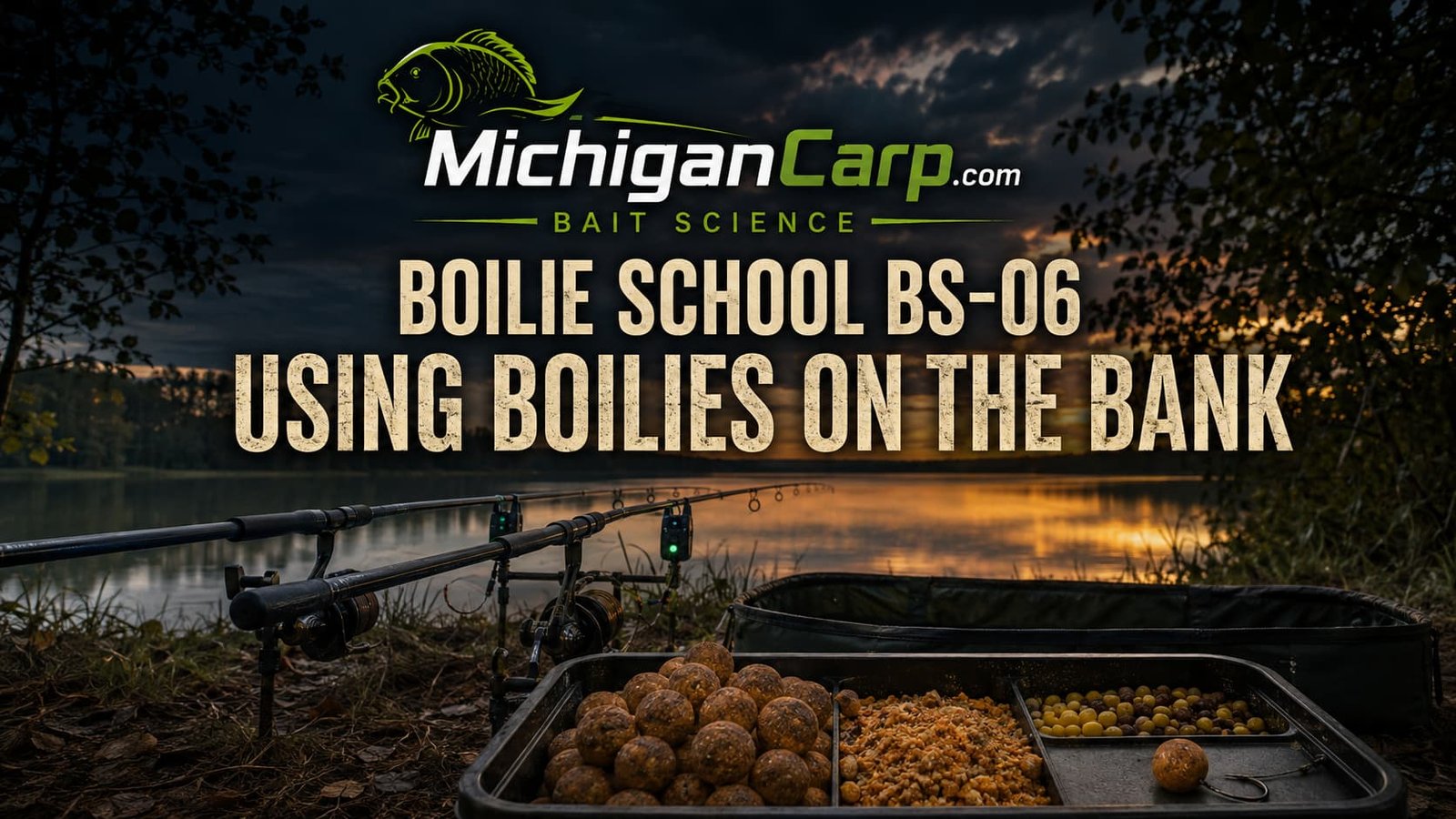
Using boilies on the bank is where bait theory has to become carp fishing.
By this point in Boilie School, you should understand what boilies are, what ingredients do, how base mix families differ, how liquids work, and how to mix, roll, boil, dry and store bait.
Now the question changes.
It is no longer “Can I make boilies?” It becomes “How do I fish them properly?”
This is where many anglers waste good bait.
They build a decent boilie, then use it randomly. They bait before finding fish. They feed too much before they know carp are present. They use hookbaits that do not match the free food. They change boilies after one quiet session. They fish three rods three completely different ways and never learn what actually happened.
Boilies are not magic balls. They are a tool.
Used properly, boilies can help create a feeding area, give carp a repeatable food item, select better fish, support multi-day sessions and build confidence over time. Used badly, they are just expensive round bait.
My BS-06 rule is simple:
Location first. Baiting style second. Hookbait third. Then adjust from what the water tells you.
BS-06 follows Boilie School BS-05: Making Boilies Step by Step and finishes the main Boilie School sequence. For preparing bait before fishing, use How to Prepare Boilies for Carp Fishing. For bait release and format choices, use Why Surface Area Matters in Carp Bait and Carp Bait Solubility and Leakage.
Boilie School navigation: Previous Lesson: BS-05 — Making Boilies Step by Step | Back to Boilie School Hub.
For location and watercraft, use How to Locate Carp Before You Cast, Reading a Lake Like a Carp Angler, Signs Carp Are Feeding and Best Depth for Carp Fishing.
For official rules and water data, check Michigan Fishing Regulations and USGS Michigan Water Data before fishing unfamiliar waters.
Table of Contents
Quick Start: Using Boilies on the Bank
If you want to fish boilies properly, start with one of three simple approaches.
| Situation | Best starting approach | Main idea |
|---|---|---|
| Short session or uncertain swim | Single hookbait with tiny attraction | Find a bite without overfeeding |
| Day session or overnight | Small dinner-plate baiting pattern | Create a compact feeding zone |
| Repeated sessions or known area | Controlled campaign feeding | Build recognition and confidence over time |
Using boilies on the bank works best when the baiting style matches the session length, the fish signs and the amount of confidence you have in the swim.
The biggest beginner mistake is trying to fish every approach at once.
One rod on a single hookbait, one rod over a big bed, one rod on particles, random top-ups, different hookbaits on every rod and a flavour change after two quiet hours does not teach you much.
A better plan is:
Choose the area.
Choose one baiting style.
Fish a believable hookbait.
Watch for signs.
Adjust slowly.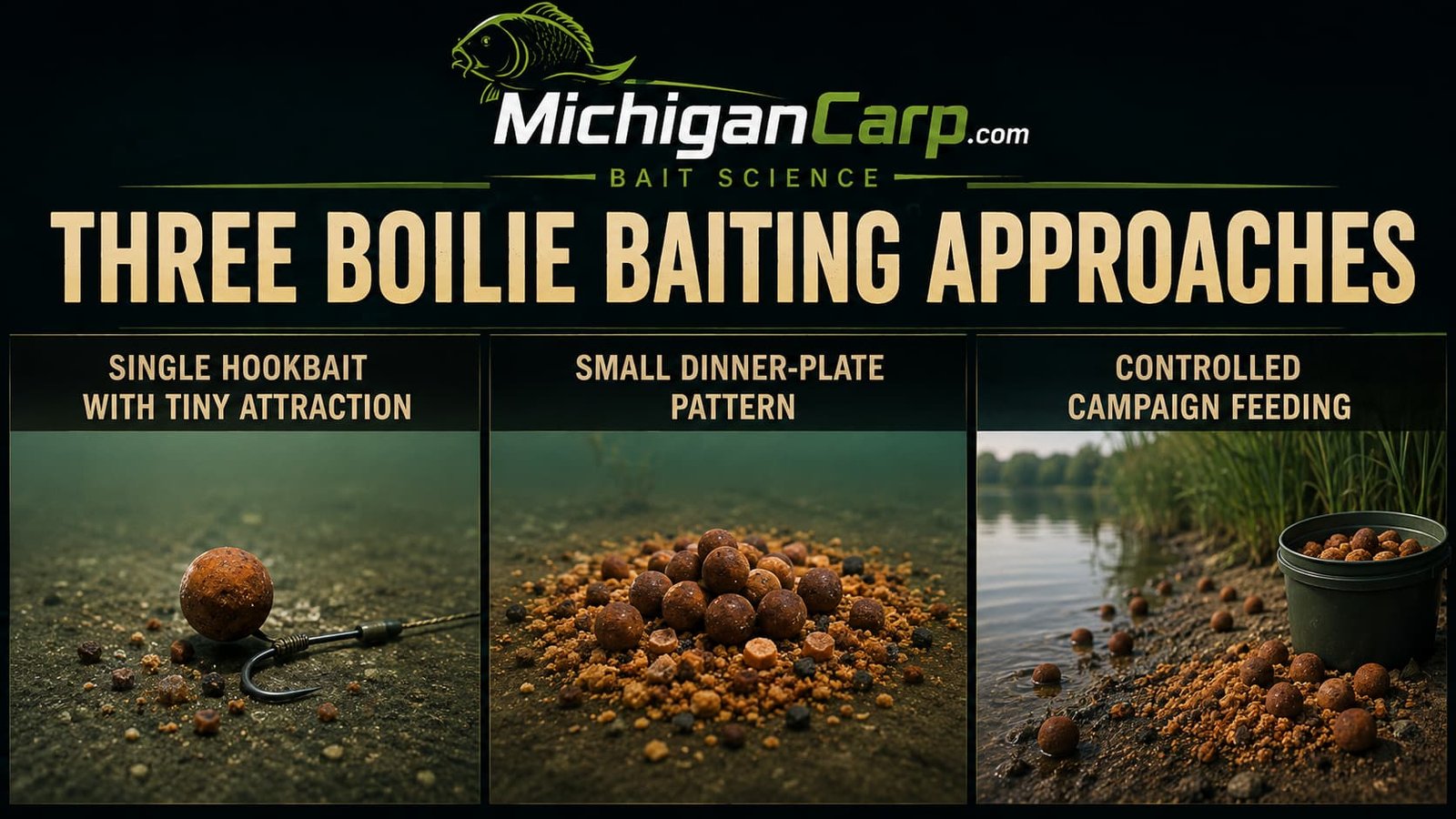
Boilies Do Not Fix Poor Location
This is the most important bank-side lesson.
A good boilie cannot catch carp that are not there.
Before baiting, ask whether you have seen fish, bubbles, fizzing, clouded water, rolling carp, bird activity, a known travel route, natural food, useful wind, suitable depth or a clean enough area to present a rig.
If the answer is no, bait is not the first problem.
Location is.
Boilies work best when they are placed where carp already want to be.
| Before baiting, check | Why it matters |
|---|---|
| Fish signs | Rolling, fizzing, bubbling or clouding show life in the area |
| Depth | Season and temperature affect where carp are comfortable |
| Wind and current | Food, scent and carp movement can be influenced by water movement |
| Natural food | Snails, mussels, weed edges and soft areas can hold carp |
| Bottom condition | A good boilie on a masked rig is still poor fishing |
| Safe access | Accurate fishing and fish care matter more than clever bait |
Use boilies to make a good situation better. Do not use them to excuse poor watercraft.
What Boilies Are Doing on the Bank
A boilie can have several jobs on the bank.
| Boilie job | Practical use |
|---|---|
| Single hookbait | Minimal bait, short sessions, cautious fish and low disturbance |
| Small feeding patch | Day sessions, overnight sessions and controlled baiting |
| Selective food item | When particles may hold fish but boilies help pick better fish |
| Campaign bait | Repeated sessions where fish learn a food source |
| Durable hookbait | Longer sits, nuisance pressure and rig reliability |
| Recognizable food source | Building confidence over time with one bait identity |
The same boilie does not have the same job in every situation.
A single 20 mm bottom bait with a tiny mesh bag is not the same strategy as feeding several pounds of bait before dark. The bait may be identical. The method is not.
Choose the role before deciding how much to feed.
Single Hookbait With Tiny Attraction
This is the simplest boilie approach.
It is useful when the session is short, the swim is uncertain, the water is pressured, fish are showing but not feeding hard, nuisance fish are active, or you want minimum disturbance.
| Part of the approach | Practical setup |
|---|---|
| Hookbait | Bottom bait, trimmed bottom bait, wafter, small snowman or subtle pop-up |
| Free bait | A few crumbs, chops or a tiny PVA stick |
| Disturbance | Low |
| Best use | Short sessions, showing fish, cautious fish or searching rods |
| Top-up rule | Do not keep feeding unless signs justify it |
This approach is not weak. It is controlled.
A single boilie in the right place can beat a large bed of bait in the wrong place.
Top up only when you see evidence: liners, fizzing, a bite, cleared bait, nuisance fish removing food or fish actively showing in the area.
The Small Dinner-Plate Pattern
The small dinner-plate pattern is one of the most useful boilie strategies for Michigan public-water carp.
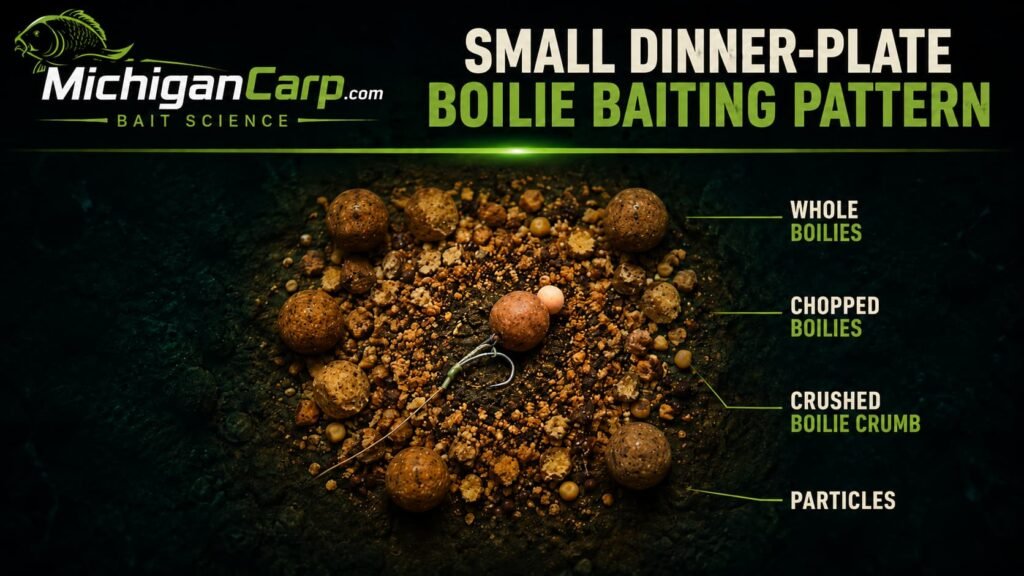
The idea is not to carpet the lake bed. The idea is to create a small, believable feeding zone that makes a carp slow down and search.
A dinner-plate pattern may include whole boilies, chopped boilies, crumb, a few matching particles and one hookbait placed inside or just at the edge.
| Component | Job |
|---|---|
| Whole boilies | Longer-lasting food items |
| Chopped boilies | Irregular pieces and faster release |
| Crushed boilie crumb | Fast signal and small food particles |
| Small particle support | Optional grubbing and confidence |
| Hookbait | The trap inside or near the feeding zone |
The patch should not contain so much bait that a fish can feed for ages without finding the hookbait.
For a day session or overnight, a good starting point is a few whole boilies, a few chopped boilies, a small handful of crumb and optional particle support. Adjust from signs and results.
Controlled Campaign Feeding
Campaign feeding means using the same bait in the same general areas over time.
This can be powerful, but it is often misunderstood.
Campaign feeding does not mean dumping huge amounts of bait into a random lake. It means building recognition and confidence around a bait and a location.
| Good campaign feeding | Poor campaign feeding |
|---|---|
| Starts with a proven area | Starts by dumping bait randomly |
| Uses modest repeated feeding | Assumes more bait always helps |
| Keeps bait type consistent | Changes bait after every quiet session |
| Observes fish response | Feeds without checking signs |
| Builds gradually | Overfeeds before fish confidence is established |
The campaign mistake is starting too heavy.
A better approach is to prove the area, introduce bait modestly, watch for signs, fish it, then increase only if fish response justifies it.
Campaign feeding should create confidence. It should not create waste.
Whole, Chopped and Crushed Boilies
Boilies do not need to be used only as perfect round balls.
Whole, chopped and crushed boilies do different jobs.
| Boilie form | Best use | Main behaviour |
|---|---|---|
| Whole boilies | Longer sits, bigger fish strategies and clear food items | Slower release and more selectivity |
| Chopped boilies | Small patches, irregular feed and natural-looking pieces | More exposed surface and faster release |
| Crushed boilies | PVA sticks, quick signal and short-session attraction | Fast local activity without heavy feeding |
| Boilie dust | Stick mixes, paste, crumb coatings and small traps | Very fast release and short-range signal |
My default boilie feed often uses all three: whole, chopped and crushed.
That gives both food items and quicker signal. A patch made only from whole 24 mm boilies behaves very differently from the same amount broken into mixed sizes.
For the deeper bait-format guide, use Why Surface Area Matters in Carp Bait.
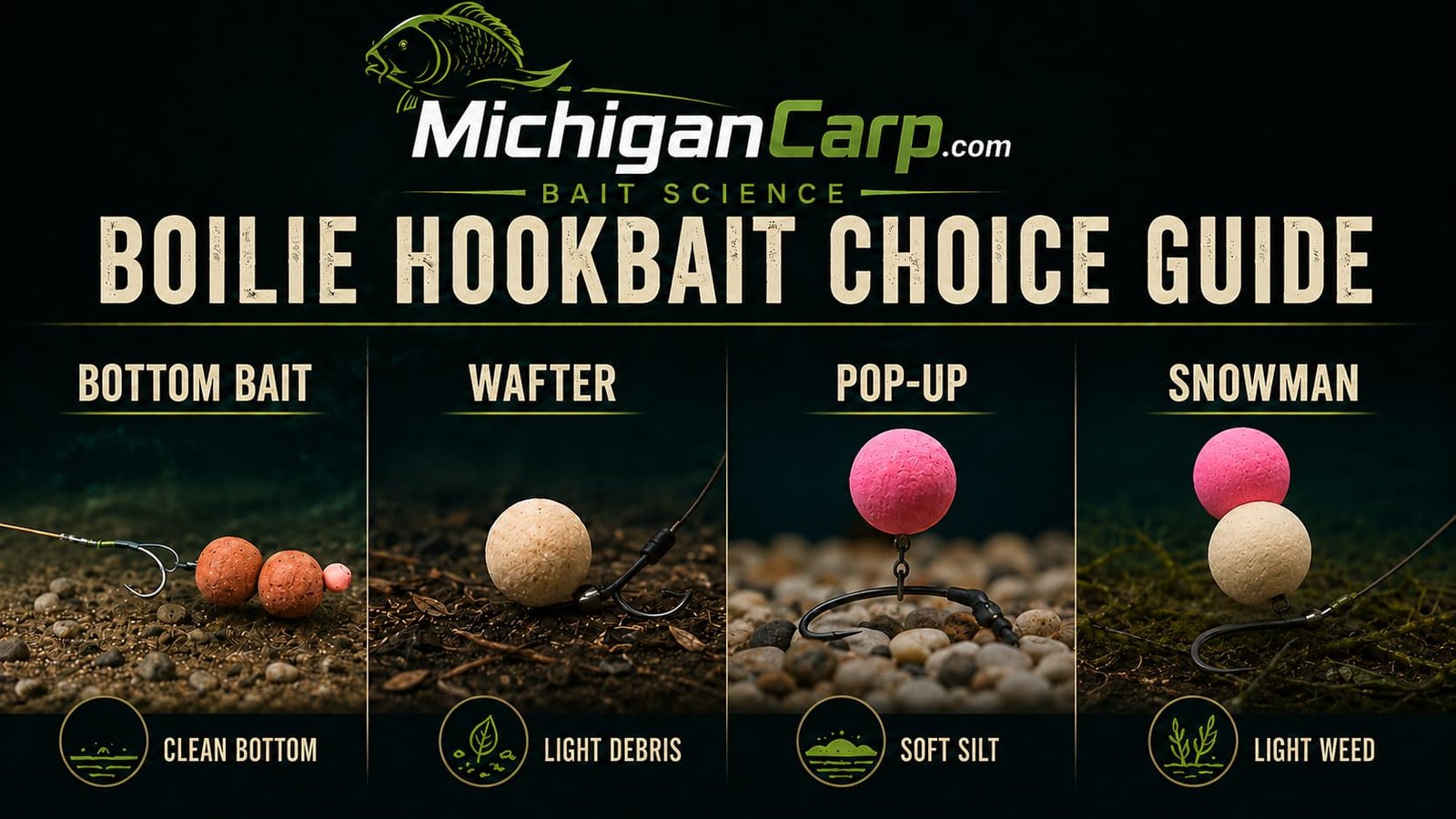
Hookbait Choice: Bottom Bait, Wafter or Pop-Up
Hookbait choice should be based on the lake bed, the feeding situation and the rig.
| Hookbait type | Best use | Main warning |
|---|---|---|
| Bottom bait | Clean bottoms, confident feeding and matching freebies | Can be poor if buried in silt, weed or debris |
| Wafter | Balanced pickup, cautious fish and subtle presentation | Must be tested with the actual hook and rig |
| Pop-up | Weed, silt, debris or deliberate visual separation | Should not be used just because it looks good in the tub |
| Snowman | Slight lift, big-food signal and controlled visual contrast | Can ruin mechanics if not balanced properly |
A bottom bait is the confidence choice when the bottom is clean enough and you want the hookbait to behave like the free offerings.
A wafter is useful when you want easier pickup without an obvious high pop-up.
A pop-up is useful over weed, silt or debris, or when the rig is designed for a raised presentation.
A snowman can work when you want a large boilie-based bait with slight lift and contrast.
For balanced bait making, use How to Make Wafters and Pop-Ups From a Boilie Base Mix.
Keep the Hookbait Believable
Your hookbait does not have to match the free boilies exactly, but it should usually stay in the same world.
If you are feeding a creamy nut bait, a hookbait with cream, nut, vanilla, maple or fruit-and-cream logic makes sense. If you are feeding a marine bait, a hookbait with fish, krill, liver, squid or savoury yeast logic makes sense.
The problem is using a hookbait that feels completely disconnected from the feeding area without deliberately testing that contrast.
| Free bait direction | Believable hookbait direction |
|---|---|
| Milk/nut boilie | Cream, nut, vanilla, maple, plum/cream or sweet dairy |
| Birdfood boilie | Seed, cereal, fruit, cream, yeast or matching base mix |
| Marine boilie | Fish, krill, liver, squid, yeast or savoury profile |
| Particle-heavy feed | Tiger nut, peanut, maize-compatible or matching boilie |
Bright singles and standout hookbaits can work, but as a default boilie strategy I prefer believable first. Then I test standout hookbaits deliberately.
How Many Boilies Should You Use?
There is no universal answer.
The right amount depends on fish presence, fish numbers, water size, session length, season, nuisance fish, natural food, bait size and whether particles are also used.
The safest rule is:
Start lighter than your ego wants. You can usually add bait. You cannot easily remove bait from the lake.
| Session type | Starting boilie approach |
|---|---|
| Short session | Single hookbait, tiny PVA stick and a few crushed or chopped boilies |
| Day session | Small patch of whole, chopped and crushed boilies |
| Overnight session | Modest start, then top up from signs, liners, fizzing or a bite |
| Multi-day session | Planned bait by day, controlled top-ups and careful response reading |
| Campaign | Small repeated feeding that builds only when fish response supports it |
A long session is not an excuse to dump bait blindly. Start with a plan, read the water and build only if fish respond.
Three-Rod Boilie Layout
If you fish multiple rods, do not make every rod random.
A useful three-rod learning layout might look like this:
| Rod | Role | What it teaches |
|---|---|---|
| Rod 1 | Tight single or tiny trap | Whether fish will pick up a minimal boilie presentation |
| Rod 2 | Small dinner-plate patch | Whether a controlled feeding zone is working |
| Rod 3 | Edge, travel line or slightly different depth | Whether fish are approaching rather than sitting in the bait |
That kind of layout teaches you something.
If every rod has different bait, different rig, different distance and different feeding pattern, the session becomes harder to read.
For rig safety and presentation, use The Complete Michigan Carp Rig Guide.
Where to Place the Hookbait
The hookbait does not always need to sit in the center of the free bait.
| Hookbait position | When it makes sense |
|---|---|
| Center of the patch | Fish are feeding confidently, the patch is small and the bottom is clean |
| Near edge of the patch | Fish are cautious, bigger fish hang back or the bottom is mixed |
| Slightly beyond the patch | Fish approach from a known direction or you want interception |
| Clear spot beside weed | You want bait close to cover without masking the hook |
| Travel route into the bait | You want the hookbait found before the main feed |
Do not cast randomly into the bait. Place the rig with purpose.
When to Top Up
Top-ups should be based on evidence.
| Good reason to top up | Poor reason to top up |
|---|---|
| You catch a fish | Boredom |
| Fish are visibly feeding | Panic |
| Liners show fish moving through | Copying someone else |
| Fizzing continues | Assuming more bait is always better |
| Bait is clearly being eaten | Trying to force action in a dead area |
| You are entering a known feeding window | Because nothing has happened for 20 minutes |
After a bite, ask whether it was a single passing fish, whether the area still shows activity, whether the fight disturbed the swim, whether other rods are quiet and whether a feeding window is opening.
Sometimes a small top-up is correct. Sometimes doing nothing is better.
Boilies and Particles
Boilies and particles can work very well together, but they need clear roles.
Particles such as maize, hemp, pigeon feed, tiger nuts and peanuts can create grubbing, feeding activity, longer search time and a wider food area.
Boilies can provide larger food items, selectivity, a consistent hookbait match and durable food in the same zone.
| Feed item | Main role | Warning |
|---|---|---|
| Particles | Hold fish grubbing and searching | Too many particles can dominate the feeding situation |
| Whole boilies | Selective larger food items | Too many can overfeed slow fish |
| Chopped boilies | Intermediate food and faster release | Can spread activity if used too widely |
| Crumb | Fast local signal | Shorter-lived than whole bait |
| Hookbait | The trap | Should not be buried under uncontrolled feed |
The mistake is adding everything. A bucket containing maize, hemp, tigers, peanuts, pigeon feed, pellets, boilies, groundbait and several liquids can work, but it can also become impossible to interpret.
If you are learning a boilie, do not bury it under too many other feeds. Let the boilie do some of the work.
For particle preparation and safety, use Particles for Carp Fishing Guide.
Seasonal Boilie Use
Season does not create fixed rules, but it changes bait quantity, oil tolerance, fish movement and feeding confidence.
| Season | Boilie approach |
|---|---|
| Spring | Smaller patches, lower oil, accurate placement, crumb for faster signal and careful location |
| Summer | Stronger food baiting may work, but watch oxygen, weed, nuisance fish and boat traffic |
| Fall | Food-bait consistency, repeat areas and controlled campaign thinking can be strong |
| Cold water | Fewer freebies, smaller zones, lower oil, accurate placement and longer waiting time |
For broader seasonal planning, use Spring Carp Fishing in Michigan, Summer Carp Fishing in Michigan and Fall Carp Fishing in Michigan.
Cold water does not mean boilies stop working. It means the strategy should tighten up.
Big Lakes, Channels, Weed and Silt
Michigan boilie fishing often happens on big, public, lightly understood waters. That changes how boilies should be used.
| Water or bottom type | Boilie thinking |
|---|---|
| Big natural lakes | Location, wind, depth, weed edges and repeatability matter more than random heavy baiting |
| Channels and current | Think about flow direction, undertow, bait rolling, scent movement and rig stability |
| Light weed | Use clear spots, wafters, pop-ups or solid bags where appropriate |
| Soft silt | Balanced hookbaits, pop-ups and careful rig retrieval checks matter |
| Debris | Avoid dropping a rig into a mess and hoping the boilie fixes it |
On big lakes, I would rather start with a tight baited area, a believable hookbait, a second rod on a travel line and controlled top-ups than begin with heavy baiting in a swim I have not proven.
Big water punishes assumptions.
For big-water tactics, use How to Find Carp in Big Lakes and Big-Lake Carp Tactics.
Reading the Session
A boilie session gives feedback. You need to watch for it.
| Signal | What it may mean | Possible adjustment |
|---|---|---|
| Fizzing, liners or rolling fish | Fish are present or moving through | Hold steady, top up lightly or place a rod on the edge |
| Clouded water | Feeding activity or disturbance | Keep rigs clean and avoid unnecessary recasting |
| Cleared bait | Fish or nuisance species are eating | Check signs, adjust amount and protect hookbait |
| Rigs masked on retrieve | Presentation problem | Change rig, hookbait buoyancy or placement |
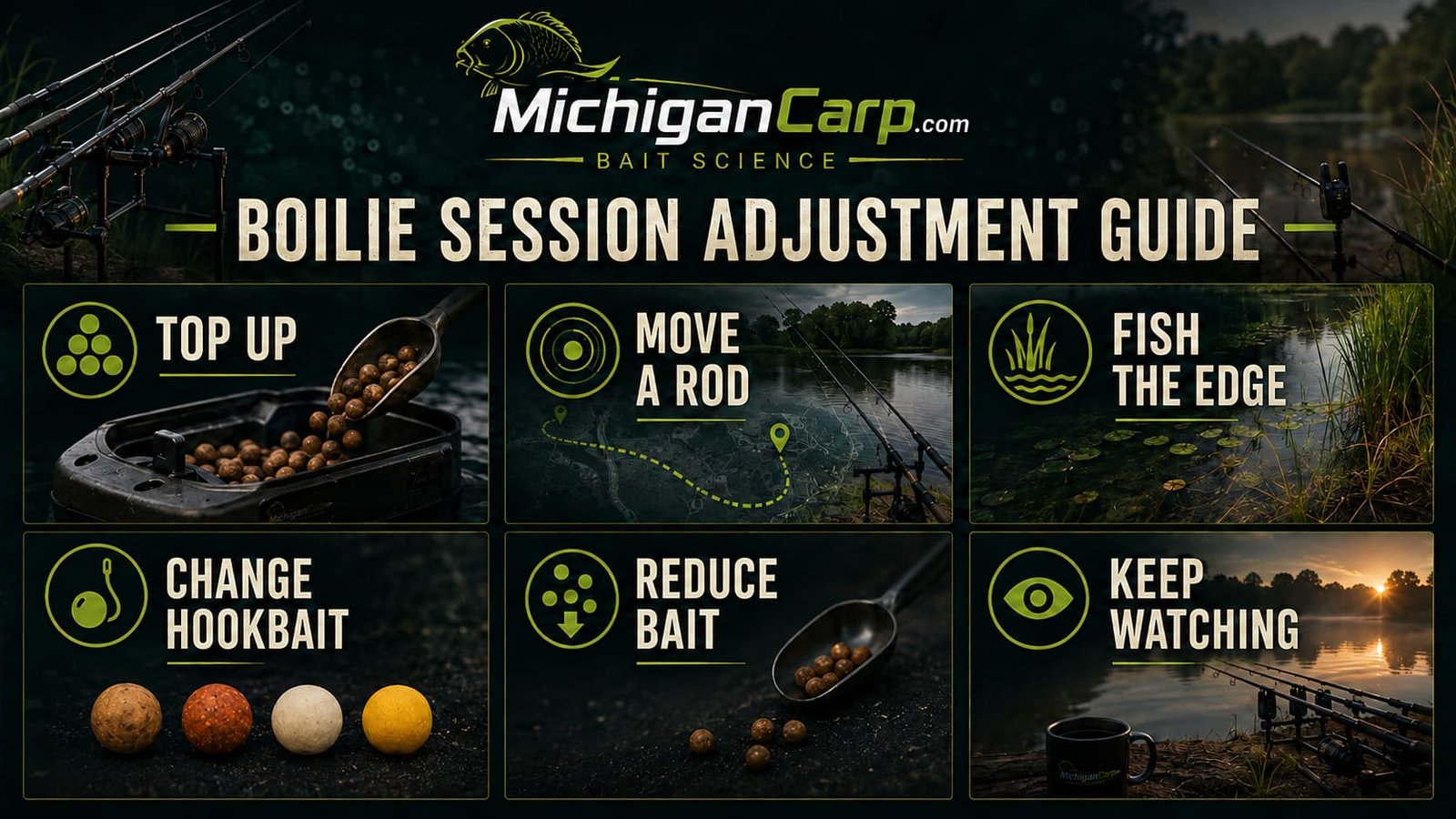
| No signs for hours | Possibly wrong area, timing or depth | Move one rod or reduce baiting |
| Nuisance fish destroying bait | Free bait may be too vulnerable | Use larger whole boilies, tougher hookbait or adjust feeding |
The key is not to change everything at once.
Move one rod. Reduce baiting. Add a small top-up. Switch to a wafter or pop-up. Fish the edge of the area. Recast less often. Observe longer.
Change one major thing at a time when possible.
Legal, Safe and Responsible Boilie Fishing
Always check current rules for the water you are fishing.
Michigan regulations can change, and some locations have specific local rules, especially on rivers, trout waters, managed waters and special regulation areas. Use the official Michigan Fishing Regulations before fishing unfamiliar water.
Also think about responsibility.
| Responsible boilie fishing | Why it matters |
|---|---|
| Do not overbait public areas | Protects access and avoids waste |
| Do not leave line, bait bags or trash | Protects wildlife and other users |
| Do not block access | Public waters are shared waters |
| Handle carp properly | Catch-and-release only works if fish are protected |
| Release fish safely | Large carp need careful handling |
| Respect other anglers and lake users | Protects the reputation of carp fishing |
For carp care, use Net to Release: Carp Fish Care and Carp Bank Setup and Fish Care.
Boilie fishing should make you more organized, not more careless.
A Simple First Boilie Session Plan
Here is a practical starter plan for a three-rod boilie session.
| Stage | Action |
|---|---|
| Before casting | Watch for bubbles, rolling fish, clouded water, wind lanes, weed edges and depth changes |
| Rod 1 | Fish a single or tiny trap with a bottom bait or wafter |
| Rod 2 | Fish a small dinner-plate patch with whole, chopped and crushed boilies |
| Rod 3 | Fish the edge, travel route or slightly different depth with a believable hookbait |
| First top-up | Only top up when signs justify it |
| End notes | Record swim, wind, depth, bait amount, hookbait, bite times, signs and next adjustment |
That is how boilie fishing becomes a system instead of guesswork.
Michigan Notes
Michigan boilie fishing is not just a copy of UK carp fishing.
Many of our waters are bigger, less pressured by carp anglers, more affected by boat traffic, full of natural food, lightly understood for carp movement, public and multi-use.
That means baiting has to be practical.
On some waters, a boilie can become a strong repeatable food bait. On others, it works best as a high-confidence hookbait over small particle support. On big lakes, I am often more interested in locating fish and building repeatability than feeding huge beds of bait. On channels and impoundments, timing, current, access and disturbance can matter as much as the bait.
For me, using boilies on the bank in Michigan means staying disciplined: find fish first, feed with purpose, keep the hookbait believable and avoid changing everything after one quiet session.
My practical Michigan view is simple:
Use boilies to make a good situation better. Do not use them to excuse poor watercraft.
Common Boilie Fishing Mistakes
| Mistake | Why it hurts the session | Better practice |
|---|---|---|
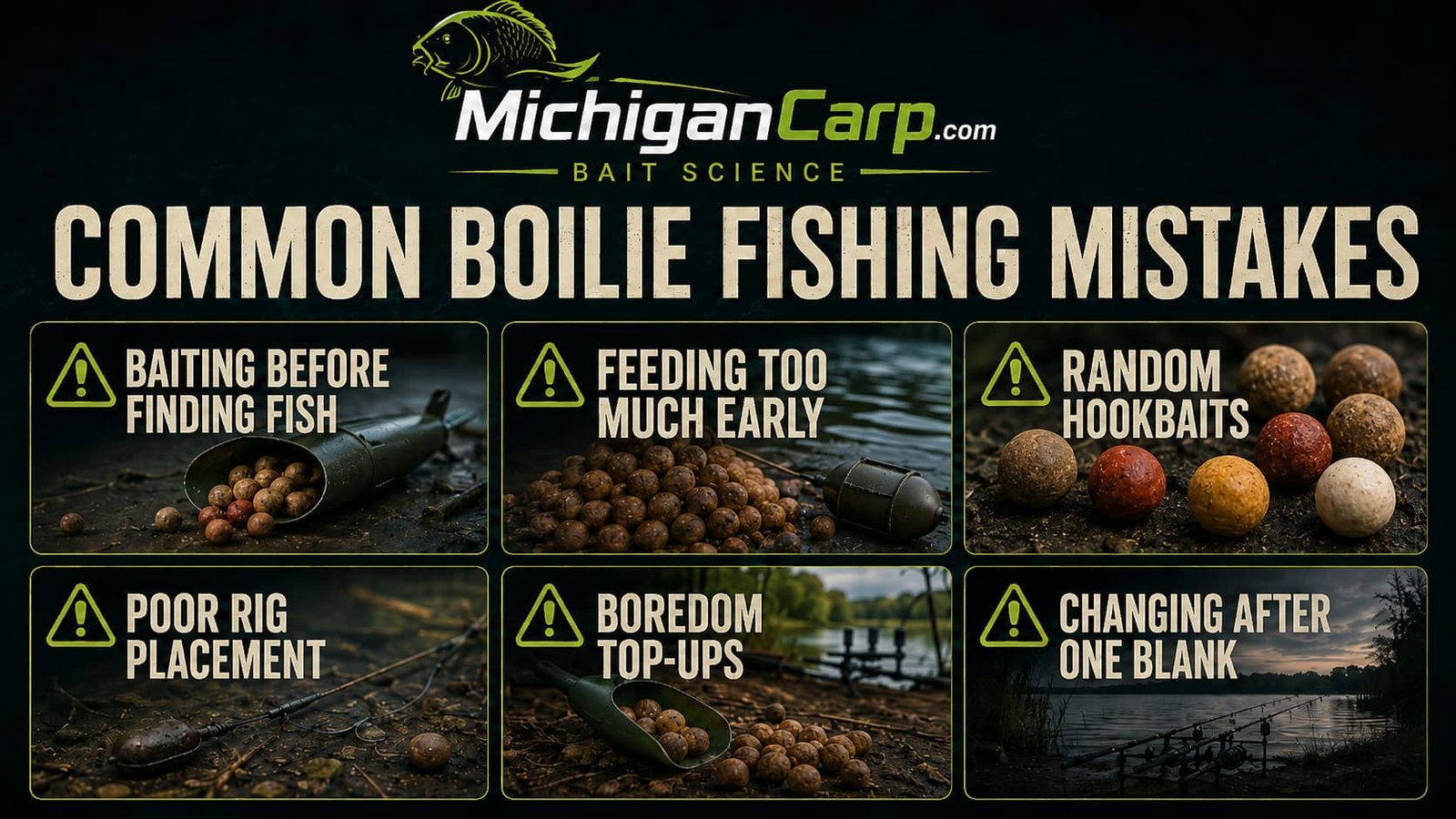
| Baiting before finding fish | Boilies cannot catch carp that are not there | Find signs, depth, routes and natural food first |
| Feeding too much too early | Fish can feed without finding the hookbait | Start modestly and build from response |
| Using random hookbaits | The trap can feel disconnected from the feed | Keep the hookbait believable unless testing contrast |
| Changing everything after one blank | You cannot learn what worked or failed | Test a good bait fairly over enough fishing |
| Ignoring the bottom | A good bait on a masked rig is poor presentation | Match hookbait and rig to the lake bed |
| Fishing every rod differently | Too many variables make the session unreadable | Use a simple rod plan with defined roles |
| Topping up from boredom | Can ruin a controlled patch | Top up from evidence |
| Using too many particles while testing boilies | The particle mix may dominate the result | Keep the feed controlled |
| Ignoring rules and fish care | Damages access, fish welfare and angler reputation | Check rules, keep clean banks and handle fish properly |
My Practical View
Boilies become powerful when they are part of a system.
The system is simple: find carp, choose the baiting style, present the hookbait correctly, feed enough to create interest, avoid feeding so much that the hookbait loses importance, read the response, and repeat what works.
The real skill in using boilies on the bank is not throwing more bait in; it is knowing when to stay quiet, when to top up and when to move a rod.
That is far more useful than changing bait names every session.
A good homemade boilie gives you confidence, but confidence only matters if the bait is used properly.
Do not ask a boilie to do the job of watercraft.
Find the fish first. Then use the bait intelligently.
That is how boilies move from theory to carp on the mat.
FAQ
What is the best way to start fishing boilies for carp?
Start with a simple controlled approach. Use a believable hookbait, a small amount of crushed or chopped boilie, and fish where carp are already likely to be feeding.
How many boilies should I use?
Use fewer than you think at first. Short sessions may need only a single hookbait and tiny attraction. Day or overnight sessions can use a small dinner-plate pattern. Increase only when fish response justifies it.
Should my hookbait match my free boilies?
Usually yes. It can stand out slightly by buoyancy, size or colour, but it should normally stay in the same bait family as the freebies.
Are bottom baits, wafters or pop-ups best?
None is always best. Bottom baits are believable on clean bottoms, wafters give balanced pickup, and pop-ups help over weed, silt or debris when the rig is designed for them.
Are crushed boilies better than whole boilies?
They do different jobs. Crushed boilies release quicker and create signal. Whole boilies last longer and can be more selective. A mixture is often a good starting point.
Should I use boilies with particles?
Yes, but keep the mix controlled. Particles can create feeding activity, while boilies provide larger food items and matching hookbaits. Do not bury the boilie signal under too many other feeds when testing.
Can I use boilies on big Michigan lakes?
Yes. On big lakes, boilies work best when combined with good location, repeatable baiting, wind and depth understanding, and controlled feeding.
Do boilies work in cold water?
Yes, but use a tighter approach. Fish fewer freebies, avoid unnecessary oil, place rigs accurately and use smaller baiting zones.
When should I top up boilies?
Top up after evidence: a bite, liners, fizzing, fish showing, bait being cleared or a known feeding window. Do not top up only because you are bored.
Should I prebait with boilies?
Prebaiting can work when the area is suitable and access is repeatable. Start modestly, observe the response and build gradually.
What size boilie should I use?
Choose size based on nuisance fish, target fish, rig mechanics and baiting pattern. Smaller baits can be useful in cautious or cooler situations. Larger baits can help with selectivity and nuisance resistance.
Can I fish a bright pop-up over natural-coloured freebies?
Yes, but make it a deliberate choice. A bright pop-up can work as a visual target, but it should still be tested against more believable hookbait options.
Should I change boilies after one blank session?
Not usually. A blank can be caused by location, timing, weather, presentation or fish movement. Give a well-designed bait a fair test.
What is the biggest boilie fishing mistake?
The biggest mistake is using boilies to compensate for poor location. Find carp first, then use boilies to hold them and create a repeatable feeding situation.
Next Steps
- Back to Boilie School Hub
- Boilie School BS-01: Boilie Basics
- Boilie School BS-02: Boilie Ingredients Explained
- Boilie School BS-03: Boilie Base Mix Families
- Boilie School BS-04: Boilie Liquids and Additives
- Boilie School BS-05: Making Boilies Step by Step
- How to Locate Carp Before You Cast — find carp before baiting.
- Reading a Lake Like a Carp Angler — understand the water before choosing the spot.
- Signs Carp Are Feeding — read bubbles, fizzing, clouding and surface signs.
- Best Depth for Carp Fishing — match depth to season and fish movement.
- Particles for Carp Fishing Guide — combine particles and boilies safely.
- The Complete Michigan Carp Rig Guide — match presentation to the bait and bottom.
- Carp Bank Setup and Fish Care — fish boilies responsibly on public water.
- Bait Science — browse the technical bait library.