

Boilie basics start with one simple question.
What is a boilie?
A boilie is a cooked or steamed carp bait made from a dry base mix and a liquid phase. The paste is shaped, cooked, dried and then used as a hookbait, free bait or part of a longer baiting plan.
That sounds simple, but a boilie is more than a round bait.
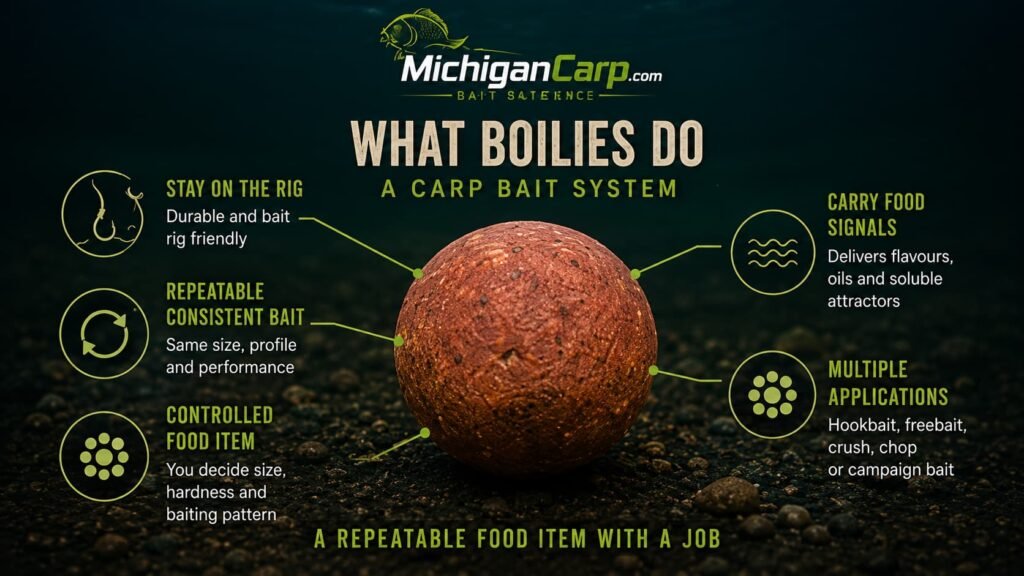
A good boilie is a repeatable food item with a job. It can stay on a hair rig, survive longer than many soft baits, carry a clear food profile and let the angler control size, hardness, baiting pattern and presentation.
That is why boilies became important in modern carp fishing.
But boilies are also misunderstood.
They are not magic. They do not replace watercraft. They do not make carp appear in a dead swim. They do not fix a bad rig. They do not become better just because the recipe contains expensive ingredients.
A boilie is not just bait. It is a repeatable food item with a job.
Boilie School BS-01 is the doorway into the full Boilie School sequence. It explains what boilies are, when they make sense, when other baits may be better, and how the rest of the Boilie School lessons fit together.
Boilie School navigation: Back to Boilie School Hub | Next Lesson: BS-02 — Boilie Ingredients Explained.
For practical bait preparation and fishing later in the sequence, use Boilie School BS-05: Making Boilies Step by Step and Boilie School BS-06: Using Boilies on the Bank.
Before fishing unfamiliar water, always check the official Michigan Fishing Regulations.
Table of Contents
Quick Start: Boilie Basics
If you are completely new to boilies, start with the simple version.
| Question | Simple answer |
|---|---|
| What is a boilie? | A cooked or steamed carp bait made from dry mix and liquid phase |
| Why use boilies? | Durability, repeatability, hookbait control and food-bait potential |
| Are boilies always best? | No. They are one tool, not the answer to every situation |
| Do boilies replace particles? | No. Boilies can work alone or with particles |
| Should beginners make complicated recipes? | No. Start simple and learn what each part does |
| What matters most? | Location, presentation, baiting style and repeatability |
A beginner does not need a perfect bait. A beginner needs a bait they can understand, repeat and fish properly.
That is the purpose of Boilie School.
What Is a Boilie?
A boilie starts as paste.
The dry base mix provides structure, food value, texture and handling qualities. The liquid phase usually includes eggs or another binder, plus any measured liquids, flavours, sweeteners, salts, oils or additives used in the recipe.
The paste is rolled into balls or dumbbells, then boiled or steamed so the bait sets.
A basic boilie system includes:
| Part of the boilie | What it does |
|---|---|
| Dry base mix | Provides structure, food value, texture and rollability |
| Liquid phase | Hydrates the mix and carries eggs, liquids and flavour direction |
| Binding system | Helps the paste hold together and set during cooking |
| Cooking | Sets the bait enough for handling and fishing |
| Drying | Controls surface condition, firmness, storage and water behaviour |
| Storage | Keeps the bait usable until the session |
The finished bait is usually firm enough to fish on a hair rig. That is one of the big differences between boilies and many soft baits.
A boilie can sit on the bottom for hours while still presenting a controlled food item. That can be very useful when carp feed slowly, move through an area in waves or return to a baited spot over time.
What a Boilie Is Not
A boilie is not automatically better than every other bait.
Sweet corn, maize, tiger nuts, peanuts, hemp, pigeon feed, worms, bread, pellets, method mix and packbait can all catch carp. In some situations, they may be easier or more effective than boilies.
A boilie becomes valuable when its specific strengths match the job.
| Boilie strength | Why it matters |
|---|---|
| Durability | Useful for longer casts, longer sits and nuisance attention |
| Repeatability | The same bait can be made or used again |
| Controlled size | Helps with hookbait matching, selectivity and feeding pattern |
| Clear food profile | Lets the angler build a recognizable bait identity |
| Hair-rig use | Allows controlled presentation separate from the hook |
| Campaign potential | Useful when fish can meet the same bait repeatedly |
The question is not whether boilies are always best.
The better question is: what job do I need this bait to do?
Why Carp Anglers Use Boilies
Carp anglers use boilies because they combine several useful features in one bait.
| Feature | Practical value |
|---|---|
| They stay on the rig | A boilie can be mounted on a hair and fished confidently |
| They can be repeated | Size, flavour, texture and food profile can stay consistent |
| They can carry food signals | Milk, nut, birdfood, seed, marine, yeast and soluble ingredients can be built into the bait |
| They can be used in different ways | Single hookbait, whole free bait, chopped bait, crumb or campaign feed |
| They can help select fish | Larger or tougher bait can reduce some nuisance problems |
Those features do not guarantee success. They simply give the angler control.
Control is useful only when it is matched with good location, safe rigs, sensible baiting and careful observation.
For ingredient roles, continue to Boilie School BS-02: Boilie Ingredients Explained. For bank use, use Boilie School BS-06: Using Boilies on the Bank.
Food Bait, Attractor Bait and Everything Between
Carp anglers often describe boilies as food baits or attractor baits.
That distinction is useful, but it can be oversimplified.
| Style | Main idea | Common use |
|---|---|---|
| Food bait | Designed to be eaten repeatedly as a believable food item | Campaigns, repeated sessions, multi-day trips and confidence feeding |
| Attractor bait | Designed to create a quicker response with flavour, colour or soluble signal | Short sessions, singles, cold water, pressured fish or searching |
| Balanced practical bait | Food identity with some attractor character | Most real fishing situations |
A milk/nut boilie can be a food bait with a fruit or cream attractor note. A fishmeal bait can be a serious food bait with extra soluble hydrolysate. A birdfood bait can be versatile enough for short sessions and repeated feeding.
The key is to understand the main job.
Do not build a bait that tries to be everything at once.
Are Boilies Better Than Particles?
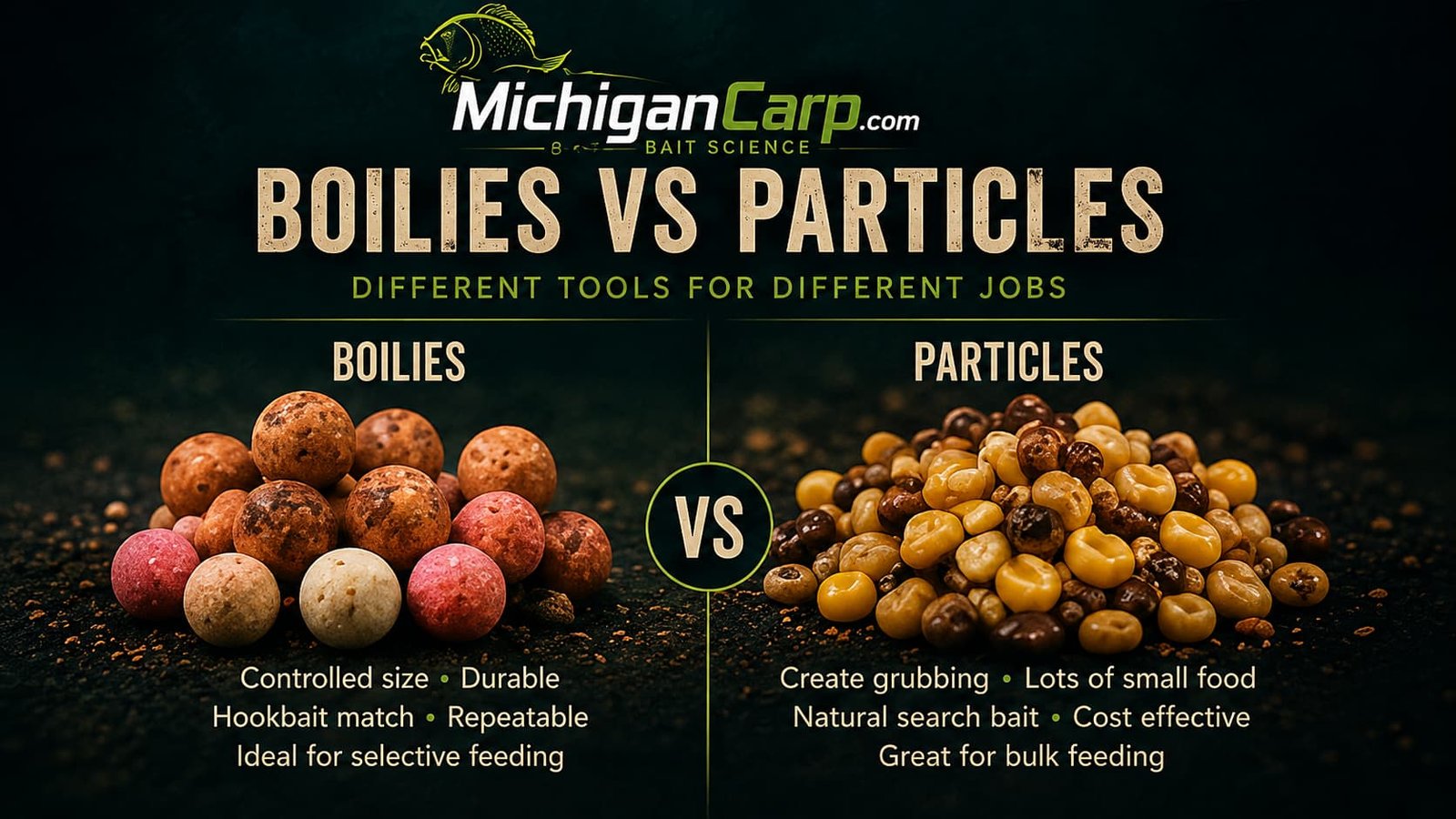
No. Boilies and particles are different tools.
Particles such as maize, hemp, tiger nuts, peanuts and pigeon feed can be excellent for carp. They can create grubbing, feeding activity and longer search time.
Boilies offer different advantages: controlled size, hookbait match, durability, repeatable bait identity and more selectivity.
| Use particles when | Use boilies when |
|---|---|
| You want fish grubbing and searching | You want a durable hookbait and matching freebait |
| You want lots of small food items | You want larger, controlled food items |
| You are creating general feeding activity | You are building a repeatable bait identity |
| You need cost-effective bulk feed | You want measured, selective feeding |
| You are fishing with maize, hemp, tigers or peanuts | You want bait that can sit on the hair for longer |
For many Michigan sessions, I like boilies and particles together. Particles can create activity. Boilies can provide the larger food item and hookbait match.
For safe particle preparation, use Particles for Carp Fishing Guide.
When Boilies Make Sense
Boilies make the most sense when their strengths solve a real fishing problem.
| Situation | Why boilies can help |
|---|---|
| Overnight sessions | A boilie can stay on the hair and fish confidently for longer periods |
| Nuisance fish waters | Larger or tougher boilies can reduce some soft-bait problems |
| Bigger-fish targeting | Boilies can act as larger food items and help with selectivity |
| Repeat sessions | The same bait can be introduced and tested over time |
| Big lakes and travel routes | A repeatable food item can help build confidence in a known area |
| Controlled baiting | Boilies are easy to count, chop, crush, measure and apply accurately |
Boilies are especially useful when you want a bait that can be fished as a hookbait, fed as matching freebait and repeated across more than one session.
For locating carp before baiting, use How to Locate Carp Before You Cast, Reading a Lake Like a Carp Angler and Signs Carp Are Feeding.
When Boilies May Not Be the Best First Choice
Boilies are not always the best starting bait.
| Situation | Better first thought |
|---|---|
| You have not found carp | Find fish first; do not bait blind just because you have boilies |
| Fish are heavily focused on tiny natural food | Smaller baits, crumb, particles or wafters may be easier to match |
| You need very fast action | Corn, bread, worms, small particles or packbait may be faster |
| The bottom is poor | Presentation and rig choice matter before bait type |
| Rules or local conditions restrict baiting | Check regulations and fish responsibly |
That does not make boilies bad. It means the situation may not require them.
Use boilies when their strengths fit the water, not because they look like proper carp bait.
The Three Basic Boilie Roles
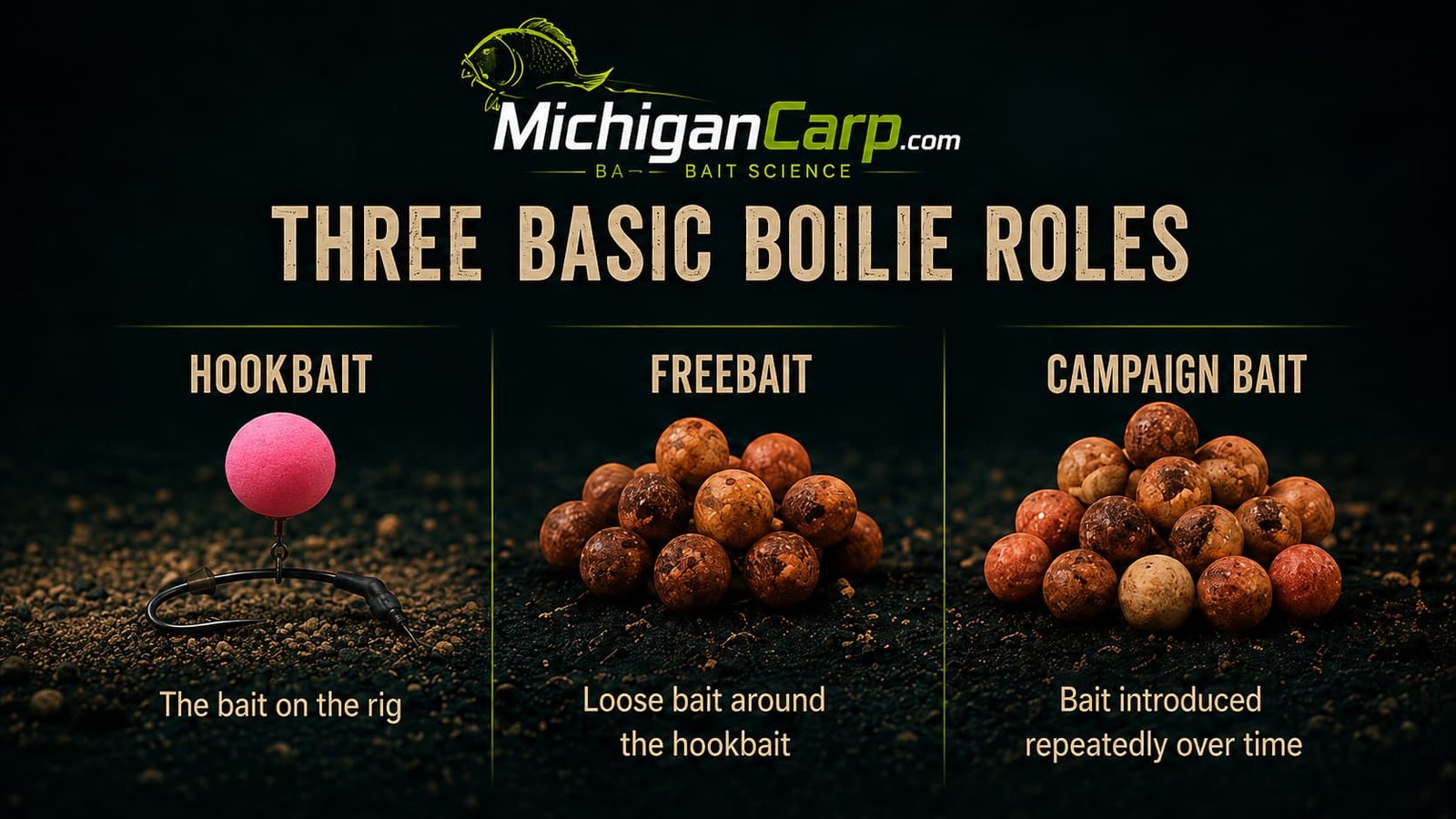
A boilie can play three main roles.
| Role | What it means | Practical note |
|---|---|---|
| Hookbait | The bait on the rig | Must stay on, present correctly and survive the fishing time |
| Freebait | Loose boilies or boilie pieces fed around the hookbait | Can be whole, chopped, crushed or crumbed |
| Campaign bait | Bait introduced repeatedly over time | Used to build recognition and confidence, not to dump bait blindly |
The hookbait and freebait do not have to be identical, but they should usually make sense together.
If you are feeding a milk/nut bait, the hookbait should normally stay in that same bait world unless you are deliberately testing contrast. If you are feeding a marine bait, a savoury hookbait is usually more believable than a random unrelated flavour.
Bottom Baits, Wafters and Pop-Ups
Beginners often get confused by boilie types. Start with the simple differences.
| Hookbait type | Basic behaviour | Best starting use |
|---|---|---|
| Bottom bait | Sinks and behaves like a normal free offering | Clean bottoms and confident feeding |
| Wafter | Sinks slowly or becomes very light on the rig | Cautious fish, balanced pickup and subtle presentation |
| Pop-up | Floats above the bottom on a suitable rig | Weed, silt, debris or deliberate raised presentation |
| Snowman | Bottom bait plus buoyant bait or topper | Large profile, slight lift and controlled contrast |
A bottom bait is the most natural starting point when the lake bed is clean and the rig is suitable. A wafter helps reduce the weight of the hookbait. A pop-up is useful when the hookbait needs to sit above weed, silt or debris.
Do not choose a pop-up just because it looks good in the tub. The rig must match the hookbait.
For rig choices, use The Complete Michigan Carp Rig Guide, Bottom-Bait Rigs for Carp and Pop-Up Rigs for Carp.
Boilie Size and Hardness Basics
Boilie size and hardness change how the bait behaves.
| Boilie size | Common use | Watch for |
|---|---|---|
| 12–16 mm | Cautious fish, cooler water, smaller traps and quicker pickup | Nuisance fish may remove them more easily |
| 18–20 mm | General carp fishing, day sessions and overnight sessions | Still needs to match rig and baiting pattern |
| 22–24 mm+ | Nuisance resistance, bigger food items and longer sits | Bigger is not automatically better |
Hardness affects casting durability, nuisance resistance, time on the hair, leakage, softening, storage and carp acceptance.
| Bait condition | Likely strength | Possible weakness |
|---|---|---|
| Softer bait | May work faster and feel more natural | May not last long enough |
| Medium bait | Often the best practical balance | Still needs testing for the session length |
| Very hard bait | Can resist nuisance fish and long soaks | May work too slowly or feel unnatural |
For making-process control, use Boilie School BS-05: Making Boilies Step by Step. For water behaviour, use Carp Bait Solubility and Leakage.
Homemade Boilies vs Shop-Bought Boilies
Both can work.
| Option | Strength | Weakness |
|---|---|---|
| Shop-bought boilies | Convenient, consistent and ready to fish | Less control over formula, freshness and bait identity |
| Homemade boilies | Control over ingredients, size, hardness, profile and learning | Requires time, testing, notes and process discipline |
A good commercial boilie is better than a poor homemade boilie.
Homemade bait is not automatically superior because you made it yourself. The advantage of homemade boilies is control and understanding. That advantage only matters if the bait is made properly and tested honestly.
For storage after making bait, use How to Store Homemade Boilies. For testing before fishing, use How to Test Boilies Before Fishing.
The Main Boilie Families
Most boilies fall into broad bait families.
| Family | Basic identity | Simple beginner view |
|---|---|---|
| Marine | Fishmeal, krill, squid, fish hydrolysates and savoury marine ingredients | Strong savoury food-bait direction |
| Birdfood | Prepared birdfoods, seed meals, cereals, CLO-style products and egg foods | Texture, openness and versatile bait structure |
| Milk/nut | Milk powders, milk proteins, tiger nut, peanut, almond, coconut and creamy profiles | Clean non-marine food-bait direction |
| Hybrid | A deliberate blend of more than one family | Useful only when each family has a clear job |
Beginners should understand the main family before blending everything together.
For the full comparison, continue to Boilie School BS-03: Boilie Base Mix Families.
What Makes a Good Beginner Boilie?
A good beginner boilie should be simple, repeatable and easy to understand.
| A good beginner boilie should be | It does not need |
|---|---|
| Simple | Ten different proteins |
| Repeatable | Six liquids |
| Easy to roll | Three flavours |
| Not overloaded with liquid | Secret additives |
| Made from available ingredients | Complicated preservation |
| Tested before serious use | A huge first batch |
A simple bait that rolls well and teaches you something is more useful than a complicated bait you cannot repeat.
For ingredient roles, continue to Boilie School BS-02: Boilie Ingredients Explained.
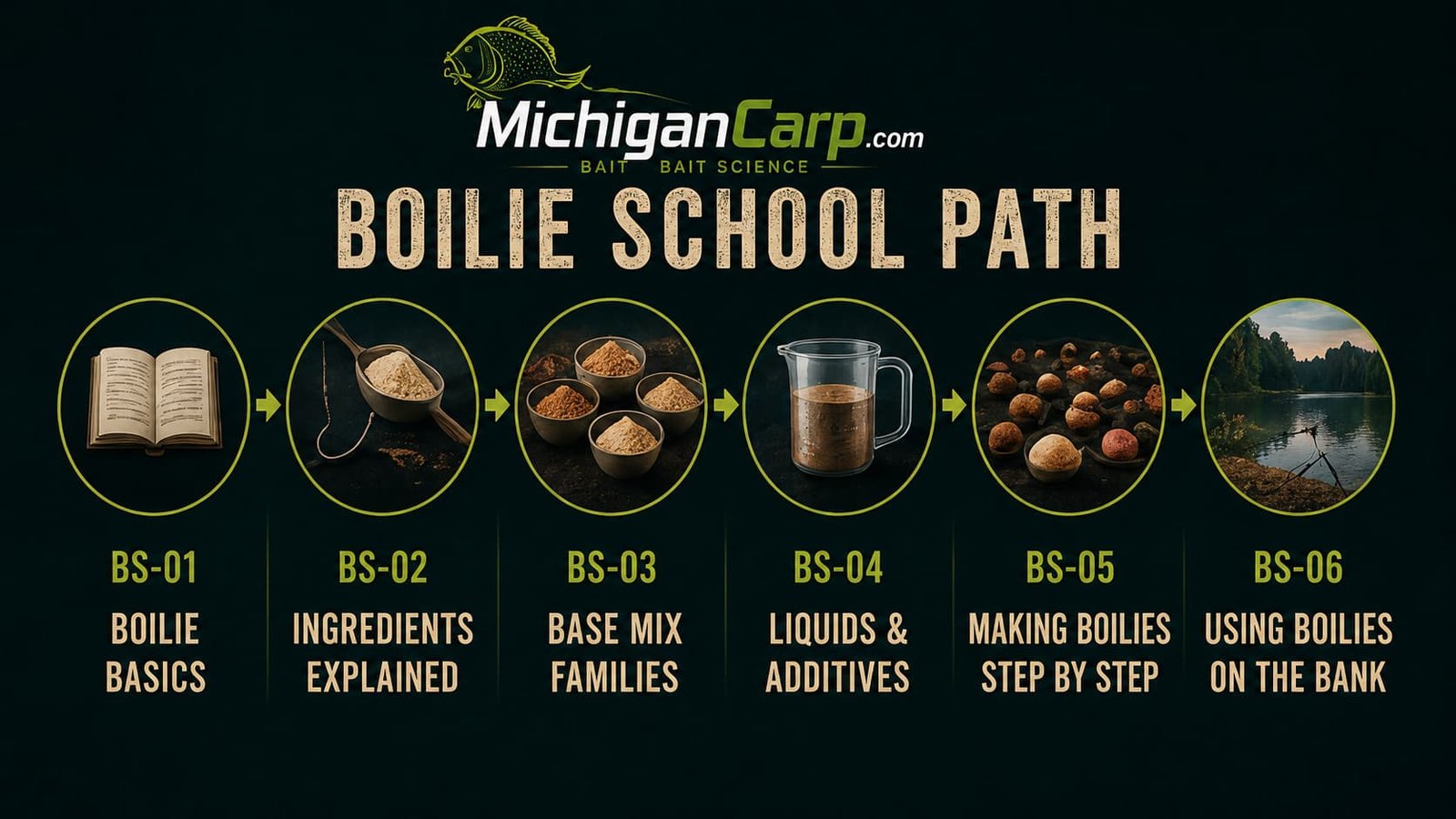
How Boilie School Fits Together
Boilie School follows a deliberate order.
| Lesson | What it teaches |
|---|---|
| BS-01: Boilie Basics | What boilies are, why they work and when to use them |
| BS-02: Boilie Ingredients Explained | What the main ingredient groups do |
| BS-03: Boilie Base Mix Families | How marine, birdfood, milk/nut and hybrid bait families differ |
| BS-04: Boilie Liquids and Additives | How to build the liquid phase without chaos |
| BS-05: Making Boilies Step by Step | How to mix, rest, roll, cook, dry, test and store bait |
| BS-06: Using Boilies on the Bank | How to fish boilies properly on real water |
This order matters.
Do not start with recipes before understanding the job of the bait. Recipes make more sense after you understand ingredients, base mix families, liquids, process and bank use.
A Simple First Boilie Plan
If you are new to boilies, keep the first plan simple.
| Step | Beginner action |
|---|---|
| Choose the role | Single hookbait, small feeding patch or repeated-session bait |
| Choose the family | Marine, birdfood, milk/nut or simple hybrid |
| Keep the recipe simple | Use ingredients you can explain and source again |
| Make a small batch | Do not make a huge amount of untested bait |
| Test the finished bait | Check softening, cracking, leakage, hookbait strength and overnight behaviour |
| Fish it properly | Use location, rig choice, baiting strategy and session notes |
This is how boilies become a system instead of a guess.
Use How to Test Boilies Before Fishing before trusting a new bait on an important session.
Boilies and Michigan Carp Fishing
Michigan carp fishing is different from heavily pressured European carp lakes.
Many Michigan waters are large, public, full of natural food, affected by boat traffic and lightly developed for specialist carp tactics.
That changes how boilies should be used.
| Michigan situation | Boilie thinking |
|---|---|
| Large natural lakes | Location, wind, depth and repeatability matter more than random heavy baiting |
| Dam ponds and impoundments | Boilies may work beside particles, crumb and controlled baiting |
| Natural-food-rich waters | The bait must be believable and placed where carp already feed |
| Boat traffic and public access | Quiet, efficient, responsible fishing matters |
| Multi-day sessions | Storage, bait planning and hookbait durability become more important |
On some waters, boilies can become a strong repeatable food bait. On others, they may work best as a high-confidence hookbait over a small amount of crumb, packbait or particle support.
The important point is to fish boilies as part of the water, not as a magic imported method.
Common Beginner Mistakes
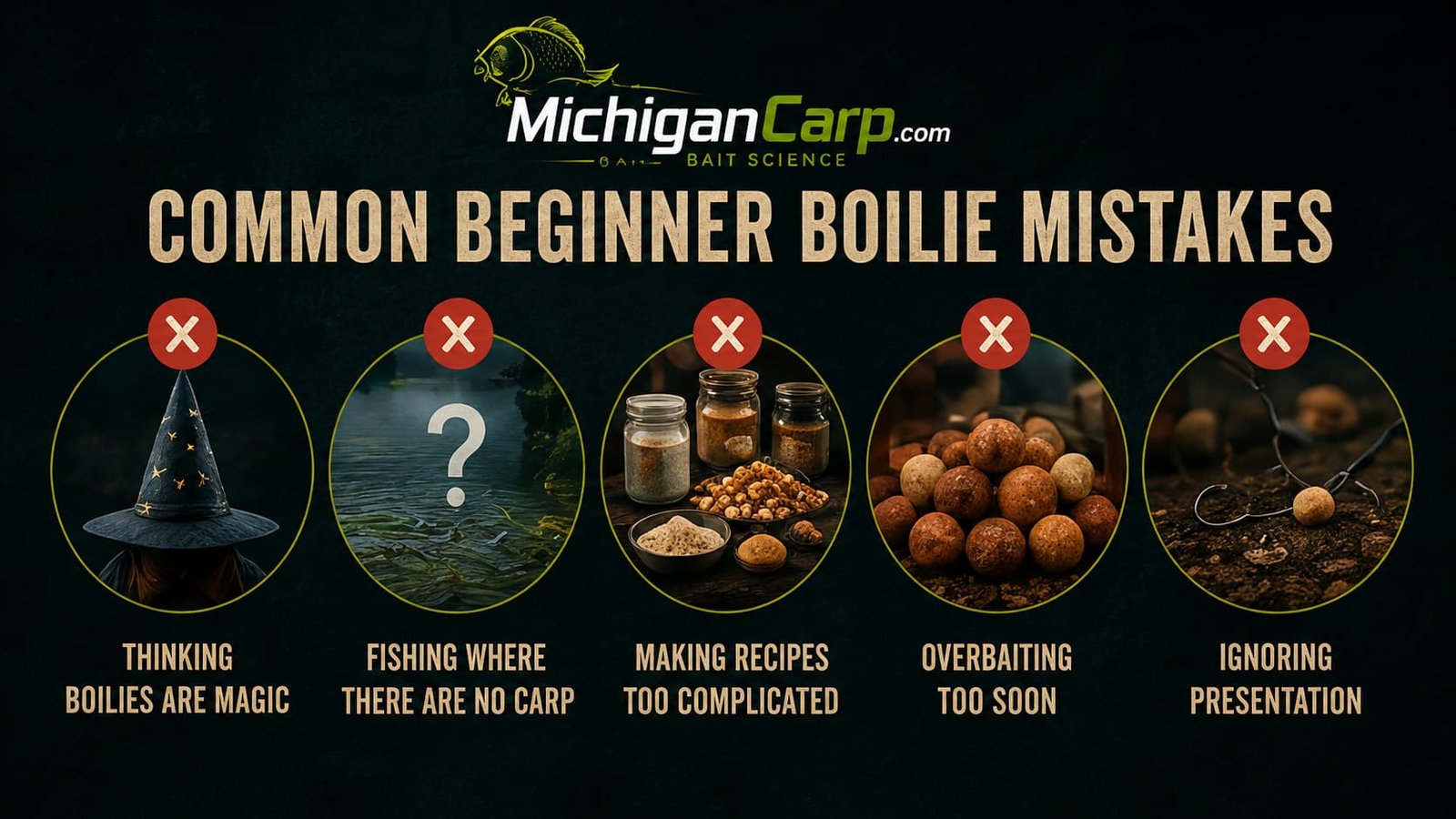
| Mistake | Why it causes problems | Better practice |
|---|---|---|
| Thinking boilies are magic | The angler stops thinking about location and presentation | Treat boilies as a tool |
| Fishing boilies where there are no carp | No bait catches fish that are not present | Find signs first |
| Making the first recipe too complicated | You cannot learn what each ingredient is doing | Start simple and repeatable |
| Using too much bait too soon | Fish can feed without finding the hookbait | Start modestly and build from response |
| Changing bait after one blank | One quiet session may be location, timing or conditions | Test bait fairly before judging |
| Ignoring hookbait presentation | A good bait on a bad rig is still poor fishing | Match rig, bottom and hookbait |
| Using old or badly stored bait | Stale bait can lose quality or become risky | Store bait properly and label batches |
| Never water-testing | Dry appearance hides underwater behaviour | Test bait before fishing it seriously |
My Practical View
Boilies are one of the most useful carp baits because they give the angler control.
Control over size. Control over ingredients. Control over hookbait durability. Control over baiting pattern. Control over repeatability.
But that control only matters if the angler uses it properly.
A boilie does not excuse poor location. It does not replace observation. It does not remove the need for safe rigs and good fish care.
It simply gives you a repeatable bait system that can be adapted to your fishing.
That is why I like boilies.
Not because they are fashionable. Not because they are complicated. Because when they are built and used properly, they help turn bait from a guess into a system.
Understand the job before you choose the bait.
That is where boilie making really begins.
FAQ
What is a boilie?
A boilie is a cooked or steamed carp bait made from a dry base mix and liquid phase. It is usually firm enough to fish on a hair rig and can be used as a hookbait or freebait.
Why are they called boilies?
The name comes from the traditional process of boiling bait balls to set them. Some anglers now steam boilies instead, but the name remains.
Do boilies catch carp in Michigan?
Yes. Boilies can catch carp in Michigan when they are used in the right location with sensible baiting and proper presentation.
Are boilies better than corn?
Not always. Corn can be excellent. Boilies are more durable, more repeatable and often more selective, but corn may be simpler or faster in some situations.
Are boilies better than particles?
No bait is always better. Particles can create feeding activity. Boilies provide controlled hookbaits, larger food items and repeatable bait identity.
Should beginners make homemade boilies?
Yes, if they are willing to start simple and learn the process. Otherwise, a good shop-bought boilie can be a better first step.
What size boilie should I start with?
For general carp fishing, 16–20 mm is a sensible starting range. Larger baits can help with nuisance fish or bigger-fish selectivity.
Should I use bottom baits, wafters or pop-ups?
Start with bottom baits on clean bottoms. Use wafters for balanced pickup and pop-ups for weed, silt or debris when the rig is designed for them.
Do boilies need flavours?
Not always. Flavour can help define a profile, but it does not replace a good base mix, location, presentation and baiting strategy.
Do boilies need oil?
No. Oil is optional. Many bait ingredients already contain fat, so added oil should have a clear purpose.
Can I fish a boilie as a single hookbait?
Yes. Single boilies can work well, especially when fish are present but you do not want to overfeed.
How many boilies should I feed?
Start light. Use a single or tiny trap for short sessions, a small patch for day or overnight sessions, and build only when fish response justifies it.
How long do boilies last in water?
That depends on size, hardness, recipe, cooking, drying, water temperature and nuisance fish. Always water-test your bait before relying on it.
Can boilies be used with packbait or method mix?
Yes. Boilies can be used as hookbaits beside packbait, method mix, crumb, chopped boilies or particles.
What is the biggest mistake with boilies?
The biggest mistake is expecting boilies to fix poor watercraft. Find the carp first, then use boilies intelligently.
Next Steps
- Next Lesson: BS-02 — Boilie Ingredients Explained
- Boilie School BS-03: Boilie Base Mix Families
- Boilie School BS-04: Boilie Liquids and Additives
- Boilie School BS-05: Making Boilies Step by Step
- Boilie School BS-06: Using Boilies on the Bank
- Back to Boilie School Hub
- Particles for Carp Fishing Guide — prepare maize, hemp, tiger nuts, peanuts and mixed particles safely.
- How to Locate Carp Before You Cast — find fish before baiting.
- Reading a Lake Like a Carp Angler — understand water, wind, depth and fish movement.
- Signs Carp Are Feeding — read bubbles, fizzing, clouding and surface signs.
- The Complete Michigan Carp Rig Guide — match bait, hookbait and presentation.
- How to Test Boilies Before Fishing — test finished bait before relying on it.
- Bait Science — browse the full technical bait library.