

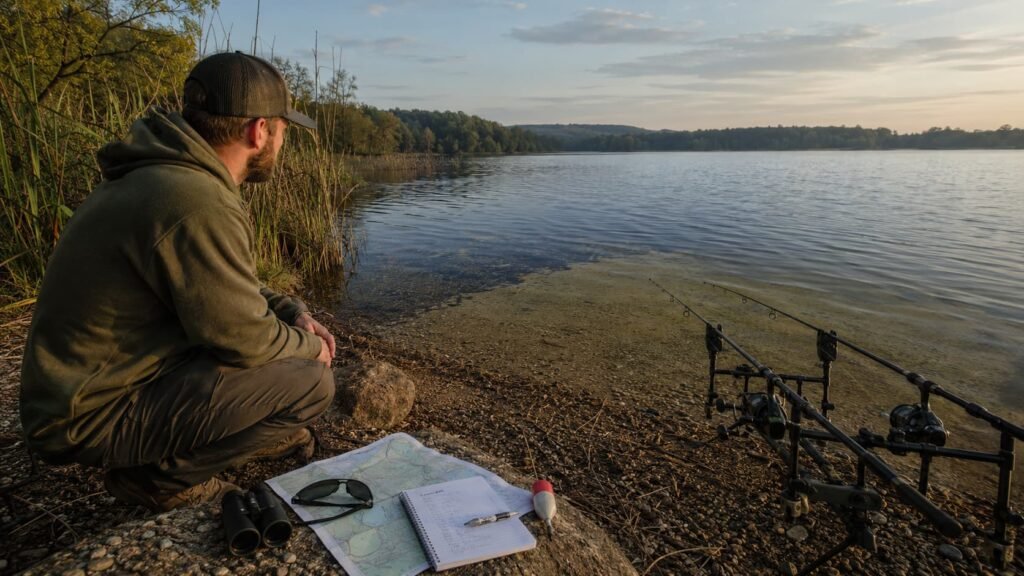
Reading a lake like a carp angler starts before a rod is cast.
It starts before bait goes in.
It starts before rigs, boilies, method mix, particles, alarms, rod pods, bait boats, spods or marker floats become important.
The first job is simple:
Find a reason for carp to be where you are fishing.
That sounds obvious, but many blank sessions happen because anglers choose a comfortable swim before they choose a carp swim. They pick the easiest parking, the flattest bank, the prettiest view, or the spot where they have enough room for the bivvy. Then they try to make carp appear with bait.
Sometimes that works.
Often it does not.
On Michigan lakes, especially large natural lakes, reservoirs, drowned river systems, channels and campground waters, carp may have huge areas to move through. If you are not near food, comfort, safety or a route, you can fish perfectly and still be wrong.
Reading a lake is about stacking clues.
Wind.
Temperature.
Depth.
Weed.
Oxygen.
Light.
Bottom type.
Natural food.
Pressure.
Fish signs.
Safe landing.
The more clues that point to one area, the more confident you can be.
This guide explains how to read a Michigan carp lake before you cast, how to separate attractive-looking water from productive water, and how to choose a swim based on carp behavior rather than convenience.
For the main section hub, read Watercraft and Conditions for Michigan Carp Fishing. For depth decisions, read Best Depth for Carp Fishing in Michigan Lakes. For temperature decisions, read Carp Water Temperature Guide for Michigan Lakes.
Quick Answer
Reading a lake for carp means identifying where food, comfort, safety and movement overlap.
A good carp area usually has at least two or three of these:
| Clue | What It Tells You |
|---|---|
| Wind pushing into a bank or bay | food, oxygen, surface drift and possible carp movement |
| Shallow water near deeper water | feeding access with safety nearby |
| Weed edges or clear holes | food, cover, oxygen and patrol routes |
| Bubbles, fizzing or cloudy water | carp may be feeding on the bottom |
| Rolling or showing fish | carp are present, but not always feeding |
| Natural food | carp have a reason to return |
| Low disturbance | carp can feed with confidence |
| Safe landing area | you can fish effectively without damaging fish |
| Repeated signs over time | a pattern, not a one-off guess |
The best swim is not always the most comfortable swim.
The best swim is the one where carp have a reason to visit.
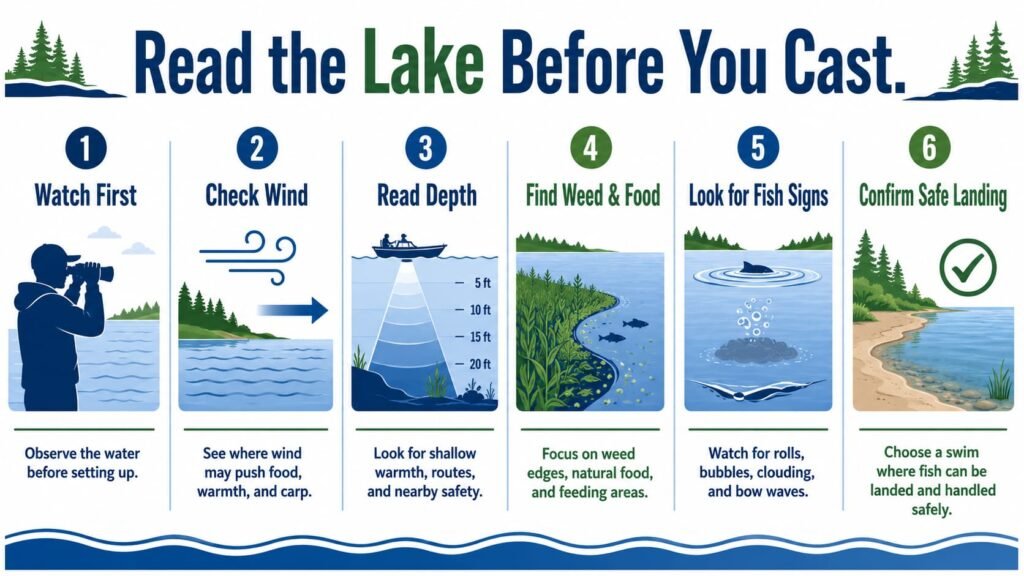
Quick Lake-Reading Framework
Use this simple process before casting.
| Step | Question | What You Are Looking For |
|---|---|---|
| 1 | What is the season doing? | warming, cooling, spawning, summer heat, fall feeding |
| 2 | What is the wind doing? | warm wind, cold wind, oxygen, food movement, pressure |
| 3 | What depth makes sense? | shallow warmth, mid-depth routes, deeper comfort |
| 4 | Where is the weed or cover? | edges, holes, reeds, pads, oxygen, food |
| 5 | Where is the natural food? | silt, snails, mussels, insects, seed, crayfish, weed |
| 6 | What signs are visible? | bubbles, rolling, clouding, bow waves, liners |
| 7 | Can you land fish safely? | clear bank, room, snags, weed, rocks, boat access |
| 8 | What is the lowest-risk first cast? | accurate rig in a place carp already want to be |
The point is not to make lake reading complicated.
The point is to avoid fishing blind.
Do Not Choose the Swim First
One of the biggest mistakes in carp fishing is choosing the swim first and reading the water second.
That is backwards.
The better order is:
- Read the water.
- Find the likely carp zone.
- Check if the area can be fished safely.
- Choose the swim that gives you the best angle.
- Then decide rigs, bait, range and rod placement.
On some Michigan waters, the best carp zone may not be directly in front of the nicest campsite or easiest parking area. It may be a wind-blown corner, an awkward weed edge, a shallow bay, a channel mouth, a reed line, a drop-off, or a quieter area away from boat traffic.
That does not mean you should fish unsafe or illegal spots.
It means the swim should be chosen because it gives you access to the carp’s world, not just because it suits yours.
Start by Watching
Before casting, watch.
Not for thirty seconds.
Properly watch.
Walk the bank if you can. Look across the whole lake, not just the water in front of you. Use polarized glasses. Use binoculars if the lake is large. Watch the surface. Watch the margins. Watch birds. Watch wind lines. Watch baitfish. Watch weed movement. Watch quiet corners.
Signs may be obvious:
- carp rolling
- tails showing
- bow waves
- mud clouds
- bubbles
- fizzing
- fish crashing in weed
- groups cruising shallow
But signs may also be subtle:
- one patch of cloudy water
- tiny pin bubbles
- a single roll at long range
- birds working one edge
- repeated liners after casting
- weed twitching
- a flat spot on the surface
- a color change over a feeding area
A carp angler should not be in a hurry to put rods out.
The first cast sets the tone of the session. If you rush it, you may spook fish, miss the real area, or commit bait to the wrong depth.
Observation is not wasted time.
It is part of fishing.
Read the Season First
Season gives you the first clue.
The same lake can fish completely differently in April, June, August and October.
Spring
In spring, carp often respond to warming water. Shallow bays, dark-bottom margins, reed edges, sheltered corners and areas near deeper water can become important.
Spring clues include:
- sunlit shallows
- slightly warmer bays
- reed growth
- dark silt
- slow cruising fish
- fish sitting high in the water
- bow waves in margins
- short afternoon feeding windows
In spring, do not ignore shallow water just because the main lake looks cold. A few degrees of warmth can matter.
Read Carp Water Temperature Guide for Michigan Lakes for a full seasonal breakdown.
Summer
In summer, carp may feed strongly, but oxygen, weed, light and boat pressure become more important.
Summer clues include:
- weed edges
- clear holes in weed
- low-light margin activity
- wind-blown banks
- inflows
- shaded areas
- oxygenated water
- dawn and dusk showing fish
- night feeding routes
- deeper comfort water near shallow feeding
The warmest water is not always the best water in summer. Comfort and oxygen can matter more.
Fall
Fall can be excellent because carp may feed before winter. But they may also begin using deeper routes and more stable areas as temperatures fall.
Fall clues include:
- feeding flats near deeper water
- remaining green weed
- dying weed edges
- silt areas with natural food
- wind-blown food lines
- deeper patrol routes
- repeated shows near drop-offs
- steady bite windows during stable weather
Fall is often about connecting food areas to deeper movement routes.
Winter and Very Cold Water
In very cold water, location becomes critical. Carp may group up, move less and feed in short windows.
Cold-water clues include:
- deeper stable water
- slow channels
- sheltered areas
- mild-weather warming spots
- low disturbance
- very small signs
- repeated sightings in the same zone
In cold water, do not try to bait carp into a dead area. Find them first.
Read the Wind
Wind is one of the strongest lake-reading clues.
It can move surface water, food, oxygen, warmth, algae, insects and baitfish. It can color the water. It can push carp into an area or make them more confident.
But wind is not automatically good.
A warm spring wind into a shallow bay can be excellent.
A cold wind after a front can slow a bank down.
A steady summer wind can improve oxygen.
A violent unsafe wind may make fishing and fish care difficult.
Ask:
- Is the wind warm or cold?
- Has it blown for hours or days?
- Is it pushing into a bay?
- Is it creating color?
- Is it improving oxygen?
- Is it pushing food onto a bank?
- Is it safe to fish?
- Is there a calmer edge just off the main blow?
- Are fish showing on the windward side or tucked behind it?
A wind-blown bank with depth, weed, food and safe landing is worth serious attention.
A wind-blown bank with no access, bad snags or dangerous waves may not be fishable.
For the dedicated guide, use Wind, Waves & Current as the keeper article in this section.
Read Depth as a Relationship
Depth is not just a number.
It is a relationship between food, comfort and safety.
A 3 ft margin can be perfect in spring or at night.
A 6 ft weed edge can be perfect in summer.
A 12 ft shelf can be perfect in fall.
A deeper basin can matter in very cold water or bright heat.
When reading depth, look for connections:
- shallow water near deeper water
- shelves
- bars
- points
- channel edges
- bay entrances
- weed edges
- drop-offs near flats
- deeper water beside reeds
- routes between holding and feeding areas
A flat depth with no features may still produce if carp patrol it, but a depth change often gives you a stronger clue.
The best depth is the depth carp use for a reason.
Read Best Depth for Carp Fishing in Michigan Lakes for the full depth guide.
Read Weed, Pads and Cover
Weed is one of the most important carp features in Michigan lakes.
Carp use weed for food, cover, oxygen and security. Weed also holds snails, insects, larvae, small fish and other natural food.
Good weed areas include:
- outside weed edges
- inside weed edges
- clear holes
- channels through weed
- reed lines
- lily pad edges
- healthy green weed in summer
- dying weed transitions in fall
- soft silt beside weed
- hard spots near weed
But weed must be fishable.
If you cannot land fish safely, it is not a good swim, even if carp are present.
Read the weed carefully:
- Can a hooked carp bury itself?
- Is the line angle safe?
- Is there a clear landing area?
- Is the weed thin enough to fish?
- Can you use stronger line or safer placement?
- Are you putting fish at risk?
The best carp spot is useless if it causes lost fish.
Your watercraft has to include fish safety.
Read Natural Food
Carp return to areas that feed them.
Natural food is one of the biggest reasons carp use a spot repeatedly.
Look for:
- snails
- mussels
- insect larvae
- bloodworm-style silt
- crayfish
- seeds
- berries
- reed edges
- weed beds
- soft silt
- gravel or shell patches
- bird activity
- disturbed bottom
- cloudy feeding patches
Do not assume the cleanest bottom is the best bottom.
A polished hard spot is nice for rig presentation, but carp often feed confidently in silt, weed edges and natural food zones.
The key is to understand whether your rig can present properly.
A soft feeding area may be excellent, but you may need a lighter lead, longer hooklink, helicopter-style thinking, a balanced bait, or careful casting to present cleanly.
Natural food tells you why carp may visit.
Rig presentation tells you whether you can catch them there.
Read Bottom Type
Bottom type matters because it affects both feeding and presentation.
Common useful bottom types include:
- soft silt
- firmer silt
- sand
- gravel
- clay
- mussel patches
- weed holes
- leaf litter
- shell fragments
- harder spots in soft areas
- soft edges beside harder areas
A marker float, lead, sonar, Deeper-style unit, boat electronics or careful casting can help, but do not overcomplicate it.
You are asking simple questions:
- Is it weedy?
- Is it soft?
- Is it hard?
- Is the lead plugging in?
- Is the bottom clean enough?
- Is there natural food?
- Is this a route or a feeding spot?
- Can I present a bait here?
A perfect bottom with no carp is useless.
A messy natural feeding area with carp present may be worth adapting to.
Read Water Clarity and Light
Clear water and stained water fish differently.
In clear water, carp may be more cautious in bright conditions. They may use weed, depth, shade or low-light periods.
In stained water, carp may feed shallower and closer with more confidence.
Light level affects movement.
Good low-light times include:
- dawn
- dusk
- night
- cloudy days
- wind-rippled water
- rain-darkened conditions
- shaded margins
Bright sun is not always bad, especially in spring when it warms shallow water. But in clear summer water, bright conditions may push carp into cover or deeper comfort.
Ask:
- Can carp see me?
- Is the water clear enough to spook them?
- Is there ripple to break up light?
- Is there shade?
- Will the area improve at dusk?
- Is the best swim actually a night swim?
Sometimes the correct answer is not a new bait or rig.
It is waiting for the right light.
Read Pressure and Disturbance
Michigan waters can have boat traffic, swimmers, kayaks, dog walkers, shore anglers, bowfishing pressure, campground noise, jet skis and weekend disturbance.
Carp adapt.
They may avoid obvious areas during the day and return later. They may use quiet corners. They may feed at night. They may move after boats stop.
Read human pressure as part of watercraft.
Ask:
- Is this area busy during the day?
- Is there a quiet window?
- Do boats push fish to edges or deeper water?
- Are carp safer in weed?
- Is night fishing legal and practical?
- Are weekdays better than weekends?
- Is the access too public for careful carp fishing?
A pressured lake can still be excellent, but timing and stealth matter.
Read Fish Signs Properly
Seeing carp is useful, but not every sign means the same thing.
A rolling carp tells you carp are present.
A feeding carp tells you much more.
Useful signs include:
| Sign | Possible Meaning |
|---|---|
| rolling | carp present, moving, sometimes comfortable |
| tails up | active feeding in shallow water |
| fizzing bubbles | possible bottom feeding |
| cloudy water | disturbed bottom, feeding or movement |
| bow waves | shallow cruising carp |
| liners | carp moving through your line area |
| jumping/crashing | presence, excitement, spawning or disturbance |
| slow cruising | not always feeding, but useful for location |
| repeated signs in one area | possible pattern |
Do not overreact to one roll.
But if you see repeated signs in one zone, especially near food, depth, weed or wind, pay attention.
For a deeper support article, keep Signs Carp Are Feeding as a separate guide and link it from this page.
Do Not Confuse Showing Fish With Feeding Fish
This is important.
Carp can show without feeding.
They can roll in open water while traveling.
They can crash during spawning behavior.
They can sit high in the sun.
They can cruise slowly and ignore bait.
A feeding area usually has more than one clue:
- bubbles
- clouding
- tails
- repeated movement
- natural food
- bottom disturbance
- fish returning
- line bites
- short bite window
- birds or other activity
Showing fish are a clue.
Feeding fish are the target.
Safe Landing Is Part of Lake Reading
A swim is not truly good if you cannot land fish safely.
Before fishing, check:
- bank height
- rocks
- roots
- steep drop-offs
- thick weed
- snags
- branches
- current
- boat traffic
- landing net access
- unhooking mat space
- night safety
- room to play fish
- whether you can follow a fish if needed
Carp care matters.
A big fish lost in thick weed, wrapped around wood, or dragged over rocks is not a successful piece of watercraft.
Sometimes the right decision is to fish a slightly less obvious area because you can land fish properly.
For the fish-care side of the site, link this article to your catch-and-release guide where appropriate.
Bank Access and Casting Angle
The best feature may not be fishable from every swim.
A weed edge might need a side angle.
A channel might need a shorter cast.
A snaggy margin might need you to fish locked-up and close.
A long-range spot might be too far to bait accurately or land fish safely.
Read the angle before you cast:
- Can I hit the spot accurately?
- Can I bait it accurately?
- Can I keep line away from weed?
- Can I play the fish away from snags?
- Can I net the fish?
- Is the line crossing boat traffic?
- Is the cast repeatable at night?
A good feature with a bad angle can become a bad fishing decision.
Do Not Drop the Rig Right on Their Heads
When you find bubbling, clouding or visible feeding activity, the temptation is to cast straight into the middle of it.
Sometimes that works, but it can also spook fish, especially in shallow or clear water.
A safer approach is often to place the rig just beyond the activity, beside it, or on the route the fish are using to enter and leave the feeding area. That lets the bait sit naturally where carp are already moving without crashing a lead directly into the middle of the disturbance.
The more shallow, clear or pressured the water is, the more carefully that first cast should be made.
The First Cast Plan
Once you have read the lake, do not just throw three rods out randomly.
Use each rod to test a theory.
A simple three-rod plan:
Rod 1: The Sign Rod
Put one rod where fish have shown, fizzed, clouded, rolled or moved.
Rod 2: The Feature Rod
Put one rod on the strongest feature: weed edge, shelf, channel, reed line, clear hole, mussel area or bottom change.
Rod 3: The Route Rod
Put one rod on the likely patrol route between holding water and feeding water.
Then watch.
If one depth or feature produces liners, shows or bites, adjust.
Move rods toward the pattern.
Do not leave rods in dead water because you spent time setting them up.
When to Move
Moving is one of the hardest decisions in carp fishing.
But lake reading does not stop after casting.
Move or adjust when:
- fish are repeatedly showing elsewhere
- your swim has no signs
- the wind changes strongly
- temperature changes the pattern
- boat traffic pushes fish out
- your rig presentation is poor
- weed makes landing unsafe
- one rod shows signs but the others do not
- you get liners but no bites
- bait is being destroyed by nuisance fish
- your original theory no longer makes sense
Do not move constantly out of panic.
But do not sit blindly either.
A good carp angler keeps reading.
How to Read a New Michigan Lake
On a new water, keep the first session simple.
Your goal is not only to catch.
Your goal is to learn.
Walk the bank.
Check access.
Study maps.
Look for inflows, bays, points, weed, depth changes, quiet corners, campgrounds, channels, bridges and boat pressure.
Watch before fishing.
Talk politely to locals if appropriate.
Take notes.
On a new Michigan lake, I would start with these questions:
- Where would carp warm up in spring?
- Where is the weed?
- Where is the shallow food?
- Where is deeper comfort water?
- Where does wind push food?
- Where can I land fish safely?
- Where is pressure lowest?
- Where are fish likely to move at dawn and dusk?
- Is there natural food?
- Is this a short-session water or campaign water?
For bigger waters, keep Finding Carp in Big Michigan Lakes as a separate support article.
For research, keep How to Research New Carp Waters in Michigan as a separate support article.
How to Avoid Fishing Dead Water
Dead water is not always empty water.
It is water with no current reason for carp to be there.
Signs of weak water include:
- no food clues
- no fish signs
- no depth change
- poor bottom
- heavy disturbance
- unsafe landing
- no weed or cover
- wrong temperature
- wrong oxygen
- poor access angle
- no connection to routes
- no repeat pattern from past sessions
Sometimes carp pass through dead-looking water. But if you are choosing a swim for a proper session, you want more than hope.
The more factors you can stack, the better.
The Carp Location Triangle
A simple way to think about lake reading is the carp location triangle:
Food + Comfort + Safety
If an area has all three, it is worth serious attention.
Food might be weed, snails, mussels, insects, seeds, bait, silt or particles.
Comfort might be temperature, oxygen, depth, shade, wind or stable water.
Safety might be weed, depth, low pressure, cover, quiet access or low light.
The more of that triangle you can find in one area, the better.
Then add one final question:
Can I fish it safely?
If yes, you may have a swim.
Common Lake-Reading Mistakes
Mistake 1: Casting Too Soon
The first cast should be based on clues, not impatience.
Mistake 2: Fishing Comfortable Swims Instead of Carp Swims
A flat bank and easy parking do not guarantee fish.
Mistake 3: Ignoring the Wind
Wind can move food, oxygen and warmth. It should always be considered.
Mistake 4: Treating Depth as a Fixed Rule
There is no single magic depth. Depth changes with season and conditions.
Mistake 5: Ignoring Weed
Weed is one of the biggest carp features in Michigan lakes, but it must be fished safely.
Mistake 6: Confusing Showing Fish With Feeding Fish
A rolling carp proves presence, not necessarily feeding.
Mistake 7: Over-Baiting the Wrong Area
Bait cannot fix poor location.
Mistake 8: Not Checking Landing Safety
A swim that cannot land fish properly is not a good carp swim.
Mistake 9: Ignoring Previous Notes
Your own session notes are one of the best lake-reading tools you have.
Mistake 10: Refusing to Move
If the clues change, your plan may need to change.
A Simple Pre-Cast Checklist
Before casting, ask:
- Have I watched the water properly?
- Have I seen fish or signs?
- What is the wind doing?
- What is the water temperature trend?
- What depth makes sense?
- Is there weed, food or cover?
- Is the bottom fishable?
- Is there safe landing access?
- Is there a route from holding water to feeding water?
- Is my baiting level suitable?
- Can I explain why each rod is where it is?
If you cannot explain why a rod is in a spot, do not cast it there yet.
How This Fits the Watercraft Section
This article should sit near the top of the Watercraft & Conditions menu because it connects all the other subjects.
Use the other Watercraft guides like tools:
- Watercraft and Conditions for Michigan Carp Fishing gives the full hub overview.
- Carp Water Temperature Guide for Michigan Lakes helps decide seasonal movement and comfort.
- Best Depth for Carp Fishing in Michigan Lakes helps choose depth zones.
- Wind, Waves & Current should explain how moving water positions carp.
- Weed Beds & Cover should explain how vegetation affects food, oxygen and safety.
- Bite Windows for Carp Fishing should explain when a good area is most likely to produce.
- Signs Carp Are Feeding should support the observation side.
Together, these pages should make Watercraft & Conditions one of the strongest sections on MichiganCarp.com.
FAQ
What does reading a lake mean in carp fishing?
Reading a lake means using clues like wind, depth, temperature, weed, natural food, fish signs, pressure and safe landing areas to decide where carp are likely to be before you cast.
How do you find carp in a lake?
Start by watching. Look for rolling fish, bubbles, cloudy water, bow waves, weed edges, wind-blown banks, shallow warming areas, natural food and quiet routes between feeding and holding water.
Should I choose bait or location first?
Location comes first. The best bait in the wrong place will usually fail. Find where carp want to be, then choose bait and rigs to suit that spot.
Are carp always in the margins?
No. Carp may use margins in spring, at night, during low pressure, or when food and safety are present. They may also use weed edges, mid-depth routes, deeper water, channels and open-water features.
Are rolling carp feeding?
Not always. Rolling carp show that fish are present, but they may be traveling, resting or showing rather than feeding. Feeding signs such as bubbles, clouded water and tails are stronger clues.
Is wind good for carp fishing?
Wind can be very good when it pushes food, warmth or oxygen into an area. But cold wind, unsafe wind or wind into poor water is not automatically good.
What is the best feature to find carp?
There is no single best feature. Weed edges, shallow bays, shelves, channels, reed lines, mussel beds, silt areas and wind-blown banks can all be good when conditions suit them.
How long should I watch before casting?
On a new or uncertain water, watch as long as you reasonably can. Even 15–30 minutes of proper observation can prevent a poor first cast. On big waters, longer observation is often better.
Should I move if I see carp elsewhere?
If carp are repeatedly showing elsewhere and your swim has no signs, moving or adjusting rods may be the right choice. Do not move from panic, but do not ignore clear evidence.
What is the biggest mistake when reading a lake for carp?
The biggest mistake is choosing a convenient swim and trying to make it work with bait, instead of finding where carp already want to be.
Final Takeaway
Reading a lake like a carp angler is about finding a reason before making a cast.
Carp need food, comfort, safety and movement routes.
Your job is to work out where those things overlap.
Watch the water.
Read the season.
Check the wind.
Think about temperature.
Choose depth with purpose.
Study weed, food, bottom and light.
Look for real fish signs.
Check pressure and disturbance.
Make sure you can land fish safely.
Then place each rod with a reason.
That is the difference between fishing water and fishing for carp.
For the main hub, read Watercraft and Conditions for Michigan Carp Fishing.
For temperature decisions, read Carp Water Temperature Guide for Michigan Lakes.
For depth choices, read Best Depth for Carp Fishing in Michigan Lakes.
For all site guides organized by topic, visit the Michigan Carp Guide Library.