
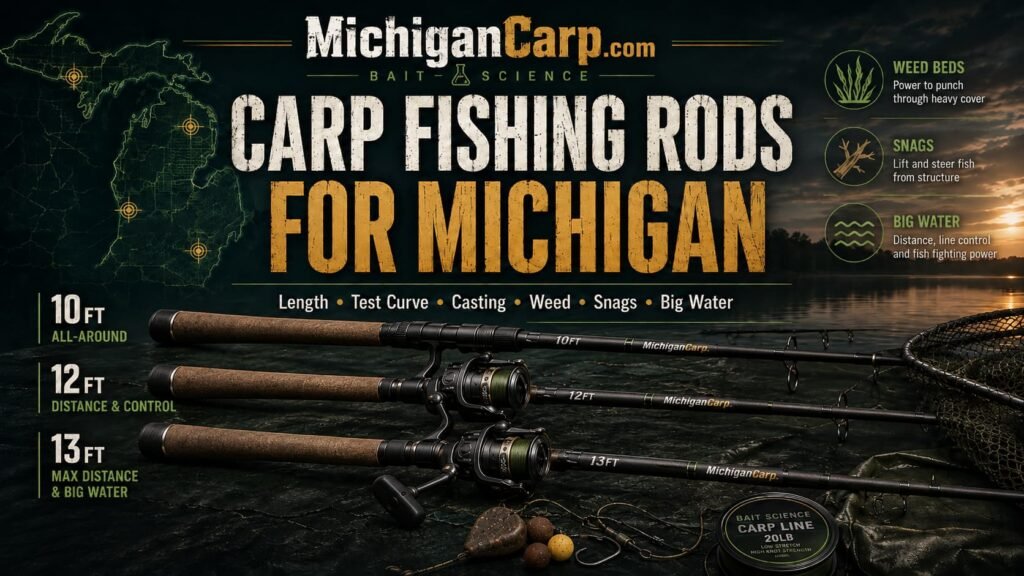
Carp fishing rods for Michigan should be chosen by the water in front of you.
That matters more than the brand, the price, the rod length, or how serious the rod looks on a pod. A rod that is perfect on a clean inland lake can be underpowered in weed. A long distance rod can be useful on open water, but awkward on a wooded campground bank. A short 10 ft carp rod can be a serious tool from a boat, kayak, tight swim or snaggy margin. A 3.5 lb test curve rod can be exactly right for solid PVA bags, channels and heavy weed, but too blunt for short-range fishing on clean bottom.
Michigan carp fishing creates a wider range of rod problems than many standard carp-rod guides admit. You may be fishing clean sand, soft silt, cabbage weed, riprap, zebra mussels, stumps, boat channels, bridge edges, dam ponds, public park margins, Great Lakes-connected water or small campground lakes. A useful carp rod has to cast the real load, control the line angle, protect the hook hold, apply pressure when a fish heads for danger and still play carp safely at the net.
The point is not to buy the most powerful rod you can afford.
The point is to buy enough rod for the swim without losing the forgiveness and control that help land carp cleanly.
For the full gear setup, read Carp Fishing Gear for Michigan. For mainline, leaders and abrasion safety, read Carp Fishing Line and Leaders for Michigan. For safe rigs and lead systems, read Michigan Carp Rig Guide. For landing and fish care, read Carp Fish Care and Safety.
The best Michigan carp rod is the rod that lets you cast accurately, control fish safely and match the hazards of the water.
Table of Contents
Quick Start: Best Carp Rod Choice for Michigan
Use this table as the practical starting point.
| Main Michigan Situation | Best Rod Starting Point | Why |
|---|---|---|
| First proper carp rods | 12 ft, 3 lb to 3.25 lb | Best all-round bank-fishing range |
| Clean inland lakes | 12 ft, 2.75 lb to 3.25 lb | Forgiving, enjoyable and strong enough |
| Mixed public lakes | 12 ft, 3.25 lb | Stronger all-round Michigan choice |
| Weed and moderate snags | 12 ft, 3.25 lb to 3.5 lb | More backbone and line control |
| Heavy solid bags or method feeders | 12 ft, 3.5 lb | Safer casting load and better compression |
| Tight swims, boats, kayak support | 9–10 ft, 3 lb to 3.5 lb | Easier handling and close-range control |
| Big open water or distance | 12 ft 6 in to 13 ft, 3.5 lb | Extra casting leverage and line pick-up |
| Rivers, channels and current | 12 ft to 13 ft, 3.25 lb to 3.75 lb | Handles heavier leads and pressure |
| Extreme snags or timber | 10–12 ft, 3.5 lb+ only where justified | Control matters more than distance |
For most Michigan carp anglers, the best first dedicated carp rods are 12 ft rods around 3 lb to 3.25 lb. If you already know you fish weed, solid bags, channels, bigger water or stronger line, move toward 12 ft 3.25 lb or 12 ft 3.5 lb.
A 10 ft rod is not a toy. It is often better for boats, kayaks, tight swims, campground banks and short-range control.
A 13 ft rod is not automatically better. It earns its place only when distance, open-bank casting or line pick-up at range is a real advantage.
What a Carp Rod Actually Has to Do
A carp rod is a pressure-control tool.
It has four jobs. It must cast the load. It must manage the line angle. It must transfer pressure without ripping the hook out. It must help you land the fish safely.
The first job is casting the real load, not the imaginary one. A bare 3 oz lead is easy for many rods. A 3 oz lead plus a solid PVA bag, method feeder or packbait ball is a different load. This is one reason Michigan anglers who fish packbait, maize, boilies, tiger nuts and bags often benefit from a slightly stronger rod than a light clean-water setup.
The second job is line angle. Rod length affects how quickly you pick up line, how well you can lift line over nearby weed or riprap, and how easily you can steer a fish away from danger. A longer rod can help at range. A shorter rod can be much better close in.
The third job is pressure transfer. A soft rod with very heavy line may fail to move a fish before it reaches weed or timber. A stiff rod with light line and a poor drag can break fish off or cause hook pulls. Rod, reel, line, leader, hooklink and drag must match.
The fourth job is fish care. A rod that is too weak for the swim encourages break-offs. A rod that is too brutal for the swim can cause poor hook holds and unnecessary damage. The right rod gives control without becoming crude.
In Michigan, the hazard between you and the carp often matters more than the carp’s weight. A 20 lb carp over clean sand is one thing. The same fish crossing zebra mussels, stumps, riprap or heavy weed is a different fight.
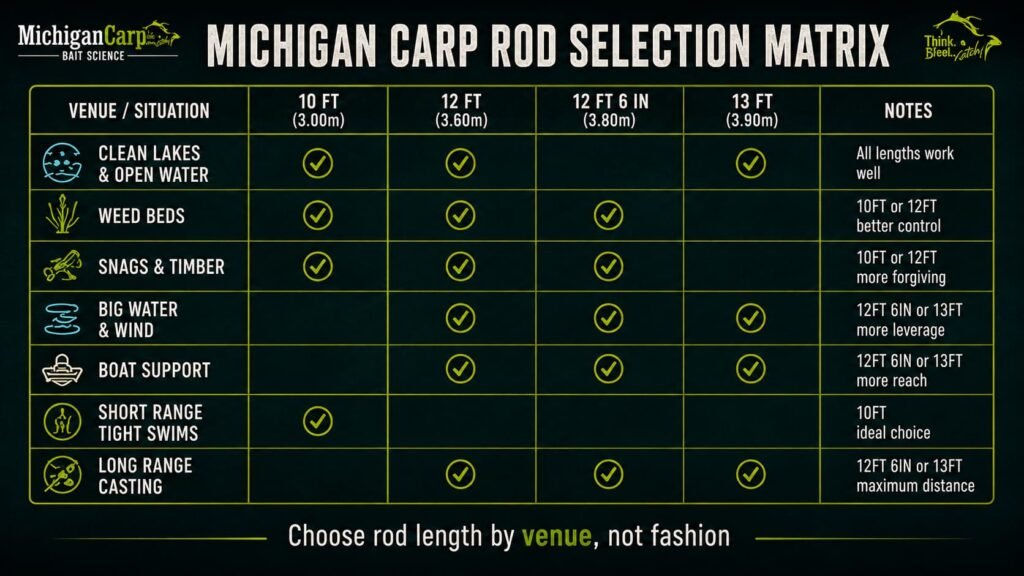
Rod Length: 10 ft, 12 ft, 12 ft 6 in and 13 ft
Rod length is a leverage choice, not a status symbol.
A longer rod gives more casting leverage and line pick-up. That can help on big open banks, distance spots, river lines and wide lake edges. A shorter rod gives better handling in boats, tight swims, wooded banks and close-range situations where you need direct control.
| Rod Length | Best Michigan Use | Main Trade-Off |
|---|---|---|
| 9–10 ft | Boats, kayaks, tight banks, close snags, mobile fishing | Less distance and line pick-up |
| 12 ft | Best general bank-fishing length | Not as compact as 10 ft, not as long-range as 13 ft |
| 12 ft 6 in | Open banks, bigger lakes, extra range without full 13 ft bulk | More specialized than a standard 12 ft rod |
| 13 ft | Distance, big open water, river/current work, long line pick-up | Awkward in tight swims and boats |
Current carp-rod ranges reflect this split. Korda’s rod guidance still treats 12 ft as the common standard, explains the growth of 13 ft rods for longer-range work, and points to 10 ft rods for shorter-range, boat and tight-swim fishing. Daiwa’s D-CARP range makes a similar distinction, with a 12 ft 3 lb option described for small-to-medium waters and a 13 ft 3.5 lb option described for long-distance or river fishing with heavier leads and stronger currents. Korda rod length and test curve guide Daiwa D-CARP rods
The mistake is thinking one length is automatically “best.” In Michigan, the right length depends on the bank, the cast, the landing angle and the hazards.
When a 10 ft Carp Rod Is the Better Tool
A 10 ft carp rod makes sense when distance is not the main problem.
That includes boat-supported fishing, kayak work, wooded swims, smaller lakes, tight public access areas, campground banks, short casts to weed edges, stalking, bridge margins, river edges and snaggy close-range spots.
The advantage is control. A shorter rod is easier to move, easier to net with, easier to use from a boat and easier to manage when a fish changes direction under the rod tip. It is also easier to transport and less awkward when trees, docks or bank clutter limit movement.
Modern compact rods are much better than the old cheap telescopic options. Nash’s Scope concept helped popularize serious compact carp rods, and Sonik’s Xtractor-style ranges show how normal 9 ft and 10 ft carp rods have become for compact and mobile fishing. Free Spirit’s compact rod information also shows serious 10 ft options from lighter stalking rods through stronger 3.25 lb and 3.5 lb versions for boat work, hit-and-hold stalking, snaggy waters and rivers. Nash Scope rods Sonik Xtractor+ carp rods Free Spirit Hi-S Compact carp rods
A 10 ft rod is not the right answer for long-distance open-water fishing, big casts with heavy bags, high line pick-up over distant weed, or open banks where range is genuinely the main issue. But for many Michigan swims inside 20–70 yards, it can be the more practical rod.
Why 12 ft Is Still the Main Michigan Carp Rod Length
A 12 ft rod remains the best all-round length for Michigan bank fishing.
It casts well without becoming awkward. It gives enough line pick-up for most lakes. It can handle normal leads, packbait, particles, boilies, tiger nuts, method feeders and moderate PVA. It also works well with alarms, banksticks, rod pods and larger reels.
For a first serious Michigan setup, two matching 12 ft rods are hard to beat.
The key decision is test curve.
A 12 ft 3 lb rod is a clean-water and general carp rod. It casts normal leads, plays fish nicely and remains forgiving under the tip.
A 12 ft 3.25 lb rod is the strongest all-round Michigan choice. It has more authority for weed, bigger fish, moderate bags, stronger line and public-water abuse without becoming too specialized.
A 12 ft 3.5 lb rod makes more sense when heavier leads, solid bags, long casts, channels, wind, weed or stronger leaders are part of your normal fishing.
For many Michigan anglers, the useful choice is not between 10 ft and 13 ft. It is whether the main 12 ft rods should be 3 lb, 3.25 lb or 3.5 lb.
When 12 ft 6 in and 13 ft Rods Make Sense
Longer rods earn their place when distance and line control matter.
A 12 ft 6 in rod is a bridge. It gives more casting leverage than a standard 12 ft rod without being quite as long as a 13 ft rod. It makes sense on open banks, bigger lakes and situations where you want more range without making every swim feel awkward.
A 13 ft rod is a distance and line-control tool. It can help on open points, large inland lakes, long bars, exposed lake edges, channels, river mouths and big-water situations where wind, bow in the line and range matter.
But a 13 ft rod is often the wrong tool in tight banks, campgrounds, woods, boats, kayaks, small rivers and close-range fishing. It can also be more tiring to use and harder to control near the net.
A longer rod does not automatically cast farther. The reel, line diameter, lead weight, rod action, casting technique and angler timing matter. Buying a 13 ft rod before you understand where carp are feeding can lead to casting over fish that were close enough for a 10 or 12 ft rod.
Use longer rods for proven distance needs, not for appearance.
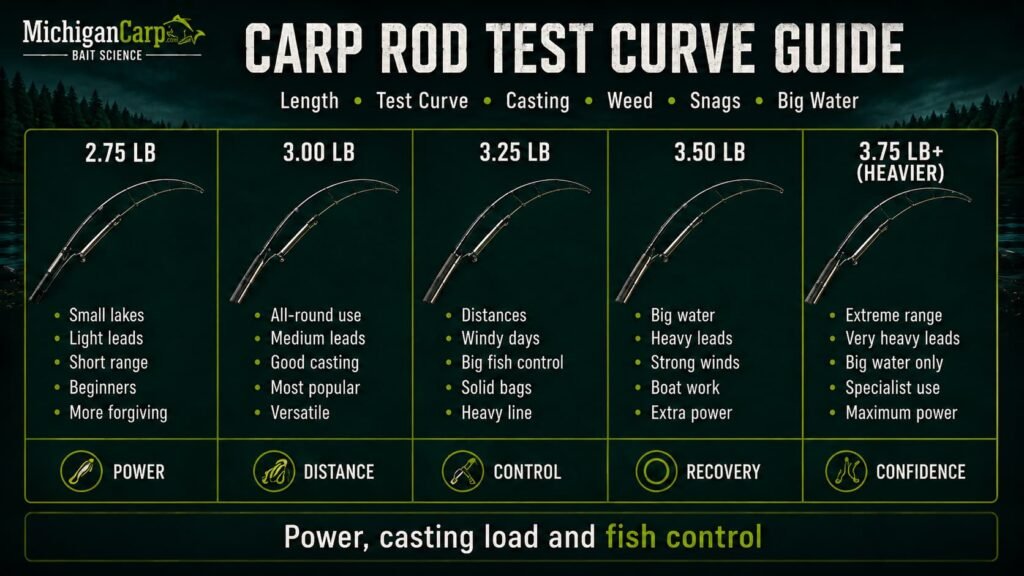
Test Curve Explained Without the Fluff
Test curve is a rough measure of rod power.
It is not an exact casting weight. It does not tell you everything about action, recovery, blank quality or fish-playing feel. Two rods with the same test curve can behave very differently.
A higher test curve usually gives more casting power, more backbone, better heavy-lead handling and more control in weed, current or bigger water. It also usually reduces forgiveness.
A lower test curve usually gives a softer fight, better cushioning and more enjoyment at close range. It also gives less control with heavy leads, bags, weed and snags.
| Test Curve | Best Michigan Use | What to Watch |
|---|---|---|
| 2.75 lb | Clean lakes, close to medium range, lighter leads | Can be underpowered in weed or bags |
| 3 lb | Clean to moderate all-round fishing | Good first rod if water is not rough |
| 3.25 lb | Best serious Michigan all-round range | Stronger without being extreme |
| 3.5 lb | Weed, bags, big water, channels, stronger line | Can feel stiff at close range |
| 3.75 lb | Distance, current, heavy bags, rough venues | More specialist; not needed everywhere |
| 4 lb+ | Extreme boat, snag, spod/marker or heavy work | Specialist tool, not beginner tackle |
The useful center point for Michigan is 3.25 lb. It gives more authority than a soft clean-water rod but does not jump straight to heavy distance-rod territory.
A 3 lb rod is fine for clean lakes and general fishing.
A 3.5 lb rod is better when weeds, solid bags, channels, heavy leads or stronger line are normal.
A 3.75 lb or heavier rod should be bought for a real job, not because the number sounds impressive.
Rod Action Matters as Much as Test Curve
Test curve tells you power. Action tells you how that power arrives.
A through-action rod bends deeper and is forgiving. It protects hook holds, cushions lunges and is enjoyable on clean lakes at short to medium range. It is not the best choice when distance, weed or heavy bags dominate.
A progressive rod bends smoothly at first and then locks into stronger power deeper in the blank. This is the best general action for Michigan because it gives both casting control and fish-playing forgiveness.
A fast-taper rod recovers quickly and casts harder. It suits distance work, heavier leads, solid bags and open water. It is less forgiving at close range and needs good drag control.
For most Michigan carp fishing, a progressive action is the safest choice. You want a rod that can compress properly on the cast, turn a fish away from trouble and still bend when a carp lunges near the net.
This is why judging rods only by test curve is risky. A good 3.25 lb progressive rod can be far more useful than a cheap 3.5 lb rod that feels dead, harsh or poorly balanced.
Casting Load: Lead, Bag, Feeder and Packbait
Rod choice should account for the complete casting load.
A 3 oz lead is not a 3 oz cast if you add a solid PVA bag. A method feeder full of packbait is not the same as a bare inline lead. A heavy baited rig with maize, boilies or tiger nuts also changes how the rod loads.
| Fishing Load | Sensible Rod Range |
|---|---|
| Small leads, corn or single boilie | 2.75–3 lb |
| Normal leads and hair rigs | 3–3.25 lb |
| Moderate solid bags or method feeders | 3.25 lb |
| Larger bags, heavier feeders or longer casts | 3.5 lb |
| Heavy current, big bags or distance work | 3.5–3.75 lb+ |
Overloading rods is unsafe. It can crack off, damage blanks, reduce accuracy and leave tackle in the water.
This is where many Michigan anglers should be honest about how they fish. If you regularly cast packbait, PVA bags, method feeders, larger leads or baited rigs into wind, a 3.25 lb or 3.5 lb rod may be a better practical choice than a softer 2.75 lb rod.
For packbait tactics, read Packbait for Carp Fishing.
Matching Rods to Line and Leaders
A rod is only as good as the system around it.
A soft rod with very heavy line can fail to move fish efficiently. A stiff rod with light line and a sticky drag can cause break-offs or hook pulls. Rod, reel, mainline, leader, hooklink, lead system and drag must work together.
| Rod Type | Sensible Line Pairing |
|---|---|
| 12 ft 3 lb | 15–25 lb mono |
| 12 ft 3.25 lb | 18–30 lb mono |
| 12 ft 3.5 lb | 20–40 lb mono or controlled braid setup |
| 10 ft 3–3.25 lb | 15–30 lb mono for close/tight work |
| 10 ft 3.5 lb+ | Heavy mono or braid for boats/snags |
| 13 ft 3.5 lb | 15–30 lb mono depending distance and hazards |
| Heavy snag rod | Heavy mono/braid plus safe leader system |
If the water has zebra mussels, riprap, timber, stumps or heavy weed, rod strength becomes part of the fish-care system. Stronger line and leaders only help if the rod can apply pressure and the rig remains safe if something breaks.
For heavy line, shock leaders and snag-leader combinations, read Carp Fishing Line and Leaders for Michigan.
Rods for Clean Lakes
Clean lakes are where softer carp rods make sense.
A 12 ft 3 lb rod is often ideal. It casts normal leads cleanly, plays fish nicely and gives enough cushioning to protect hook holds. A 2.75 lb rod can also be enjoyable where range is moderate and there is little weed or structure.
A clean-lake setup does not need to be overbuilt. A 12 ft 3 lb rod, 15–20 lb mono, a safe lead clip or inline lead, and simple hair rigs will handle a lot of carp fishing if the bottom is open and the landing area is safe.
This is where anglers often buy too much rod. A 3.5 lb rod can still work, but it may feel harsh if the fish are close and the water is clean. Accuracy, location and a smooth drag matter more than raw power.
Rods for Weed
Weed is one of the main reasons to move up in rod power.
When a carp reaches weed, the fight becomes a line-angle and pressure problem. The rod needs enough backbone to lift, steer and keep contact without ripping the hook out.
For moderate weed, a 12 ft 3.25 lb progressive rod is a strong choice. It pairs well with 20–25 lb mono, safe lead clips and stronger hooklinks.
For heavier weed, a 12 ft 3.5 lb rod often makes more sense, especially with stronger mono, controlled braid, heavier leads or drop-off lead arrangements where fish safety justifies them. From a boat or kayak, a strong 10 ft rod can be easier to manage than a long rod.
Weed fishing is not just “use a heavier rod.” It is a complete setup: rod power, line strength, leader choice, lead release, hook strength, swim angle and landing plan.
Rods for Snags, Stumps and Timber
Snag fishing is where rod choice becomes an ethical decision.
A rod that is too soft gives fish time to reach the snag. A rod that is too long can be awkward in a tight margin. A rod that is too stiff can cause hook damage if used badly. The right rod depends on range, angle and how quickly you must apply pressure.
For controlled snag edges, a 10–12 ft rod in the 3.25–3.5 lb range is normally more useful than a pure distance rod. The rod must let you apply side pressure quickly and move the fish before it reaches timber.
For severe stump fields or flooded timber, a 3.5 lb+ rod may be justified, but only with matching line, leaders, hooks and lead safety. Heavy rods do not make impossible swims safe. If a carp can immediately reach unrecoverable wood, the better choice may be to change angle, fish a safer edge, use boat support where legal and safe, or leave that spot alone.
A serious snag setup is not about bullying carp. It is about reducing break-offs and preventing fish from towing tackle.
Rods for Zebra Mussels, Rock and Riprap
Zebra mussels and riprap are line problems first, but rod choice still matters.
A stronger rod can help change the angle of a fish before it rubs line across shell or rock. A longer rod can sometimes help lift line over close riprap or a sharp margin. A progressive 12 ft 3.25–3.5 lb rod is a good starting point for this kind of water.
But the rod cannot save damaged line. If you fish mussels, concrete, riprap, bridge edges or rocky channels, use abrasion-resistant mainline, consider a suitable mono or fluorocarbon leader, and check the last several feet after every cast, fish or suspected contact.
In this water, soft clean-lake rods are often the wrong tool. You need enough rod to control the fish before the bottom cuts you off.
Rods for Rivers and Channels
Rivers and channels add current, heavier leads, abrasion and difficult line angles.
A 12 ft 3.25–3.5 lb rod covers many river and channel situations. A 13 ft 3.5 lb rod becomes useful where distance, stronger current or higher line pick-up matters. In current, the rod must cast the lead required to hold bottom and still cushion the fight.
The issue is pressure. Current adds load to the line and makes the carp feel heavier than it is. Rocks, pilings, riprap and mussels increase abrasion risk. This is why river and channel rods should usually be stronger than clean-lake rods.
Pair the rod with a smooth drag, suitable line, abrasion-aware leader and a safe lead system. A strong rod with a poor rig is not a safe system.
Rods for Big Michigan Lakes
Big water does not automatically mean long casts, but it often rewards better casting and line control.
On large inland lakes or Great Lakes-connected water, carp may feed along close weed edges, bay mouths, points, silt transitions or mussel beds. A 12 ft 3.25 lb rod may cover much of that fishing. When the feeding area is farther out, the bank is open and wind or line bow becomes an issue, a 12 ft 6 in or 13 ft rod starts to make sense.
A big-water rod should recover cleanly, handle a suitable reel, cast the necessary lead accurately and give you enough line control at range. It should not be bought simply because the water looks large.
For big-water location work, read Finding Carp in Big Michigan Lakes and Watercraft and Conditions for Michigan Carp Fishing.
Rods for Boats, Kayaks and Placed Rigs
Boat-supported carp fishing changes the rod equation.
If you are placing rigs by boat, fighting from a boat, recovering weeded fish or working close to features, a shorter rod is usually easier than a 12 or 13 ft rod. A 9–10 ft rod gives better handling, easier netting and more direct control.
A 10 ft 3–3.25 lb rod is useful for moderate boat-supported work. A 10 ft 3.5 lb or heavier compact rod can make sense for heavy weed, snags or placed rigs where casting distance is not the issue.
This is one reason compact rods deserve serious consideration in Michigan. Boats, kayaks, wooded banks, campground swims and tight margins are common. Long rods are not always practical.
Boat work still needs safe judgment. Strong rods and heavy line do not replace life jackets, weather awareness, legal access, safe night lighting and a clear landing plan.
Rod Combinations That Make Sense in Michigan
Three identical rods are tidy and simple. That is often the best setup.
But Michigan carp fishing sometimes rewards a mixed rod system because one rod may be fishing open water while another is placed near a weed edge, margin or snag line.
| Angler Type | Useful Rod Setup | Why |
|---|---|---|
| Beginner | Two 12 ft 3 lb rods | Simple, balanced, clean-water capable |
| Serious all-rounder | Two or three 12 ft 3.25 lb rods | Best broad Michigan setup |
| Weed / public water angler | 12 ft 3.5 lb plus 12 ft 3.25 lb rods | Stronger rod for the harder spot |
| Big-water angler | 12 ft 6 in or 13 ft rods plus one 12 ft rod | Distance plus a closer practical rod |
| Boat / tight-bank angler | 10 ft rods plus optional 12 ft rod | Short rods for control, longer rod for bank casting |
| Snag angler | 10–12 ft 3.5 lb+ rods where justified | Close control and heavy-line compatibility |
Do not fish more rods just because you own them. Multiple rods create more line angles, more tangles, more public-bank responsibility and more fish-care pressure. Michigan DNR regulations currently state a three-rod limit per angler, but local rules and site-specific restrictions still matter, so always check current regulations before fishing. Michigan DNR Fishing Regulations
Carp Rod Brands Worth Considering
Brand choice matters, but it should come after the fishing problem.
A rod from Avid, Fox, Sonik, NGT, Century, Harrison or Free Spirit can all be useful in the right situation. The important question is not which brand is “best.” The better question is whether that rod’s length, test curve, action, build quality, guides, reel-seat quality and price make sense for the water you fish in Michigan.
Use brand information as a way to narrow the search, not as a substitute for understanding rod choice.
| Brand | Best Role in a Michigan Setup | How I Would Think About It |
|---|---|---|
| Avid | Practical mid-range rods, all-round rods, distance models | Good for anglers wanting modern carp rods without premium custom-blank pricing |
| Fox | Mainstream UK carp rods, all-round and compact options | Recognized carp brand with broad rod and tackle-system support |
| Sonik | Value rods, compact rods, North America-friendly practical setups | Strong option for 9–10 ft compact rods and sensible budget-conscious carp setups |
| NGT | Budget starter rods, spare rods, travel rods | Useful for starting out, but inspect carefully before heavy snag or serious long-session work |
| Century | Premium all-round, distance and close-quarter rods | Best for experienced anglers who know the exact job they need |
| Harrison | Premium UK-built blanks, Torrix and Aviator-style rods | Strong long-term choice if action and blank quality matter |
| Free Spirit | Premium carp rods, compact rods, boat/stalking/specialist actions | Good for refined actions and serious compact or specialist rods |
Avid sits in a useful middle ground. Its Traction Pro range is described around a more traditional parabolic-style action using modern carbon materials, while Elevate is described as a lighter, faster-recovery and distance-accuracy range. For Michigan, that means Avid can fit both the smoother all-round role and the stronger casting role, depending on model. Avid Traction Pro rods Avid Elevate rods
Fox is a mainstream carp brand with broad rod support. Its Horizon X range includes 10, 12 and 13 ft models and test curves from lighter options up to 3.5 lb. That makes Fox relevant for anglers who want one brand range covering compact, all-round and more powerful rods. Fox Horizon X rods
Sonik is one of the more realistic brands for many North American carp anglers because it offers strong value and compact rods. The Xtractor+ range includes compact 6 ft, 9 ft and 10 ft rods, and Sonik also lists higher-end Xtractor Custom rods with fast recovery and modern guide layouts. For Michigan, Sonik is worth looking at for 9–10 ft compact rods, boat work, campground banks and affordable 12 ft all-round setups. Sonik Xtractor+ rods Sonik Xtractor Custom rods
NGT is best viewed as budget and entry-level carp tackle. Its range includes 12 ft 3 lb and 13 ft 3.5 lb carp rods. That can be useful for beginners, spare rods or low-cost entry setups, but I would be cautious about using budget rods for heavy solid bags, brutal snags, severe zebra mussels or long-term heavy public-water abuse unless I had checked guides, joints, reel seat and action carefully. NGT rods
Century sits at the premium end. Its C2-D information describes a rod built from the C2 all-round concept, emphasizing playing ability, light weight, quick tip recovery and use from close margins to distances suited to most venues. Century’s close-quarter rods also show how specialist short rods fit into tight or margin fishing. For Michigan, Century makes most sense once you already know whether you need all-round, distance or close-quarter rods. Century C2-D rods Century CQ close-quarter rods
Harrison is a premium UK blank and rod-builder name with Torrix and Aviator ranges. Harrison describes Torrix as one of its best-known all-round carp rods, while Aviator spans from 10 ft to 13 ft, including distance and lighter close-range actions. For Michigan, Harrison is a serious long-term rod choice, especially if you care about blank action and build quality. Harrison carp rods Harrison Aviator carp rods Harrison Torrix rods
Free Spirit also sits in the premium/specialist category. Its compact Hi-S information is especially relevant to Michigan because it describes 10 ft rods from lighter stalking models through 3 lb, 3.25 lb and 3.5 lb versions for more backbone, boat carping, hit-and-hold stalking, snaggy waters and rivers. For Michigan anglers who value compact rods, Free Spirit is one of the more interesting premium options. Free Spirit Hi-S Compact carp rods
The brand decision should be practical.
For a first budget-conscious Michigan setup, I would look hardest at Sonik, Avid, Fox or carefully selected NGT models.
For a serious all-round upgrade, I would look at Avid, Fox, Sonik’s better ranges, Century C2/C2-D, Harrison Torrix or Free Spirit all-round models.
For compact rods, I would compare Sonik Xtractor-style rods, Nash Scope-style rods, Fox compact options, Free Spirit compact rods and Century close-quarter options.
For premium long-term rods, Century, Harrison and Free Spirit are the strongest names in this list.
For extreme snags, the exact rod matters more than the brand name. I would want a strong progressive action, suitable test curve, excellent guides, good reel balance, heavy-line compatibility and a safe landing plan. I would not choose a cheap rod for brutal snag fishing just because the printed test curve number looks high.
Carp Rods vs Catfish Rods
Many Michigan anglers start with catfish rods.
That is understandable. A strong catfish rod can catch carp, and it is usually easier to find locally than specialist carp tackle. For someone testing the water, a decent catfish rod is better than a weak bass rod.
But a proper carp rod usually has advantages once you start fishing seriously. Carp rods are built for static bait fishing, repeated casting with leads, bite alarms, banksticks, hair rigs, long fights and fixed-spool reels. They usually cast a lead-and-rig setup more smoothly and protect hook holds better than many heavy catfish rods.
The upgrade point is simple.
Use catfish rods while learning. Once you know carp fishing is something you will keep doing, dedicated carp rods are worth it.
Rods, Reels and Balance
A rod should balance with the reel.
A compact 10 ft rod can feel clumsy with a massive big-pit reel. A 13 ft distance rod can feel underpowered with a small reel that lacks spool diameter and line capacity. A 12 ft all-round rod usually pairs well with a medium-large baitrunner, free-spool or carp-style reel.
The drag matters as much as the rod. A good rod cannot fix a sticky drag. If the drag starts in jerks, a sudden run near weed or rock can break line or pull hooks.
| Rod | Reel Style |
|---|---|
| 10 ft compact rod | Medium baitrunner/free-spool reel |
| 12 ft all-round rod | Medium-large baitrunner or carp reel |
| 12 ft 6 in / 13 ft rod | Larger spool or big-pit style reel |
| Heavy snag/boat rod | Strong reel with excellent drag and gearing |
Do not build a rod setup around looks. Build it around balance, line capacity, drag control and how the rod will actually be used.
Used Carp Rod Buying Checks
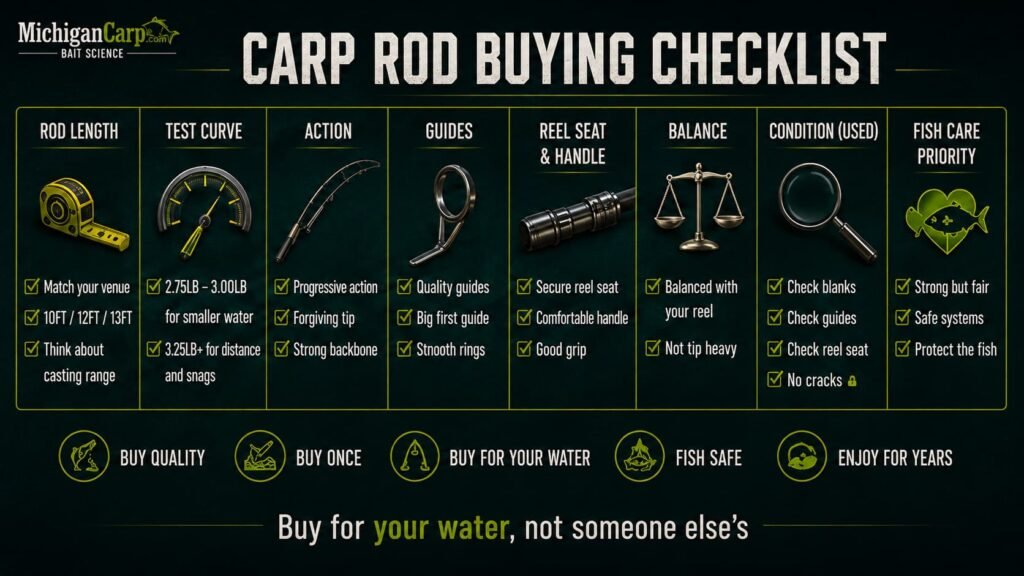
Used rods can be a good deal, but inspect them carefully.
The most important checks are the guides, joints, tip ring and blank. A cracked guide can destroy line. A worn joint can creak, twist or slip under pressure. A damaged tip ring can cost fish. A crushed blank can fail on a cast or under load.
Assemble the rod fully. Check that the sections fit cleanly. Look down the blank for twist. Flex it gently and listen for clicking. Run a cotton swab around the inside of each guide; if cotton catches, the insert may be cracked.
Be especially careful with rods previously used with braid, heavy leaders, spodding or snag fishing. They may have had a harder life than they look.
A cheap used rod with damaged rings is not a bargain if it costs you the first good carp of the season.
What I Would Buy First
For a first proper Michigan carp setup, I would buy two matching 12 ft 3.25 lb carp rods.
That is the most useful compromise for the way many Michigan anglers actually fish. It is strong enough for mixed public water, moderate weed, packbait, boilies, tiger nuts, stronger line and normal casting, but it is not as specialized as a 13 ft distance rod or a heavy boat/snagger.
If your fishing is mostly clean water and shorter sessions, two 12 ft 3 lb rods are a very good choice.
If you already know you fish weed, solid bags, channels or heavier water, two 12 ft 3.5 lb rods may be more practical.
If you fish boats, kayaks, tight campground banks or short snaggy swims, add a 10 ft rod before buying 13 ft distance rods.
If you genuinely need range on open water, then look at 12 ft 6 in or 13 ft rods.
The worst first purchase is a rod bought for imaginary fishing. Buy for the water you actually fish.
Common Rod Mistakes
The most common mistake is buying too much rod too early. A 13 ft distance rod is pointless if your best fish are feeding on a weed edge forty yards out.
The second mistake is buying too little rod for rough water. Light rods are enjoyable on clean lakes, but they are poor tools for heavy weed, stumps, riprap and strong line.
The third mistake is ignoring casting load. A rod that feels fine with a bare lead may be overloaded with a full PVA bag, method feeder or packbait ball.
The fourth mistake is judging only by test curve. Rod action, recovery, guide quality, reel balance and line pairing matter.
The fifth mistake is using long rods in tight swims. A shorter rod may land more fish when trees, boats, docks or campground banks limit movement.
The sixth mistake is upgrading rods before upgrading fish care. A better rod is not more important than a proper landing net, unhooking mat and safe rig system.
Practical Michigan Rod Recommendations
For clean lakes, choose a 12 ft 3 lb rod if you want a forgiving, enjoyable setup.
For general Michigan carp fishing, choose a 12 ft 3.25 lb rod.
For weeds, bags, channels and bigger public water, choose a 12 ft 3.5 lb rod.
For boats, kayaks, tight swims and short-range control, choose a 9–10 ft rod in a suitable test curve.
For big open water and true distance fishing, choose a 12 ft 6 in or 13 ft rod only when the venue justifies it.
For extreme snags, choose power only as part of a full system: heavy line, safe leaders, strong hooks, proper lead release, controlled drag and a realistic landing angle.
My own practical starting point for Michigan would be:
12 ft, 3.25 lb, progressive action.
That rod will not be perfect everywhere, but it will be useful almost everywhere.
FAQ
What is the best carp rod for Michigan?
For most Michigan carp anglers, a 12 ft rod around 3 lb to 3.25 lb is the best starting point. A 12 ft 3.25 lb rod is the strongest all-round recommendation for mixed public water.
Are 10 ft carp rods good for Michigan?
Yes. A 10 ft carp rod is very useful for boats, kayaks, tight swims, wooded banks, short sessions, small waters and close-range snag control.
Do I need a 13 ft carp rod?
Only if you genuinely need distance or line control on open water. A 13 ft rod is not necessary for most close to medium-range Michigan carp fishing.
What test curve should I choose?
Choose 3 lb for clean lakes, 3.25 lb for all-round Michigan carp fishing, and 3.5 lb for weed, bags, channels, bigger water and stronger line.
Is a 3.5 lb carp rod too heavy?
Not for weed, solid bags, rivers, channels or bigger water. It can be too stiff for close-range clean-water fishing if you prefer a softer fight.
Is a 2.75 lb carp rod enough?
Yes, on clean water with lighter leads and short to medium-range fishing. It is not the best choice for heavy weed, solid bags, big water or snag fishing.
Can I use catfish rods for carp?
Yes, especially at the beginning. Strong catfish rods can catch carp, but proper carp rods usually cast better, balance better on alarms, and play carp more cleanly.
What rod should I use for heavy weed?
A 12 ft 3.25 lb to 3.5 lb rod is a good choice. In boat-supported weed fishing, a strong 10 ft rod can be even more practical.
What rod should I use around snags?
Use a strong 10–12 ft rod around 3.25 lb to 3.75 lb depending on range and severity. The rod must be matched with heavy line, safe leaders, strong hooks and a proper landing plan.
What rod should I use for solid PVA bags?
A 12 ft 3.25 lb rod is suitable for moderate bags. A 12 ft 3.5 lb rod is better for larger bags, heavier leads or longer casts.
Which carp rod brands are worth considering?
Avid, Fox, Sonik, NGT, Century, Harrison and Free Spirit can all make sense depending on budget and use. Sonik, Avid and Fox are practical mainstream options. NGT is more budget/entry-level. Century, Harrison and Free Spirit are premium or specialist choices.
Are premium carp rods worth it?
Premium rods are worth it when you know exactly what you need and care about action, recovery, components and long-term ownership. They are not necessary for a beginner who still needs to learn venues and buy fish-care gear.
How many carp rods should I buy first?
Buy two matching rods first. A pair of 12 ft 3 lb or 3.25 lb rods is a sensible start. Add specialist rods only after your venues prove you need them.
What rod would I choose as a single Michigan all-rounder?
I would choose a 12 ft 3.25 lb progressive-action carp rod. It gives the best balance of casting, control, fish playing and public-water strength.
Next Steps
Use these supporting guides next:
Carp Fishing Gear for Michigan
Carp Fishing Line and Leaders for Michigan
Watercraft and Conditions for Michigan Carp Fishing
Finding Carp in Big Michigan Lakes
External references:
Korda Rod Length and Test Curve Guide
Korda Complete Guide to Carp Fishing Rods
Sonik Xtractor Custom Carp Rods
Free Spirit Hi-S Compact Carp Rods
Michigan DNR Fishing Regulations
FAQ Schema Note
Enable Rank Math FAQ Schema for the FAQ section.
Do not manually add duplicate FAQ JSON-LD if Rank Math already generates it.