

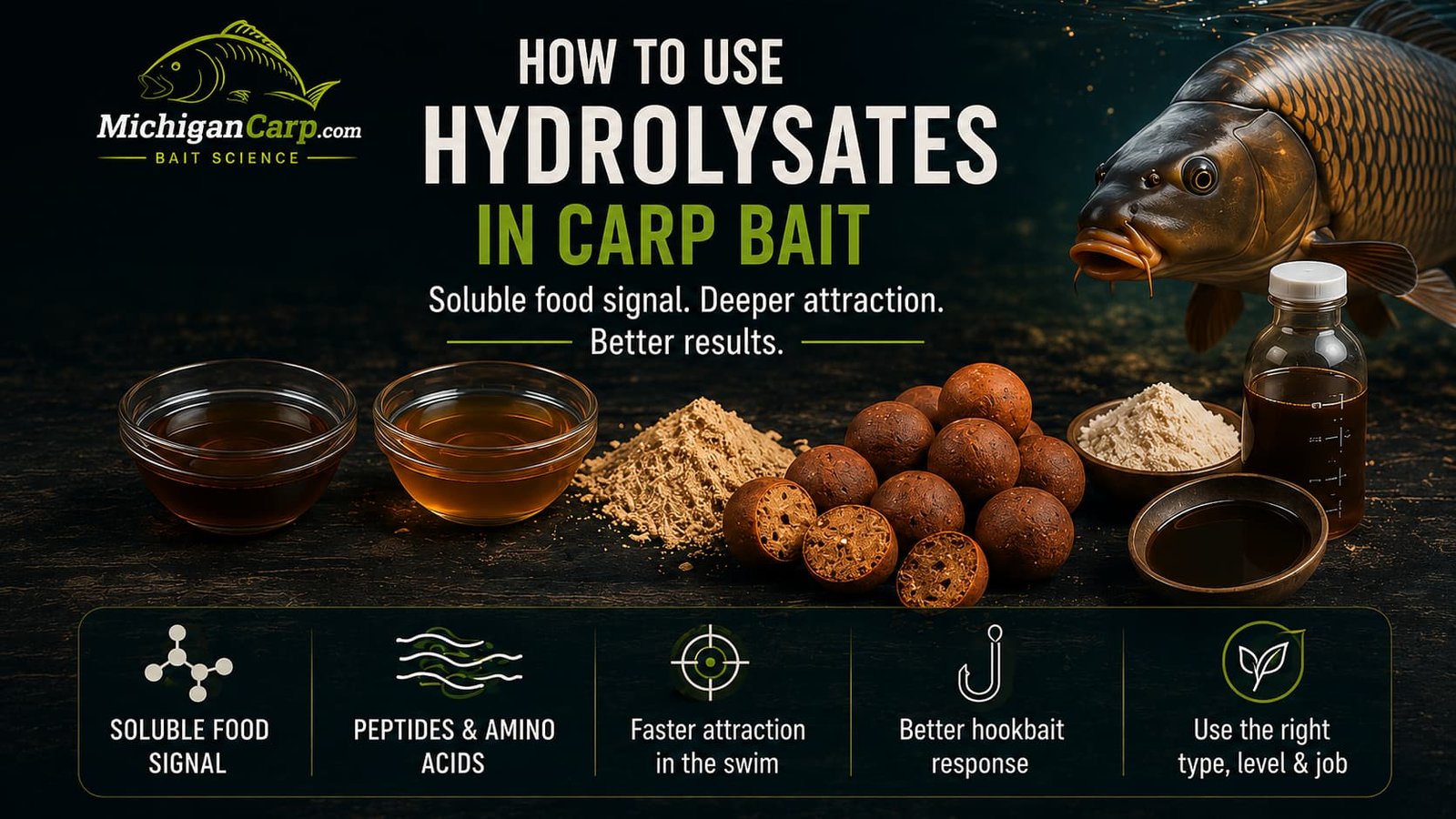
How to use hydrolysates in carp bait is one of the most useful bait-making subjects to understand, but it is also one of the easiest to overdo.
Hydrolysates can add soluble food signal, savoury depth, peptide-rich fractions, amino-acid-containing material, dairy character, liver character, fishmeal-style attraction and fast outer leakage. They can improve boilies, hookbaits, glugs, sprays, powder coatings, crumb, packbait, method mix and particle liquids.
But hydrolysates are not magic. They do not fix bad bait. They do not replace watercraft. They do not automatically make carp feed. Used badly, they can make bait bitter, harsh, sticky, unstable, sour, too soft or completely overpowered.
The goal is not to use the most hydrolysate possible. The goal is to use the right hydrolysate, at the right level, in the right part of the bait system.
This article owns the practical side: how to use hydrolysates in carp bait, where to put them, which forms suit different bait jobs, how to avoid overuse, and how to test them before scaling up.
For the broader protein science behind intact proteins, peptides, hydrolysates and free amino acids, read Proteins, Peptides and Hydrolysates in Carp Bait. For enzyme-treatment claims, use Do Enzymes and Phytase Really Improve Carp Bait?. For soluble release, use Carp Bait Solubility and Leakage. For practical pre-fishing treatment, use How to Prepare Boilies for Carp Fishing.
For external technical context, see Enzymatic Fish Protein Hydrolysates in Finfish Aquaculture and A Review of Feed Attractants as a Guide for Aquaculture Operations.
Table of Contents
Quick Start: How to Use Hydrolysates in Carp Bait
How to use hydrolysates in carp bait depends on the bait job. A hydrolysate used inside a boilie base mix is not doing exactly the same job as a hookbait spray, crumb treatment, powder coating or particle finishing liquid.
| Use | Best direction | Starting point | Main warning |
|---|---|---|---|
| Boilie dry mix | Powder hydrolysates, liver powder, hydrolyzed whey, yeast extract | 5–30 g per 1 kg dry mix | Too much can become bitter or sticky |
| Boilie liquid phase | Liquid liver, fish hydrolysate, liquid yeast, whey hydrolysate | 10–40 ml per 1 kg dry mix | Count it as part of the wet phase |
| Hookbait conditioning | Liver, whey, yeast, PG/glycerin carrier | Light coating only | Do not drown wafters or pop-ups |
| Glugs and soaks | Liquid hydrolysates, yeast liquids, matching bait liquids | 10–50 ml per 1 kg boilies | Wet bait spoils faster |
| Powder coating | Hydrolyzed whey, liver powder, yeast powder, crumb | Light dusting | Heavy dusting can overpower the bait |
| Crumb, chops and pellets | Liver, fish, yeast, whey or blended hydrolysate liquids | Small coating, mixed evenly | Keep the feed active, not sloppy |
| Packbait and method | Dry hydrolysate powders or low liquid additions | Small additions to carrier mix | Do not ruin binding or breakdown |
| Particles | Yeast, liver, whey, fish hydrolysate used after cooking | Low finishing-liquid level | Do not cover poor particle preparation |
The simplest rule is:
Use hydrolysates for soluble food signal. Use enough to support the bait, not so much that the hydrolysate becomes the bait.
What Hydrolysates Are — and What They Are Not
A hydrolysate is produced when protein material is broken into smaller fractions. Depending on the product and processing method, a hydrolysate may contain larger protein fragments, peptides, smaller peptides, free amino acids, salts, minerals, flavour-active compounds, bitter fractions and other soluble material.
That does not make every hydrolysate the same.
A mild whey hydrolysate is not the same as a strong liquid fish hydrolysate. Beef liver hydrolysate is not the same as yeast extract. A liquid hydrolysate behaves differently from a spray-dried powder. A product made for feed use may differ from a bait-shop liquid, food ingredient or supplement powder.
Hydrolysates are best understood as soluble food-signal tools. They can make protein-derived material more available in water, but the finished bait still controls the release. Bait hardness, drying, skin formation, oil level, powder loading, crumb size and water temperature all affect what actually reaches the swim.
This is why hydrolysates should support formulation, not replace it.
Choose the Hydrolysate by Source
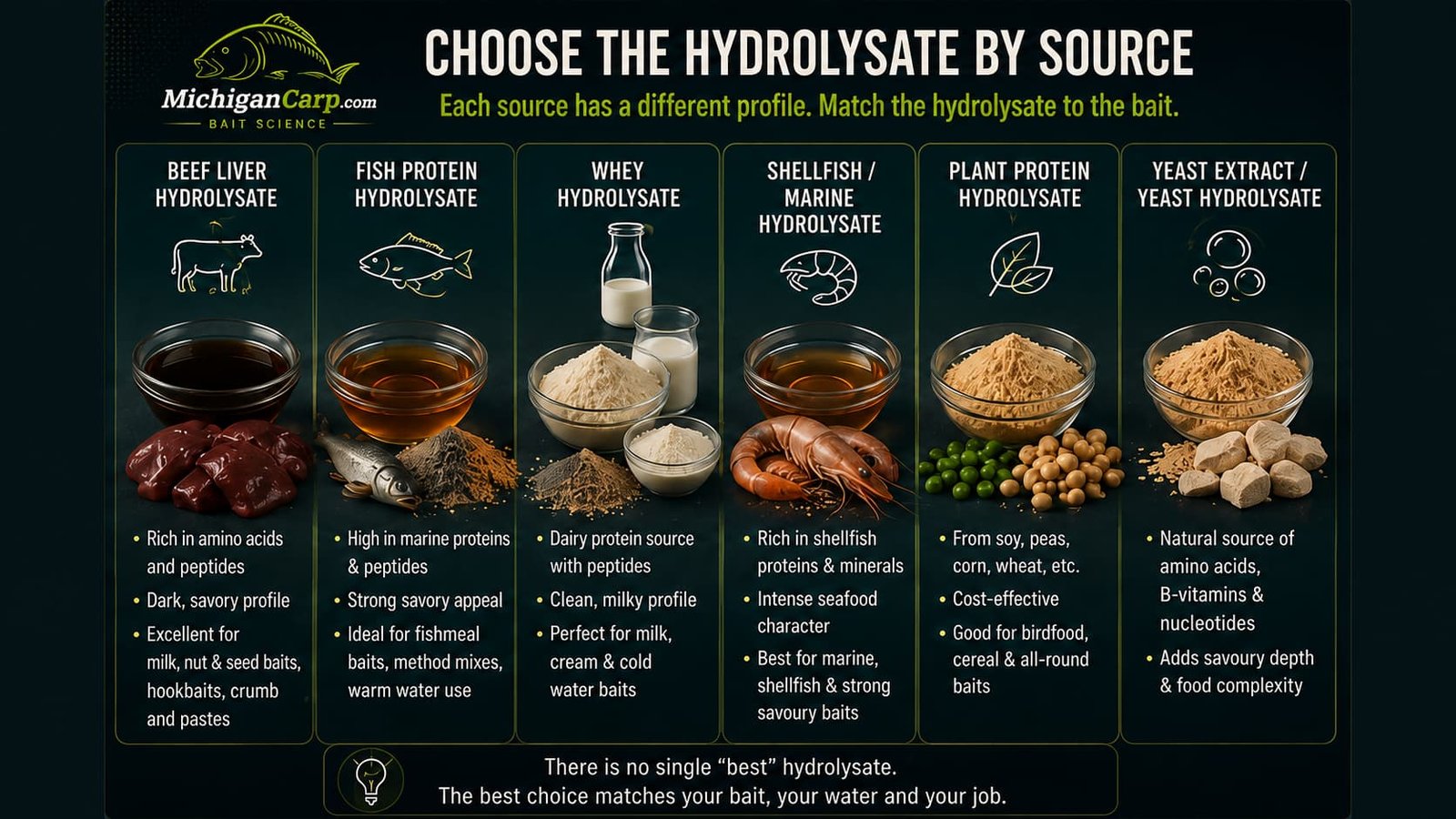
The source material gives a hydrolysate much of its bait identity. Before worrying about dosage, decide whether the source actually fits the bait.
| Hydrolysate type | Best practical use | Use with caution when |
|---|---|---|
| Beef liver hydrolysate | Milk-nut baits, hookbait conditioning, crumb, paste, savoury support | The bait is meant to stay very clean, sweet or delicate |
| Fish protein hydrolysate | Fishmeal baits, savoury baits, method mix, warm-water glugs | You want a non-marine milk, nut or fruit-cream identity |
| Whey hydrolysate | Milk baits, cream baits, cold-water powders, hookbait coatings | The product tastes harsh or bitter at higher levels |
| Shellfish, krill or marine hydrolysate | Marine, fishmeal, crab, shrimp or strong savoury baits | You do not want the bait pulled into a marine profile |
| Plant protein hydrolysate | Cereal, birdfood, economical feed-style mixes | The source, taste or processing quality is unclear |
| Yeast extract or yeast hydrolysate | Savoury depth, milk-nut baits, birdfoods, crumb, packbait | The product is very salty or intense |
For my own non-marine milk, nut and seed bait direction, I normally find beef liver hydrolysate, hydrolyzed whey and yeast-derived ingredients cleaner than making everything taste like fish hydrolysate.
Liquid Hydrolysates vs Powder Hydrolysates
Liquid and powder hydrolysates both work, but they solve different bait-making problems.
Liquid hydrolysates are useful when you want coating, movement, wet-side food signal, glug behaviour, crumb treatment, particle finishing liquid or hookbait conditioning. Their weakness is that they add moisture. In boilie paste they must be counted as part of the liquid phase. In stored bait they may increase spoilage risk.
Powder hydrolysates are useful when you want controlled inclusion, dry-mix accuracy, powder coatings, PVA-friendly dry blends, stick mixes, packbait powders or hookbait dusts. Their weakness is that strong powders can become bitter, clumpy, sticky or harsh when overused.
| Decision | Use liquid when | Use powder when |
|---|---|---|
| Base mix | You want liquid-phase signal and can adjust moisture | You want repeatable dry inclusion |
| Glugging | You want coating and absorption | You want a dusted soluble skin |
| Hookbaits | You want light conditioning or spray | You want powder coating without drowning the bait |
| PVA | Only if carrier is tested PVA-safe | Usually safer in dry stick or bag mixes |
| Storage | Better for short-term prepared bait | Easier to control in dry systems |
A good system can use both forms, but not at extreme levels.
Where to Use Hydrolysates in the Bait System
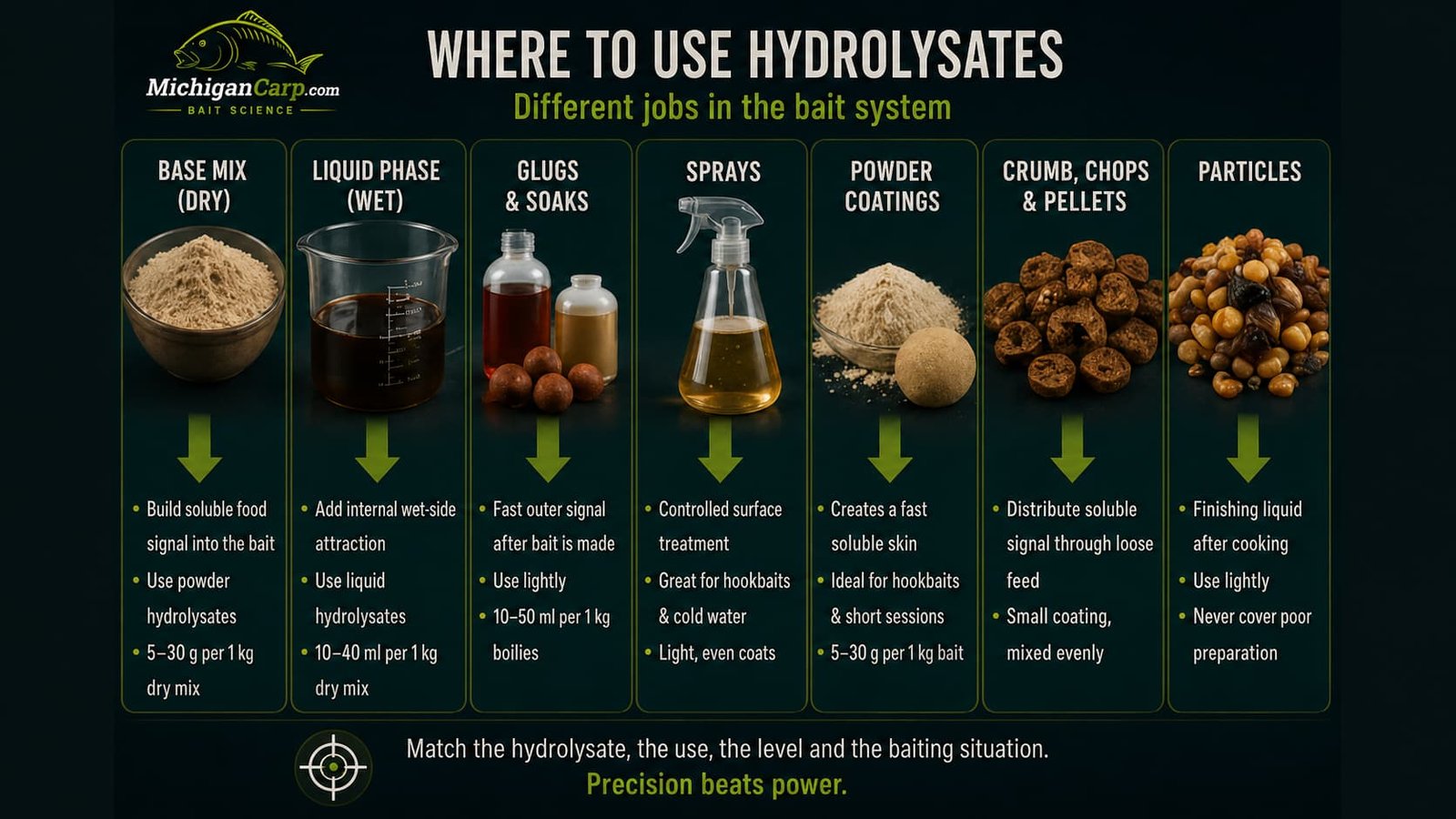
Hydrolysates can be used in several places, but each place has a different job.
| Part of the bait system | What hydrolysate does there | Best approach |
|---|---|---|
| Dry base mix | Builds soluble food signal into the bait | Use measured powder levels |
| Liquid phase | Adds internal wet-side leakage and identity | Reduce other liquids if needed |
| Glug or soak | Adds fast outer signal after bait is made | Use lightly and keep bait cool |
| Spray | Adds controlled surface treatment | Useful for hookbaits and cold water |
| Powder coating | Creates a fast soluble skin | Best for short sessions and hookbaits |
| Crumb and chops | Distributes signal through exposed bait pieces | One of the best practical uses |
| Packbait and method | Adds food signal to carrier bait | Do not ruin binding or breakdown |
| Particles | Adds finishing liquid after safe prep | Use after cooking, cooling and draining |
The biggest mistake is treating every use as the same. A powder in a dry mix, a spray on a pop-up and a liquid added to cooked particles should not be judged by one universal dosage rule.
Practical Starting Levels
These are starting points, not laws. Product strength varies, so always test the actual product.
| Use | Conservative start | Moderate working range | High-risk range |
|---|---|---|---|
| Powder hydrolysate in dry mix | 5–10 g/kg | 10–30 g/kg | 30 g/kg+ |
| Liquid hydrolysate in liquid phase | 10 ml/kg | 10–40 ml/kg | 50 ml/kg+ |
| Glug for finished boilies | 10–25 ml/kg bait | 25–50 ml/kg bait | 50–100 ml/kg bait |
| Hookbait conditioning | Light spray or short roll | Repeated light coats | Long soak without buoyancy test |
| Powder coating | 5–15 g/kg bait | 15–30 g/kg bait | Heavy dry crust |
| Packbait or method | Small dry or liquid addition | Enough to match the hookbait area | Wet, sticky, sour mix |
When in doubt, start low. Hydrolysates are easier to increase than remove.
Hydrolysates in Milk, Nut and Seed Baits
Milk, nut and seed baits are one of the best places to use hydrolysates carefully. The key word is carefully.
A milk-nut bait already has a clear identity: dairy protein, nut meals, seed meals, cereal structure, birdfood texture and usually a cream, fruit, nut or sweet profile. A hydrolysate should support that identity, not erase it.
My preferred hydrolysate directions for this style are hydrolyzed whey, beef liver hydrolysate and yeast extract or soluble yeast. Hydrolyzed whey keeps the dairy line clean. Beef liver adds darker savoury depth without automatically making the bait fishmeal-based. Yeast extract gives a rounded savoury background that fits milk, nut, cereal and birdfood systems well.
| Milk-nut bait job | Good hydrolysate choice | Practical comment |
|---|---|---|
| Clean dairy lift | Hydrolyzed whey | Best first choice for milk/cream baits |
| Dark savoury support | Beef liver hydrolysate | Use low to moderate levels |
| Rounded food depth | Yeast extract or soluble yeast | Good in birdfood and nut baits |
| Fishmeal-style pull | Fish hydrolysate | Use only if you want that profile |
A practical dry support package for 1 kg of milk-nut dry mix could be:
20 g hydrolyzed whey powder
10 g beef liver powder or liver hydrolysate powder
10 g yeast extract or soluble yeast powder

Total: 40 g
That is already a strong soluble-support package. It should be tested before increasing.
For the base-mix side, use How to Formulate a Milk, Nut and Birdfood Boilie Base Mix. For milk ingredient choices, use Milk Powders in Boilie Making.
Hydrolysates in Fishmeal, Birdfood and Savoury Baits
Fishmeal and strongly savoury baits can tolerate more marine or animal hydrolysate character than subtle milk-nut baits. That does not mean they should be overloaded.
Fish protein hydrolysate, squid, krill, shellfish, liver hydrolysate and yeast extract can all fit savoury bait. The question is whether the bait needs a stronger marine note, a darker liver note, or a more rounded yeast background.
| Bait type | Good hydrolysate direction | Main warning |
|---|---|---|
| Fishmeal boilies | Fish, krill, squid, liver, yeast | Easy to make the bait harsh or salty |
| Birdfood boilies | Yeast, hydrolyzed whey, low liver | Do not make an open bait sticky and heavy |
| Savoury non-fishmeal bait | Liver, yeast, mild fish if wanted | Keep the profile coherent |
| Pellet-based bait | Fish, liver, yeast liquids | Watch oil and moisture |
Birdfood baits are good hydrolysate carriers because their texture and openness can help treated bait work quickly. But too much liquid can collapse that advantage by making the bait dense, sticky or slow to dry.
Hookbaits, Glugs, Sprays and Powder Coatings
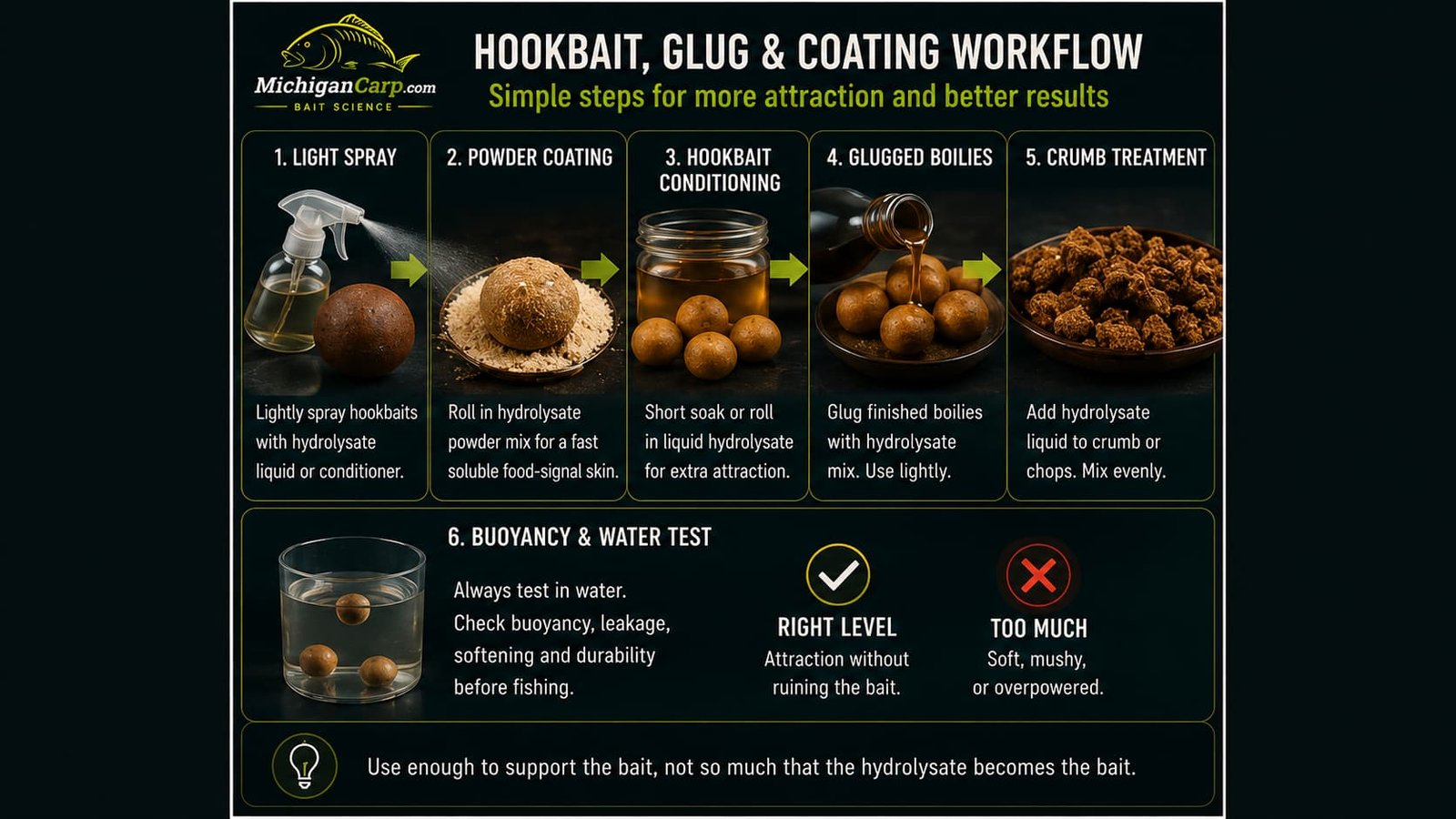
Hookbaits are one of the best places to use hydrolysates because the quantity is small and the job is targeted. You can make a hookbait or rig-area presentation more active without treating every free bait the same way.
The warning is mechanics. A hydrolysate treatment that ruins hardness, buoyancy, balance, casting strength or water life is not an improvement.
A simple 250 ml hookbait conditioner:
90 ml food-grade propylene glycol
60 ml food-grade glycerin
40 ml tiger nut extract or matching bait liquid
30 ml beef liver hydrolysate
20 ml hydrolyzed whey liquid or liquid yeast
10 ml molasses or maple syrup

Total: 250 ml
Use this lightly. Shake a small number of hookbaits in a small amount, then test buoyancy and texture with the actual rig.
A simple 100 g milk-nut hookbait coating dust:
30 g hydrolyzed whey powder
20 g skimmed milk powder
20 g tiger nut flour
15 g beef liver powder
10 g yeast powder
5 g betaine

Total: 100 g
Lightly spray or dampen the bait, roll it in the dust, allow it to stand, and test it in water. Powder coatings are often better than heavy glugs because they create a fast outer signal without flooding the bait with liquid.
For glugging 1 kg of finished boilies, a light starting mix is:
15 ml beef liver hydrolysate
15 ml liquid yeast
10 ml tiger nut extract
10 ml food-grade glycerin or propylene glycol

Total: 50 ml
Use lightly and shake well. A glug should support the bait, not turn it into wet soup.
For the broader pre-fishing bait treatment guide, use How to Prepare Boilies for Carp Fishing: Glugs, Soaks and Hookbait Conditioning.
Crumb, Chops, Packbait, Method Mix and Particles
Hydrolysates often work better through crumb, chops and loose feed than through large, hard, over-dried boilies.
Crumb and chopped boilies expose more surface area. Water reaches more bait material quickly. A small amount of hydrolysate, yeast extract or soluble food liquid can spread through the rig area more efficiently.
This suits short sessions, cool water, mobile fishing, travel-route fishing, PVA traps, method feeders and tight rig-area feeding.
| Carrier | Best hydrolysate use | Warning |
|---|---|---|
| Boilie crumb | Light liver, whey, yeast or fish liquid | Do not make it paste unless that is the goal |
| Chopped boilies | Light coating plus matching powder | Do not drown the bait |
| Packbait | Dry hydrolysate powder or small liquid addition | Do not ruin bind and breakdown |
| Method mix | Small food-liquid addition | Keep castability and breakdown |
| Particles | Finishing liquid after safe preparation | Never use hydrolysate to cover unsafe prep |
A simple dry packbait support blend is:
100 g fine boilie crumb
30 g brewer’s yeast
30 g hydrolyzed whey
20 g beef liver powder

Total: 180 g
Mix this into the dry carrier, then wet the packbait as normal. Do not make the mix wet, sticky or sour. It still needs to bind, cast, sink and break down properly.
Particles should be soaked, cooked and cooled correctly before hydrolysates are added. Use hydrolysates as finishing liquids or short-term soaks, not as a way to disguise poor preparation. For particle prep, use How to Prepare Particles for Carp Fishing.
Cold Water, Warm Water and Session Length
Hydrolysates are useful in cold water because they can add signal without requiring a lot of feed. That does not mean heavy glugging is the answer. Cold-water bait usually benefits from precision: smaller amounts, lower oil, crumb, chops, sprays, powder coatings and carefully treated hookbaits.
In warmer water, when carp are feeding harder, there is more room for richer hydrolysate use. But warmer water also increases spoilage risk, especially with wet treated bait.
| Situation | Best hydrolysate approach | Biggest mistake |
|---|---|---|
| Cold water | Low-level whey, liver, yeast, sprays and powders | Overfeeding or heavy oil/liquid use |
| Cool spring water | Crumb, chops, light hookbait treatment | Making the bait system too big too early |
| Warm water | Moderate liver, fish, yeast or whey support | Letting wet bait spoil in heat |
| Short sessions | Rig-area signal, crumb, coated hookbaits | Treating too much bait |
| Long campaigns | Good food bait with controlled hydrolysate support | Trying to build the whole campaign around strong liquids |
For long campaigns, hydrolysates should support the food package. They should not replace digestibility, balance, energy, texture or sensible baiting quantity.
Storage, PVA and Shelf-Life Cautions
Hydrolysates can complicate storage because many of them add moisture, solubles and biological richness.
Dry powders are easier to control in shelf-life bait than water-rich post-boil soaks. Liquid hydrolysates are excellent for same-session bait preparation, freezer bait, hookbait conditioning and short-term glugs, but they should not be treated casually in warm storage.
| Issue | Practical rule |
|---|---|
| Shelf-life bait | Use dry hydrolysates or tested preserved systems cautiously |
| Freezer bait | Hydrolysates are easier to use after thawing or before freezing |
| Warm storage | Do not leave wet hydrolysate-treated bait in heat |
| PVA | Assume water-based liquids may melt it until tested |
| Pop-ups and wafters | Test buoyancy after treatment |
| Powder clumping | Keep powders dry and sealed |
For PVA, test the actual finished mix, not just the liquid. Add a piece of PVA to the treated mix and check it after several minutes. Many water-based hydrolysates are not PVA-safe unless carried in a suitable PVA-friendly system.
For shelf-life bait, read Water Activity in Boilies, Potassium Sorbate, Sodium Benzoate and Citric Acid in Shelf-Life Boilies and How to Store Homemade Boilies.
A Simple Hydrolysate Test Plan
Before scaling up, test small. Hydrolysate testing without notes is just guessing.
| Step | What to do |
|---|---|
| 1. Choose one direction | Test liver, whey, fish, yeast or a milk-nut blend, not everything at once |
| 2. Make three levels | Low, medium and high versions of the same bait |
| 3. Keep everything else identical | Same base mix, liquid level, boiling, drying and storage |
| 4. Water test | Check 1 hour, 6 hours, 12 hours and 24 hours |
| 5. Record behaviour | Paste, hardness, leakage, smell, softness, bitterness and durability |
| 6. Fish it sensibly | Compare results over repeated sessions, not one cast |
A useful 1 kg dry-mix test structure is:
Low: 10 g powder or 10 ml liquid
Medium: 25 g powder or 25 ml liquid
High: 40 g powder or 40 ml liquid
The “high” version is not automatically better. It is there to show where the bait starts becoming too strong, too sticky, too soft or too bitter.
For water-testing structure, use How to Test Boilies Before Fishing.
Common Hydrolysate Mistakes
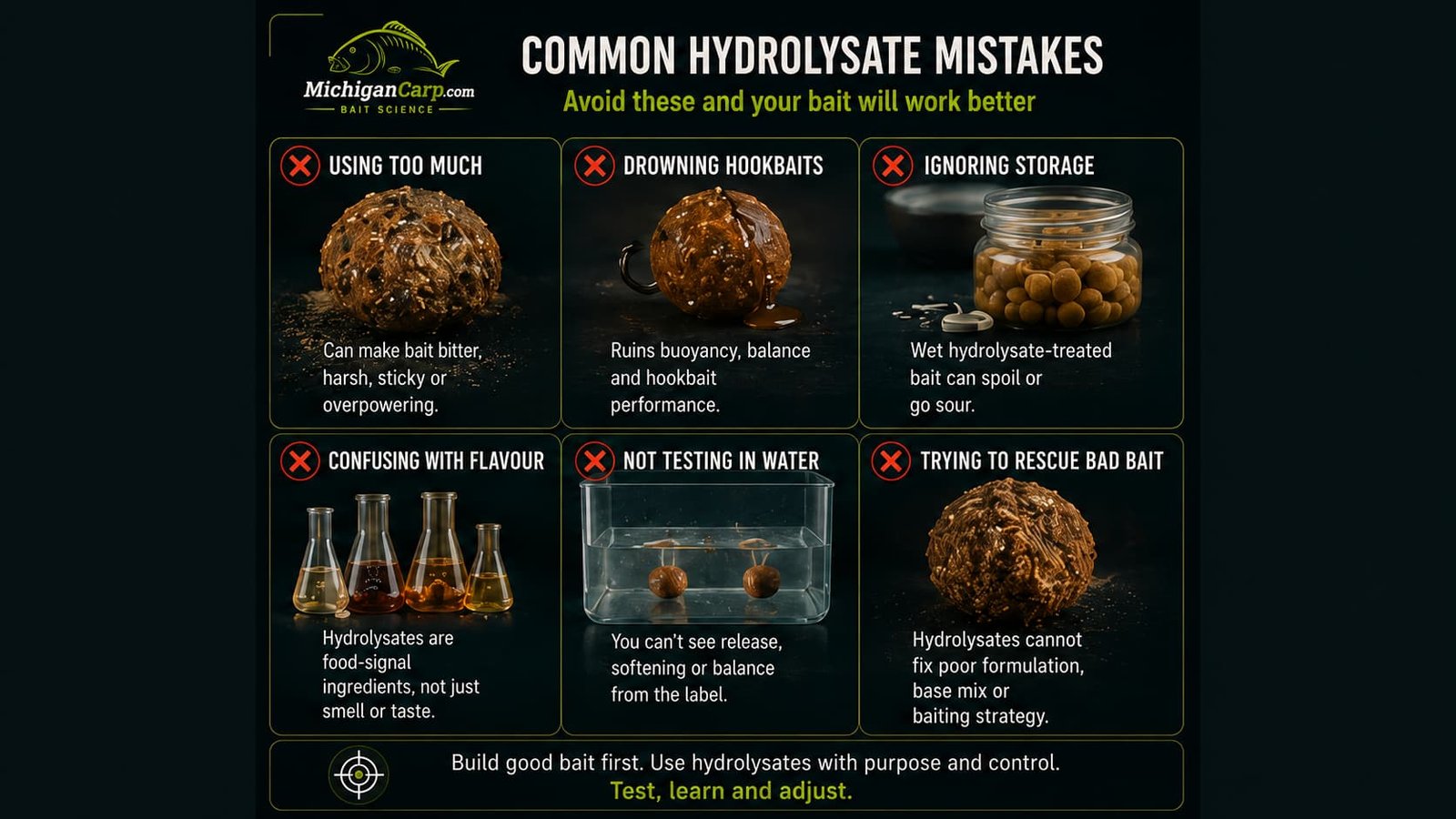
| Mistake | Why it causes problems | Better practice |
|---|---|---|
| Using too much | Can make bait bitter, harsh, sticky or overpowering | Start low and test |
| Confusing hydrolysate with flavour | Hydrolysates are food-signal ingredients, not just smell | Match them to the bait’s food profile |
| Adding liquid without adjustment | Liquid hydrolysates change paste moisture | Count them as wet phase |
| Drowning hookbaits | Wafters and pop-ups can lose balance | Use sprays, short dips and powder coatings |
| Ignoring storage | Wet treated bait can sour or spoil | Use soon, keep cool or preserve/test properly |
| Using fish hydrolysate everywhere | It can dominate milk, nut or fruit-cream baits | Use fish products where the profile fits |
| Ignoring powder options | Liquids are not always the cleanest tool | Use powders for dry control and coatings |
| Not testing in water | You cannot see release, softening or balance from the label | Water test every treated bait |
| Trying to rescue bad bait | Hydrolysates cannot fix poor formulation | Build good bait first |
My Practical View
Hydrolysates are one of the most useful bait-making tools when they are used with control.
For my own Michigan bait thinking, I want hydrolysates to support the bait identity. In milk, nut and cream baits, that usually means hydrolyzed whey, beef liver hydrolysate, yeast extract, liquid yeast and matching nut or dairy support. In fishmeal and marine baits, fish, krill, shellfish and stronger savoury hydrolysates make more sense.
For packbait and method, liver, yeast, whey and boilie crumb can help the loose feed match the hookbait. For hookbaits, hydrolysates can be excellent — as long as they do not wreck balance, buoyancy or durability.
The biggest improvement most anglers could make is not buying more glugs. It is using hydrolysates more intelligently.
Use hydrolysates for soluble food signal. Match them to the bait. Start low. Test in water. Do not overpower good bait.
FAQ
What are hydrolysates in carp bait?
Hydrolysates are protein-derived ingredients that have been broken into smaller fractions such as peptides, smaller peptides and free amino-acid-containing material. In carp bait, they are used mainly for soluble food signal and bait palatability support.
Are hydrolysates good for carp bait?
Yes, hydrolysates can be very useful in boilies, glugs, hookbaits, crumb, packbait, powders and particles. They work best when used with a clear job rather than simply added heavily to every bait.
What is the best hydrolysate for carp bait?
There is no single best hydrolysate. Beef liver hydrolysate suits savoury milk-nut support and hookbait treatment. Hydrolyzed whey suits milk and cream baits. Fish hydrolysate suits fishmeal and marine profiles. Yeast extract adds rounded savoury depth.
How much hydrolysate should I use in boilies?
For powder hydrolysates, start around 5–30 g per 1 kg dry mix. For liquid hydrolysates, start around 10–40 ml per 1 kg dry mix and reduce other liquids if needed.
Can you use too much hydrolysate?
Yes. Too much hydrolysate can make bait bitter, harsh, sticky, sour, soft, salty or overpowering.
Should hydrolysates go in the base mix or the glug?
Both can work. Base-mix inclusion gives built-in signal, while glugs, sprays and powder coatings add faster outer signal. The best choice depends on whether the bait needs internal support or short-term surface activity.
Are hydrolysates PVA-safe?
Many liquid hydrolysates are water-based and may melt PVA. Powder hydrolysates are usually easier to use in PVA systems, but the finished mix should always be tested with the actual PVA product.
What hydrolysate should I use in cold water?
Hydrolyzed whey, beef liver hydrolysate, yeast extract, liquid yeast and light powder coatings are good cold-water directions. Use low levels and avoid heavy oil or excessive bait quantity.
Can hydrolysates be used in packbait?
Yes. Hydrolysates work well in packbait and method mix when used lightly with carriers such as boilie crumb, milk powders, yeast, liver powder and nut ingredients. Do not make the mix too wet or sticky.
Can hydrolysates be used with particles?
Yes, but particles must be safely prepared first. Add hydrolysates after soaking, cooking, cooling and draining as a finishing liquid or short-term soak.
Do hydrolysates replace good boilie formulation?
No. Hydrolysates support good bait. They do not replace base-mix design, proper cooking, drying, storage, baiting strategy or location.
What is the biggest mistake with hydrolysates?
The biggest mistake is using too much without understanding the bait’s job. Stronger is not automatically better.
Next Steps
- Proteins, Peptides and Hydrolysates in Carp Bait — understand the protein continuum behind hydrolysates.
- Do Enzymes and Phytase Really Improve Carp Bait? — separate active enzyme treatment from finished hydrolysate ingredients.
- Carp Bait Solubility and Leakage — understand how soluble food signals leave bait.
- Carp Bait Digestibility — connect soluble signal with usable nutrition.
- Boilie Liquids and Additives — fit hydrolysates into the wider liquid phase.
- How to Prepare Boilies for Carp Fishing — use glugs, soaks and hookbait conditioning without ruining bait.
- How to Formulate a Milk, Nut and Birdfood Boilie Base Mix — apply hydrolysate support inside a complete bait.
- Milk Powders in Boilie Making — choose dairy ingredients that work with whey hydrolysate and milk-nut bait systems.
- Packbait for Carp Fishing — use hydrolysates in carrier bait and method-style mixes.
- How to Prepare Particles for Carp Fishing — prepare particles correctly before adding soluble finishing liquids.
- Bait Science — browse the technical bait library.