

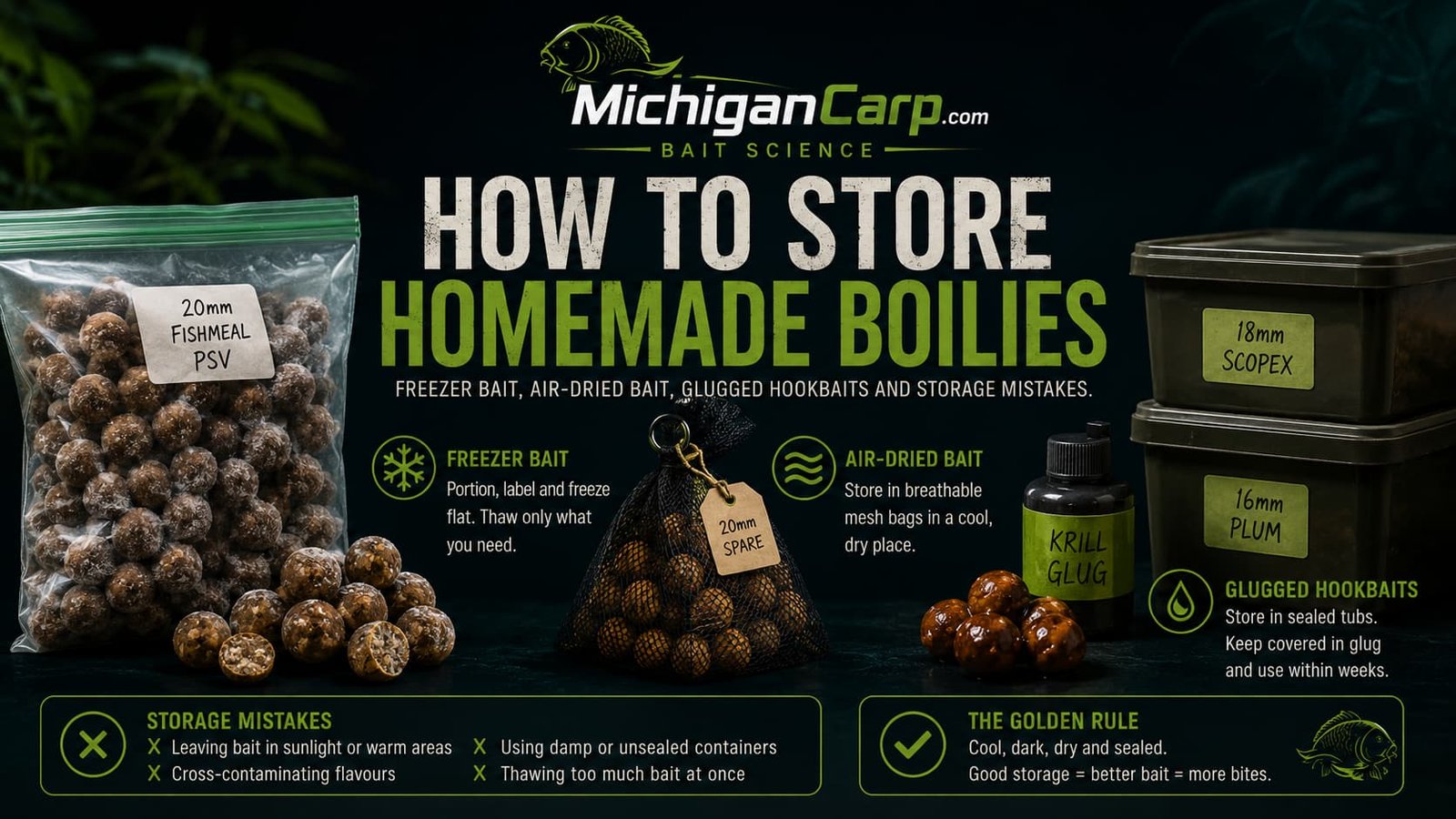
Learning how to store homemade boilies is just as important as learning how to roll, boil and dry them.
You can build a good recipe, mix the paste properly, roll the bait cleanly, boil it for the right time and dry it carefully, then still damage the finished bait by storing it badly.
Bad storage can ruin texture, smell, leakage, freshness, hardness, hookbait durability, moisture balance and freezer quality. It can also create mold, souring, rancidity, sweating, soft bait and false confidence in bait that should not be used.
Storage is part of bait making. The finished bait is not protected until it is cooled, dried, portioned, labeled and stored for the way you actually fish.
Homemade boilies are not all stored the same way. Freezer baits, short-term air-dried baits, shelf-life baits, glugged boilies, hookbaits, wafters, pop-ups, high-fat milk/nut baits and session bait tubs all need slightly different handling.
The biggest mistake is assuming that “dry” means preserved.
It does not.
A boilie can feel dry on the outside but still hold enough internal moisture to mold, sweat, sour, soften, ferment badly or go stale in storage.
This article owns the practical storage workflow after boilies have already been made. For the production step before storage, read How to Boil and Dry Boilies Properly. For the available-water and drying-risk side, read Water Activity in Boilies. For the preservation system, read Potassium Sorbate, Sodium Benzoate and Citric Acid in Shelf-Life Boilies.
This guide also connects with How to Test Boilies Before Fishing, How to Prepare Boilies for Carp Fishing, Boilie Liquids and Additives, How to Make Wafters and Pop-Ups From a Boilie Base Mix, How to Balance Fat in Boilies and the main Bait Science hub.
For external technical background, see FDA: Water Activity in Foods, USDA FSIS: Freezing and Food Safety and National Center for Home Food Preservation.
Table of Contents
Quick Start: Best Way to Store Homemade Boilies
For most homemade boilies, the safest and most practical storage method is simple:
Dry the bait properly, bag it in session-sized amounts, label it and freeze it.
| Bait type | Best storage method | Main risk |
|---|---|---|
| Fresh homemade freezer boilies | Dry 12–24 hours, bag, label and freeze | Freezing too wet or repeatedly thawing |
| Same-week bait | Cool storage or fridge after drying | Mold if stored damp |
| Short-term air-dried boilies | Mesh bag, cool airflow and daily checks | Assuming they are shelf-life bait |
| True shelf-life boilies | Proper preservative, drying and storage system | Poor preservation or rancidity |
| Glugged boilies | Dry first, condition carefully and keep cool | Sweating, souring, softening and mold |
| Hookbaits | Dry longer, store separately and test after soaking | Cracking, buoyancy change or over-conditioning |
| High-fat milk/nut boilies | Freeze unless shelf-life system is proven | Rancidity, surface oil and softness |
| Session bait | Small active tub, shaded and used quickly | Heat, wet hands, insects and contamination |
The simple storage rule is:
Freezer bait needs cold storage.
Air-dried bait needs airflow and checking.
Shelf-life bait needs proper preservation.
Glugged bait needs moisture control.
Hookbaits need separate storage and testing.
This simple system protects more bait than any clever storage trick.
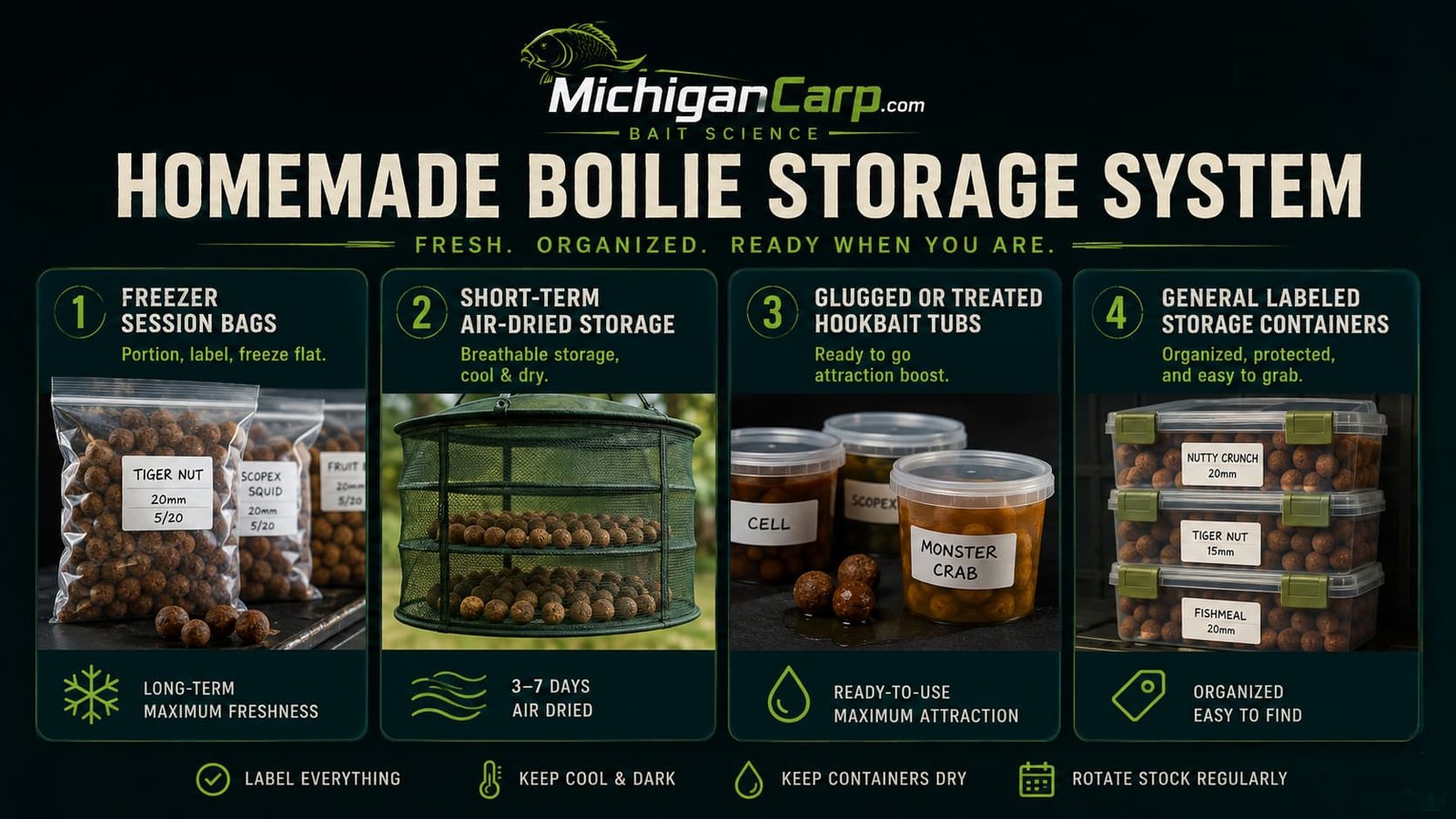
Freezer Bait vs Shelf-Life Bait
The first storage decision is whether the bait is freezer bait or genuine shelf-life bait.
These are not the same thing.
Freezer boilies are stored cold or frozen. They usually rely on freezing to protect freshness, texture and bait quality. For most home bait makers, freezer bait is the best default because it allows you to make food-rich bait without pretending it is shelf-stable.
Shelf-life boilies are designed to remain stable longer at room temperature. That does not simply mean they are dry or hard. Shelf-life bait depends on recipe, drying, preservative system, water activity, pH where relevant, packaging, hygiene, storage temperature and retained-sample testing.
| Storage type | What protects the bait | Best use |
|---|---|---|
| Freezer bait | Freezing, good drying, clean handling and good packaging | Most homemade boilies and food baits |
| Short-term fridge bait | Cool storage for a short window | Immediate sessions and thawed bait |
| Short-term air-dried bait | Reduced surface moisture and airflow | Travel, multi-day trips and tougher bait |
| True shelf-life bait | Preservatives, moisture control, pH support and testing | Room-temperature storage after proper validation |
Freezer bait usually protects homemade bait quality better. Shelf-life bait is convenient only when it has genuinely been designed and tested for shelf life.
Why Dry Does Not Automatically Mean Preserved
This is the most important storage lesson.
A boilie can feel dry on the outside and still contain enough internal moisture to spoil. The surface can harden while the middle remains wetter than you think.
Food preservation science uses the idea of water activity, which is about how much water is available for microbial growth, not just whether a product feels dry to the touch. For bait making, the practical lesson is simple:
Surface-dry is not the same as shelf-stable.
| What you see | What it may hide | Storage risk |
|---|---|---|
| Hard outside | Damp center | Mold or souring inside sealed bags |
| Dry skin | High internal moisture | Sweating after bagging |
| No visible mold | Fat oxidation beginning | Rancid smell later |
| Good smell when fresh | Poor long-term stability | Decline after warm storage |
| Air-dried for several days | No preservative system | False shelf-life confidence |
That is why homemade bait should usually be frozen unless it has been properly designed, dried, preserved and tested as shelf-life bait.
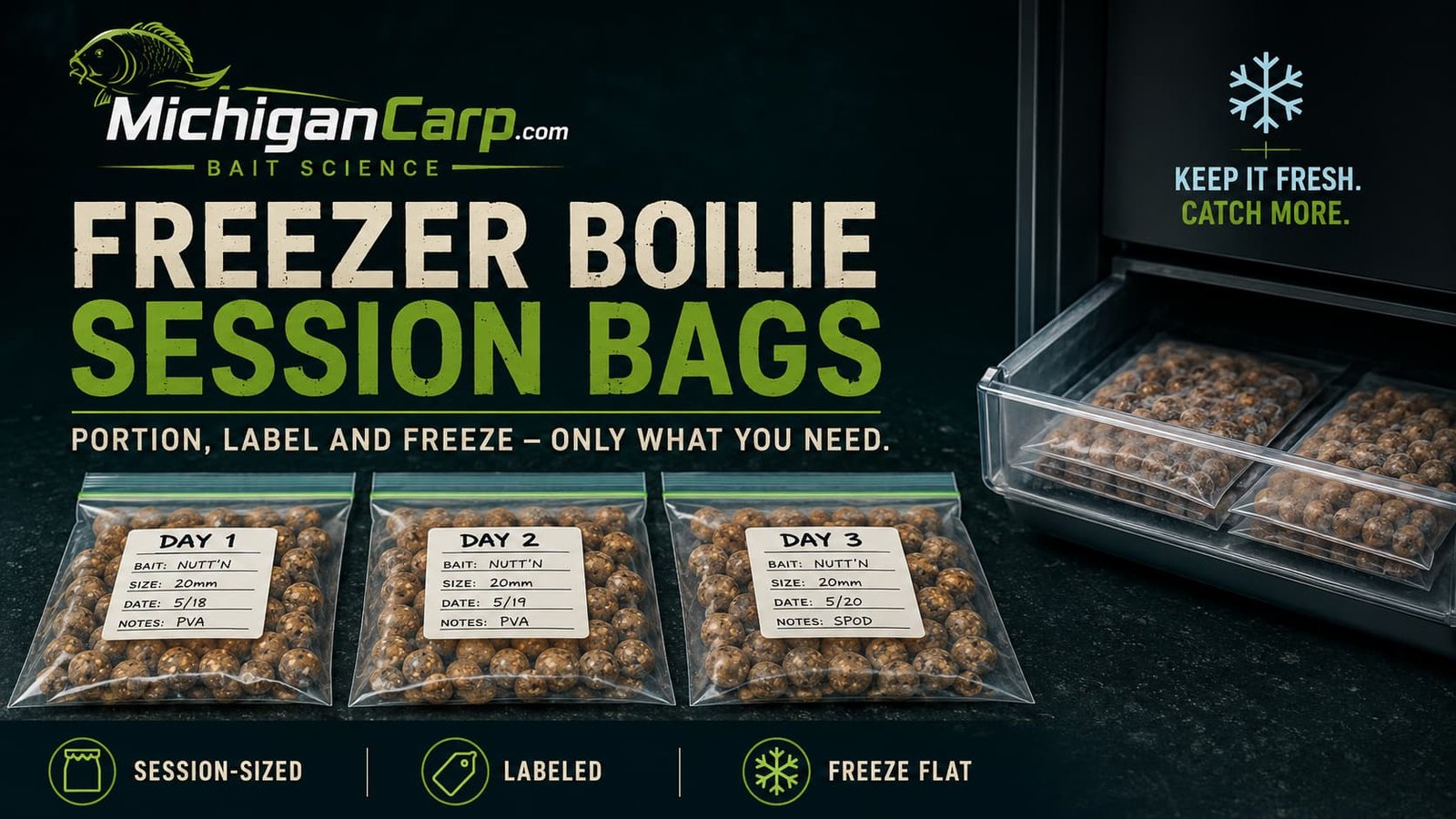
The Best Default Method: Freeze in Session Bags
For most home bait makers, freezer storage is the best default.
It is simple, reliable and protects bait quality.
| Step | Storage action | Why it matters |
|---|---|---|
| 1 | Boil the bait correctly | Storage cannot fix badly cooked bait |
| 2 | Air-dry until cool and surface dry | Prevents sweating, clumping and trapped moisture |
| 3 | Bag in session-sized amounts | Prevents repeated thawing of one large bag |
| 4 | Push out excess air | Improves freezer quality and reduces freezer burn |
| 5 | Label the bag | Protects batch tracking and recipe learning |
| 6 | Freeze flat where practical | Makes storage and thawing easier |
| 7 | Thaw only what you need | Protects texture, smell and moisture balance |
Session-sized bags matter because they stop you thawing a big bag, using half, then refreezing the rest. That habit damages bait quality and makes storage records useless.
Write useful information on every bag:
Bait name
Flavour
Size
Date made
Boil time
Drying time
Freezer bait / hookbait / test batch
Special notes
Example:
Milk/Nut Plum-Scopex-Vanilla
20 mm
Made July 14
Boiled 100 sec
Dried 18 hr
Freezer bait
Good bait records are part of good bait making.
How Dry Should Boilies Be Before Freezing?
Boilies should not be frozen hot, wet, steaming or sticky.
They should be cool, surface dry and firm enough to handle without clumping.
| Bait condition | Ready to freeze? | Reason |
|---|---|---|
| Cool and surface dry | Yes | Good normal freezer-bait condition |
| Warm or steaming | No | Creates condensation and sweating |
| Wet or sticky | No | Creates clumps, ice and poor thawing |
| Dry outside but soft inside | Test first | May need longer drying or recipe adjustment |
| Dry and over-hard | Maybe | May be too slow or hard for free bait |
For most homemade freezer boilies, 12–24 hours of drying is a good starting point before freezing. Same-day bait may only need 2–6 hours if it will be used quickly. Harder freezer bait may benefit from 24–48 hours.
These are practical starting points, not laws. Bait size, recipe, humidity, fat level, milk powders, birdfood texture and drying airflow all change the result.
How Long Do Freezer Boilies Last?
Frozen bait can remain usable for a long time if it is packed well and kept properly frozen, but quality still changes over time.
Think in terms of bait quality, not just whether the bait is technically frozen.
| Storage time | Practical bait view |
|---|---|
| 1–3 months | Excellent for most homemade bait if packed well |
| 3–6 months | Usually still very good with clean handling and good bags |
| 6–12 months | Often usable, but check smell, texture and freezer burn |
| Over 12 months | Test carefully before trusting on an important session |
High-fat bait, nut meals, cream powder, milk replacer, whole milk powder and oils may lose quality faster than leaner bait. A bait can be mold-free and still smell stale, waxy, rancid or wrong after long storage.
Before using older freezer bait, check smell, texture, colour, surface condition and water behaviour.
Thawing and Refreezing Boilies
Thaw only what you need.
The best method is to thaw a session bag slowly before fishing, then open the bag enough to let surface moisture escape once the bait has softened.
| Good thawing practice | Poor thawing practice |
|---|---|
| Thaw one session bag | Thaw one huge bag repeatedly |
| Keep bait cool | Leave bait baking in a hot vehicle |
| Open once thawed enough to breathe | Leave damp bait sealed and sweating |
| Use within a sensible time | Keep warm bait for days |
| Keep hookbaits separate | Mix free bait, hookbaits and wet particles together |
You can refreeze boilies once if they were handled cleanly and kept cool, but repeated thawing and refreezing is poor bait practice. It can cause sweating, softening, freezer burn, cracked skins, uneven moisture, smell loss and lower confidence.
Freeze smaller bags. Thaw only what you need. Do not make refreezing part of normal bait management.
How to Store Boilies for a Weekend or Multi-Day Session
For a two- or three-day session, storage should be simple and practical.
Use one bait bag for day one, one for day two, one spare bag, separate hookbait tubs, glugs stored separately and one small active bait tub for use around the rods.
| Session item | Best storage plan | Reason |
|---|---|---|
| Day-one free bait | Thawed or partly thawed session bag | Ready to use without opening everything |
| Day-two bait | Kept frozen or cool until needed | Protects freshness |
| Spare bait | Left frozen or air-dried backup | Prevents waste if fishing is slower |
| Hookbaits | Separate labeled tubs | Protects rig bait from moisture and contamination |
| Glugs and liquids | Separate sealed bottles | Prevents accidental over-soaking |
| Active bait | Small shaded tub | Keeps most bait protected while you fish |
On Michigan summer sessions, heat and humidity matter. A sealed tub of damp boilies left in a hot truck can go downhill quickly. Keep bait shaded, dry, covered, out of direct sun, away from insects and away from lake water until you intentionally use it.
For boat-in or camp sessions, I would rather use several small bags than one big container. It keeps bait cleaner, easier to manage and easier to ration.
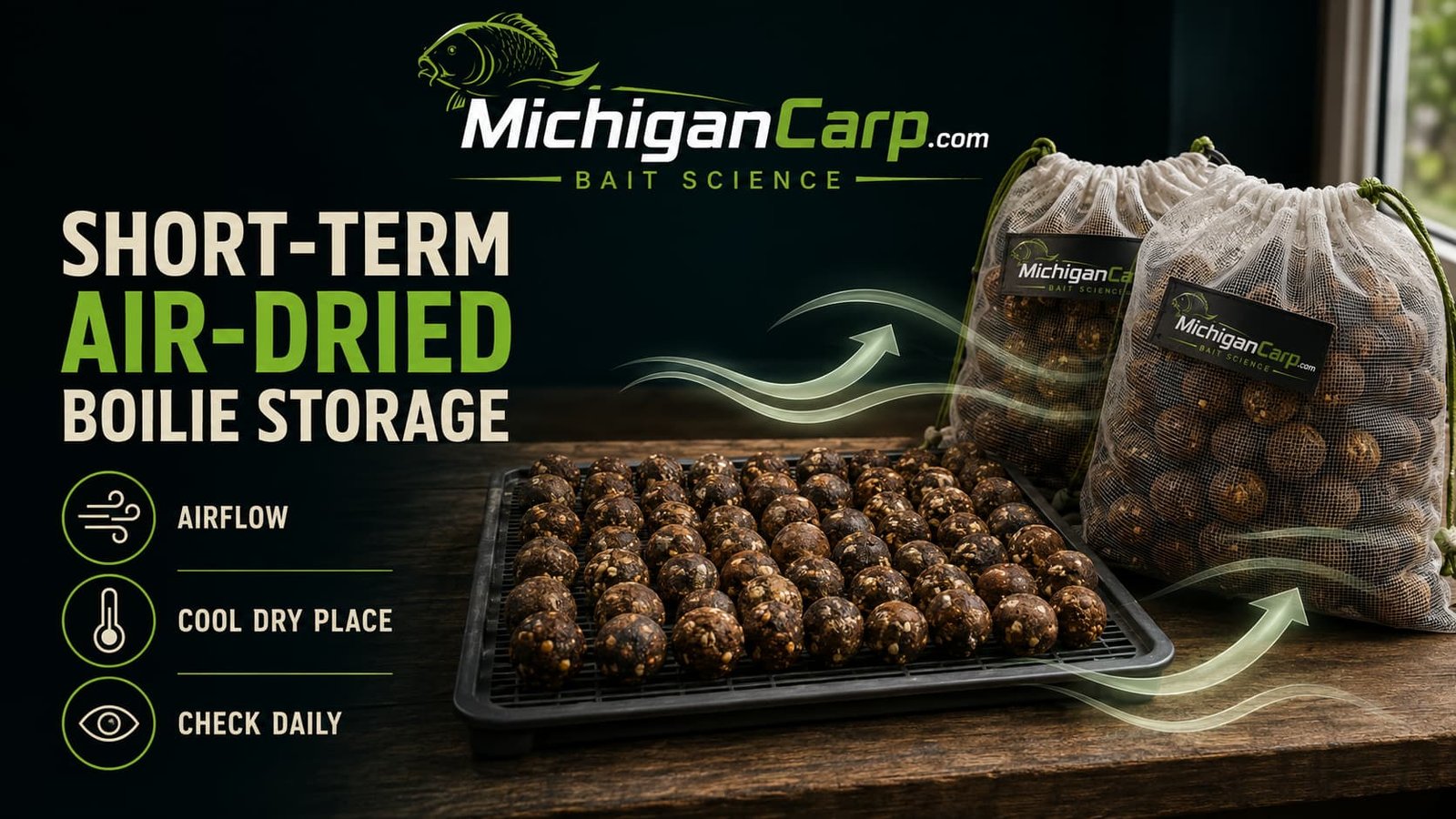
How to Store Short-Term Air-Dried Boilies
Short-term air-drying can be useful when you want tougher bait for travel, multi-day sessions or nuisance resistance.
But short-term air-dried bait is not the same as true shelf-life bait.
| Step | Short-term air-dry method |
|---|---|
| 1 | Boil and drain the bait properly |
| 2 | Dry 24 hours on racks |
| 3 | Move to a mesh bag or breathable tray |
| 4 | Hang or store in cool airflow |
| 5 | Shake or turn daily |
| 6 | Check smell, texture and surface condition |
| 7 | Use within a sensible short window |
| 8 | Freeze if unsure |
Short-term air-dried boilies are useful for travel bait, tougher bait, longer sessions and reducing surface moisture. The risks are over-hardening, cracking, mold in humidity, sour smell, loss of leakage and fat rancidity in rich baits.
Do not assume every air-dried bait is stable for weeks.
How to Store Shelf-Life Boilies
Shelf-life boilies are designed for room-temperature storage, but they are not indestructible.
Store shelf-life boilies cool, dry, out of sunlight, away from heat, away from damp sheds, away from rodents and insects, in clean bags or tubs, and labeled clearly.
| Do | Avoid |
|---|---|
| Store cool and dry | Hot vehicles |
| Keep out of direct sun | Window sills or warm garages |
| Use clean dry bags or tubs | Wet bait buckets |
| Check regularly | Forgetting opened bags for months |
| Keep retained samples | Assuming all batches store the same |
| Monitor smell and surface | Ignoring rancid fat smell |
For my own shelf-life boilie work, the preservation system is not potassium sorbate alone. It uses potassium sorbate, sodium benzoate and citric acid together, alongside drying, hygiene, storage observation and retained-sample testing.
That does not automatically prove a six-month shelf life unless the bait is tested properly.
Use Potassium Sorbate, Sodium Benzoate and Citric Acid in Shelf-Life Boilies for the preservation logic and Water Activity in Boilies for the available-moisture side.
Mold, Rancidity and When to Reject Bait
Mold and rancidity are different problems.
Mold is usually linked to moisture, poor drying, weak preservation, contamination or warm damp storage. Rancidity is fat spoilage, and it matters especially in high-fat baits.
| Problem | Warning signs | What to do |
|---|---|---|
| Mold | Fuzzy growth, white/green/black/blue patches, musty smell, damp clumps, condensation | Reject the bait |
| Souring | Bad sour smell, gas pressure, wet sticky bait, unpleasant fermentation | Reject unless it was a deliberately controlled process you trust |
| Rancidity | Stale oil smell, paint-like smell, old nut smell, bitter waxy smell | Reject high-fat bait if smell is wrong |
| Freezer burn | Dry stale smell, icy surface, damaged texture | Test carefully or reject for important sessions |
| Severe softening | Bait collapses, splits or will not stay on hair | Do not use as hookbait; test before using as feed |
High-fat boilies need extra care. This includes bait with peanut meal, tiger nut flour, whole milk powder, Nido, cream powder, milk replacer, nut oils, full-fat soya and coconut meal.
A bait can be mold-free and still smell rancid.
How to Store Milk, Nut and High-Fat Boilies
Milk/nut boilies can be excellent food baits, but they need disciplined storage.
They may contain tiger nut flour, peanut protein, peanut meal, Nido, whole milk powder, cream powder, milk replacer, WPC80, casein, nut oils, lecithin and seed meals. Those ingredients can produce excellent bait, but they also increase the need for drying, freezing, fat control and careful storage.
| Bait type | Best default storage | Watch for |
|---|---|---|
| Milk/nut freezer bait | Freeze in session bags | Softness, surface oil, mold if stored damp |
| High-fat nut bait | Freeze and use within sensible time | Rancidity, greasy surface and stale smell |
| Casein-heavy bait | Freeze free bait; store hookbaits separately | Over-hardening and slow release |
| WPC80-supported bait | Freeze unless shelf-life system is proven | Tight texture and storage hardening |
| Hookbait version | Dry longer, store separately and test | Cracking, buoyancy change and over-hardening |
If a milk/nut bait contains a lot of fat, cream powder, milk replacer or nut meals, do not leave storage to chance. Freeze it unless you have built and tested a proper shelf-life system.
For fat balance, read How to Balance Fat in Boilies. For base-mix design, use How to Formulate a Milk, Nut and Birdfood Boilie Base Mix.
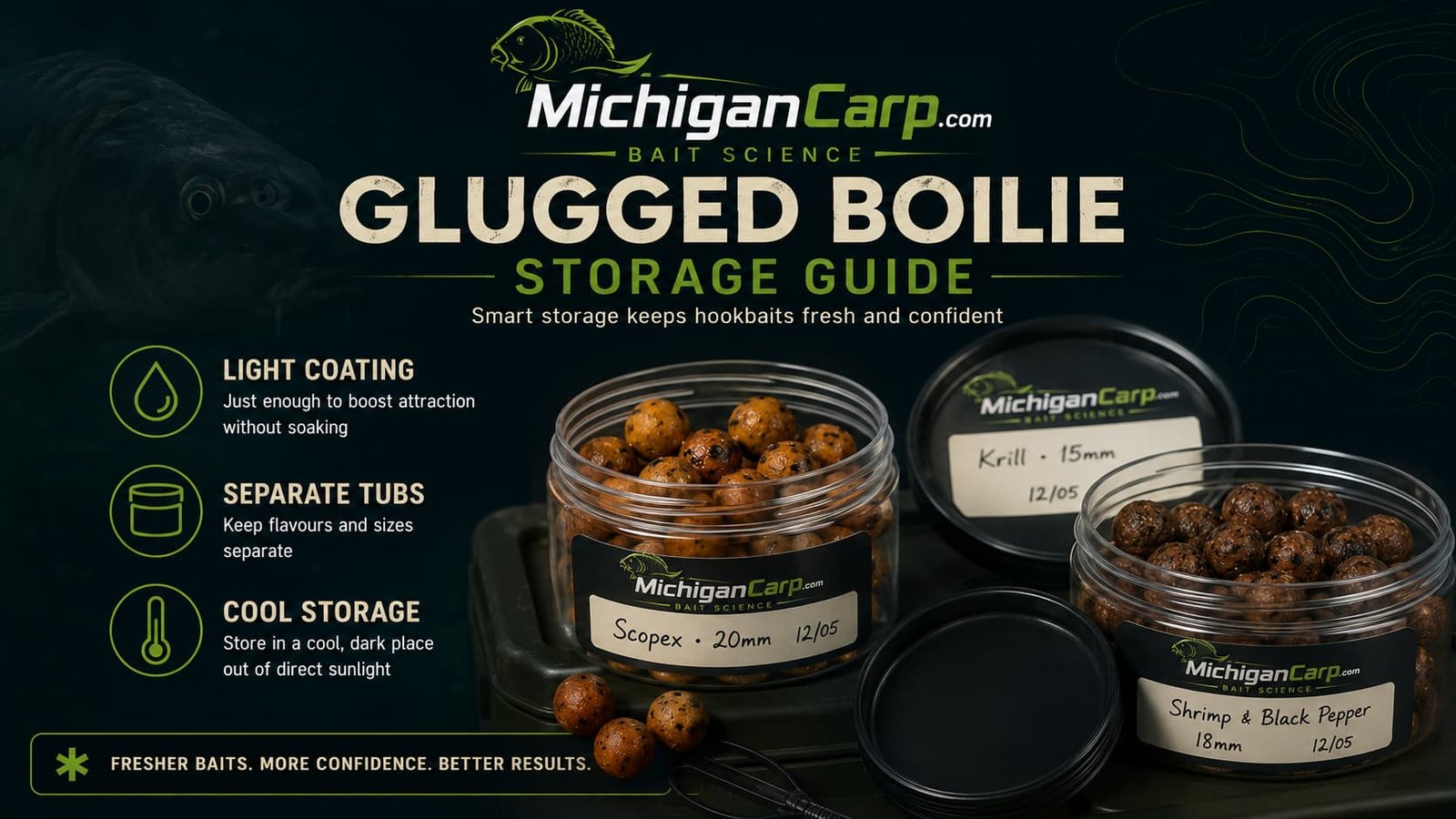
How to Store Glugged Boilies
Glugged boilies need more care than dry boilies because adding liquid changes moisture, texture and storage behaviour.
The first rule is simple:
Do not heavily glug boilies while they are still wet from boiling. Dry them first.
For most freezer baits, dry at least 12–24 hours before heavy glugging. For hookbaits, dry 24–48 hours before long conditioning.
| Glugging style | Storage approach | Main risk |
|---|---|---|
| Light surface coating | Use soon or keep cool in a clean tub | Sticky bait if overdone |
| Heavy glugging | Small amounts, cool storage and frequent checks | Souring, sweating and softness |
| Water-based liquid | Refrigerate for short-term storage if unsure | Mold or souring |
| PG/glycerine/alcohol-style hookbait soak | Only trust if the system is proven | False shelf-stability assumptions |
| Glugged freezer bait | Dry first, condition, then freeze or use soon | Clumping and unstable thawing |
Use clean tubs, small bait amounts, just enough liquid to coat, regular shaking or turning, cool storage and frequent checking. Do not assume any liquid-soaked bait is shelf-stable.
For liquid design, use Boilie Liquids and Additives. For practical hookbait conditioning, use How to Prepare Boilies for Carp Fishing.
How to Store Hookbaits, Wafters and Pop-Ups
Hookbaits should be stored separately from free bait because they have a different job.
They need durability, consistent texture, consistent buoyancy, clear labels, protection from excess moisture and long-soak testing.
| Hookbait type | Storage method | Test before use |
|---|---|---|
| Bottom-bait hookbaits | Small labeled tubs, dry or lightly conditioned | Hair-hole strength, screw hold and soak durability |
| Wafters | Separate tubs with controlled liquid exposure | Balance with actual hook after storage and soaking |
| Pop-ups | Sealed tubs, avoid drowning in heavy liquids | Buoyancy after the intended soak time |
| Corkball hookbaits | Dry stable storage, separate from wet bait | Cracking, cork exposure and buoyancy |
| Glugged hookbaits | Small tubs and monitored conditioning | Softening, smell and rig mechanics |
A wafter is only correct when tested with the actual hook and rig. A pop-up is only reliable when it still has enough lift after the soak time you intend to fish.
For making and testing balanced baits, read How to Make Wafters and Pop-Ups From a Boilie Base Mix.
Buckets, Fridges and Vacuum Sealing
Buckets, fridges and vacuum sealers can all be useful, but none of them replace correct drying and storage logic.
| Storage option | Useful for | Be careful with |
|---|---|---|
| Buckets | Dry air-dried bait, shelf-life bait and active session bait | Warm bait, damp bait and sealed moisture |
| Fridge | Short-term thawed bait, glugged bait and immediate-use bait | Assuming fridge storage makes unstable bait safe long-term |
| Vacuum sealing | Freezer bait, portion control and reducing freezer burn | Damp bait, soft bait, glugged bait and room-temperature assumptions |
| Air-dry bags | Short-term toughening and travel bait | Humidity, rancidity and false shelf-life confidence |
| Small hookbait tubs | Rig bait, wafters, pop-ups and conditioned hookbaits | Over-glugging and poor labeling |
Use buckets only when bait is dry and cool. Do not seal warm or damp boilies in buckets.
Use the fridge for short-term storage only unless the bait has been properly designed and tested. A fridge slows problems. It does not make unstable bait shelf-life.
Vacuum sealing can help freezer storage, but vacuum sealing damp bait and leaving it warm can create problems. Vacuum sealing works best with freezer storage or genuinely stable bait.
Storage for Boilie Crumb and Packbait
Boilie crumb and packbait ingredients need their own storage logic.
Crumb has much more exposed surface area than whole boilies, so it can dry, stale, absorb moisture or lose quality differently.
| Bait material | Storage method | Main warning |
|---|---|---|
| Fresh moist boilie crumb | Freeze | Can mold or sour quickly if left damp |
| Fully dried boilie crumb | Airtight dry container | Check for rancid fat smell |
| Crumb with liquid added | Use quickly or keep cold | Liquid starts the spoilage clock |
| Dry packbait ingredients | Dry sealed container | Protect from damp and rodents |
| Wet packbait | Use quickly or keep cold | Do not store wet food-rich packbait warm |
Once liquids are added to packbait, especially with milk powders, nut meals, sweet liquids or yeast products, treat it as active wet bait and use it within a sensible window.
For packbait systems, read Packbait for Carp Fishing.
Storage Checklist Before Fishing
Before using stored boilies, check them.
Stored bait should not be judged by date alone. Judge smell, texture, appearance and water behaviour.
| Check | Acceptable signs | Reject or test carefully if |
|---|---|---|
| Smell | Clean, intentional bait smell | Rancid, moldy, rotten, sour in a bad way or chemically wrong |
| Texture | Firm enough for the job | Too soft, too hard, greasy, sticky, cracked or sweating |
| Appearance | No mold, no wet patches, no strange film | Mold, discoloration, damp clumps, insect contamination or severe freezer burn |
| Water test | Softens, leaks and holds together according to purpose | Collapses, cracks badly, smells wrong after soaking or fails on the rig |
| Hookbait test | Stays attached and fishes correctly | Hair hole fails, screw pulls out or buoyancy has changed |
If the bait fails the test, do not fish it with confidence.
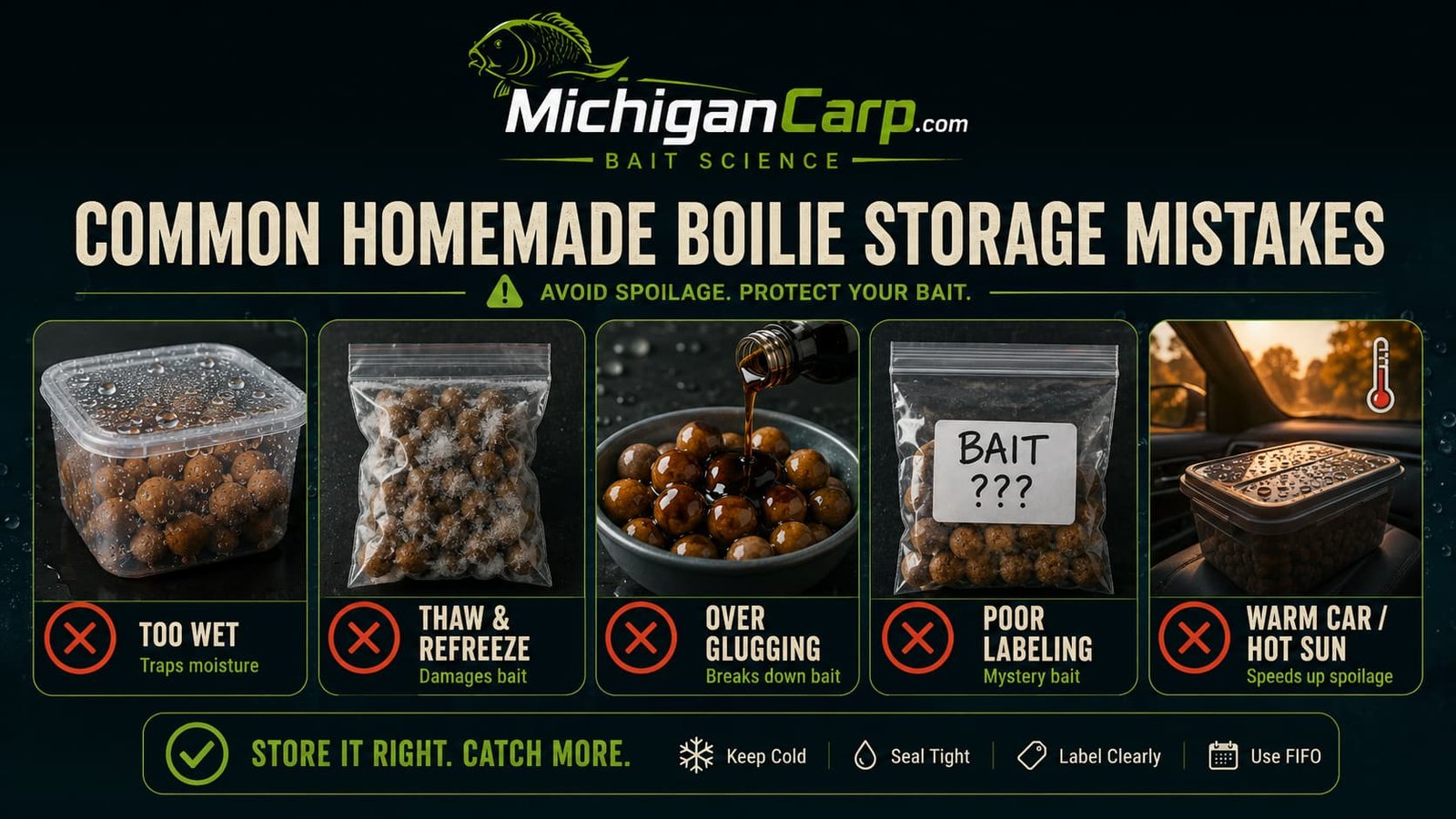
Common Boilie Storage Mistakes
| Mistake | Why it causes problems | Better practice |
|---|---|---|
| Bagging bait too wet | Wet bait sweats, molds and softens | Cool and surface-dry before bagging |
| Freezing bait while warm | Creates condensation and clumps | Let bait cool fully first |
| Repeated thawing and refreezing | Damages texture and moisture balance | Freeze in session bags |
| Assuming air-dried means shelf-life | Air-dried bait is not automatically preserved | Use real preservation logic and testing |
| Leaving bait in a hot vehicle | Heat accelerates spoilage and quality loss | Keep bait shaded and cool |
| Over-glugging | Too much liquid can make bait soft, sour or unstable | Use small amounts and monitor moisture |
| Storing hookbaits with free bait | Hookbaits need separate mechanics and moisture control | Use labeled hookbait tubs |
| Ignoring fat rancidity | High-fat bait can go stale without visible mold | Smell-check and freeze rich bait |
| Not labeling bags | Unlabeled bait becomes guesswork | Record recipe, date, size and processing |
| Not soak testing old bait | Stored bait may not fish like fresh bait | Test before important sessions |
My Practical View
For homemade boilies, I prefer a simple storage system.
Dry the bait properly. Freeze it in session-sized bags. Keep hookbaits separate. Only glug what you need. Do not trust warm damp storage. Do not pretend air-dried bait is shelf-life bait unless it has been designed and tested properly.
For Michigan fishing, freezer bait makes the most sense for most home rollers. It protects bait quality, keeps the bait closer to its original working state and avoids many of the problems that come from trying to make shelf-life bait without proper preservation knowledge.
Shelf-life bait has a place. Air-dried bait has a place. Glugged bait has a place. Hookbait tubs have a place. But freezer bait in labeled session bags is the safest, simplest and most reliable foundation.
Store bait for the way you actually fish. If you fish short sessions, use small freezer bags. If you fish multi-day sessions, plan bait by day. If you use glugs, control moisture. If you make high-fat milk/nut bait, respect rancidity risk. If you make hookbaits, test them separately.
Good bait deserves good storage.
FAQ
What is the best way to store homemade boilies?
For most homemade boilies, the best method is to air-dry them until cool and surface dry, bag them in session-sized amounts, label them and freeze them.
How long should boilies dry before freezing?
Most freezer boilies should dry for 12–24 hours before freezing. Same-day bait may only need 2–6 hours if it will be used quickly, while harder freezer bait may need 24–48 hours.
Can you freeze homemade boilies?
Yes. Freezing is usually the best storage method for homemade boilies that are not designed as true shelf-life bait.
Should boilies be frozen in one big bag?
No. Session-sized bags are better because you only thaw what you need and avoid repeated thawing and refreezing.
Can you refreeze boilies?
You can refreeze boilies once if they were handled cleanly and kept cool, but repeated thawing and refreezing damages bait quality.
How long do freezer boilies last?
Well-packed freezer boilies are usually best within 1–6 months, though they can last longer. Always check smell, texture, freezer burn and water behaviour before using older bait.
Are air-dried boilies shelf-life boilies?
Not automatically. Air-drying reduces moisture, but true shelf-life bait requires proper formulation, preservation, drying, packaging and storage testing.
How should I store glugged boilies?
Dry the boilies first, use clean tubs, avoid too much liquid, keep them cool and check regularly for sweating, softness, sour smell or mold.
Should glugged boilies be refrigerated?
If they are moist, food-rich, water-based or being kept for several days, refrigeration is safer for short-term storage.
Can boilies go moldy?
Yes. Boilies can mold if they are stored damp, under-dried, poorly preserved, contaminated or kept warm.
Can boilies go rancid?
Yes. High-fat boilies containing nut meals, oils, cream powder, whole milk powder or milk replacer can go rancid over time.
How should I store hookbaits?
Store hookbaits separately in labeled tubs. Dry them longer than free bait if needed and test soak time, hardness, attachment strength and buoyancy.
Can I store boilies in buckets?
Yes, but only if the bait is dry and cool. Do not seal warm, damp or freshly boiled bait in buckets.
Can I vacuum seal boilies?
Vacuum sealing can help freezer storage and portion control, but it is not a replacement for proper drying, freezing or preservation.
What is the biggest boilie storage mistake?
The biggest mistake is bagging or sealing bait while it is still warm, wet or unstable.
Next Steps
- How to Boil and Dry Boilies Properly — prepare bait correctly before storage.
- Water Activity in Boilies — understand moisture, drying and available water.
- Potassium Sorbate, Sodium Benzoate and Citric Acid in Shelf-Life Boilies — understand the preservation system.
- How to Test Boilies Before Fishing — check stored bait before important sessions.
- How to Prepare Boilies for Carp Fishing — manage glugs, soaks and hookbait conditioning.
- Boilie Liquids and Additives — understand bait liquids before long conditioning.
- How to Make Wafters and Pop-Ups From a Boilie Base Mix — store and test balanced hookbaits properly.
- How to Balance Fat in Boilies — avoid high-fat storage and rancidity problems.
- How to Formulate a Milk, Nut and Birdfood Boilie Base Mix — build bait that stores and fishes properly.
- Packbait for Carp Fishing — manage dry and wet carrier baits safely.
- Bait Science — browse the full technical bait library.