

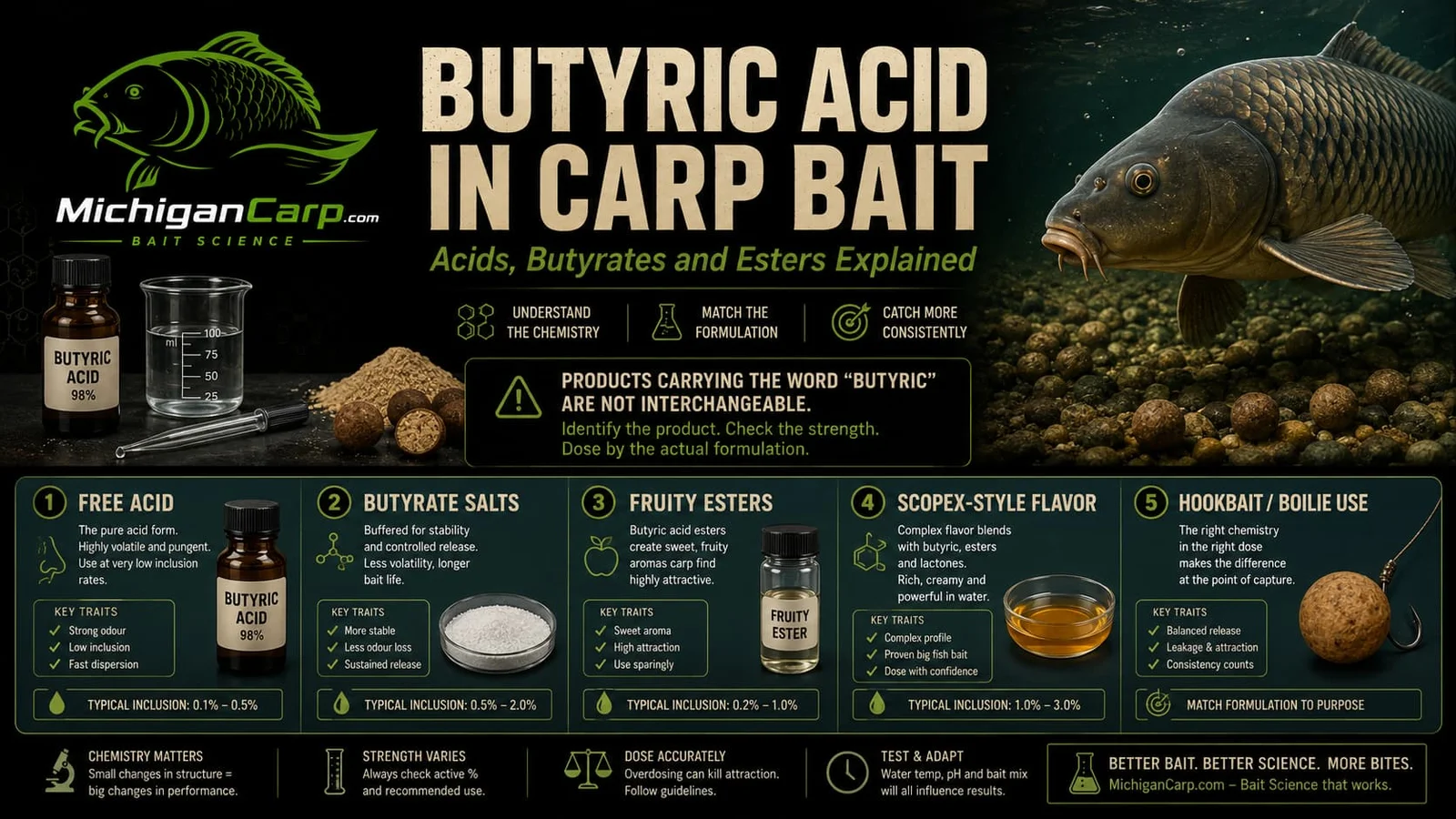
Butyric acid in carp bait is normally used as a restrained supporting note rather than the main liquid ingredient or complete bait identity.
At a suitable product-specific level, it can add a sharp fermented, buttery or aged-dairy edge to milk, nut, fruit and Scopex-style baits.
Used carelessly, it can overpower the formula, create a serious handling problem and contaminate equipment, clothing and storage areas with a persistent odor.
The subject becomes confusing because products carrying the word butyric may be chemically and physically different.
A bottle may contain concentrated n-butyric acid, a heavily diluted food-flavor preparation, a proprietary bait flavor, a mineral butyrate salt or a fruity ester such as ethyl butyrate.
These products are not interchangeable.
Scopex is not automatically neat butyric acid either. Scopex is a commercial flavor style rather than one standardized chemical formula. Different manufacturers may build it from different combinations of cream, butter, vanilla, caramel, lactone, ester and fermented-dairy notes.
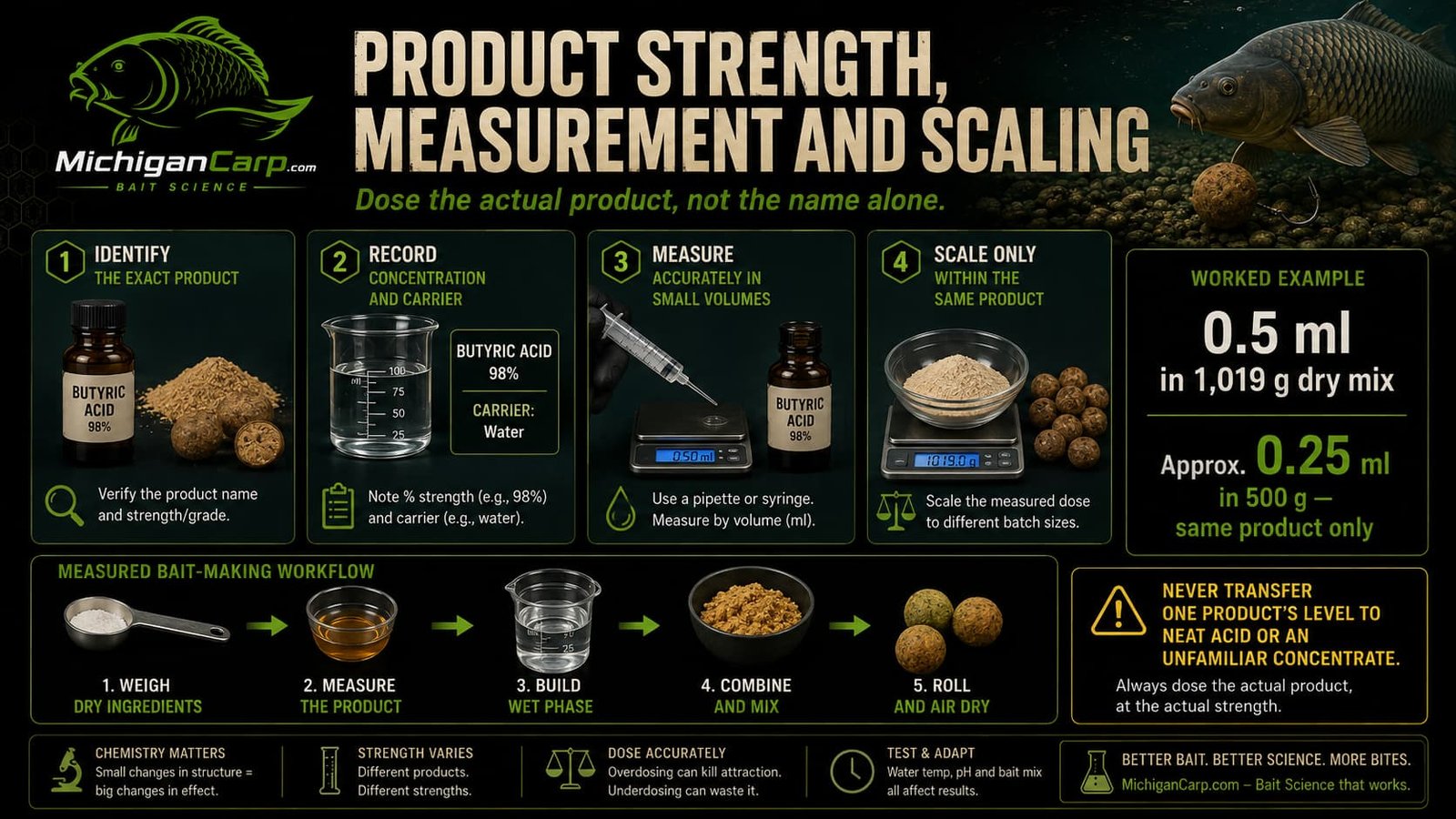
Before copying any butyric dosage, identify the exact product, concentration and carrier.
In my Plum, Scopex and Vanilla milk-nut development bait, I used 0.5 ml of one known pre-diluted butyric bait product in a recorded 1,019 g dry batch.
That amount belongs only to that product and formulation. It must not be transferred automatically to neat laboratory-grade acid, a different commercial flavor or an unfamiliar concentrate.
The field results from the Plum, Scopex and Vanilla bait direction justify keeping the complete flavor system as a control. They do not isolate the butyric component as the reason the carp were caught.
For the wider acid comparison, use Organic Acids in Carp Bait. For full flavor construction, use How to Flavor Boilies Properly: Strength, Carriers and Layering.
For the wider chemistry, read Minerals, Salts and pH in Carp Bait and How pH Changes Carp Bait Performance.
Quick Start: The Essential Butyric Rules
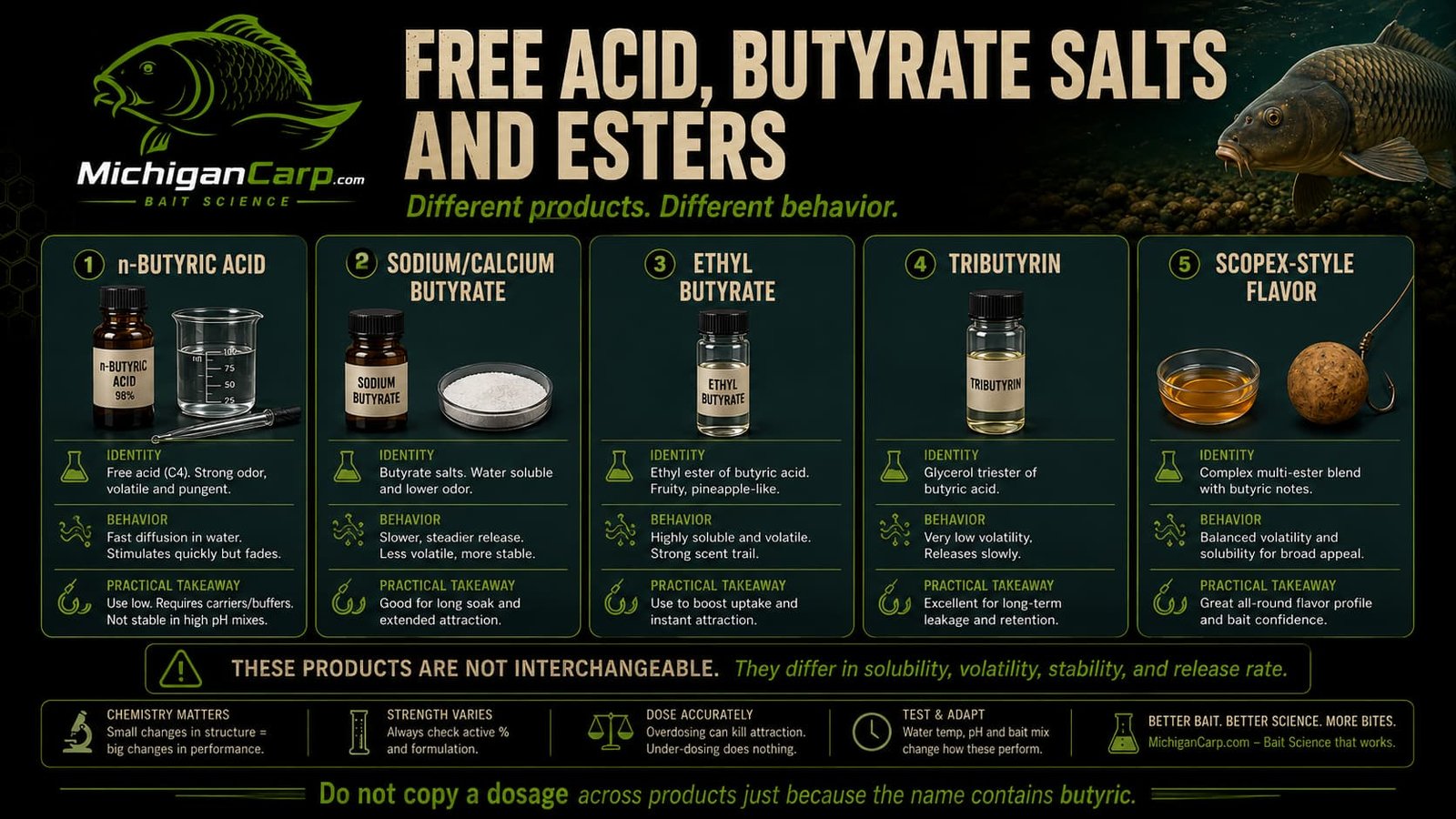
- Identify whether the product contains free acid, a salt, an ester or a proprietary diluted flavor.
- Record its manufacturer, exact name, concentration, carrier and supplier rate.
- Never transfer my 0.5 ml level to another product automatically.
- Use suitable small-volume measuring equipment rather than random drops.
- Distribute the measured product through the complete wet phase.
- Do not use neat concentrated acid in a spray bottle or hookbait soak.
- Do not treat a normal flavor-level dose as the complete preservation system.
- Keep a zero-butyric control when testing a new level or product.
Table of Contents
| Product description | What it is | Practical implication |
|---|---|---|
| n-Butyric acid | The straight-chain free acid, also called butanoic acid | Strong, acidic and potentially corrosive when concentrated |
| Isobutyric acid | A branched structural isomer | A separate compound that should not inherit the n-butyric dosage |
| Sodium or calcium butyrate | Mineral salts of butyric acid | Different odor, volatility, mineral contribution and pH behavior |
| Ethyl butyrate | The ethyl ester of butyric acid | Fruitier flavor material with different physical behavior |
| Tributyrin | A glycerol triester containing three butyrate groups | Different again from free acid, mineral salt and ethyl ester |
| Commercial butyric bait flavor | May be a diluted acid, ester or proprietary blend | The label and supplier instructions control the dosage |
| Scopex flavor | A proprietary sweet-and-creamy flavor style | It is not a standardized concentration of butyric acid |
My recorded level was:
0.5 ml of the same known pre-diluted product in 1,019 g of recorded dry mix.
The mathematically scaled equivalent for 500 g is approximately 0.25 ml. That is a recipe conversion for the same product—not a general recommendation for butyric acid.
Free Acid, Butyrate Salts and Esters
Butyric acid is also called butanoic acid. It is a four-carbon short-chain fatty acid associated with butter, cheese, fermentation and a powerful pungent odor.
The FDA lists butyric acid as a flavoring agent or adjuvant and a pH-control agent. That establishes recognized technical food uses, but it does not establish a universal carp-bait dosage.
See FDA: Butyric Acid and PubChem: Butyric Acid.
n-Butyric acid and isobutyric acid
n-Butyric acid is the common straight-chain form. Isobutyric acid, also called 2-methylpropanoic acid, contains the same numbers of carbon, hydrogen and oxygen atoms arranged in a branched structure.
They are structural isomers—not two names for the same ingredient.
Their sensory and physical behavior can differ, so an isobutyric product should not inherit the inclusion level of an n-butyric product without supplier guidance.
Sodium and calcium butyrate
Sodium butyrate and calcium butyrate are mineral salts.
They are ionic materials rather than the volatile free acid and bring sodium or calcium into the formula. Their molecular weight, odor, solubility, pH contribution and practical dosage differ from liquid n-butyric acid.
A mineral salt should not be substituted gram for gram for the free acid merely because both names contain the word butyrate.
Ethyl butyrate and other esters
Ethyl butyrate—also called ethyl butanoate—is the ethyl ester of butyric acid.
It normally produces a much fruitier aroma direction than the sharp free acid and is widely associated with fruit-flavor construction.
FDA records ethyl butyrate separately as a flavoring agent or adjuvant. See FDA: Ethyl Butyrate and PubChem: Ethyl Butyrate.
An ester does not behave as though an equivalent amount of free acid has simply been added to the bait.
The acid and ester can differ in odor quality, volatility, water behavior, pH effect, heat response and supplier dosage.
Tributyrin
Tributyrin is a glycerol triester containing three butyrate groups.
It should not be treated as another name for free acid, sodium butyrate or ethyl butyrate. It has its own molecular structure and product specifications.
See PubChem: Tributyrin.
Commercial butyric flavors
A commercial bait product may contain a small amount of free acid in propylene glycol, alcohol, triacetin or another carrier. Another may use esters or a proprietary mixture to produce a butyric-style profile.
The bottle name alone may not reveal:
- which butyric compound is present;
- the active concentration;
- the carrier;
- the density;
- whether other flavors or acids are included;
- the supplier’s intended use.
Three bottles described informally as “butyric” may contain a corrosive acid, a fruity ester and a mild diluted cream-flavor component.
Scopex, Flavor Identity and Realistic Claims
Scopex is not one defined molecule.
It is generally interpreted as a sweet, creamy, buttery, vanilla-like or lightly fermented flavor style, but commercial formulas differ.
A Scopex product may contain combinations of:
- cream and butter notes;
- vanilla or vanillin;
- caramel-style materials;
- lactones;
- fruity esters;
- sweet flavor components;
- low-level fermented or acidic character.
Unless the manufacturer supplies the composition, adding Scopex should not be counted as adding a known amount of free n-butyric acid.
Why I use Scopex and a butyric product together
In my Plum, Scopex and Vanilla system, the ingredients perform different jobs.
| Component | Practical role |
|---|---|
| Plum | Main recognizable fruit identity |
| Scopex | Connects fruit with the dairy, cereal and cream section |
| Vanilla | Rounds and softens the profile |
| Known pre-diluted butyric product | Adds a restrained sharp or aged-dairy accent |
The butyric note should remain behind the Plum, Scopex and Vanilla rather than erasing them.
What butyric material can contribute
A low measured level may add contrast to an otherwise soft fruit-and-cream profile. It can make a bait seem less like simple confectionery and more like an aged, buttery or fermented food.
That direction can fit logically with milk powders, cream powder, buttermilk, yeast, Scopex, Vanilla, Plum, Peach, Banana, Maple and nut meals.
What it does not prove
Butyric material does not automatically:
- cause carp to feed;
- outperform real food ingredients;
- work better at a stronger concentration;
- work equally in every water or season;
- replace location and presentation;
- preserve an egg-based boilie at a normal flavor dose.
For the wider distinction between detection, investigation and feeding acceptance, read Carp Feeding Attractants Explained.
Product Strength, Measurement and Scaling
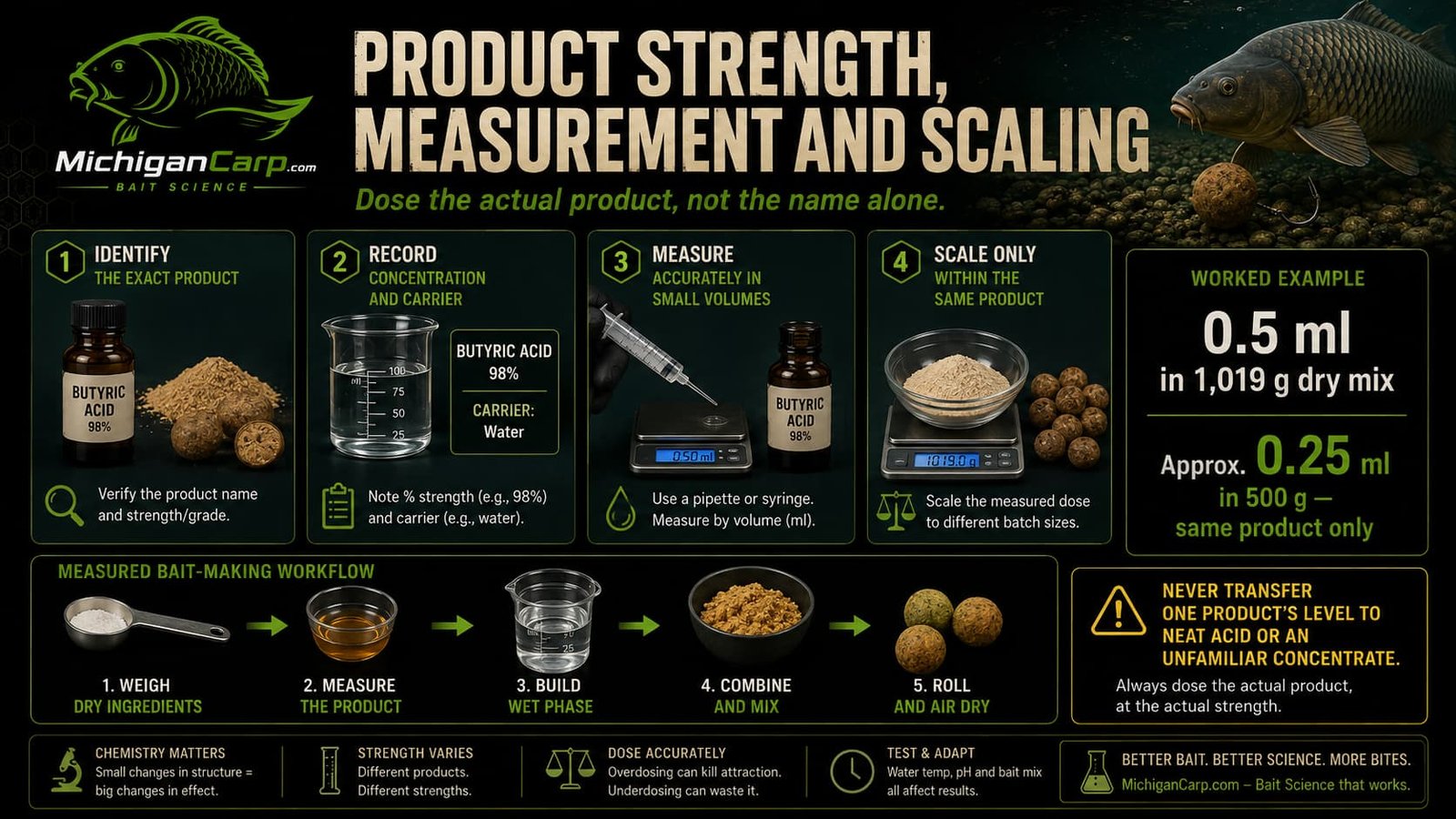
Before using a butyric product, establish as much of the following information as possible.
| Product detail | Why it matters |
|---|---|
| Exact chemical or flavor name | Distinguishes free acid, salt, ester and proprietary blend |
| Concentration or assay | Shows how much active material is present |
| Carrier | Affects dispersion, density, paste behavior and hookbait balance |
| Intended application | Separates food, feed, laboratory and prepared bait-flavor products |
| Supplier inclusion guidance | Provides the appropriate product-specific starting direction |
| Safety Data Sheet | Identifies hazards, protective equipment, storage and spill response |
| Batch or lot number | Helps identify changes between purchases |
Neat acid and diluted flavor are fundamentally different
A product with an assay near 100% is fundamentally different from a bait flavor containing a small percentage of butyric acid in a carrier.
For illustration, 0.5 ml of a 10% preparation contains approximately one-tenth of the active concentration of the same volume of neat acid before allowing for density differences.
This is why “use ten drops per kilogram” is inadequate advice unless the exact product and dropper have been identified.
Drops are not a reliable universal unit
Drop size changes with the dropper opening, liquid viscosity, temperature, surface tension, bottle angle and user technique.
Use a suitable graduated syringe, fine pipette or adjustable micropipette dedicated to bait work.
A syringe marked only in whole milliliters cannot measure 0.12 or 0.25 ml accurately.
Do not return unused measured product to the original bottle.
Avoid improvised home dilution
Diluting a concentrated acid can make very small inclusions easier to measure, but it also requires a compatible carrier, suitable equipment and correct safety controls.
The safer home-bait option is to buy a professionally prepared food flavor or commercial bait product with a declared use rate.
Do not improvise a concentrated-acid dilution in a domestic kitchen without understanding the product Safety Data Sheet and compatibility requirements.
Using Butyric Products in Boilies and Hookbaits
The most controlled starting method is to distribute a measured known product through the complete wet phase before the dry blend is added.
Recommended addition sequence
- Identify the exact product and review its instructions and Safety Data Sheet.
- Measure the required amount using dedicated accurate equipment.
- Pre-blend the small quantity into a compatible measured portion of the wider liquid phase when necessary.
- Add that portion to the eggs and remaining liquids while mixing.
- Mix until the wet phase appears reasonably uniform.
- Add the dry blend gradually.
- Rest the paste and record how much dry mix it accepts.
- Retain an untreated control sample during development.
Do not drip concentrated product onto one area of finished paste. Local concentration can create harsh pockets, uneven acidity and poor repeatability.
Free boilies
Free boilies should normally carry the restrained established flavor level within the complete food-oriented liquid phase.
The objective is a coherent fruit, milk, nut or cream profile—not the maximum odor the paste can tolerate.
Hardened bottom hookbaits
A hardened hookbait may seem less aromatic after additional albumen, casein and drying.
Begin with the accurately scaled free-bait level. Do not automatically double the butyric product to compensate for a presumed cooking or drying loss.
Wafters and pop-ups
The butyric volume may be tiny, but its carrier and the rest of the hookbait liquid package can affect density.
Retest the completed wafter or pop-up with the exact hook, screw, swivel, ring and putty after drying, storage, treatment and the full intended soak.
The complete manufacture belongs in How to Make Wafters and Pop-Ups From a Boilie Base Mix.
Post-drying treatment
A professionally formulated diluted flavor treatment can refresh the surface identity of a hardened hookbait.
Repeated light applications are easier to control than a deep soak.
Never soak a hookbait in neat concentrated acid and never place concentrated acid into an atomizing spray bottle.
Hookbait Conditioners for Carp: Glugs, Sprays, Soaks and Buoyancy Control owns the full post-production treatment method. The broader live preparation guide is How to Prepare Boilies for Carp Fishing.
Worked Plum, Scopex and Vanilla Example
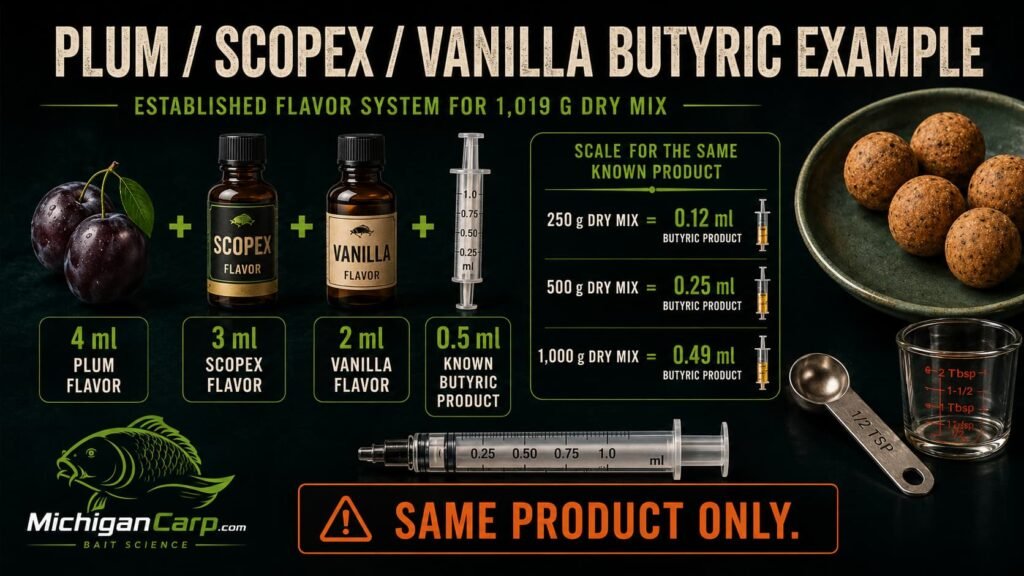
The recorded development formula contained 1,019 g of dry mix and the following flavor package:
| Flavor component | Recorded amount | Role |
|---|---|---|
| Plum flavor | 4 ml | Main fruit identity |
| Scopex flavor | 3 ml | Creamy bridge |
| Vanilla flavor | 2 ml | Rounding note |
| Same known pre-diluted butyric product | Up to 0.5 ml | Trace sharp or fermented-dairy accent |
The butyric level was tied to that specific product, flavor combination, dry base, liquid phase, cooking process and recorded batch size.
The full bait history belongs in Plum Scopex Vanilla Boilie: Development and Michigan Results.
Scaling the same known product
Use the following formula only when scaling the exact product already tested:
New product volume = 0.5 ml × new dry-mix weight ÷ 1,019 g
| New dry-mix weight | Calculated amount of the same known product |
|---|---|
| 250 g | 0.12 ml |
| 500 g | 0.25 ml |
| 1,000 g | 0.49 ml |
| 1,500 g | 0.74 ml |
Rounding must match the accuracy of the measuring equipment. When 0.12 ml cannot be measured reliably, make a larger test batch or use a suitable calibrated instrument rather than guessing.
Practical 500 g matching flavor package
| Flavor component | 500 g starting amount |
|---|---|
| Plum flavor | Approximately 2 ml |
| Scopex flavor | Approximately 1.5 ml |
| Vanilla flavor | Approximately 1 ml |
| Same known pre-diluted butyric product | Approximately 0.25 ml |
The specialist hookbait paste may accept a different total amount of liquid from the free bait. Keep the flavor ratio controlled while adjusting the complete egg and liquid phase to the actual paste.
Field evidence from the Plum direction
Closely related versions of the Plum, Scopex and Vanilla milk-and-nut bait have produced several twenties, two Muskegon Channel commons of 29 lb 6 oz and 29 lb 12 oz, and two additional 29 lb carp from other Michigan waters.
A later Ultra 24 version produced a 26 lb common and two additional low-twenties, while four recorded bites during a Dale Hollow comparison came on the Plum version.
Those results justify keeping the complete Plum, Scopex and Vanilla direction as the control.
They do not prove that the butyric product caused the captures, that every fish came on the exact 1,019 g formula or that the established inclusion is universally superior.
The complete bait earned field confidence. The individual butyric component still requires controlled comparison.
Cooking, pH, Release and Preservation
Cooking and drying
Free n-butyric acid and many low-molecular-weight butyric esters are volatile. Cooking, steam, airflow and drying may change the aroma remaining in the finished bait.
Mineral salts and tributyrin do not have the same volatility or sensory behavior, which is another reason not to group all products together.
The final result depends on product form, concentration, carrier, bait diameter, cooking method, cooking time, drying conditions and the surrounding bait matrix.
Do not assume complete destruction or complete retention.
For the wider process, read What Boiling and Heat Do to Carp Bait Ingredients.
Do not compensate blindly for cooking loss
Doubling the raw inclusion because some aroma may be lost during cooking is not controlled formulation.
A larger dose may overpower the finished bait, create stronger production fumes, shift the liquid-phase pH more than intended and make the batch harder to assess.
Cook the established level consistently and compare the finished bait before making one measured adjustment.
pH contribution
Free butyric acid can lower pH in a water-containing system, but the final change depends on product concentration, amount, water content and the buffering supplied by eggs, proteins, minerals, salts and the rest of the dry mix.
A tiny flavor-level addition should not be assumed to acidify the complete boilie to a specific value.
Measure pH using a declared, repeatable method when pH matters to processing or preservation.
Underwater release
A powerful smell above the bait does not prove rapid or useful release in lake water.
Release depends on the compound, carrier, bait porosity, water penetration, cooking, drying and the presence of other soluble materials.
Use Carp Bait Solubility and Leakage for the full physical explanation.
Butyric flavor is not the preservative system
At a normal flavor-level inclusion, butyric acid should not be treated as the complete protection against mold, yeast or bacterial spoilage.
At normal flavour levels, butyric acid is not the preservative system. Shelf-life bait still depends on the preservative formula, sensible drying, clean handling, packaging and storage. If room-temperature stability is uncertain, freezing remains the safer home-bait option.
My preservation system uses potassium sorbate, sodium benzoate and citric acid rather than relying on the butyric flavor component.
The complete preservation method is covered in Potassium Sorbate, Sodium Benzoate and Citric Acid in Shelf-Life Boilies. For practical drying and storage checks, use How to Tell When Boilies Are Dry Enough and How to Store Homemade Boilies.
Handling Concentrated Butyric Acid Safely
Concentrated n-butyric acid requires substantially more care than an ordinary bottle of diluted Vanilla or Plum flavor.
A current supplier Safety Data Sheet classifies concentrated n-butyric acid as harmful if swallowed and capable of causing severe skin burns and eye damage.
See the Fisher Scientific n-Butyric Acid Safety Data Sheet.
A heavily diluted bait flavor may carry different hazards. The label and Safety Data Sheet for the actual product remain the controlling instructions.
Food grade does not mean harmless
Food grade describes suitability and manufacturing controls for an intended application. It does not mean a concentrated acid is safe on skin or in the eyes.
For example, Eastman Food-Grade Butyric Acid has a stated minimum assay of 99.5%.
A high-purity food-grade acid should still be handled according to its safety documentation.
Basic handling rules
- Work in a well-ventilated area suitable for bait production.
- Use gloves compatible with the exact product and specified by its safety information.
- Wear splash-resistant eye protection when handling concentrated acid.
- Keep the original container closed except during measurement.
- Do not deliberately sniff the bottle.
- Do not use household food utensils.
- Use dedicated measuring and mixing equipment.
- Keep the material away from children and pets.
- Never transfer it into an unmarked container.
- Follow the supplier’s spill, first-aid and disposal instructions.
Do not atomize concentrated acid
Do not put neat or highly concentrated butyric acid into a misting or spray bottle.
Creating airborne droplets introduces avoidable eye, skin and inhalation exposure.
Use only a professionally formulated treatment intended for controlled surface application.
Storage and odor contamination
Keep the product in its original tightly closed container with the label and lot information intact.
Store it at the temperature stated by the supplier, away from heat, ignition sources and incompatible materials identified in the Safety Data Sheet.
Dedicated equipment is sensible because the odor can transfer to syringes, seals, plastic containers, clothing, cupboards and unrelated flavor bottles.
A separate small measuring kit prevents later baits from acquiring an unintended butyric background.
Controlled Testing and Common Mistakes
Three-batch comparison
For the same known product, compare:
| Batch | Butyric treatment | Purpose |
|---|---|---|
| Control | No separately added butyric product | Shows the Plum, Scopex and Vanilla system without the accent |
| Reduced | Half the accurately scaled established amount | Tests whether a lower inclusion gives enough contrast |
| Established | Equivalent of 0.5 ml per 1,019 g dry mix | Provides the recorded product-specific control |
Keep the base mix, egg weight, Plum, Scopex, Vanilla, bait diameter, color, cooking, drying, hookbait construction and storage unchanged.
Assess the finished bait
Record the profile in raw paste, freshly cooked bait, twenty-four-hour dried bait, bait at its intended final drying stage and after one, six, twelve and twenty-four hours in water.
Check whether the butyric note:
- supports the fruit and cream;
- remains detectable without taking over;
- becomes harsher after drying;
- changes after freezing or storage;
- remains balanced after immersion.
Use How to Test Boilies Before Fishing for the wider testing method.
Field comparison
Rotate test hookbaits between reasonably comparable positions and repeat the comparison across more than one session.
Record venue, date, water temperature, position, hookbait version, surrounding feed, bites and captures.
One bite is useful information. It is not enough to establish universal superiority.
Common mistakes
| Mistake | Why it matters | Better practice |
|---|---|---|
| Treating all butyric products as identical | The product may contain free acid, salt, ester or a diluted blend | Identify the exact material and concentration |
| Copying 0.5 ml into another product | Active concentration may differ dramatically | Begin again with supplier guidance and small tests |
| Measuring in random drops | Drop volume is inconsistent | Use calibrated small-volume equipment |
| Assuming Scopex equals butyric acid | Scopex is a proprietary flavor profile | Record Scopex and the butyric product separately |
| Using human smell as the only test | Airborne intensity does not prove underwater performance | Assess processed bait and timed water samples |
| Adding concentrate to finished paste | Creates harsh pockets and uneven acidity | Distribute through the complete wet phase |
| Doubling the dose for cooking loss | Actual retention is product- and matrix-dependent | Compare finished controlled batches |
| Spraying neat acid | Mist creates unnecessary exposure risk | Use only a suitable prepared treatment |
| Treating flavor as preservation | Ambient shelf life requires broader control | Use the dedicated preservation system |
| Replacing free acid with sodium butyrate gram for gram | They have different molecular and formulation behavior | Formulate from the exact product specification |
| Replacing n-butyric with isobutyric acid | They are separate structural isomers | Treat the new product as a new ingredient |
| Deep-soaking wafters and pop-ups | The carrier can alter texture and buoyancy | Use light measured treatment and retest the exact rig |
My Practical View
I see the butyric component as a background tool rather than the foundation of the bait.
In the Plum, Scopex and Vanilla milk-nut system, the complete identity comes from the milk and whey ingredients, tiger nut, cereals, birdfood, yeast, Plum, Scopex and Vanilla.
The known pre-diluted butyric product adds one narrow sharp or aged-dairy edge to that much larger system.
The recorded 0.5 ml level worked with the particular product I used in the 1,019 g development batch.
I would keep that as the product-specific control rather than increasing it simply because the open bottle smells powerful.
When changing supplier or product, I would begin again and establish:
- whether it contains free acid, an ester, a salt or a blend;
- its active concentration;
- its carrier;
- the supplier’s recommended application;
- how it behaves after cooking and drying;
- whether it remains balanced after immersion.
The honest field conclusion is that related Plum, Scopex and Vanilla formulas have caught carp and earned practical confidence.
The evidence does not prove that the butyric product alone produced those captures.
Use a butyric product as a measured supporting note—not as a competition to create the strongest-smelling bait.
FAQ
What is butyric acid?
Butyric acid, also called butanoic acid, is a four-carbon short-chain fatty acid associated with butter, cheese, fermentation and a strong pungent odor.
Is butyric acid the same as Scopex?
No. Scopex is a proprietary sweet-and-creamy flavor style. It may contain butyric or ester notes, but it is not a standardized concentration of free butyric acid.
Is ethyl butyrate the same as butyric acid?
No. Ethyl butyrate is an ester formed from butyric acid and ethanol. It generally has a fruitier profile and different physical and formulation behavior.
Is sodium butyrate the same as butyric acid?
No. Sodium butyrate is a mineral salt. It contributes sodium and should not be substituted gram for gram for liquid free acid.
What is tributyrin?
Tributyrin is a glycerol triester containing three butyrate groups. It is different from free butyric acid, ethyl butyrate and mineral butyrate salts.
What is the difference between n-butyric and isobutyric acid?
They are structural isomers. n-Butyric acid has a straight carbon chain, while isobutyric acid has a branched structure. They are separate ingredients.
How much butyric acid should be used in boilies?
There is no responsible universal volume because products range from concentrated free acid to mild diluted flavors. Follow the exact supplier information and test small batches.
What was My recorded level?
The recorded level was up to 0.5 ml of one known pre-diluted butyric bait product in 1,019 g of dry mix. It is not a dosage for neat acid or another product.
How much of the same product goes into a 500 g batch?
Scaling the historical formula gives approximately 0.25 ml for 500 g of dry mix. This applies only to the same known product.
Can it be measured in drops?
Drops vary in size and are unreliable for concentrated ingredients. Use a suitable graduated syringe or micropipette.
Should it be added before or after boiling?
The most controlled starting method is to distribute the measured product through the complete wet phase before adding the dry mix. A suitable prepared post-boil treatment can also be tested, but neat acid should not be sprayed.
Does boiling destroy it?
Cooking can alter volatile material, but retention depends on the chemical form, concentration, carrier, bait matrix and process. Do not assume complete loss or complete retention.
Does butyric acid preserve boilies?
A normal flavor-level addition should not be treated as a complete preservative system. Shelf-life bait still requires pH, water activity, antimicrobial, drying, packaging and storage control.
Can it be used in wafters and pop-ups?
Yes, when the exact product is accurately scaled and distributed. Retest buoyancy because the carrier and supporting liquids may change bait density.
Can hookbaits be soaked in butyric acid?
Do not soak hookbaits in neat concentrated acid. Use a properly formulated diluted treatment intended for hookbait use and test it carefully.
Is food-grade butyric acid safe to handle without protection?
No. Concentrated food-grade material can still cause serious skin and eye injury. Follow the product label and Safety Data Sheet.
Does a stronger butyric smell mean a better bait?
No. Human odor intensity does not prove improved underwater release, feeding acceptance or carp response.
Next Steps
Continue through the related MichiganCarp.com bait-science and boilie-making guides:
- How to Flavor Boilies Properly: Strength, Carriers and Layering — build the wider flavor profile.
- Plum Scopex Vanilla Boilie: Development and Michigan Results — follow the complete recipe and field record.
- Organic Acids in Carp Bait — compare citric, lactic, acetic, butyric and other organic acids.
- How to Make Wafters and Pop-Ups From a Boilie Base Mix — scale matching specialist hookbaits.
- Hookbait Conditioners for Carp: Glugs, Sprays, Soaks and Buoyancy Control — apply prepared post-production treatments.
- Propylene Glycol vs Glycerin in Carp Bait — understand common flavor and conditioner carriers.
- Potassium Sorbate, Sodium Benzoate and Citric Acid in Shelf-Life Boilies — build the separate antimicrobial system.
- Water Activity in Boilies: Moisture, Mold and Shelf-Life Control — validate ambient storage.
- Minerals, Salts and pH in Carp Bait — understand acid, mineral and buffering effects.
- How pH Changes Carp Bait Performance — use repeatable pH interpretation.
- Carp Feeding Attractants Explained — separate detection from feeding acceptance.
- Carp Bait Solubility and Leakage — understand release from the finished bait.
- What Boiling and Heat Do to Carp Bait Ingredients — understand processing changes.
- How to Test Boilies Before Fishing — compare control and treated batches.
- Bait Science — explore formulation, chemistry and finished-bait behavior.
- Boilie School — follow the structured boilie-making route.