
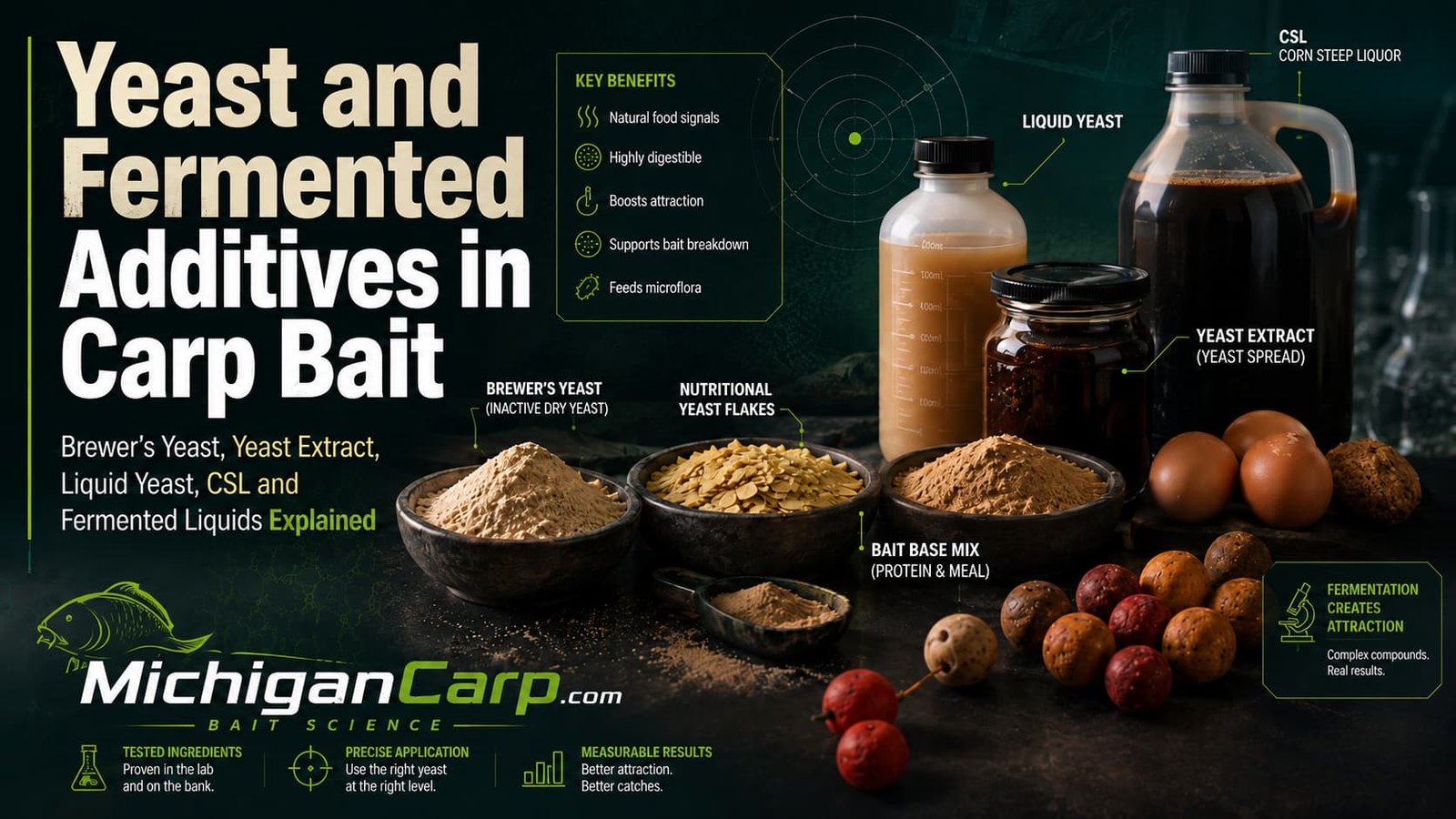
Yeast in carp bait is one of the most useful — and most confused — areas of modern homemade bait making.
Brewer’s yeast, nutritional yeast, autolyzed yeast, yeast extract, Marmite-style yeast spreads, liquid yeast products, CSL and fermented liquids are often discussed as though they are variations of the same ingredient.
They are not.
Some are dry nutritional ingredients.
Some are concentrated soluble yeast fractions.
Some are liquid fermentation products.
And CSL is not yeast at all.
Understanding those differences matters because the wrong product at the wrong level can make a bait unnecessarily salty, bitter, sticky, wet, sour or difficult to store.
Used intelligently, however, yeast and fermented additives can contribute:
SAVORY FOOD CHARACTER.
SOLUBLE MATERIAL.
PROTEIN AND B-VITAMIN BACKGROUND.
AMINO-ACID AND PEPTIDE FRACTIONS, DEPENDING ON PRODUCT.
NUCLEOTIDE-CONTAINING YEAST FRACTIONS, DEPENDING ON PRODUCT.
LIQUID FOOD SIGNAL.
BOILIE BASE-MIX SUPPORT.
HOOKBAIT AND GLUG SUPPORT.
PACKBAIT AND PARTICLE APPLICATIONS.
The important word is support.
Yeast does not rescue a poor base mix.
CSL does not compensate for bad particle preparation.
A dark fermented liquid is not automatically attractive because it smells powerful to us.
And adding several yeast products together at high levels does not make a bait more scientific.
For the wider soluble-protein picture, read How to Use Hydrolysates in Carp Bait.
For the specific role of nucleotides and yeast extract, use Nucleotides in Carp Bait.
For boilie-liquid formulation, use Boilie Liquids and Additives.
The rule for this article is simple:
KNOW WHICH YEAST PRODUCT YOU ARE USING.
KNOW WHAT JOB IT IS DOING.
START LOW ENOUGH TO TEST IT PROPERLY.
Table of Contents
Quick Start: Yeast Additives for Carp Bait
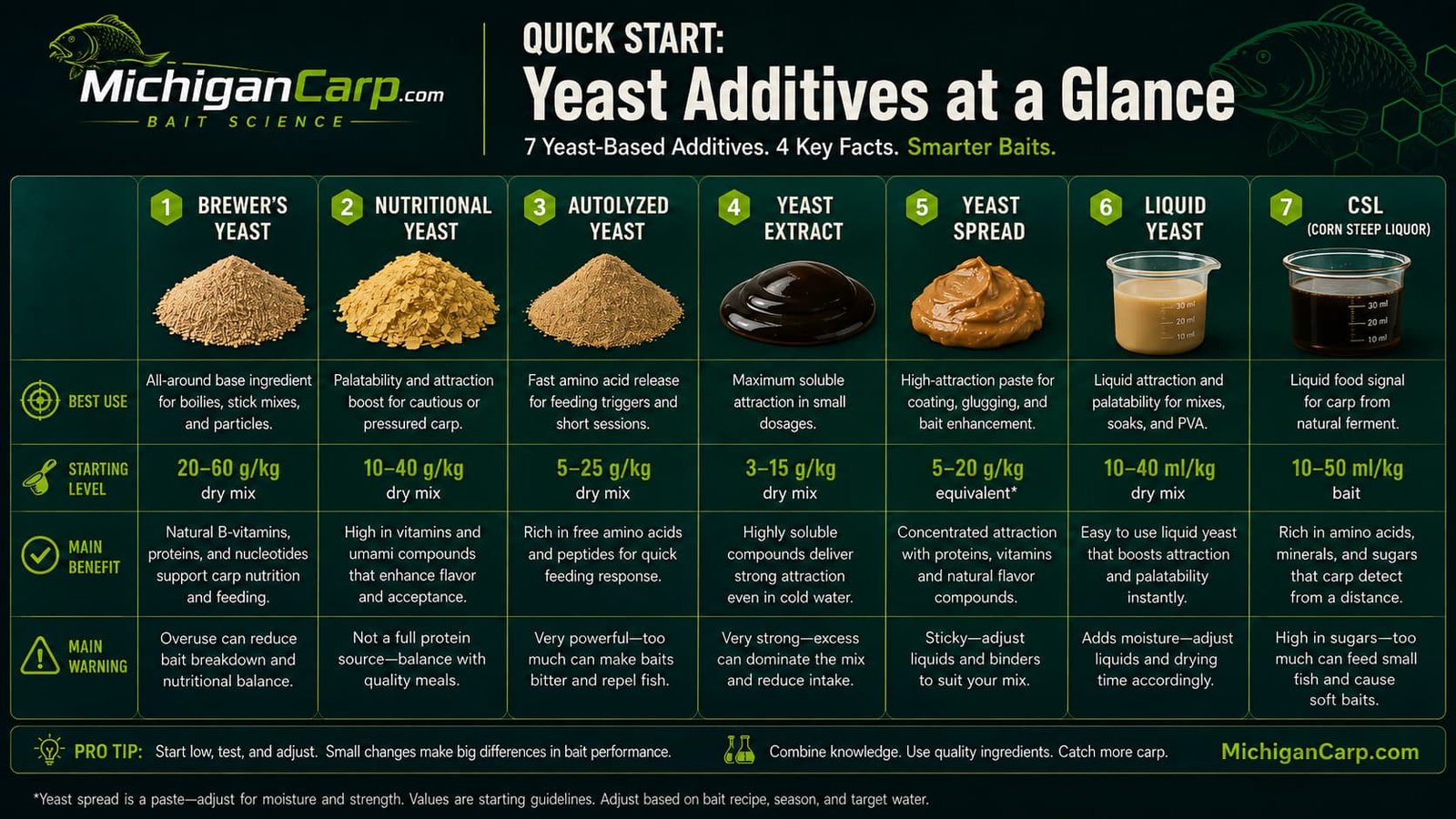
The table below is the fastest way to understand the main differences.
| Ingredient | What It Really Is | Practical Starting Range | Best General Role | Main Caution |
|---|---|---|---|---|
| Brewer’s yeast | Usually inactive whole dried yeast | 20–60 g/kg dry mix | Nutritional/background ingredient | Can dry or dominate a mix at high levels |
| Nutritional yeast | Inactive food-grade yeast flakes/powder | 10–40 g/kg dry mix | Mild savory/background ingredient | Brands vary considerably |
| Autolyzed yeast | Yeast broken down partly by its own enzymes | 5–25 g/kg dry mix | More soluble savory support | Stronger than ordinary whole yeast |
| Yeast extract | Concentrated soluble components of yeast cells | 3–15 g/kg dry mix | Savory/soluble concentrate | Can become intense or salty |
| Yeast spread | Food spread based largely on yeast extract | 5–15 g/kg equivalent | Small liquid/paste addition | Salt and formulation vary by brand |
| Liquid yeast product | Commercial liquid containing yeast-derived material | 10–40 ml/kg dry mix | Wet-side food signal | Product identity and stability vary |
| CSL | Concentrated corn steep liquor from wet milling | 10–50 ml/kg bait | Fermented corn-derived liquid | Acidic, variable and water-rich |
| Homemade fermented liquid | Microbially transformed bait liquid | No universal rate | Short-term experimental bait preparation | Safety and stability depend on the process |
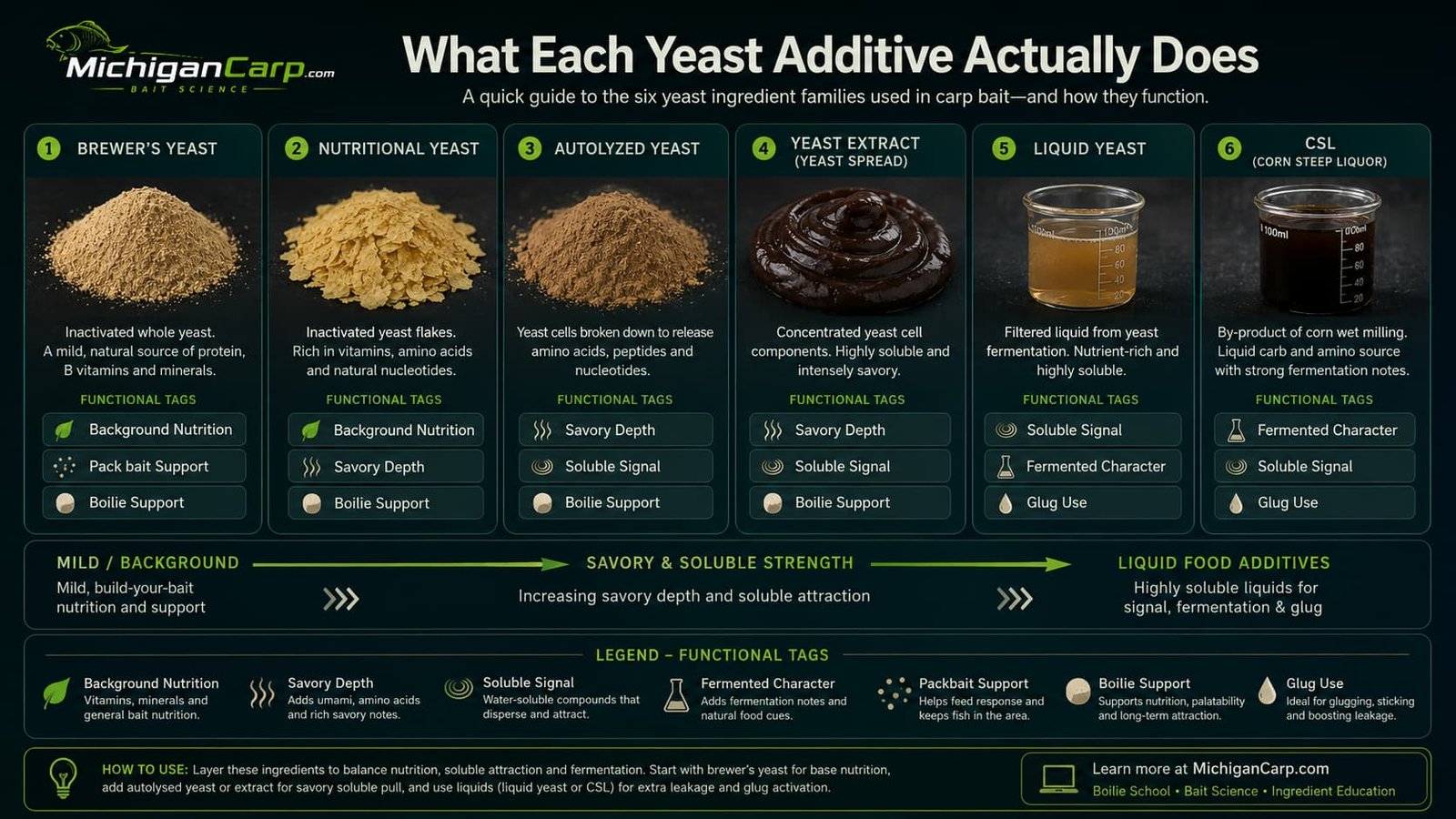
Yeast in carp bait works best when the type of yeast matches the job. Whole brewer’s yeast can support the base mix, while autolyzed yeast and yeast extract provide a more concentrated soluble fraction. Liquid yeast and CSL belong mainly on the wet side of the bait system.
These are practical test ranges, not scientifically established optimum carp-attraction doses.
Product concentration can vary enormously.
A mild brewer’s yeast powder and a concentrated yeast extract should not be treated gram-for-gram as equivalent ingredients.
Why Yeast Can Be Useful in Carp Bait
Yeast has a long history in animal and aquaculture feeds.
Different yeasts and yeast derivatives may contribute:
- protein;
- amino acids;
- B vitamins;
- minerals;
- cell-wall material;
- nucleic-acid and nucleotide fractions;
- peptides and other soluble material after processing.
A review of yeast as an aquafeed ingredient reports protein levels commonly around 40–55% across yeast products, although the exact composition depends heavily on species and processing. See Yeast as a Major Protein-Rich Ingredient in Aquafeeds.
Yeast derivatives can also contain nucleotide fractions and other biologically active compounds, but composition and purity vary substantially between products. That variability is important when bait makers talk about “yeast” as though every product is chemically identical. See Yeast Derivatives as a Source of Bioactive Components in Animal Nutrition.
For carp bait, I interpret this evidence practically rather than claiming laboratory-proven bait attraction.
Yeast gives us a food ingredient family with useful nutritional and soluble characteristics.
That is enough reason to test it.
It is not enough reason to claim:
40 grams of yeast will make carp feed more than 20 grams.
That has to be tested in the actual bait.
Brewer’s Yeast: The Best General Starting Point
Brewer’s yeast is the yeast ingredient I would recommend most often to a home bait maker who simply wants to add a sensible yeast component to a base mix.
Most bait-grade brewer’s yeast is inactive dried yeast originating from brewing or other fermentation production.
Its biggest advantage is that it behaves more like a food ingredient than a concentrated attractor.
That makes it relatively easy to incorporate into:
- milk/nut boilies;
- birdfood mixes;
- cereal bases;
- fishmeal baits;
- packbait;
- method mixes;
- boilie crumb;
- dry coating blends.
What Brewer’s Yeast Contributes
Depending on the actual product, brewer’s yeast may add:
- protein;
- B-vitamin-rich material;
- amino-acid-containing protein;
- yeast cell-wall fractions;
- modest savory character;
- dry-mix body;
- nutritional complexity.
I do not use brewer’s yeast because I expect it to produce an instant feeding response.
I use it because it can form a useful part of a coherent food bait.
Practical Starting Range
For most boilie mixes:
20–60 g per kg dry mix
For my preferred milk/nut direction, I would usually start nearer:
20–40 g/kg
That is enough to make brewer’s yeast meaningful without allowing it to take over the formula.
When More Is Not Better
At higher inclusion levels brewer’s yeast can change:
- paste hydration;
- rolling;
- finished texture;
- smell;
- nutritional balance.
If the bait becomes drier or more difficult to roll, that does not necessarily mean brewer’s yeast is a bad ingredient.
It can simply mean the recipe has not been rebalanced around the new dry material.
Nutritional Yeast: Useful, Accessible, but Not Identical
Nutritional yeast is particularly useful for North American bait makers because it is easy to source from supermarkets and online food suppliers.
It is usually an inactive yeast sold as flakes or powder.
That makes it convenient for:
- experimental boilie batches;
- packbait;
- method mixes;
- dry coatings;
- boilie crumb;
- birdfood mixtures.
But nutritional yeast should not automatically be treated as identical to brewer’s yeast.
Different brands may be:
- fortified with vitamins;
- more or less savory;
- more strongly flavored;
- more finely ground;
- different in salt or other added ingredients.
Practical Starting Range
10–40 g/kg dry mix
If I were testing a grocery-store nutritional yeast for the first time, I would start at approximately:
15–20 g/kg
Then judge the paste, taste, smell and water behavior before increasing it.
The label matters more than the name on the front of the packet.
Autolyzed Yeast: A More Soluble Yeast Ingredient
Autolyzed yeast has been processed so the yeast’s own enzymes break down cellular material.
That can create a product containing more readily soluble:
- peptides;
- amino-acid-containing fractions;
- nucleotide-containing fractions;
- savory compounds.
That makes autolyzed yeast different from intact dried brewer’s yeast.
It sits closer to the soluble-food-signal side of the ingredient spectrum.
Where It Fits
Autolyzed yeast can make sense in:
- boilies;
- hookbait mixes;
- milk/nut baits;
- birdfood baits;
- savory formulations;
- powder coatings.
Practical Starting Range
5–25 g/kg dry mix
A useful first test would be approximately:
10 g/kg
The stronger the product tastes and smells, the less interested I am in beginning at the top of the range.
This is where bait making benefits from restraint.
Yeast Extract: A Concentrate, Not a Bulk Ingredient
Yeast extract is substantially different from whole dried yeast.
The soluble internal material of yeast cells has been separated and concentrated.
Depending on the product, yeast extract may contain:
- amino acids;
- small peptides;
- glutamate;
- nucleotides;
- other soluble savory components.
That is why yeast extract can taste extremely savory or “umami” to humans.
It is also why I treat it as a concentrate.
For more detail on the nucleotide side, use Nucleotides in Carp Bait.
This distinction is important when using yeast in carp bait because yeast extract should not be dosed like whole brewer’s yeast.
Practical Starting Range
For a standard free-bait boilie:
3–15 g/kg dry mix
I would normally begin around:
5 g/kg
For specialist hookbait experiments you can test above that, but there should be a reason for doing it.
Why Yeast Extract Is Easy to Overuse
Concentrated yeast extract can:
- dominate a subtle bait;
- add substantial savory character;
- add salt depending on the product;
- alter paste behavior;
- make a cream or fruit bait taste completely different.
A bait does not become better simply because the soluble fraction is stronger.
Marmite and Other Yeast Spreads
Marmite and similar products are useful because they provide an easily available yeast-extract-based ingredient.
But they are formulated food spreads, not pure laboratory yeast extracts.
That means they can contain:
- yeast extract;
- salt;
- vegetable extracts;
- vitamins;
- other formulation ingredients depending on the brand.
Their main characteristics are usually:
STRONG.
SALTY.
STICKY.
HIGHLY SAVORY.
Practical Starting Range
For one kilogram of dry boilie mix:
5–15 g
I would start around:
5–10 g/kg
Dissolve the spread into the liquid phase before adding it to the eggs.
That gives much better distribution than pushing a spoonful of thick spread into dry powders.
Best Uses
Small amounts can work in:
- savory boilies;
- milk/nut boilies needing a background edge;
- hookbait paste;
- short-term glugs;
- packbait liquids.
But I would not build an entire bait around the smell of Marmite.
It is supporting material.
“Liquid Yeast” Is Not a Standardized Ingredient
This is one of the biggest corrections I would make to older bait advice.
Liquid yeast does not describe one standardized product.
A product sold as “liquid yeast” could potentially be:
- a suspension of yeast;
- a yeast fermentation liquor;
- a yeast hydrolysate;
- a yeast extract solution;
- a mixture containing yeast-derived solubles;
- a preserved commercial bait liquid containing several other ingredients.
So the words LIQUID YEAST on the label do not tell you enough.
Read the Technical Information
Before using it, look for:
- ingredient declaration;
- whether the yeast is active or inactive;
- moisture content;
- salt;
- sugar;
- preservatives;
- recommended storage;
- whether refrigeration is required;
- whether it is actually a hydrolysate or extract.
Practical Starting Range
For a commercial stable bait-grade liquid yeast:
10–40 ml/kg dry mix
But this is only a general bench-testing range.
A concentrated yeast extract liquid may need far less.
Count It as Liquid
If you add 30 ml of liquid yeast to a boilie recipe, you have added 30 ml to the wet phase.
That sounds obvious, but it is one of the easiest ways to turn a previously good paste into a wet, sticky mix.
Adjust the rest of the liquids accordingly.
CSL: Corn Steep Liquor Is Not Yeast
CSL deserves its own explanation because it is frequently grouped with yeast products in bait discussions.
CSL means corn steep liquor.
It is produced during the wet milling of corn.
Corn is steeped during processing and the resulting soluble liquid is concentrated.
Published reviews describe CSL as containing combinations of:
- proteins and peptides;
- amino acids;
- lactic acid and other organic acids;
- sugars;
- vitamins;
- minerals;
- other soluble corn-derived material.
See Corn Steep Liquor as an Efficient Bioresource.
That explains why CSL has value in fermentation and feed industries.
It does not prove that carp prefer every product sold to anglers as CSL.
What CSL Can Contribute to Bait
A suitable CSL product can add:
- soluble corn-derived material;
- organic-acid background;
- amino-acid-containing fractions;
- fermented character;
- liquid-phase complexity.
Practical Starting Range
In boilie liquid phase:
10–40 ml/kg dry mix
As a light particle or freebait treatment:
10–50 ml/kg prepared bait
Again, these are practical starting ranges.
Commercial CSL products can vary in solids, acidity, salt, preservatives and dilution.
Do Not Judge CSL by Color
Dark brown does not equal good.
Thick does not equal concentrated attraction.
And sour does not automatically equal fermented quality.
Read the specification wherever possible.
Fermented Liquids: Controlled Fermentation vs Spoilage
“Fermented” has become one of those bait words that can sound more scientific than it actually is.
Fermentation simply means microorganisms have transformed components of the original material.
That can produce useful changes.
It can also produce a failed or contaminated product.
Controlled Fermentation May Produce
Depending on the organism and substrate:
- organic acids;
- alcohols;
- peptides;
- amino-acid changes;
- sugars consumed or transformed;
- volatile compounds;
- changes in pH.
That does not mean every fermentation product is attractive to carp.
And it certainly does not mean a bucket that smells terrible has become more powerful.
Spoilage Is Not Fermentation Expertise
Red flags include:
- unexpected mold;
- rotten odor;
- uncontrolled gas production;
- swelling containers;
- unknown pH;
- slimy contamination;
- inconsistent batches;
- prolonged warm storage.
For particle safety and proper preparation, use How to Prepare Particles for Carp Fishing.
I would rather throw away a suspect batch than try to convince myself that “carp like fermented bait.”
Practical Inclusion Ranges: Start Here, Then Test
These are the ranges I would use as bench-development starting points.
They are not scientific optimum feeding levels.
| Ingredient | Conservative Start | Normal Test Range | Strong Experimental End |
|---|---|---|---|
| Brewer’s yeast | 20 g/kg | 20–40 g/kg | 60 g/kg |
| Nutritional yeast | 10 g/kg | 10–30 g/kg | 40 g/kg |
| Autolyzed yeast | 5 g/kg | 5–15 g/kg | 25 g/kg |
| Yeast extract powder | 3 g/kg | 3–10 g/kg | 15 g/kg |
| Yeast spread | 5 g/kg | 5–10 g/kg | 15 g/kg |
| Liquid yeast product | 10 ml/kg | 10–30 ml/kg | 40 ml/kg |
| CSL | 10 ml/kg | 10–40 ml/kg | 50 ml/kg |
The important word is test.
If 5 g of yeast extract gives you the finished bait you want, there is no reason to use 15 g simply because a table says you can.
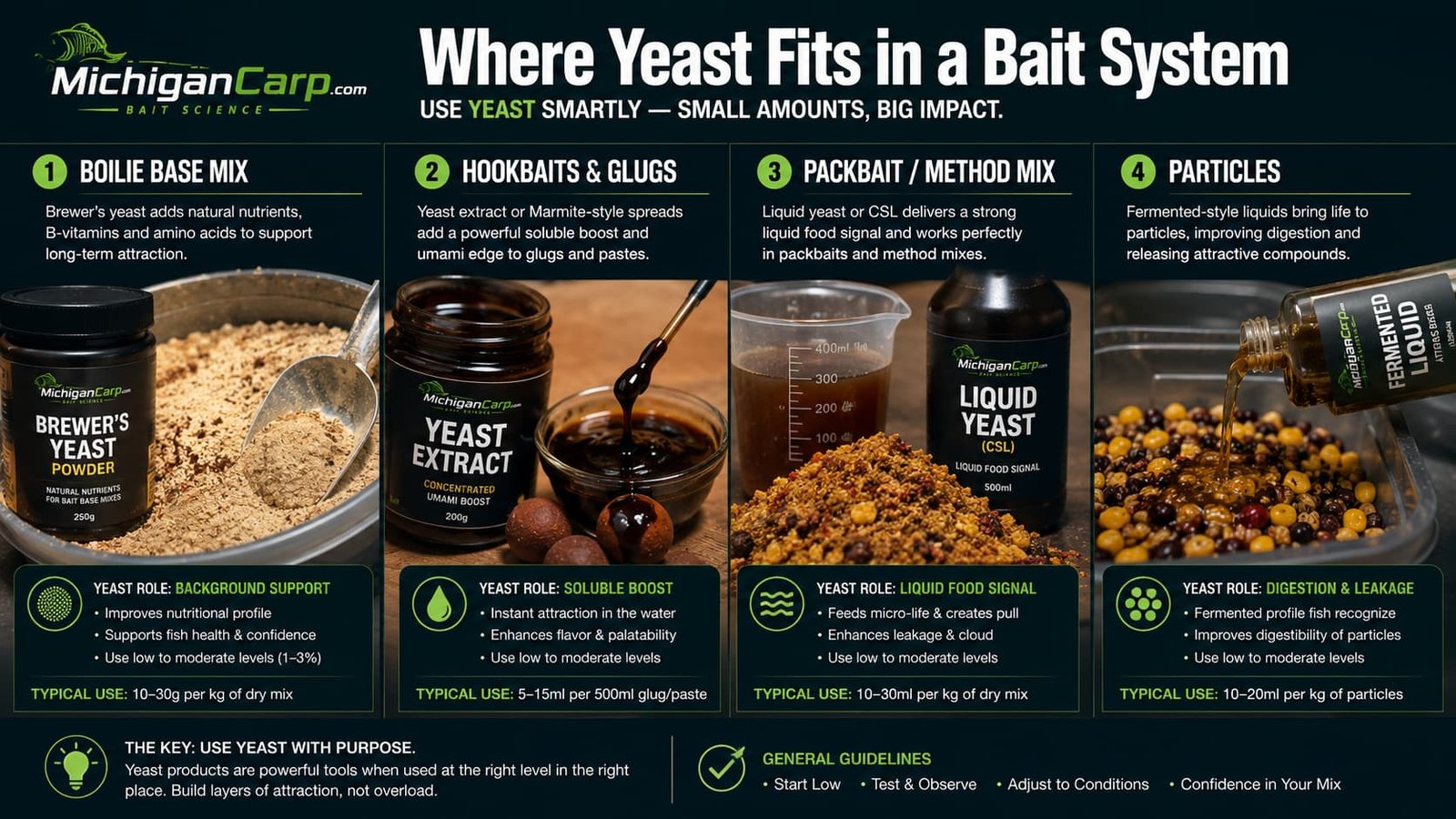
Where Yeast Fits in a Complete Bait System
The easiest way to use yeast intelligently is to give each product a specific job.
The most useful way to think about yeast in carp bait is as a family of ingredients with different jobs rather than one universal attractor.
Boilie Base Mix
This is where brewer’s yeast and, at lower levels, nutritional yeast fit most naturally.
Their role is:
- food background;
- dry ingredient support;
- modest savory character;
- nutritional contribution.
Soluble Support
Autolyzed yeast and yeast extract fit here.
Their role is:
- soluble material;
- savory depth;
- smaller-molecule yeast fractions;
- supporting a food-signal layer.
Liquid Phase
Liquid yeast products and CSL fit here.
Their role is:
- wet-side soluble material;
- fermented or savory character;
- external and internal leakage after the bait hydrates.
Hookbait Treatment
A small amount of yeast extract or suitable liquid yeast can form part of a hookbait conditioner.
But this subject is already covered properly in How to Treat Boilies for Carp.
The key point here is:
Do not soak a good hookbait until you destroy its texture or buoyancy.
Packbait and Method Mix
Yeast can connect a packbait or method carrier to the food identity of the hookbait.
Brewer’s yeast can go into the dry mix.
Liquid yeast or CSL can form part of the wetting liquid.
But packbait still has to:
- bind;
- cast;
- sink;
- release;
- break down at the intended speed.
Attraction does not compensate for bad mechanics.
For the dedicated system, use Packbait for Carp Fishing.
Particles
Liquid yeast or CSL can be added after proper preparation as a finishing liquid.
They should never be used to disguise badly prepared or questionable particles.
Yeast in Milk, Nut and Birdfood Boilies
This is the direction I find most useful for MichiganCarp bait development.
A milk/nut bait often already contains:
- milk powders;
- whey proteins;
- tiger nut flour;
- peanut ingredients;
- soy;
- semolina or maize;
- birdfood;
- yeast or hydrolysate support.
Yeast can add savory depth without automatically giving the bait a strong fishmeal identity.
I particularly like yeast in carp bait when building milk, nut and birdfood boilies because a modest yeast background can add savory complexity without turning the bait into a conventional fishmeal formula.
A Sensible Starting Package
For a one-kilogram dry mix:
Brewer’s yeast: 20–30 g
Yeast extract: 3–5 g
That is already a meaningful yeast contribution.
If I am also using liver hydrolysate, hydrolyzed whey, IMP/GMP or other soluble ingredients, I would be even less interested in pushing the yeast level upward.
The complete bait matters more than the individual additive.
For formulation, use Boilie Ingredients Explained and How to Use Hydrolysates in Carp Bait.
Yeast in Fishmeal and Savory Boilies
Yeast can also fit fishmeal-style formulations very naturally.
But these baits can accumulate savory ingredients very quickly.
A mix containing:
- fishmeal;
- fish hydrolysate;
- liver;
- krill;
- yeast extract;
- CSL;
- betaine;
- strong spices
does not necessarily improve every time another savory ingredient is added.
The risk becomes signal stacking.
I would rather choose two or three ingredients that each have a clear job than throw every savory additive in the cupboard into one mix.
Yeast, Hydrolysates and Nucleotides Are Related — but Not the Same
These subjects overlap, which is why MichiganCarp treats them as a connected cluster rather than one enormous article.
Whole Yeast
Provides intact yeast material plus its nutritional components.
Autolyzed Yeast
Contains more broken-down yeast material.
Yeast Extract
Contains concentrated soluble cell components.
Protein Hydrolysate
Made by breaking protein into smaller peptides and amino-acid-containing fractions.
Nucleotides
Specific molecules that can occur in yeast-derived materials and other foods.
Those distinctions matter.
Calling all five “amino attraction” would be inaccurate.
For the dedicated science, read:
Yeast in Hookbaits, Glugs and Coatings
Yeast-derived products are useful for hookbait treatments because only a small quantity is needed.
A practical light treatment could combine:
- a suitable carrier;
- a small amount of liquid yeast or yeast extract;
- a hydrolysate matched to the bait;
- the existing bait liquid.
But hookbait treatment should remain controlled.
A glug should not turn a 20 mm boilie into a sponge.
A wafter should not become a bottom bait.
A shelf-life hookbait should not be made microbiologically unstable because an untreated water-rich liquid was poured over it.
For the full treatment workflow use How to Treat Boilies for Carp.
Water Temperature: Do Not Invent a “Cold-Water Yeast”
Older bait writing often creates separate “cold-water” and “warm-water” additive rules.
I would be more careful.
Yeast does not suddenly become a different ingredient because the lake is 45°F instead of 75°F.
What changes is the fishing situation.
In colder water I generally want:
- less total feed;
- smaller traps;
- controlled soluble material;
- limited heavy oil;
- faster feedback from the hookbait.
That can make small amounts of yeast extract, autolyzed yeast or a suitable liquid useful.
But I would not claim yeast is inherently a special cold-water attractor.
In warmer water, carp may accept larger quantities of feed, but spoilage and bait-storage problems also become more important.
Use the baiting situation, not folklore, to decide the level.
Yeast, CSL and Shelf-Life Boilies
This is an important distinction.
Dry yeast does not preserve a bait.
Fermentation does not automatically preserve a bait.
CSL does not automatically make a bait shelf stable.
Shelf-life stability depends on the complete system, including:
- final moisture;
- water activity;
- pH;
- preservative system;
- sanitation;
- packaging;
- storage temperature;
- retained-sample testing.
In my own shelf-life work I use a combined system containing potassium sorbate, sodium benzoate and citric acid, but even that should not be treated as a guaranteed storage period without checking pH, water activity and retained samples.
Water-rich liquid yeast, CSL and homemade fermented liquids create more, not fewer, storage questions.
If I add them to freezer bait for immediate use, that is easy to manage.
If I want six months of room-temperature shelf life, the standard of evidence needs to be much higher.
Use How to Store Homemade Boilies for the full storage system.
Active Baker’s Yeast Is a Different Problem
Active dry yeast and instant baking yeast are easy to buy in the USA.
That does not mean they are the same thing as inactive brewer’s yeast.
Live or active yeast can ferment suitable carbohydrates when moisture, temperature and other conditions allow.
That can change:
- gas production;
- pH;
- smell;
- texture;
- storage stability.
If you are specifically designing a controlled fermentation experiment, that may be relevant.
If you simply want 30 g of nutritional yeast material in a boilie, use an appropriate inactive yeast ingredient instead.
Do not accidentally turn bait storage into a fermentation experiment.
USA Buying Guide: What to Look For
American bait makers do not need to import every yeast ingredient from the UK.
Brewer’s Yeast
Look at:
- brewing suppliers;
- animal-feed ingredient suppliers;
- food ingredient suppliers;
- online nutrition suppliers.
Prefer a clean inactive product with an understandable label.
Nutritional Yeast
Easy to find through:
- supermarkets;
- health-food stores;
- warehouse retailers;
- online food suppliers.
Check whether it is fortified and whether salt or other ingredients have been added.
Autolyzed Yeast and Yeast Extract
Look at:
- food ingredient suppliers;
- seasoning suppliers;
- fermentation suppliers;
- specialist bait suppliers.
These products can be powerful, so buying a small quantity first makes sense.
CSL
Look for a product whose identity is actually clear.
Ask:
- Is it genuine corn steep liquor?
- Is it concentrated?
- What is the solids level?
- Is it preserved?
- Does it require refrigeration?
- Is anything else added?
Do not buy an anonymous brown liquid because a marketplace seller calls it “fermented carp attractor.”
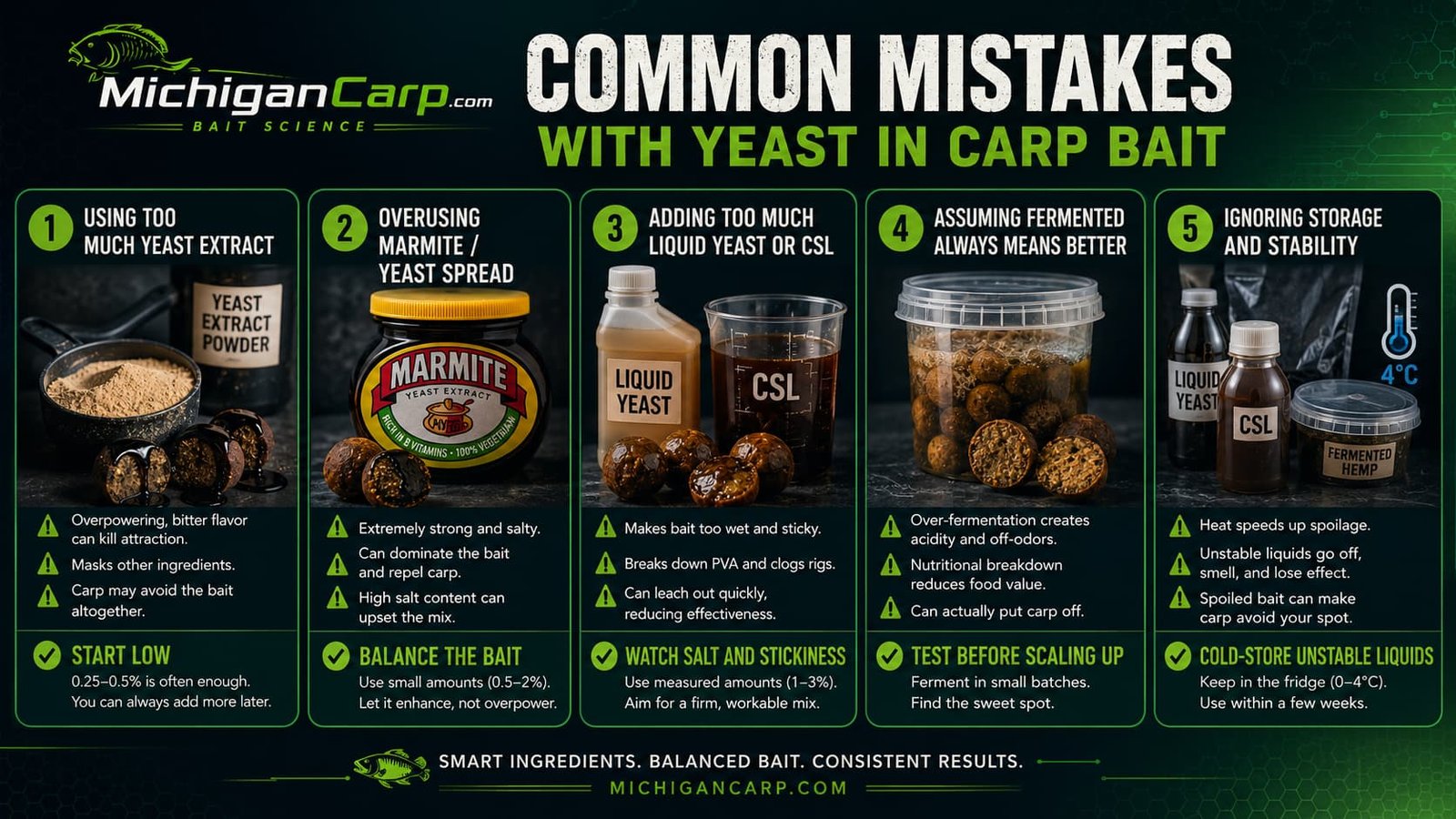
Common Mistakes With Yeast in Carp Bait
Most problems with yeast in carp bait come from confusing whole yeast, extracts and liquids or simply using more than the formula requires.
Using Every Yeast Product Together
Brewer’s yeast plus autolyzed yeast plus yeast extract plus Marmite plus liquid yeast plus CSL is not automatically a better system.
It may simply be six versions of the same broad direction.
Treating Brewer’s Yeast Like Yeast Extract
They are not interchangeable.
One is usually a whole inactive yeast ingredient.
The other is a concentrated soluble fraction.
Using Too Much Yeast Extract
This is probably the easiest yeast mistake to make.
If the bait becomes extremely savory, salty or harsh, reduce the level.
Ignoring Salt
Yeast spreads and some extracts can contain meaningful salt.
Count it as part of the formula rather than adding it blindly on top.
Forgetting That Liquids Change the Paste
Thirty milliliters of liquid yeast is still 30 ml of liquid.
Adjust the egg/liquid balance.
Assuming Fermented Means Attractive
Controlled fermentation may create useful compounds.
Spoilage may create rubbish.
The word alone tells you nothing.
Believing CSL Is Yeast
It is not.
CSL is a corn wet-milling by-product.
Ignoring Storage
A stable dry yeast powder and a water-rich homemade fermented liquid do not have the same storage requirements.
Trying to Judge Everything by Smell
Strong smell in air is not a reliable measurement of what carp detect underwater.
Changing Too Many Variables at Once
If you change brewer’s yeast, liver, liquid yeast, flavor and sweetener in the same batch, you learn almost nothing from the result.
A Better Way to Test Yeast in a Boilie
If I wanted to find the right brewer’s yeast level for a new bait, I would use a simple controlled test.
Batch A
No added yeast.
Batch B
20 g brewer’s yeast per kg dry mix.
Batch C
40 g brewer’s yeast per kg dry mix.
Keep everything else the same.
Record:
- paste hydration;
- rolling quality;
- boiling behavior;
- drying;
- smell;
- texture;
- 1-hour water test;
- 6-hour water test;
- overnight water test;
- actual fishing observations.
Then choose the batch that performs best as a bait system.
Not the one that smells strongest in the kitchen.
For structured bait testing, use How to Test Boilies Before Fishing.
My Practical View
Yeast belongs in serious carp bait making.
But I use different yeast products for different reasons.
BREWER’S YEAST is primarily a background food ingredient.
NUTRITIONAL YEAST is a convenient alternative or experimental ingredient.
AUTOLYZED YEAST moves further toward soluble savory support.
YEAST EXTRACT is a concentrate.
YEAST SPREADS are strong formulated food products that need restraint.
LIQUID YEAST needs its label read before we even know exactly what it is.
CSL is a corn-derived liquid food ingredient, not yeast.
FERMENTED LIQUIDS can be useful only when the process and storage make sense.
That hierarchy is much more useful than simply asking:
Is yeast attractive to carp?
The better question is:
Which yeast-derived material does this bait actually need?
For a MichiganCarp milk/nut bait, that may be 20–30 g of brewer’s yeast and a small yeast-extract fraction.
For a packbait, brewer’s yeast may go into the dry carrier while a little CSL goes into the wet side.
For a specialist hookbait, a small amount of yeast extract may make more sense than a large dose of whole yeast.
For a shelf-life bait, I care as much about stability as attraction.
That is bait formulation.
Ingredients have jobs.
The goal is not to collect the most additives.
The goal is to build the cleanest system that does what you need.
USE YEAST WITH PURPOSE.
USE CONCENTRATES AS CONCENTRATES.
COUNT LIQUIDS AS LIQUIDS.
DO NOT CONFUSE FERMENTATION WITH SPOILAGE.
TEST THE FINISHED BAIT IN WATER.
FAQ
These are the most common questions I receive about yeast in carp bait, brewer’s yeast, yeast extract, CSL and fermented liquids.
Is yeast good in carp bait?
Yes. Yeast can be a useful food ingredient or soluble-support ingredient depending on the type. Brewer’s yeast, autolyzed yeast and yeast extract perform different jobs, so they should not be treated as interchangeable.
What is the best yeast for boilies?
Brewer’s yeast is the easiest general-purpose starting point because it works well as a background ingredient. Autolyzed yeast and yeast extract are stronger and are better treated as lower-level soluble or savory additives.
How much brewer’s yeast should I use in boilies?
A sensible practical starting range is approximately 20–60 g per kg of dry mix. For many milk/nut formulas I would begin around 20–30 g/kg and adjust after testing.
Is nutritional yeast good for carp bait?
It can be. Nutritional yeast is easy to source in the USA and can work in boilies, packbait and coatings. Check the label because brands vary in fortification, flavor and formulation.
What is autolyzed yeast?
Autolyzed yeast is yeast that has been partly broken down through its own enzymes, creating more soluble cell components than ordinary intact dried yeast.
What is yeast extract?
Yeast extract is concentrated soluble material from yeast cells. It can contain amino acids, peptides, glutamate and nucleotide-containing fractions depending on the product. It is much stronger than ordinary brewer’s yeast.
Can I use Marmite in carp bait?
Yes, but use it carefully. Marmite-style products are concentrated yeast-extract spreads that can also contain substantial salt and other ingredients. Start around 5–10 g/kg rather than using spoonfuls without measuring.
What is liquid yeast in carp bait?
There is no single standardized definition. A product sold as liquid yeast could contain yeast extract, hydrolyzed yeast, fermentation liquor or other yeast-derived material. Read the specification before deciding how much to use.
What is CSL in carp bait?
CSL means corn steep liquor. It is a concentrated by-product of corn wet milling containing soluble corn-derived nutrients including proteins/peptides, amino acids, organic acids, sugars, vitamins and minerals. CSL is not yeast.
How much CSL should I use?
A practical starting range is around 10–40 ml/kg in a boilie liquid phase or 10–50 ml/kg as a light treatment for prepared bait. Product concentration varies, so begin low.
Is fermented bait always better?
No. Controlled fermentation can change food chemistry in useful ways, but accidental spoilage is not the same thing. A badly contaminated or unstable bait should not be fished simply because it smells fermented.
Can yeast make boilies spoil?
Dry inactive yeast itself is not automatically a storage problem, but water-rich liquid yeast, CSL and homemade fermented liquids can increase moisture and storage risk. The complete preservation system matters.
Can I use yeast in milk and nut boilies?
Yes. Brewer’s yeast works particularly well as a low-to-moderate supporting ingredient in milk, nut and birdfood formulations because it can add savory depth without forcing the bait into a heavy marine direction.
Is yeast extract the same as brewer’s yeast?
No. Brewer’s yeast is generally a dried whole-yeast ingredient. Yeast extract is a more concentrated soluble fraction and is normally used at much lower levels.
Should I use several yeast products in one bait?
Usually not unless each has a clear purpose. A good bait may contain brewer’s yeast plus a small yeast-extract fraction, but stacking multiple yeast concentrates can quickly become unnecessary.
Next Steps
For the broader soluble-food-signal system, read How to Use Hydrolysates in Carp Bait.
For nucleotide-containing savory additives, use Nucleotides in Carp Bait.
For amino-acid signaling and protein form, read Amino Acids in Carp Bait.
For ingredient-function fundamentals, use Boilie Ingredients Explained.
For liquid formulation, read Boilie Liquids and Additives.
For glugs and post-boil treatment, use How to Treat Boilies for Carp.
For storage and shelf-life handling, use How to Store Homemade Boilies.
For particle safety, use How to Prepare Particles for Carp Fishing.
For the complete ingredient-science library, return to Bait Science.
For practical bait preparation, use The Bait Shed.
And for the structured homemade-boilie learning route, return to Boilie School.