
Learning when to use each type of carp bait liquid is much more useful than collecting bottles and trying to find a place for every one of them. The right liquid is not simply the strongest-smelling product, the most expensive hydrolysate or the latest glug being promoted online. It is the treatment that fits the bait, the amount being prepared, the length of the session and the specific job that needs doing.
That distinction matters because anglers often start at the wrong end of the decision. They open a bottle and ask where it can be used, when the better question is what they are trying to change. Treating ten hookbaits is not the same operation as preparing five gallons of particles. Activating a small crumb trap for a six-hour session is not the same as maintaining a feeding area for three nights on a large Michigan lake.
A liquid can add soluble food material, reinforce an existing bait profile, carry flavor, change sweetness, add a fermented or savoury layer, alter how quickly a bait wets, or simply help distribute other ingredients. It can also make bait too wet, soften pellets, change hookbait buoyancy, interfere with PVA, encourage spoilage or bury an already good bait beneath unnecessary complexity. The bottle is therefore only one part of a system.
My own approach is situation-first. I begin with the bait form, then consider scale, session length and purpose. On a multi-day campaign I may use an economical fermented or CSL-style liquid lightly through the wider feed, a more concentrated yeast or hydrolysate treatment in the rig area, and either a separately conditioned hookbait or no hookbait treatment at all. Those three parts do not need the same product or the same dose.
This guide explains that practical system. It does not claim that one liquid family is chemically superior or that any ingredient can overcome poor location. For the deeper ingredient science, use Fermented and Food-Signal Baits for Carp, How to Use Hydrolysates in Carp Bait and Sugars, Sweeteners and Carbohydrates in Carp Bait. Here the aim is simpler: choose a liquid that performs a defined bankside job without damaging the bait that carries it.
Start with the job, not the bottle. If you cannot explain what the liquid is meant to improve, the bait may not need it.
Table of Contents
Quick Start: Choose the Liquid by the Job
The table below is a starting point rather than a list of fixed rules. Products sold under the same general name can differ greatly in raw material, solids, salt, acidity, viscosity, flavor and carrier. Begin with the finished fishing situation, then check the actual product and the bait after treatment.
| Fishing situation | Useful starting point | Main caution |
|---|---|---|
| Large particle or bulk-feed mix | Compatible fermented food liquid, CSL-style liquid or modest sweet food liquid | Do not waste a concentrated specialist product across a large volume without a defined reason |
| Selected whole and chopped boilies | Matching fermented liquid, yeast extract, measured hydrolysate or coherent sweet/flavor treatment | Protect the bait’s texture and original food identity |
| Hookbaits | Any suitable category used precisely for continuity, contrast or a stronger local layer | Retest buoyancy, hardness, swelling and attachment after conditioning |
| Crumb, crushed pellet or a small rig-area trap | Yeast extract, hydrolysate or selected fermented liquid added gradually | Keep the mix open and granular rather than turning it into paste |
| Short session | One active small bait package placed accurately | Liquid strength cannot compensate for poor location |
| Multi-day session | Economical light treatment across the wider feed; concentrated liquid used selectively | Do not make every top-up progressively wetter or more complicated |
| Cold or uncertain conditions | Less bait, open bait forms and controlled water-mixable treatment where appropriate | Cold water does not make one liquid category universally superior |
| Bait already producing consistently | Use the bait unchanged or run a small controlled comparison | Do not alter a proven system merely because another bottle is available |
In practical terms, bulk feed usually rewards economy and compatibility, selected bait rewards precision, and hookbaits demand the most attention to mechanics. That is why a five-gallon bucket of particles and a pot of ten hookbaits should rarely receive identical treatment. The cost, physical effect and purpose are different before the bait ever reaches the water.
Start With the Job, Not the Bottle
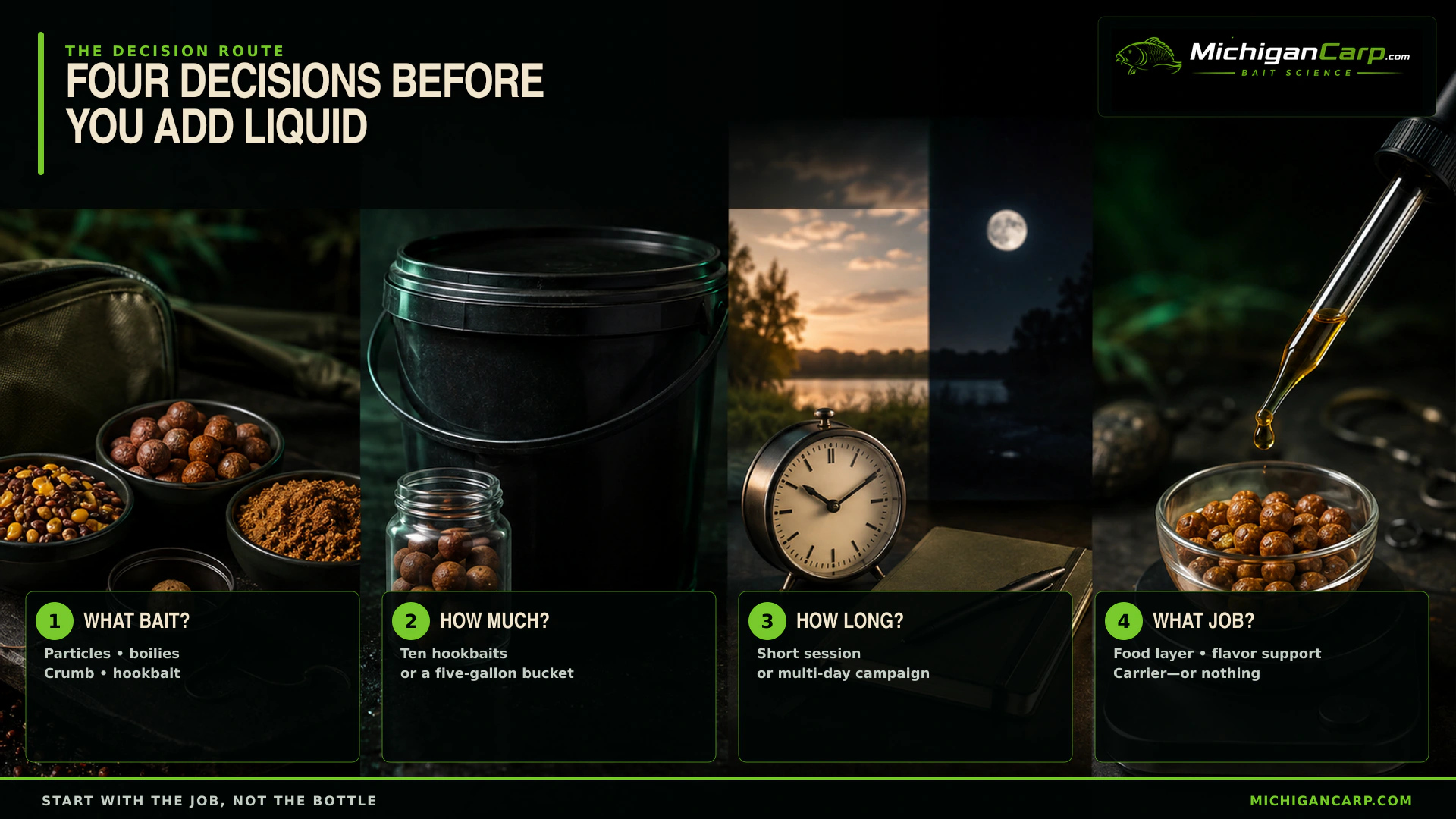
Four questions remove most of the confusion surrounding carp bait liquids. The first is what bait is being treated. A particle mix already contains many small food items and exposes a great deal of surface area. A whole air-dried boilie has a smaller exposed area and a more structured outer skin. Crumb accepts liquid quickly, while a hookbait must retain a precise balance and attachment throughout the complete fishing period.
The second question is how much bait is involved. An expensive protein hydrolysate may be perfectly reasonable on a few chops, a stick mix or a small batch of hookbaits. The same product poured heavily into a bucket of maize, pigeon feed, hemp, tiger nuts and peanuts may add considerable cost without giving the angler a clearer or more repeatable system. At bulk scale, a compatible economical liquid often makes more sense.
The third question is how long the bait must work. A short evening session may call for a small, accurately placed trap that begins wetting and releasing quickly. A three- to five-day session needs a treatment that can be repeated consistently without creating a saturated feed bed, damaging stored bait or making every top-up richer than the last. The longer the campaign, the more important economy, storage and repeatability become.
The fourth question is what problem the liquid is meant to solve. Perhaps the boilies are very dry and need controlled conditioning. Perhaps a crumb trap needs a small savoury layer. Perhaps the free bait would benefit from continuity with a fermented particle system. Perhaps a fruit-and-cream hookbait needs a restrained matching conditioner. If none of those jobs exists, adding more liquid may only make the bait harder to understand.
This approach also prevents the common mistake of treating smell as proof. A powerful aroma above water does not tell us how the complete product mixes with water, how it interacts with the bait matrix or how carp will respond. Controlled carp taste research shows that responses can be compound-specific rather than a simple reaction to a human idea such as strong, sweet or sour. The recent primary study Taste Responses of Carp Fishes to Carboxylic Acids is useful here because it reinforces the need to avoid universal flavor slogans.
What the Main Carp Bait Liquids Actually Do
Liquid names are useful only when they describe something real. Fermentation, yeast extraction and protein hydrolysis are different processes. Molasses, flavor, glycerol and oil are different materials. They may be blended in one commercial bottle, but the angler should still understand which part is food material, which part is carrier, which part affects viscosity and which part is present mainly to support aroma or handling.
| Liquid family | What it is best understood as | Where it often fits |
|---|---|---|
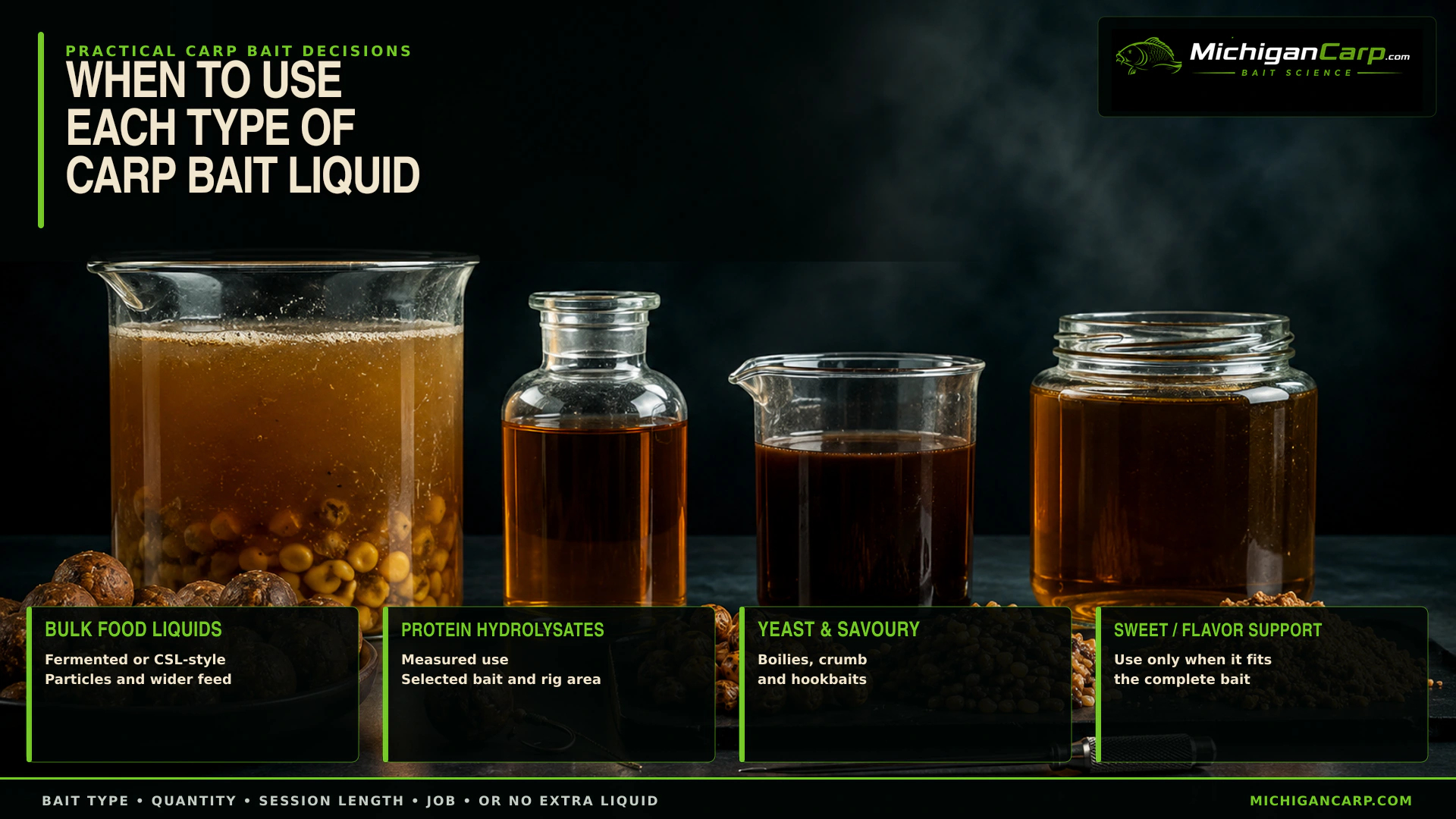
| Fermented food liquid | Food substrate transformed by controlled microbial activity | Particles, pellets, compatible crumb and broader feeding areas |
| CSL-style liquid | Economical corn- or grain-derived food liquid; products vary | Bulk feed, particles, pellet and method mixes |
| Yeast extract or yeast-derived liquid | Yeast-derived soluble and savoury material | Boilies, crumb, paste, hookbaits and non-marine bait systems |
| Protein hydrolysate | Protein broken into smaller peptide and amino-acid fractions | Selected boilies, crumb, pellets, paste and hookbait treatment |
| Sweet food liquid | Molasses, honey, syrup or another carbohydrate-rich food liquid | Particles, method/packbait and bait profiles where sweetness fits |
| Flavor or high-intensity sweetener | A concentrated sensory ingredient used at a much lower rate | Precisely designed boilie liquids and hookbait conditioners |
| Oil or oil-rich liquid | Hydrophobic energy source or carrier that does not dissolve in water | Selected bait formulas and light coatings where its physical behavior is understood |
Fermented food liquids and CSL-style products
A fermented food liquid begins with a substrate that has been changed through microbial activity. Depending on the material and process, fermentation may alter acids, aroma compounds, soluble fractions, pH and texture. That does not make every fermented bucket automatically safe, stable or attractive. It means the original food material has been transformed, and the result must still be judged by preparation, smell, visible spoilage, storage history and its effect on the final bait.
These liquids often make practical sense across particles and wider feed because they can be produced or purchased economically and they fit the food system already being used. A light compatible treatment on maize, pigeon feed or mixed particles is easier to repeat than a heavy specialist treatment. The liquid should support properly prepared bait, not be used to disguise particles that were unsafe before treatment. For the complete safety and preparation sequence, use Particles for Carp Fishing.
CSL-style products belong in the same practical conversation but should not all be assumed identical. Commercial bottles vary in solids, salt, acidity, sweetness, preservation and raw material. They can be useful for economical wider treatment, pellet dampening or method mixes, but the label and the finished bait matter more than the letters on the bottle. The practical homemade route is covered in Homemade CSL for Carp Fishing in Michigan.
Yeast extracts and savoury liquids
Yeast extract is not simply another name for fermented grain liquid. It is yeast-derived material with its own soluble, savoury and nutritional characteristics. I find it especially useful when a non-marine milk, nut or seed bait needs a deeper food background without being pushed into a strong fishmeal or meat profile. It can fit whole and chopped boilies, crumb, paste, pellets and hookbait conditioners.
The important word is restraint. A dense yeast product may change color, salt level, flavor and texture quickly. On a good plum, cream or nut boilie, I would rather build a measured supporting layer than make yeast the only thing the finished bait smells and tastes of. Homemade Yeast Extract for Carp Bait explains the ingredient in more depth.
Protein hydrolysates
A protein hydrolysate is produced by breaking protein into smaller fractions, including peptides and free amino acids. That definition does not make all hydrolysates interchangeable. The original protein source, enzyme or chemical process, degree of hydrolysis, solids, ash, fat and preservation all influence the finished material. Controlled research on bovine liver hydrolysates made with different proteases demonstrates how processing changes molecular-weight and amino-acid characteristics.
For fishing, that variability is a reason to use hydrolysates deliberately rather than treating the name as a guarantee. They often make sense in a small rig-area trap, boilie crumb, chops, paste, selected pellets or a hookbait conditioner, where a modest amount can be distributed through a small quantity of bait. My preference for beef liver hydrolysate belongs in this category: it is a chosen protein-derived layer, not proof that liver should dominate every bait. Read Liver Hydrolysate for Carp Bait for that specific system.
Sweet food liquids, flavors and sweeteners
Molasses, honey and syrup can add carbohydrate-rich food material, sweetness, color and viscosity. A flavor such as plum, peach, maple or vanilla is a different tool, normally used at a much lower level. A high-intensity sweetener is different again. Combining all three under the word sweet hides important differences in dose and physical effect.
Molasses may fit a particle or packbait system because it contributes food material and can alter binding. A matching plum-and-cream conditioner may fit a small batch of hookbaits because it supports a defined bait identity. Neither application proves that carp experience sweetness exactly as people do, and neither requires every sweet ingredient to be stacked together. The deeper evidence and limitations are explained in Sugars, Sweeteners and Carbohydrates in Carp Bait.
Oils, glycerol, propylene glycol and water
The carrier controls much of what happens before any food claim is considered. Water can enter many bait structures and carry water-soluble material. Food-grade glycerol and propylene glycol are water-miscible carriers, although their viscosity, concentration and effect on the bait still matter; their chemical records are available through PubChem: Glycerol and PubChem: Propylene Glycol. A water-miscible carrier does not automatically make every compound in the bottle equally soluble or make the product biologically superior.
Oil behaves differently because it does not dissolve in water. It may form droplets, a film or an oil-rich coating, and heavy use can change how readily water contacts the bait surface. That is not the same as saying oil is always useless in cold water. It means oils should be chosen for an understood job and used at a level that does not smother the release pattern the angler is trying to create. For the complete physical explanation, read Oils, Fats and Energy in Carp Bait and Carp Bait Solubility and Leakage.
Match the Liquid to the Bait Form
Particles and bulk feed
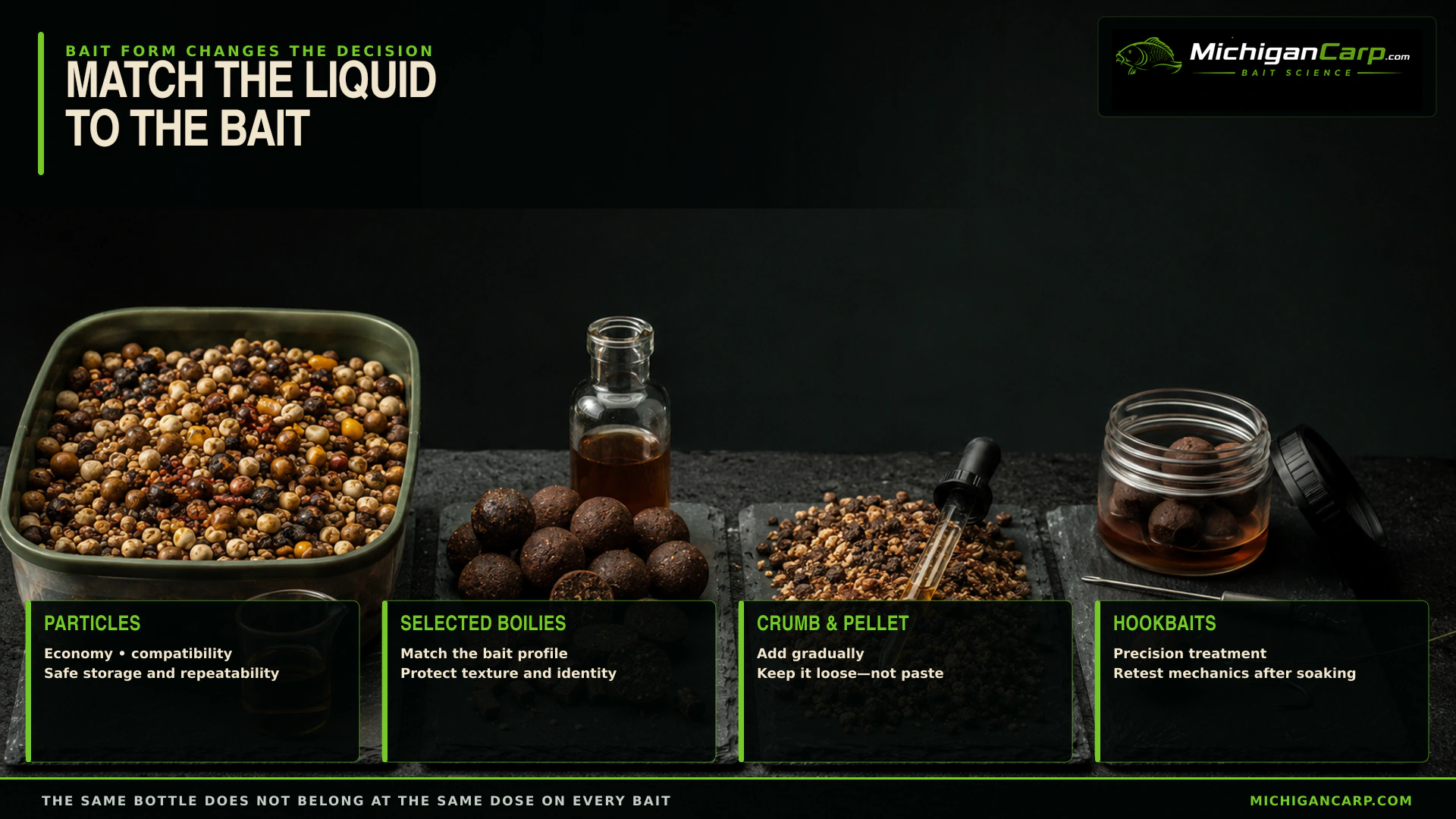
Particles already create a broad feeding system through their variety, size and distribution. The main liquid decision is therefore usually about compatibility, economy and storage rather than maximum concentration. A light fermented grain liquid, CSL-style product or restrained molasses treatment can make sense across a large mix because the application can be repeated without turning the bucket into an expensive experiment.
Add liquid after the particles are safely prepared and drained to the condition you actually want to feed. Measure it, mix thoroughly and allow time for distribution before deciding whether more is needed. A surface shine at the top of the bucket does not prove the liquid has been distributed evenly. For a three-day session, I would rather feed a consistent particle mix and add a more concentrated local treatment around selected rigs than keep increasing the liquid load in every top-up.
Pellets need similar restraint because absorption and softening vary. Treat a small batch, wait, then check whether the pellets remain suitable for loose feed, a method mix or a PVA presentation. The correct result for a feeder mix may be completely wrong for pellets that must remain intact during a long cast.
Boilies and hookbaits
Whole boilies should be treated according to their existing formula and condition. A milk-and-nut bait may accept a matching sweet-and-cream layer, restrained yeast extract or a low-level hydrolysate used beneath the flavor profile. A savoury bait may accept a compatible hydrolysate or yeast treatment. The important point is that the liquid should reinforce or deliberately contrast the boilie rather than accidentally masking it.
Very dry boilies can take up more treatment, but absorption is not the same as improvement. Excessive soaking may create a heavily flavored exterior while the bait remains mechanically brittle, or it may soften the surface faster than the center. Chops and crumb expose more internal structure and often need less liquid than anglers expect. The complete measured conditioning process is in How to Prepare Boilies for Carp Fishing.
Hookbaits deserve separate treatment because the quantity is small and the mechanical demands are high. A concentrated liquid may be economical in a ten-bait pot even when it would be wasteful across five gallons of feed. After conditioning, however, the bait must still drill or needle cleanly, remain secure on a hair or screw, keep the intended buoyancy and survive the actual immersion period.
Crumb, method mix, packbait and PVA
Crumb and chopped boilies are among the most useful places for a measured liquid because the physical bait form already exposes a large surface area. A small amount of hydrolysate, yeast extract or compatible fermented liquid can be distributed through a loose rig-area trap without treating every free offering in the swim. Add gradually and mix between additions. Once crumb becomes a wet paste, its breakdown and casting behavior have changed.
Method mix and packbait introduce a second job: mechanics. Molasses, syrup, creamed corn or fermented liquid may alter binding as well as food character. Build the physical mix first, then fit the liquid around the required compression, cast and breakdown. A liquid that smells impressive but makes the packbait detach in flight or remain glued to the feeder has failed.
PVA should never be judged from the product name alone. Water, syrup, glycerol, propylene glycol, salts and blended carriers behave differently, and the actual formulation may not be clear from the front label. Test the exact liquid with the exact PVA bag, mesh or tape before the session, using the same waiting time and bait mixture you intend to fish.
Adapt the Liquid to Session Length
Short sessions
A short session does not automatically require the strongest available liquid. It requires the right amount of active bait in the right place. Location remains the first decision, followed by a bait package that can begin working without feeding the swim heavily. Crumb, chops, a few pellets or a small particle patch can all provide exposed surfaces while a durable hookbait keeps fishing.
For a six-hour session I prefer one clearly defined liquid job. That might be yeast extract through boilie crumb, a measured hydrolysate on a small pellet-and-chop trap, or a light fermented liquid on a modest particle patch. The hookbait can match the free bait or provide a controlled contrast, but I do not need several liquids competing in the same small presentation.
This simplicity makes the result easier to read. If a bite arrives, I know what was around the rig. If the swim remains quiet, I can reconsider location, timing, depth, bait quantity or presentation without pretending that one more bottle would have solved everything.
Multi-day sessions
Longer sessions shift the emphasis toward economy, consistency and storage. A three- to five-day campaign may involve particles, pellets, boilies, chops, crumb and method mix. Treating all of them heavily with one concentrated liquid is rarely necessary. It can also make later top-ups progressively wetter as old liquid, particle moisture and new treatment accumulate.
A more repeatable system is to use a light compatible treatment through the wider food area, keep selected boilies coherent with their original profile, and reserve the more concentrated liquid for a small rig-area component. Hookbaits are conditioned separately only when they need a different job. This reduces cost, protects bait mechanics and makes it possible to compare rods or zones without changing every part of the feeding plan at once.
Storage also matters. A water-rich homemade treatment can shorten the usable life of dry bait, and warm buckets of wet feed can change quickly. Prepare sensible quantities, keep equipment clean, protect bait from heat and do not assume that a pleasant fermentation smell proves the complete mix will remain safe indefinitely.
Adjust for Water Temperature and Water Movement
Cold-water decisions
Cold-water liquid choice should begin with the complete baiting system, not a slogan about one category. Carp may feed less predictably, and a large amount of bait can be more difficult to recover from if the swim is wrong. I normally reduce food quantity, improve placement and use open bait forms such as crumb, chops or a small pellet patch before reaching for a more concentrated liquid.
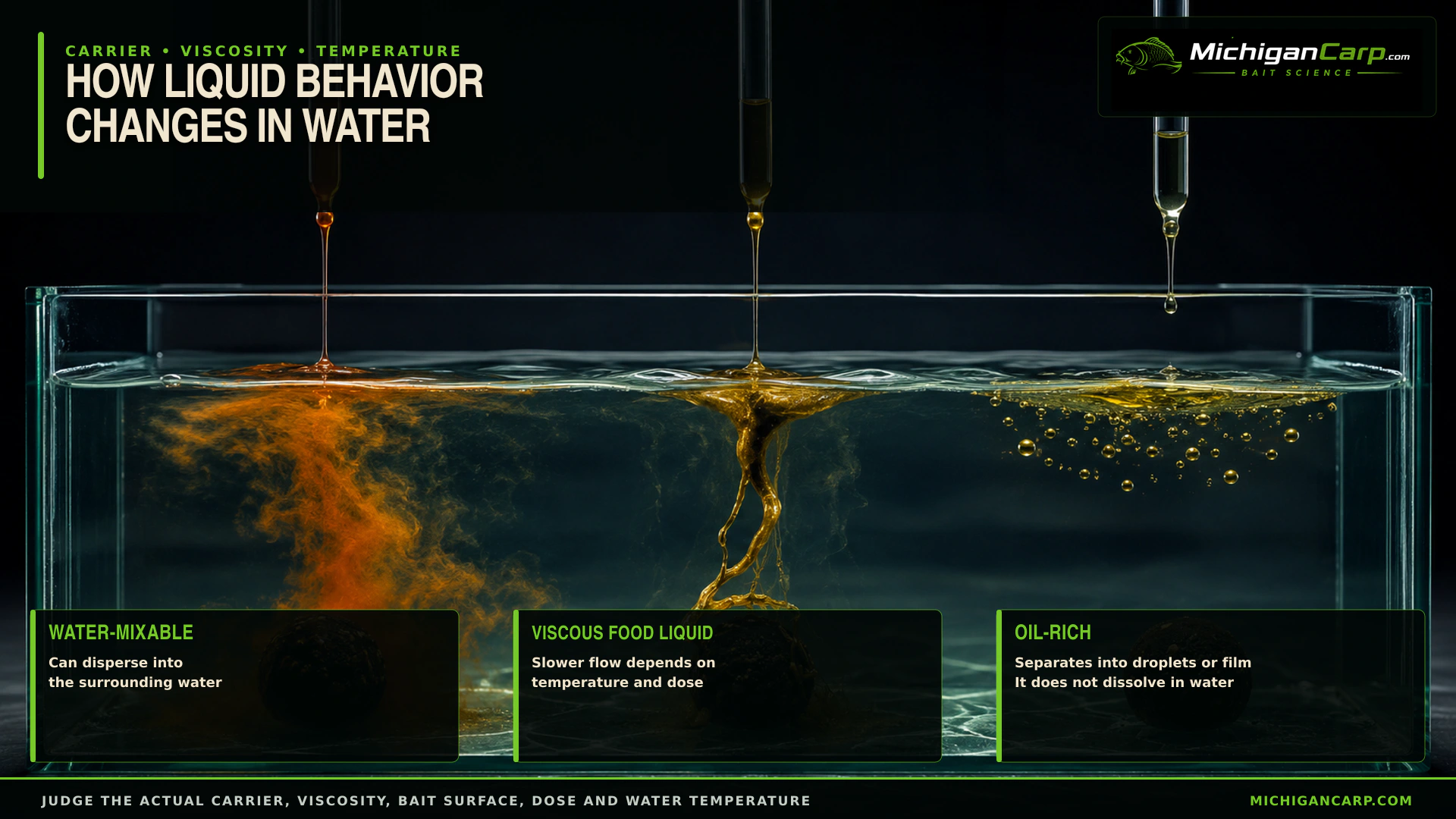
Water-mixable treatments can be useful because they can move into the surrounding water, but viscosity, bait surface and dose still influence the result. A thick syrup will not behave like a thin liquid merely because both contain water-soluble components. Oil-rich treatments remain separate from water and may move as droplets or films. Rather than declaring every oil bad or every thin liquid good, judge the actual carrier and the amount on the finished bait.
A practical cold-water trap might be a small amount of crumb and crushed pellet with measured yeast extract or hydrolysate, or a few prepared particles with a light CSL-style treatment. The hookbait should remain mechanically reliable. The biggest improvement often comes from placing a modest bait package where carp are willing to feed, not from doubling the liquid level.
Warm water, rivers and channels
Warm water can support more active feeding, but it also brings nuisance fish, catfish, turtles, faster spoilage and changing oxygen conditions. Those factors may justify tougher hookbaits or more frequent fresh baiting, not necessarily heavier liquid treatment. An economical fermented food liquid may fit a wider summer feed, while a measured hydrolysate or yeast product remains concentrated around selected rigs.
Moving water changes transport. Released material does not remain evenly around the rig; current carries it downstream and turbulence mixes it through a larger volume. I prefer repeated small release surfaces—crumb, chops, pellets and method mix—rather than trying to defeat current with an overpowering bottle. A durable hookbait and a compact active area can keep the presentation working while the water distributes released material naturally.
On big Michigan lakes, the same principle applies in a different way. Wind and undertow can move released material, but a liquid cannot attract carp from an empty part of the lake with any reliability. Find the travel route, feeding area, depth change, weed edge or bite window first. Use liquid to improve a bait package that is already in a plausible place.
Build a Three-Zone Michigan Liquid Strategy
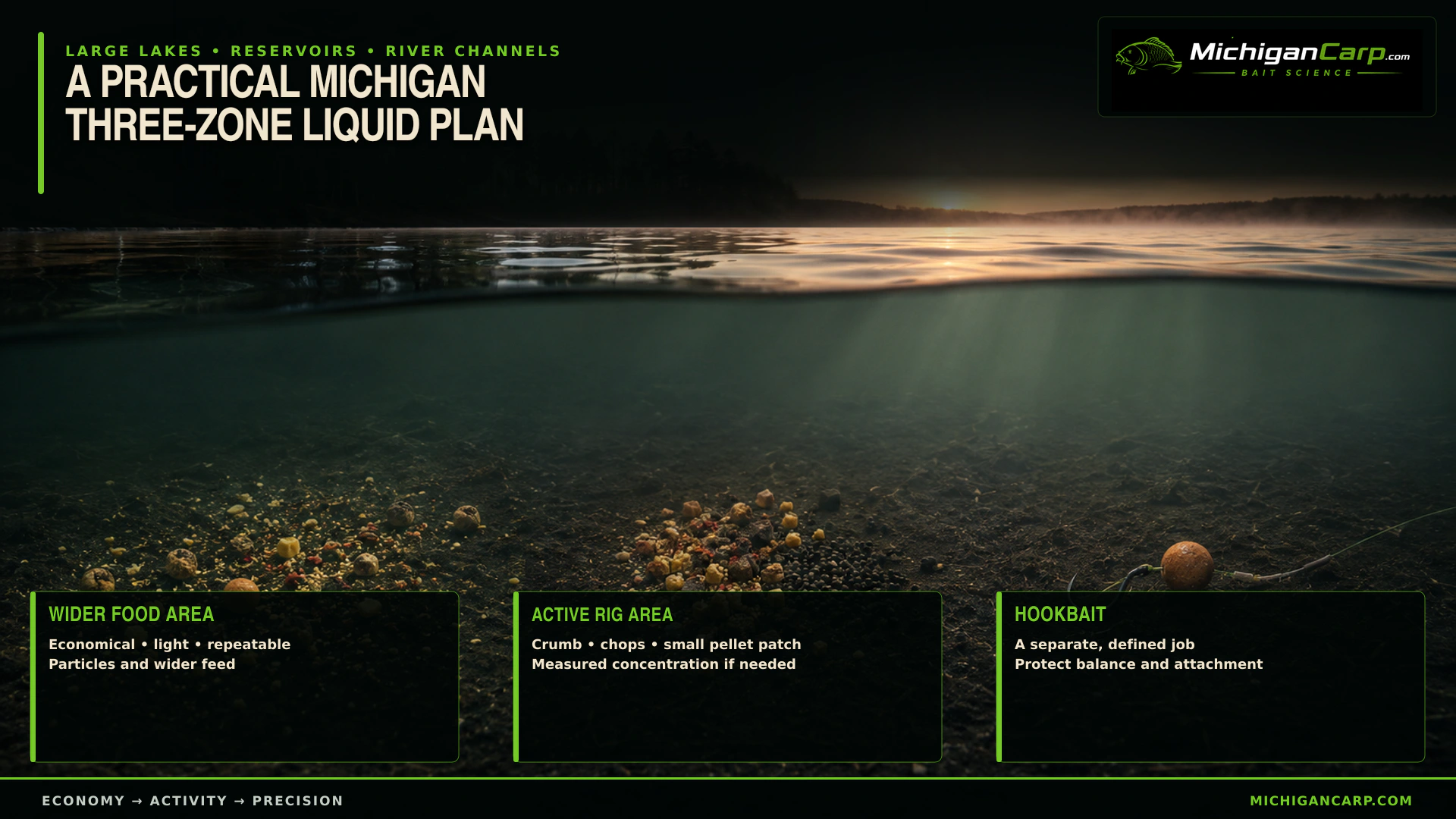
My practical Michigan system separates the baiting plan into three zones. The wider food area creates a repeatable place for carp to browse. This is where prepared particles, pellets and whole boilies may be used with a light economical treatment. Fermented or CSL-style liquids often make sense here because the quantity can be scaled without using a concentrated specialist product as though it were bucket water.
The active rig area is smaller and more precise. Crumb, chopped boilies, crushed pellet or a modest method mix gives water access to more exposed bait surface. This is where yeast extract, hydrolysate or another selected food liquid can be used more deliberately. Concentration is not being spread across the whole swim; it is being placed in a controlled area where the rig is fishing.
The hookbait has the narrowest job. It must remain attached, balanced and suitable for the expected soak time while either matching the surrounding food or providing a controlled point of difference. It may receive the same general liquid family, a matching flavor conditioner, a low-level savoury layer or nothing. The decision is made separately because hookbait mechanics are too important to leave to whatever liquid happened to be used in the bucket.
This three-zone arrangement is especially useful on the large natural lakes, reservoirs and river systems I fish because it separates economy from precision. The wider feed can remain simple and repeatable, the rig area can be made more active, and the hookbait can be protected. It also allows three rods to perform different but understandable tests instead of carrying three versions of the same over-treated bait.
Wider food area: economy. Rig area: measured activity. Hookbait: precision.
Protect Bait Mechanics and Presentation
Liquid loading can change the bait
Every treatment changes the balance between the bait and the surrounding water. A dry porous boilie may take up liquid readily. A dense, well-sealed bait may hold more treatment at the surface. Crumb can become paste, pellets can soften, and dry method mix can cross from workable to unusable with one unnecessary addition. Measure first, mix thoroughly and allow absorption time before deciding that the bait needs more.
Texture is not a cosmetic issue. A hookbait that becomes soft around the bait screw or splits when needled is no longer performing its basic job. A wafter that takes up liquid and becomes too heavy may present like an ordinary bottom bait. A pop-up may lose useful buoyancy long before the intended fishing period ends. The connected article How Bait Texture Affects Carp Feeding Confidence explains why firmness, toughness, brittleness and attachment strength must be judged separately.
Test the complete presentation
Do not test only the naked bait in a jar. Test the bait on the hair, bait screw or swivel you intend to use. Include the hooklink, putty, pop-up weight or balanced-bait arrangement and soak it for a realistic period. Examine the bait at the same intervals you care about on the bank: after the cast, after one hour, after six hours and after the full overnight period if that is how you fish.
Check swelling, softening, color loss, surface damage, buoyancy, balance and attachment. If crayfish, gobies, turtles or catfish are likely, remember that water testing alone cannot reproduce every nuisance-species problem, but it can reveal avoidable mechanical weakness before the bait is cast. A treatment that improves smell but shortens reliable fishing time below the required period is not an improvement.
The same standard applies to storage. Once water-rich liquid is added, do not assume a previously dry bait has the same shelf life. Prepare smaller batches, label the date and treatment, and watch for physical or aroma changes. Attraction claims should never be allowed to replace basic bait hygiene.
Test Liquids Without Losing the Plot
A liquid test becomes meaningless when several things change together. If one rod has a different liquid, different hookbait, different rig, different distance and a larger pile of feed, a bite does not tell you which difference mattered. Keep the test narrow enough that the result can guide the next decision.
With three rods, a useful starting comparison is an untreated control, a measured treatment that fits the bait, and one deliberate alternative. For example, Rod A might fish the normal plum milk-and-nut hookbait over the standard feed. Rod B might use the same bait with a light matching conditioner. Rod C might use the same bait with a restrained yeast or liver-hydrolysate background. Rig, bait size, placement and free-bait quantity should remain as similar as the swim allows.
Record the liquid, measured amount, treatment time, water temperature, soak time, rod position and result. Rotate positions when that can be done without destroying the fishing, because one part of the swim may be naturally better. A few captures are useful field evidence, not laboratory proof. Repeated results across sessions are more valuable than one dramatic bite.
This is also why I avoid making every rod smell the same. If particles, crumb, hookbaits and PVA sticks all receive the same complicated blend, the angler has no control and no comparison. One wider food idea, one active local idea and one clear hookbait strategy produce much better information.
For the broader distinction between release, transport, detection, investigation and acceptance, read Carp Feeding Attractants Explained. It is an important reminder that making material available in the water is not the same as proving a feeding response.
When No Extra Liquid Is the Better Choice
A good bait does not become incomplete merely because it is not glugged. Properly prepared particles already provide varied food items and natural cooking liquor. A well-formulated boilie already contains a liquid phase, soluble ingredients, flavor and food material. Fresh crumb already exposes the internal bait structure. In those situations, extra liquid should earn its place.
I would leave bait untreated when it is producing consistently, when the liquid would make storage or mechanics less reliable, when the treatment does not fit the bait profile, or when I cannot define the question being tested. I would also avoid adding a strong new layer immediately before an important session unless the same treatment had been checked at home.
Using no extra liquid is not a lack of imagination. It is a control, a way of protecting a proven bait and sometimes the most disciplined choice available. The angler can always treat a small separate portion later; removing liquid from an over-treated bucket is impossible.
Frequently Asked Questions and Final View
What is the best all-round carp bait liquid?
There is no universal best liquid because the job changes. For bulk particles and wider feed, an economical compatible fermented or CSL-style liquid is often practical. For selected crumb, chops or hookbaits, yeast extract or a suitable hydrolysate may make more sense. For a sweet particle or packbait profile, molasses may be useful. The correct answer begins with the bait and application, not a category winner.
Can I mix fermented liquid, hydrolysate and sweet liquid?
They can be blended, but compatibility is not proof that the combination is better. Each component should have a defined role, and the final bait must still retain the correct moisture, texture, storage stability and flavor identity. I would test a small measured batch against a simpler control before treating the main session bait.
Should hookbaits use the same liquid as the free bait?
They can when continuity is the purpose, but they do not have to. A hookbait may use a matching treatment, a controlled contrasting layer or no added liquid. Its separate mechanical job means it should always be checked for buoyancy, hardness and attachment after treatment, regardless of what was used on the wider feed.
Are stronger-smelling liquids better in cold water?
No general rule supports that conclusion. Human smell intensity does not describe water miscibility, viscosity, bait release or carp response. In cold or uncertain conditions, I would first reduce bait quantity, improve placement and use open bait forms. Then I would choose a measured liquid according to its actual carrier and purpose.
The practical conclusion is straightforward. Choose carp bait liquids in the order that the fishing presents the problem: bait type, quantity, session length and job. Use economical treatment where the feed is broad, concentration where the bait quantity is small, and precision where mechanics matter. Sometimes that leads to fermentation, yeast, hydrolysate, sweetness or oil. Sometimes it leads to no extra liquid at all.
Next Steps
To understand how fermented liquids, yeast products and hydrolysates fit into one wider bait system, continue with Fermented and Food-Signal Baits for Carp. For a closer examination of protein-derived liquids, read How to Use Hydrolysates in Carp Bait.
For bulk-feed preparation and safe bankside use, continue with Particles for Carp Fishing: Safe Prep, Mixes and Feeding Rules. If you are formulating liquids inside a boilie rather than treating finished bait, use Boilie Liquids and Additives: Build the Liquid Phase.
The best liquid system is not the one with the most ingredients. It is the one you can explain, repeat and test without damaging the bait.