

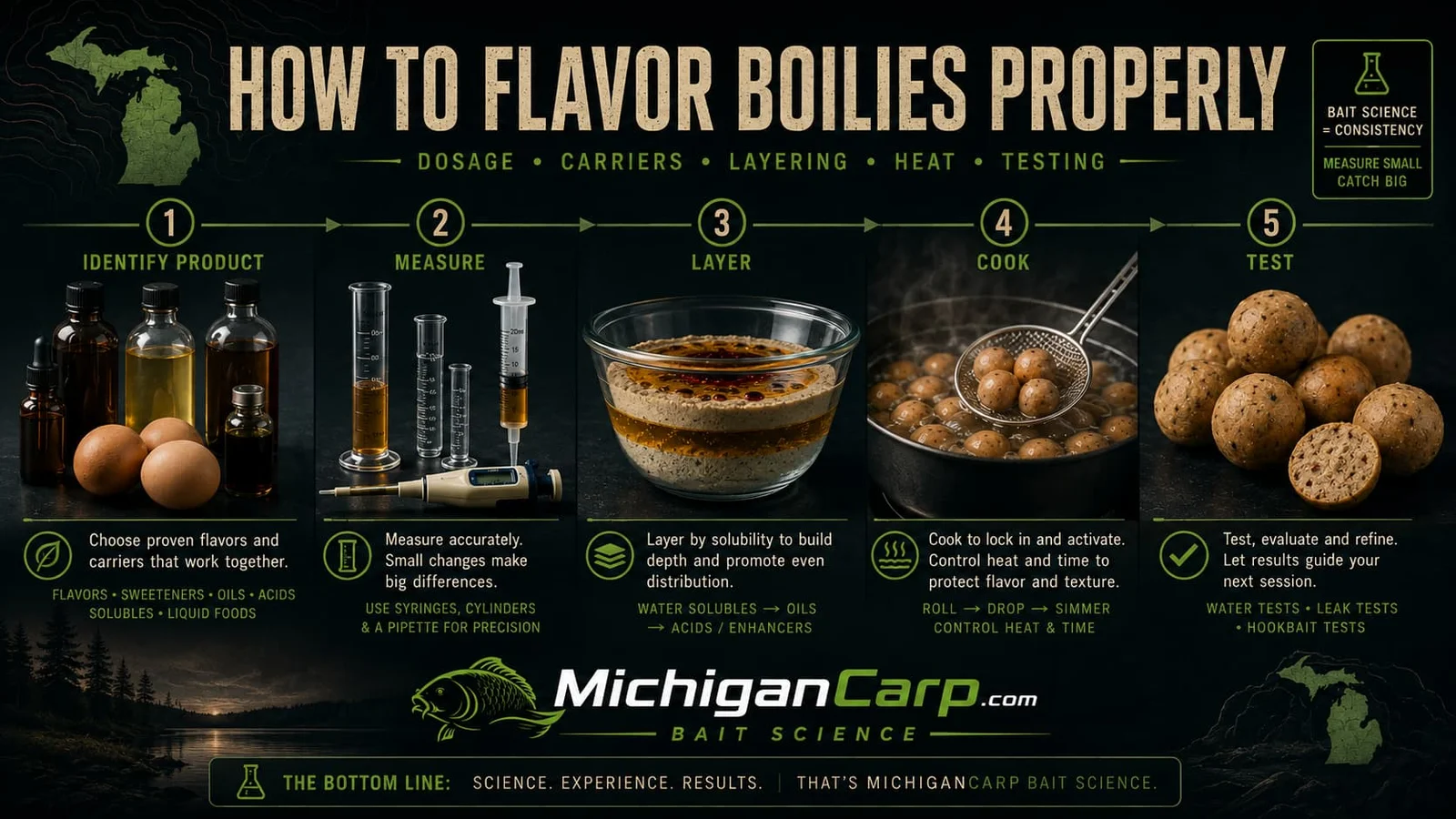
Learning how to flavor boilies properly is not about pouring the largest possible collection of sweet-smelling liquids into the eggs.
It is about choosing a clear bait identity, identifying the exact products being used, understanding their strength and carriers, measuring them accurately and testing what remains after cooking, drying, storage and immersion.
Flavor can help make a bait recognizable and repeatable. It can connect plum to cream, maple to vanilla, spice to birdfood or a restrained savory note to a milk-and-nut base.
It cannot rescue stale ingredients, excessive fat, poor paste structure, unsuitable cooking, unstable storage, weak location or bad presentation.
The strongest-smelling bait in the kitchen is not automatically the bait producing the clearest or most useful signal in water.
An open bottle releases concentrated volatile material directly into the air near your nose. A cooked boilie contains a much smaller quantity held within a matrix of egg protein, starch, milk protein, particles, moisture and fat.
Water must enter that matrix before many compounds can move out. Carrier, solubility, volatility, bait diameter, drying and storage all influence the result.
Identify the product, give it one clear job and test the finished bait—not merely the open bottle.
My Plum, Scopex and Vanilla bait demonstrates the approach. Plum provides the main fruit identity. Scopex connects that fruit to the milk, nut and cereal ingredients. Vanilla rounds the profile. A known pre-diluted butyric product can provide a restrained fermented-dairy accent.
The combination is layered, but it is not crowded.
For the complete liquid-phase framework, begin with Boilie Liquids and Additives. For choosing between flavors, hydrolysates, fermented products and other bait liquids, use When to Use Each Type of Carp Bait Liquid.
Table of Contents
Quick Start: How to Flavor Boilies — 7 Rules to Follow
- Record the manufacturer and exact product—not only the flavor name.
- Use supplier guidance or a proven rate for that exact product.
- Build one main identity before adding supporting notes.
- Do not combine several full standalone dosage rates automatically.
- Measure with suitable graduated equipment rather than caps or random drops.
- Assess the bait after cooking, drying and immersion—not only in raw paste.
- Keep a proven control while testing one measured change at a time.
| Decision | Practical rule |
|---|---|
| Selecting a flavor | Fit it to the base mix and intended bait identity rather than choosing only by bottle smell |
| Selecting a dose | Use product-specific guidance or an accurately recorded rate previously tested with the same product |
| Combining products | Use one lead flavor, one bridge and only a restrained rounding note or accent |
| Changing brands | Treat the replacement as a new product even when the name is identical |
| Measuring | Use graduated syringes, pipettes or a recorded weight |
| Adding to paste | Distribute flavor through the complete wet phase before introducing the dry blend |
| Processing | Do not assume complete destruction or complete retention during cooking |
| Hookbaits | Start with the scaled matching system rather than automatically doubling every flavor |
| Testing | Compare low, control and higher levels while keeping everything else stable |
The basic MichiganCarp liquid hierarchy remains:
Egg foundation first. Main food signal second. Supporting liquids only when justified. Flavor used to clarify the finished identity.
This is a design hierarchy rather than a rigid pouring order. Flavor may be physically mixed into the wet phase before some minor ingredients, but it should not be expected to define or repair the complete food system.
Flavor Products and Why Their Strength Varies
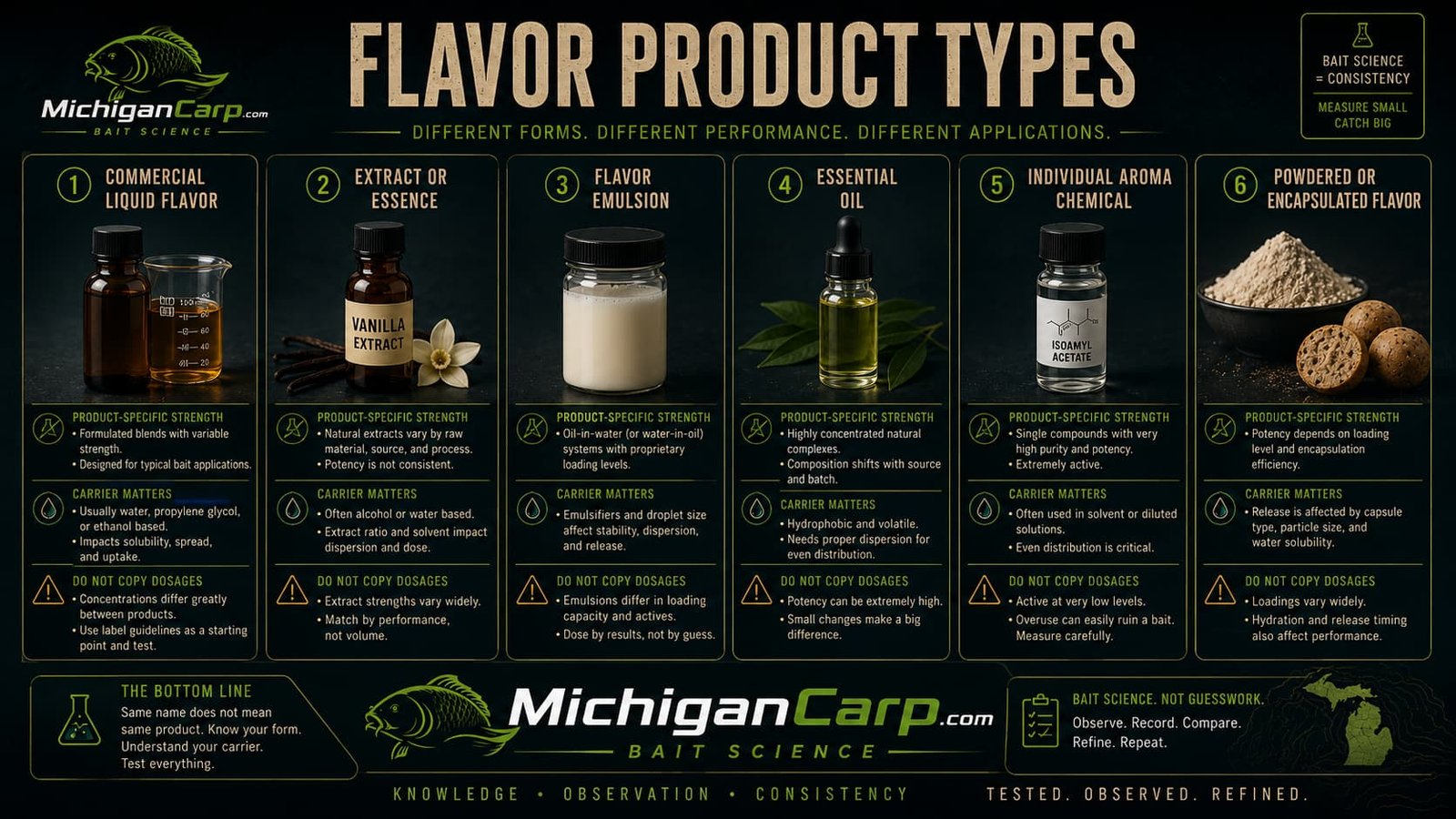
The word flavor covers products with very different compositions.
US food-labeling regulations define natural flavor broadly enough to include essential oils, oleoresins, essences, extracts, hydrolysates, distillates and flavoring materials produced through roasting, heating, fermentation or enzymatic processing.
That definition helps explain why two bottles carrying the same fruit name can behave very differently.
See 21 CFR §101.22: Food Flavoring Definitions.
Commercial food and bait flavors
Commercial flavors are normally formulated blends designed to create a recognizable profile such as Plum, Peach, Maple, Vanilla, Scopex, Cream, Shellfish or Spice.
The name does not reveal:
- the active concentration;
- the number of aroma components;
- the carrier;
- heat stability;
- whether sweeteners, acids or colors are included;
- whether another manufacturer’s version is equivalent.
A recipe record should therefore state the manufacturer, exact product name, dosage and purchase or lot information where practical.
Extracts and essences
An extract contains flavoring material obtained from a source ingredient through an extraction process.
Vanilla, almond, coffee, spice and fruit extracts can vary greatly in concentration and solvent. Some grocery-store extracts contain substantial alcohol or water, which remains part of the complete wet phase.
Do not assume an extract is automatically weaker, stronger or more suitable than a formulated flavor.
Flavor emulsions
An emulsion helps distribute flavor oils through a water-containing system.
That may make the product convenient in an egg-based paste, but emulsification does not make the oil genuinely water-soluble. An emulsion may also contain water, gums, stabilizers or colors that affect paste consistency.
For the difference between dispersion, dissolution and underwater movement, read Carp Bait Solubility and Leakage.
Essential oils
Essential oils are concentrated volatile materials derived from aromatic plants.
Traditional bait examples include black pepper, anise, fennel, citrus, clove and cinnamon. These materials should be treated as specialist concentrated ingredients—not ordinary milliliter-dose liquid flavors.
Recognition of particular essential oils for an intended food use does not mean that every oil, grade or dosage is appropriate. See 21 CFR §182.20: Essential Oils and Natural Extractives.
Do not rely on uncalibrated drops as a universal measurement. Drop size changes with the opening, viscosity, temperature and technique.
Individual aroma chemicals and concentrates
Individual compounds or narrowly formulated concentrates may include butyric acid, ethyl butyrate, vanillin, ethyl vanillin, ethyl maltol, esters, lactones and aldehydes.
They are not direct substitutes for complete Plum, Vanilla, Cream or Scopex flavors. One aroma chemical may provide only one section of a rounded profile.
US regulations for listed synthetic flavoring substances emphasize use at the minimum quantity needed for the intended effect. See 21 CFR §172.515: Synthetic Flavoring Substances and Adjuvants.
Neat acids and unfamiliar concentrates should never be substituted automatically for a pre-diluted bait product. Do not atomize concentrated acids or unidentified aroma chemicals.
The detailed acid, salt and ester distinctions belong in Butyric Acid in Carp Bait: Acids, Butyrates and Esters Explained.
Powdered and encapsulated flavors
Powdered flavors may use maltodextrin, starches, gums, milk solids or another dry carrier.
They belong in the dry calculation and may hydrate or process differently from a liquid product carrying the same flavor name.
Do not replace a liquid flavor gram for gram with powder unless the supplier provides suitable conversion guidance.
Why identical names do not mean identical strength
Two Plum or Scopex products may differ because of concentration, carrier, aroma composition, intended application, emulsification, sweeteners, acids or storage stability.
Even a familiar product may change through reformulation while retaining the same marketing name.
When the manufacturer, product or formulation changes, begin with a small new test rather than copying the previous dosage blindly.
Understanding Flavor Carriers
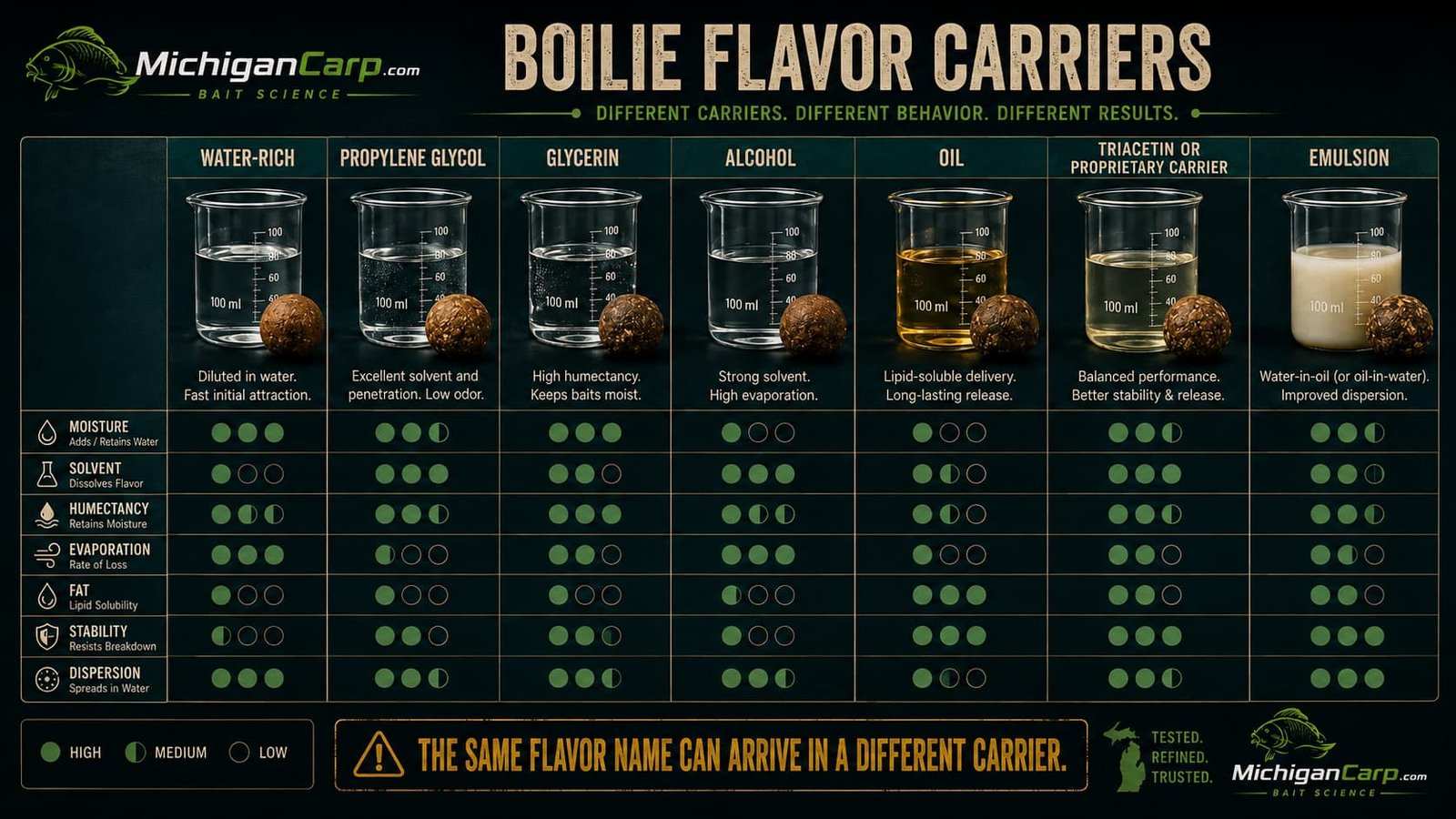
The carrier holds, dissolves or disperses the flavoring material.
It may influence mixing, paste softness, viscosity, volatility, drying, total fat, storage and hookbait buoyancy.
| Carrier or system | Practical characteristics | Main caution |
|---|---|---|
| Water or water-rich carrier | Mixes readily into eggs and contributes direct moisture | Can soften paste and increase drying or preservation demands |
| Propylene glycol | Common solvent and vehicle with humectant and formulation functions | Count it in the wet phase and use only clearly identified food-grade material |
| Glycerin | Viscous, sweet and moisture-retaining | Adds mass and can soften bottom baits or upset wafter balance |
| Alcohol-rich carrier | Carries many volatile aroma compounds and evaporates readily | The profile may change during mixing, heating and drying |
| Oil carrier | Suitable for oil-compatible aroma material | Contributes to total fat and is not equivalent to water-soluble signal |
| Triacetin or proprietary carrier | May be selected for solubility, stability or reduced volatility | Do not assume it behaves like water, glycol or glycerin |
| Emulsion system | Disperses oil-compatible flavor through a water-containing system | May include gums, water and stabilizers that change paste handling |
Propylene glycol
Food-grade propylene glycol is used in food formulation as a solvent, vehicle, humectant and flavor-related ingredient. See 21 CFR §184.1666: Propylene Glycol.
That makes it a logical carrier for many commercial flavors, but it does not make every propylene-glycol flavor equally concentrated.
Never confuse food-grade propylene glycol with ethylene glycol or automotive products.
Propylene Glycol vs Glycerin in Carp Bait owns the detailed carrier, paste and preservation comparison.
Glycerin
Glycerin is recognized for food use under good manufacturing practice. See 21 CFR §182.1320: Glycerin.
In bait, glycerin can add sweetness, viscosity, moisture retention and mass.
Those effects can help condition a hardened bottom bait but may be undesirable in a carefully balanced wafter or marginal pop-up.
Alcohol-rich products
Alcohol can carry volatile aroma materials effectively and may produce a powerful bottle smell because it evaporates readily.
That airborne strength does not prove that the same profile will remain after boiling and several days of drying.
Keep alcohol-rich products tightly closed and away from ignition sources.
Oil-based products
Oil-based flavors and essential oils belong in the complete lipid calculation.
Their inclusion may be small, but several oil-compatible products can accumulate alongside eggs, full-fat soy, nuts, seeds, milk replacer and added oil.
For the complete fat system, read Oils, Fats and Energy in Carp Bait and How to Balance Fat in Boilies: Milk, Nut and Seed Mixes.
Mixed carriers
A three-flavor system may contain propylene glycol in one bottle, alcohol in another and glycerin or an emulsion in the third.
The individual flavor volumes may appear small while the combined carrier package still changes the wet phase.
Record every product rather than treating flavor liquid as invisible.
Building a Clear Layered Flavor System
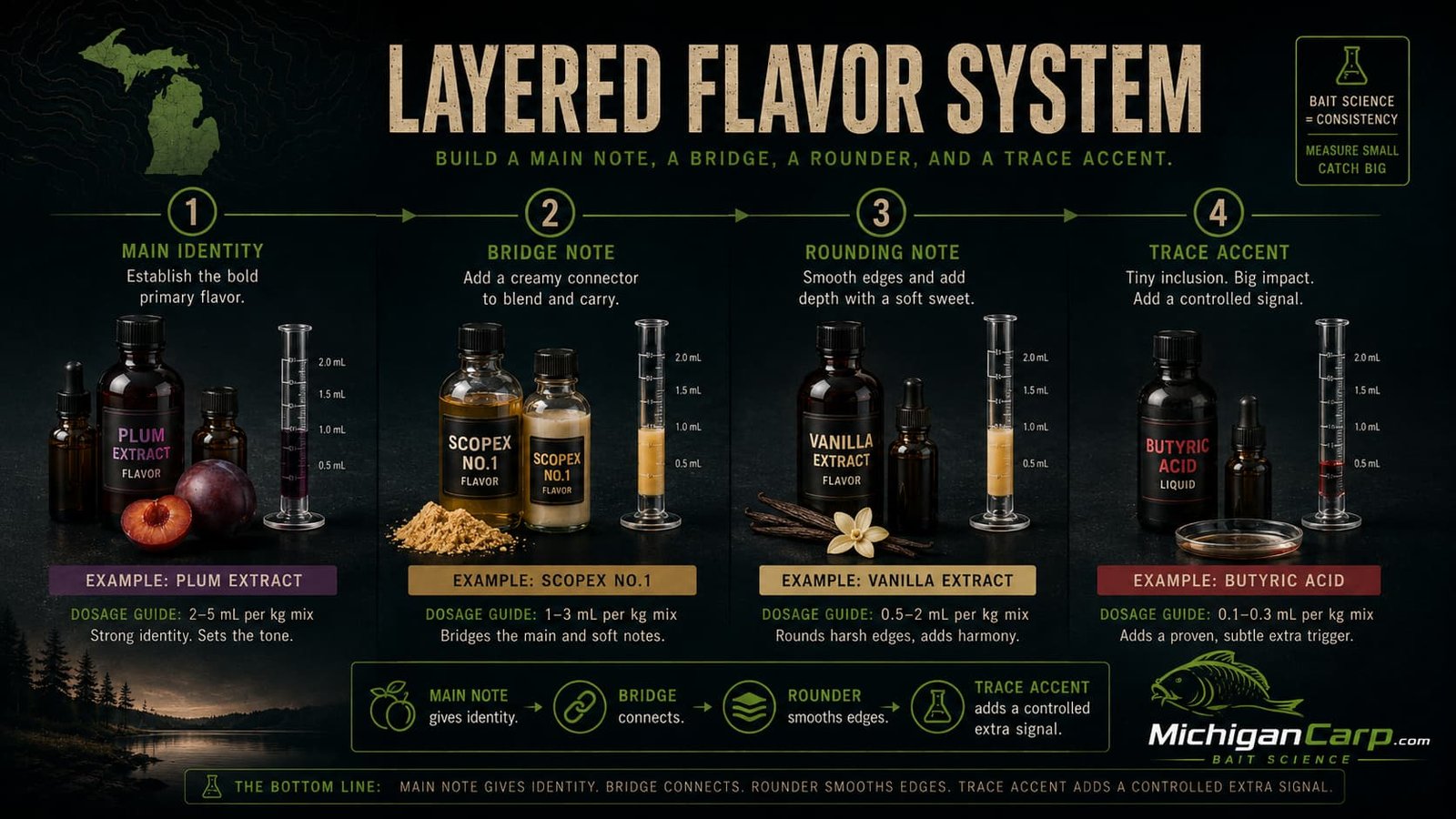
A good flavor direction should be describable in one short sentence.
Examples include:
- plum and cream over a milk-and-nut base;
- maple and vanilla over tiger nut and birdfood;
- peach and cream over a light dairy bait;
- warm spice over a nut-and-seed mix;
- yeast and liver beneath a savory birdfood bait;
- natural fishmeal with very little added flavor.
When the description becomes Plum, Strawberry, Banana, Scopex, Maple, Garlic, Squid and Black Pepper, the system may be too crowded to understand or reproduce.
Start with the base mix
| Base direction | Possible compatible flavor directions |
|---|---|
| Milk and whey | Vanilla, cream, Scopex, soft fruits, maple and caramel-style profiles |
| Nut and seed | Maple, cream, vanilla, spice, plum, peach and bakery-style profiles |
| Birdfood | Fruit-and-cream, spice, citrus, seed, bakery and restrained savory profiles |
| Fishmeal | Minimal flavor, spice, shellfish, liver or a deliberately tested fruit contrast |
| Liver and yeast | Savory, spice, cream, maple, dark fruit or restrained fermented notes |
These are formulation directions rather than fixed laws.
A fruit flavor can work with fishmeal and a savory ingredient can support a cream bait. The important question is whether the combination has a defined purpose.
Main identity
The main identity is the flavor intended to remain recognizable first.
In the MichiganCarp milk-and-nut system, Plum performs that role.
Bridge
The bridge connects the main flavor to the base ingredients.
Scopex can connect Plum to dairy, cereal and cream. Vanilla can connect Maple to cream powder. Spice can connect liver to birdfood.
Rounding note
A rounding note smooths the profile without becoming a competing headline flavor.
Vanilla often performs this job in milk, cream, fruit and bakery-style baits.
Accent
An accent adds controlled contrast at a much lower level.
Examples include a known pre-diluted butyric product, a measured essential-oil trace, fenugreek, citrus or a restrained smoke note.
The accent should add depth without erasing the main identity.
Not every bait needs three or four components
A well-made vanilla milk bait may require one commercial flavor. A fishmeal bait may require none. A nut bait may obtain enough identity from the actual ingredients and fenugreek.
Layering is a formulation tool—not a requirement for technical credibility.
Develop the layers in order
- Test the main flavor by itself.
- Add the bridge at a lower supporting level.
- Add the rounding note only when it improves coherence.
- Add powerful accents last and at accurately measured levels.
- Adjust one component at a time after cooking and drying.
Do not combine three full standalone supplier rates automatically. A recommendation for 5 ml per kilogram may assume that the product is being used as the complete flavor identity by itself.
Measuring and Scaling Flavor Accurately
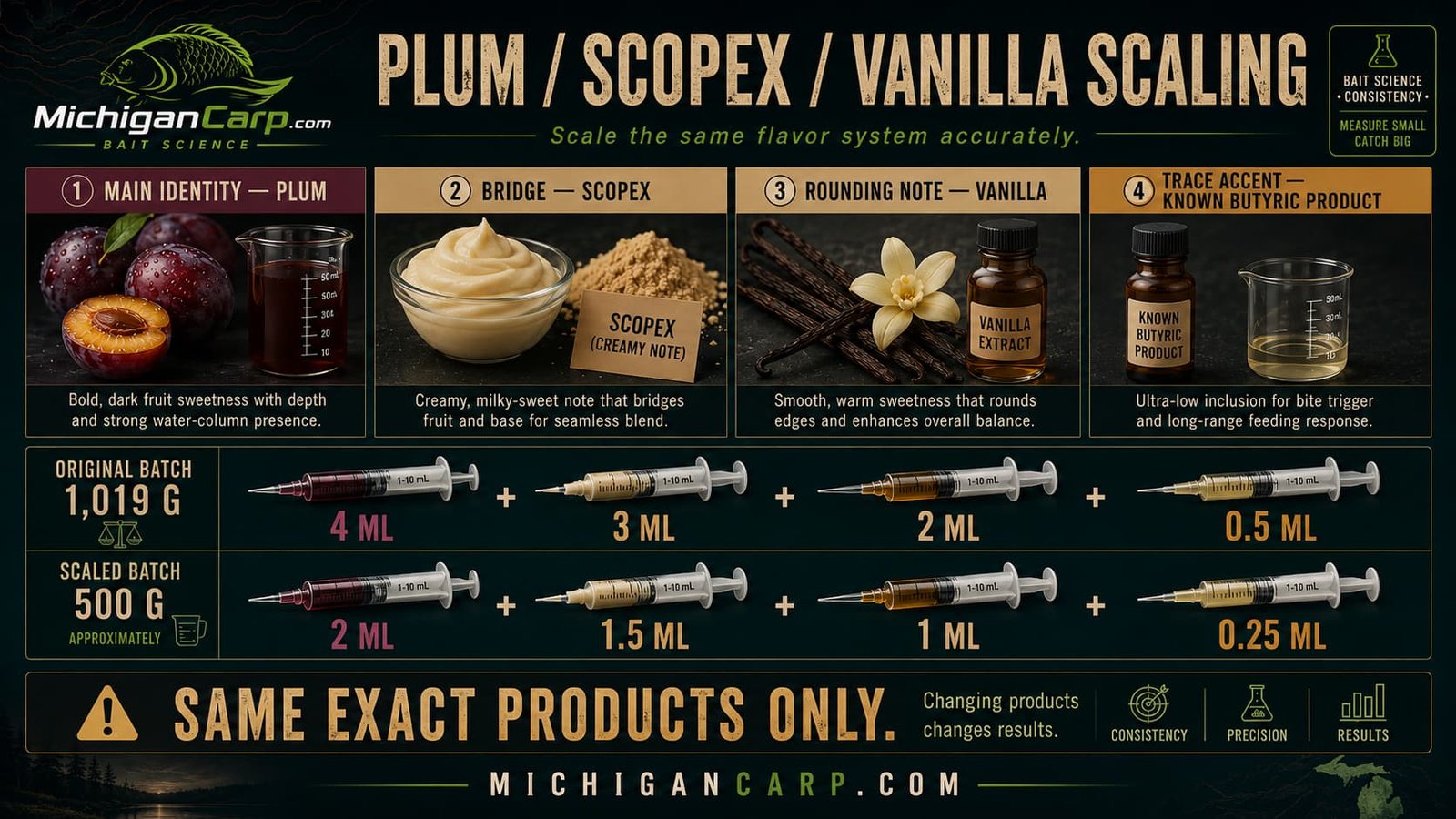
Once an exact product and flavor ratio have been tested, the system can be scaled mathematically.
New amount = original amount × new dry-mix weight ÷ original dry-mix weight
Historical Plum, Scopex and Vanilla system
The recorded field-development formula contained 1,019 g of dry mix with:
| Flavor component | Recorded amount | Role |
|---|---|---|
| Plum flavor | 4 ml | Main identity |
| Scopex flavor | 3 ml | Creamy bridge |
| Vanilla flavor | 2 ml | Rounding note |
| Same known pre-diluted butyric product | Up to 0.5 ml | Trace accent |
| Total flavor system | 9.5 ml |
The complete recorded system equals approximately 9.32 ml per kilogram of dry mix, but that number applies only to those exact products.
| Dry-mix weight | Plum | Scopex | Vanilla | Same butyric product |
|---|---|---|---|---|
| 250 g | 0.98 ml | 0.74 ml | 0.49 ml | 0.12 ml |
| 500 g | 1.96 ml | 1.47 ml | 0.98 ml | 0.25 ml |
| 1,000 g | 3.93 ml | 2.94 ml | 1.96 ml | 0.49 ml |
| 1,500 g | 5.89 ml | 4.42 ml | 2.94 ml | 0.74 ml |
For a practical 500 g trial using suitable equipment, that can be rounded to:
- 2 ml Plum;
- 1.5 ml Scopex;
- 1 ml Vanilla;
- 0.25 ml of the same known pre-diluted butyric product.
The normalized exact 1,000 g PSV production formula can use the practical 4:3:2 system, but it should be recorded as a normalized production version rather than described as mathematically identical to the historical 1,019 g batch.
Use suitable measuring equipment
Useful equipment includes graduated syringes, fine pipettes, adjustable micropipettes for suitable concentrated products and an accurate scale when the product is being measured by weight.
Kitchen teaspoons, bottle caps, visual estimates and unverified droppers are poor tools for concentrated flavor development.
A syringe marked only in whole milliliters cannot measure 0.12 or 0.25 ml reliably.
Volume and weight are not interchangeable
One milliliter does not always weigh one gram.
Water is close under ordinary conditions, but propylene glycol, glycerin, alcohol, syrups and oils have different densities.
When scaling a recipe recorded by weight, use the original product weight. When scaling by volume, retain the volume method and identify it clearly.
Changing products invalidates the scaling table
The table remains valid only while the same Plum, Scopex, Vanilla and butyric products are being used.
A replacement bottle with the same flavor name requires new small-batch testing.
Mixing, Cooking, Drying and Underwater Release
Flavor should normally be distributed through the complete liquid phase before the dry ingredients are added.
Recommended mixing sequence
- Crack and weigh the eggs.
- Blend the yolks and whites completely.
- Add the main food liquid or extract when one is being used.
- Add measured carriers, humectants and sweet liquids.
- Add the accurately measured flavor system.
- Mix until reasonably uniform.
- Add the dry blend gradually.
- Rest the paste and record how much dry mix it accepts.
Very small accents can be pre-blended into a compatible measured portion of the wider liquid phase to improve distribution.
Do not create a home dilution of concentrated hazardous material unless the product, carrier, final concentration and handling procedure are understood.
Do not add concentrated flavor to one part of finished paste
Dripping concentrated flavor onto completed dough can create local soft spots, uneven acidity, concentrated pockets and poor repeatability.
When flavor has been omitted from a batch, documenting the mistake is normally better than kneading a powerful concentrate randomly through thick paste.
Cooking changes the profile
Flavor components do not all respond to heating in the same way.
Some volatile material may leave with steam. Some less-volatile components may remain more readily. Other material may remain associated with fat, protein or the carrier system.
The relative balance between fruit, cream, spice and background notes can therefore change even when the finished bait remains clearly flavored.
Do not assume boiling removes everything, and do not assume everything remains.
For the wider processing explanation, use What Boiling and Heat Do to Carp Bait Ingredients.
Do not double flavor to compensate for imagined losses
Automatically doubling the flavor because half is assumed to disappear during cooking is not controlled formulation.
Loss is not automatically 50%, and each component can behave differently.
- Make the established batch.
- Cook it consistently.
- Assess the cooked and dried bait.
- Change one measured component in the next test.
Use How to Boil and Dry Boilies Properly to standardize the process before comparing flavor levels.
Boiling and steaming
Boiling and steaming expose the bait to different combinations of heat, surface water and movement.
One method may preserve a particular flavor profile better in one formula, but that cannot be assumed universally. Compare equal bait sizes, matched heat exposure and identical drying conditions.
Drying continues to change the bait
Freshly cooked bait may smell different from the same batch after one, three or seven days of drying.
Volatile material may continue leaving, the surface becomes firmer and the relative concentration of the material remaining inside changes as water is lost.
Judge the bait at the drying stage at which it will actually be stored or fished.
Underwater release is not bottle smell
A recognizable smell above a water-test container confirms that volatile material is present near the surface.
It does not measure all dissolved compounds leaving the bait or establish how carp interpret them.
Flavor release depends on water penetration, soluble fractions, pores, fat, particle size, cooking and drying. The full mechanism belongs in Carp Bait Solubility and Leakage.
Flavoring Free Baits and Specialist Hookbaits
Matching free baits, hardened bottom baits, wafters and pop-ups can share the same flavor identity without using identical liquid systems.
Free boilies
Free boilies should usually carry the established flavor level within a food-oriented liquid phase.
The aim is a recognizable profile that remains coherent after cooking—not the maximum smell the paste can physically hold.
Hardened bottom hookbaits
Additional albumen, casein and drying may make a hardened hookbait smell less intense at the surface.
Begin with the accurately scaled free-bait flavor system rather than doubling it automatically.
Assess the finished bait after the intended drying and soak period.
Wafters
Wafters are sensitive to added liquid mass.
The flavor volume may be small, but glycerin, syrup, hydrolysate and deep conditioning can collectively turn a carefully balanced bait into a normal bottom bait.
Test the completed wafter with the exact hook and attachment after drying, flavoring, storage, conditioning and the full intended immersion period.
Pop-ups
A cork-dust or corkball pop-up can retain the matching flavor ratio while using a cleaner, lighter liquid phase than the free bait.
An egg-white-led system with the measured flavors and only the required carrier is normally easier to control than copying every syrup, molasses, condensed-milk and glycerin addition.
The complete manufacture belongs in How to Make Wafters and Pop-Ups From a Boilie Base Mix.
High-attraction hookbaits
A high-attraction hookbait may use a stronger or contrasting profile, but change one major feature at a time.
- Increase the main flavor slightly;
- use a brighter color;
- add one soluble food material;
- apply a restrained matching spray;
- or use a deliberate contrast flavor.
Changing flavor, color, soluble additives, buoyancy and conditioner together produces a poor experiment.
Post-drying treatment
A light matching spray or measured surface conditioner can restore surface identity after extensive drying.
Repeated light applications are easier to control than fully submerging a hookbait.
After treatment, check attachment strength, surface softness, cracking, mass gain, buoyancy and long-soak behavior.
Hookbait Conditioners for Carp: Glugs, Sprays, Soaks and Buoyancy Control owns the full treatment system. The broader free-bait preparation process remains in How to Prepare Boilies for Carp Fishing.
Worked Plum, Scopex and Vanilla Flavor System
The Plum, Scopex and Vanilla system was built around a milk, nut, cereal and birdfood boilie rather than selected in isolation.
| Component | Recorded role | Historical amount |
|---|---|---|
| Plum | Main recognizable fruit identity | 4 ml |
| Scopex | Connects fruit with cream, dairy and cereal | 3 ml |
| Vanilla | Rounds and softens the profile | 2 ml |
| Known pre-diluted butyric product | Trace fermented-dairy accent | Up to 0.5 ml |
Why the 4:3:2 relationship works practically
The recorded ratio gives the three main commercial flavors distinct positions.
- Plum remains the highest and most recognizable.
- Scopex remains strong enough to bridge the fruit and milk-nut base.
- Vanilla remains lower and rounds the profile.
- The butyric product remains a trace accent rather than a headline smell.
This is not a universal rule that every three-flavor bait should use a 4:3:2 ratio.
Another manufacturer’s Vanilla could be stronger than its Plum, while a concentrated Scopex might dominate at half the volume. Product strength remains more important than the numerical ratio alone.
Field evidence
Closely related versions of the Plum, Scopex and Vanilla milk-and-nut direction have produced several twenties, the 29 lb 6 oz and 29 lb 12 oz Muskegon Channel commons, and two additional 29 lb carp from other Michigan waters.
A later Ultra 24 version produced a 26 lb common and two additional low-twenties, while four recorded bites during a Dale Hollow comparison came on the Plum version.
Those results justify keeping Plum, Scopex and Vanilla as the control flavor direction.
They do not prove that Plum is universally superior, that the exact 4:3:2 ratio caused each capture or that location, baiting, timing and presentation were unimportant.
The complete recipe and field record belong in Plum Scopex Vanilla Boilie: Development and Michigan Results.
Alternative control comparisons
Peach–Scopex–Vanilla and Maple–Vanilla–Butter are useful alternative directions, but they should be tested against the established Plum control rather than replacing it after one session.
Keep the base mix, bait diameter, color intensity, cooking, hookbait construction and baiting quantity as similar as practical.
A proven control bait creates knowledge. Constantly changing every variable creates only activity.
Controlled Flavor Testing and Troubleshooting
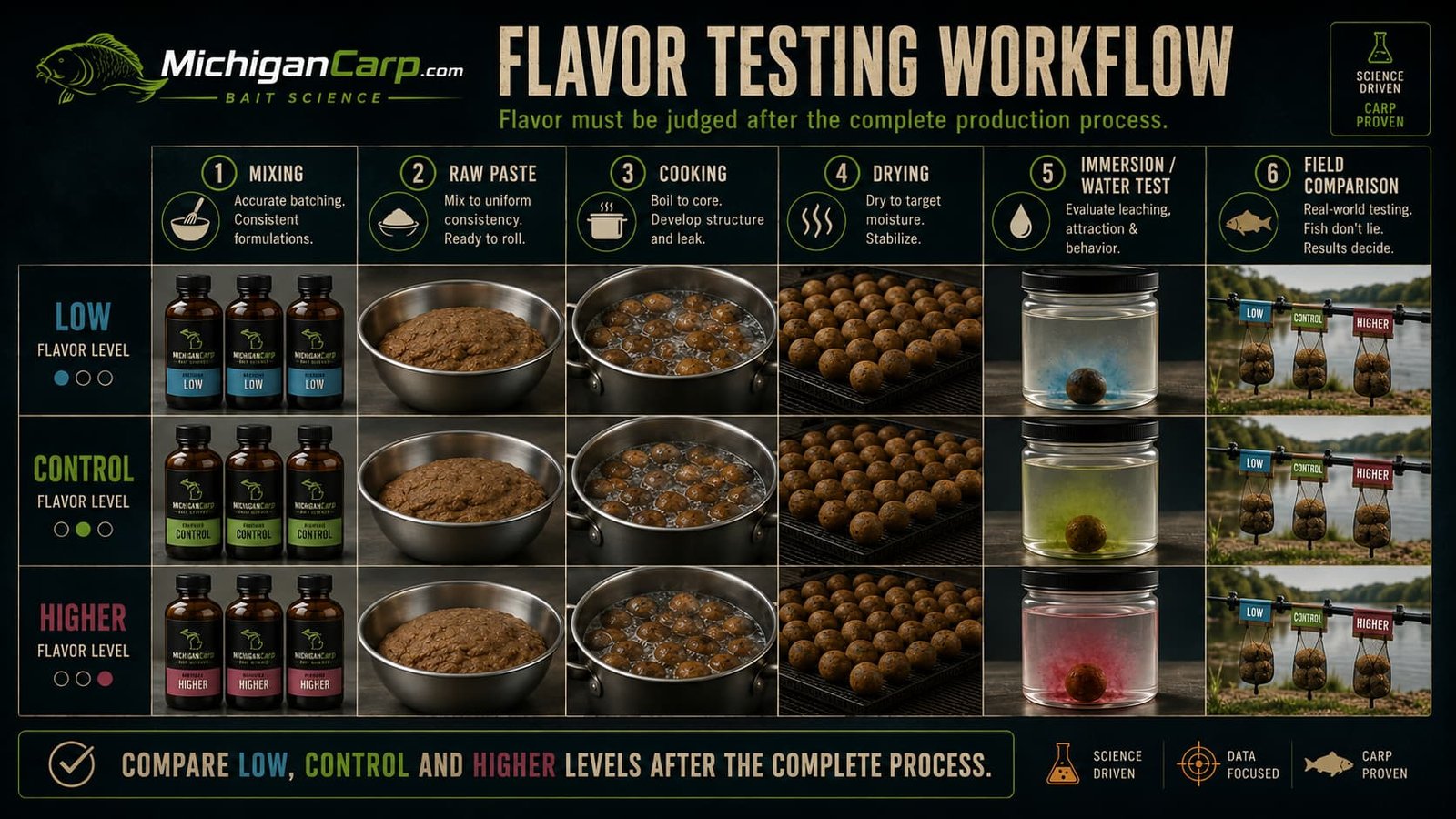
A flavor test should change the flavor level while keeping the rest of the bait as consistent as possible.
Three-batch starting test
| Batch | Flavor level | Purpose |
|---|---|---|
| Low | Approximately 60–70% of the established level | Tests whether the profile remains clear with less flavor |
| Control | The accurately recorded established level | Provides the known comparison |
| Higher | Approximately 125% of the established level | Tests whether a modest increase improves or overloads the finished bait |
Do not apply these percentages blindly to neat acids, essential oils or unfamiliar concentrates. Those require product-specific guidance and smaller controlled work.
Keep the remaining formula constant
Control the dry mix, egg weight, food liquids, bait size, color, cooking time, drying, storage and hookbait presentation.
When increasing the flavor adds more liquid, account for that difference rather than allowing the higher batch to become wetter accidentally.
Assess at several production stages
- Complete liquid phase
- Raw paste after resting
- Freshly cooked bait
- Twenty-four-hour dried bait
- Bait at its intended final drying stage
- Frozen–thawed or stored bait
- Bait after timed immersion
Timed water comparison
Use equal numbers of each bait in separate containers holding the same volume and temperature of water.
Compare after one, four, eight and twenty-four hours where relevant.
Record surface condition, swelling, water color, oil film, recognizable odor above the container, softness and the cut internal texture.
This is a physical comparison—not a controlled experiment measuring carp preference.
Use How to Test Boilies Before Fishing for the wider method.
Field comparisons
Rotate test baits between comparable rod positions and repeat the comparison across several sessions.
Record venue, date, water temperature, position, hookbait version, surrounding feed, bites and captures.
One fish is useful information. It is not enough to establish universal flavor superiority.
Common flavoring problems
| Problem | Likely cause | Controlled correction |
|---|---|---|
| Bait smells harsh after cooking | Flavor level or one accent is excessive | Reduce one component rather than diluting the complete system randomly |
| Main fruit identity disappears | Bridge or rounding note is too strong | Reduce the supporting flavor while retaining the main flavor |
| Raw paste smells good but dried bait is weak | Volatile profile, carrier or processing change | Compare a modest product-specific increase or a different product |
| Paste becomes wetter in the high-flavor test | Additional carrier volume was not balanced | Keep the complete wet phase comparable |
| Flavor pockets occur | Concentrate was added to finished paste | Distribute through the wet phase before adding dry ingredients |
| Wafter becomes a bottom bait | Carrier, conditioner or absorbed liquid increased mass | Reduce liquids and retest the exact rig |
| Pop-up loses lift | Insufficient buoyancy reserve after flavoring or conditioning | Control the liquid phase or increase buoyancy in the next formula |
| New bottle behaves differently | Product or carrier changed | Treat it as a new formulation test |
| No difference between control and flavored bait | Base ingredients may already provide sufficient identity | Consider reducing or omitting added flavor |
| Strong oil slick but weak soluble release | Oil release is being confused with dissolved signal | Review soluble ingredients and bait structure |
| Unpleasant stale odor develops | Old flavor, oxidized carrier or contaminated product | Discard and replace with fresh correctly stored material |
For general paste and processing failures, use Boilie Problems: Real Causes and Practical Fixes.
My Practical View
I use flavor to give a good food bait a clear identity.
I do not begin by asking how many flavors can fit into the liquid phase.
I begin with the base mix, food direction, bait size, presentation and the job the flavor is expected to perform.
For a milk, nut and birdfood bait, fruit-and-cream profiles often fit naturally over the ingredients rather than fighting them.
Plum, Scopex and Vanilla works for me because each component has a different job.
Plum leads. Scopex bridges the fruit and creamy cereal base. Vanilla rounds the profile. The known butyric product remains an optional trace accent.
I would rather fish that repeatable system than add six more flavors because they smell interesting on the workbench.
When testing Peach–Scopex–Vanilla or Maple–Vanilla–Butter, I keep the proven Plum system as the control.
My practical flavor rules are:
- Build the food bait first.
- Choose one recognizable direction.
- Record the exact products.
- Measure accurately.
- Keep powerful accents restrained.
- Assess after cooking and drying.
- Retest treated hookbaits.
- Change one variable at a time.
- Keep a proven control bait.
- Allow field evidence to accumulate before making strong claims.
One main identity, one bridge, one optional accent and one carefully recorded test process.
Flavor should support good ingredients, controlled processing and effective fishing—not be used to disguise their absence.
FAQ
How much flavor should I add to boilies?
Use the supplier’s product-specific starting rate or an accurately recorded rate already tested with the same product. There is no responsible universal milliliter level for every flavor.
Is 5 ml of flavor per kilogram enough?
It may be suitable for one product and excessive or ineffective for another. Concentration, carrier, intended application and the wider flavor system all matter.
Can two boilie flavors be combined?
Yes. Use one as the main identity and the second as a supporting bridge. Do not automatically use both at their full standalone recommended rates.
Can three flavors be combined?
Yes, when each has a defined role. A practical system may contain a lead flavor, a bridge and a lower rounding note.
How many flavors are too many?
Once each product no longer has a clear function, the system is probably too crowded to test and reproduce effectively.
Should flavor be added to the eggs?
Normally, yes. Mix it uniformly through the complete wet phase before adding the dry blend.
Does boiling destroy boilie flavor?
Cooking can alter volatile material and change the balance of the profile, but retention depends on the compounds, carrier, bait matrix and process. Do not assume complete loss or complete retention.
Should flavor be doubled because boilies are cooked?
No. Produce and assess a controlled cooked batch first. Blindly doubling the flavor may overload the finished bait.
Is steaming better for flavor retention?
It may produce a different result in a particular recipe, but it is not universally superior. Compare the methods under controlled conditions.
Is natural flavor better than artificial flavor?
Not automatically. The terms describe source and labeling status rather than strength, processing stability, underwater behavior or carp response.
What is the best carrier for boilie flavor?
There is no universal best carrier. Water, propylene glycol, glycerin, alcohol, oil and emulsions have different effects on the liquid phase and finished bait.
Can grocery-store extracts be used?
Yes, when their ingredients are suitable. Extracts vary in strength and may contain substantial water or alcohol, which must be included in the complete formula.
Can essential oils be used in boilies?
Yes, when the exact product is appropriate and accurately measured. Essential oils can be highly concentrated and should not be treated like ordinary liquid food flavor.
Are drops accurate for essential oils?
No. Drop size varies. Use calibrated small-volume equipment and product-specific guidance.
Should hookbaits contain more flavor than free boilies?
They can, but begin with the accurately scaled matching level. Stronger hookbaits must still retain the intended texture, attachment strength and buoyancy.
Can flavor be sprayed onto finished boilies?
Yes, using a suitable formulated treatment. Apply it lightly and retest texture, attachment, buoyancy and storage. Do not atomize concentrated acids or unfamiliar aroma chemicals.
Does stronger-smelling bait catch more carp?
Not necessarily. Human bottle-smell intensity does not establish underwater release, feeding acceptance or field performance.
Is Scopex one standardized chemical?
No. Scopex is a proprietary flavor style. Different products can use different dairy, butter, vanilla, ester, caramel and cream-type components.
What is the best way to test a new flavor?
Make small low, control and modestly higher batches while keeping the base mix, wet phase, size, color, cooking and drying unchanged. Assess the finished bait and repeat the comparison during real sessions.
Next Steps
- Boilie Liquids and Additives — build the complete wet phase before selecting flavors.
- When to Use Each Type of Carp Bait Liquid — decide whether the bait needs flavor, food liquid or another type of support.
- Plum Scopex Vanilla Boilie: Development and Michigan Results — follow the complete recipe and field record.
- Butyric Acid in Carp Bait: Acids, Butyrates and Esters Explained — understand specialist acidic and ester-based accents.
- Propylene Glycol vs Glycerin in Carp Bait— compare the main flavor and conditioner carriers.
- How to Make Wafters and Pop-Ups From a Boilie Base Mix — flavor specialist hookbaits without destroying buoyancy.
- Hookbait Conditioners for Carp: Glugs, Sprays, Soaks and Buoyancy Control — treat finished hookbaits safely and consistently.
- Carp Feeding Attractants Explained — separate detection, investigation and feeding acceptance.
- Carp Bait Solubility and Leakage — understand how signal leaves the finished bait.
- What Boiling and Heat Do to Carp Bait Ingredients — understand processing changes.
- How to Boil and Dry Boilies Properly — standardize production before comparing flavors.
- How to Test Boilies Before Fishing — compare finished test batches.
- How to Prepare Boilies for Carp Fishing — apply post-production treatments.
- Bait Science — explore formulation, processing and finished-bait behavior.
- Boilie School — follow the structured boilie-making route.
- How to Balance Fat in Boilies: Milk, Nut and Seed Mixes