

Understanding what carp actually eat in natural lakes is much broader than boilies, corn or any other bait anglers introduce.
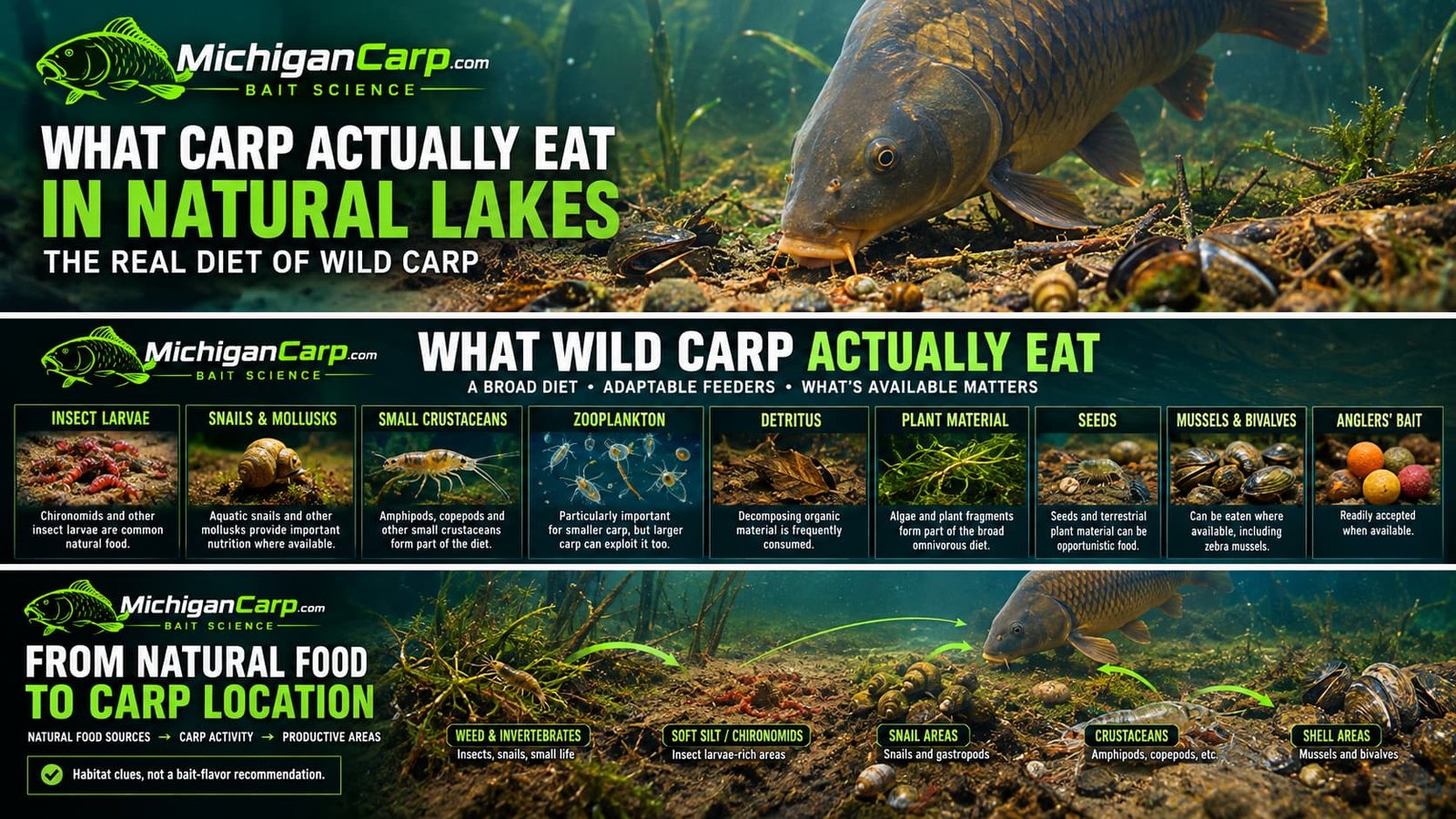
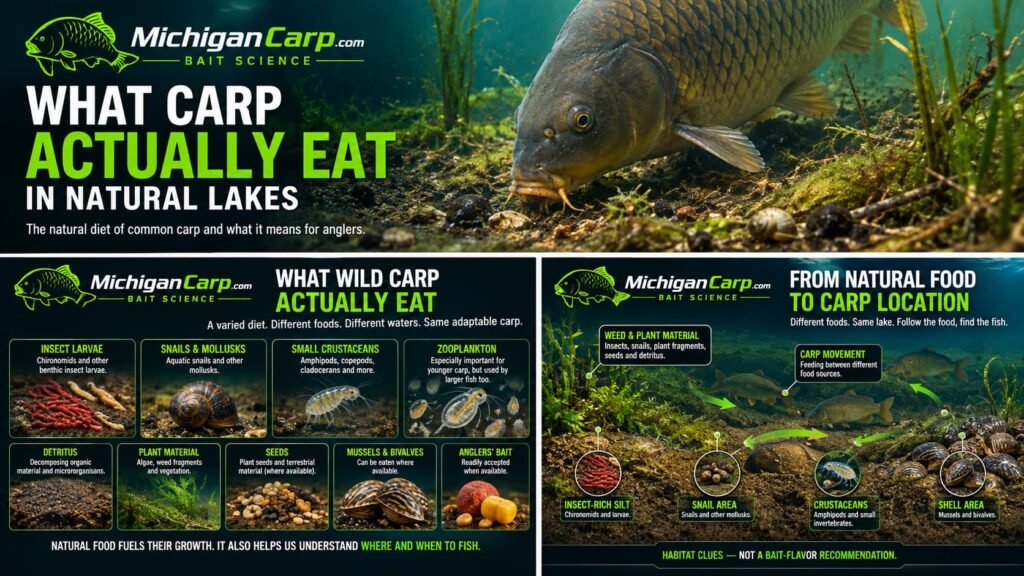
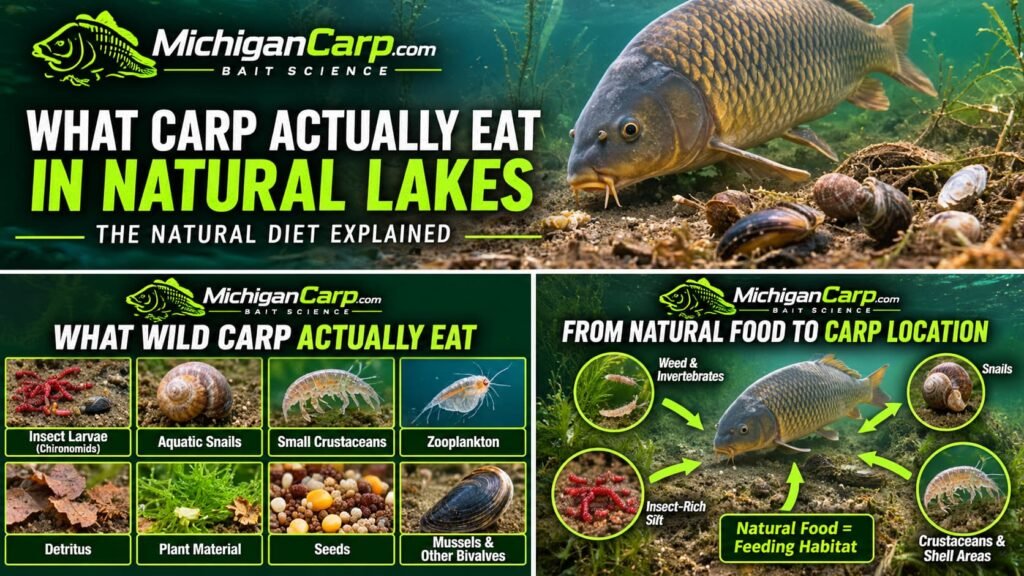
Wild common carp are adaptable omnivores. Depending on the water, season, fish size and what food is available, their diet can include bottom-dwelling insect larvae, small crustaceans, aquatic snails and other mollusks, detritus, plant material, plankton and other opportunistic food.
That flexibility is one reason carp thrive in such different environments.
It also explains something important for anglers:
Carp do not need our bait.
They may already be feeding extremely well on natural food before a boilie, particle or piece of corn ever enters the lake.
Understanding that natural diet improves bait decisions, but more importantly it improves how we think about carp themselves.
This article focuses specifically on what carp naturally eat and how they obtain it.
For the separate question of where those foods occur, use How to Find Natural Carp Feeding Areas in Michigan Lakes.
Table of Contents
“Quick Start: What Carp Actually Eat in Natural Lakes”
| Natural Food | Potential Importance | Where Carp May Encounter It |
|---|---|---|
| Chironomids and other insect larvae | Important benthic food on many waters | Silt, mud, weed and organic bottom |
| Aquatic snails | Common where suitable habitat supports them | Weed, rock, reeds and hard surfaces |
| Small crustaceans | Can form an important part of the diet | Weed, bottom material and open water |
| Zooplankton | Particularly important to young carp, but larger carp can exploit it | Productive shallows and open water |
| Detritus | Frequently encountered during bottom feeding | Soft organic bottom |
| Plant material | Part of the broad omnivorous diet | Weed beds, margins and bottom debris |
| Seeds and terrestrial material | Opportunistic food where available | Margins, flooded ground and inflows |
| Mussels and other bivalves | Can be eaten where available | Shell beds and harder bottom |
| Anglers’ bait | Readily accepted once recognized as food | Baited areas |
The important word is availability.
Common carp are not locked into one natural food.
They exploit what a water produces.
That means the diet of carp from one lake can differ substantially from carp living somewhere else.
Carp Are Opportunistic Omnivores
Common carp are best understood as broad, adaptable feeders rather than specialists.
The USGS Common Carp Species Profile describes juvenile and adult common carp feeding on benthic organisms including chironomids, gastropods and other insect larvae, alongside vegetation, detritus and plankton such as cladocerans, copepods, amphipods and mysids.
USGS also notes that North American carp diets include organic detritus, chironomids, small crustaceans and gastropods.
The important lesson is not that every carp eats every item in equal amounts.
It does not.
Instead, carp are capable of adjusting their feeding to the resources available in their environment.
That distinction matters.
A Michigan carp living in a shallow, weedy, silty lake may encounter a very different food supply from a carp living in clearer water with extensive hard bottom and zebra mussels.
Their underlying feeding ability is similar.
Their available menu is not.
Carp Are Built to Exploit the Bottom
Adult carp spend a great deal of their feeding time working on or close to the lakebed.
They can suck bottom material into the mouth, separate edible material from unwanted sediment and expel material they do not retain.
This activity can disturb the substrate.
That is why feeding carp may create:
- clouded water;
- disturbed silt;
- small feeding depressions;
- moving weed;
- and the bubbles anglers commonly call fizz.
The USGS Common Carp Species Profile specifically notes that active common-carp feeding can disturb sediment and increase turbidity.
For the specialist guide to interpreting those signs, use Why Carp Blow Bubbles: How to Read Carp Fizz.
Bottom feeding does not mean carp are permanently glued to the lakebed.
They can exploit food elsewhere in the water column when the opportunity is worthwhile.
Experimental work reported through PubMed on common-carp feeding behaviour found that carp spent more time close to the bottom when benthic macroinvertebrates were available, but used the water column more when plankton was the available natural food.
That tells us something important about the species:
Common carp are adaptable feeders, not rigid bottom-feeding machines.
Chironomids and Other Insect Larvae
Chironomids are non-biting midge larvae and are among the better-documented natural foods in common-carp diets.
Some red chironomid larvae are commonly referred to by anglers as bloodworm.
These larvae can live within soft sediment and organic bottom, exactly the type of substrate carp are capable of disturbing and sorting through.
But not every patch of silt contains huge quantities of bloodworm.
That distinction matters.
The scientific evidence supports chironomids as common carp food.
It does not support treating every soft Michigan lakebed as automatically “bloodworm rich.”
Productive silt has to be discovered rather than assumed.
Other aquatic insect larvae can also form part of the diet, with their relative importance changing according to the lake and season.
This helps explain why apparently unattractive soft bottom can sometimes hold feeding carp for long periods.
The food may be inside the substrate, rather than visibly lying on top of it.
Aquatic Snails and Other Mollusks
Gastropods — the group that includes aquatic snails — are another well-established component of common-carp diets.
Snails may occur around:
- submerged vegetation;
- rock;
- timber;
- reeds;
- harder substrate;
- and other surfaces where they can feed and shelter.
Their abundance varies enormously between waters.
Where snails are plentiful, they may provide carp with a recurring natural food supply.
That does not mean an angler therefore needs a snail-flavored boilie.
Natural diet should help us understand where carp may feed and how broad their food acceptance can be.
It should not be turned into an unsupported flavor-matching rule.
Do Carp Eat Zebra Mussels?
Yes. Common carp can eat zebra mussels.
The USGS review of fish predation on zebra mussels identifies common carp as physically capable of crushing mollusks using their pharyngeal teeth and grinding pad.
USGS also records a published observation of zebra mussels in common-carp diets.
There is an important qualification, however.
Zebra mussels should not automatically be described as the primary food of carp simply because a Michigan lake contains them.
The USGS review suggests common carp may exploit zebra mussels particularly when aquatic insect larvae become less available.
That is very different from saying:
“Zebra-mussel lake = carp mainly eat zebra mussels.”
Availability, alternative food and the ecology of the individual water still matter.
Small Crustaceans
Small crustaceans also occur naturally in common-carp diets.
Depending on habitat, these can include organisms such as:
- amphipods;
- copepods;
- cladocerans;
- mysids;
- and other small aquatic crustaceans.
The USGS Common Carp Species Profile specifically includes several of these groups in the species’ documented diet.
Again, their importance changes according to availability.
A weed-rich environment can support large numbers of small invertebrates.
Productive shallow water can contain abundant plankton.
Another water may be dominated by different benthic food.
Carp do not require one particular prey item to feed successfully.
They can use a broad range of resources.
Zooplankton
Zooplankton are particularly important during the early life stages of common carp, but they should not be dismissed entirely when discussing larger fish.
The USGS species profile notes that larval carp feed primarily on zooplankton and that plankton remains among the foods recorded for juveniles and adults.
Experimental work also shows how feeding position can change with food availability.
In the common-carp feeding-behaviour study, fish used the water column more when plankton was available without benthic macroinvertebrates.
For anglers, the practical lesson is not to construct a new bait theory around zooplankton.
The useful lesson is much simpler:
Carp feeding behaviour is flexible.
Detritus and Organic Material
Detritus appears frequently in descriptions of common-carp diet.
Detritus is decomposing organic material — plant fragments, microorganisms and other organic matter accumulating in aquatic environments.
Carp working through soft organic sediment inevitably encounter it.
Some material may be consumed directly, while some may be taken in as the fish sorts through the bottom for other food.
This is one reason stomach-content studies have to be interpreted carefully.
Finding something inside a carp does not necessarily mean it was deliberately selected in exactly the same way as a visible insect larva or snail.
The lakebed is a mixture.
Carp are sorting through that mixture.
Plant Material
Common carp are omnivorous and plant material can form part of their diet.
That does not mean adult carp simply graze aquatic vegetation in the same way that livestock graze grass.
Plant fragments, algae and other vegetable matter can occur alongside detritus, invertebrates, plankton and other foods.
The relative importance changes between waters.
This is another area where oversimplified statements cause problems.
“Carp are vegetarian” is wrong.
“Carp are carnivorous bottom feeders” is also incomplete.
They are broad omnivores capable of exploiting both animal and plant-derived material.
Seeds and Terrestrial Material
Seeds and other terrestrial plant material can also enter aquatic systems through:
- flooding;
- runoff;
- vegetation;
- wind;
- shoreline trees and plants;
- and inflowing water.
Common carp are capable of ingesting this sort of material opportunistically.
USGS research has even identified common carp as a potential dispersal vector for aquatic plant seeds, demonstrating that seeds can pass through carp.
That does not mean cultivated maize naturally grows underwater waiting for carp.
And it does not prove that every grain is suitable carp bait.
The more defensible interpretation is that carp are accustomed to encountering and evaluating many different small food items.
That broad feeding behaviour helps explain why correctly prepared particles can become effective angling baits.
Do Carp Eat Other Fish?
Common carp are not normally specialist fish predators.
They should not be thought of in the same way as pike, muskellunge or predatory bass.
However, an opportunistic omnivore may consume animal material such as fish eggs when available.
The USGS Common Carp Species Profile records a very broad range of food use.
That should not be exaggerated into the claim that adult common carp routinely hunt and kill fish.
Their typical feeding system is much more closely associated with benthic foraging, browsing and opportunistic consumption of smaller food items.
For bait development this distinction matters.
A fish-derived ingredient can be useful in carp bait without requiring a story that common carp naturally hunt fish.
Ingredient value and natural feeding behaviour are different subjects.
What Changes With the Size of the Carp?
Natural diet changes as carp develop.
Larval common carp rely heavily on tiny planktonic food.
As the fish grows, its ability to exploit larger benthic organisms and other food expands.
Larger carp can physically process food items that very small carp cannot use as efficiently.
But fish size is only one factor.
Food availability can be equally important.
A large carp living where small benthic organisms are extremely abundant may spend considerable time exploiting them.
Another population may have easy access to snails, crustaceans or mollusks.
There is no universal adult-carp menu.
Natural Diet Changes Between Lakes
This may be the most important part of the whole subject.
There is no single natural diet that describes every carp lake.
One lake may provide soft organic sediment rich in insect life.
Another may contain extensive weed and aquatic snails.
Another may contain large quantities of plankton.
Another may contain harder areas with mollusks.
Another may be highly productive and provide several of these food sources simultaneously.
That is why studies of common-carp diet can produce different dominant food items without necessarily contradicting each other.
The fish are responding to different ecosystems.
A recent stomach-content study from Ethiopia’s Lake Ardibo recorded zooplankton, phytoplankton, macrophytes and detritus as major components of the diet.
The full study can be viewed through PubMed: Food and Feeding Habits of Common Carp in Lake Ardibo.
That does not mean Michigan carp should suddenly be described as plankton specialists.
It demonstrates something much more useful:
diet flexibility.
Natural Diet Changes Through the Year
Food availability also changes seasonally.
Aquatic insect activity changes.
Weed develops and dies back.
Zooplankton populations change.
Shallow-water productivity changes.
Water temperature changes the distribution and activity of both carp and their food.
Therefore the natural menu available to a carp in April may be very different from the menu available in July or October.
This is why I avoid rigid claims such as:
“Carp always want this food in spring.”
The better question is:
What food is available in the water the fish are currently using?
For the environmental side of that decision, use Carp Water Temperature Guide for Michigan Lakes.
What Natural Diet Tells Us About Carp Bait
Natural diet is extremely useful for understanding carp.
It becomes less useful when anglers push the idea too far.
For example:
Carp eat insect larvae.
That does not prove every bait needs bloodworm powder.
Carp eat snails.
That does not prove a snail-flavored boilie is automatically superior.
Carp can eat zebra mussels.
That does not prove a shellfish-flavored bait will always outperform another good food bait.
Carp encounter plant material.
That does not prove every grain is nutritionally appropriate or safe without correct preparation.
The useful lesson is broader.
Common carp readily investigate and consume many different kinds of food.
Good angling bait should therefore be judged by things such as:
- nutritional value;
- digestibility;
- physical structure;
- release of soluble material;
- palatability;
- appropriate inclusion rate;
- familiarity;
- and suitability for the season and fishing situation.
For practical bait selection, use Carp Bait Guide for Michigan Lakes.
For ingredient mechanisms, attraction, nutrition and bait formulation rather than simple bait choice, use the MichiganCarp Bait Science section.
Natural Food Does Not Mean Bait Has to Imitate It
An artificial bait does not need to look like a snail, chironomid larva or crustacean to be eaten.
Boilies demonstrate this perfectly.
There is nothing naturally occurring about a cooked spherical bait made from combinations of cereals, milk proteins, nut meals, seed products, birdfoods and attractors.
Yet carp readily accept well-designed boilies.
The bait does not have to visually imitate one particular natural prey item.
Instead, it can provide chemical, nutritional and physical properties that carp investigate and ultimately accept as food.
That is a much more useful bait-science framework than attempting to make every boilie “copy nature.”
This is also why I do not like adding ingredients simply because they sound natural or sophisticated.
Every ingredient should have a job.
Natural Food Can Compete With Your Bait
A lake with abundant natural food can sometimes make fishing more difficult.
Carp have alternatives.
They may have little reason to remain on an introduced baited area simply because an angler has put food there.
But abundant natural food also helps us.
It gives carp a reason to repeatedly visit particular areas.
A naturally productive feeding zone can therefore be more valuable than trying to establish a baited area in water the carp have little natural reason to use.
This is exactly where this article hands over to How to Find Natural Carp Feeding Areas in Michigan Lakes.
That page explains where the food is likely to occur.
This page explains what the food actually is.
Michigan Notes
Michigan carp waters vary enormously.
We have:
- shallow inland lakes;
- deeper natural lakes;
- dam ponds and reservoirs;
- drowned river mouths;
- rivers and channels;
- and Great Lakes-connected systems.
Their food bases are not identical.
On some waters, productive soft bottom and insect activity may be particularly important.
On others, weed, snails and associated invertebrates are much more obvious.
Zebra mussels are widespread in many Michigan waters, and common carp are physically capable of consuming them, but I would never assume their presence automatically means they dominate the carp’s diet.
Field observation helps establish where carp are feeding.
Scientific evidence helps explain what kinds of foods carp are capable of exploiting.
Those two sources of information should support each other rather than being confused.
What I Look for on the Bank
We cannot normally inspect the complete natural diet of a wild carp while fishing.
Instead, we build a picture from the water.
I look at:
- bottom type;
- insect activity;
- aquatic weed;
- snail shells;
- mussel shells;
- soft sediment;
- clouding;
- fizz;
- feeding pits;
- bird activity;
- flooded vegetation;
- and repeated carp use of the same zone.
These observations cannot tell us that a carp’s diet is, for example, “40 percent snails.”
They tell us what food opportunities may exist.
For the full location system, use How to Find Natural Carp Feeding Areas in Michigan Lakes.
To determine whether carp are actually using those areas, combine that with Signs Carp Are Feeding.
Common Mistakes When Thinking About Carp Diet
Assuming Carp Have One Preferred Natural Food
They do not.
Different ecosystems provide different feeding opportunities.
Treating Gut Contents as a Perfect Measure of Preference
Carp suck and sort mixed bottom material.
Something found in the digestive tract may have been consumed alongside another food rather than deliberately targeted.
Turning Natural Food Directly Into Flavor Recommendations
A carp eating snails does not scientifically prove that a snail-flavored boilie will outperform a well-designed milk, nut or other food bait.
Assuming Every Silty Area Is Bloodworm Rich
Chironomids are established carp food.
That does not mean every soft-bottomed area contains large quantities of them.
Assuming Mussels Must Dominate Because You Can See Them
Visible zebra mussels tell us the food exists.
They do not tell us what proportion of the carp’s current diet they represent.
Adding Ingredients Just Because Carp Eat Something Similar Naturally
Natural-diet research should improve bait thinking.
It should not become an excuse to make unnecessarily complicated recipes.
Forgetting Availability
Carp cannot eat natural food that is not present.
Their ability to exploit whatever is available is one of the reasons they are such adaptable fish.
My Practical MichiganCarp View
Understanding what wild carp eat has changed how I think about bait.
Not because I am trying to reproduce their natural diet ingredient by ingredient.
That would miss the point.
What matters is recognizing that common carp spend their lives making food decisions in complicated natural environments.
They encounter:
animal material;
plant material;
hard foods;
soft foods;
tiny foods;
larger foods;
bottom food;
and sometimes food higher in the water column.
They can investigate, sort, reject and accept.
That is why I prefer to build bait around genuine functions rather than marketing stories.
The natural diet tells us carp are adaptable.
Understanding what carp actually eat in natural lakes has changed how I think about bait.
It does not tell us that adding every natural-sounding ingredient makes a better boilie.
Good bait development should become simpler as our understanding improves, not more complicated.
For the technical framework behind that approach, continue into MichiganCarp Bait Science.
FAQ
What do carp eat naturally?
Common carp are adaptable omnivores. Their natural diet can include insect larvae, small crustaceans, aquatic snails and other mollusks, plankton, detritus and plant material. The relative importance of each food varies between waters.
Do carp eat bloodworm?
Yes. Carp eat chironomid larvae, some of which anglers commonly refer to as bloodworm. Chironomids are well documented in common-carp diets.
Do carp eat snails?
Yes. Gastropods such as aquatic snails are a documented natural food of common carp.
Do carp eat zebra mussels?
Yes. Common carp can consume zebra mussels and are physically equipped to crush mollusks. Their importance in the diet depends on availability and alternative food sources.
Do carp eat plants?
Yes. Plant material can form part of their broad omnivorous diet alongside animal foods, detritus and plankton.
Do carp eat seeds?
Carp can ingest seeds and other plant material entering aquatic environments. The importance of those foods depends on what is locally available.
Do carp mainly feed on the bottom?
Adult carp commonly exploit benthic food and spend substantial periods foraging on or within bottom material. They are adaptable, however, and can also exploit plankton and other food in the water column.
Does a carp’s natural diet change through the year?
Yes. Available food changes seasonally, and carp can alter feeding behaviour according to the resources that are accessible.
Should my bait copy the carp’s natural food?
Not necessarily. Natural diet is useful for understanding carp and locating feeding habitat, but an effective angling bait does not need to imitate one specific natural prey item.
Does lots of natural food make carp harder to catch?
It can. Carp surrounded by abundant natural food have less reason to depend on anglers’ bait. On the other hand, natural food gives you valuable clues about where carp have a genuine reason to spend time.
Next Steps
To turn natural-food knowledge into location decisions, continue with How to Find Natural Carp Feeding Areas in Michigan Lakes.
To recognize whether carp are actively using those areas, read Signs Carp Are Feeding.
For fizz and bottom disturbance specifically, use Why Carp Blow Bubbles: How to Read Carp Fizz.
For practical bait selection, continue with Carp Bait Guide for Michigan Lakes.
For ingredient function, nutrition, attraction and formulation, use MichiganCarp Bait Science.
For the seasonal temperature picture, read Carp Water Temperature Guide for Michigan Lakes.