

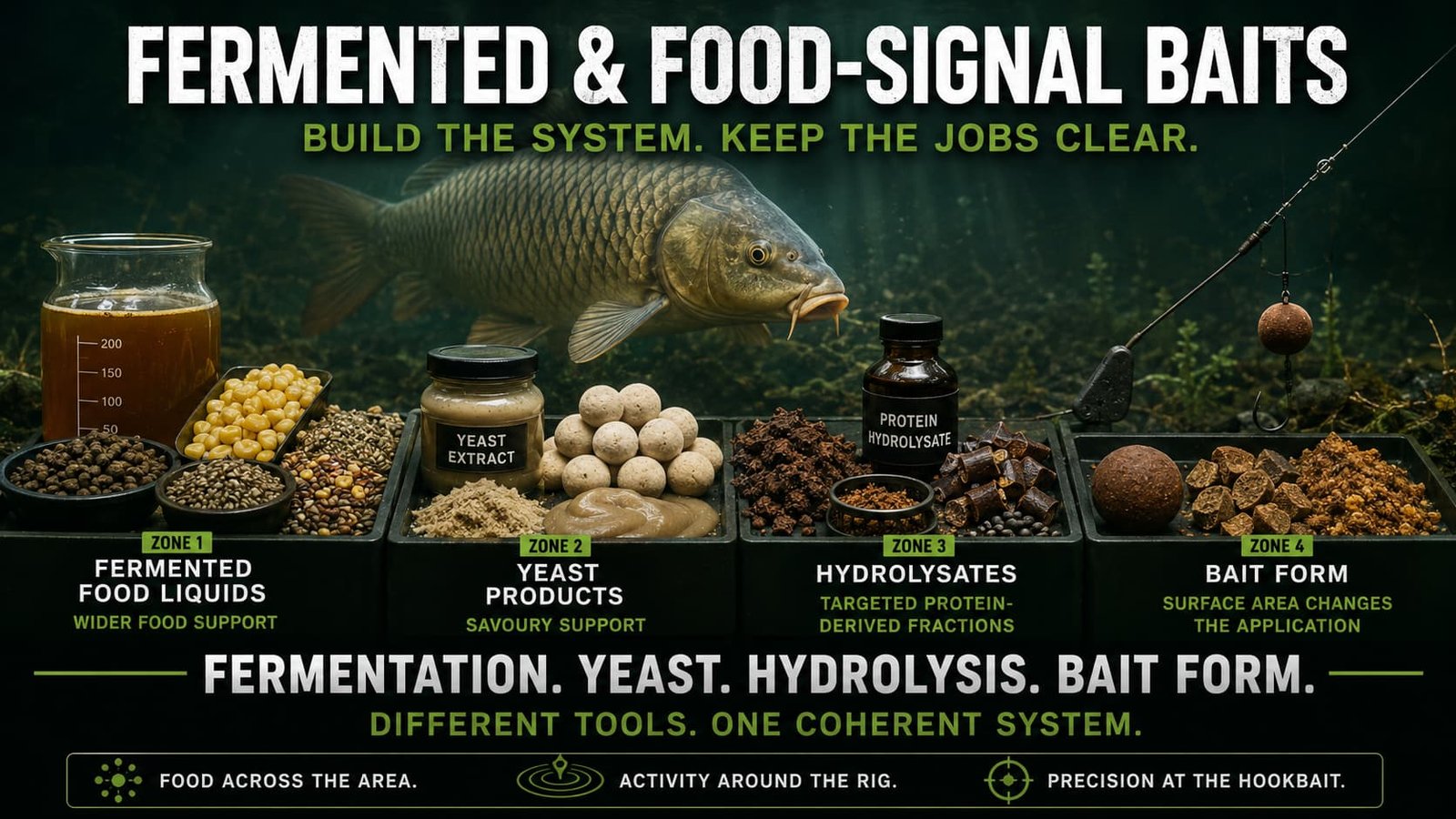
Fermented carp bait and food-signal baits for carp are often discussed as though they are one simple category.
They are not.
A fermented corn liquid, yeast extract, liver hydrolysate, boilie crumb and chopped boilies can all contribute to an active baiting system.
But they do not come from the same process.
They do not contain the same compounds.
And they do not automatically perform the same job.
That distinction has become increasingly important as this Bait Science section has developed.
My practical view is now simple:
How Fermented Carp Bait Fits Into a Food-Signal System
FERMENTED FOOD LIQUIDS → TRANSFORMED FOOD MATERIAL FOR COMPATIBLE BAITING SYSTEMS
YEAST PRODUCTS → YEAST-DERIVED SAVOURY AND SOLUBLE MATERIAL
HYDROLYSATES → PROTEIN-DERIVED SMALLER FRACTIONS
CRUMB AND CHOPS → PHYSICAL BAIT FORMS WITH MORE EXPOSED SURFACE
HOOKBAIT TREATMENTS → PRECISE SMALL-SCALE APPLICATION
These tools can work together.
But first, understand what each one is doing.
The purpose of this page is not to prove that every bait needs fermentation, hydrolysate, yeast extract and CSL.
It is to show how those tools fit into one practical baiting system.
For the practical liquid-selection guide, read When to Use Each Type of Carp Bait Liquid.
For the direct process comparison, read Fermented Liquids vs Hydrolysates for Carp.
Table of Contents
Quick Start
The practical version is this.
Fermented Liquids
Best suited to:
- particles;
- maize;
- grain feeds;
- pellets;
- broader food areas;
- compatible crumb systems.
Main idea:
Use them where transformed food liquid fits the wider baiting system.
What Fermented Liquids Actually Improve
A fermented bait liquid should not be treated as a magic attractor.
Its practical job is bait communication. A useful fermented liquid can add water-active material around a bait package, especially when the bait form already allows water to enter, dissolve, wash, disperse or move material away from the bait.
That is why these liquids often show their best effect on bait forms with exposed surface area, such as:
- prepared particles;
- pellets;
- boilie crumb;
- chopped boilies;
- method and packbait mixes;
- small hookbait traps.
This does not mean a fermented liquid pulls carp from impossible distances or fixes a dead swim. It means the bait can start communicating more clearly in the area where carp encounter it.
The liquid should support the bait. It should not become the bait.
A simple bait often does not need another five powders, three liquids and a stronger flavour. Sometimes the better improvement is a light, compatible treatment on particles, pellets, crumb or chops so the bait begins working sooner without losing its original purpose.
Best Use by Bait Type
| Bait Type | Best Liquid Approach | Use Level | Watch For |
|---|---|---|---|
| Particles | CSL-style or matching grain liquid | Light to moderate | Pooling liquid, poor storage or unsafe particle preparation |
| Pellets | Light fermented coating | Light | Pellets becoming mushy before fishing |
| Boilie crumb | CSL, yeast liquid or compatible fermented liquid | Add gradually | Turning crumb into paste by accident |
| Chopped boilies | Light matching liquid treatment | Light | Masking the original bait profile |
| Hookbaits | Short dip, glaze or controlled soak | Very light to moderate | Softening, loss of buoyancy or poor presentation |
| PVA mixes | Only after compatibility testing | Minimal | Water-based liquids damaging the PVA |
The main warning is over-wetting. Liquid should improve the bait form, not destroy it. Pellets should not become mush before they are fished. Crumb should remain crumb. Hookbaits still need to stay hard enough, balanced enough and clean enough to present correctly.
For PVA work, never assume a liquid is safe because it smells useful or looks thick. Test the exact liquid with the exact PVA product before relying on it during a session.
CSL-Style Liquids
Best suited to:
- particles;
- pellets;
- crumb;
- free bait;
- wider baited areas.
Main idea:
Economical food-liquid support rather than an expensive hookbait-only treatment.
Yeast Extract
Best suited to:
- boilies;
- crumb;
- paste;
- selected pellet treatments;
- hookbait conditioners;
- non-marine milk and nut baits.
Main idea:
Savoury yeast-derived support rather than simply calling it fermented liquid.
Hydrolysates
Best suited to:
- crumb;
- chops;
- pellets;
- paste;
- selected boilie treatments;
- hookbait treatments;
- small local traps.
Main idea:
Protein-derived smaller fractions used with a clear purpose.
Crumb and Chops
Best suited to:
- short sessions;
- cool water;
- rig-area activity;
- small controlled traps.
Main idea:
The bait form itself changes water contact and exposed surface.
The Main Rule
One wider food idea. One active local idea. One clear hookbait strategy.
You do not need every liquid in every part of the swim.
What Is a Food-Signal Bait?
I use food-signal bait as a practical angling term.
It describes a baiting system designed to make food-related material available to the surrounding water while still functioning as real fishing bait.
That system might include:
- particles;
- boilies;
- pellets;
- crumb;
- chops;
- paste;
- fermented liquids;
- yeast products;
- hydrolysates;
- selected hookbait treatment.
The important correction is that a food signal is not one substance.
And it is not one guaranteed behavior.
A bait system has to move through several stages:
RELEASE → TRANSPORT → DETECTION → INVESTIGATION → TASTING → ACCEPTANCE
Different ingredients can contribute to different parts of that sequence.
For the full explanation, read Carp Feeding Attractants Explained.
Fermented Bait and Food-Signal Bait Are Not the Same Thing
This distinction is worth keeping.
Fermented Bait
A food material changed through controlled microbial activity.
Depending on the substrate and process, fermentation can change:
- acids;
- alcohols;
- soluble compounds;
- aroma compounds;
- microbial metabolites;
- texture;
- pH.
The exact changes depend on the microorganisms, starting material and conditions. Controlled fermentation studies consistently show that process conditions and substrate composition influence the resulting acids, alcohols, pH and other product characteristics.
Food-Signal Bait
A broader angling concept.
It may use:
- fermented liquid;
- hydrolysate;
- yeast extract;
- crumb;
- chops;
- soluble food ingredients;
- particles;
- pellets.
Therefore:
all fermented baits can contribute to a food-signal system, but not every food-signal bait is fermented.
That distinction prevents several category errors.
Fermentation Is Not Hydrolysis
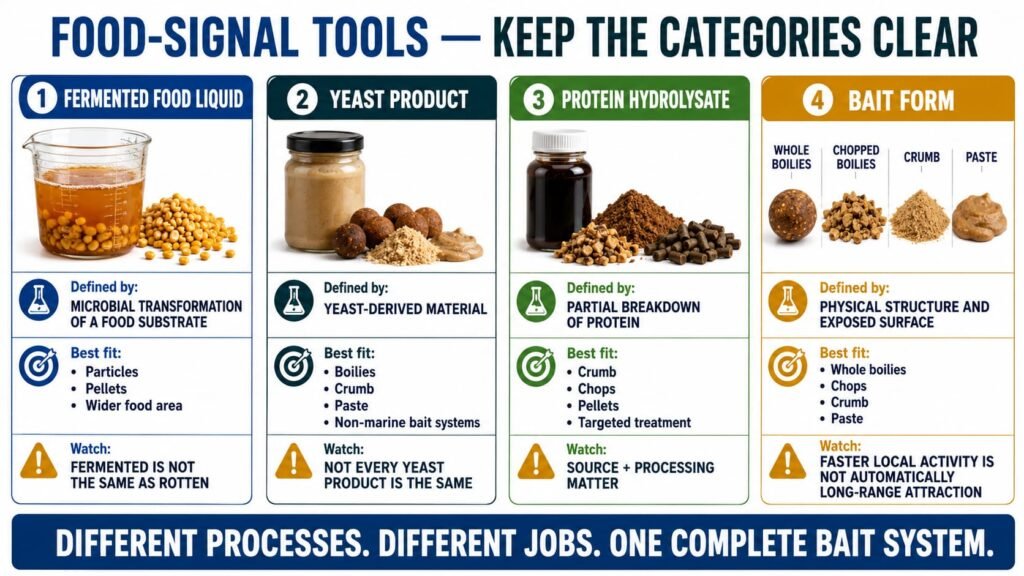
This is one of the most important points in the modern Bait Science cluster.
Fermentation is a biological transformation process driven by microorganisms and their metabolism.
Protein hydrolysis is the breaking of peptide bonds within proteins.
A hydrolysate can contain mixtures of:
- larger protein fragments;
- peptides of different sizes;
- shorter peptides;
- free amino acids.
The resulting profile depends on:
- starting protein;
- enzyme or processing method;
- reaction conditions;
- degree of hydrolysis;
- subsequent concentration or filtration.
That is why I no longer describe fermented liquid and hydrolysate as two versions of the same thing.
They can both be useful.
They are still different tools.
For the full comparison, read Fermented Liquids vs Hydrolysates for Carp.
Fermented Does Not Mean Rotten
Controlled fermentation and spoilage should never be confused.
A useful food fermentation is an intentional process.
Uncontrolled spoilage is not a bait-making technique.
Do not use material that is:
- visibly moldy;
- putrid;
- unexpectedly slimy;
- clearly decomposing;
- contaminated;
- inconsistent with the process you intended.
The useful question is not:
Does it smell strong?
It is:
Was the process controlled, and is the finished material suitable for the baiting job?
Strong human smell is not a scientific quality test.
For practical particle safety, read Particles for Carp Fishing: Safe Prep, Mixes and Feeding Rules.
Where Fermented Food Liquids Fit Best
For my style of fishing, fermented food liquids make most sense where I am already building a food area.
That can include:
- maize;
- hemp;
- pigeon feed;
- mixed particles;
- pellets;
- selected crumb systems.
I particularly like this logic for:
Multi-Day Sessions
Where I may be applying larger quantities of free bait.
Big Natural Lakes
Where I am trying to establish a feeding area after solving location.
River and Channel Fishing
Where repeated small bait releases may be useful.
Warm-Water Particle Fishing
Where carp are actively feeding and a broader food area is practical.
The key is economy.
A wider food area does not necessarily need the most expensive concentrated liquid I own.
Homemade CSL-Style Liquid
CSL-style liquid deserves its own practical place.
I use the term carefully because a homemade corn fermentation is not automatically identical to a commercial industrial corn steep liquor.
But a controlled homemade fermented corn liquid can still be useful in:
- particles;
- pellets;
- crumb;
- chopped boilies;
- wider food areas.
For me, its best role is:
broad compatible food-liquid support.
I would not normally save it exclusively for ten hookbaits.
Nor would I assume that pouring more over every top-up automatically improves the swim.
Use it as part of a coherent food system.
For the complete method, read Homemade CSL for Carp Fishing in Michigan.
Yeast Extract Has Its Own Job
Yeast extract is frequently grouped together with:
- fermented liquids;
- hydrolysates;
- CSL.
That can become confusing.
Yeast extract is a yeast-cell-derived ingredient.
Its practical bait role can include:
- savoury depth;
- soluble food material;
- boilie support;
- crumb treatment;
- paste;
- hookbait conditioners;
- non-marine bait systems.
I particularly like yeast-based savoury support in:
- milk baits;
- nut baits;
- cereal baits;
- birdfood mixes.
It can add depth without forcing the complete bait toward an obvious fishmeal or meat profile.
For the practical homemade approach, read Homemade Yeast Extract for Carp Bait.
Hydrolysates Have a Different Role
Hydrolysates are protein-derived ingredients.
They are not automatically:
- stronger than fermentation;
- better than yeast;
- suitable for every bait;
- worth pouring over gallons of bulk feed.
The value depends on:
- source material;
- processing;
- concentration;
- bait form;
- fishing job.
For my own baiting, I particularly like suitable hydrolysates in:
- boilie crumb;
- chopped boilies;
- crushed pellets;
- paste;
- selected boilie treatments;
- small targeted traps;
- hookbait conditioners.
Because those uses involve relatively small amounts of bait, a more concentrated ingredient can make practical and economic sense.
For the technical explanation, read What Hydrolysates Really Do in Carp Bait.
For my preferred homemade liver approach, read Liver Hydrolysate for Carp Bait. For homemade liver liquids, beef liver remains my preferred option when I want a darker, richer profile.
Why Crumb and Chops Matter
Not every improvement to a food-signal bait comes from another bottle.
Sometimes the physical bait form is the more important change.
Compare:
- whole boilie;
- chopped boilie;
- boilie crumb.
They can contain the same original bait but present different exposed surface areas and different pathways for water to contact the bait structure.
That is why I like:
- crumb;
- chops;
- pellet dust;
- crushed pellets;
around the active rig area.
The practical advantage is not:
crumb attracts fish from impossible distances.
It is:
a small quantity of bait can create a locally active feeding area.
For the complete physical explanation, read Why Surface Area Matters in Carp Bait.
Also read Why Some Carp Baits Leak Faster Than Others.
Particles as a Food-Signal System
Particles already provide real food.
That is an important starting point.
A particle system might include:
- maize;
- hemp;
- pigeon feed;
- tiger nuts;
- peanuts.
Depending on the session, I may support them with:
- CSL-style liquid;
- compatible fermented food liquid;
- modest sweet food treatment;
- chopped boilies;
- crumb close to the rig.
I do not think a particle bucket needs to become a chemistry experiment.
The free bait already has a job:
encourage browsing and feeding.
The liquid should support that job.
Pellets
Pellets can fit both the wider food area and the more active rig area.
For larger freebait use, I think about:
- cost;
- compatibility;
- texture;
- breakdown.
For a small trap, I might use:
- crushed pellet;
- pellet dust;
- crumb;
- one selected liquid.
The important rule is to test the pellets.
Some absorb liquid quickly.
Some soften.
Some become mush.
A strong-smelling pellet that no longer fishes correctly is not automatically an improvement.
Treated Hookbaits
Hookbaits are ideal for precise experimentation because the total amount of bait is small.
Possible objectives include:
Continuity
Use a treatment related to the wider feed.
Savoury Depth
Use:
- yeast extract;
- appropriate hydrolysate.
Flavor Support
Use a matching conditioner.
Controlled Contrast
Use a different but intentional treatment from the free bait.
The hookbait must still:
- remain hard enough;
- retain buoyancy where needed;
- maintain balance;
- resist nuisance fish;
- present correctly.
For the complete treatment process, read How to Treat Boilies for Carp Step by Step.
The Three-Layer Food-Signal System
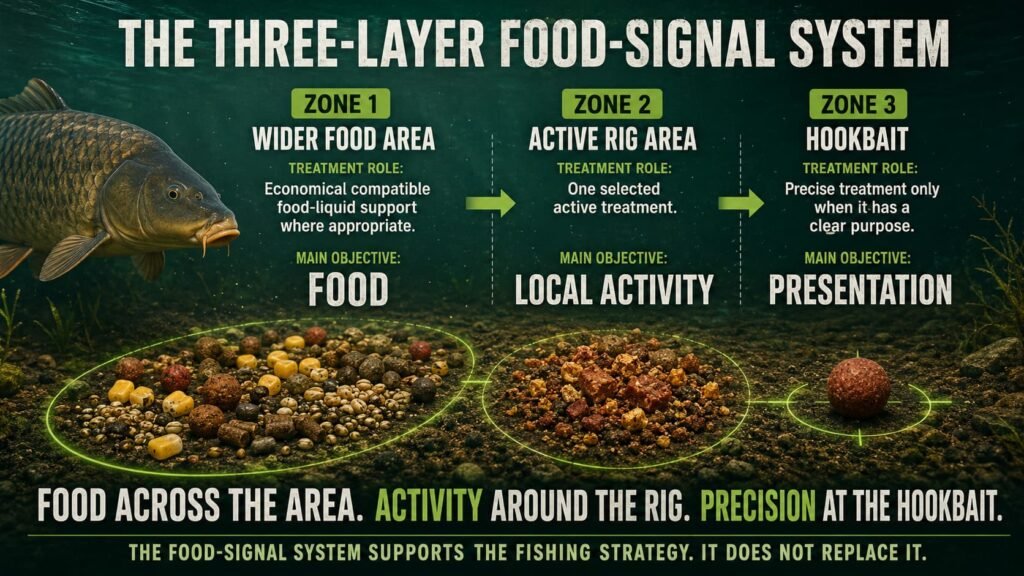
For much of my own fishing, I prefer to divide the baiting system into three layers.
Layer 1 — Wider Food Area
Use:
- particles;
- pellets;
- selected boilies.
Liquid role:
economical compatible food treatment where appropriate.
Main objective:
FOOD
Layer 2 — Active Rig Area
Use:
- crumb;
- chopped boilies;
- crushed pellets.
Treatment role:
one selected active treatment.
Main objective:
LOCAL ACTIVITY
Layer 3 — Hookbait
Use:
- boilie;
- tiger nut;
- maize;
- another durable suitable bait.
Treatment role:
precision only when it has a clear purpose.
Main objective:
PRESENTATION
This creates a simple progression:
FOOD ACROSS THE AREA.
ACTIVITY AROUND THE RIG.
PRECISION AT THE HOOKBAIT.
That is much easier to test than pouring every attractive liquid into every bait component.
Short Sessions
Short sessions often reward control.
I may use:
- small crumb trap;
- several chops;
- crushed pellet;
- durable hookbait;
- one liquid treatment.
Possible treatments include:
- yeast extract;
- hydrolysate;
- compatible fermented liquid.
The key is not simply “fast signal.”
The most important factors remain:
- fish location;
- accurate placement;
- sensible food quantity.
A small active trap in the correct place can be very effective.
A brilliant attractant in an empty swim remains in an empty swim.
Cold Water
The old page sometimes leaned too heavily on the idea that colder water automatically makes fast-leaking bait more valuable.
I would now phrase the argument more carefully.
Cold-water fishing often favors:
- reduced bait quantity;
- accurate placement;
- crumb;
- chops;
- small particle patches;
- selected liquid treatments.
That makes food-signal systems practical.
But the advantage is not that:
strong chemistry defeats cold water.
It is that:
a small amount of carefully designed bait can fit the feeding situation.
For the full seasonal comparison, read Fermented Baits: Cold Water vs Warm Water.
Cool Spring Water
Spring is a transition period.
Carp may begin:
- moving farther;
- visiting shallow water;
- using new weed;
- feeding on emerging natural foods;
- moving between depth zones.
A practical system might be:
Wider Feed
- maize;
- hemp;
- pigeon feed;
- light CSL-style treatment.
Rig Area
- crumb;
- chops;
- crushed pellet.
Hookbait
- simple durable bait;
- light treatment only if needed.
The most important change should come from fish activity and location.
Not the calendar alone.
Warm Water
Warm water can support broader feeding systems where carp are active.
Possible components include:
- particles;
- pellets;
- boilies;
- chops;
- method mix;
- packbait.
Fermented food liquids can fit very well here.
But the answer is not:
add more liquid because the water is warmer.
The more important questions are:
- How much are the carp feeding?
- Are nuisance species active?
- Is the bait spoiling?
- Are oxygen conditions changing?
- Is the feeding window occurring at night?
For the practical situation-first guide, read When to Use Each Type of Carp Bait Liquid.
Short Sessions vs Multi-Day Sessions
This is one of the most useful practical distinctions.
Short Session
Emphasis:
- small trap;
- limited food;
- accurate placement;
- local activity.
Possible tools:
- crumb;
- chops;
- crushed pellet;
- yeast extract;
- hydrolysate;
- selected fermented liquid.
Multi-Day Session
Emphasis:
- sustainable food area;
- consistency;
- bait economy;
- repeated top-ups;
- real food value.
Possible structure:
Wider food area:
Particles and boilies with economical compatible treatment.
Rig area:
Crumb, chops and selected local treatment.
Hookbait:
Separate treatment only if it has a clear purpose.
The session length changes the economics of the complete system.
Attraction and Food Value Are Different Jobs
This remains one of the stronger ideas from the original article and should stay.
A bait can release useful material without offering much sustained food value.
A nutritionally substantial bait can also be physically slow to release some water-available material.
The answer is not to choose one extreme.
A practical system can contain:
- real food;
- useful water-available fractions;
- suitable physical structure;
- controlled bait quantity.
For the full discussion, read Solubility vs Nutrition in Carp Bait.
One Lead Idea. One Support Idea.
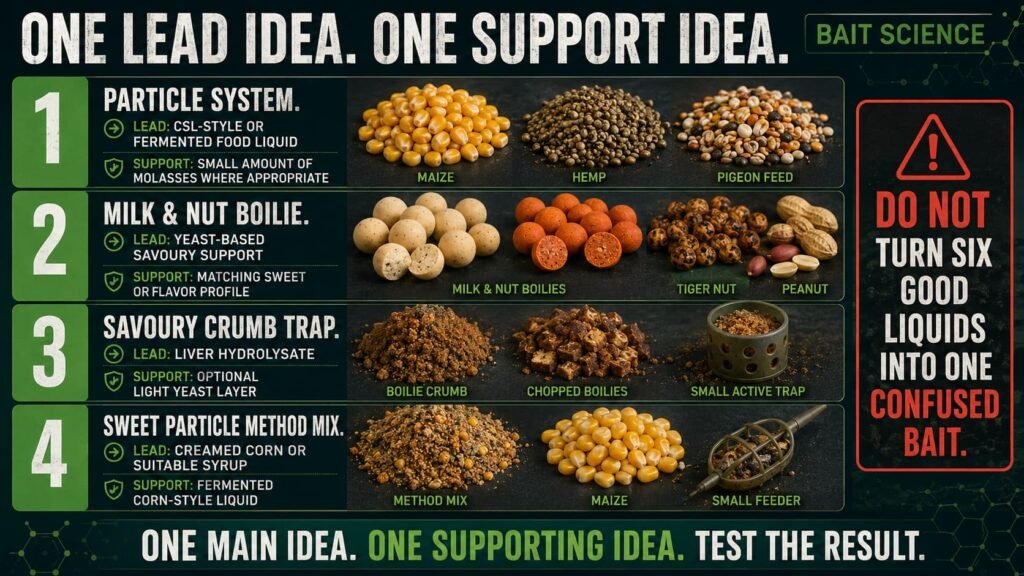
One of the easiest ways to ruin useful bait testing is to combine too many ingredients at once.
Imagine adding:
- fermented liquid;
- yeast extract;
- liver hydrolysate;
- molasses;
- sweetener;
- flavor;
- acid;
- salt;
to one small bait mix.
Even if every ingredient is individually useful, the final system becomes difficult to understand and difficult to test.
My preferred approach is:
ONE MAIN IDEA.
ONE SUPPORTING IDEA.
Examples:
Particle System
Lead:
CSL-style or compatible fermented food liquid
Support:
small amount of molasses where appropriate
Milk and Nut Boilie
Lead:
yeast-based savoury support
Support:
matching sweet or flavor profile
Savoury Crumb Trap
Lead:
liver hydrolysate
Support:
optional light yeast layer
Sweet Particle Method Mix
Lead:
creamed corn or suitable syrup
Support:
fermented corn-style liquid
The rule is:
DO NOT TURN SIX GOOD LIQUIDS INTO ONE CONFUSED BAIT.
Practical Michigan Systems
Early Spring Small Trap
Use:
- crumb;
- chopped boilies;
- a few scattered whole boilies;
- light selected treatment.
Purpose:
create a small active feeding point without heavy food volume.
Cool Spring Particle System
Use:
- maize;
- hemp;
- pigeon feed;
- light CSL-style treatment;
- crumb near the rig.
Purpose:
intercept moving carp without immediately building a large food bed.
Summer Food Area
Use:
- prepared maize;
- hemp;
- pigeon feed;
- tiger nuts or peanuts where appropriate;
- pellets;
- chopped boilies;
- controlled fermented food liquid.
Purpose:
build and maintain a feeding area where carp activity justifies it.
River or Channel System
Use:
- particles or pellets as wider feed;
- crumb and chops around the rig;
- durable hookbait.
Purpose:
use repeated bait surfaces and food availability rather than simply increasing liquid concentration.
When Food-Signal Baits Are Overrated
Food-signal bait ideas are overrated when anglers expect them to solve:
- poor location;
- no fish movement;
- unsuitable depth;
- excessive baiting;
- poor rig presentation;
- unsafe particle preparation;
- spoiled bait;
- damaged hookbait mechanics.
The bait can help once the fishing situation makes sense.
It cannot manufacture carp where none are present.
Common Mistakes
Calling Every Food Liquid Fermented
Yeast extract, hydrolysate and fermented grain liquid are not automatically the same category.
Calling Every Fermented Product a Hydrolysate
Fermentation and protein hydrolysis are different processes.
Calling Spoilage Fermentation
Controlled processing and uncontrolled spoilage are different things.
Assuming Hydrolysates Are Always Stronger
Source, processing, concentration and application matter.
Ignoring Bait Form
Whole boilies, crumb, chops and paste do not behave identically.
Using Expensive Liquid Across Bulk Feed Without a Reason
Concentrated treatment may make more sense in the rig area.
Treating Hookbaits Until They No Longer Fish Properly
Always protect bait mechanics.
Using Too Many Liquids
More ingredients can make testing less useful.
Trying to Fix Location With Bait Chemistry
Move before rebuilding the liquid package.
My Practical View
I believe strongly in food-signal bait systems.
But I no longer think the useful lesson is:
Make the bait stronger.
The better lesson is:
Give each part of the baiting system a clear job.
For my own fishing:
Wider Food Area
I want:
- real food;
- practical cost;
- consistent treatment.
Rig Area
I want:
- exposed bait surfaces;
- crumb;
- chops;
- one selected treatment.
Hookbait
I want:
- correct mechanics;
- durability;
- precise treatment only when needed.
That gives me:
food across the area;
activity around the rig;
precision at the hookbait.
The best food-signal bait is not the bait with the longest list of liquids.
It is the bait system where:
- the wider feed makes sense;
- the active trap makes sense;
- the hookbait makes sense;
- the fishing location makes sense.
That is how I would use fermented liquids, yeast products, hydrolysates and active bait forms together.
FAQ
What is a food-signal bait for carp?
I use the term for a baiting system designed to make food-related material available to the surrounding water while still functioning as practical fishing bait. It can include fermented liquids, hydrolysates, yeast products, particles, crumb, chops and treated hookbaits.
Are all food-signal baits fermented?
No. A hydrolysate, yeast extract, crumb trap or treated hookbait can contribute to a food-signal system without being fermented.
Are fermented liquids the same as hydrolysates?
No. Fermentation is a microbial transformation process. Protein hydrolysis involves breaking peptide bonds within proteins.
Is yeast extract a fermented liquid?
It should not automatically be treated as one. Yeast extract is a yeast-cell-derived ingredient and should be judged according to its actual production method and composition.
Are hydrolysates good for carp bait?
They can be useful in crumb, chops, pellets, paste and selected bait treatments. Source, processing, concentration and application all matter.
What is the best liquid for particles?
A compatible fermented food liquid or CSL-style liquid can be a practical starting point. The correct choice depends on the particle mix and feeding strategy.
Are crumb and chopped boilies food-signal baits?
They can contribute strongly to a food-signal system because their physical form increases exposed surface and water contact compared with large whole hardened baits.
Do fermented baits work in cold water?
They can. The practical advantage is best understood through small, accurate baiting systems rather than claiming that fermentation somehow defeats temperature.
Should I use fermented liquid, yeast extract and hydrolysate together?
You can, but I would only do so when each ingredient has a clear role. One lead idea and one supporting idea are usually easier to test.
Can food-signal bait replace good location?
No. Bait chemistry supports good fishing; it does not replace location.
Final Thoughts
Fermented and food-signal baits are valuable because they encourage better thinking about the complete bait system.
But the categories need to stay clear.
Fermentation is not hydrolysis.
Yeast extract is not automatically fermented liquid.
Hydrolysate is not one uniform ingredient.
Crumb is not simply liquid attraction in another form.
Hookbait treatment is not a reason to soak every item of free bait.
The most useful system is simple:
build real food;
use appropriate transformed food liquids where they fit;
use concentrated protein-derived treatments selectively;
take advantage of crumb and chops;
keep the hookbait mechanically correct;
solve location before chemistry.
That is the role of this page in the Bait Science series.
It is the overview.
The deeper articles explain each tool.
The fishing strategy decides which tools you actually need.
Next Steps
Continue through the fermentation, hydrolysate and food-liquid series with:
For the practical liquid-selection guide, read
When to Use Each Type of Carp Bait Liquid.
Fermented Liquids vs Hydrolysates for Carp
Fermented Liquids vs Hydrolysates vs Sweet Liquids
When to Use Each Type of Carp Bait Liquid
Fermented Baits: Cold Water vs Warm Water
Yeast, CSL and Fermented Liquid Foods for Carp Bait
Homemade CSL for Carp Fishing in Michigan
Homemade Yeast Extract for Carp Bait
What Hydrolysates Really Do in Carp Bait
The Role of Hydrolysates in Carp Bait
Liver Hydrolysate for Carp Bait
Why Surface Area Matters in Carp Bait
Solubility vs Nutrition in Carp Bait