


Organic acids in carp bait can sharpen a fruit profile, add fermented character, alter pH, change paste behavior and support a properly designed preservation system.
They can also make a balanced boilie harsh, destabilize a milk-rich liquid phase, damage hookbait presentation or create a false sense of storage security.
The mistake is treating every acid as though it performs the same job.
Citric and malic acids are dry fruit acids. Lactic acid is sold in liquid products of different concentrations and can contribute a softer fermented acidity. Food vinegar is a water-rich acetic-acid product with a declared acidity. Butyric and hexanoic—or caproic—acid are powerful specialist materials requiring much tighter product identification and handling.
Propionic, sorbic and benzoic systems belong mainly to preservation rather than flavor construction.
These materials differ in molecular structure, strength, volatility, taste, solubility, concentration and safety. The same weight or volume cannot be transferred from one acid to another.
Choose an acid for a defined job, identify the exact product and test the finished bait—not merely the pH number.
Research supports a cautious approach. Controlled common-carp studies show that some carboxylic acids can affect pellet acceptance, but the response is acid-specific. Lower pellet pH alone does not predict which acid a carp will accept.
Aquaculture research also investigates organic acids as complete-diet additives affecting digestion, mineral availability, microbial control and fish health. Those studies do not establish an ideal inclusion for boilies fed intermittently to wild carp.
For the wider chemistry, read Minerals, Salts and pH in Carp Bait and How pH Changes Carp Bait Performance.
Table of Contents
Quick Start: 7 Rules for Using Organic Acids
- Identify the exact acid, chemical form, concentration and carrier.
- Decide whether its job is flavor, pH adjustment, processing or preservation support.
- Change one acid at a time while keeping the rest of the bait stable.
- Use powder weights and liquid concentrations—not vague spoonfuls or drops.
- Judge paste, cooked bait, dried bait, immersed bait and field use separately.
- Do not use vinegar or low pH as a shortcut for particle safety or shelf life.
- Do not prepare homemade stocks from concentrated butyric or hexanoic acid unless you have the necessary technical controls; a professionally prepared product is the safer bait-room option.
| Acid or product | Most logical bait role | Controlled starting approach | Main warning |
|---|---|---|---|
| Citric acid powder | General fruit sharpness, measured pH adjustment and preservation support | Compare a control with 1 g and 2 g per 1 kg dry mix | Do not assume the lowest pH or strongest sourness is best |
| Malic acid powder | Apple, plum, peach, berry and other fruit profiles | Compare a control with 0.5 g and 1 g per 1 kg dry mix | Can make a soft fruit-and-cream bait unnecessarily sharp |
| Tartaric acid powder | Grape, berry or wine-style acidity | Begin below the malic-acid test level | Do not substitute cream of tartar gram for gram |
| Lactic acid liquid | Measured fermented-dairy acidity | Use the supplier’s concentration and lower recommended level | Commercial products vary substantially in strength |
| Food vinegar | Same-session particle or bait finishing | Compare 0, 10 and 20 ml of 5%-acidity vinegar per 1 kg prepared bait | It adds water and does not make unsafe particles safe |
| Known diluted butyric bait product | Trace aged-dairy or fermented accent | Use only a product-specific established level | Never transfer the amount to neat acid or another product |
| Hexanoic or caproic product | Specialist fatty-dairy or cheese-style accent | Follow the exact prepared product’s guidance | No universal home-bait rate is established |
| Propionate, sorbate or benzoate system | Preservation support | Formulate within the complete pH and water-activity system | Preservative function does not prove attraction or shelf life |
The powder levels above are practical MichiganCarp test levels—not scientifically validated optimum dosages for wild carp.

Acid Strength, Sourness and pH Are Different Questions
An organic acid is a carbon-containing compound capable of donating hydrogen ions under suitable conditions.
That definition includes compounds with very different sensory and physical properties. Citric acid is a crystalline powder with three acidic groups. Acetic acid is a volatile liquid normally encountered by home bait makers as diluted vinegar. Butyric and hexanoic acids are short-chain fatty acids with powerful odors. Sorbic acid is used principally for antimicrobial control.
The term organic describes the chemistry. It does not mean USDA-certified organic.
What pH measures
pH describes hydrogen-ion activity in a water-containing system.
It does not directly tell you:
- how much total acid is present;
- how strongly the system resists further pH change;
- how sour it will taste;
- which acid created the reading;
- whether carp will accept it;
- whether the bait is shelf-stable.
Buffering
Eggs, caseins, whey proteins, milk replacer, phosphates, calcium, salts and other minerals can resist pH movement.
Two recipes receiving the same gram weight of citric acid may therefore finish at different pH values.
This is why a formula should not state that a particular acid quantity will always produce one exact pH.
Sourness and titratable acidity
Sourness is a sensory response influenced by acid identity, concentration, pH, buffering, sugars, salts and the wider food matrix.
Two liquids can share a similar pH but taste different because one contains a larger reserve of acid or a different acid structure.
The useful question is not “How low can I make the pH?” It is “What does this acid improve in the finished bait?”
Free acids, salts and esters
The free acid, its mineral salts and its esters are separate materials.
For example, butyric acid, sodium butyrate and ethyl butyrate differ in odor, volatility, pH behavior and formulation use. Potassium sorbate is a salt of sorbic acid. Sodium benzoate is a salt of benzoic acid.
Sharing part of a chemical name does not make products interchangeable.
The full butyric distinction belongs in Butyric Acid in Carp Bait: Acids, Butyrates and Esters Explained.
What Common-Carp and Aquaculture Research Actually Shows
Common carp possess well-developed taste systems and repeatedly test food objects inside the mouth before swallowing or rejecting them.
Controlled pellet studies show that carboxylic acids are not one uniform taste category.
In recent common-carp testing, some acids increased pellet consumption, one reduced it and many produced no significant change. The researchers also found that common-carp acceptance was not explained simply by the pH of the acid-containing pellets.
See Taste Responses of Carp Fishes to Carboxylic Acids: Feeding Behavior and the related Taste Preferences Study.
This is more useful than saying that carp simply like acidic bait.
Carp can respond to particular acids, but acid identity matters more than the slogan “low pH attracts carp.”
Aquaculture evidence
Organic acids are studied in aquaculture as complete-diet acidifiers, mineral-utilization aids, microbial-control tools and health-support additives.
Reported outcomes depend on the fish species, acid or blend, basal diet, inclusion level, trial duration and rearing conditions.
See the open-access review Organic Acids in Aquaculture.
An aquaculture feed consumed as the primary diet for several weeks is not equivalent to one boilie, a hookbait spray or a small pile of particle feed.
The research supports organic acids as legitimate formulation tools. It does not provide a direct recreational-bait recipe.
Comparing the Main Organic Acids
Citric acid
Citric acid is the most accessible technical acid for most home bait makers.
It is a crystalline powder that can be weighed accurately and dispersed through a dry mix or dissolved into a measured water-containing portion of the liquid phase.
The US regulations recognize citric acid as a direct food ingredient used under current good manufacturing practice. That confirms its food-function status, not an optimum carp-bait rate.
See 21 CFR §184.1033: Citric Acid.
Citric acid can perform three distinct bait jobs:
- add clean general fruit sharpness;
- lower pH in a measured formula;
- support a pH-dependent antimicrobial system.
Those roles should not be confused. A freezer bait may use a small amount for flavor balance. A shelf-life version may use it primarily for pH control. The complete quantities and test requirements can differ.
Directly placing concentrated acid solution against milk proteins or egg can create uneven local acidity. Distribute it through a suitable measured liquid or the complete dry blend before final paste formation.

Malic and tartaric acid
Malic acid is commonly associated with apple-like and lingering fruit tartness. It can fit Plum, Peach, Apple, Pear and berry-style profiles.
Tartaric acid is associated more strongly with grape and wine acidity. It can provide a firmer, more pointed fruit impression.
Both are recognized separately as food ingredients and pH-control or flavoring agents. See 21 CFR §184.1069: Malic Acid and 21 CFR §184.1099: Tartaric Acid.
Malic acid can support a fruit profile without giving exactly the same sensory effect as citric acid. Tartaric acid should normally begin at a lower experimental level.
Cream of tartar is potassium bitartrate, not pure tartaric acid. It cannot be substituted gram for gram without changing the mineral and acid system.
Lactic acid
Lactic acid can fit fermented-dairy, yogurt, sour-cream, yeast and milk-and-nut directions.
It is recognized for several food functions, including pH control, flavoring and antimicrobial use. See 21 CFR §184.1061: Lactic Acid.
The practical difficulty is concentration.
A brewing product, diluted food preparation and high-strength commercial lactic acid cannot share one milliliter recommendation. Record the percentage or assay and use the supplier’s lower food-application level as the starting point.
A fermented liquid containing lactic acid is also not equivalent to purified lactic acid. It may contain sugars, peptides, salts, microorganisms and several other acids.
Acetic acid and food vinegar
Acetic acid is the defining acid in vinegar. Food vinegar is a diluted, water-rich product carrying a declared percentage of acidity.
Acetic acid is recognized for food flavoring, pickling and pH-control functions. See 21 CFR §184.1005: Acetic Acid.
For home bait making, normal food vinegar is considerably easier to control than concentrated acetic acid.
Read the acidity declaration. Standard food vinegar is often around 5%, but products vary. Cleaning vinegar and industrial acetic-acid products should not be treated as food ingredients.
Vinegar can be tested as a same-session finishing liquid for cooked maize, tiger nuts, pigeon feed or other particles. It adds water and sharp fermented character.
It does not replace soaking, boiling, cooling or clean storage.
Use How to Prepare Particles for Carp Fishing before adding any finishing liquid.
Butyric and hexanoic acids
Butyric acid and hexanoic acid—also called caproic acid—are specialist short-chain fatty acids.
Butyric acid can provide a sharp aged-butter, cheese or fermented-dairy edge. Hexanoic acid can provide a heavier fatty, goat-cheese or dairy-fermentation character.
FDA identifies hexanoic acid separately as a flavoring agent or adjuvant. See FDA: Hexanoic Acid.
That food-function listing does not establish a carp-bait dose or make concentrated material safe to handle casually.
This broad comparison article does not provide homemade dilution instructions for concentrated butyric or hexanoic acid.
Use a clearly identified professionally prepared flavor product with known strength, carrier, supplier guidance and safety documentation.

Robert’s recorded use of one known pre-diluted butyric bait product belongs in Butyric Acid in Carp Bait: Acids, Butyrates and Esters Explained. The quantity recorded there must not be copied into another product.
Propionic, sorbic and benzoic systems
Propionic acid and propionates are commonly associated with mold control in feed and bakery-style systems.
Sorbic acid and potassium sorbate are used principally against molds and yeasts. Benzoic acid and sodium benzoate have their own pH-dependent antimicrobial roles.
These ingredients should not be included merely to make the bait sound more technical.
Robert’s practical shelf-life system uses potassium sorbate, sodium benzoate and citric acid. Their separate functions and testing requirements belong in Potassium Sorbate, Sodium Benzoate and Citric Acid in Shelf-Life Boilies.
Adding Acids to Boilie Paste
The safest addition method depends on whether the acid is a dry powder or a prepared liquid product.
Dry powdered acids
Citric, malic and tartaric acid can normally be weighed into the complete dry blend.
- Measure the acid with a scale suitable for the quantity.
- Pre-blend it with a larger amount of semolina, maize meal or another fine base ingredient.
- Add the pre-blend to the complete dry formula.
- Mix thoroughly before introducing the eggs and other liquids.
This reduces the risk of acid-rich pockets.
Prepared liquid acids and flavors
A measured prepared liquid should normally be dispersed through a compatible portion of the complete wet phase before the dry blend is introduced.
Do not drip concentrated material onto one area of finished paste. Uneven local acidity can change protein behavior, texture and flavor intensity.
Paste behavior
Acid can affect protein charge, mineral interactions and the way milk proteins behave in the wet phase.
A small addition may have little visible effect. A stronger or poorly dispersed addition may cause thickening, aggregation, stickiness, cracking or changes after cooking.
Do not assume citric acid automatically makes bait brittle or that lactic acid automatically softens it. The result depends on the whole formula.
Record:
- acid identity and amount;
- product concentration;
- egg and complete wet-phase weight;
- paste resting time;
- extrusion pressure;
- rolling quality;
- cooking and drying behavior.
For broader production diagnosis, read Boilie Problems: Real Causes and Practical Fixes.
A repeatable comparative pH method
A solid boilie cannot be measured reliably by pushing a pH strip against its surface.
For internal batch comparison, use one declared slurry method consistently:
- Calibrate a suitable pH meter with fresh pH 4.00 and pH 7.00 buffers.
- Grind or finely cut a representative sample.
- Weigh 10.0 g of bait and 20.0 g of distilled or deionized water.
- Mix thoroughly, cover and rest for ten minutes.
- Mix again and measure once the reading stabilizes.
- Repeat with a second sample and record both readings, temperature and timing.
This is a comparative MichiganCarp bench method. It is not a regulatory equilibrium-pH determination and should not be used alone to validate shelf life.
The complete interpretation belongs in How pH Changes Carp Bait Performance.
Acids in Robert’s Milk, Nut and Fruit Baits
Milk-and-nut baits normally depend on creaminess, cereal warmth, nut character, protein structure and controlled sweetness.
Acid should support that identity rather than turn the boilie into sour candy.
Plum, Scopex and Vanilla
Robert’s established Plum, Scopex and Vanilla direction already obtains contrast from Plum and one known pre-diluted butyric bait product.
Citric or malic acid should not be added automatically simply because Plum is a fruit flavor.
A useful future comparison would keep the complete bait unchanged and test:
| 500 g dry-mix batch | Acid change | Question |
|---|---|---|
| Control | No added citric or malic acid | How does the established fruit-and-cream profile perform? |
| Citric test | 0.5 g citric acid | Does general brightness improve without becoming sour? |
| Malic test | 0.25 g malic acid | Does the fruit character become clearer or merely sharper? |
Do not add citric and malic together during the first test. That would prevent a clean interpretation.
The complete bait formula and capture history belong in Plum Scopex Vanilla Boilie: Development and Michigan Results.
Peach, Scopex and Vanilla
Peach can accept a small citric or malic adjustment, but the cleaner question is which individual acid improves the finished Peach profile.
Begin with the same control, 0.5 g citric and 0.25 g malic comparison per 500 g dry mix.
Maple, Vanilla and Butter
Maple, Vanilla and Butter normally require warmth rather than pronounced fruit acidity.
The control version should be tested before adding citric or malic acid. A prepared lactic or specialist dairy accent may fit the concept more logically, but it still requires product-specific testing.
Freezer bait and shelf-life bait
A freezer-bait acid test and a preservation acid system are different experiments.
In Robert’s separate shelf-life development, citric acid has a pH-control and preservation-support role alongside potassium sorbate and sodium benzoate.
That system should not be silently folded into the field record of an ordinary freezer-bait version.
For complete base construction, read How to Formulate a Milk, Nut and Birdfood Boilie Base Mix.
Hookbaits, Glugs, Powders, Particles and PVA
Hookbaits
Hookbaits are useful for acid comparisons because small controlled batches can be tested without rebuilding the complete free-bait system.
That does not mean every hookbait should contain more acid than the free offerings.
An acid-treated wafter or pop-up must still retain:
- the required buoyancy;
- attachment strength;
- surface integrity;
- long-soak stability;
- the intended flavor balance.
Test the completed bait with the exact hook, swivel, screw, ring and putty after the intended immersion period.
The full finished-bait treatment system is covered in How to Prepare Boilies for Carp Fishing: Glugs, Soaks and Hookbait Conditioning.
Glugs, sprays and soaks
An acid glug is not automatically preserved, safe to spray or compatible with every hookbait.
Water-rich ingredients such as vinegar, particle liquid, liquid yeast and some hydrolysates can increase spoilage risk and change bait mass.
Use a measured prepared product, make small quantities and keep water-rich treatments cool.
Do not atomize neat or highly concentrated butyric, hexanoic, acetic or lactic acid.
For the complete carrier comparison, use Propylene Glycol vs Glycerin in Carp Bait.
Powder coatings
A powdered citric- or malic-acid component can be distributed through a food-based dust rather than applied as straight acid crystals.
The food dust should dominate the coating. The acid should remain a small measured part.
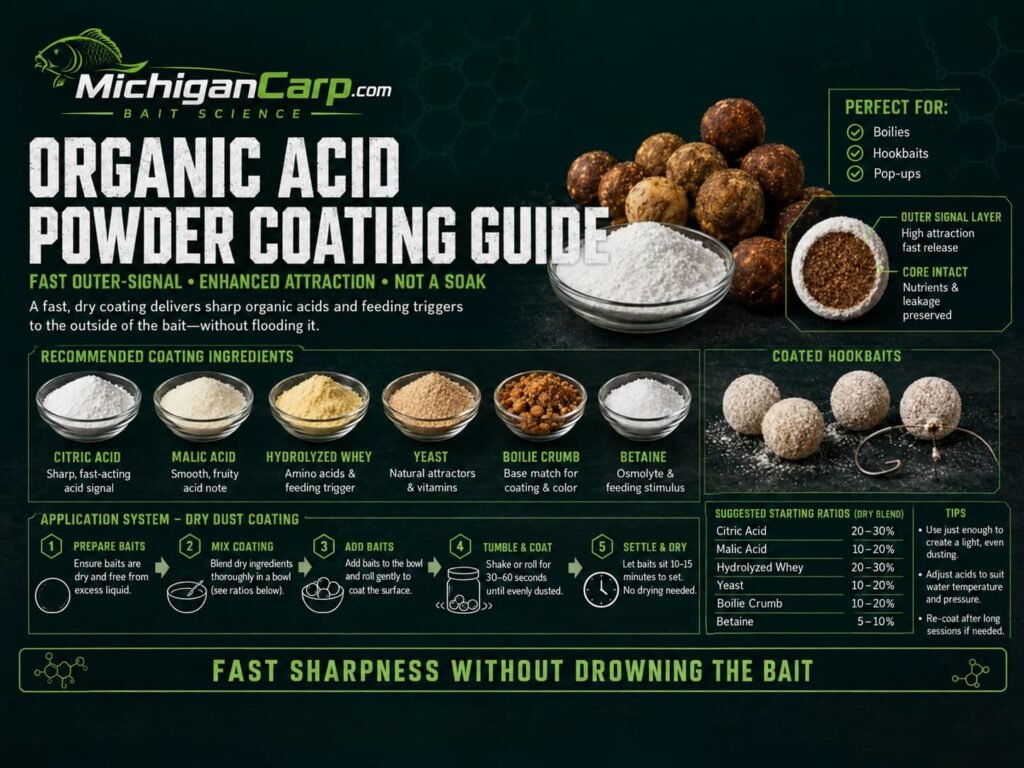
Do not roll damp hookbaits directly in pure citric or malic acid. Uneven crystals can create intense local sourness and make the test difficult to reproduce.
Packbait and method mix
Acid should not interfere with the primary mechanical job of packbait or method mix.
The mixture must still bind, cast, reach the bottom and break down at the intended rate.
A small amount of acid-containing boilie crumb or a same-session food-vinegar liquid can be tested, but the breakdown test remains more important than the smell of the wet mix.
Use Packbait for Carp Fishing for the complete mechanical system.
Prepared particles
Acid belongs after the particle has been soaked, cooked and cooled correctly.
A simple same-session comparison can use three equal containers of prepared particles:
| Prepared particles | Food vinegar at 5% acidity | Purpose |
|---|---|---|
| 500 g control | 0 ml | Shows the normal cooked particle |
| 500 g low test | 5 ml | Tests a light fermented edge |
| 500 g higher test | 10 ml | Shows whether the stronger treatment becomes dominant |
Keep the samples cool and use them promptly. This is a flavor and handling comparison—not a preservation validation.
PVA compatibility
The acid itself is not the only PVA question.
Water and other aqueous ingredients are often the main reason a liquid weakens PVA. Propylene glycol, glycerin, syrups and formulated liquids can also behave differently depending on their water content.
- Prepare the final liquid or coated bait exactly as it will be fished.
- Place a scrap of the actual PVA material against it.
- Wait longer than the expected loading and casting time.
- Check for softening, sticking, pinholes and loss of strength.
- Repeat after the treated bait has stood for several hours.
“PVA-friendly” should describe a tested finished product—not an assumption based on one ingredient.
Organic Acids Do Not Create Shelf Life by Themselves
Acidification can support antimicrobial preservation, but shelf life depends on the complete bait system.
Important controls include:
- water activity;
- finished-bait pH measured by a repeatable method;
- the correct antimicrobial ingredients;
- ingredient quality and hygiene;
- drying consistency;
- packaging and oxygen exposure;
- storage temperature;
- fat oxidation;
- retained-sample testing.
The FDA explains that water activity measures the moisture available to support chemical reactions and microbial growth. See FDA: Water Activity in Foods.
The familiar pH 4.6 threshold belongs to US acidified and low-acid canned-food regulation. It is not a boilie target and does not establish safe room-temperature storage for egg-based bait.
Robert’s shelf-life work uses potassium sorbate, sodium benzoate and citric acid as a combined system. Even that does not justify a claimed storage period without pH, water-activity and retained-sample evidence.
The detailed framework belongs in How to Tell When Boilies Are Dry Enough and Potassium Sorbate, Sodium Benzoate and Citric Acid in Shelf-Life Boilies.
For ordinary homemade freezer bait, use How to Store Homemade Boilies.
How to Select and Buy Acid Ingredients
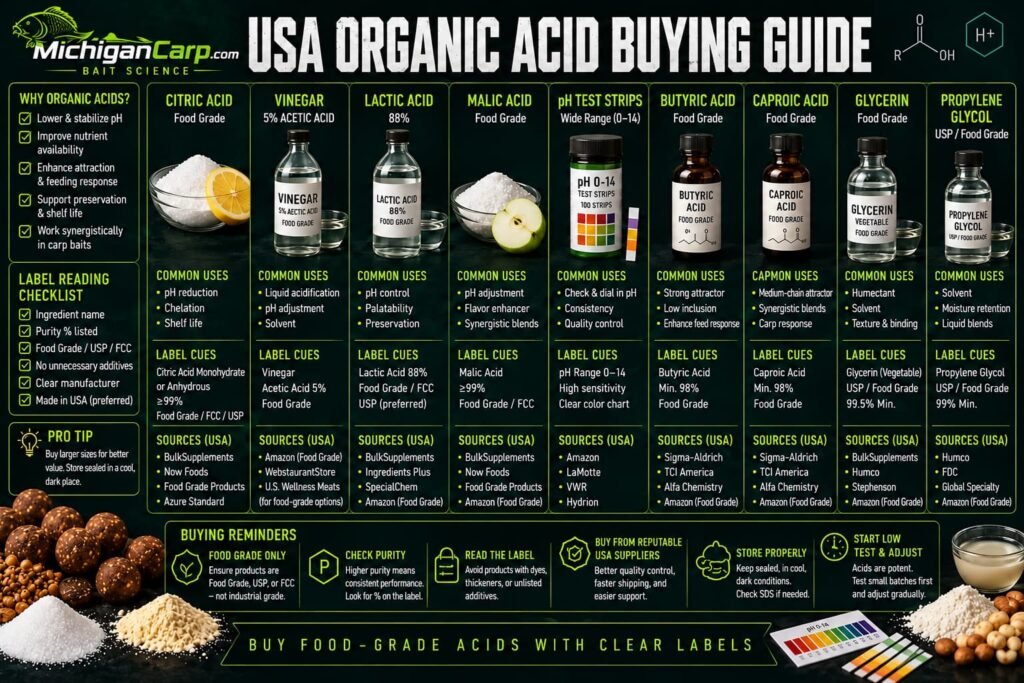
Food, brewing, winemaking and specialist ingredient suppliers can provide suitable products, but the label remains more important than the shop category.
| Check | What to record |
|---|---|
| Identity | Exact chemical and product name |
| Grade | Food-grade or clearly suitable feed-grade status |
| Concentration | Percentage, assay or guaranteed analysis |
| Form | Powder, aqueous solution, salt, ester, flavor or blend |
| Carrier | Water, propylene glycol, glycerin, alcohol, oil or proprietary system |
| Instructions | Supplier application and storage guidance |
| Safety | Label hazards and Safety Data Sheet |
| Traceability | Supplier, date opened and lot number where available |
For routine home bait work, the easiest controlled options are food-grade citric or malic acid powder and normal food vinegar with a declared acidity.
Liquid lactic acid requires concentration information. Concentrated butyric, hexanoic and glacial acetic acid require substantially greater handling control and are not necessary for most home bait makers.
Avoid:
- cleaning or pool acids;
- automotive products;
- unknown fragrance oils;
- unlabeled “sour” concentrates;
- products without concentration information;
- transferring acids into unmarked bottles;
- using household food utensils for concentrated products.
A calibrated meter is more useful than pH paper for opaque boilie slurries. Strips can provide a rough indication in a clear liquid but are easily obscured by color and particles.
Controlled Acid Testing and Troubleshooting
An acid test should answer one clear question.
Do not change the acid, flavor, sweetener, hydrolysate, color, egg level and cooking method in the same experiment.
Three-batch dry-acid test
| 500 g batch | Citric-acid example | Malic-acid example |
|---|---|---|
| Control | 0 g | 0 g |
| Low | 0.5 g | 0.25 g |
| Higher | 1.0 g | 0.5 g |
Test citric and malic in separate experiments. The table shows equivalent levels of 0, 1 and 2 g/kg for citric and 0, 0.5 and 1 g/kg for malic.
What to record
- complete recipe version;
- acid identity, grade and amount;
- liquid concentration where applicable;
- wet-phase and paste weight;
- comparative slurry pH;
- paste handling and rolling;
- cooking and drying;
- surface and internal texture;
- one-, six-, twelve- and twenty-four-hour immersion behavior;
- hookbait buoyancy where relevant;
- field position, surrounding feed, bites and captures.
Common problems
| Problem | Possible acid-related cause | Controlled response |
|---|---|---|
| Fruit bait becomes harsh | Acid level is too high or the wrong acid was selected | Return to the control and reduce one acid only |
| Milk liquid thickens unevenly | Concentrated acid contacted protein locally | Improve pre-dispersion and addition order |
| Paste rolls differently | Protein, mineral or hydration behavior changed | Compare with the acid-free control before changing binders |
| Low pH but poor bait identity | The number became more important than the flavor system | Rebuild around the intended food profile |
| Vinegar-treated particles spoil | Vinegar was mistaken for full preservation | Improve cooling, hygiene and storage; use promptly |
| Wafter sinks | Liquid carrier increased mass or water uptake | Reduce treatment and retest the exact rig |
| PVA weakens | The treatment contains too much water | Test the finished product and reduce aqueous liquid |
| Strong smell but little soluble release | Volatile odor is being confused with waterborne leakage | Review soluble ingredients and bait structure |
| Mold develops despite low pH | Water activity, hygiene or preservative control is inadequate | Use the complete shelf-life framework |
| Results cannot be interpreted | Several acids and other variables changed together | Repeat with one controlled acid variable |
Use How to Test Boilies Before Fishing for the complete physical testing process.
My Practical View
I see organic acids as precision ingredients rather than headline attractors.

Citric acid is the easiest place to begin because it is a stable powder, widely available and simple to weigh accurately.
Malic acid is a useful alternative when I want to test whether a fruit profile needs a different kind of tartness.
Lactic acid can suit a fermented milk or cream direction, but the actual concentration must be known.
Food vinegar can be useful with correctly prepared particles or same-session bait, but I would not use it as proof of safety or storage life.
Butyric and hexanoic acids belong in the specialist category. I prefer a professionally prepared, clearly identified product rather than improvising a stock from concentrated acid.
In my Plum, Scopex and Vanilla bait, the established control already contains one product-specific butyric accent. I would compare citric or malic acid against that control rather than adding both automatically.
For shelf-life work, citric acid becomes part of a larger pH, preservative, water-activity, drying and storage system.
The acid should always have a recorded job:
- clarify a fruit profile;
- add controlled fermented character;
- move pH for a measured technical reason;
- support a separately validated preservation system.
Do not chase acidity. Use one identified acid to make one measured improvement.
FAQ
What are organic acids in carp bait?
They are carbon-containing acids used for purposes such as fruit sharpness, fermented character, pH control and preservation support. Citric, malic, lactic, acetic, butyric and hexanoic acids are different ingredients.
Does lower pH make bait more attractive?
Not automatically. Controlled carp studies show that responses differ among acids and that pH alone does not predict pellet acceptance.
Can common carp taste organic acids?
Yes. Laboratory studies show common carp respond differently to carboxylic-acid pellets. Some acids can increase acceptance, while others have no effect or can reduce it.
How much citric acid should I test in boilies?
A conservative comparison is a control against 1 g and 2 g per kilogram of dry mix. These are practical test levels rather than a universal optimum.
Is malic acid better than citric acid for Plum boilies?
It may produce a different fruit impression, but it must be tested. Compare citric and malic in separate batches against the same acid-free control.
Can lactic acid be measured with one universal milliliter rate?
No. Liquid products have different concentrations. Record the assay or percentage and follow product-specific guidance.
Is vinegar useful for carp bait?
Food vinegar can be tested as a same-session finishing liquid for properly prepared particles or boilies. It adds water and acetic character and does not create dependable shelf life by itself.
Can vinegar make particles safe?
No. Particles still require appropriate soaking, cooking, cooling and storage. Vinegar is not a substitute for safe preparation.
Should I dilute concentrated butyric or hexanoic acid at home?
A professionally prepared product with known concentration, carrier and supplier guidance is the safer bait-room option. Do not copy homemade stock recipes without the necessary technical and safety controls.
Do organic acids preserve boilies?
They can support preservation, but dependable shelf life also depends on water activity, antimicrobial ingredients, hygiene, drying, packaging, temperature and retained-sample testing.
Does pH below 4.6 make a boilie shelf-stable?
No. The pH 4.6 threshold comes from acidified and low-acid canned-food regulation. It is not a validation target for homemade boilies.
How should boilie pH be measured?
For internal comparison, use a calibrated meter and one repeatable ground-bait slurry method. Record the sample-to-water ratio, temperature, resting time and duplicate readings.
Are acid glugs PVA-safe?
Not necessarily. Water content often controls PVA compatibility more than acid identity. Test the complete finished treatment against the actual PVA product.
Can acids change wafter or pop-up buoyancy?
Yes. Liquid carriers and absorbed moisture add mass. Test the finished hookbait on the exact rig after its full intended soak.
Next Steps
- Butyric Acid in Carp Bait: Acids, Butyrates and Esters Explained — understand Robert’s product-specific use and specialist-acid safety.
- How to Flavor Boilies Properly: Strength, Carriers and Layering — place acid accents inside a coherent flavor system.
- Plum Scopex Vanilla Boilie: Development and Michigan Results — follow the complete control bait and field record.
- Potassium Sorbate, Sodium Benzoate and Citric Acid in Shelf-Life Boilies — build the separate antimicrobial system.
- How to Tell When Boilies Are Dry Enough — validate storage rather than relying on pH alone.
- How to Prepare Boilies for Carp Fishing: Glugs, Soaks and Hookbait Conditioning — treat specialist hookbaits without destroying presentation.
- Propylene Glycol vs Glycerin in Carp Bait — compare common carriers used in acid and flavor products.
- Minerals, Salts and pH in Carp Bait — understand buffering, minerals and ionic effects.
- How pH Changes Carp Bait Performance — measure and interpret pH consistently.
- Carp Bait Solubility and Leakage — separate airborne odor from waterborne release.
- How to Formulate a Milk, Nut and Birdfood Boilie Base Mix — place acid inside the complete formula.
- How to Prepare Particles for Carp Fishing — prepare particles safely before acid finishing.
- How to Test Boilies Before Fishing — compare control and acid-treated batches.
- Bait Science — explore bait chemistry, formulation and stability.
- Boilie School — follow the structured boilie-making route.