
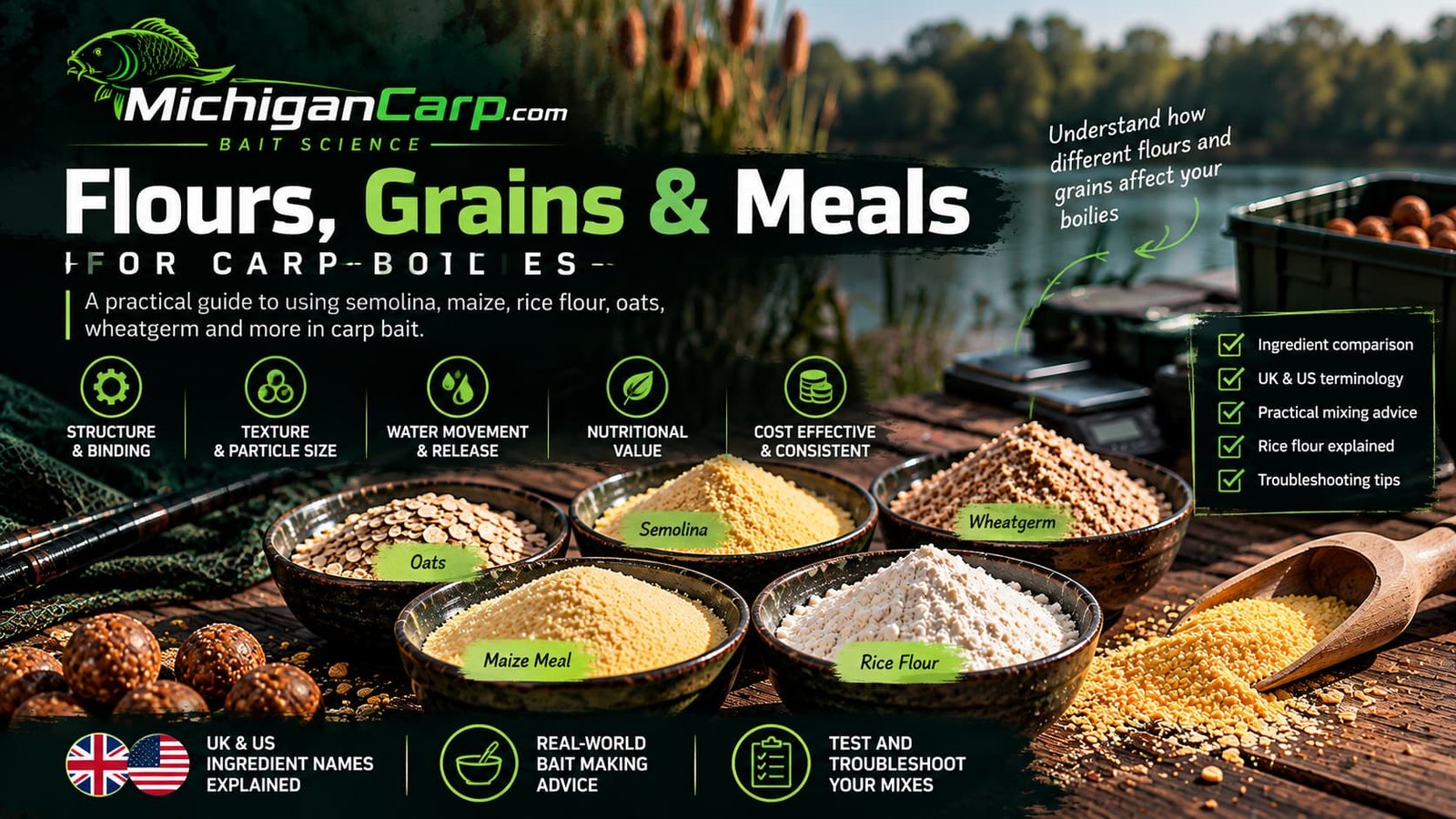
Choosing flours and grains for carp boilies involves much more than finding inexpensive ingredients. Semolina, maize, rice flour, oats and wheatgerm can all influence how a bait mixes, rolls, cooks and behaves in the water.
Semolina, maize meal, wheat flour, rice flour, oats and wheatgerm all have places in carp bait making. The difficulty is that they do not perform the same job. One ingredient may improve paste handling, another contributes texture, and another supplies starch without offering much binding strength.
This guide explains how to select and combine these ingredients, including the differences between British and American product names. It is intended for anglers building their own boilies, from simple cereal-based recipes to more complicated milk-protein, nut, birdfood or fishmeal formulations.
For anglers following recipes from both sides of the Atlantic, our UK–USA Carp Bait Glossary explains ingredient names, equivalent products and important differences to check before making substitutions.
Table of Contents
Quick Start: Choosing Flours for Carp Boilies
If you are making your first boilie mix, begin with the function of each ingredient rather than trying to include every flour available.
- For reliable structure: Start with semolina or a suitable wheat flour.
- For starch and texture: Consider fine maize flour, cornmeal or rice flour.
- For a different consistency: Experiment with oats, wheatgerm or a modest amount of coarse cereal material.
- For additional binding: Review the whole formulation before reaching for concentrated wheat gluten.
- For a more nutritious bait: Balance cereals with suitable proteins, fats and other ingredients rather than expecting flour alone to provide everything.
The essential question is not which flour catches the most carp. It is which ingredient helps the finished bait do the job you need it to do.
For the broader principles of formulation, see Boilie Ingredients Explained.
What Flours and Grains Actually Do in a Boilie
A cereal ingredient can perform several different functions simultaneously. Understanding those functions makes it easier to diagnose problems and avoid unnecessary additions.
Structure and binding
A boilie needs sufficient cohesion to survive mixing, extrusion, rolling and cooking. During preparation, hydrated wheat proteins, starch, eggs and other binding ingredients contribute to that structure.
Semolina and wheat flour are popular partly because they can produce manageable doughs in many formulations. But no individual flour guarantees a successful bait. Protein concentrates, coarse particles, liquid quantity and mixing method also matter.
Starch and energy
Rice, maize, wheat and oats contain substantial amounts of starch. Starch contributes carbohydrate energy and influences how the bait behaves when heated in water.
Under suitable moisture and heating conditions, starch granules absorb water and gelatinise. The extent of that change depends on the ingredient, particle size, temperature, water availability and cooking time.
That is one reason raw flour, hydrated paste and a finished boiled bait behave differently.
Texture and particle size
Compare a very fine flour with coarse polenta. They may originate from the same cereal, yet their particle sizes influence mixing and the finished bait’s texture.
Coarse particles can interrupt an otherwise smooth paste, while fine particles help create a more uniform mixture. Neither is automatically better.
Water movement and release
A common claim is that a particular flour makes boilies leak faster. The reality is more complicated.
Cereal flour is not the same thing as a water-soluble attractant. The finished bait’s hydration, porosity, cooking, drying and soluble ingredients affect how material moves into the surrounding water.
A boilie can remain physically intact while releasing soluble compounds. Equally, a bait that sheds crumbs is not necessarily releasing a stronger dissolved feeding signal.
The distinction is explained in Carp Bait Solubility and Leakage.
Cost and repeatability
Cereals are generally accessible to home bait makers. They allow anglers to adjust texture and structure without relying exclusively on expensive specialist ingredients.
Their greatest practical advantage may be repeatability: ingredients that are affordable and consistently available make controlled testing easier.
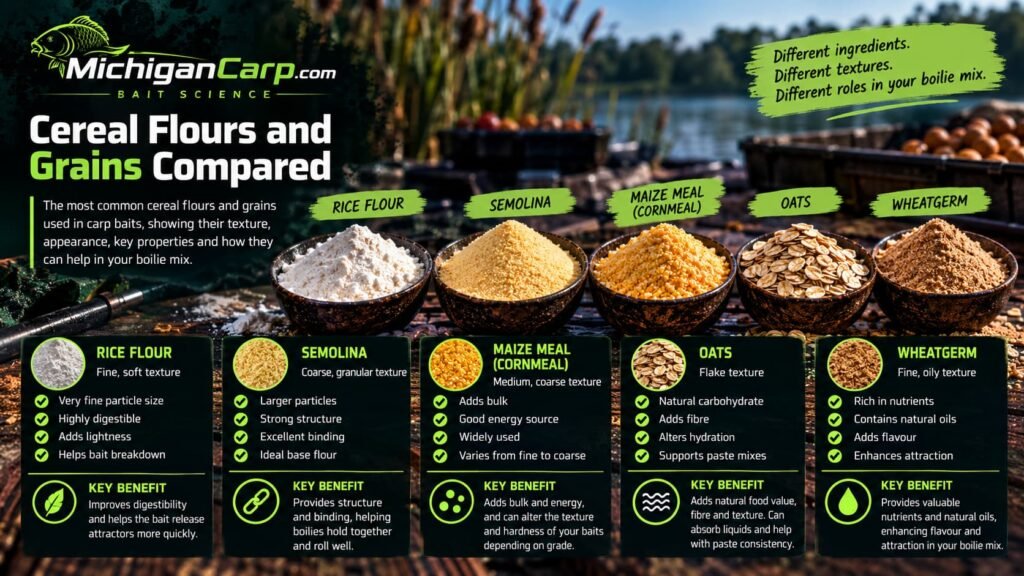
Flour and Grain Comparison Table
The following table is a starting guide, not a prediction of how an ingredient will perform in every boilie recipe.
| Ingredient | Main contribution | Important consideration |
|---|---|---|
| Semolina | Structure, starch, paste handling | Coarse and fine grades behave differently |
| Wheat flour | Cohesion, starch, elasticity | Protein content varies by type |
| Maize flour / cornmeal | Starch, texture, bulk | Grind size strongly affects consistency |
| Rice flour | Fine starch-rich material | Does not form a wheat-style gluten network |
| Oat flour | Starch, fibre, texture | Can alter hydration and paste consistency |
| Wheatgerm | Nutrients, fat, texture | Freshness and storage matter |
| Wheat bran | Fibre, coarse texture | Excessive amounts may weaken cohesion |
| Farina | Milled wheat cereal material | Not always equivalent to durum semolina |
| Breadcrumb / biscuit meal | Texture, starch and bulk | Composition varies with the product |
| Corn gluten meal | Concentrated maize protein | Not the same as cornmeal or wheat gluten |
| Vital wheat gluten | Concentrated wheat binding protein | Small additions can substantially change texture |
These materials are tools for the bait maker. Their usefulness depends on the complete formulation.
Flours and Grains for Carp Boilies: Ingredient Guide
Semolina: A dependable structural ingredient
Semolina is milled from durum wheat and is a familiar ingredient in traditional carp boilie recipes.
Its usefulness comes from a combination of starch and wheat proteins, along with the physical characteristics of the milled grain. It can help create a workable paste and contribute to the texture of a cooked bait.
However, a fine semolina and a coarse semolina need not behave identically. The amount of liquid required, the smoothness of the finished paste and its handling during rolling may change.
Semolina makes a sensible starting point for many formulations, particularly when combined with ingredients that contribute other nutritional or textural properties.
Do not assume that adding more always produces a better bait. Beyond a certain point, it may simply alter the balance you originally intended.
Wheat flour: All-purpose, bread and whole wheat
Wheat flour is readily available in both the UK and the USA.
American all-purpose flour and British plain flour are broadly comparable categories, but their protein specifications are not identical across brands.
Bread flour generally contains more gluten-forming protein than many all-purpose flours. When properly hydrated and worked, that can influence dough elasticity and cohesion.
Whole-wheat flour includes more of the original grain components and can behave differently because of its bran and germ content.
Choose the type according to how the finished paste handles. A flour that creates an excellent bread dough is not automatically the ideal flour for every carp boilie.
Maize meal, cornmeal and polenta
Maize is a useful carbohydrate ingredient in many established boilie formulations.
Fine maize flour produces a different texture from coarse-ground cornmeal or polenta. A coarser product may create a more visibly granular bait, while fine material tends to blend more evenly with other powders.
Neither guarantees improved attraction or faster leakage.
When sourcing maize ingredients in America, check whether the product is plain ground corn, a nixtamalised product such as masa harina, or a refined starch. These are not interchangeable simply because they share the word corn.
Yellow and white maize products may also differ in composition and milling specification. Colour alone tells us little about their usefulness in bait.
Farina and milled wheat cereals
In the USA, farina is commonly sold as a hot breakfast cereal, including products marketed as Cream of Wheat.
It is made from milled wheat, but it should not automatically be treated as identical to durum semolina.
It may be useful as part of a structural cereal blend, depending on its grind and composition. Check whether a breakfast product contains other ingredients or fortification before substituting it directly into a recipe.
Rice Flour for Carp Bait: What You Need to Know
Rice flour deserves closer attention because it is widely available, reasonably priced in many markets, and often described in bait-making discussions as a hardener or binder.
That description needs qualification.
What rice flour contributes
Ordinary rice flour is a finely milled, starch-rich ingredient. It can change dough consistency, cooking behaviour and the texture of the finished boilie.
Unlike wheat flour, rice flour does not contain the gluten-forming protein system responsible for the characteristic elasticity of wheat dough.
Consequently, it should not be assumed to provide the same binding strength as semolina or wheat flour.
Rice starch can contribute to structure after suitable hydration and heating, but its performance depends on the surrounding ingredients and processing conditions.
In some mixes it may help produce a compact texture. In others, excessive substitution for an effective binder can result in weaker, more brittle bait.
White rice flour versus brown rice flour
White rice flour is produced from polished rice and is predominantly starch.
Brown rice flour retains more of the bran and germ components, contributing differences in fibre, fat and nutrient composition.
Those differences can influence handling and storage. Because brown rice flour contains more lipid-bearing material, it deserves particular attention to freshness.
For controlled experiments, ordinary white rice flour is a straightforward starting material. There is no requirement to use brown rice flour merely because it sounds nutritionally richer.
Rice flour is not glutinous rice flour
Asian grocery stores often sell both ordinary rice flour and glutinous rice flour, sometimes called sweet rice flour.
The word glutinous refers to the sticky character associated with its starch composition, not the presence of wheat gluten.
These flours can behave differently when heated and hydrated. If you change from one to the other, treat it as a genuine formulation change rather than a straightforward substitution.
How much rice flour should you use?
There is no scientifically established universal inclusion percentage for rice flour in carp boilies.
As a practical experiment, you could begin by replacing a small part of an existing cereal fraction with ordinary rice flour and comparing the result against an unchanged control batch.
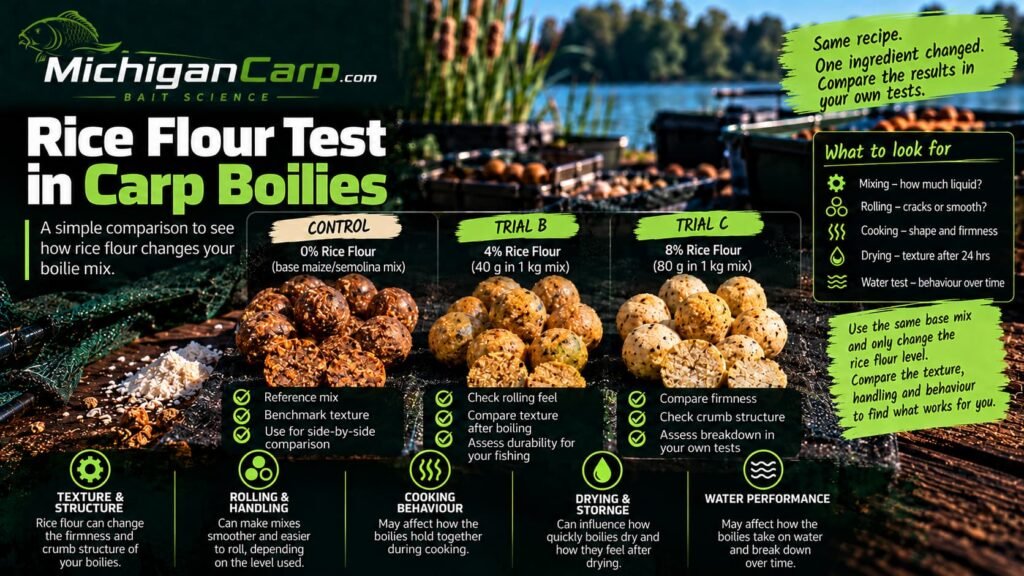
For a 1 kg dry mix, trial additions of 40 g and 80 g represent 4% and 8% of the formula. They are convenient comparison points, not proven optimum levels.
The sensible amount depends on the remaining structural ingredients, eggs, other liquids, particle size, cooking method and the result you want.
What should rice flour be combined with?
Rice flour can be tested alongside semolina, wheat flour, maize products and protein-containing ingredients.
In a milk-protein or nut-based bait, it may offer a useful way of adjusting the cereal layer without changing the nutritional ingredients.
But if the original recipe already rolls, cooks and performs well, adding rice flour may provide no meaningful improvement.
The purpose is to solve a problem, not introduce another powder simply because it is available.
Oats, Wheatgerm, Bran and Other Supporting Ingredients
Oat flour and ground oats
Oats contribute starch, some protein, fat and fibre. Grinding rolled oats at home can provide a practical ingredient, although the texture will depend on the grinder and the oats used.
They may change water absorption and produce a different paste consistency from wheat or rice flour.
Use them as a controlled part of the blend rather than assuming they will make a bait softer, more attractive or more digestible in every formulation.
Wheatgerm
Wheatgerm is the germ portion of the wheat kernel. It contains protein, lipids and various micronutrients.
It can add nutritional and textural variation, but it should not be treated as a guaranteed feeding stimulant.
Its fat content also matters during storage. Buy sensible quantities, keep them cool and dry, and reject material that develops an obviously stale or rancid odour.
Wheat bran
Bran is richer in fibre than refined wheat flour and can change the texture of a cereal mixture.
In small quantities it may be useful when experimenting with coarse texture. At higher levels it can interrupt a smooth binding matrix and make rolling or cooking more difficult.
It is best regarded as a texture adjustment rather than a primary structural ingredient.
Breadcrumbs and biscuit meals
Plain breadcrumbs and selected biscuit meals provide convenient cereal material.
Their composition varies considerably. Commercial breadcrumbs may contain salt, oils, seasonings or other additions, while biscuit meals can contain sugar and fat.
Check the label before assuming two products behave the same way.
Corn gluten meal is not wheat gluten
Corn gluten meal is a maize-processing coproduct used as a concentrated protein ingredient. Despite its name, it does not contain wheat-style gluten.
It is also different from corn gluten feed, ordinary cornmeal and vital wheat gluten.
If sourcing it from agricultural suppliers, confirm the exact ingredient and obtain a suitable feed-grade specification. Avoid products formulated for lawn or weed-control use.
For a broader discussion of plant-ingredient suitability, read Anti-Nutritional Factors in Carp Bait.
Chickpea flour, peanut flour and other legume or nut meals are separate ingredient families. They can contribute protein, fat or texture, but should not be treated simply as cereal substitutes. See Nut & Seed Meals for that category.
Soya Flour: A Legume Rather Than a Cereal
Soya flour (soy flour in the USA) is commonly used in homemade carp boilies, although soybeans are legumes rather than cereal grains.
Full-fat soya flour typically contains around 40% protein and 18–21% fat, making it useful for contributing both protein and oil to a base mix. Defatted soya flour contains less fat and generally more protein. Both can influence water absorption, dough consistency and finished-bait texture, but neither behaves exactly like wheat flour.
For bait making, choose a properly heat-treated or toasted product with a known specification. Raw soybean flour can contain active trypsin inhibitors, and briefly boiling finished baits should not be relied upon to correct inadequate ingredient processing.
Soya can be a valuable part of milk-protein, birdfood, nut and fishmeal formulations, but the inclusion level should be judged against the whole recipe rather than following a universal percentage.
For more information, see Vegetable Proteins and Anti-Nutritional Factors in Carp Bait.
UK versus USA: Flour and Corn Terminology
This is an area where British and American bait makers can easily misunderstand each other.
| UK terminology | US terminology or explanation |
|---|---|
| Maize | Corn |
| Maize meal | Cornmeal, depending on grind |
| Cornflour | Cornstarch — refined maize starch |
| Fine maize flour | Often sold as corn flour in the USA |
| Plain flour | Broadly similar to all-purpose wheat flour |
| Strong bread flour | Bread flour, with specification differences |
| Wheatgerm | Wheat germ |
| Semolina | Semolina, usually durum wheat |
| Gram flour | Chickpea flour or besan |
The most important distinction is cornflour versus corn flour.
In British cooking, cornflour generally means the refined white starch Americans call cornstarch.
American corn flour commonly refers to finely ground maize. It is not necessarily pure cornstarch.
Neither should be confused with coarse cornmeal.
Masa harina is another separate product: maize that has undergone alkaline treatment, usually called nixtamalisation, before being dried and milled.
When working from a British or American recipe, check the actual ingredient description rather than relying on a familiar name.
A Practical Rice Flour Test for Your Own Boilie Mix
Here is a simple way to investigate rice flour without changing your whole bait.
Suppose an existing 1 kg dry boilie mix includes a 300 g cereal fraction, with all other ingredients accounting for the remaining 700 g.
Keep the other 700 g unchanged and compare these three cereal blends:
| Cereal ingredient | Control A | Trial B | Trial C |
|---|---|---|---|
| Semolina | 160 g | 160 g | 160 g |
| Maize meal | 140 g | 100 g | 60 g |
| Rice flour | 0 g | 40 g | 80 g |
| Total cereal fraction | 300 g | 300 g | 300 g |
This is a controlled substitution test, not a finished bait recipe. It assumes the other 700 g already forms part of a workable formulation.
Make small batches and record the same observations:
- Mixing: Does the powder hydrate readily? How much liquid is needed for comparable paste consistency?
- Rolling: Does the paste roll evenly, crack, stick or crumble?
- Cooking: Do the baits retain their shape under the same method?
- Drying: What changes after the same drying period?
- Water exposure: How do the baits behave after 30 minutes, two hours and overnight in the same water conditions?
Keep bait size, cooking method, drying environment and other ingredients as consistent as practical. Record necessary adjustments to liquid volume rather than hiding them.
A batch that rolls beautifully may not produce the best finished texture. A bait that feels hard when dry may soften unexpectedly in water.
The purpose of the test is to understand what changed and whether that change is useful.
For more on physical release behaviour, refer to Carp Bait Solubility and Leakage.
Troubleshooting Common Cereal Base Problems
The paste cracks during rolling
Possible causes include insufficient hydration, excessive coarse material, weak cohesion or a mismatch between the cereal fraction and the protein ingredients.
First check your liquid additions, resting time and mixing method. Then consider whether a modest increase in an effective structural ingredient is appropriate.
Adding concentrated gluten should not be the automatic first response.
The paste is sticky and difficult to handle
Sticky paste can result from excess moisture, ingredient hydration characteristics or processing technique.
Allowing a short resting period may change the consistency as dry materials absorb moisture. Avoid adding large amounts of extra flour immediately, because doing so changes the recipe.
Record what you add so the next batch can be repeated.
The boilies become too hard
Hardness has several possible causes: ingredient balance, protein coagulation, water content, cooking time, drying conditions and storage.
Do not blame one flour without testing it.
Compare the finished bait with an earlier successful batch, then change one variable at a time.
The baits crack after drying
Excessively rapid drying, large moisture differences or weak internal cohesion may contribute.
Try drying under more consistent conditions and checking the bait’s behaviour before changing the entire formula.
The bait breaks apart too quickly
Review the proportion of coarse particles, structural proteins, egg mix and cooking method.
A bait that disintegrates in one hour may be useful in one application and unsuitable in another. Decide what water life you actually require.
The bait looks intact but seems inactive
Appearance cannot tell you how much dissolved material a bait releases.
Do not assume a hard boilie is chemically inactive, or that a cloudy bait is necessarily more attractive.
A sensible water test can compare softening and visible breakdown. It cannot, by itself, prove that one bait will catch more carp.
Michigan Notes: Matching the Bait to the Session
In colder water, I pay attention to how a bait behaves over the time it is expected to fish. That might mean a durable hookbait accompanied by a small amount of crumb or other material capable of releasing soluble compounds locally.
I would not automatically replace nutritious ingredients with cereal flour in the belief that a softer bait always performs better in spring.
On waters containing abrasive structure, timber or nuisance fish, durability becomes more important. The hookbait must remain suitable for the intended rig and fishing period.
These decisions are not unique to Michigan. British and European anglers face similar questions about bait durability, water movement and natural food competition.
The principle is the same everywhere: match the bait’s physical behaviour to the fishing situation, rather than choosing an ingredient because it has a fashionable reputation.
Frequently Asked Questions
Is rice flour good for carp boilies?
It can be useful as part of the cereal fraction. Its main potential benefits are related to starch, particle size and cooked-bait texture. It is not a substitute for understanding the whole formula.
Does rice flour make boilies harder?
It may change firmness in some formulations, but increased hardness is not guaranteed. The result depends on the other ingredients, hydration, cooking and drying.
Is rice flour a good binder?
Rice flour does not form the same elastic gluten network as wheat flour. Its starch can contribute to structure after heating, but its binding performance must be judged in the complete mix.
What is the difference between cornmeal and cornflour?
In the UK, cornflour usually means refined cornstarch. In the USA, corn flour usually means finely ground maize, while cornmeal is generally coarser.
Can I make boilies without semolina?
Yes. Other combinations of structural ingredients, proteins and binders can work. However, replacing semolina may require adjustments to hydration, rolling and cooking.
Is wheatgerm an attractant?
Wheatgerm contributes nutritional and physical properties, but there is no basis for treating it as a universally effective carp attractant.
Should I use fine or coarse flour?
It depends on the texture and processing behaviour required. Fine and coarse materials can both be valuable, but they should be tested rather than treated as interchangeable.
Are expensive specialist cereal meals necessary?
Not necessarily. Ordinary food-grade ingredients may perform the required structural jobs reliably. Specialist ingredients can still have legitimate value where their composition or processing characteristics serve a specific purpose.
Final Word: Choose Function Before Fashion
Successful boilie making is not a competition to include the greatest number of ingredients.
Semolina, maize, wheat, rice and oats all have potential uses. What matters is how they work together with the proteins, liquids, fats and other components of the finished bait.
Start with a formula that already performs reasonably well. Identify the problem you want to solve. Change one ingredient or one small group of ingredients, and test the result.
That approach produces useful knowledge, not just another complicated recipe.
Know your bait. Understand your ingredients. Fish with confidence.
Sources and Further Reading
The scientific and ingredient-terminology background can be explored through the American Society of Baking’s rice flour reference, USDA guidance on grains and nixtamalisation, UK Government guidance on flour terminology and the University of Illinois explanation of corn gluten meal.
Next Steps
Continue with Bait Ingredients for the wider ingredient families, Boilie Ingredients Explained for formulation fundamentals, and Carp Bait Science for the science behind food value, processing and release.