
Marine Boilie Ingredients
Fishmeal, krill, squid, mussel ingredients, hydrolysates and oils—choose each for the job it needs to do.
Marine boilie ingredients can contribute to a practical carp bait, but the name on the packet does not tell you how the finished boilie will behave. This guide helps UK and USA bait makers compare product forms, read specifications and plan small, repeatable trials.
When choosing marine boilie ingredients, start with a workable base mix and define each ingredient’s role. Test the complete bait before buying or making it in bulk.
Choose the Food Base
Compare meals by identity, analysis and consistency before changing your main recipe.
Start with fishmeal →Understand the Liquid
Separate hydrolysates, recovered solubles and oils before comparing amounts.
Compare product forms →Make a Useful Trial
Keep a control, change one ingredient and record the result after cooking.
Plan a small batch →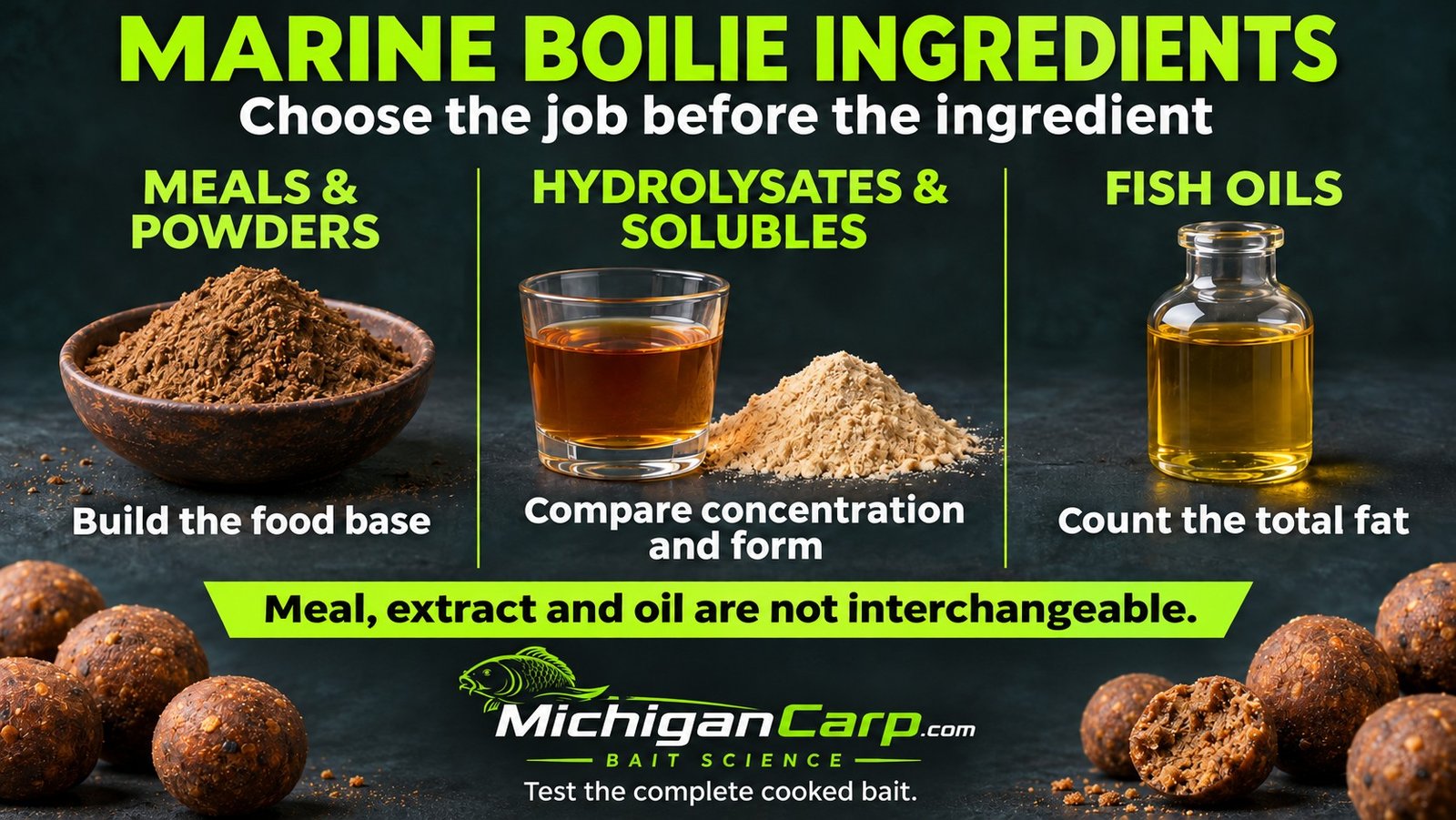
Marine Boilie Ingredients at a Glance
Choose marine boilie ingredients for defined jobs. A meal supplies a different package from an extract, and neither is equivalent to an oil. “Marine” describes origin, not a guaranteed level of attraction.
| Ingredient | What to evaluate | Practical decision |
|---|---|---|
| Fishmeal | Protein, oil, ash, freshness and particle size | Consider it as part of the food base; retain enough structure for rolling and cooking. |
| Krill or shrimp meal | Whole meal versus extract, shell content, oil and grind | Test the actual product for dough handling, density and finished-bait behaviour. |
| Squid products | Meal, dried tissue, extract, hydrolysate or flavour blend? | Identify the form before choosing an inclusion level. |
| Green-lipped mussel | Whole powder, extract, hydrolysate and any carrier | Treat it as a specialist ingredient with a measurable cost. |
| Fish hydrolysates and solubles | Dry solids, protein fractions, salt, water and preservation | Compare concentration before comparing the price per bottle. |
| Fish oil | Oil identity, freshness and total recipe fat | Count it separately from protein ingredients and water-based liquids. |
Fishmeal: Start with the Specification
Fishmeal is one of the main marine boilie ingredients, but it is a processed material, not simply dried fish smell. FAO describes conventional manufacture as cooking, separating liquids and oil, concentrating recovered solubles, drying and grinding. Differences in raw material and processing help explain why two meals can behave differently.
Read the analysis for protein, fat, ash and moisture. Ash is the mineral residue measured in analysis; it is not another name for protein. A high protein figure does not describe the entire ingredient or predict how a boilie will roll.
Standard, low-temperature and “pre-digested” labels
A low-temperature label concerns processing. Ask for supporting information rather than assuming the label proves superior bait performance. “Pre-digested” is especially worth checking: establish whether the supplier means a hydrolysed product, its composition and how it differs from ordinary meal.
Choose a consistent, documented product first. A repeatable supply is more useful for learning than continually changing meals while keeping the recipe name the same. See Fishmeal Boilies vs Milk Baits for the broader bait-family comparison.
Krill, Shrimp, Squid and Mussel Ingredients
Krill and shrimp: check what is actually in the bag
When comparing marine boilie ingredients such as krill and shrimp, do not substitute products solely because both names describe crustaceans. Ask whether the product is a whole meal, a shell-rich material or a processed extract. Compare the supplier’s analysis and grind, then assess the complete boilie.
In a small trial, record whether the dough becomes easier or harder to roll and whether the cooked bait still sinks and survives its intended fishing period. Do not assume that a dramatic colour or strong smell represents a better feeding response.
Squid: one name, several product forms
Among marine boilie ingredients, “squid” can refer to meals, powders, liquids or flavour products. These are purchasing categories to clarify, not interchangeable additions. A flavour blend does not establish a squid-protein contribution, and a liquid should not replace dry meal gram-for-gram without accounting for its water and solids.
Green-lipped mussel: use a specific product for a specific reason
With GLM, identify whether you are buying whole powder, an extract or a hydrolysate. Read the complete ingredient list and look for carriers or blends. Cost the amount used in one finished batch, rather than judging value by the small packet price.
For the detailed distinctions and evidence limits, read Green-Lipped Mussel in Carp Bait. Wild carp encountering freshwater mussels does not, by itself, prove a preference for a particular marine mussel product.
Hydrolysates, Fish Solubles and Oils
Hydrolysis breaks proteins into smaller fractions. The resulting product is not a single standardized attractant: its source, processing and concentration matter. Fish solubles recovered during meal manufacture are a separate product category; do not assume every soluble fish liquid is enzymatically hydrolysed.
For liquid marine boilie ingredients, compare dry-matter content, protein information, salt, preservatives and storage instructions before weighing one against another. A thicker appearance is not a reliable concentration test. Where the manufacturer supplies a usage range, establish what that range is intended for before applying it to bait.
Illustrative solids calculation: 40 g of a liquid containing 25% dry matter contributes 10 g of solids. A different product at 50% dry matter contributes 20 g of solids in the same 40 g dose. This does not establish equivalent peptide content or attraction; it simply explains why equal liquid weights need not be equivalent additions.
How to Use Hydrolysates and Proteins, Peptides and Hydrolysates cover these differences in more depth.
Fish oil is a separate formulation choice
Do not count oil as a water-soluble protein ingredient. Start by adding up the fat already supplied by meals, eggs, nuts and other ingredients before adding another oil. As a simple calculation, 200 g of meal labelled 10% fat already contributes approximately 20 g of fat.
Test finished baits containing marine boilie ingredients at the water temperature you expect to fish. Avoid a rigid calendar rule that all fishmeal belongs in summer or that a particular oil dose must work in cold water. Use Oils, Fats and Energy and Balancing Fat in Boilies to assess the complete mix.
Buying Marine Boilie Ingredients in the UK and USA
Start with a supplier that clearly identifies the ingredient and its intended food or feed use. Do not assume a similarly named gardening product is an equivalent bait ingredient. Obtain the label before buying a bulk sack.
- Identity: species or source, meal versus extract, and any blended ingredients.
- Analysis: protein, fat, ash and moisture where available; dry solids for liquids.
- Processing: drying method or hydrolysis information if the sales claim relies on it.
- Traceability: producer, batch and dates, rather than a repacked bag with only a nickname.
- Storage: unopened and opened instructions, including refrigeration where specified.
- Practical cost: delivered price, amount used per batch and likely wastage.
For UK recipes bought from US suppliers, use the UK–USA Carp Bait Glossary. A similar name is a starting point for comparison, not permission for an automatic substitution.
IFFO identifies freshness, processing, lipid stability and traceability as important quality considerations. Marine fats can oxidize. Buy quantities you can store and use properly, retain labels and follow the manufacturer’s instructions. An ordinary fishy smell is not proof of freshness, and smell alone cannot establish safety.
Build a Small Trial Before Changing Your Main Bait
The following is a comparison method, not a proven recipe or universal inclusion recommendation. Use a base mix you already know rolls and fishes reliably.
- Define the question. For example: does replacing part of one existing meal with this fishmeal maintain a workable, durable boilie?
- Make a control. Prepare a small batch of your unchanged dry mix and record the liquids by weight.
- Make one substitution. In a separate 250 g dry batch, an illustrative 25 g replacement equals 10% of the dry mix. Remove 25 g from a named ingredient and add 25 g of the test meal. This is experimental arithmetic, not advice that every marine product should be used at 10%.
- Record hydration. If the new mix needs more liquid, measure the adjustment. Do not silently change eggs, binders, flavours and oils at the same time.
- Keep processing comparable. Match bait diameter, batch loading, cooking method and drying conditions.
- Check before fishing. Compare rolling, cracking, sinking, hair-rig strength and changes after immersion.
Replacing a binder can disrupt structure; replacing an oily meal changes fat as well as identity. Choose the displaced ingredient deliberately and interpret the trial accordingly. The Carp Bait Calculator helps scale weights, but a calculated recipe still needs physical testing.
Test what matters to the fishing job
For a short session, look at presentation and early physical changes. For a long soak, check whether the bait remains usable for the intended period. Test at a recorded temperature and use separate containers with equal water volumes and bait sizes.
A cloudy jar demonstrates visible dispersion, not a measured quantity of dissolved feeding compounds. Clear water does not prove that nothing has been released. Follow How to Test Boilies Before Fishing and Solubility and Leakage.
Troubleshooting the Finished Boilie
| Problem | Check first | Useful next step |
|---|---|---|
| Crumbly dough | Hydration, grind and the structural ingredient removed | Record resting time and adjust one factor in a small batch. |
| Sticky dough | Added liquid, soluble powders and total hydration | Review the measured liquid addition before adding several more dry ingredients. |
| Bait floats or suspends | Trapped air and the behaviour of the complete formula | Test cooked and dried samples; do not rely on the powder’s name. |
| Bait softens too quickly | Structure, cooking, diameter and drying | Repeat a timed immersion test before making campaign quantities. |
| Strong smell but no bites | Fish presence, timing, rig presentation and feeding opportunity | Review the fishing situation before increasing additives. |
Using Marine Baits on Michigan Waters
Choose marine boilie ingredients with the fishing situation in mind: session length, presentation, nuisance fish, natural food and how confidently you have located carp. A marine ingredient can be part of a useful bait without becoming the answer to every blank session.
For an unfamiliar water, my suggested approach is to retain a familiar bait as a reference and introduce the new bait in a controlled way. Record what was actually fished, where, for how long and under which conditions. One successful rod does not isolate an ingredient effect when its position or presentation also differs.
In colder conditions, first examine bait quantity, placement and the finished bait’s behaviour. In warmer conditions, avoid treating temperature as permission to add unlimited feed or oil. Use the Carp Bait Guide for seasonal bait-choice routes and Water Temperature Guide for context.
A well-established milk, nut or birdfood bait is a valid alternative. You do not need to abandon it because a marine ingredient sounds more scientific. Compare approaches in Fishmeal Boilies vs Milk Baits.
Marine Boilie Ingredients: Common Questions
Are fishmeal boilies better than milk-protein boilies?
There is no universal winner established here. Compare complete baits and fishing situations, not simply the names of their protein sources.
How much fishmeal should I put in a kilogram of mix?
There is no single rate suitable for every meal and base mix. Consider the product specification, existing recipe and bait’s purpose, then test a small substitution. The trial above demonstrates calculation, not an optimal dose.
Can I combine fishmeal, krill, squid and GLM?
You can formulate with several ingredients, but each should have a defined role. Adding them all at once makes it difficult to identify what changed and may increase cost without a demonstrated benefit.
Is liquid fish hydrolysate the same as fish oil?
No. They are different ingredient categories. Check the composition of blends rather than assuming every fish-based bottle has the same function.
Does “soluble” mean it will leak quickly from a boilie?
No. Cooking, structure, water access and the complete formulation also matter. Test finished bait rather than predicting its performance from powder behaviour alone.
Should a strong-smelling ingredient be used at a higher dose?
Smell strength is not a dosing method. Follow relevant product guidance, measure additions and test. More is not automatically a better formulation.
Sources and Evidence
These sources support the manufacturing and ingredient-quality background. They do not establish catch-rate advantages for these boilie formulations.
- FAO: The Production of Fish Meal and Oil — The Process. A technical manufacturing reference covering separation, recovered solubles, drying and related processes.
- IFFO: Quality Control and Quality Assurance. Industry guidance on freshness, processing, oxidation and traceability; read it as an industry source.
- NOAA Fisheries: Feeds for Aquaculture. Background on formulated feeds and marine ingredients. Aquaculture nutrition should not be confused with evidence that a hookbait attracts wild carp.
The small-batch method and purchasing workflow above are practical recommendations. They are not results from a controlled carp-feeding study. For the wider distinction between release, detection and acceptance, read Carp Feeding Attractants Explained.