

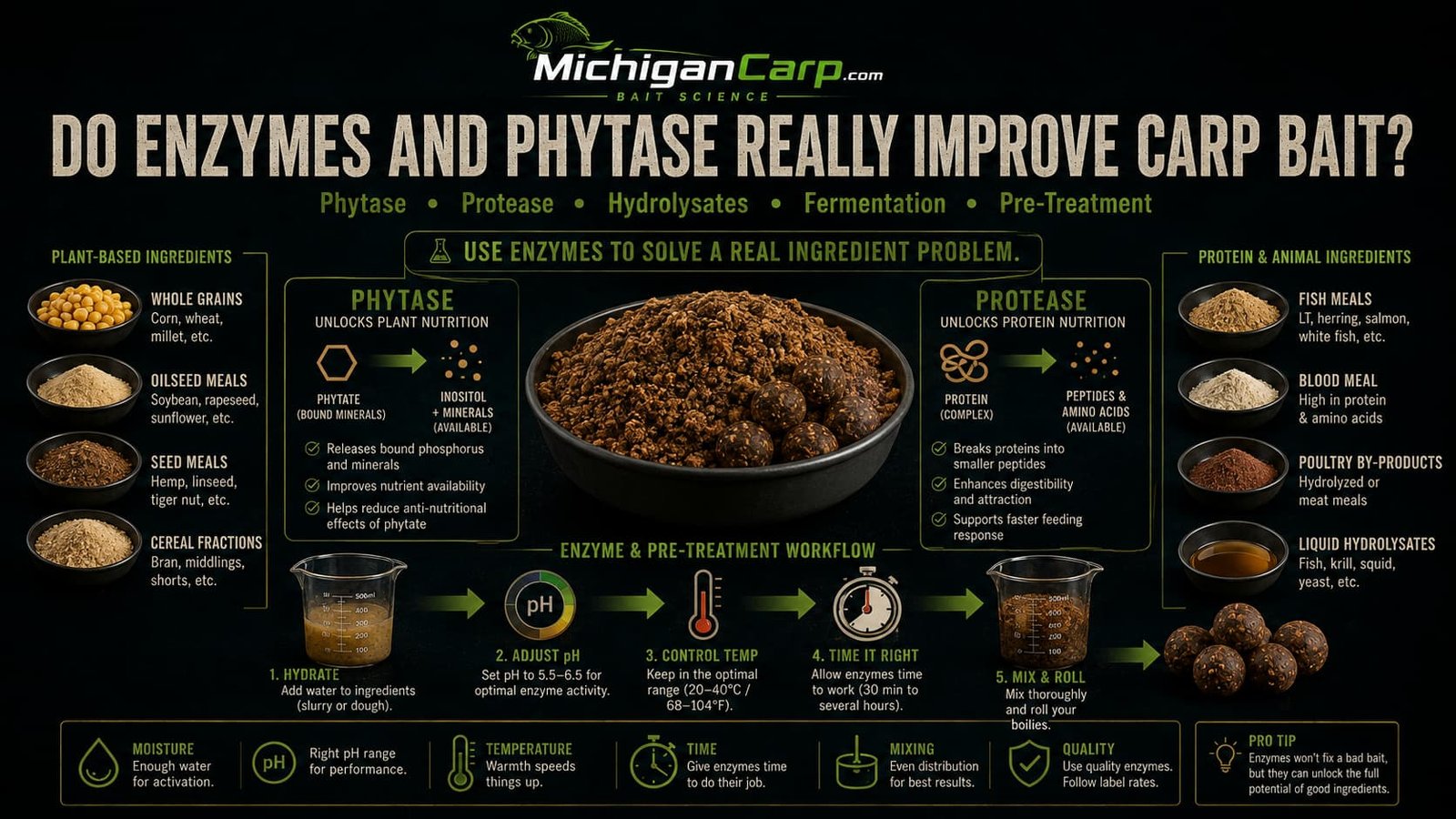
Enzymes in carp bait can genuinely improve certain ingredient systems, but they are also among the most misunderstood tools in homemade bait making.
The word enzyme sounds technical. That often leads anglers to assume that adding an enzyme powder automatically makes bait more digestible, more soluble, more attractive, pre-digested or more scientific.
None of those results is automatic.
An enzyme can only perform a useful reaction when the correct enzyme meets the correct substrate under suitable conditions. That means moisture, pH, temperature and reaction time all matter.
This is why simply adding phytase, protease or a multi-enzyme blend to a dry boilie mix and then cooking the bait should not automatically be described as pre-digestion.
The question is not whether enzymes work. The question is which enzyme is acting on which ingredient, under what conditions, and what useful change you are trying to create.
This article explains the difference between active enzymes, enzyme-treated ingredients, hydrolysates and fermentation. It also looks at phytase, protease, amylase and other enzyme systems from a practical carp-bait perspective.
This guide works alongside Raw vs Processed Ingredients in Carp Bait, How to Process Carp Bait Ingredients, Anti Nutritional Factors in Carp Bait Ingredients, What Boiling Does to Carp Bait, Carp Bait Digestibility and the main Bait Science hub.
For external technical context, see FAO: Effects of Processing on the Nutritional Value of Feeds, Phytate and Phytase in Fish Nutrition and Application of Enzymes as a Feed Additive in Aquaculture.
Table of Contents
Quick Start: Enzymes in Carp Bait
Enzymes in carp bait can help, but only when they are used as targeted ingredient-processing tools rather than miracle additives.
| Question | Practical bait answer |
|---|---|
| Do enzymes improve carp bait? | Sometimes, but only when a real reaction happens under suitable conditions. |
| Is phytase useful? | Yes, mainly where phytate is a genuine issue in plant-heavy feed ingredients. |
| Is phytase an attractor? | No. Its clearest role is phytate breakdown, not flavour attraction. |
| Can protease pre-digest bait? | Only if it has suitable protein substrate, moisture, pH, temperature and time. |
| Is hydrolysate the same as enzyme? | No. A hydrolysate is the result of previous hydrolysis, not the active enzyme itself. |
| Is fermentation the same as enzyme treatment? | No. Fermentation uses living microorganisms and produces broader changes. |
| Do enzymes work in dry shelf-life boilies? | Reaction may be limited unless the ingredient was pre-treated or moisture becomes available. |
| What is the safest home approach? | Pre-treat one ingredient, compare it with a control, and record the result. |
The simplest rule is:
Use enzymes to solve a specific ingredient problem. Do not add them because the word sounds advanced.
What an Enzyme Actually Is
An enzyme is a biological catalyst. It speeds up a specific chemical reaction without being consumed in the same way as the ingredient it acts upon.
One important correction is needed before going further:
Enzymes are not alive.
They may be produced by microorganisms, plants or animals, but the purified enzyme itself is not a living organism. It is a molecule with a particular structure and a particular job.
If the right conditions are present, the reaction proceeds. If the conditions are unsuitable, activity may slow sharply or stop. If the enzyme structure is damaged enough, activity can be lost.
This is why enzyme use in bait making must be discussed as a process, not as a label claim.
Substrate Specificity: The Most Important Rule
Enzymes are not general-purpose bait improvers. They act on particular substrates or chemical bonds.
| Enzyme group | Main substrate | Possible carp-bait relevance |
|---|---|---|
| Phytase | Phytate | Plant-heavy feeds and phytate reduction |
| Protease | Proteins and peptide bonds | Controlled protein hydrolysis |
| Amylase | Starch | Selected starch-rich ingredient systems |
| Xylanase | Xylan-rich plant fibre structures | Specialist plant-feed processing |
| Beta-glucanase | Beta-glucans | Ingredient-specific cereal or plant systems |
| Cellulase | Cellulose | Specialist fibre treatment |
| Lipase | Lipids | Specialist fat hydrolysis systems |
This is why buying a product labelled digestive enzyme blend tells you very little unless you know which enzymes it contains, their activity levels, their substrates and their working conditions.
Phytase is not protease. Protease is not amylase. Amylase is not a universal plant-ingredient cure.
The Six Things an Enzyme Reaction Needs
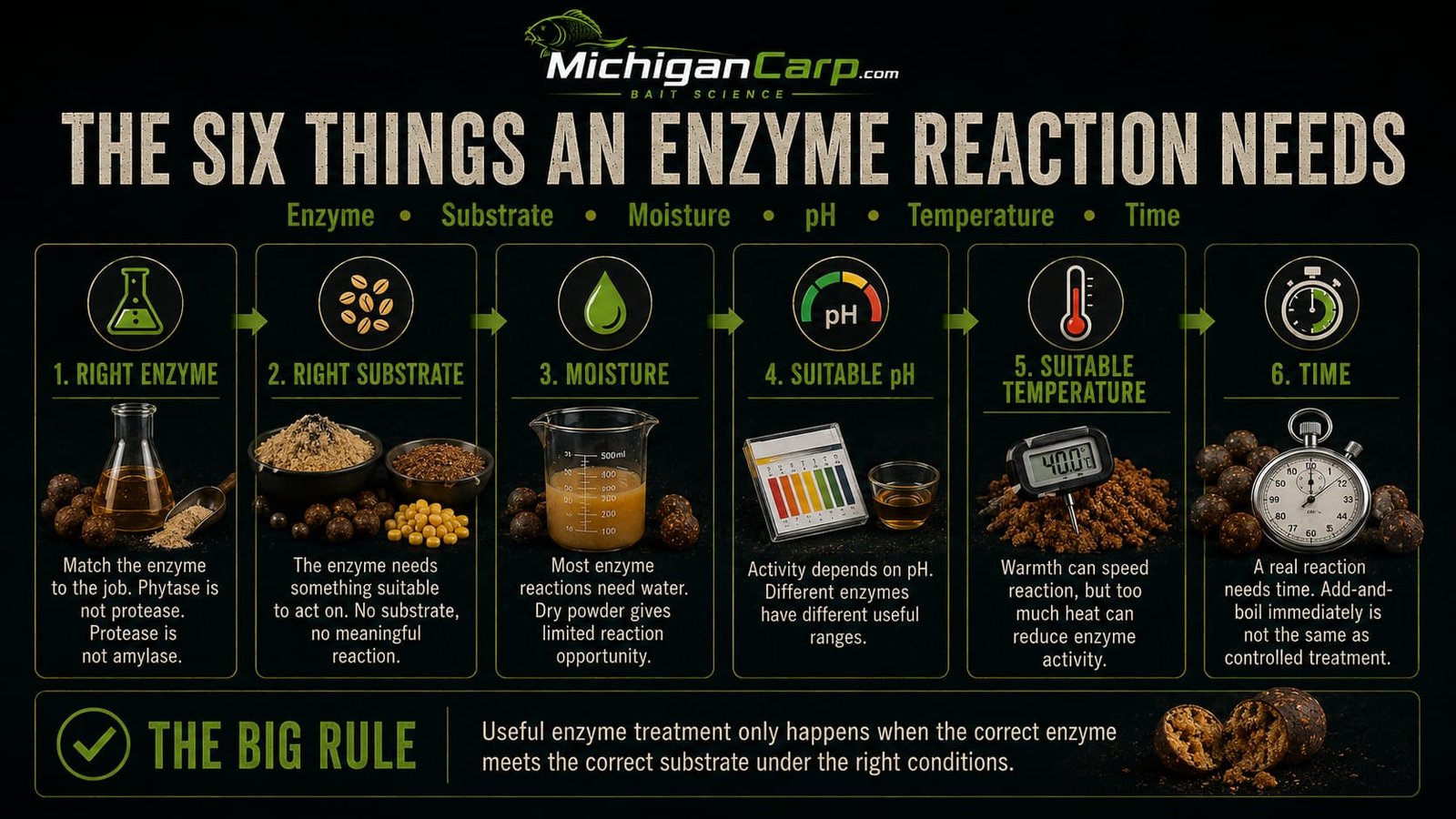
For practical bait making, every useful enzyme treatment needs six things to line up.
1. The right enzyme
The enzyme must match the job. Phytase cannot be expected to hydrolyse protein. Protease is not a phytate treatment. Amylase acts on starch rather than every plant compound.
2. The right substrate
An enzyme needs something suitable to act upon. Adding phytase to a bait with very little meaningful phytate gives the enzyme little reason to be there.
3. Moisture
Most useful enzyme-treatment reactions need an aqueous environment. A dry powder blend gives limited opportunity for meaningful reaction compared with a hydrated slurry, paste, soaked ingredient or conditioned bait.
4. Suitable pH
Different enzymes have different pH activity profiles. There is no universal rule that every bait enzyme works best at one acidic or alkaline number.
5. Suitable temperature
Temperature can increase reaction rate within a useful range, but excessive heat can damage enzyme structure. The useful range is product-specific.
6. Time
Enzyme treatment is a reaction process. Adding enzyme and immediately cooking the bait gives a very different opportunity from conditioning a hydrated substrate for a controlled period.
Useful enzyme treatment only happens when the correct enzyme meets the correct substrate under the right conditions.
Active Enzyme, Enzyme-Treated Ingredient, Hydrolysate and Fermentation
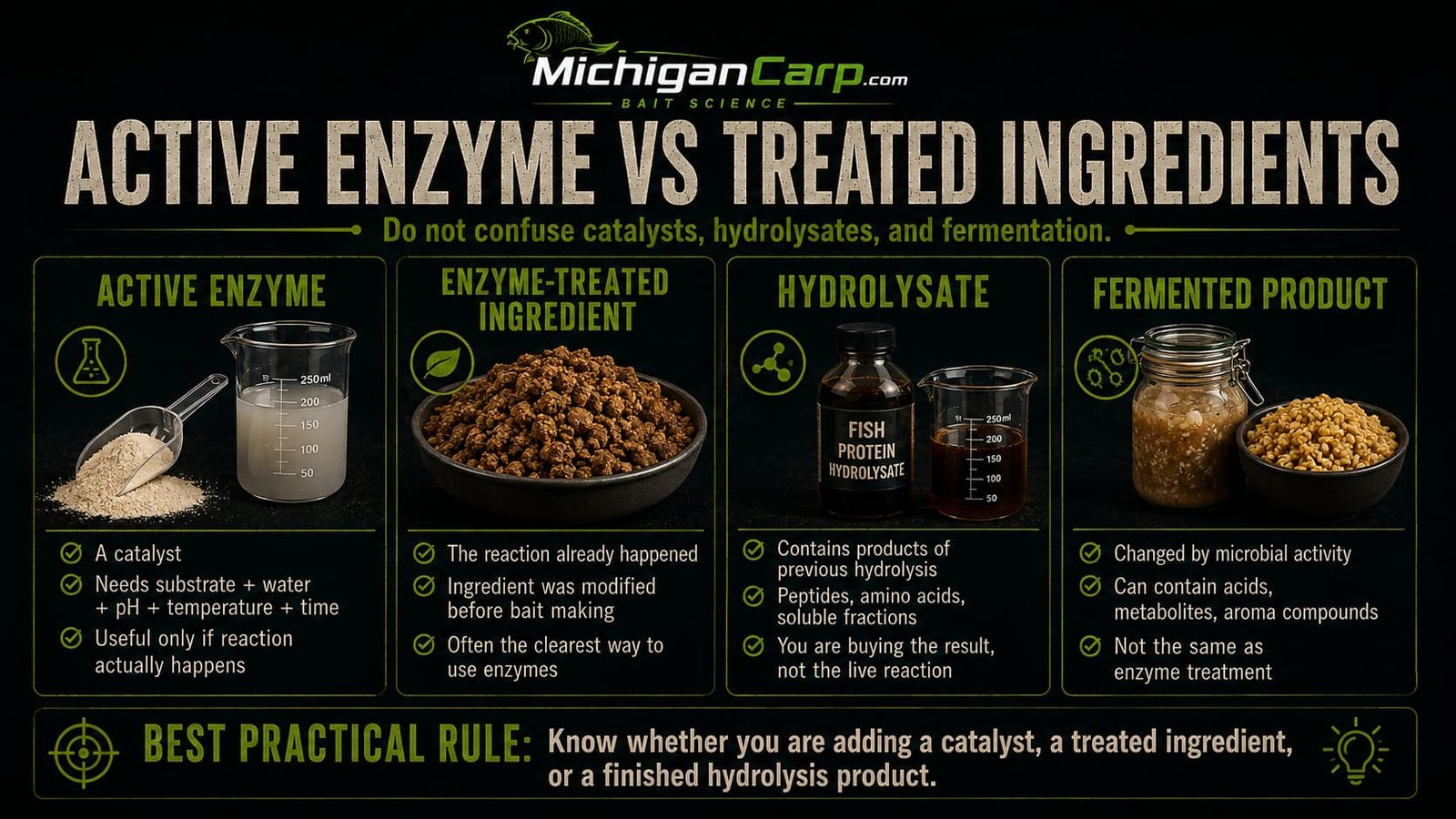
This distinction is essential.
| Material | What it is | Main practical meaning |
|---|---|---|
| Active enzyme | A catalyst still capable of carrying out its reaction | Needs substrate, moisture, pH, temperature and time |
| Enzyme-treated ingredient | An ingredient that has already undergone enzyme action | The useful change may already have occurred |
| Hydrolysate | A product containing material broken into smaller fractions by hydrolysis | You are buying the result, not relying on a new reaction inside the bait |
| Fermented product | Material transformed by microbial activity | May contain acids, metabolites, microbial products and altered nutrients |
A commercial liver hydrolysate, yeast hydrolysate or protein hydrolysate is not simply a bottle of protease waiting to digest your boilie. The hydrolysis has already occurred during manufacturing.
The resulting product may contain peptides, free amino acids, salts and other soluble food-derived compounds. That can make hydrolysates easier for most bait makers to use than trying to control a protease reaction at home.
For the full protein breakdown subject, use The Science of Proteins, Peptides and Hydrolysates in Carp Bait.
Phytase: The Clearest Plant-Feed Enzyme
Phytase is the enzyme that receives the most attention in plant-heavy aquafeeds because its target is clear: phytate.
Phytate occurs in many grains, seeds, legumes, oilseed meals and bran-rich ingredients. It is associated with phosphorus storage in plants and can reduce the availability of phosphorus and some minerals.
The important carp-bait point is:
Phytase has a clear substrate and a clear biochemical job. It is not primarily a flavour, an attractor or a generic digestibility powder.
This connects directly with Anti Nutritional Factors in Carp Bait Ingredients.
When phytase makes the most sense
Phytase makes the most sense when the bait or ingredient system is genuinely plant-heavy.
That may include formulas built heavily around grains, seed meals, legume ingredients, oilseed meals, bran-rich materials and repeated feeding bait where nutritional exposure matters.
It also makes more sense as a controlled pre-treatment than as blind inclusion in a dry bait mix.
When phytase is probably unnecessary
I would not automatically add phytase to a single hookbait, a mostly milk-protein bait, a hydrolysate-heavy specialist bait, a small short-session trap, or a formula where phytate-rich ingredients are minor components.
This does not mean phytase would be harmful. It means the bait maker should ask whether a significant problem exists before solving it.
Phytase Treatment Is Product-Specific
Different phytase products may differ in enzyme source, activity units, pH profile, temperature profile, carrier material and stability.
That means a responsible treatment plan should be based on the product’s own activity specification and instructions, not copied gram-per-kilo dosing from a different product.
Enzyme products are often specified by activity units. Two powders with the same weight may have very different activity.
A sensible phytase pre-treatment workflow is:
- Identify the phytate-rich ingredient that justifies treatment.
- Check that the phytase product is suitable for feed or food-style use.
- Read the manufacturer’s enzyme activity and treatment guidance.
- Hydrate the substrate sufficiently for reaction.
- Use suitable pH, temperature and time rather than guessing.
- Allow the reaction to happen before final bait production.
- Use the treated material promptly or preserve it properly.
The goal is not to keep phytase active forever. The goal is to let the desired reaction occur.
Once the substrate has been treated, later heat inactivation of the enzyme does not reverse the hydrolysis that already occurred.
Protease and the Pre-Digested Bait Claim
Proteases hydrolyse peptide bonds in proteins. Depending on the enzyme and conditions, protein treatment can create mixtures containing larger peptides, smaller peptides and free amino acids.
This is where the phrase pre-digested bait often appears.
But the wording needs care.
Adding protease powder to a mix is not pre-digestion. A hydrolysis reaction must actually occur.
A controlled protease treatment may reduce the average size of protein fractions, increase smaller peptide fractions, change solubility, change taste, change texture and change how a protein ingredient behaves in water.
But none of those automatically proves increased attraction.
The result depends on the starting protein, the protease used, the degree of hydrolysis, the resulting peptides and amino acids, concentration and the complete bait system.
Where protease makes most sense
Protease makes most sense when the bait maker can control the protein phase.
Possible use cases include protein slurry pre-treatment, short-life paste systems, specialist hookbait conditioning and ingredient-development trials on one selected protein material.
It makes less sense when it is simply thrown into a complete dry mix with no moisture, no reaction time and no control.
Amylase, Carbohydrases and Plant Structure
Amylase acts on starch. That sounds immediately useful because many boilie formulas contain semolina, maize products, wheat products, rice products and other cereal ingredients.
But substrate form still matters.
Raw starch granules, cooked starch, hydrated starch and gelatinized starch do not behave identically. A useful amylase process needs the right starch source, hydration, pH, temperature and reaction time.
For most ordinary boilie makers, amylase is not a necessary default additive. It is a specialist processing tool.
Other carbohydrases, including xylanases, beta-glucanases and cellulases, target particular plant structures. Their relevance depends heavily on the actual plant ingredient. This is another area where a multi-enzyme product may sound impressive while making it hard to know what is really happening.
Heat and Enzyme Activity
Heat is one of the main reasons enzyme use in boilie making needs careful planning.
Different enzymes have different thermal stability. Some lose activity relatively easily. Other commercial feed enzymes are designed or selected for better processing stability.
I would avoid both extreme claims:
Boiling instantly destroys every enzyme.
and:
My enzyme will definitely remain active after cooking.
The responsible position is:
Do not assume the original activity survives your bait process unless you have evidence for that particular enzyme product and process.
For the deeper heat discussion, read What Boiling Does to Carp Bait: Heat, Steaming, Leakage and Structure.
Pre-Treatment Usually Makes More Sense Than Hope
If the objective is ingredient modification, the reaction can occur before the final boilie is cooked.
The clean sequence is:
Hydrate substrate → add suitable enzyme → allow reaction → incorporate treated ingredient → form bait → cook if required.
The enzyme may later lose activity during heating, but the chemical changes that already happened do not simply reverse.
This is why pre-treatment is one of the cleanest ways to understand enzyme use in homemade bait.
For the wider ingredient-processing decision, read How to Process Carp Bait Ingredients.
Post-Boil Enzyme Treatments
Post-boil enzyme use can make sense, but only when enough reaction opportunity exists.
A weak version would be:
- Take a dry boilie.
- Dip it in enzyme liquid.
- Cast immediately.
- Call the bait pre-digested.
That may create a surface treatment, but meaningful enzyme hydrolysis still requires substrate access, water and time.
A more credible post-treatment would involve a suitable protein or carbohydrate coating, a compatible enzyme, controlled moisture, appropriate conditioning time and safe storage.
Even then, compare the result against a simpler hydrolysate or food-liquid treatment.
Can Enzymes Work in Shelf-Life Boilies?
A dry shelf-life boilie is not an ideal environment for rapid enzyme activity because available water is limited.
That does not mean the enzyme disappears. It means meaningful activity may be restricted until sufficient moisture becomes available.
Once the bait enters lake water, several other questions appear:
- How quickly does water penetrate?
- Is the enzyme still active after production and storage?
- Can it reach its substrate?
- Does it have enough time to create a meaningful change?
- Would a hydrolysate or pre-treated ingredient have been simpler?
For that reason, I prefer one of two strategies:
- pre-treat the ingredient before making the shelf-life bait;
- use a hydrolysate or already processed ingredient where the desired conversion has already occurred.
This is especially important when working with preservation systems, drying targets and long storage. Enzyme logic should not be allowed to undermine bait stability.
Enzymes, Fermentation and Hydrolysates Are Not the Same
Enzyme treatment, fermentation and hydrolysates can overlap in bait discussions, but they should not be treated as identical.
| Approach | What happens | Practical bait meaning |
|---|---|---|
| Enzyme treatment | A specific catalyst acts on a suitable substrate | Useful only when conditions allow a real reaction |
| Fermentation | Microorganisms grow and metabolize material | Can create acids, aroma compounds, microbial biomass and broader changes |
| Hydrolysate | A material has already been broken down through hydrolysis | You are buying the resulting food fractions |
Fermentation may involve enzymes, but it is not the same thing as adding a purified enzyme product.
A hydrolysate may have been produced using enzymes, acid, heat or controlled industrial methods, but the bait maker is usually buying the finished hydrolysis product rather than trying to run the reaction in the bait.
For the fermentation side, read Fermented and Food-Signal Baits for Carp.
Where Enzymes Make the Most Practical Sense
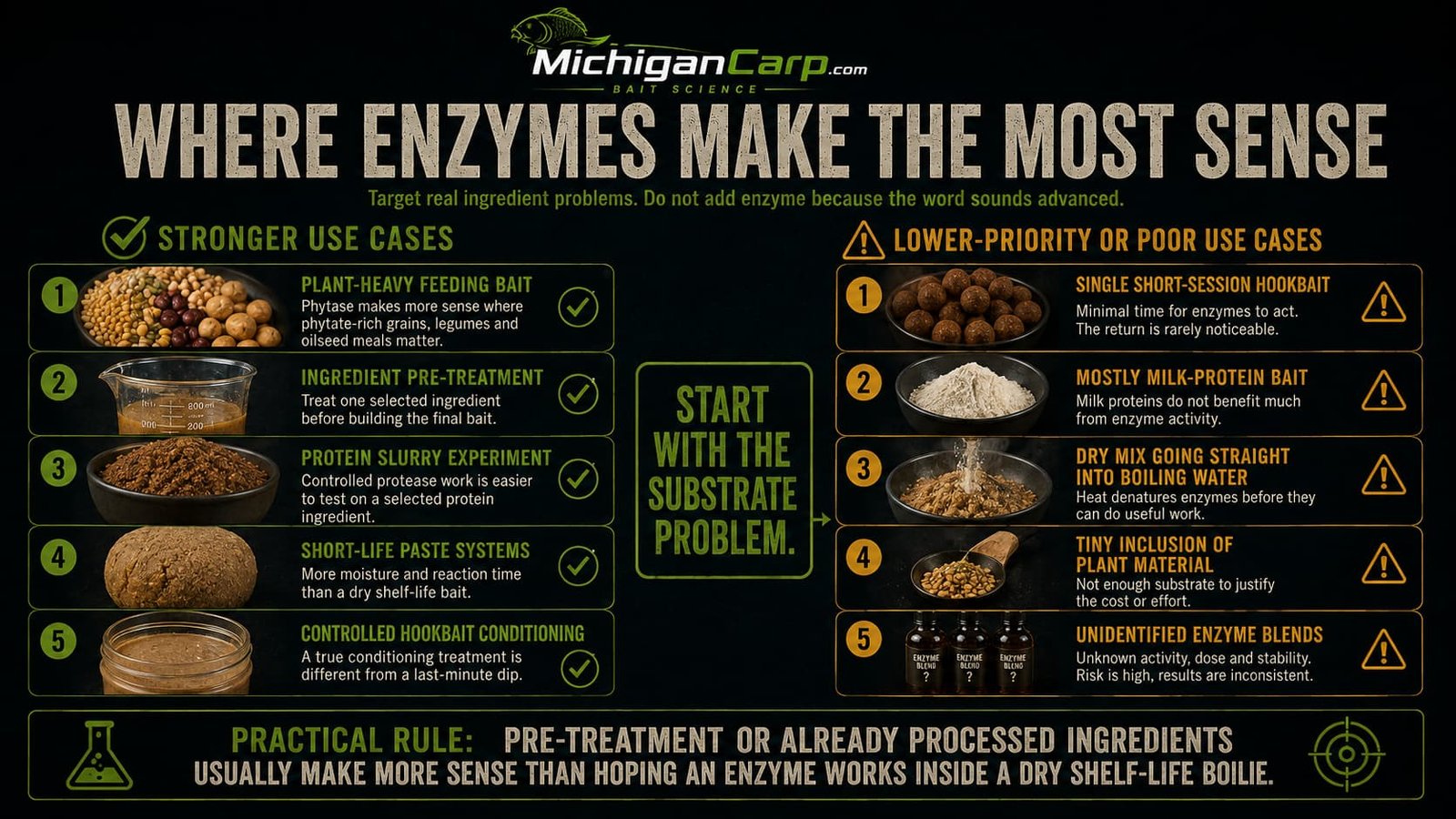
Enzymes make the most practical sense when there is a real substrate problem and the treatment can be controlled.
| Use case | Enzyme logic | My practical view |
|---|---|---|
| Plant-heavy feeding bait | Phytase may help where phytate is genuinely relevant | Potentially useful in serious plant-heavy bait development |
| Ingredient pre-treatment | One substrate and one process can be controlled | Strongest home-bait use case |
| Protein slurry experiment | Protease can act on hydrated protein | Useful for controlled testing |
| Short-life paste systems | More moisture and less severe processing | More realistic than dry shelf-life bait |
| Controlled hookbait conditioning | Reaction has time to occur on or near the bait | Possible, but should be compared with simpler treatments |
Where I Would Not Bother
There are also situations where enzyme use is usually low priority.
| Situation | Why enzymes are lower priority |
|---|---|
| A good bait with no clear enzyme problem | A balanced bait does not improve automatically because another powder is added |
| Tiny inclusion of plant material | Phytase becomes harder to justify when phytate-rich ingredients are minor |
| Dry mix going straight into boiling water | Little opportunity for controlled pre-treatment |
| Last-minute hookbait dip | Not enough time or substrate access for meaningful hydrolysis |
| Unidentified enzyme blends | Unknown activity, dose, stability and substrate match |
| Mostly milk-protein bait | Phytase may have little useful substrate to act upon |
This is not anti-enzyme thinking. It is controlled bait-making thinking.
How I Would Test an Enzyme Treatment
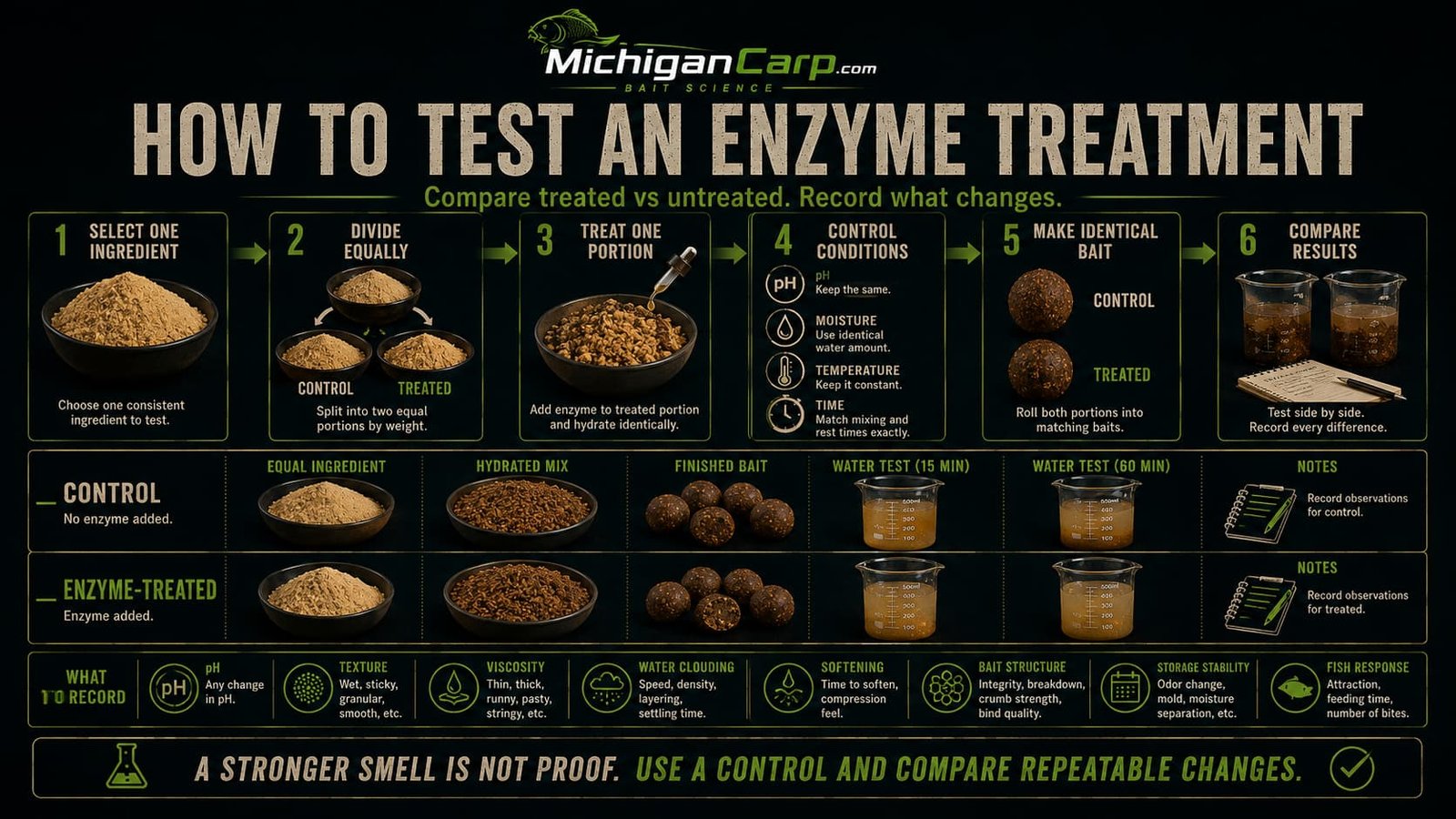
Do not test an enzyme by adding it to every bait in the bucket and then going fishing.
Use a control.
Basic test structure
- Start with one consistent ingredient batch.
- Divide it equally by weight.
- Treat one portion with the enzyme system.
- Keep the other portion identical without enzyme.
- Control moisture, pH, temperature and treatment time.
- Make identical bait from both portions.
- Compare water behaviour and fishing results over repeated trials.
Things worth recording
- pH before and after treatment;
- texture;
- viscosity;
- smell, but not as proof;
- water clouding;
- softening rate;
- bait structure;
- soluble release where measurable;
- storage stability;
- fish response over repeated sessions.
A stronger smell after treatment is not proof of better bait. Measure and compare what you can.
For a wider controlled testing method covering water uptake, swelling, softening, cracking, breakdown and batch consistency, use How to Test Boilies Before Fishing.
Michigan Notes
For the way I fish in Michigan, enzyme treatment has to earn its place.
Big-water campaign bait
This is where phytase interests me most. If a large feeding bait relies heavily on cereals, seed meals, soy products and other plant proteins, targeted treatment has a clearer nutritional purpose.
Three- to five-day sessions
For a multi-day session, I would still prioritize good ingredient selection, correct particle preparation, balanced feeding and appropriate bait quantity.
Enzyme treatment should sit on top of those basics rather than replace them.
Short cool-water sessions
For a short cool-water session, I usually see more immediate value in accurate location, small bait quantities, crumb, chopped boilies, hydrolysates, yeast-derived food liquids and controlled hookbait preparation.
Non-marine milk, nut and seed baits
In a milk-and-nut bait, protease treatment is technically possible, but I would first ask whether the bait needs it.
If the objective is better local food signal, a controlled hydrolysate or yeast system may be simpler.
If the objective is research into ingredient processing, then controlled protease treatment becomes more interesting.
Common Mistakes With Enzymes in Carp Bait
| Mistake | Why it causes problems | Better practice |
|---|---|---|
| Calling enzymes living organisms | Creates confusion with fermentation | Remember enzymes are catalysts, not microbes |
| Adding enzyme without a substrate plan | The enzyme may have nothing useful to act on | Start with the ingredient problem |
| Calling enzyme powder pre-digested bait | Pre-digestion requires a real reaction | Control moisture, pH, temperature and time |
| Copying dosage from another product | Activity units can differ greatly | Use product-specific guidance |
| Ignoring pH | Different enzymes have different activity ranges | Match conditions to the enzyme |
| Ignoring moisture | Dry systems limit reaction opportunity | Use hydrated pre-treatment where needed |
| Ignoring time | Reactions need opportunity to occur | Allow a controlled treatment window |
| Assuming every enzyme survives boiling | Thermal stability is product-specific | Do not assume retained activity without evidence |
| Assuming every enzyme is instantly destroyed | Some feed enzymes are more stable than others | Avoid blanket claims either way |
| Using phytase as an attractor | Its clearest job is phytate hydrolysis | Use it where phytate matters |
| Using protease as miracle dust | Protein changes do not automatically mean attraction improves | Test the treated ingredient against a control |
| Making the process impossible to repeat | Unrepeatable bait development teaches very little | Keep notes and control variables |
Simple Rules for Enzymes in Carp Bait
- Start with the substrate problem.
- Choose the enzyme for that substrate.
- Give the enzyme moisture, suitable pH, suitable temperature and time.
- Do not confuse active enzyme with hydrolysate.
- Do not confuse enzyme treatment with fermentation.
- Use phytase mainly where phytate genuinely matters.
- Use protease as a controlled protein-processing tool, not miracle dust.
- Do not assume cooking preserves enzyme activity.
- Consider pre-treatment before final bait cooking.
- Test against an untreated control.
- Use manufacturer activity data rather than copied gram dosages.
- Keep the process reproducible.
My Practical View
Enzymes can genuinely improve some carp bait ingredients and feed systems.
But their value comes from chemistry, not from the word enzyme on a label.
Phytase has a clear role when phytate is a genuine issue in plant-heavy feeds. Proteases can create smaller protein fractions when they are given a suitable substrate and proper reaction conditions. Carbohydrases can modify selected plant and cereal structures.
But simply adding an enzyme powder to a dry boilie mix does not prove that meaningful pre-digestion has occurred.
For homemade bait, the strongest approach is:
Identify the ingredient problem → choose the correct enzyme → create suitable reaction conditions → allow the reaction to happen → then build the bait.
For my own Michigan carp fishing, I treat enzymes as specialist tools. I am most interested in phytase for genuinely plant-heavy feeding bait and in controlled protease experiments on selected protein ingredients.
For quick hookbait signal, crumb, chops, hydrolysates, yeast products and proven food liquids are usually simpler.
An enzyme is only useful when it has a real substrate, a real reaction and a real job.
FAQ
Do enzymes really improve carp bait?
They can, but only when the correct enzyme acts on a suitable substrate under conditions that allow a useful reaction.
Are enzymes in carp bait the same as pre-digested bait?
No. Adding enzyme powder is not the same as pre-digestion. A real hydrolysis reaction must occur before that claim makes sense.
Is phytase useful in carp bait?
Phytase can be useful in plant-heavy feed systems where phytate is a genuine nutritional issue. It is harder to justify as a default addition to every bait.
Does phytase attract carp?
Its clearest function is phytate hydrolysis. It should not be treated primarily as a flavour or direct attractor.
What does protease do in bait?
Protease hydrolyses peptide bonds and can produce smaller protein fractions. The result depends on the starting protein, enzyme, treatment conditions and degree of hydrolysis.
Is protease the same as a protein hydrolysate?
No. Protease is an enzyme catalyst. A hydrolysate is a product containing material already broken down through hydrolysis.
Does boiling destroy enzymes?
Heat can reduce enzyme activity, but thermal stability differs between enzyme products. Do not assume complete survival or complete destruction without information about the particular enzyme and process.
Can I add phytase directly to boilie mix?
You can physically add it, but that does not guarantee useful reaction. Phytase still needs access to phytate, adequate moisture, suitable pH, temperature and reaction time.
Can I use enzymes on hookbaits?
Yes, but a last-minute enzyme dip is not the same as a controlled enzyme treatment. The reaction needs suitable substrate access and time.
Are enzymes useful in shelf-life boilies?
They may be useful through ingredient pre-treatment, but a dry shelf-life bait is not an ideal reaction environment. Already treated ingredients or hydrolysates are often easier to control.
Is fermentation the same as enzyme treatment?
No. Fermentation involves microbial metabolism and can cause many simultaneous changes. Enzyme treatment uses specific catalysts acting on specific substrates.
Should I use a multi-enzyme blend?
Only when you understand what enzymes it contains, their activity, the substrates present and the treatment conditions required.
What is the best home use of phytase?
The clearest experimental use is controlled pre-treatment of a genuinely phytate-rich plant ingredient or plant-heavy feeding-bait component using product-specific instructions.
Next Steps
- Anti Nutritional Factors in Carp Bait Ingredients — understand phytate, trypsin inhibitors, lectins and plant-ingredient limits.
- Raw vs Processed Ingredients in Carp Bait — understand when ingredient processing helps and when it is unnecessary.
- How to Process Carp Bait Ingredients — apply practical processing decisions to real bait ingredients.
- What Boiling Does to Carp Bait: Heat, Steaming, Leakage and Structure — understand what finished-bait cooking can and cannot do.
- Carp Bait Digestibility — connect ingredient form with usable nutrition.
- How to Test Boilies Before Fishing — test treated and untreated bait versions properly.
- Carp Bait Solubility and Leakage — understand water entry, release and food-signal movement.
- The Science of Proteins, Peptides and Hydrolysates in Carp Bait — understand hydrolysis, peptides and protein-derived food signals.
- Fermented and Food-Signal Baits for Carp — separate controlled fermentation from spoilage.
- How pH Changes Carp Bait Performance — understand pH, acids and bait behaviour.
- Bait Science — browse the technical bait library.