

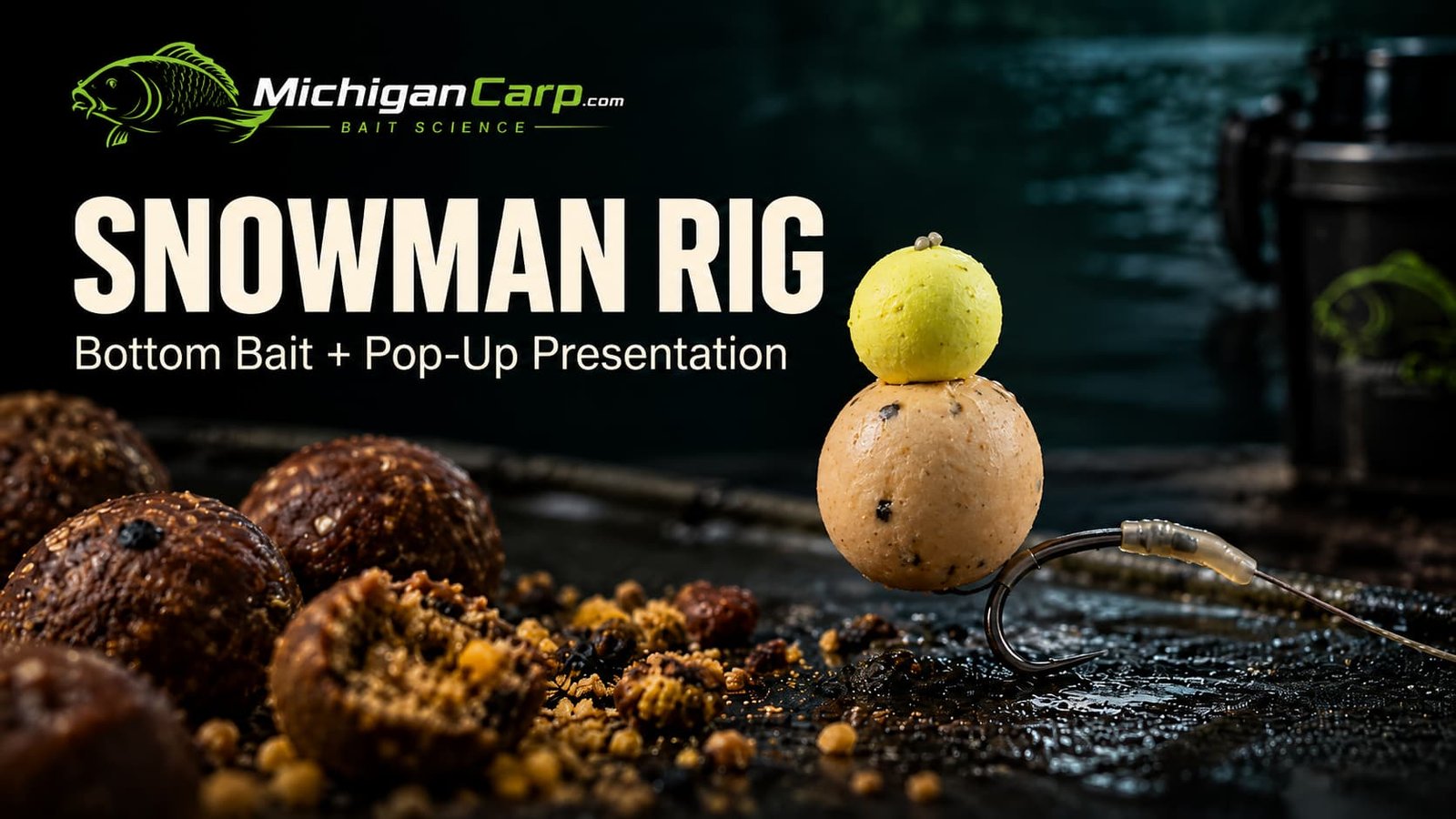
The snowman rig for carp is best understood as a hookbait presentation rather than a completely separate rig.
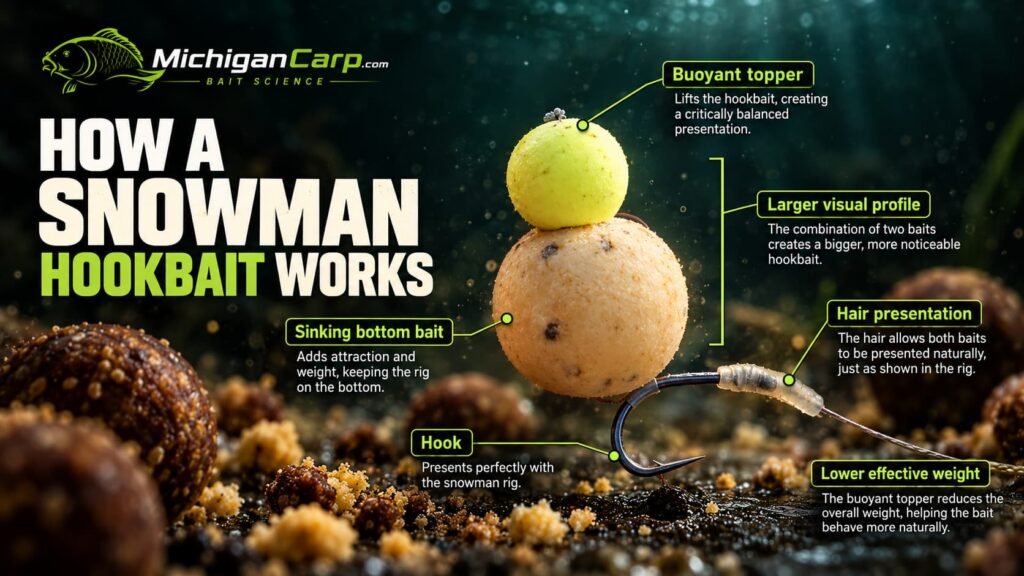
A snowman combines a sinking bottom bait with a smaller buoyant bait mounted above it. The two baits form the familiar snowman shape, but the important part is not the appearance alone. The buoyant topper changes the effective weight, balance, visual profile and movement of the complete hookbait.
That can make a snowman extremely useful when you want to keep the identity of a conventional bottom bait while making the finished presentation lighter, more visible or easier for a feeding carp to move.
What it does not do is automatically create a perfectly critically balanced hookbait.
Different bottom baits sink at different rates, different pop-ups have different buoyancies, and hook size, rig hardware, water absorption and bait size can all change the result. A snowman therefore needs to be tested as a finished combination, not copied from a size chart and assumed to be right.
The underlying hook rig can remain simple. A standard Hair Rig works well, while the Blowback Rig is particularly useful when you want additional controlled movement between the larger combined hookbait and the hook.
For the wider rig-selection framework, use Complete Carp Rig Guide for Michigan.
Table of Contents
Quick Start: Snowman Rig for Carp
| Question | Practical Answer |
|---|---|
| What is a snowman? | A sinking bottom bait topped with a smaller buoyant bait |
| Is it a separate rig? | Not really; it is mainly a hookbait presentation used on a suitable rig |
| Best rig bases | Hair Rig, Blowback Rig and other suitable bottom-bait rigs |
| Main advantage | Alters hookbait weight, profile and visibility without using a full pop-up |
| Best bottoms | Clean ground, firm silt and low weed |
| Deep silt | Usually better solved with a different rig or lead arrangement |
| Pop-up size | Use enough buoyancy to create the behavior you want rather than following a fixed ratio |
| Hair length | Must give the complete two-bait stack enough clearance from the hook |
| Colour | Matching or contrasting can both work |
| Most important test | Check the finished rig in water before casting |
The most useful rule is:
BUILD THE SNOWMAN AROUND THE FINISHED BAIT, NOT A PRESET BAIT-SIZE FORMULA.
What a Snowman Presentation Actually Is
A traditional snowman consists of a larger sinking bait beneath a smaller buoyant topper.
Common examples might include a boilie with a small pop-up, a hard hookbait with a buoyant topper or another sinking bait combined with a lighter visual bait.
The exact sizes are not what define it.
The defining feature is that the bottom bait still contributes enough weight to keep the presentation associated with the lakebed, while the topper reduces some of that effective weight and changes how the bait behaves.
This places the snowman somewhere between a conventional bottom bait and a fully buoyant pop-up.
That intermediate position is what makes it so versatile.
A current Korda Snowman Rig guide describes the same basic concept: a bottom bait paired with a smaller pop-up to create the snowman profile.
A Snowman Is Not Automatically Critically Balanced
This is the biggest technical correction I would make to the old article.
Anglers often describe every snowman as “critically balanced,” but the term should be used more carefully.
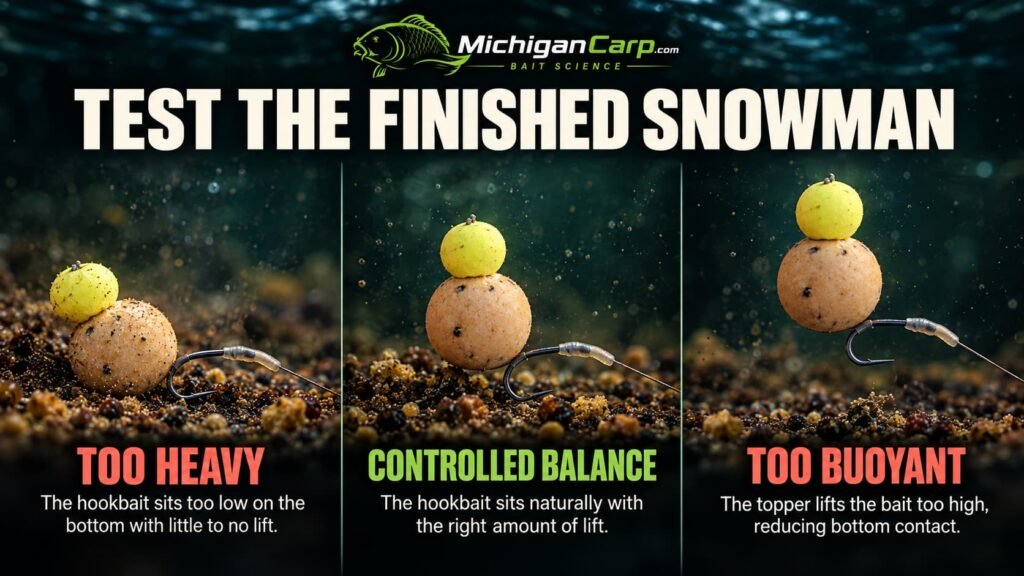
A genuinely balanced hookbait is influenced by the combined buoyancy of the bait, hook, hooklink and any rig components around it. Some snowmen remain quite heavy. Others become almost neutral. Some can even become too buoyant and begin to lift the hook or behave more like a pop-up.
Two visually identical combinations can behave differently if the pop-ups come from different recipes.
Even individual baits from the same tub can vary.
The useful approach is therefore not:
18 mm bottom bait + 12 mm pop-up = balanced.
It is:
Assemble the actual hookbait, attach it to the actual rig and put it in water.
Then decide whether the behavior is what you want.
What the Pop-Up Topper Actually Changes
The topper can influence several things at once.
It reduces some of the apparent weight of the bottom bait, increases the total size of the food item, introduces another colour or flavour if desired and changes the way the hookbait reacts to water movement and suction.
The important point is that these effects are mechanical and visual.
There is no need to claim that a snowman is inherently easier for every carp to inhale or that it automatically produces better hookholds.
Those outcomes depend on the finished rig, carp behavior and feeding situation.
What you can say confidently is that the topper changes the physical behavior of the hookbait.
That gives the angler another way to tune the presentation.
Hair Rig or Blowback Rig?
The snowman does not require one specific rig underneath it.
A straightforward Hair Rig is an excellent starting point because the mechanics are easy to understand and the complete bait can move independently of the hook.
For larger snowmen or when I want more controlled movement during attempted ejection, I prefer the logic of the Blowback Rig.
The blowback arrangement allows the hair connection to move along the hook shank, which can suit a relatively bulky two-bait presentation.
Korda’s current Blowback guide also specifically identifies snowman hookbaits as a strong use for that rig style.
The important point is not that one of these rigs is universally better.
It is to choose a rig that still gives the hook enough freedom to work once the larger combined bait has been added.
Hook Clearance Matters More Than a Fixed Hair Gap
The old article prescribed a specific 5–10 mm gap.
I would no longer treat that as a rule.
The correct separation depends on:
- total hookbait length;
- diameter of the bottom bait;
- topper size;
- hook size;
- hair attachment point;
- rig style;
- and how freely the bait can move.
A small snowman may need relatively little separation.
A large two-bait combination may need substantially more.
The test is simple: the complete hookbait should not crowd the hook gape or prevent the hook from turning and taking hold.
Judge the finished presentation rather than measuring one universal distance.
Bottom-Bait Size and Topper Size
Traditional snowmen often pair a larger bottom bait with a visibly smaller topper, which is where the name comes from.
That relationship is useful, but it does not need to become a rule.
A large dense bottom bait may require a relatively buoyant topper before the finished bait changes noticeably.
A light homemade bottom bait may need very little additional buoyancy.
The more useful question is:
What do I want the finished hookbait to do?
If I want only a little lift, I use less buoyancy.
If I want the bait noticeably lighter, I increase it.
If the hook begins to lift awkwardly or the bait behaves like a pop-up when I intended a bottom presentation, I have gone too far.
Matching or Contrasting Toppers
A topper does not need to be fluorescent.
Matching colours can produce a very natural snowman, especially when the bottom bait and free offerings are all from the same bait family.
A contrasting topper can create a strong visual marker.
Neither approach is automatically superior.
Water clarity, light level, angling pressure and the way the carp are feeding all influence whether standing out is useful.
Underwater observations published by Korda have shown occasions where subtler hookbaits outperformed brighter ones, while snowman combinations also worked well in the same filming sessions. That is a useful reminder that colour response can be highly situational rather than universal.
I would therefore use colour deliberately rather than because every snowman “needs a bright top.”
Matching the Free Bait
One of the strongest uses for a snowman is keeping the bottom bait closely related to the free food.
If I am feeding one boilie, I can use that same boilie as the lower bait and make only a small change with the topper.
That produces a hookbait which still belongs visually and chemically to the baited area while behaving differently enough to provide a presentation advantage.
This makes particular sense when the free bait is already being eaten confidently.
The topper does not have to turn the hookbait into a completely different food item.
Sometimes it only needs to alter the balance.
How to Balance a Snowman Properly
The easiest way is to test it in the margin or in a container of lake water.
Mount the actual bottom bait and actual topper on the hair, attach the finished rig and lower it into water.
Watch how it behaves.
A heavier snowman may settle firmly but still feel lighter than the plain bottom bait.
A more balanced version may settle slowly.
A very buoyant combination may begin to lift the hook or stand unnaturally high.
There is no single correct position.
You are trying to create the behavior that suits the rig and lakebed.
Do Not Test Only the Baits
Testing the two boilies in your hand tells you very little.
The finished rig includes the hook.
It may include a swivel, rig ring, screw or other metalwork.
The hooklink itself can affect how the bait settles.
Waterlogged baits can also change during the session.
For that reason, test the complete rig, not just whether the topper floats.
This becomes particularly important with homemade boilies because density can vary substantially between recipes and drying levels.
[IMAGE 3 — SNOWMAN BALANCE TEST HERE]
Clean Bottoms
Clean sand, gravel and firm clay are straightforward snowman water.
The rig can settle without vegetation or deep sediment interfering with the hook, and the angler can concentrate primarily on hookbait mechanics.
On this type of ground, a normal lead clip or inline system may both work depending on the complete rig.
For the current lead-system guide, use Carp Lead Systems: Lead Clip vs Inline vs Helicopter.
Light Silt
Light or firm silt can also suit a snowman extremely well.
The slight reduction in effective bait weight may help the hookbait sit more prominently than a heavy conventional bottom bait.
However, I would not claim that the topper prevents the rig from sinking into silt.
The lead, hooklink and complete terminal tackle still determine how the presentation lands.
If the silt is genuinely deep and soft, simply making the hookbait more buoyant does not solve the underlying presentation problem.
That is when the lead arrangement or rig family may need to change.
Deep Silt
A snowman should not be forced onto every soft bottom.
If the lead penetrates deeply and drags the hooklink down with it, the fact that the hookbait contains a pop-up does not automatically make the presentation clean.
A helicopter or Chod-style arrangement may separate the hook section from the lead more effectively.
Use Silt, Weed & Chod-Style Carp Rigs when the lakebed is genuinely difficult.
The right answer can also be to find cleaner ground.
Low Weed
Sparse or low weed can be good snowman territory when the hook and hookbait can still settle cleanly.
A little additional buoyancy may help the bait remain visible above very short growth, but again it does not make a conventional bottom-bait rig weed-proof.
Check the hook after retrieving.
If it repeatedly returns masked in weed, change the presentation.
Do not keep adding a larger topper and hoping buoyancy will solve everything.
Heavy Weed
Heavy weed usually requires a different problem-solving approach.
A snowman built on a conventional bottom rig can disappear into thick strands or land with the hook masked.
In that situation, a true pop-up presentation or specialist weed/chod approach is usually easier to control.
The purpose of a snowman is not to replace every pop-up rig.
It occupies the useful middle ground between sinking and fully buoyant presentations.
Snowman vs Wafter
A wafter and a snowman can create similar overall goals: reduce the effective weight of the hookbait while keeping it associated with the bottom.
The difference is construction.
A wafter achieves its balance inside one bait.
A snowman combines two baits.
That gives the snowman greater control over visual contrast and total profile, but it also creates a larger, longer hookbait with more leverage.
A wafter may therefore be the cleaner option where a compact presentation is desirable.
A snowman becomes attractive when you specifically want the two-bait combination.
Snowman vs Pop-Up
A pop-up is fully buoyant and is normally held above the bottom by the mechanics of the rig and counterbalance.
A snowman still relies on the sinking bait to keep the hookbait close to or on the lakebed.
This difference matters.
If I want the hookbait clearly suspended above debris, I choose a proper pop-up rig.
If I want a bottom-associated presentation that is simply lighter or more visually obvious, I may choose the snowman.
For dedicated buoyant rigs, use Pop-Up Rigs for Carp.
Snowman vs Ordinary Bottom Bait
A standard bottom bait is simpler.
There is only one bait, less bulk and fewer variables.
If the carp are feeding confidently on the loose-fed boilies and the standard hookbait is presenting perfectly, there may be no reason to add a topper.
The snowman earns its place when the topper performs a job.
That job might be:
- reducing effective weight;
- adding visual contrast;
- altering total profile;
- or making the hookbait behave differently from the loose feed.
If none of those are needed, the plain bottom bait remains an excellent option.
Large Snowman Presentations
Large bottom baits with toppers are perfectly possible, but they increase the importance of hook clearance and rig strength.
The larger the combined bait, the more leverage and bulk you place near the hook.
That does not mean oversized snowmen are wrong.
It means the rig must be built around them.
Use a hook and hooklink suitable for the bait, fish size, weed and snags rather than selecting tackle from a rigid size chart.
The bait should not overwhelm the hook gape.
Small Snowman Presentations
Small snowmen can be useful when you want subtle buoyancy rather than a large visual target.
They can also create a presentation closer to a traditional balanced boilie.
Again, the actual size matters less than how the whole bait behaves on the rig.
The same testing principle applies.
Snowman Hookbaits With Homemade Boilies
Homemade boilies make the water test even more important because density is strongly influenced by recipe, moisture, drying and the ingredients used.
A dense milk-protein hookbait may require a different topper from a lighter nut or birdfood bait.
A dried hookbait can also behave differently from a fresh freezer bait.
That means there is little value in publishing a universal topper size and pretending it applies to every homemade boilie.
For MichiganCarp bait development, this is one of those cases where practical testing beats theory.
Mount the actual bait you intend to fish and watch what it does.
Glugged and Soaked Hookbaits
Liquids can also change balance.
A bottom bait may take on liquid and become heavier.
A pop-up may lose buoyancy after prolonged soaking depending on its structure.
If the snowman has been glugged for days, test it again rather than assuming it still behaves like the original dry combination.
That is particularly important with hookbaits intended for long sessions.
How Long Should the Hooklink Be?
There is no special universal snowman hooklink length.
Hooklink length should follow the lakebed, rig mechanics, casting requirement and lead system.
A clean bottom might allow a relatively compact presentation.
Silt or debris may justify more separation.
Snags may require a different setup again.
The snowman itself does not dictate one measurement.
Choose the rig first, then tune the hookbait to it.
Lead Systems for Snowman Rigs
Snowmen can be fished on more than one lead system.
A lead clip works well for many conventional bottom-rig situations.
An inline lead can make sense on clean ground with a compact presentation.
A helicopter arrangement can be useful when the bottom requires more separation between lead and hooklink.
Use Carp Lead Systems: Lead Clip vs Inline vs Helicopter rather than choosing the lead system simply because the hookbait is a snowman.
Michigan Notes
Snowman hookbaits suit the varied bottoms we encounter on Michigan waters because they can be tuned without abandoning the familiar boilie presentation.
On clean gravel, sand or clay, I see them primarily as a balance and visibility tool.
On light silt, they can give the hookbait a little more presence while still fishing like a bottom-bait setup.
Around low weed, they can work well provided the hook remains clear.
Where the bottom becomes deep, soft or heavily vegetated, I would rather change the actual presentation than keep increasing topper buoyancy.
The underlying principle is the same one used throughout the MichiganCarp rig section:
Solve the lakebed first. Fine-tune the hookbait second.
Common Snowman Rig Mistakes
Assuming Every Snowman Is Critically Balanced
Some remain heavy and some become too buoyant. Test the finished rig.
Using a Topper Because It Looks Good
The topper should perform a mechanical or visual job.
Overloading the Hook With Too Much Bait
Large snowmen need enough hook gape and separation to allow the hook to work.
Copying Exact Bait Sizes Without Testing
Different baits have different densities and buoyancies.
Trying to Fix Deep Silt With More Pop-Up
If the lead and hooklink are buried, the lakebed problem has not been solved.
Ignoring Water Absorption
Hookbait balance can change during a long soak.
Choosing the Rig After Building the Snowman
The bait and rig should be designed together.
My Practical MichiganCarp View
The Snowman is one of the simplest ways to alter a boilie presentation without abandoning a bottom-bait approach.
That simplicity is its real strength.
You can fish the same boilie you are feeding, add a smaller buoyant bait and change the effective weight, profile and visibility of the hookbait without moving to a full pop-up presentation.
But I would remove much of the mythology that has built up around it.
A snowman is not automatically critically balanced.
It does not automatically produce better hookholds.
It does not need one fixed combination of bait sizes.
And it does not solve deep silt or heavy weed by itself.
The useful process is much simpler:
CHOOSE THE RIG → BUILD THE HOOKBAIT → TEST THE COMPLETE PRESENTATION → ADJUST THE BUOYANCY
That gives you a repeatable method rather than another carp-fishing rule.
FAQ
What is a Snowman Rig for carp?
It is usually a bottom-bait rig carrying a sinking bait topped with a smaller buoyant bait. The snowman describes the hookbait arrangement more than a unique rig.
Does a snowman have to use two boilies?
No. The principle is simply a sinking bait combined with a smaller buoyant topper. Boilies are the classic version.
What size pop-up should I use?
Use enough buoyancy to create the finished behavior you want. Do not rely solely on a fixed size ratio because pop-up buoyancy and bottom-bait density vary.
Is a snowman critically balanced?
It can be, but not automatically. Test the complete rig in water.
What is the best rig for a snowman?
A Hair Rig is a simple starting point, while a Blowback Rig is useful when you want controlled bait movement. Other rigs can also work.
Can I use a snowman over silt?
Yes, over light or reasonably firm silt. Deep soft silt may require a different lead system or rig family.
Is a snowman good in weed?
It can work over low weed or clean patches, but heavy weed generally calls for a more specialized presentation.
Should the topper be bright?
Not necessarily. Matching and contrasting toppers can both work. Choose colour according to the water and fish response.
Can I use a large bottom bait with a small topper?
Yes, provided the complete bait does not interfere with hook gape and the rig is strong enough for the fishing situation.
Is a wafter better than a snowman?
Not automatically. A wafter gives you a compact single bait, while a snowman lets you combine two baits and change both balance and visual profile.
Can I use a snowman with an inline lead?
Yes, especially on clean ground where the complete presentation can settle neatly.
Should I test the snowman before casting?
Yes. Testing the finished bait and rig in water is one of the most useful steps you can take.
Next Steps
For the simplest underlying bottom-bait setup, read Hair Rig for Carp Fishing.
For a rig particularly well suited to larger or snowman-style hookbaits, use Blowback Rig for Carp Fishing.
For the broader bottom-bait system, continue with Bottom-Bait Rigs for Carp.
For fully buoyant presentations, use Pop-Up Rigs for Carp.
For choosing the complete rig family, read Complete Carp Rig Guide for Michigan.
For difficult silt, weed and debris, continue with Silt, Weed & Chod-Style Carp Rigs.
For matching the lead arrangement to the lakebed, use Carp Lead Systems: Lead Clip vs Inline vs Helicopter.
For an external step-by-step example of the traditional presentation, see Korda: How to Tie the Snowman Rig.