

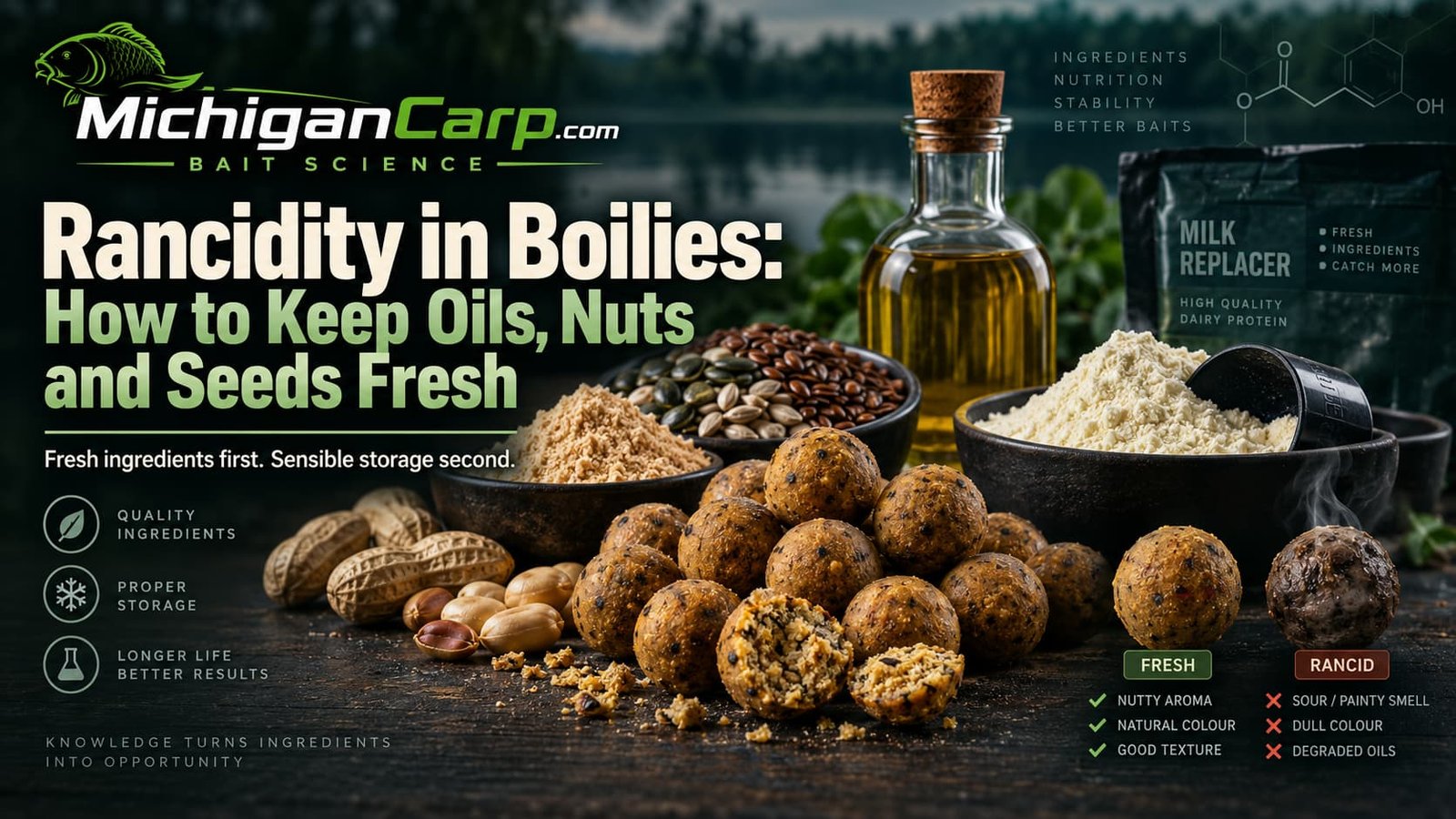
Rancidity in boilies can develop without visible mould, package swelling or any other obvious sign of microbial spoilage.
That matters because many of the ingredients used in rich homemade carp bait naturally contain fat: nut meals, ground seeds, full-fat soy, oily birdfoods, egg yolk, milk powders and bottled oils.
Given enough oxygen, heat, light and time, those fats can deteriorate.
The result can be stale, cardboard-like, paint-like or soapy odours and a general loss of the clean nut, seed or dairy character that made the ingredient useful in the first place.
Flavour cannot make rancid ingredients fresh again. More boiling cannot repair them. Potassium sorbate and sodium benzoate control a different storage problem and do not stop fat oxidation.
Fortunately, home bait makers do not need laboratory equipment to make sensible decisions about rancidity.
The practical approach is much simpler: buy vulnerable ingredients fresh, keep them cool and sealed, limit unnecessary exposure to air and light, use them within a sensible period and discard anything that develops abnormal stale or rancid characteristics.
For the wider role of fats in formulation, read Oils, Fats and Energy in Carp Bait. If you need help deciding how much fat belongs in a mix, use How to Balance Fat in Boilies.
Rancidity can be slowed before it happens. Once an ingredient or finished bait has gone rancid, it should be rejected rather than disguised with more flavour.
Table of Contents
Quick Answer
| Question | Practical Answer |
|---|---|
| What is rancidity? | Deterioration of fats and oils, usually through oxidation during normal bait storage. |
| Which ingredients are most vulnerable? | Ground nut meals, oilseeds, bottled oils, full-fat soy, oily birdfoods and high-fat dairy ingredients. |
| What makes rancidity happen faster? | Heat, oxygen, light, grinding, long storage and poor packaging. |
| Can strong flavour hide rancidity? | It may disguise some odour, but it cannot reverse the deterioration. |
| Do potassium sorbate and sodium benzoate stop rancidity? | No. They address microbial spoilage rather than fat oxidation. |
| Can tocopherols help? | Yes. They can slow oxidation when used correctly in fresh ingredients, but they cannot restore rancid material. |
| What is the simplest storage option? | Buy sensible quantities, keep vulnerable ingredients cool and airtight, and freeze homemade boilies when long room-temperature storage is unnecessary. |
What Rancidity Actually Is
Rancidity is the deterioration of fats and oils.
For most dry boilie ingredients, the main practical concern is oxidative rancidity. Oxygen reacts with vulnerable fatty acids and gradually creates new compounds that change aroma, flavour and nutritional quality.
The chemistry can become complicated, but a home bait maker does not need to follow every reaction.
The useful sequence is:
- fresh fat is exposed to oxygen;
- oxidation starts and develops;
- unstable oxidation products form;
- those products break down into compounds responsible for many familiar stale and rancid odours.
The FAO guide to storage problems in feed ingredients identifies lipid oxidation and rancidity as important causes of deterioration in stored feed materials, particularly where vulnerable fats are involved.
The practical lesson is more important than the chemistry: freshness declines over time, and warm, oxygen-rich storage makes that decline faster.
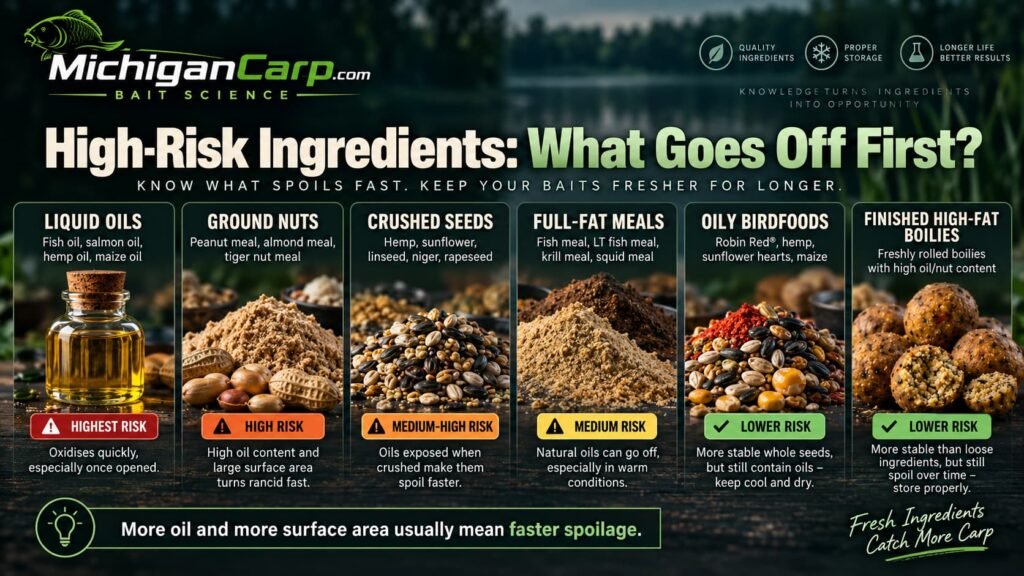
Boilie Ingredients Most at Risk of Rancidity
Not every boilie ingredient carries the same oxidation risk.
The ingredients I watch most closely are the ones that contain meaningful amounts of oil and have either been ground or processed in a way that exposes more of that oil to air.
Nut Meals and Ground Nuts
Peanut, almond, hazelnut and other nut ingredients can contain substantial fat.
Whole nuts protect much of their oil inside intact structure. Grinding increases the exposed surface area and gives oxygen easier access to the fat.
That does not mean ground nut meal spoils immediately. It means I would rather buy a sensible quantity of fresh material than keep a large opened bag through several seasons simply because the bulk price was cheaper.
For their wider formulation role, see Nut Boilie Base Mix Recipes.
Hemp, Linseed and Other Oilseeds
Hemp, linseed, sunflower and other oil-rich seeds also deserve attention.
Whole dry seed normally has better natural protection than the same ingredient after crushing or grinding. Once milled, more of the oil is exposed.
If I grind oily seeds myself, I prefer to do it reasonably close to bait production rather than keeping a large quantity of meal open for months.
See Birdseeds for Boilies for the different roles of common seed ingredients.
Bottled Oils
A large bottle of oil is not necessarily good value if it remains half-used for several years.
Every opening introduces fresh air. A partially empty bottle also contains more headspace, while clear bottles and warm storage increase light and heat exposure.
I would rather buy an amount I can realistically use while it is still fresh.
High-Fat Dairy Powders and Milk Replacers
Cream powder, whole-milk powder, coconut milk powder and some milk replacers contain substantially more fat than skimmed milk powder or highly concentrated low-fat milk proteins.
That makes storage history more important.
An opened high-fat dairy powder left warm and poorly sealed for a long period is not something I would automatically put into an expensive batch of boilies.
Use Milk Powders in Boilie Making and Milk Replacer for Carp Bait for the wider ingredient differences.
Full-Fat Soy and Rich Birdfoods
Full-fat soy, oily birdfoods and compound feed ingredients can contribute more fat than their name suggests.
This is another reason I calculate the approximate fat already present in a base mix rather than thinking only about bottled oil.
A milk, nut and birdfood boilie can already be fairly rich before any extra oil is poured into it.
What Makes Oils and Boilie Ingredients Go Rancid Faster?
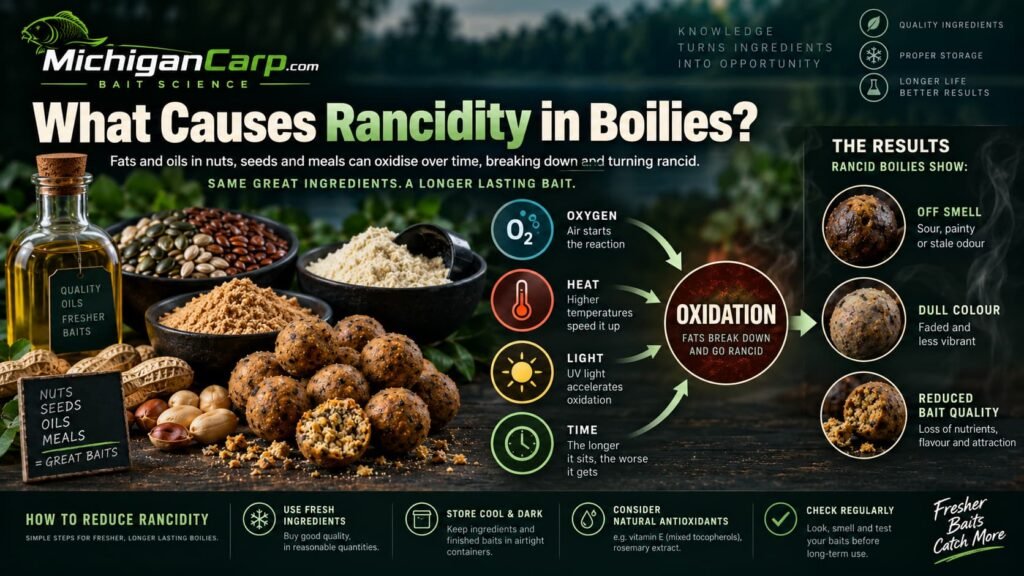
For home bait making, five factors deserve most of the attention: oxygen, heat, light, increased surface area and time.
Oxygen
Oxidative rancidity needs oxygen.
Leaving bags open, repeatedly opening large containers and keeping half-empty oil bottles for long periods all increase exposure.
Vacuum packing can reduce the amount of air surrounding a finished bait, but it does not make old or oxidized ingredients fresh again and should not be treated as a complete solution by itself.
Heat
Warm storage speeds many deterioration reactions.
A hot truck, sun-heated garage or warm shed is therefore a poor place to keep vulnerable oils, nut meals or finished high-fat bait for long periods.
This is particularly relevant during a Michigan summer session when reserve bait can spend several days inside a vehicle.
Light
Light can accelerate oxidation in vulnerable oils.
Dark cupboards, opaque packaging and amber or non-transparent bottles are preferable to leaving clear bottles on an exposed shelf.
Grinding
Grinding nuts and seeds increases surface area and exposes oils that were previously protected inside the ingredient.
This is why freshly ground oily ingredients deserve more careful storage than intact dry seeds.
Time
No storage system makes high-fat ingredients permanent.
The age of the ingredient before you buy it, how long it has been open and how long the finished boilies are stored all contribute to its total oxidation history.
How a Home Bait Maker Can Recognize Rancidity
You do not need a laboratory test for every bag of peanut meal or bottle of oil.
For normal home bait making, the most useful tools are good storage records and comparison with fresh material.
Possible warning signs include:
- stale-nut odour;
- cardboard or papery smell;
- paint, varnish or putty-like notes;
- unusual soapy or metallic odours;
- loss of the clean aroma the ingredient had when fresh;
- abnormal surface oil or separation;
- unexpected discolouration;
- an old or generally stale smell that is clearly different from a fresh control.
Not every oxidized ingredient produces exactly the same smell, and early deterioration may be subtle.
That is why I like having a known-fresh comparison when possible.
Do not taste ingredients or bait that may be mouldy, contaminated or otherwise suspect.
If I am sufficiently doubtful about a high-fat ingredient that I have to convince myself it is still usable, I would rather discard it than risk spoiling the rest of an expensive mix.
Throwing away a questionable bag of nut meal is cheaper than throwing away the entire finished batch made from it.
Tocopherols and Antioxidants in Boilies
Antioxidants are useful because they can slow oxidation before serious damage develops.
They are preventative tools, not repair products.
What Tocopherols Are
Tocopherols are vitamin-E compounds with antioxidant activity.
The USDA technical report on tocopherols describes their use as antioxidants in lipid-containing foods and notes that commercial mixed-tocopherol products may be supplied in vegetable oil or on powdered carriers.
That last point matters in bait formulation.
If a liquid mixed-tocopherol product is diluted in oil, that carrier oil becomes part of the bait’s total fat system. A powdered product may contain a different carrier.
Always look at the actual product specification rather than assuming every bottle labelled “vitamin E” contains the same concentration.
What Tocopherols Can Do
- help slow oxidation in fresh oils and fat-containing ingredients;
- help protect aroma and fat quality during storage;
- provide additional protection in nut, seed and high-fat dairy mixes;
- extend the useful life of a properly stored ingredient or bait compared with the same system without adequate antioxidant protection.
What Tocopherols Cannot Do
- reverse rancidity that has already developed;
- make stale nut meal fresh again;
- replace clean storage;
- remove oxygen from a package;
- replace potassium sorbate or other microbial-preservation systems;
- make an opened bottle of oil last indefinitely.
If I use mixed tocopherols, I add them while the ingredients are still fresh and follow the concentration and use directions for that particular product.
I would not copy a dose from a different antioxidant simply because both products are sold for oxidation control.
How I Store High-Fat Boilie Ingredients
Good storage usually achieves more than trying to rescue poor ingredients later.
| Ingredient | Practical Storage |
|---|---|
| Bottled oils | Keep tightly closed, cool and dark. Buy a bottle size you will realistically use. |
| Ground nut meals | Keep airtight and cool. Refrigerate or freeze longer-term supplies where appropriate. |
| Ground hemp, linseed and oily seeds | Grind close to use where practical, or keep the meal tightly sealed and cold. |
| Whole seeds and nuts | Keep cool, dry, airtight and protected from pests. |
| High-fat dairy powders | Keep tightly sealed, cool and dry; follow the manufacturer’s storage instructions. |
| Full-fat soy and rich birdfoods | Seal after opening, date the container and rotate older material first. |
Buy Quantities You Will Actually Use
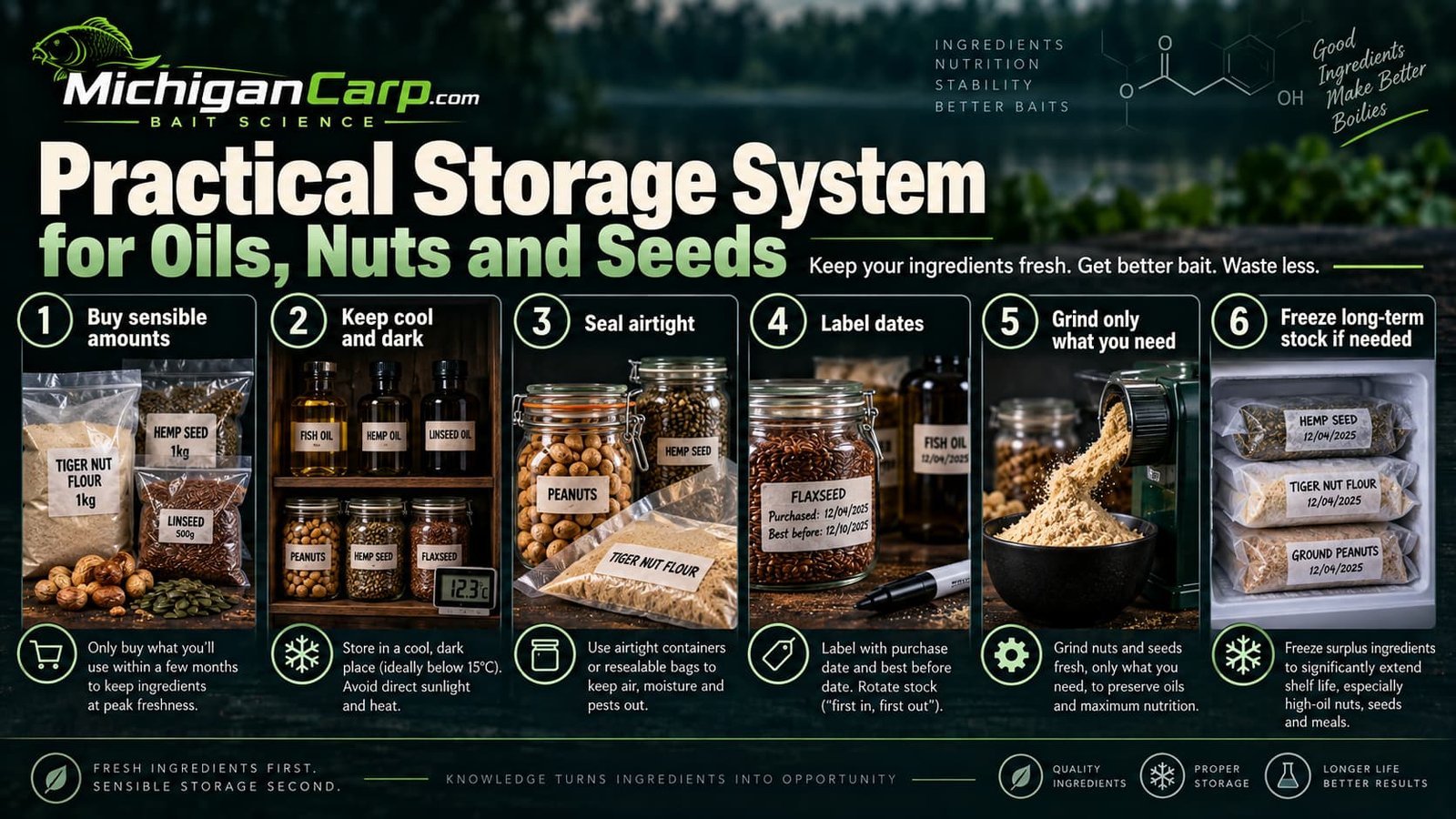
Bulk buying is only economical if the ingredient remains fresh.
A smaller fresh bag can be better value than a large oily ingredient sitting open through several fishing seasons.
Date Opened Ingredients
I would write the purchase or opening date on oils, nut meals, oily seed meals and high-fat dairy ingredients.
You do not need an industrial batch-record system. A marker pen on the bag or container is enough to stop you wondering a year later when it was opened.
Use Refrigeration or Freezing Where It Helps
Cold storage can slow oxidation significantly.
For vulnerable ground nut or seed meals that I am not going to use quickly, refrigeration or freezing can make sense when the product and packaging are suitable.
Seal the ingredient well before cold storage so it does not absorb moisture or other food odours.
When removing a frozen or refrigerated powder, allow the sealed container to approach room temperature before opening it. That reduces the chance of humid room air condensing directly onto the cold ingredient.
Keep Containers Clean
Do not pour fresh oil into a bottle containing an old unidentified film from the previous season.
Clean and completely dry reusable containers before refilling them.
How Rancidity Affects Finished Boilies
Boiling and drying do not stop oxidation permanently.
A finished boilie can still contain nut oil, seed oil, egg-yolk fat, dairy fat, soy oil and any separate bottled oils added to the mix.
This means a bait can remain completely free from visible mould and still become stale through fat oxidation.
That distinction is particularly important in rich milk, nut and seed recipes.
Microbial preservation and rancidity control are separate parts of storage.
If you are deliberately making shelf-life bait, Carp Bait Preservatives covers the microbial side. Antioxidants, fresh ingredients and sensible storage deal with the fat-oxidation side.
For most homemade bait, freezing remains the simplest option when extended room-temperature storage is unnecessary.
Use How to Store Homemade Boilies for the complete freezer, drying and session-storage workflow.
A Simple Home System for Keeping High-Fat Bait Fresh
I do not think ordinary home bait makers need a complicated oxidation-testing programme.
This is the routine I consider realistic:
- Buy fresh ingredients. Do not begin with stale oil, old nut meal or questionable seed.
- Buy realistic quantities. Avoid keeping high-fat materials for years simply because a large pack was cheaper.
- Date them when opened. This immediately improves ingredient rotation.
- Keep them sealed, cool and dark. Refrigerate or freeze particularly vulnerable meals where practical.
- Smell and inspect them before making bait. Compare with known-fresh material when you are unsure.
- Use antioxidants before deterioration occurs. Follow the specification for the actual product.
- Freeze finished homemade bait when long ambient storage is unnecessary.
- Discard anything clearly abnormal. Do not try to cover rancidity with stronger flavour.
If I am experimenting with longer storage, I may keep a small labelled sample of the finished bait and compare it periodically with fresh bait from the same recipe.
That is very different from pretending every angler needs laboratory peroxide testing or a formal six-month retained-sample programme.
Do Not Forget Bank-Side Storage
A bait that stores perfectly well at home can spend several hot days in a truck, bivvy or bait bucket during a long session.
That is part of the real storage history too.
On multi-day sessions, I would keep reserve bait shaded, sealed and as cool as practical rather than leaving the whole supply in direct sun.
Take the amount you expect to use onto the bank and protect the remainder.
Repeatedly opening one large bag also exposes all of the bait to fresh air, humidity and dirty hands. Session-sized bags are often more convenient for that reason as well as for freezer storage.
Common Rancidity Mistakes
- Buying the biggest oil bottle because it is cheaper per ounce. It is not cheaper if half becomes stale before use.
- Keeping ground nut or seed meal open for months. Grinding exposes more oil to oxygen.
- Assuming strong flavour will fix stale ingredients. It may mask some odour but cannot reverse oxidation.
- Adding tocopherols after rancidity appears. Antioxidants are preventative.
- Treating antioxidants as mould preservatives. They solve a different problem.
- Using the same antioxidant amount regardless of product concentration. Mixed-tocopherol products vary.
- Ignoring the carrier oil in a liquid antioxidant product. It contributes to the bait’s total fat.
- Keeping oils in warm, bright storage. Heat and light accelerate deterioration.
- Assuming vacuum packing makes fat permanent. It may help reduce oxygen exposure but does not stop time or repair old ingredients.
- Confusing no mould with fresh bait. Rancidity can develop without microbial spoilage.
- Keeping questionable ingredients because throwing them away feels wasteful. Spoiling an entire batch wastes more.
My Practical View
I use a lot of milk, nut, seed and birdfood ingredients in my own boilie development, so rancidity is something I take seriously.
But I do not think home bait makers need to turn it into another laboratory exercise.
The most useful controls are ordinary ones.
Buy ingredients fresh. Store them properly. Use oily meals within a sensible time. Grind vulnerable seeds reasonably close to use. Keep oils cool and dark. Freeze longer-term supplies where appropriate. Use antioxidants while the material is still fresh rather than after it smells wrong.
And when finished boilies do not need to sit on a shelf for months, freezing removes much of the storage pressure.
The key distinction is simple:
Preservatives help control microbial spoilage. Antioxidants and good storage help control fat oxidation. Neither can turn poor ingredients back into fresh ones.
FAQ
What causes rancidity in boilies?
Rancidity in homemade boilies is usually associated with oxidation of vulnerable fats. Oxygen, heat, light, grinding and long storage can all increase the rate of deterioration.
What does rancid boilie bait smell like?
Possible warning signs include stale nuts, cardboard, paper, paint, varnish, soap or unusual metallic odours. Different ingredients deteriorate differently, so comparison with a known-fresh sample is useful.
Can I cover rancidity with more flavour?
No. Strong flavour may disguise some stale odour, but it cannot reverse the chemical deterioration of the fat. Reject rancid ingredients or finished bait.
Do tocopherols stop boilies going rancid?
Tocopherols can slow lipid oxidation when used correctly in fresh material. They are gradually used up and cannot protect bait indefinitely or restore ingredients that are already rancid.
Are tocopherols the same as potassium sorbate?
No. Tocopherols are antioxidants used to help protect fats from oxidation. Potassium sorbate is used primarily as an antimicrobial preservative. They address different storage problems.
Should ground nuts and oily seeds be refrigerated?
Cold storage can be useful for vulnerable high-fat meals that will not be used quickly. Keep them airtight and follow any specific supplier storage instructions. Freezing is also practical for some dry nut and seed meals.
Does freezing prevent rancidity?
Freezing slows oxidation considerably but does not make fats permanent. Good packaging, fresh ingredients and sensible storage time still matter.
Can a mould-free boilie still be rancid?
Yes. Microbial spoilage and lipid oxidation are different processes. A bait can contain no visible mould and still develop stale or rancid fats.
How can I check rancidity at home?
Label and date vulnerable ingredients, compare their odour with known-fresh material, inspect them before each batch and discard anything clearly abnormal. Laboratory testing exists, but it is unnecessary for normal home boilie making.
Next Steps
For the wider fat system, continue with Oils, Fats and Energy in Carp Bait and How to Balance Fat in Boilies.
For ingredient-specific formulation, use Nut Boilie Base Mix Recipes, Birdseeds for Boilies, Milk Powders in Boilie Making and Milk Replacer for Carp Bait.
If your concern is microbial shelf life rather than oxidation, read Carp Bait Preservatives.
For practical storage, use How to Store Homemade Boilies. And before fishing a stored batch, How to Test Boilies Before Fishing covers the physical and water-behaviour checks.
For the wider technical library, return to Bait Science or Boilie School.