


If you want to know how to tell when boilies are dry enough, you do not need a laboratory. For most homemade freezer bait, session bait and hookbaits, a few simple home checks will tell you far more than relying on drying time alone.
For ordinary freezer bait, session bait and most homemade hookbaits, the useful question is not whether the boilie contains an exact laboratory-measured percentage of moisture. The useful question is whether the finished bait has reached the right condition for what you intend to do with it.
A freezer bait needs to be cool, surface dry and suitable for clean packaging before freezing. A session bait needs enough firmness to transport, cast and survive the intended fishing period. A hookbait may need considerably more durability. Genuine room-temperature shelf-life bait is different again and needs more than simply drying the outside hard.
This distinction matters because boilies do not dry at one universal rate. Diameter, formula, cooking, airflow, room temperature and humidity all affect how quickly moisture moves from the center of the bait to the surrounding air.
A 24 mm milk-and-nut boilie can feel extremely hard outside while still being noticeably softer in the middle. A smaller or more open-textured birdfood bait may dry much faster. Humid Michigan summer air can also produce a very different result from a dry heated room in winter.
That is why instructions such as “dry for three days” should be treated as starting points rather than guarantees.
This guide focuses on simple checks any home bait maker can use: handling the bait, cutting one open, weighing a test batch, using an overnight sealed-jar check and testing the finished bait in water.
For the actual boiling and drying process, use How to Boil and Dry Boilies Properly. For packaging, freezing and storage after drying, read How to Store Homemade Boilies.
Table of Contents
Quick Start: Dry Enough Depends on What the Bait Is For
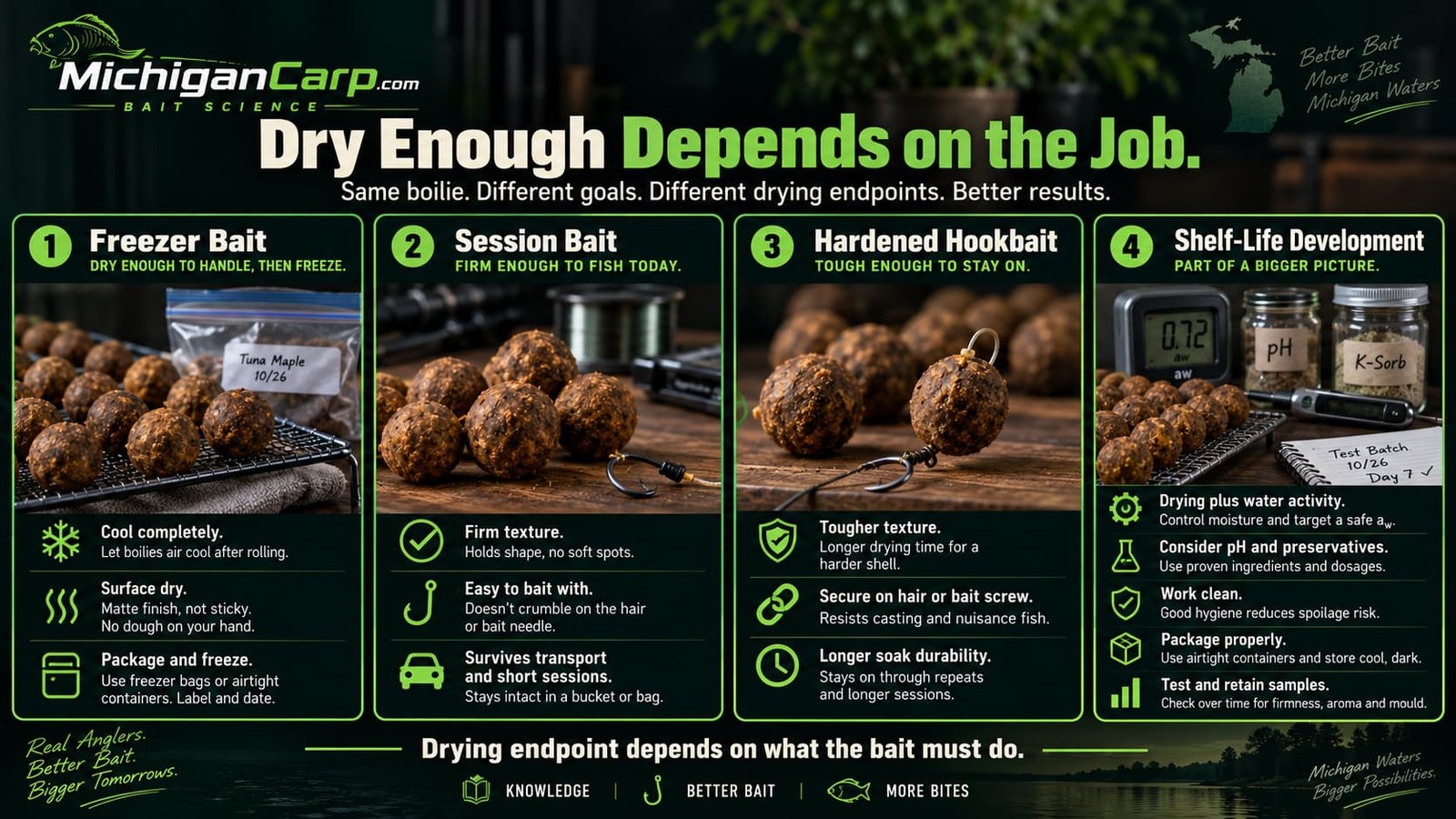
The first decision is not how many hours to dry the bait. It is what you need the bait to do.
| Bait type | Practical drying goal | Main check |
|---|---|---|
| Freezer bait | Cool, surface dry and easy to package without trapped steam or wet surfaces | Handling check before freezing |
| Session/free bait | Firm enough to transport, bait with and survive the intended session | Texture plus soak test |
| Hardened hookbait | Tough enough to remain attached and withstand nuisance fish or long soak times | Needle/screw strength plus long soak test |
| Shelf-life development | Controlled moisture as part of a complete preservation system | More advanced testing, including water activity and retained samples |
Most home bait makers are producing one of the first three.
That means most batches do not need to be dried until they resemble hard marbles, and they do not need laboratory-style moisture analysis before they can be used.
The aim is to make the bait fit its fishing and storage job.
Why Drying Time Alone Is Unreliable
Drying time tells you how long the boilies have been exposed to air. It does not tell you exactly how much moisture remains inside them.
Two batches left for seventy-two hours can finish very differently.
One may be drying in warm indoor air with good circulation. Another may be sitting in humid summer weather. One may contain 14 mm cereal-and-birdfood boilies. Another may contain dense 24 mm milk-protein and nut baits.
The outside of a boilie also dries before its center. This is particularly important with larger baits.
A hard skin can therefore give false confidence. The bait may feel finished in the hand while moisture is still redistributing from the center.
That does not mean drying time is useless. Once you know your own formula, diameter and drying environment, previous drying times become useful reference points.
But time should support your observations, not replace them.
How to Tell When Boilies Are Dry Enough: 5 Practical Checks
These five practical checks show how to tell when boilies are dry enough without turning homemade bait making into a laboratory exercise.
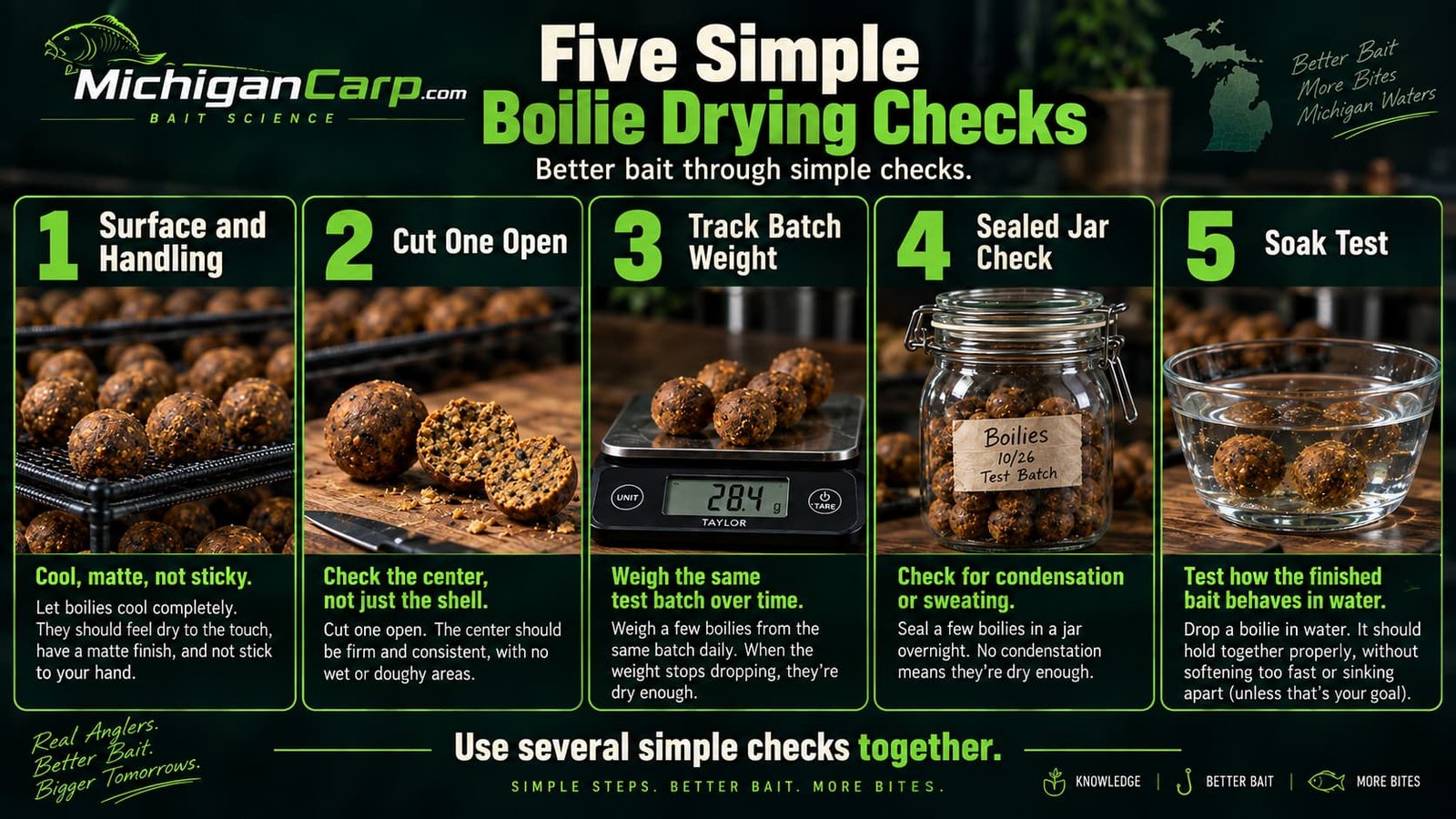
1. Check the surface and handling
Start with the obvious.
The boilies should be completely cool. They should not feel wet or greasy from trapped surface water, and they should not stick together when moved around the tray.
Freezer bait does not need to become extremely hard. For ordinary freezer bait, I mainly want the surface dry enough that the bait can be bagged without trapping obvious moisture or steam.
If boilies still stick together, feel damp in the hand or leave moisture on the tray, they need more drying.
Surface feel is only the first check. It cannot tell you exactly what is happening in the center.
2. Cut several boilies through the center
This is one of the simplest and most useful home checks.
Take several boilies from different parts of the drying tray and cut them directly through the middle.
Look for a major difference between the outside and center.
A slightly softer center is not automatically a problem, particularly with freezer bait. What matters is whether the difference fits the intended product.
Warning signs include a very dry shell surrounding a noticeably wet or paste-like center, visible cracking around a damp core, or strong differences between boilies taken from different parts of the tray.
Do not cut only the smallest or hardest bait. Check several representative boilies.
3. Track the weight of a test batch
A kitchen scale can give you useful information without calculating an exact moisture percentage.
Take a known amount of cooked, drained and cooled bait—500 g or 1,000 g works well—and keep that test group together.
Weigh it at consistent intervals such as every twelve or twenty-four hours.
An illustrative record might look like this:
| Drying point | Batch weight |
|---|---|
| Starting weight after cooling | 1,000 g |
| 24 hours | 823 g |
| 48 hours | 777 g |
| 72 hours | 765 g |
| 96 hours | 761 g |
These figures are only an example. They are not a target for another batch.
The useful information is the pattern. The bait lost a large amount of mass early, but very little between seventy-two and ninety-six hours. The drying curve is flattening.
You do not need to calculate the percentage loss unless you want to. Simply recording the batch weight can show when drying has slowed dramatically.
A flattening drying curve tells you the batch is losing much less mass. It does not tell you an exact final moisture percentage.
4. Use an overnight sealed-jar check
This is particularly useful with larger boilies or batches that feel extremely dry outside.
Take six to ten representative boilies and place them in a clean, dry glass jar or airtight container once they are completely cool.
Leave them sealed overnight at room temperature.
Then inspect them.
If the surface has softened slightly but the bait still looks and smells normal, moisture may simply have redistributed from the center toward the drier outside.
If you see condensation, obvious sweating, sticking or a major change in texture, I would regard that as a warning that the bait is not ready for ordinary sealed storage.
Return the main batch to the drying trays and continue drying.
The sealed-jar check is diagnostic. It does not turn the bait into shelf-life bait and it does not prove that room-temperature storage is safe.
5. Soak test the finished bait
A bait can pass every dry-land check and still perform badly in water.
Put representative boilies into lake water or clean tap water and test them for the period you expect to fish them.
Check after one hour, four hours, eight hours and—where relevant—overnight.
Look at:
- surface softening;
- swelling;
- cracking;
- center texture;
- whether a hair or bait screw remains secure;
- whether the bait becomes excessively brittle;
- whether it remains unnecessarily hard after prolonged immersion.
For the complete testing workflow, use How to Test Boilies Before Fishing.
How Dry Should Freezer Bait Be?
Freezer bait is the simplest case because you are not trying to prove long-term room-temperature stability.
I want freezer bait completely cool, drained properly, surface dry and firm enough to survive packaging and freezing without becoming one wet frozen lump.
I do not automatically want it dried until the center is extremely hard.
Once it is ready, portion it into sensible session quantities, label the bags and freeze it promptly.
If the bait is still warm when sealed, trapped heat and moisture can create sweating. If it is obviously wet, it can freeze into clumps and thaw with poor texture.
But once the surface moisture has been controlled, additional days of extreme drying are not automatically an improvement.
For the storage stage, use How to Store Homemade Boilies.
How Dry Should Session and Free Bait Be?
For ordinary free offerings, I want a firm, cohesive boilie that handles well but still hydrates and softens progressively in water.
I do not believe free bait needs to be as hard as a specialist hookbait.
A bait that is deliberately dried very hard may be useful when transport is difficult, nuisance fish are severe or a long session requires additional durability. But maximum hardness should not become the default target.
The best endpoint is found by testing the actual bait in water.
If a normal free bait remains almost unchanged after twelve or twenty-four hours, it may be considerably harder than the job requires. If it falls apart in an hour, it probably needs more structural strength, more cooking, more drying or a formula adjustment.
Texture is a separate subject from moisture. Use How Bait Texture Affects Carp Feeding Confidence for the deeper comparison.
How Dry Should Hookbaits Be?
Hookbaits normally need more durability than the surrounding free bait.
A bottom hookbait may need to survive a hard cast, remain secure on a hair or bait screw, resist crayfish or small fish and continue fishing overnight.
That can justify longer controlled drying.
But the useful target is tough, not necessarily glass-hard.
A hookbait that becomes brittle enough to split when pierced, fracture around the hair or crack from a bait screw has gone too far for that presentation.
I would test hookbaits using the exact attachment method and hook you intend to fish with.
Leave them in water for the intended fishing period, then check attachment strength and center texture again.
Humidity, Diameter and Formula Change the Result
One of the biggest reasons fixed drying schedules fail is that the drying environment changes.
Humidity
Drying slows when the surrounding air is humid. Previously dried bait can also take moisture back from damp air.
A fan can improve airflow, but the aim is clean moving air rather than intense heat.
Bait diameter
Small boilies generally dry faster because they have more surface area relative to their mass.
Large 20–24 mm boilies deserve extra attention to the center because moisture has further to travel.
Do not assume a drying routine developed for 14 mm bait will behave the same way with 24 mm bait.
Formula
Milk proteins, egg, cereal starches, full-fat soy, nut meals, birdfood, sugars, salt, glycerin, propylene glycol and coarse ingredients can all change the finished texture and the way the bait handles water.
This is why one formula cannot provide a universal drying schedule for every other boilie.
For the wider effect of drying and later rehydration, read Freezing, Drying and Rehydration: What Changes in Boilies?.
Do Not Chase One Magic Moisture Percentage
This is one of the main changes I would make to the way home bait makers think about drying.
There is no universal moisture percentage that tells every angler that every boilie is finished.
A figure such as 10–12% can be useful during controlled development of one particular formula, but it should not become a general rule for all boilies.
A 12% result also does not prove that a bait is shelf-stable.
Total moisture and water activity are different measurements. A boilie can contain water that is held differently depending on salt, sugar, glycerin, propylene glycol, proteins and other ingredients.
For normal freezer bait, I would not spend time trying to prove an exact moisture percentage. I would produce the bait consistently, dry it appropriately, package it cleanly and freeze it.
Exact measurements become much more relevant when deliberately developing room-temperature shelf-life bait.
Shelf-Life Bait Is a Different Project
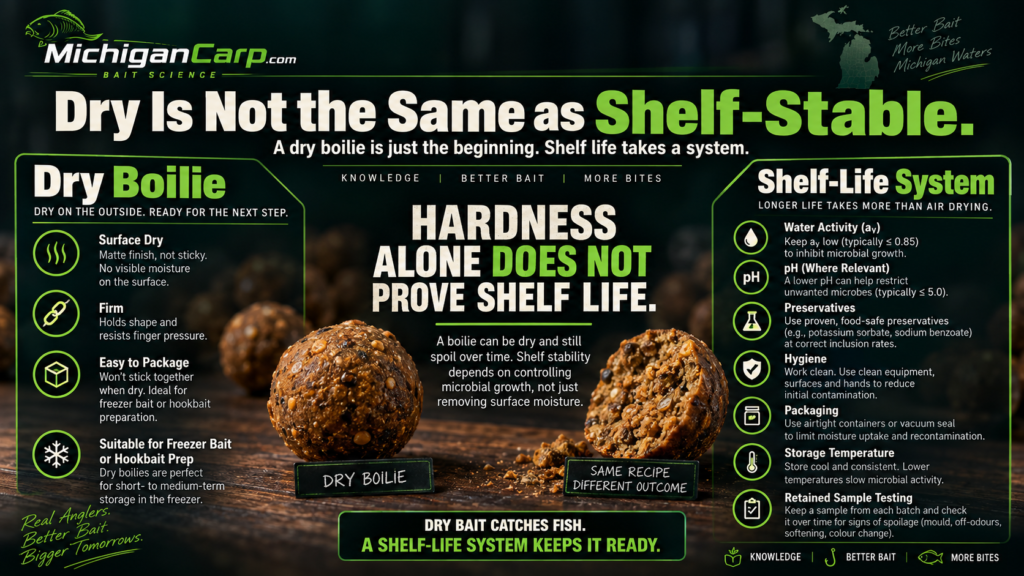
A dried boilie is not automatically a shelf-life boilie.
Room-temperature storage involves more than hardness or drying time. The complete system can include water activity, pH where relevant, preservatives, hygiene, packaging, storage temperature, fat stability and retained-sample testing.
The FDA describes water activity as the water available to support microbial growth rather than simply the total amount of water present. For the underlying food-science distinction, see FDA: Water Activity in Foods.
The boilie-specific explanation belongs in Water Activity in Boilies: Moisture, Mold and Shelf-Life Control.
My combined shelf-life system uses potassium sorbate, sodium benzoate and citric acid as part of the preservation design, but even that does not prove an arbitrary six-month storage life by itself.
The full preservation system belongs in Potassium Sorbate, Sodium Benzoate and Citric Acid in Shelf-Life Boilies.
Dry enough to fish is not the same as dry enough to claim shelf life.
What About Oven Tests and Moisture Analyzers?
They have a place, but I would treat them as advanced development tools rather than something every home bait maker needs.
A controlled oven loss-on-drying test or a halogen moisture analyzer can help compare batches when you are trying to standardize a commercial-style process, develop shelf-life bait or investigate why two formulas behave differently.
They can produce useful comparative data when the sampling and method are repeatable.
But that is a different level of bait development from simply making a few kilos of freezer bait for a fishing session.
For the average home bait maker, a kitchen scale, drying tray, knife, sealed jar and water test will answer most of the practical questions that actually matter.
If you do move into analytical testing, remember that heating loss is not necessarily pure water. Volatile flavor carriers and other compounds can also contribute to weight loss, which is one reason laboratory-style numbers need careful interpretation.
I would not buy a moisture analyzer simply because you have started making homemade boilies.
Glugging Changes the Bait Again
Once a dried boilie is treated with a liquid, it becomes a different moisture system.
Water-rich extracts, liquid yeast, hydrolysates and similar liquids can soften the bait and add moisture quickly. Propylene glycol and glycerin can alter texture and interact with water, but small additions do not automatically make the treated bait shelf-stable.
For the difference between the two carriers, read Propylene Glycol vs Glycerin in Carp Bait.
If you condition hookbaits, retest them after treatment. Check texture, bait-screw or hair security, buoyancy where relevant and the full intended soak time.
A wafter that balanced perfectly before soaking may not behave exactly the same after absorbing liquid.
Common Drying Mistakes
Using time as the only test
“Three days” or “four days” describes time, not the condition of the bait. Use the bait itself to decide when it is ready.
Judging only the hard outside
Large boilies can develop a firm shell while remaining softer inside. Cut several through the center.
Making free bait as hard as hookbaits
Free bait and hookbait do different jobs. Extra hardness is not automatically an improvement.
Bagging bait while it is warm
Warm bait can create trapped condensation and sweating. Allow it to cool fully before packaging.
Assuming dry means shelf-life
Drying is only one part of shelf-life design. Do not make room-temperature storage claims from hardness or drying time alone.
Ignoring humidity
A routine that worked during a dry winter may behave very differently during a humid Michigan summer.
Skipping the soak test
The bait ultimately has to work underwater. Dry-land hardness is only part of the picture.
My Practical MichiganCarp Method
For ordinary homemade freezer bait, I keep this much simpler than a laboratory test.
I cook the bait consistently and record the formula, size and boil time. After draining, I spread the bait in a single layer with good clean airflow.
Once it is cool, I check the surface and cut several boilies through the center.
If I am trying a new formula or a large 20–24 mm bait, I may weigh a 500 g or 1 kg test portion at regular intervals. I am mainly watching for the amount of weight loss to slow sharply.
When I think the bait is ready, I use the overnight sealed-jar check on a few boilies. If I see condensation or major softening, the main batch goes back onto the drying tray.
Then I soak-test the finished bait.
For freezer bait, that is normally enough. I am not trying to manufacture a laboratory-certified product. I am trying to make a consistent bait that stores cleanly in the freezer, handles properly and fishes the way I intended.
Hookbaits get more drying and longer testing because their job is different.
Shelf-life bait gets a completely different level of attention because a room-temperature storage claim needs more evidence than a dry surface.
Dry the bait for its job. Check the center. Track changes when useful. Test it in water before you trust it.
FAQ
How to tell when boilies are dry enough at home?
The simplest way to tell when boilies are dry enough is to combine surface feel, a center cut, batch-weight tracking where useful, an overnight sealed-jar check and a soak test. The correct endpoint depends on the formula, bait size and whether you are making freezer bait, session bait or hardened hookbaits.
How long should homemade boilies dry?
There is no universal time. Small boilies in dry moving air may finish much faster than large dense boilies in humid weather. Use time as a reference, not the only test.
Do boilies need to be hard before freezing?
No. Freezer bait normally needs to be completely cool, surface dry and firm enough to package cleanly. It does not have to be dried into a hard hookbait before freezing.
Why are my boilies hard outside but soft inside?
The outer surface loses moisture before the center. This difference is more noticeable in larger boilies and when drying is fast at the surface. Cut several baits open and continue drying if the center remains much wetter than intended.
Can I weigh boilies to see if they are drying?
Yes. Weighing the same test batch at regular intervals is an easy way to see when mass loss begins to slow. It does not tell you the exact final moisture percentage, but it is very useful for comparing batches.
What is the sealed-jar test?
Place several completely cooled boilies into a clean dry airtight jar overnight. If condensation, sweating, sticking or major softening appears, the bait likely needs more drying before sealed storage.
Does dry bait automatically have shelf life?
No. Shelf-life stability also depends on factors such as water activity, pH where relevant, preservatives, hygiene, packaging, storage conditions and retained-sample testing.
Do I need a moisture analyzer to make boilies?
No. Most home bait makers can make freezer bait, session bait and hookbaits successfully using ordinary scales, drying trays, center checks, sealed-jar checks and soak testing. Analytical equipment is more relevant to advanced shelf-life or process-development work.
Should hookbaits be dried longer than free bait?
Often yes. Hookbaits may need additional toughness for casting, attachment, nuisance-fish resistance and long soak times. Test them with the exact hair, screw or rig you intend to use.
Should I dry glugged boilies again?
That depends on the treatment and intended storage. Liquid treatment changes the bait again, so treat conditioned bait as a separate product and retest its texture, durability and storage requirements.
Next Steps
Continue through the practical boilie-making and drying guides:
- How to Boil and Dry Boilies Properly — the main production guide for boiling, draining and air drying.
- How to Store Homemade Boilies — freezing, air-dried bait, hookbaits and storage decisions.
- How to Test Boilies Before Fishing — soak time, swelling, texture, attachment and breakdown.
- Freezing, Drying and Rehydration: What Changes in Boilies? — understand the physical changes after production.
- How Bait Texture Affects Carp Feeding Confidence — soft, firm and hard boilies for different jobs.
- Potassium Sorbate, Sodium Benzoate and Citric Acid in Shelf-Life Boilies — the complete preservation-system article.
- Boilie School — follow the complete homemade boilie learning route.
- Bait Science — explore the deeper formulation and ingredient library.
Knowing how to tell when boilies are dry enough is not about finding one magic drying time or moisture percentage. The practical goal is to produce a bait that is dry enough for its storage plan, durable enough for its fishing job and still behaves properly once it enters the water.