

Introduction: What Really Makes Carp Bait Work?
This carp bait guide explores the science behind successful bait making, from ingredients and feeding signals to practical preparation and cost.
Whether you’re in a British tackle shop or browsing an American carp-bait supplier, the choice can be bewildering: boilies, flavours, liquid foods, extracts and feeding additives, each with a different promise. Some are excellent products; with others, the claims are much harder to evaluate. The challenge is working out which differences matter to the fish and which matter mainly to the marketing.
Carp possess sophisticated sensory systems capable of detecting chemicals in water and assessing potential food. But detecting a substance, investigating a bait, accepting it as food and ultimately being caught are not the same thing. Amino acids, protein hydrolysates, natural extracts and other ingredients can all have legitimate roles in bait making. Their usefulness, however, depends on their composition, concentration, processing and contribution to the finished bait. A strong smell, an expensive ingredient or a complicated recipe does not automatically produce better fishing.
After more than fifty years of carp fishing and bait making in Britain and the United States, I have become convinced that understanding the complete bait is more valuable than chasing individual miracle ingredients. That understanding is especially useful on large natural waters, where carp may have abundant natural food and feeding opportunities can be unpredictable. The same principles apply to British gravel pits, rivers and commercial fisheries, although the practical fishing conditions may differ. This guide brings together research on fish senses, aquaculture and ingredient chemistry with practical bait making and fishing experience.
We will examine how carp detect food, what amino-acid research actually demonstrates, how to evaluate bait labels, where alternative ingredients may offer genuine value, and how to prepare and test homemade baits. Throughout, we will distinguish established scientific findings from reasonable possibilities and personal fishing observations.
The aim is not to find one perfect bait. It is to understand how to make better decisions about the bait you use.
Five Principles Worth Remembering
- Chemical detection does not guarantee feeding or improved catch rates.
- A balanced, properly prepared bait matters more than the length of its ingredient list.
- Specialist ingredients can be valuable, but their function should justify their cost.
- Water temperature, natural food, bait presentation and fishing conditions all influence practical results.
- Consistent recipes, careful observation and controlled comparisons are more useful than unsupported claims of guaranteed attraction.
Know your bait. Understand your ingredients. Fish with confidence.
Table of Contents
Part 1: What a Carp Actually Detects
How Carp Detect Bait in Water

Before deciding whether a carp bait ingredient or additive is worth buying, it helps to understand how carp actually detect food. Carp do not experience flavours in quite the same way humans do. A liquid that smells wonderfully sweet, fruity or fishy to an angler does not necessarily produce an equally attractive signal underwater. Instead, carp possess highly developed chemical sensing systems that respond to substances present in the surrounding water or encountered when investigating food. Two systems are especially important: olfaction (smell) and gustation (taste).
Both contribute to feeding behaviour, but they perform different functions. Understanding that distinction explains why a bait can attract interest without necessarily being eaten, and why a relatively simple bait may outperform a far more complicated formulation.
The Nose: Detecting Chemical Signals in Water
A carp’s olfactory system detects dissolved chemical substances through sensory receptors in its nasal chambers. These chambers are connected to the surrounding water, allowing the fish to sample chemical information as water passes through them. Research has demonstrated that fish can detect various dissolved substances, including certain free amino acids and other organic compounds associated with food. A useful reference is the 2009 review by Elkins, Barrow and Rochfort, Carp Chemical Sensing and the Potential of Natural Environmental Attractants for Control of Carp, published in Environmental Chemistry.
The research helps explain why water-soluble food-related substances are of interest to bait makers. But detection is only the beginning.
The fact that a carp can detect a substance does not automatically mean it will swim towards it or begin feeding.
Concentration, background water chemistry, currents, water movement, competing signals and the fish’s current behaviour may all influence the result. There is also no universal attraction distance for a particular bait ingredient. A dissolved substance must first leave the bait, enter the water and reach the fish in a detectable concentration. For bait makers, this makes solubility and controlled release important considerations. A boilie does not need to dissolve or fall apart to release water-soluble material. However, the ingredients, processing methods and finished bait structure determine what can escape into the surrounding water and how quickly. For a detailed explanation, see Carp Bait Solubility and Leakage: How Bait Releases Food Signal.
The Mouth and Barbels: Assessing Potential Food
Once a carp encounters a potential food item, its gustatory system becomes particularly important. Carp possess taste receptors inside the mouth and on external structures, including the lips and barbels. These allow chemical assessment during close-range investigation and food handling. The fish may pick up an item, manipulate it, retain it briefly or reject it. Taste is not the only influence on this decision. Texture, size, hardness, familiarity and the fish’s feeding motivation may also contribute.
The extensive 2003 review Taste Preferences in Fishes, by Kasumyan and Døving, describes the importance of taste in food acceptance and the considerable differences in taste preferences between fish species. One particularly useful finding is that olfactory and gustatory preferences do not necessarily correspond.
In practical terms, a substance that produces an interesting smell signal is not automatically one that makes a bait more palatable when the carp picks it up.
This distinction should be central to how we evaluate specialist bait liquids, flavours and feeding attractants. A product may influence one part of the feeding process without improving every other stage.
Detection, Attraction and Acceptance Are Not the Same Thing
These three terms are frequently used interchangeably in carp bait advertising, but they describe different outcomes. Detection means the fish can sense a chemical substance. Attraction means the stimulus produces a behavioural response that encourages investigation or movement towards its source. Acceptance means the fish takes and retains the potential food item rather than rejecting it. None of these outcomes automatically proves that more fish will be caught.
A successful carp bait must also be presented in the right place, at an appropriate time, with a suitable rig and enough confidence in its durability and performance. This is particularly relevant on large natural waters, where carp may have abundant alternative food sources and only visit particular feeding areas for short periods. The objective is not simply to produce the strongest possible chemical signal. It is to create a bait that releases appropriate food-related substances while remaining palatable, nutritionally useful where required, and suitable for the fishing conditions.
For a more detailed discussion, read Carp Feeding Attractants Explained.
What This Means for the Practical Carp Angler
The practical lesson is that one fashionable ingredient rarely explains how a whole bait performs. A well-made boilie may provide water-soluble food signals, a suitable texture, nutritional value and the durability needed to remain fishing effectively. A simple particle bait may perform extremely well without containing a complicated collection of specialist additives. Equally, an expensive liquid may contain useful compounds but still offer little practical advantage if the underlying bait already performs the required job.
Understanding what a product contributes is more valuable than assuming that stronger smells, more ingredients or higher prices automatically mean greater attraction. That leads us to one of the most frequently discussed subjects in modern carp bait making: amino acids.
Part 2: Amino Acids — What the Research Actually Found
Why Are Amino Acids Important in Carp Bait?
Amino acids are the building blocks of proteins, but their role in carp bait extends beyond nutrition. When present in a free, water-soluble form, some amino acids can act as chemical stimuli detected by fish. This is one reason they have attracted considerable scientific interest and why amino-acid products feature so prominently in commercial carp bait formulations. However, an important distinction needs to be made.
An amino acid that produces a positive response in a laboratory experiment is not automatically a proven catch-enhancing additive for wild carp.
The response may depend on the particular compound, its concentration, the experimental method and whether the fish encounters it alone or as part of a complete food item. Understanding the original research is much more useful than relying on marketing claims.
The Landmark 1996 Common Carp Taste Study
One of the most relevant studies was published in 1996 by Alexander Kasumyan and A. M. Kh. Morsi in the Journal of Ichthyology. Their paper, Taste Sensitivity of Common Carp Cyprinus carpio to Free Amino Acids and Classical Taste Substances, examined behavioural taste responses to 21 individual free amino acids and several other substances. The experiments used juvenile common carp measuring approximately 9–12 cm. By presenting experimental pellets and observing the fishes’ responses, the researchers identified substances associated with increased acceptance, little measurable preference, or reduced acceptance under their test conditions. The findings included:
| Taste response in the experiment | Examples of substances |
|---|---|
| Positive | L-cysteine, L-proline, L-alanine, L-glutamic acid, L-aspartic acid and L-glutamine |
| Little or no preference | Glycine, histidine, lysine, leucine and several others |
| Negative | L-arginine, L-methionine, L-valine, L-tryptophan, L-threonine, L-serine and L-phenylalanine |
Citric acid and calcium chloride also produced positive taste responses in the experiments. These findings are valuable because they were obtained specifically from common carp rather than inferred from other fish species. Nevertheless, their interpretation requires care.
What Does a Negative Taste Response Actually Mean?
The most common misunderstanding concerns amino acids described as deterrents. In the original experiment, certain individual amino acids reduced the acceptance of test pellets. That does not establish that these compounds repel carp over long distances, make a complete bait unattractive or should be eliminated from a boilie recipe. Arginine, methionine and valine, for example, are naturally present in many protein-rich ingredients that anglers use successfully. They are also important components of normal fish nutrition.
Amino acids chemically bound within an intact protein are not equivalent to a concentrated dose of the same amino acid presented in its free form. Nor can we assume that a negative response to an isolated compound will be reproduced when that compound occurs alongside many other substances in a balanced food formulation. The original study tells us something important about how juvenile carp evaluate individual taste stimuli. It does not provide a universal list of ingredients that should or should not be included in carp bait. That distinction matters enormously when interpreting amino-acid research.
The Difference Between Free Amino Acids and Protein Nutrition

Commercial bait advertising sometimes blurs the distinction between total protein content and the free amino acids available to interact with a fish’s chemical sensing systems. A protein-rich ingredient may contain substantial quantities of glutamic acid, alanine or proline, but much of that amino-acid content may be bound within protein molecules. It does not follow that all those amino acids will immediately dissolve out of the finished bait. Intact proteins, smaller peptides, protein hydrolysates and individual free amino acids differ in molecular structure, solubility, nutritional properties and behaviour in water.
Protein hydrolysates may contain varying proportions of peptides and free amino acids, depending on their source material and processing methods. Free amino acids can contribute readily available dissolved chemical signals where their solubility and the bait matrix permit release. But this does not make them universally superior to peptides, hydrolysates or intact proteins. Those materials can serve different purposes within a complete bait formulation, including nutrition, texture and the release of soluble food-related compounds.
For a deeper explanation, see Amino Acids in Carp Bait: Free vs Intact Proteins.
The “Big Six” Feeding Stimulants: An Important Qualification
Another influential paper was published in 1996 by Carr, Netherton, Gleeson and Derby in The Biological Bulletin. The study examined chemical substances present in marine fish and invertebrate tissues and compared them with compounds previously reported to stimulate feeding in 35 fish species. Glycine and alanine were among the most frequently reported feeding stimulants across those species. Other compounds of interest included proline, arginine, betaine and histidine. The researchers also identified naturally occurring mixtures of several such substances in molluscs and crustaceans.
These findings help explain why marine-derived materials are of interest in fish feeding research and bait formulation. However, there is an essential qualification.
A feeding stimulant identified across multiple fish species cannot automatically be classified as a proven stimulant for common carp.
Different species may respond quite differently to the same substance. Glycine provides a useful example. It appeared frequently in the broader cross-species research, yet was classified as neutral in the 1996 juvenile common carp taste study. The results are not contradictory. They describe responses from different fish species and experimental conditions. The term “Big Six” can therefore be a useful informal description of a group of widely discussed feeding-related compounds, but it should not be treated as a definitive ranking of the six best carp bait additives.
Are Amino-Acid Blends Worth Buying?
Amino-acid products are not inherently good or bad. Their value depends on their composition, concentration, quality, price and intended role in the finished bait. A product described as an amino complex may contain useful free amino acids, peptides or hydrolysed proteins. But its name alone tells us very little about how it will perform. Equally, a simple blend of individually purchased amino acids is not guaranteed to outperform a well-formulated commercial liquid or a naturally derived ingredient.
Amino-acid concentrations matter, mixtures may behave differently from individual compounds, and a positive laboratory taste response does not establish an effective inclusion rate for a finished boilie. There is also little justification for automatically rejecting a protein hydrolysate because it contains amino acids that produced negative responses when individually tested. A more sensible approach is to consider the quality of the whole formulation and the function of each ingredient.
If testing an amino-acid addition, compare it with an otherwise similar bait without the addition. Keep records over multiple sessions, and avoid drawing conclusions from a single capture.
Putting the Science Into Practice
For anglers making their own boilies, the best starting point remains a sound base mix made from ingredients selected for clear reasons. Protein quality, digestibility, texture, binding, processing and the release of water-soluble material should all be considered before introducing specialist attractants. Free amino acids may have a useful role, particularly where a formulation is designed to release particular dissolved food-related compounds. However, they should be viewed as optional tools rather than compulsory additions.
The research supports investigating particular amino acids and understanding their different sensory effects. It does not support claims that adding a fixed mixture will always make carp feed harder, retain hookbaits longer or produce more captures. That is an important distinction between scientific evidence and marketing interpretation. After more than five decades of carp fishing and bait making, my view is that good ingredients, careful preparation, appropriate baiting and accurate presentation remain more important than chasing the latest supposedly irresistible chemical additive.
The smartest bait maker uses science to understand what an ingredient might contribute — and practical fishing to establish whether it makes a worthwhile difference.
That is the foundation for assessing bait labels, specialist additives and their real value, which brings us to Part 3.
Part 3: How to Read a Carp Bait Label and Spot the Markup
Introduction: What Are You Actually Paying For?
Once you start comparing carp-bait products, the labels can be as confusing as the prices. One promises a faster feeding response; another advertises a proprietary amino complex or a revolutionary extract. Some contain carefully selected ingredients and represent years of practical development. Others rely heavily on impressive terminology, attractive packaging and claims that are difficult to verify. Terms such as amino complex, enzyme-treated protein, feeding stimulant, natural attractor and scientifically formulated are particularly common. These descriptions may refer to genuinely useful materials, but they are not explanations of how a product works.
An angler buying a bottle of liquid attractant, a bag of boilies or a specialist protein powder should be asking a more useful question:
What does this product contribute to my bait that I cannot already obtain from the ingredients I am using?
That question does not mean we should dismiss specialist bait manufacturers. The British and European carp-bait industry has contributed enormously to modern bait making, and many manufacturers produce excellent products. There is genuine value in formulation expertise, consistent ingredient quality, specialist processing, practical testing and convenience. But there is also value in understanding what you are buying. Here we’ll look at what labels actually tell you, what they leave out, and how to weigh a specialist product against a possible alternative. The objective is not simply to find the cheapest bait.
It is to understand what makes a bait worth its price.
3.1 What Can a Carp Bait Label Actually Tell You?
A bait label may provide several different types of information:
- Ingredient identity: What materials are included.
- Composition: The declared nutritional or analytical characteristics.
- Product function: Whether it is intended as a complete feed, additive, flavour, coating or hookbait treatment.
- Recommended usage: Suggested inclusion rates or application methods.
- Storage information: How the product should be handled before and after opening.
- Manufacturer information: Who produces or distributes the product and what support they provide.
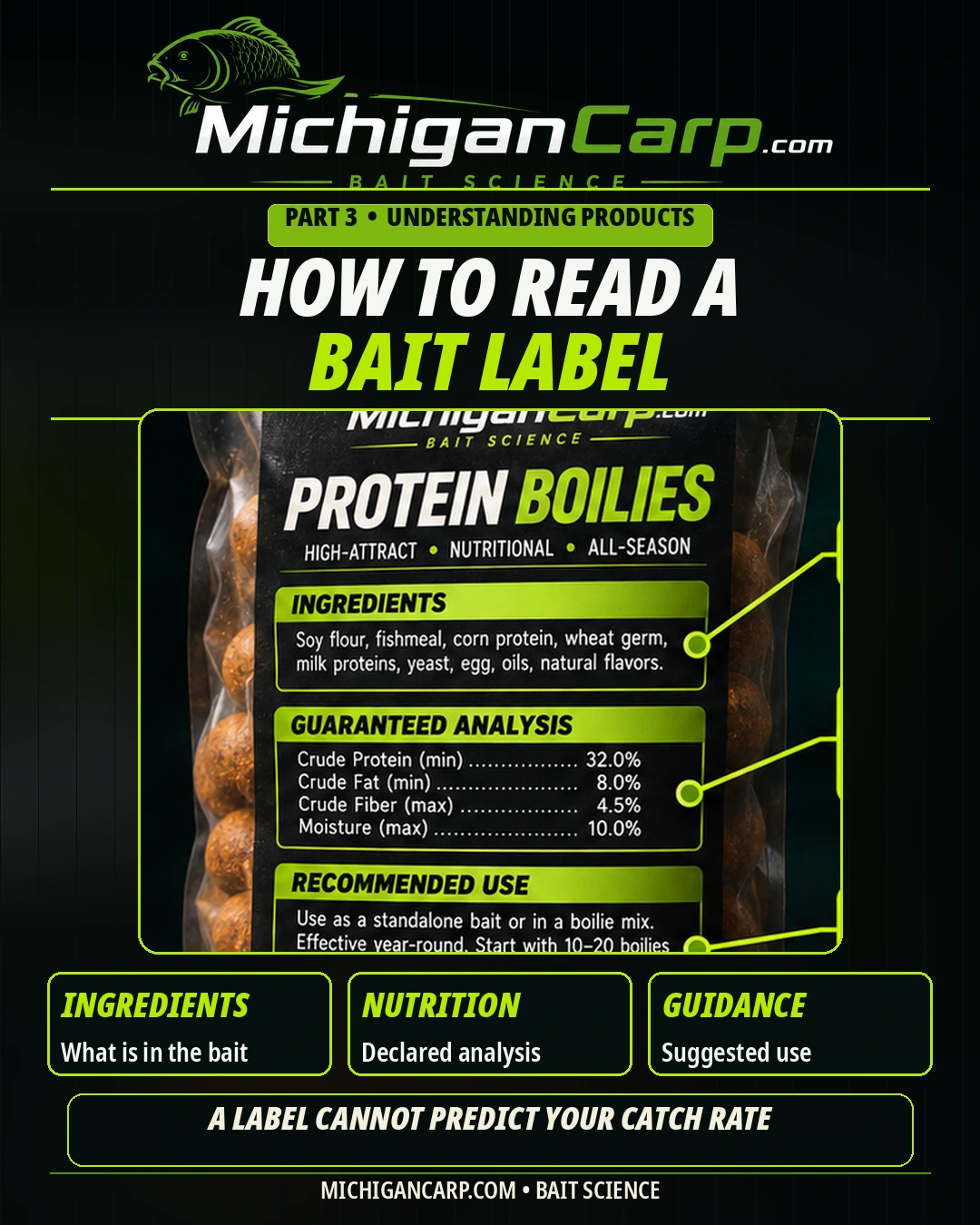
The amount of information varies considerably. A commercial aquaculture feed may include a detailed ingredient declaration and guaranteed analysis. A specialist recreational carp-bait product may provide substantially less detail. It is important not to assume that every fishing bait is labelled under exactly the same rules as a manufactured aquaculture feed or pet food. Requirements differ between jurisdictions and product categories. The University of Florida’s guide, Interpreting a Fish Food Package Label, provides a useful explanation of the information commonly found on formulated fish-feed labels.
One important principle is that an ingredient declaration and a nutritional analysis answer different questions. The ingredient list tells us something about what went into the product. The analysis provides limited information about its measured or guaranteed composition.
Neither, by itself, tells us how effectively the finished bait will attract or be accepted by wild carp.
That distinction should guide every purchasing decision.
3.2 Understanding the Ingredient List
Where ingredients are listed in descending order by weight, those appearing first normally contribute more to the original formulation than those appearing later. This is a standard principle of regulated animal-feed labelling, although anglers should check which labelling rules apply to the particular product. For example, imagine a hypothetical dry bait containing:
- Wheat semolina
- Soya flour
- Fishmeal
- Maize gluten meal
- Brewer’s yeast
- Betaine
- Flavouring
This tells us that cereal and plant-derived materials form an important part of the formulation. It also identifies fishmeal, yeast and betaine as ingredients. But the list does not tell us their exact proportions or whether the finished bait has a desirable texture, leakage profile or nutritional value. Nor does it establish that the relatively small amount of betaine makes the bait more attractive than another product without it. An ingredient should be judged by its contribution to the complete formulation, not simply by whether its name appears on the packet.
Ingredient names can hide important differences
Consider the following examples:
| Ingredient description | What you need to establish |
|---|---|
| Fishmeal | Fish species or source, processing method, freshness and protein quality |
| Milk protein | Whether it refers to casein, whey, milk powder, caseinate or another material |
| Soya flour | Whether it is full-fat, defatted, toasted or otherwise processed |
| Protein hydrolysate | The source protein, processing method, concentration and composition |
| Yeast product | Whether it is whole yeast, yeast extract, autolysed yeast or another preparation |
| Nut meal | The nut or seed source, oil content, processing and particle size |
| Liquid extract | Whether it is a concentrated extract, diluted suspension, hydrolysate or flavouring |
None of these ingredient categories is automatically good or bad. A correctly processed plant protein may be highly useful in a boilie formulation. A poorly handled animal-derived ingredient may be considerably less desirable. The exact identity and processing history often matter more than the broad category.
For more detailed comparisons, see Compare Carp Bait Ingredients and the Bait Ingredients Guide.
3.3 What Does Crude Protein Really Mean?
Protein percentages are frequently used to promote carp bait. A bag of boilies might advertise 35% protein, while another contains only 20%. It is tempting to assume the higher-protein bait must be better. That conclusion is not justified by the percentage alone. Crude protein is normally estimated from the nitrogen content of a sample, using a conversion factor. This measurement does not directly establish the digestibility or biological quality of the protein. Protein quality also depends on factors such as:
- The essential amino-acid profile
- Protein source and digestibility
- Processing conditions
- The presence of other nutrients
- The balance of ingredients in the finished feed
A bait containing more crude protein may offer a different nutritional profile from a lower-protein alternative. But the higher number does not automatically mean that carp can make better use of that protein. Equally, the nutritional requirements of fish in commercial aquaculture are not necessarily identical to what an angler needs from a hookbait used for a few hours. A single hookbait and several kilograms of regularly introduced feed serve different purposes. This is why the intended role of the bait matters.
Protein percentage is useful information, but it is not a carp-bait quality score.
For a more detailed explanation of proteins, digestibility and ingredient function, visit the Michigan Carp Bait Science Hub.
3.4 Why Moisture Content Matters
Moisture is another frequently overlooked factor. Comparing the protein percentage of a dry ingredient with the percentage of a wet or preserved bait can be misleading. A wet product contains water that contributes to the overall weight. For example, imagine two hypothetical products:
| Product | Moisture | Protein as sold |
|---|---|---|
| Dry bait | 10% | 30% |
| Moist bait | 40% | 20% |
On the face of it, the dry bait appears to contain considerably more protein. However, when calculated on a dry-matter basis:
- The dry bait contains approximately 33.3% protein.
- The moist bait contains approximately 33.3% protein.
Their protein concentrations are effectively identical when the water content is removed from the comparison. That does not mean the products are equivalent. They may differ substantially in ingredient quality, digestibility, texture, preservation and behaviour in water. The example simply demonstrates why comparisons should be made on a consistent basis. For anglers making their own boilies, moisture also affects handling, drying, storage and the physical properties of the finished bait. A wetter bait is not automatically more attractive, and a drier bait is not necessarily more nutritious.
3.5 Free Amino Acids, Hydrolysates and Protein Claims
Few ingredient categories attract more exaggerated claims than amino acids. As discussed in Part 2, common carp can respond to certain free amino acids under controlled experimental conditions. However, three different forms of protein-related material must be distinguished. Intact proteins consist of amino acids chemically joined into larger structures. They can provide nutritional value and important functional properties in a bait. Protein hydrolysates contain smaller peptides and varying amounts of free amino acids produced by breaking down a parent protein.
Free amino acids are individual amino-acid compounds that may dissolve into the water when accessible within a bait. All three can have legitimate uses. The mistake is assuming that one category automatically replaces the others. A hydrolysate can contribute soluble material without providing exactly the same properties as intact protein. A few grams of purified amino acids cannot reproduce the complete nutritional and physical characteristics of fishmeal, liver powder, casein or green-lipped mussel. Similarly, two protein hydrolysates produced from different raw materials may contain very different peptide and amino-acid mixtures. Their performance can also depend on processing methods and inclusion levels.
What should you ask about an amino-acid complex?
If a product is advertised as an amino-acid complex, useful questions include:
- Does it contain free amino acids, hydrolysed proteins or both?
- Is the source material identified?
- Is the product a dry concentrate or a diluted liquid?
- Does the manufacturer provide any information about concentration?
- What inclusion rate is recommended?
- Is the recommendation based on carp-specific research, general fish-feed research or practical product testing?
A manufacturer may reasonably choose not to disclose an exact formula. That does not make the product ineffective. But it does limit how accurately an angler can compare it with other products. The scientific literature does not provide a universal formula showing that one fixed mixture of free amino acids will outperform every other bait. Nor does it establish that ingredients containing an amino acid which produced a negative response in an isolated laboratory taste test should be rejected.
For a full explanation, read Amino Acids in Carp Bait: Free Amino Acids, Hydrolysates and Intact Proteins.
3.6 Understanding Other Commonly Advertised Attractants
Amino acids are only one part of the chemical picture. Many bait products contain substances described as feeding stimulants, enhancers or attractants. Some have been investigated extensively in aquaculture. Others are supported mainly by practical experience or manufacturer testing. The following table provides a more realistic way of interpreting common claims.
| Substance | What is known | What should not be assumed |
|---|---|---|
| Betaine | A naturally occurring soluble compound investigated in fish feeding and nutrition | That it is a universal appetite trigger or always improves catches |
| Free amino acids | Some produce positive taste responses in common carp and other fish | That all amino acids are attractive or that one inclusion rate works everywhere |
| Protein hydrolysates | Can supply soluble peptides and free amino acids | That all hydrolysates have identical compositions or feeding effects |
| Organic acids | Can influence chemical conditions and produce sensory responses depending on species and concentration | That every acid is a proven long-range carp attractant |
| Nucleotides | Have been investigated for taste and feeding responses in various fish species | That results from another species automatically apply to wild common carp |
| Yeast extracts | May supply soluble savoury compounds and other food-derived constituents | That all yeast products contain equivalent levels of active substances |
| Essential oils | Contain aromatic compounds with differing chemical properties | That a strong human-perceived aroma proves underwater attraction |
A useful reference is the University of Florida’s Review of Feed Attractants as a Guide for Aquaculture Operations. It discusses several classes of compounds used in aquaculture feed-attractant research, including amino acids, nucleotides, betaine and organic acids. The important qualification is that much of this research concerns species and feeding systems other than wild common carp. It provides useful scientific direction, but it should not be presented as a guarantee of improved recreational angling results.
An ingredient can perform several jobs. Citric acid provides a useful example. It may influence acidity, contribute to a particular taste profile and form part of a preservation system. However, adding a small amount of citric acid does not automatically make a homemade bait shelf-stable. Effective preservation depends on the complete formulation, including moisture, water activity, acidity, hygiene, packaging and storage conditions. Likewise, adding betaine does not correct a nutritionally unbalanced base mix or guarantee that a hookbait will be accepted.
The function of an ingredient should be understood before its attraction claims are considered.
3.7 The Truth About Carp Bait Flavours
Flavours deserve particular attention because their reputation is built on decades of successful carp fishing. Strawberry, pineapple, scopex, plum, cream, chocolate, maple, spice and fish-based flavour profiles have all become familiar to British and American anglers. Some have been used successfully for generations. But does that mean the compounds responsible for their human-perceived flavours have been scientifically demonstrated to attract carp? Not necessarily. A commercial flavour may contain a mixture of aromatic compounds together with solvents, carriers and stabilisers.
The name describes its intended flavour character. A plum flavour does not necessarily contain meaningful quantities of plum fruit, and a cream flavour does not automatically provide milk protein. This is normal flavour formulation. What matters to the angler is how the product behaves in the finished bait and whether it contributes anything useful under fishing conditions.
Human smell is not a reliable measure of carp attraction
A flavour can smell exceptionally strong to an angler without necessarily releasing a correspondingly strong or useful dissolved signal in water. Different compounds vary in water solubility, volatility and how they interact with other ingredients. The base mix, carrier liquid, processing and finished bait structure can all affect release. An oil-based flavour and a water-compatible flavour preparation should not automatically be expected to behave identically. The fact that a flavour remains detectable to our noses does not reveal how much of its individual compounds are reaching a carp.
It is also important not to assume that adding more flavour improves performance. Higher concentrations may change the behaviour or palatability of a bait, and the available evidence does not establish universal optimum flavour levels for wild carp.
What does field research tell us?
A particularly relevant study was published by Kasumyan, Kuzishchin and Gruzdeva in the Journal of Ichthyology in 2024. The researchers investigated wild common carp in the Akhtuba River, comparing different flavoured boilies and another baiting method during a 79-day experiment. The results showed that relative catches on the different flavoured boilies changed over the experimental period. Mussel-flavoured boilies performed comparatively well early in the experiment, while sweetcorn-flavoured boilies became increasingly prominent later. The researchers also noted the possible influence of other anglers introducing corn kernels into the area.
This is important evidence that bait-related responses in wild carp can change over time. But it does not identify a universal best flavour. Nor does it establish that every commercial sweetcorn flavour is superior to plum, mussel, strawberry or other bait profiles. The research investigated actual fishing outcomes under particular conditions. It cannot tell us that the flavour compounds alone caused every difference.
Should you use flavours at all?
Absolutely, if they contribute to a bait system you have confidence in. In my own fishing, flavoured boilies have been highly successful. But I would not claim that a particular flavour alone explains those captures. The base mix, presentation, fishing location, feeding conditions, prior exposure and baiting strategy must all be considered. A familiar flavour may also help give a bait a consistent identity, although we should distinguish that possibility from a demonstrated effect of a particular chemical mixture.
For the complete discussion, read Carp Bait Flavours: The Science, the Myths and What Really Matters.
The practical conclusion is straightforward:
Choose flavours to complement a sound bait, not to compensate for an inadequate one.
3.8 Natural, Artificial and Food-Grade: What Do These Terms Mean?
Marketing often suggests that natural ingredients are automatically preferable to manufactured compounds. The distinction is rarely that simple. A natural extract may contain many different chemical substances, with composition varying according to its source and processing. A manufactured ingredient may have a precisely defined chemical identity and consistent purity. Neither characteristic alone tells us how effective the ingredient will be in carp bait. Likewise, food-grade indicates suitability for a specified food-related use and relevant quality requirements. It does not establish that an ingredient attracts carp or that any dosage is appropriate for aquatic use.
An ingredient intended for human consumption is not automatically a validated fish-feed attractant. For example, food-grade glycerine may be useful as a liquid carrier. But it is not equivalent to a complete bait liquid containing protein hydrolysates, extracts or other substances. Similarly, a culinary fish sauce can contain useful products of protein fermentation, but its composition, salt concentration and processing may differ substantially from a specialist fish protein hydrolysate. The two products may overlap in some chemical characteristics without being interchangeable.
When assessing alternative sources, check identity, concentration, purity, additives, moisture content and intended use. A lower purchase price is valuable only if the material can perform the required job.
3.9 Does Bait Colour Really Matter?
Brightly coloured liquids and hookbaits are often marketed as more attractive. Colour can certainly influence how anglers select products. But it would be equally misleading to dismiss colour as irrelevant to fish. Carp possess visual sensory abilities, and visual characteristics may influence how a bait is detected or investigated under suitable conditions. A brightly coloured hookbait may be easier to distinguish from the surrounding lakebed. However, visibility depends on factors such as water clarity, illumination, depth, background and the bait’s position.
A fluorescent pop-up can serve a different purpose from a dark, food-coloured bottom bait. Neither is automatically superior. It is also essential to distinguish colour from chemical attraction. Red colouring in a liquid does not establish that the liquid contains an effective dissolved feeding stimulant. A cloud released by a bait may create a visible effect without proving that meaningful quantities of soluble attractants are present. Likewise, a strongly coloured bait may perform well because of its visual presentation, other ingredients or the fishing situation.
Judge colour as one possible part of presentation, not as proof of chemical attraction.
3.10 Proprietary Blends: Legitimate Formulation or Marketing?
The words proprietary blend often attract suspicion among experienced bait makers. Some anglers interpret them as proof that a manufacturer is hiding inexpensive ingredients. Others believe secrecy demonstrates that a product contains something uniquely effective. Neither conclusion necessarily follows. Commercial manufacturers invest money in developing formulations and may reasonably protect their recipes. Ingredient ratios, processing methods and quality-control procedures can form part of a company’s competitive advantage. There is nothing inherently wrong with keeping that information confidential. The problem arises when secrecy is used to support claims that cannot be independently evaluated. Consider two hypothetical descriptions.
Product A:
“Revolutionary amino-based super attractant with exclusive feeding technology. Guaranteed to stimulate feeding.”
Product B:
“Concentrated liquid protein hydrolysate intended for use in boilies and groundbait. Derived from identified protein sources. Recommended inclusion rate and storage instructions provided.” The second description gives the buyer more useful information. It does not guarantee that Product B will catch more carp. But it provides a clearer basis for assessing the product’s role in a bait formulation. A manufacturer does not need to reveal every gram of its recipe to provide meaningful information about intended use, composition, compatibility and storage.
A useful approach is to favour manufacturers that answer reasonable technical questions clearly. The distinction is between protecting a legitimate formula and making extraordinary performance claims without adequate support.
3.11 What Does “Scientifically Proven” Actually Mean?
Scientific language is common in modern carp bait advertising. It can also be misleading when results from one type of experiment are applied to a completely different situation. There are several levels of evidence worth distinguishing.
| Evidence | What it may establish | Main limitation |
|---|---|---|
| Chemical analysis | What compounds a product contains | Does not show how carp respond |
| Sensory or laboratory testing | Whether fish detect or respond to particular substances under controlled conditions | May not predict wild-carp catches |
| Controlled feeding trials | Feed intake, acceptance or growth under specified conditions | Usually conducted under managed conditions |
| Controlled field trials | Comparative outcomes in natural fishing environments | Results can depend on water, season and study design |
| Angling experience | How a bait performs during actual fishing | Many variables are difficult to control |
Every category has value. Laboratory research can identify relevant chemical mechanisms. Aquaculture trials can reveal nutritional and feeding responses. Field studies can test whether these effects translate into a more realistic environment. Personal fishing experience can reveal practical advantages that are not yet explained by published research. However, the evidence should be described accurately. A study showing that juvenile carp accept an amino-acid-treated pellet does not prove that a commercial liquid containing that amino acid increases the capture rate of large wild carp.
Similarly, a successful catch photograph demonstrates that the bait caught a fish. It does not establish which particular ingredient made the difference. For this reason, I prefer to describe ingredient claims using three broad categories: Established: Supported by appropriately designed research for the specific claim being made. Plausible: Consistent with relevant research or known chemical properties, but not directly demonstrated in the proposed carp-bait application. Unproven: Supported mainly by assertion, anecdote or evidence that does not adequately test the claim.
A product can be worth using even when its precise mechanism remains unproven. But anglers deserve to know the difference.
3.12 Why Specialist Carp Bait Can Be Worth the Extra Money
Understanding commodity ingredients should not lead us to assume that specialist products are always overpriced. Two manufacturers can use similar raw materials and produce very different finished baits. Processing, consistency, ingredient freshness and formulation expertise all matter. For example, a high-quality ready-made boilie may offer advantages that are difficult to reproduce in small home batches:
- Consistent rolling and cooking
- Reliable physical properties
- Controlled manufacturing procedures
- Suitable storage and packaging
- Convenient bulk purchasing
- Established practical performance
- Less preparation time for the angler
A carefully formulated liquid may combine several compatible ingredients with a particular concentration and physical character. That can be more useful than simply mixing together inexpensive materials purchased separately. Specialist suppliers may also offer ingredients in small quantities that would otherwise require uneconomical bulk purchases. Conversely, an experienced bait maker may achieve excellent results using conventional food ingredients, carefully selected specialist materials and a relatively simple formulation. The real question is whether the premium buys something useful.
Pay for proven quality, suitable formulation, consistency and convenience — not simply an impressive product name.
3.13 Comparing Alternative Ingredient Sources
One of the advantages of living in the United States is access to an enormous range of food, agricultural and supplement ingredients. British anglers have long sourced materials beyond specialist tackle shops, and the same approach can work in America. However, finding an ingredient with the same name is only the beginning. Before treating two products as interchangeable, compare the following:
| Check | Why it matters |
|---|---|
| Exact chemical or ingredient identity | Similar names may describe different products |
| Concentration and purity | A diluted liquid is not equivalent to a dry concentrate |
| Moisture and fat content | These influence storage, formulation and cost |
| Processing method | Heat treatment, extraction or hydrolysis can change properties |
| Particle size | Affects mixing, texture and water access |
| Added ingredients | Salt, preservatives, sweeteners or other substances may influence suitability |
| Freshness and storage | Quality can deteriorate before the ingredient is used |
| Cost per usable quantity | Pack price alone may conceal poor value |
For British and American readers, terminology can add another complication. Soya flour is generally described as soy flour in America. Maize may refer broadly to corn, but American cornmeal, corn flour and cornstarch are not automatically interchangeable. Likewise, British cornflour generally means what Americans call cornstarch. Birdfood mixes, milk powders and nut meals can vary widely even when the descriptions appear familiar. Our UK–USA Carp Bait Glossary explains these differences and identifies substitutions that require additional care. The important rule is to compare actual ingredient specifications rather than relying on familiar names.
3.14 Calculating the Real Value of an Additive
An inexpensive ingredient is not necessarily economical. Suppose an angler purchases a large quantity of a specialist amino-acid powder at a low price per gram. If only a small amount is used each year, the remaining material may sit in storage for a considerable period. The upfront cost, storage conditions and likelihood of deterioration all matter. Conversely, a more expensive small container from a specialist supplier may be practical for someone who makes only occasional batches. When comparing products, consider:
- Cost per gram or millilitre of usable material
- Concentration of the relevant ingredients
- Recommended inclusion rate
- Shipping and minimum purchase quantities
- Storage life and expected usage
- The cost of the complete finished bait
A fair comparison starts with what the ingredient actually costs at the intended inclusion rate per kilogram of dry base mix. However, cost alone cannot establish performance. If one liquid is cheaper but its composition is unknown, it may not be possible to compare it directly with a concentrated specialist product. Likewise, a homemade mixture should not be described as equivalent simply because it contains some of the same compounds. Part 4 examines individual ingredients and purchasing alternatives in greater detail.
3.15 Five Warning Signs When Evaluating Carp Bait Products
Not every poorly explained product is ineffective, but some marketing claims deserve particular caution.
1. Guaranteed catch improvements
Statements promising more carp, bigger fish or dramatically increased feeding activity should be supported by evidence appropriate to those specific claims. Fish location, feeding behaviour, presentation and many other variables influence results.
2. Attraction claims based only on ingredient presence
The presence of an amino acid, organic acid or other soluble compound does not establish an effective concentration or demonstrate that the finished bait will release it in a useful way.
3. Laboratory results presented as field-catch proof
Fish detecting or accepting a substance under controlled conditions is not equivalent to demonstrating improved angling results in natural waters.
4. Unrealistic comparisons with specialist formulations
A grocery ingredient may share some constituents with a specialist extract, but that does not establish identical composition, nutritional value or performance.
5. Products that rely entirely on secrecy and dramatic language
A manufacturer can legitimately protect a formula while still explaining what the product is intended to do, how it should be used and how it should be stored. These warning signs are reasons to investigate further, not automatic grounds for dismissing a product.
3.16 A Practical Bait-Buying Checklist
Before purchasing another additive, liquid or specialist ingredient, ask yourself:
- What problem am I trying to solve? Do I need more soluble material, improved texture, better binding, nutritional value, preservation support or a different hookbait presentation?
- Does my current bait already perform that job? An unnecessary additive may increase cost and complicate the formulation.
- What evidence supports the product? Is the claim based on chemistry, laboratory research, controlled trials or anglers’ experience?
- Can I use it correctly? Consider dosage, compatibility, storage and the effect on the finished bait.
- Is there a genuinely comparable alternative? Check specifications rather than comparing names alone.
- Can I test its contribution? A small controlled batch may teach you more than a large purchase based on advertising.
This approach can save money, but the more important benefit is that it creates a better understanding of bait formulation. Instead of continually adding ingredients, anglers begin to identify what each material actually contributes.
3.17 My Approach After More Than Fifty Years of Carp Fishing
Over the years I have used many different bait types, including particles, milk-protein boilies, nut-based mixes, fishmeal formulations, specialist liquids and a considerable range of flavours. Some have performed exceptionally well. Others have added cost and complexity without providing an obvious practical benefit. One lesson has remained consistent: a successful bait is rarely the result of one ingredient acting alone. A well-formulated bait is a complete system. It must be suitable for the water, remain effective during the intended fishing period and provide the fish with something worth investigating or eating.
Its physical properties matter as much as the marketing claims made about its chemical composition. On the large natural waters I fish in Michigan, the presence of abundant natural food can make bait selection particularly interesting. However, the principles are equally relevant to a heavily fished British gravel pit, a commercial fishery or a European river. Carp do not suddenly require a different chemistry because they live on another continent. Their behaviour and the fishing conditions may differ, but the fundamental need to understand ingredients remains.
I am not interested in dismissing commercial bait companies or claiming that every expensive additive is unnecessary. Some products are excellent. But I believe anglers should be encouraged to ask questions, understand their ingredients and test their assumptions.
A good bait maker doesn’t need to know every secret in the industry. The important thing is understanding what your own bait is designed to do.
Part 3: The Key Lesson
A carp bait label can provide useful information, but it cannot tell the entire story. Ingredient lists, protein percentages, flavour descriptions and claims about chemical attractants all need to be interpreted in context. The research demonstrates that fish respond to particular chemical stimuli, but the response varies according to the compound, fish species, experimental conditions and finished food. It does not support a universal formula for irresistible carp bait.
The most sensible approach is to begin with a sound bait, identify what each ingredient contributes and improve it only when there is a clear reason to do so. A specialist product may justify its price through quality, concentration, processing or convenience. An alternative ingredient may provide the same practical function at lower cost. And sometimes the best purchasing decision is not to buy another additive at all.
Understand the ingredient. Understand the job. Then decide whether the price represents real value.
In Part 4, we move from these principles to specific materials, including amino acids, grocery-store ingredients, specialist proteins, marine extracts, fermentation products and other potential alternatives. The aim is to separate useful savings from false economy and identify where spending more genuinely makes sense.
Part 4: The Real Cost of Carp Bait Additives
Understanding Ingredients Before Paying Premium Prices
One of the pleasures of making your own carp bait is choosing the ingredients yourself. You can buy from a specialist bait firm, a food supplier, an agricultural merchant or a supplement company—and make that decision on the merits of the material. A familiar ingredient might be available from several different sources, sometimes at very different prices. But a shared name or a lower price tells only part of the story. The chemical identity, purity, concentration, freshness, processing method and physical properties of an ingredient can all influence its suitability for bait making.
A cheap ingredient that fails to perform the required job is not good value. Equally, paying a substantial premium for an ordinary material without understanding its purpose makes little sense. I am much more interested in what an ingredient contributes than in how impressively it is advertised. I am perfectly happy to pay for specialist ingredients when they offer something useful. But I also see little reason to overlook a good-quality alternative simply because it comes from a supermarket rather than a tackle shop.
The objective of this section is to examine some of the most commonly discussed carp-bait additives, explain their realistic functions and identify where alternative sources may offer worthwhile savings. We will also examine three ingredients that have acquired almost legendary reputations in British carp fishing: green-lipped mussel, Robin Red and krill meal.
The aim is not to make the cheapest possible bait. It is to avoid paying for ingredients or claims that do not add meaningful value.
4.1 Amino Acids and Supplements: Are Specialist Products Worth the Premium?
Individual amino acids are among the most frequently discussed additives in modern carp bait making. Names such as L-proline, L-alanine, L-cysteine, glycine, glutamic acid and taurine regularly appear in bait-making discussions. Some are sold by specialist carp-bait companies. Others can be purchased from nutritional supplement suppliers or food-ingredient distributors. In some cases, the underlying chemical substance may be identical. However, this does not mean that every product sold under a similar name has the same composition or concentration.
Understanding Different Chemical Forms
Betaine provides a good example. Two forms commonly encountered are:
- Betaine anhydrous, also known as trimethylglycine.
- Betaine hydrochloride, commonly written as betaine HCl.
These are related materials but they are not identical by weight. Betaine hydrochloride contains hydrochloride in addition to the betaine component. Consequently, the same mass of betaine anhydrous and betaine HCl does not supply the same mass of betaine. This matters when comparing prices or interpreting research that specifies a particular chemical form. The same principle applies to amino acids sold as hydrochloride salts. A label describing L-cysteine hydrochloride is not equivalent, gram for gram, to one describing pure L-cysteine.
There can also be differences between free acids, salts, hydrated forms and blended products. For this reason, comparing only the headline price per 100 grams can be misleading.
Does the L-Form Always Matter?
Many naturally occurring protein amino acids are predominantly present in the L-configuration. Research into fish taste and smell has shown that responses can differ between molecular forms. However, it would be incorrect to assume that every L-amino acid is an effective carp attractant or that every D-form is inactive. Responses depend on the compound and experimental conditions. Glycine is a particularly useful exception to remember because it is not chiral and therefore does not have separate L- and D-forms.
The Kasumyan and Morsi common-carp research discussed in Part 2 demonstrated that individual amino acids can produce markedly different taste responses. It did not establish a universal recipe for combining them into an irresistible bait.
What About Betaine?
Betaine is worth discussing because research has investigated its effects specifically in common carp. Murthy, Manai and Patil (2016) examined diets containing different concentrations of betaine hydrochloride in juvenile common carp. Under their controlled conditions, the group receiving 0.25% betaine in the diet showed improved growth and feed-utilisation measures compared with the control. That is legitimate carp-specific evidence. It is not, however, proof that adding the same percentage to a recreational boilie will produce more captures of wild adult carp.
The experiment examined feeding and growth over 60 days in tanks. The study did not establish an optimum inclusion rate for fishing hookbaits in natural lakes.
Read the original betaine study.
Buying Individual Amino Acids
Alternative suppliers may offer attractive prices, especially for larger quantities. Before purchasing, I would check:
- The exact chemical identity and form
- Ingredient purity and any added substances
- Available technical specifications
- The manufacturer or distributor
- Recommended storage conditions
- The quantity realistically required
- The total cost including delivery
Do not assume that a supplement labelled pharmaceutical grade or laboratory tested is superior without understanding what those claims cover. Equally, do not assume that a specialist bait supplier is simply repackaging an inexpensive commodity. The specialist product may offer a different concentration, formulation, preparation method or practical convenience.
My recommendation: Buy individual amino acids only when you have a clear reason to use them, understand the compound and have a practical plan for evaluating the result.
There is little advantage in accumulating expensive powders that may sit unused for years.
For further information, see Amino Acids in Carp Bait: Free vs Intact Proteins.
4.2 Grocery Store Gold: Useful Ingredients Without the Carp-Bait Price Tag
Some of the most practical bait-making ingredients can be found in an ordinary supermarket. British anglers have used household ingredients in carp bait for generations. The same opportunities exist in American grocery stores. The important thing is to understand what each ingredient contributes.
| Grocery ingredient | Potential use in bait | Important qualification |
|---|---|---|
| Food-grade glycerine (glycerol) | Liquid carrier and humectant | Not automatically equivalent to a complete specialist bait liquid |
| Molasses | Sweetness, colour, binding and soluble sugars | Composition varies; not a proven universal feeding stimulant |
| Citric acid | Acidity adjustment and formulation function | Does not independently make a bait shelf-stable |
| MSG (monosodium glutamate) | Source of glutamate in a soluble salt form | Does not establish improved wild-carp catch rates |
| Sweetened condensed milk | Milk solids, lactose and added sugars | Not equivalent to purified casein or whey protein |
| Vanilla extract | Flavour ingredient | Human-perceived aroma is not proof of carp attraction |
| Garlic powder | Flavour and plant-derived constituents | Chemical composition changes during processing and storage |
| Turmeric | Colour and spice character | Carp-specific attraction claims require evidence |
Glycerine: A Useful Carrier
Food-grade glycerine is commonly used in homemade liquids. It is viscous, mixes with water and can help alter the handling properties of a liquid preparation. However, a glycerine-based mixture is not automatically PVA-compatible. PVA is short for polyvinyl alcohol, the water-soluble material used in many carp-fishing bags, mesh systems and tapes. Water-containing mixtures may damage or dissolve PVA, and compatibility also depends on the complete formulation and the particular PVA product. If you intend to use a liquid in a PVA bag, test the finished mixture with the exact PVA material first. Do not assume that adding glycerine to a water-based liquid makes the mixture PVA-safe.
Molasses: More Than Just Sweetness. Molasses is inexpensive, widely available and useful in several bait applications. It contributes sugars, colour and viscosity. It can be useful when preparing particles, method mixes and some boilie formulations. However, blackstrap molasses, ordinary cane molasses and other syrup products can differ in composition. There is no sound reason to claim that molasses automatically stimulates carp feeding at every concentration. Its most defensible advantages are practical formulation properties and the presence of soluble food-derived constituents.
Citric Acid: Useful but Frequently Misunderstood. Citric acid is an important ingredient in food science. It can adjust acidity and contribute to the taste profile of a formulation. But adding a little citric acid to an otherwise perishable mixture does not guarantee preservation. Effective preservation depends on the finished product’s pH, water activity, hygiene, packaging and storage conditions. An acidic bait is not necessarily shelf-stable. For homemade boilies and wet liquids, freezing may be a more reliable storage choice than relying on untested preservative combinations.
MSG and Glutamic Acid. MSG is the sodium salt of glutamic acid. It is widely used in the food industry to provide a savoury or umami taste. Glutamic acid is also among the substances investigated in fish taste research. However, these observations do not establish that adding MSG to a boilie increases the catch rate of wild carp. The finished bait’s concentration, release characteristics and other ingredients remain relevant. MSG may be worth investigating as an experimental ingredient, but it should not be promoted as a scientifically proven shortcut to more carp.
Garlic and Turmeric
Garlic and turmeric are familiar ingredients in traditional bait making. Both can influence colour, aroma and the character of a finished mix. Fresh garlic produces reactive sulphur-containing compounds when its tissues are damaged. Their presence and stability depend on processing and handling. Consequently, ordinary dried garlic powder should not automatically be assumed to contain a fixed concentration of allicin. Turmeric contributes a distinctive yellow colour and contains several plant compounds, including curcuminoids. Claims about their biological properties in other contexts do not automatically establish feeding stimulation in common carp.
These ingredients can be used for their practical effects without inventing scientific certainty. The grocery-store lesson: An ingredient does not need an expensive carp-fishing label to be useful, but being inexpensive or natural does not make it a proven attractant.
4.3 The Asian Grocery Store: Fermented Foods and Marine Ingredients
Asian grocery stores can be particularly interesting sources of bait-making ingredients. Many traditional products rely on fermentation, protein breakdown and ingredients derived from fish, shellfish or soya beans. These processes can generate soluble amino acids, peptides and other food-related substances. It is easy to see why they appeal to experimental bait makers. Before using one as a substitute for a specialist liquid, though, compare its actual composition, especially the salt content and the level of protein breakdown.
Fish Sauce: A Genuine Fermented Protein Product
Fish sauce is one of the more interesting alternatives. Traditional fish sauce is generally produced by fermenting fish with substantial quantities of salt. During processing, naturally occurring and microbial enzymes contribute to the breakdown of fish proteins. The finished liquid can contain soluble nitrogen compounds, peptides, free amino acids and other products of fermentation. The underlying process has been studied extensively in food science. A review of enzymes in seafood processing describes fish sauce as a product of enzyme-solubilised fish protein, preserved with salt.
Read: Enzymes in Fish and Seafood Processing.
That makes fish sauce potentially useful in bait making. But it does not establish that a bottle from the grocery store is equivalent to a specialist low-salt fish protein hydrolysate. The raw materials, salt content, processing conditions and degree of protein breakdown may be very different. Commercial fish sauce can contain substantial amounts of sodium chloride. That matters when calculating its contribution to a complete bait formulation. For practical experiments, choose products with clearly declared ingredients and avoid assuming that every brand has an identical chemical profile.
Fish sauce can be explored as a food-derived liquid ingredient, but its usefulness should be assessed in the finished bait rather than inferred solely from its smell.
Shrimp Paste and Fermented Seafood. Shrimp paste, including products sold as belacan, is another traditional fermented ingredient. Its composition depends on the raw material, salt concentration and manufacturing process. A fermented shrimp paste may contain useful food-derived compounds, but it is not a purified crustacean extract. It may also be quite salty. If experimenting with it, evaluate how it affects the mix’s consistency, flavour profile and processing. Do not assume that an inexpensive block reproduces the properties of concentrated commercial shrimp or krill extracts.
Miso Paste. Miso is produced through fermentation of ingredients such as soya beans, rice or barley. The process changes the composition of the starting materials and generates distinctive soluble food-related substances. Miso can therefore be an interesting experimental ingredient for bait makers. However, it generally contains salt, and the different varieties can vary considerably. A sweet white miso and a darker, longer-fermented miso should not automatically be treated as equivalent. There is also no established basis for claiming that the presence of glutamate in miso guarantees greater carp attraction.
Oyster Sauce. Oyster sauce deserves particular caution. Some commercial products contain oyster extracts alongside water, sugar, salt, thickeners and other ingredients. The proportion of actual oyster material can differ substantially between brands. Consequently, oyster sauce should not be compared directly with concentrated oyster extract or mollusc powder simply because the product name contains the word oyster. Read the ingredients and consider the quantity of actual marine material supplied.
Dried Shrimp and Squid. Plain dried shrimp and squid may offer practical alternative animal-derived ingredients. They can be ground for use in homemade dry mixes, provided the product is appropriate for bait making. Choose unseasoned products and check for salt, other additives and storage quality. A dried shrimp powder can contribute crustacean-derived proteins and other constituents. But shrimp and Antarctic krill are different organisms. Their nutritional compositions and processing histories are not necessarily interchangeable. The same applies to dried squid, which should not be regarded as an automatic replacement for a professionally produced squid hydrolysate.
Are These Products Worth Trying? Yes, particularly for anglers who enjoy experimenting with homemade baits. But keep the experiments modest and controlled. Introduce one ingredient at a time where practical, compare it against an otherwise similar formulation and record the results. Refrigerate or freeze perishable homemade preparations appropriately. Do not assume that a commercially shelf-stable fermented food will remain equally stable after dilution or mixing with other ingredients. And remember that a strong fermented aroma is not direct evidence of a stronger underwater feeding response.
4.4 Pet Food, Koi Feed and Livestock Ingredients
Agricultural and pet-food suppliers offer another potential source of bait-making materials. In America, the range of feed ingredients available through farm stores can be particularly extensive. Products may include maize, grains, feed pellets, yeast products, protein meals, oilseed meals and other ingredients. British anglers will recognise similar sourcing opportunities through animal-feed merchants and birdfood suppliers. However, feed products require careful evaluation.
Koi Pellets: An Interesting Starting Point. Koi are domesticated forms of common carp. That makes commercially formulated koi diets particularly relevant when considering carp nutrition. Many koi pellets contain combinations of protein sources, carbohydrates, fats, vitamins and minerals designed to support feeding and growth. But koi pellets are not all made to the same recipe. Some contain substantial fishmeal content, while others rely on different protein sources. Ingredients and guaranteed analyses vary between manufacturers and product ranges. It would therefore be incorrect to claim that every koi pellet contains betaine, citric acid, spirulina or any other particular additive. The label needs to be checked.
What Can We Learn From Koi Feed?
A properly formulated koi feed demonstrates the importance of ingredient balance, processing and palatability. It also illustrates why a recreational carp bait does not necessarily need an elaborate fruit flavour to function as food. However, an aquaculture or ornamental-fish feed has a different primary purpose from a fishing hookbait. It may be designed for regular feeding, growth and nutritional maintenance rather than hookbait durability, casting distance or prolonged immersion. A pellet that performs well as a complete feed is not automatically suitable as a boilie base without modification.
For homemade bait, ground koi pellets may be worth experimenting with. But the exact pellet formulation, oil content, particle size and binding characteristics should be considered.
Livestock Feed and Range Cubes
Livestock feeds can sometimes provide economical quantities of cereals and plant-derived ingredients. However, the broad name range cube or livestock pellet tells us very little about the actual formulation. Some animal feeds contain additives intended for a particular livestock species, including medications or other substances unsuitable for introducing into fisheries. Only use products whose complete composition and suitability are established. Avoid medicated feeds and products with ingredients you cannot identify or evaluate.
The fact that a feed is safe for cattle, poultry or another terrestrial animal does not automatically make it suitable for carp or for use in open water. Local regulations and fishery rules should also be respected.
Spirulina and Claims About DMPT
Spirulina is frequently advertised as a natural source of numerous beneficial compounds. It is a protein-rich cyanobacterial ingredient used in various food and feed applications. However, claims that a particular spirulina powder contains meaningful quantities of dimethyl-beta-propiothetin, commonly called DMPT, require specific analytical evidence. DMPT occurs in certain marine organisms and has been investigated as a feeding-related compound in aquaculture research. That does not establish that ordinary spirulina powders provide a significant or predictable DMPT concentration. Nor does it mean DMPT is an approved or appropriate ingredient for every jurisdiction or fishery.
Spirulina should be evaluated for its documented nutritional and formulation properties, not for an assumed concentration of a fashionable additive.
4.5 Decoding Green-Lipped Mussel: What Is Actually in This Premium Ingredient?

Few ingredients enjoy a stronger reputation among experienced British carp anglers than green-lipped mussel powder. Usually abbreviated to GLM, it has been used for many years in specialist boilie formulations. Its reputation is substantial. But is it really necessary to pay premium prices for GLM, and can cheaper ingredients reproduce its benefits? To answer that sensibly, we need to understand what GLM actually is.
The Difference Between Green-Lipped and Blue Mussels. New Zealand green-lipped mussel is the species Perna canaliculus. It is distinct from commercially important blue mussel species such as Mytilus edulis. Research on one species cannot automatically be used to establish the exact composition of the other. That matters because some bait discussions combine results from different marine organisms and then describe them as though they apply specifically to green-lipped mussel powder. A 2023 review of Greenshell mussel products discusses the composition and processing of Perna canaliculus, including its proteins, fats and other constituents.
Read: Greenshell Mussel Products — A Comprehensive Review.
What Does GLM Contain?
Whole green-lipped mussel material contains a mixture of:
- Proteins and peptides
- Amino acids
- Marine lipids
- Minerals
- Carbohydrate-related constituents
- Other naturally occurring compounds
Depending on the product, marine fatty acids and phospholipids may also be present. However, GLM powder is not a single, chemically standardised substance. Its composition can vary with the raw material, processing method and whether the product contains whole dried mussel, extracted material or a mixture. A powder sold for human supplementation may also contain added carriers or other ingredients. For bait making, this means a simple label stating green-lipped mussel does not tell us everything we need to know.
Why Are Amino Acids So Often Mentioned?
Mussel tissues contain amino acids, including compounds that have been investigated in fish chemoreception research. Betaine, glycine, alanine, proline and taurine are frequently discussed in relation to marine ingredients. However, an important distinction needs to be made between total amino-acid content and the free, water-soluble fraction. Much of the amino-acid content of any protein-rich ingredient may remain chemically bound within proteins. It is not all released immediately when the ingredient enters water. Nor can we assume that the presence of these substances establishes a particular level of attraction in wild common carp.
Research on marine organisms helps us understand their chemistry. But it does not provide a reliable numerical measurement of how much each constituent contributes to carp catch rates.
Can You Reproduce GLM With Individual Amino Acids?
You can purchase some of the individual compounds found in marine ingredients. That does not mean you can reproduce the properties of whole green-lipped mussel powder simply by mixing those compounds together. The complete product contains proteins, lipids and many other constituents that isolated amino acids cannot replace. Its physical behaviour in a boilie may also be different. Similarly, a cheaper mussel powder from another species may offer useful properties without being chemically equivalent to GLM. For example, published comparisons of green-lipped and blue mussels have identified differences in lipid and fatty-acid composition. That is evidence of biological variation, not proof that one species catches more carp.
Is GLM Worth the Money?
GLM may be worth considering when a bait maker wants a genuine marine-derived ingredient with a particular composition and physical character. But it is not compulsory. A balanced milk-protein, nut-based or birdfood boilie can be a perfectly legitimate alternative to a marine-based formulation. If you decide to use GLM, buy a product with clear identification and appropriate quality information. Compare the cost at the intended inclusion level rather than simply looking at the price of the bag.
For example, using a relatively small quantity of a premium ingredient may have a modest impact on the total cost of a kilogram of base mix. Using much more without a clear purpose can increase the cost considerably. The practical conclusion: GLM is a legitimate specialist ingredient with an established history in carp bait making, but there is insufficient evidence to claim that every bait requires it or that its attraction can be recreated by mixing a fixed set of free amino acids.
4.6 Decoding Robin Red: Understanding a Classic British Bait Ingredient
Robin Red occupies a special place in British carp-fishing history. Developed by Haith’s, it became closely associated with highly successful boilie formulations and has remained a familiar ingredient for decades. For many anglers, the name alone represents a particular style of rich, spicy, red-coloured bait. But understanding the product requires us to distinguish its history, declared composition and reputation from scientifically proven attraction.
What Is in Robin Red?
Haith’s currently offers different Robin Red formulations. Its Robin Red Natural product for the UK/EU market has a published composition that includes:
- Capsicum
- Red beet extract
- Sucrose
- Vegetable oil
- Maltodextrin
- Silicon dioxide
The manufacturer also publishes analytical information about the product’s oil, protein, fibre, moisture and other constituents.
View Haith’s Robin Red Natural product information.
This is useful information because it reveals the broad character of the formulation. It is not simply red colouring. Nor is it a pure capsicum extract. It contains several ingredients that contribute to the physical and sensory character of the finished material.
What About Robin Red HB? Haith’s distinguishes Robin Red HB, described as a hookbait or lure formulation, from its newer UK/EU Natural product. These formulations should not automatically be treated as interchangeable. Before incorporating either version into bait, check the manufacturer’s stated intended use and current guidance. Do not assume that a product intended for a hookbait application is automatically appropriate for general feeding bait.
Is Capsaicin a Proven Carp Attractant? Capsicum contains several compounds, including capsaicinoids that contribute to the heat associated with chilli peppers. However, the presence of capsicum does not establish that capsaicin is the specific reason carp respond to Robin Red-based baits. An ingredient’s sensory effect on humans cannot automatically be transferred to fish. The complete formulation, associated food ingredients and fishing circumstances all matter. Robin Red has an extensive practical history, which deserves recognition. But its reputation cannot be reduced confidently to one molecule.
Can You Make Your Own Robin Red? You can certainly make a homemade spicy bait ingredient. Paprika, suitable pepper products, beetroot powder and other food-derived materials may contribute colour and flavour character. But combining similar ingredients does not necessarily reproduce the original product’s proportions, processing, consistency or behaviour in a bait. A homemade spicy mixture should be treated as its own formulation. That may still produce an excellent bait. It simply means we should not describe it as chemically identical to Robin Red or claim equivalent attraction without comparative testing.
Is Genuine Robin Red Worth Buying? For anglers who want to use the established ingredient, genuine Robin Red offers the advantage of a known commercial product with a documented composition and consistent manufacturing source. For anglers experimenting with other spice and birdfood formulations, alternatives may be entirely satisfactory. My view is that both approaches have merit. The important thing is to understand what you are using and why.
The lesson from Robin Red is not that expensive ingredients are essential. It is that successful ingredients often have more complexity and history than their simplest marketing descriptions suggest.
4.7 Freeze-Dried Beef Liver: A Practical Alternative Ingredient
Freeze-dried beef liver is an interesting example of a useful bait-making material available outside specialist tackle shops. It is commonly sold as a pet treat. I have used freeze-dried beef liver purchased from Costco as a convenient ingredient, avoiding the need to prepare fresh liver myself. But what does it actually offer?
Understanding Freeze-Dried Liver. Freeze-drying removes much of the moisture from a food material under controlled conditions. The result is generally lightweight and comparatively easy to store when correctly packaged. Beef liver contains proteins, vitamins, minerals and other naturally occurring constituents. However, drying liver does not automatically convert all its protein into free amino acids. The material remains a complex food ingredient. Its composition and behaviour should not be confused with a concentrated liver hydrolysate.
How to Choose a Suitable Product. If buying freeze-dried liver from a pet-food supplier, look for a clearly labelled single-ingredient product. Avoid added seasonings, unknown additives or formulations that cannot be evaluated. Consider the quality, packaging and storage conditions. A product sold for pets is not automatically suitable for every bait formulation or aquatic environment.
Using Liver Powder in a Boilie. Freeze-dried liver can be ground into a powder for experimental use in a homemade base mix. The fineness of the powder can influence how it mixes with the other ingredients. It may also affect texture, binding and the behaviour of the finished bait in water. A small test batch is the sensible starting point. Assess the material’s effects on dough handling, rolling, cooking and subsequent immersion. Do not assume that grinding dried liver into water produces the same material as an industrially manufactured liquid liver hydrolysate. The two may contain very different proportions of soluble constituents.
Is It Better Value Than Specialist Liver Powder? That depends on the products being compared. A small bag of freeze-dried liver treats may have a higher cost per kilogram than a specialist bait ingredient purchased in bulk. Conversely, it may be a convenient option for anglers who require only a modest amount. Calculate the cost of the actual quantity used, including shipping and unused material. The useful comparison is not simply whether the ingredient comes from a pet shop or tackle shop. It is whether the chosen product supplies the desired function at a reasonable total cost.
4.8 Krill Meal: What Makes This Marine Ingredient Different?
Krill meal is another widely discussed ingredient in modern carp bait making. Antarctic krill, particularly Euphausia superba, are small marine crustaceans used in various aquaculture and nutritional applications. Krill meal can supply substantial amounts of protein along with marine lipids, phospholipids and other constituents. Its composition depends on the raw material and processing method.
Protein Is Only Part of the Story
Krill meal is often discussed in terms of its amino-acid profile. However, it contains much more than protein. Research on krill products used in aquaculture identifies several potentially relevant components, including:
- Protein
- Marine omega-3 fatty acids
- Phospholipids
- Naturally occurring carotenoids
- Minerals
- Other food-derived constituents
One particularly recognisable compound is astaxanthin, the reddish-orange pigment found in various crustaceans. Astaxanthin contributes to the colour and nutritional characteristics of some marine ingredients. But its presence does not establish that an isolated astaxanthin powder attracts wild carp. Nor does adding paprika or another red pigment reproduce the properties of krill meal.
What Does Aquaculture Research Tell Us? Krill products have been investigated extensively in aquaculture, particularly in salmonid feeding and nutrition. Research has examined their effects on feed intake, growth and aspects of fish health. A 2022 review in Aquaculture Nutrition describes the composition of several krill products and their use in salmonid feeds.
This is relevant nutritional research. However, results obtained in salmonids cannot automatically establish the effect of krill meal on wild common carp. The species, feeding environment and intended use differ.
Can Dried Shrimp Replace Krill Meal? Plain dried shrimp may offer a useful crustacean-derived ingredient for homemade bait. But shrimp and krill are not the same raw material. The two may differ in protein composition, lipid content, mineral levels and other properties. A culinary dried-shrimp product may also contain substantial added salt. Consequently, a cheaper shrimp powder should not be assumed to provide the same nutritional or sensory properties as a specialist krill meal. That does not mean it cannot work well. It simply needs to be evaluated on its own merits.
When Would I Buy Krill Meal? I would consider genuine krill meal when I wanted a marine-derived ingredient with its particular combination of protein and lipid characteristics. I would also consider the quality of the product, its source, freshness, price and how it fits into the complete formulation. If working with a non-marine milk-protein, nut or birdfood bait, there is no automatic requirement to add krill. A successful bait should not be judged by the number of expensive marine ingredients it contains.
Krill meal can be a legitimate premium ingredient, but its reputation should not be turned into a claim that every carp bait needs it.
4.9 How to Calculate the Real Cost of a Carp Bait Ingredient
The simplest way to compare ingredients is to calculate their cost at the amount actually used in a finished formulation. Consider two hypothetical products containing the same specified dry ingredient.
| Item | Product A | Product B |
|---|---|---|
| Pack size | 500 g | 50 g |
| Purchase price | $20 | $8 |
| Cost per gram | $0.04 | $0.16 |
| Cost at 10 g per kg of dry mix | $0.40 | $1.60 |
These are illustrative prices, not current supplier quotations or recommended inclusion rates. The larger pack is cheaper per gram. But that does not automatically make it the better purchase. If an angler only needs 25 grams during an entire season, buying 500 grams may tie up money in material that remains unused. The condition and storage life of the ingredient also matter.
Cost Per Kilogram of Dry Base Mix
For dry ingredients, a straightforward calculation is:
Ingredient cost per kg of dry mix = ingredient price per gram × grams used per kg
Liquid ingredients can be compared in a similar way using price per millilitre, provided the products are genuinely comparable. However, a concentrated liquid cannot automatically be compared with a diluted preparation simply by looking at the volume. The concentration of the relevant constituents matters. Where possible, calculate the cost at the manufacturer’s intended or experimentally selected inclusion rate. For more meaningful comparisons, consider the complete bait rather than one ingredient in isolation. A slightly more expensive ingredient that performs several useful functions may reduce the need for other materials.
A cheap ingredient that requires additional binding, processing or preservation may turn out to be less economical than expected.
Do Not Forget the Hidden Costs
Homemade bait costs include more than ingredients. Depending on the scale of production, there may also be costs associated with:
- Eggs and liquid ingredients
- Packaging and storage
- Freezing
- Cooking energy
- Equipment wear
- Delivery charges
- Wasted or spoiled batches
Time is another consideration. For some anglers, making bait is an enjoyable part of the sport. For others, the convenience of a reliable ready-made bait may be worth paying for. Neither approach is inherently better. The relevant question is what represents the best value for the individual angler.
4.10 Where I Would Save Money — and Where I Would Be More Careful
Not every part of a bait formulation deserves the same purchasing approach. I would generally be more comfortable considering alternative suppliers for straightforward, clearly identified commodity ingredients. Examples include familiar cereal flours, certain nut meals and well-specified food-grade materials. There may be little advantage in buying an ordinary ingredient from a specialist fishing supplier when an equivalent product with suitable specifications is readily available elsewhere. However, I would be more cautious when comparing complex products. Protein hydrolysates, concentrated extracts, specialist processed ingredients and formulated liquids can vary considerably.
Two products may share a broad ingredient category without having the same composition or practical behaviour. I would also pay attention to ingredient freshness. Marine meals, oily seed products and other materials containing substantial fats may deteriorate during unsuitable storage. A bargain is of little value if the ingredient arrives in poor condition or cannot be used before its quality declines.
A Practical Buying Priority
For an angler beginning to make boilies, I would establish a reliable base mix before purchasing an extensive collection of attractants. Learn how the ingredients work together. Understand the binding system, nutritional contributions, dough consistency and cooking process. Observe how the finished bait behaves in water. Only then consider whether an additional specialist ingredient would perform a useful function. For a bait maker with an established formulation, buying one carefully selected ingredient may be more productive than making several changes simultaneously.
If you alter the protein source, flavour, soluble additives and texture at the same time, it becomes extremely difficult to establish which change produced any practical difference. That is an important consideration when trying to improve a proven bait.
4.11 Testing an Alternative Before Replacing a Proven Ingredient
Suppose you currently use a specialist marine powder and want to investigate a less expensive alternative. The sensible approach is not to replace the entire ingredient immediately. Instead, prepare a small comparison batch. Keep the rest of the formulation as similar as practical and record the change. Evaluate:
- Mixing and dough handling
- Texture and binding
- Rolling consistency
- Cooking behaviour
- Finished bait hardness
- Behaviour after immersion
- Changes in appearance or odour
- Storage performance
These observations can reveal whether the alternative is workable before any fishing takes place. Fishing comparisons then provide additional information. But catches alone need to be interpreted carefully. A fish caught on one experimental bait does not prove that the altered ingredient caused the capture. Ideally, comparisons should include repeated fishing opportunities and an otherwise similar control bait. Keep records of the water temperature, fishing conditions, baiting quantities and captures where possible. This will not remove every source of uncertainty.
It will, however, produce more useful information than simply assuming a cheaper ingredient must be equally effective because it contains similar compounds.
4.12 My Conclusion: Buy Ingredients for Their Function, Not Their Reputation
There is an enormous amount of valuable knowledge within the modern carp-bait industry. British manufacturers helped establish many of the ingredients and bait-making approaches still used today, while developments in food science and aquaculture continue to provide useful information. American anglers also have access to an extensive range of agricultural, food and supplement suppliers. That creates genuine opportunities to make good-quality bait without unnecessary expense. But sensible bait making requires more than searching for cheaper versions of familiar ingredients.
It requires an understanding of what each product actually contributes. Individual amino acids cannot automatically replace whole marine ingredients. Culinary fish sauce is not necessarily identical to a commercial protein hydrolysate. A homemade spice blend is not proven equivalent to Robin Red. And dried shrimp should not be described as the same product as Antarctic krill meal. These distinctions do not diminish the value of alternative ingredients. They simply provide a more accurate basis for using them. I have always believed that bait making should combine scientific curiosity with practical judgement.
Research can help explain what fish detect, how ingredients behave and which nutritional properties matter. Experience helps us understand whether a bait is practical, reliable and worth continuing to use. Neither should be ignored.
The smartest bait maker is not necessarily the angler who spends the least money or uses the most additives. It is the angler who understands what each ingredient contributes and makes every addition earn its place.
Part 5: Practical Carp Bait Recipes and Preparation
Turning Bait Science Into Something You Can Actually Fish
Knowing the science behind a bait is valuable, but eventually you have to turn that knowledge into something you can mix, roll, cook, store and fish with confidence. A promising formula can still disappoint if the finished bait is poorly prepared. A carefully formulated boilie can become too hard, too soft, difficult to roll or unsuitable for the conditions. An expensive liquid can be wasted by applying too much. Poorly prepared particles can create unnecessary risks for fish, while badly stored wet bait can deteriorate before it reaches the water.
Good bait making is about controlling the complete process, not simply assembling an impressive list of ingredients. In my own bait making, repeatability matters enormously. If I produce a batch of boilies that works well, I want to know how to make it again. If I change an ingredient, I want to understand what effect that change has on the finished bait.
If I experiment with a new liquid or hookbait treatment, I want a sensible way to judge whether it offers a genuine advantage. This section provides practical starting methods for preparing boilies, corn, tiger nuts and liquid treatments. The recipes are intended as workable examples and development starting points, not laboratory-validated optimum formulations or guaranteed catch enhancers.
For the full practical learning route, see Michigan Carp Boilie School and The Bait Shed.
Before You Begin: Five Rules for Better Bait Preparation
1. Weigh ingredients rather than guessing.
Digital scales make it much easier to repeat successful formulations. Small quantities of powders should be measured in grams, not heaped teaspoons.
2. Prepare dry particles properly.
Soaking, cooking and checking their internal condition are essential. Do not introduce raw, hard particles simply because they have been sitting in water.
3. Understand the difference between soluble and insoluble material.
A liquid can contain suspended solids, dissolved compounds and oils. They behave differently when added to bait or released underwater.
4. Treat wet bait as perishable unless its stability has been established.
Refrigeration and freezing are generally more predictable approaches for homemade wet bait than assuming a little salt, sugar or acid makes it shelf-stable.
5. Test small batches before scaling up.
A 500 g experimental base mix can reveal problems with rolling, cooking, texture and leakage without wasting expensive ingredients. These principles apply whether you are making a simple cereal boilie or a complex milk-protein formulation.
5.1 A Practical Alternative to the Universal Master Glug
Liquid attractants have become an important part of modern carp fishing. There are amino-acid liquids, fermented extracts, protein hydrolysates, sugars, syrups, oils, flavour blends and numerous products sold as universal feeding stimulants. Each may have a purpose, depending on the bait and the presentation. There is no good evidence that one fixed liquid recipe is optimal for every boilie, particle, hookbait and fishing condition. It’s tempting to put several purified amino acids, glycerine, molasses, fish sauce and water into one so-called universal glug.
Such a mixture should not be assumed suitable for every bait, particularly when PVA is involved, or assigned a refrigerated shelf life of several months. The formulation and its intended use need to be considered separately. Water-rich liquids can compromise PVA, while wet mixtures made with perishable ingredients need appropriate storage rather than an untested long shelf-life claim. Nor does the research establish that one prescribed blend of free amino acids will outperform other liquids at a fixed dose.
A more useful approach is to start with a simple liquid and develop it only when there is a clear purpose.
Recipe: Simple Fresh Water-Based Boilie Coating
This small-batch recipe is intended as an optional surface treatment for already prepared boilies.
| Ingredient | Amount | Purpose |
|---|---|---|
| Clean water | 30 ml | Carrier for water-soluble constituents |
| Food-grade glycerine | 10 ml | Adds viscosity and changes handling |
| Molasses | 10 ml | Contributes soluble sugars, colour and thickness |
| Fish sauce (optional) | 5 ml | Adds fermented fish-derived constituents |
Total: Approximately 50–55 ml, depending on whether the optional fish sauce is included.
Suggested starting application: Make a small trial using approximately 10–20 ml of the finished mixture per 250 g of cooked boilies.
These quantities are practical formulation starting points, not scientifically established optimum attraction doses.
Preparation Method
- Use a clean mixing container.
- Combine the water and molasses, stirring until evenly dispersed.
- Add the glycerine.
- If desired, add the optional fish sauce.
- Mix thoroughly.
- Apply a small quantity to a measured batch of boilies.
- Turn the baits to distribute the coating.
- Assess whether the surface remains suitable for the intended presentation.
Avoid pouring on the entire batch automatically. You may find that a relatively small quantity provides the desired surface treatment. The objective is not to leave every boilie swimming in liquid.
Storage and Use
Prepare this mixture fresh, use it promptly and keep it chilled while awaiting use. It contains water and food-derived ingredients, so do not claim an extended refrigerated shelf life. Do not leave it warm for long periods or repeatedly expose the main container to dirty baiting equipment. Discard leftovers of doubtful condition. If you want a long-storage liquid, that is a different formulation problem requiring appropriate stability testing.
Important: This water-based coating is not intended for direct use inside ordinary PVA bags.
The water content can compromise water-soluble PVA. Also, the addition of fish sauce makes the recipe unsuitable for anglers who specifically want a non-marine bait system. Simply omit it in that case.
Do You Need to Add Free Amino Acids? Not necessarily. A properly formulated boilie may already contain soluble substances from its ingredients. Adding a mixture of purified amino acids does not guarantee greater attraction. If you want to investigate one, start with a clearly defined experimental objective, check the compound’s identity, and compare treated and untreated batches. Do not assume that more is better.
For further reading, see Carp Bait Solubility and Leakage.
5.2 Budget Particle Preparation: Sweetcorn and Maize

Corn is one of the most versatile carp baits available. It is inexpensive, widely recognised by anglers and can be used as both a hookbait and loose feed where permitted. However, the word corn can create confusion between British and American terminology. In Britain, anglers commonly distinguish sweetcorn from maize. In America, the same distinction is often made between canned sweet corn and dry field corn. These are not interchangeable in preparation.
Canned Sweetcorn: Ready to Fish
Commercial canned sweetcorn has already been heat processed. It can usually be used directly after opening, without further boiling. A basic preparation method is:
- Open a suitable can of plain sweetcorn.
- Drain off excess liquid if required.
- Retain a little of the canning liquid if you want to keep the kernels moist.
- Transfer the required quantity to a clean bait container.
- Use as a hookbait or controlled loose feed.
That is all many anglers need. There is no requirement to add a cocktail of amino acids before sweetcorn becomes effective.
Should You Enhance Sweetcorn? You can experiment with a liquid flavour or soluble food ingredient. But the original recipe’s claim that sweetcorn must have its amino-acid profile corrected was not supported by the cited research. It is also misleading to assume that adding cysteine, proline and betaine in a fixed ratio automatically improves catch rates. A more meaningful experiment would compare plain sweetcorn against the same corn with one carefully measured additional treatment. Keep other variables as consistent as possible and repeat the comparison over several sessions.
A catch on treated corn is useful practical information, but it is not proof that the additive alone caused the capture.
Dry Maize: Preparation Is Essential
Dry maize is completely different from canned sweetcorn. It must be hydrated and cooked properly before being introduced as carp bait. A practical starting method is:
- Inspect and rinse the maize.
- Cover generously with clean water.
- Soak for approximately 24–48 hours, using cool conditions and monitoring the grain.
- Boil or simmer for approximately 45–90 minutes.
- Check several of the larger grains for proper hydration.
- Continue cooking if the centres remain dry and hard.
- Allow the prepared maize to cool promptly.
- Rest it in its cooking liquor under suitable refrigerated conditions if further hydration is required.
- Use promptly or freeze in session-sized portions.
The precise cooking time depends on the grain size, age and condition. The finished bait is more important than the number on the clock. If you cut open several grains and find that they remain hard and dry in the centre, they are not properly prepared.
Should You Keep the Cooking Liquor? The liquid remaining after cooking may contain substances released from the grains. It can therefore be useful as part of a particle mix. However, retaining cooking liquor does not mean leaving wet particles at room temperature indefinitely. Prepared maize and its liquid should be handled as perishable wet bait. Cool and store it appropriately. A practical approach is to freeze manageable portions with enough liquor to keep the maize moist. For a detailed preparation chart covering maize, hemp, pigeon feed, chickpeas and other particles, read How to Prepare Particles for Carp Fishing Safely.
5.3 Budget Particle Preparation: Tiger Nuts
Tiger nuts are among the most useful durable particle hookbaits in modern carp fishing. Despite their name, tiger nuts are small underground tubers rather than true nuts. Their firm texture makes them particularly interesting when soft baits are being cleared by nuisance species or when a longer-lasting hookbait is required. However, their hardness also makes correct preparation especially important. It is sometimes suggested that tiger nuts need their amino-acid profile ‘correcting’ because they contain arginine. That takes the laboratory evidence much further than it can support.
A response to an isolated amino acid in a juvenile-carp taste test tells us little about the acceptability of a properly prepared tiger nut. The presence of arginine within tiger-nut proteins does not establish that tiger nuts are unattractive to carp. There is no need to describe a successful traditional hookbait as chemically defective simply because one isolated amino acid produced a negative response in a juvenile carp taste experiment.
Basic Tiger Nut Preparation
A practical starting method is:
- Inspect the dry tiger nuts and remove debris or damaged material.
- Rinse thoroughly.
- Soak in plenty of clean water for approximately 24–48 hours.
- Boil or simmer for approximately 30–60 minutes.
- Check their hydration and internal texture.
- Allow to cool promptly.
- Rest in the cooking liquor for further hydration under suitable cool storage conditions.
- Refrigerate for short-term use or freeze in manageable portions.
Larger, older or exceptionally dry tiger nuts may require more preparation. Do not assume that every batch is ready after the minimum time. If the product supplier gives specific preparation instructions, consider them alongside these general starting ranges.
Why I Prefer to Keep Tiger Nuts Simple. There is nothing wrong with experimenting with flavours or other ingredients. But properly prepared tiger nuts already offer useful physical characteristics. They can remain on a hair rig for longer periods than soft sweetcorn and may be suitable for situations where a tougher hookbait is desirable. The most important considerations are correct preparation, appropriate hookbait size, reliable presentation and sensible feeding quantities. They do not require an elaborate amino-acid treatment before they can be used effectively.
What About Fermented Tiger Nuts?
Some anglers deliberately produce fermented tiger-nut preparations. There is a long tradition of using the sweet or thickened liquor associated with certain preparation methods. However, deliberate controlled fermentation should not be confused with leaving cooked particles in a warm bucket until they spoil. Uncontrolled storage can allow unwanted microorganisms to grow. A sour smell or thickened liquid is not proof of a safe or beneficial fermentation. For this guide, I recommend the more predictable approach of preparing tiger nuts properly, cooling them, refrigerating or freezing them, and avoiding unverified room-temperature fermentation recipes. Do not describe a sour liquid as a scientifically proven source of irresistible carp attractants.
Tiger Nut Hookbait Options
Properly prepared tiger nuts can be presented in several ways:
- A single tiger nut on a hair rig
- Two smaller tiger nuts
- A tiger nut combined with a suitable artificial or buoyant bait
- Chopped tiger nuts used sparingly around a durable hookbait
Each presentation changes the size, appearance or buoyancy of the hookbait. Check that the rig performs safely and that the chosen combination produces the intended presentation.
For more detail, read Tiger Nuts for Carp Fishing: Safe Preparation, Hookbaits and Feeding.
5.4 A Budget Boilie: The Koi Pellet Foundation Mix
One interesting way to experiment with homemade boilies is to begin with a suitable commercially formulated fish feed. Koi pellets are worth considering because koi are domesticated common carp. However, not every koi feed contains the same ingredients, and not every pellet is suitable for grinding into a boilie base mix. Before using one, check the manufacturer’s full ingredient declaration and intended use. Avoid medicated products or feeds containing substances unsuitable for introduction into fisheries. A plain, appropriate koi feed can form part of a simple experimental formulation.
The following recipe is intended as a practical starting point. It has not been established through controlled field trials as superior to commercial boilies.
Budget Koi Pellet Boilie — 500 g Dry Mix
| Ingredient | Quantity | Main function |
|---|---|---|
| Finely ground suitable koi pellets | 180 g | Main compound ingredient |
| Semolina | 140 g | Binding and structure |
| Toasted soya flour | 80 g | Protein and texture |
| Fine maize flour | 60 g | Cereal contribution and texture |
| Plain dried shrimp powder | 30 g | Optional marine-derived ingredient |
| Egg albumen powder | 10 g | Additional binding and firmness |
| Total dry mix | 500 g |
This formulation is deliberately simpler than the original recipe. Garlic, turmeric, purified amino acids and other additives can all be investigated separately, but a first trial recipe doesn’t need large quantities of them or speculative feeding claims. The aim here is to make a consistent bait and learn how the ingredients behave. For a non-marine alternative, replace the 30 g shrimp powder with an equivalent weight of semolina as an experimental substitution. Expect the mixture’s properties to change, and test accordingly.
Egg albumen can also be omitted for a simpler budget version, replacing its weight with semolina, although the finished bait may be less firm.
Liquid Ingredients
Start with:
- Three large eggs, beaten
- A fourth egg available if required
- Optional suitable bait flavour at the manufacturer’s recommended level
There is no fixed egg quantity that works for every dry base mix. Egg sizes vary, and different powders absorb different amounts of liquid. Begin with three eggs and incorporate the dry mixture gradually. If the paste remains too dry, add more beaten egg in small amounts. If the paste becomes too wet, adjust carefully rather than adding uncontrolled quantities of extra flour. The objective is a smooth, workable dough that can be rolled without crumbling or sticking excessively.
Why This Recipe Is Different. The recipe focuses on basic ingredient functions. Ground pellets contribute the materials present in the chosen feed. Semolina supports structure and rolling. Soya flour contributes protein and influences texture. Maize flour provides another cereal component. Egg albumen can help increase firmness. The optional shrimp powder introduces a marine-derived ingredient. It is not necessary to claim that every component is a proven feeding stimulant. The recipe is useful because it gives the bait maker a starting point that can be adjusted and tested.
UK and USA Ingredient Note. British anglers use the term soya flour, while Americans commonly use soy flour. Also, British cornflour usually means what Americans call cornstarch. For this recipe, fine maize flour means finely ground whole corn, not purified cornstarch. These differences matter because using the wrong ingredient can substantially change the finished dough.
For further terminology guidance, see the UK–USA Carp Bait Glossary.
5.5 Rolling, Cooking and Drying the Budget Boilies

A good base mix can still fail if it is processed badly. Boilie preparation involves several distinct stages.
Step 1: Mix the Dry Ingredients
Weigh every ingredient accurately. Combine the powders thoroughly before adding them to the egg mixture. This helps reduce uneven patches of binder or other ingredients.
Step 2: Prepare the Liquid Phase
Beat the eggs until evenly mixed. If using a flavour or other appropriate liquid additive, incorporate it according to the intended formulation. Avoid adding several unrelated liquids simply because they are available.
Step 3: Form the Paste
Gradually introduce the dry mixture into the eggs. Mix until the ingredients form a cohesive paste. Knead sufficiently to distribute the ingredients, but avoid unnecessary handling once the dough is workable. Allowing the paste a short covered rest may improve hydration and rolling consistency.
Step 4: Roll the Boilies
Roll into the desired diameter. For example, 16 mm and 20 mm baits make useful experimental sizes. Keep the bait reasonably consistent in size so cooking and testing are more repeatable. Remember that the number of boilies produced will depend on their diameter, paste density and the amount of liquid incorporated. Avoid promising a fixed number of baits from every 500 g batch.
Step 5: Cook the Boilies
Cooking sets the structure of the finished bait. Boiling time depends on several factors, including diameter, binding system, egg content and the ingredients used. These are practical starting windows for development:
| Boilie diameter | Initial boiling test range |
|---|---|
| 14 mm | 45–75 seconds |
| 16 mm | 60–90 seconds |
| 20 mm | 75–120 seconds |
| 24 mm | 90–150 seconds |
These times are not guarantees that every formulation will cook or set correctly. The water temperature, batch loading and finished bait structure must be considered. Remove a sample, allow it to cool and cut it open. Assess the interior rather than relying only on the surface. If the bait is not adequately set, adjust the cooking process. Some formulations require substantially different processing conditions, particularly harder hookbaits and mixes containing unusual binders.
Step 6: Dry and Cool
Spread the cooked boilies in a clean, well-ventilated area. Avoid piling large quantities of hot, wet boilies into a container. Surface drying can improve handling, but it does not prove that the bait is microbiologically shelf-stable. For fresh homemade freezer baits, I prefer a controlled drying period followed by suitable packaging and freezing. An 18–24-hour drying period may be workable for some batches, but it should be treated as a process choice rather than a universal requirement.
For full guidance, see How to Boil and Dry Boilies Properly.
5.6 What Boiling Really Does to a Boilie
Boiling changes the physical structure of a bait. It affects protein setting, starch behaviour, binding and the way water can enter and move through the finished matrix. Some soluble substances may also be lost into the cooking water. But the extent of that loss depends on the ingredient, its concentration, bait structure and cooking conditions. It would be misleading to claim that boiling destroys all of the valuable amino acids in a bait. It would be equally misleading to suggest that a 24-hour soak in a homemade glug automatically restores everything lost during cooking.
The finished bait is a complex material. Some compounds remain within it. Others may be lost during cooking or released gradually during immersion. The exact behaviour cannot be established from the flavour name or ingredient list alone.
Does a Boilie Need to Break Down to Work? No. A boilie can remain intact while water-soluble substances move from the bait into the surrounding water. The rate and extent of this process depend on the physical structure and formulation. A harder hookbait may retain its shape for many hours while still releasing some soluble material. Conversely, a soft bait may break apart rapidly without necessarily producing a stronger dissolved chemical signal. These are different processes.
For further explanation, read The Science of Carp Bait Solubility and Leakage.
5.7 Making Hookbaits Different From Free Baits
One mistake in homemade boilie production is assuming that every bait in a batch must perform the same job. Free offerings and hookbaits often have different requirements. A free bait may be designed to provide food and encourage carp to search an area. A hookbait must also work reliably with the chosen rig. It may need to withstand casting, nuisance species, water movement and prolonged immersion. For these reasons, some anglers deliberately produce harder or more durable hookbaits from a familiar base mix.
Others prefer softer or more soluble hookbaits. Neither approach is automatically correct.
Harder Hookbaits. Increasing the strength of the binding system, modifying processing and controlling drying can alter hookbait durability. However, harder is not always better. An excessively hard bait may be difficult to drill or may behave poorly with the intended rig. Always test the finished hookbait.
Paste-Wrapped Hookbaits. Paste can be used around a prepared boilie to create a different surface texture and release profile. The paste may be made using an appropriate base mix and liquid system. However, uncooked paste containing egg or other perishable ingredients requires careful handling. Prepare small quantities, keep them chilled until use and freeze portions intended for later sessions. Paste can soften or detach during immersion. Test the finished presentation rather than assuming that every paste coating will remain in place indefinitely.
Snowman Presentations. A snowman normally combines a bottom bait with a smaller buoyant component. The purpose is to change the presentation and potentially alter how the rig behaves. A 20 mm or 24 mm bottom bait might be combined with a smaller pop-up, but the exact sizes should be selected according to the hook, rig and desired buoyancy. Test the complete rig in water. A successful snowman presentation is not simply two baits tied together. It is a balanced arrangement that must work mechanically and safely.
When Should a Hookbait Be Different?
A hookbait may need to be different when:
- Small fish repeatedly damage the bait
- The bait must remain in place overnight
- A particular rig requires altered buoyancy
- Casting or retrieving damages soft baits
- The lakebed or surrounding debris requires a different presentation
The important thing is that the change solves a practical problem. Do not make hookbaits more complicated simply because you can.
5.8 Liquids, Oils and PVA: Avoiding Common Mistakes
PVA bags and mesh have become important tools in modern carp fishing. They allow anglers to present small quantities of feed close to a hookbait. However, the addition of liquids requires care. PVA is designed to dissolve in water. For that reason, ordinary water-rich liquids can damage the bag or mesh before casting.
Are Oils PVA-Friendly? Some oils and professionally formulated PVA-compatible liquids can be suitable. But not every bottled oil or complex liquid is automatically safe for every PVA product. The practical rule is to test the exact liquid and PVA material together before fishing.
Are Glycerine-Based Liquids PVA-Friendly? Some glycerine-based preparations are marketed as PVA-compatible. It does not follow that every homemade glycerine mixture will behave the same way. Adding water, syrups or other ingredients changes the complete formulation. Compatibility should be tested rather than assumed.
What About Wet Particles? Freshly cooked particles generally carry water on their surfaces and within the preparation. Introducing wet particles directly into ordinary PVA may compromise it. Draining them does not guarantee that the remaining moisture is harmless. If using a specially prepared particle mixture with PVA, check the manufacturer’s instructions and test the finished combination.
A Simple PVA Test
- Cut a small piece of the actual PVA material you intend to fish.
- Apply a small quantity of the proposed liquid or treated bait.
- Observe whether the material softens, stretches, tears or begins dissolving before the expected casting period.
- Test the prepared bag’s breakdown in water at a temperature relevant to the fishing conditions.
- Use the mixture only when its behaviour is reliable.
Remember that PVA dissolution in the lake may differ from what happens during a quick test in warm indoor water. Cold water can change dissolution times.
For more information, see PVA Bag Fishing for Carp.
5.9 Storage, Freezing and Shelf-Life Claims
Storage is part of bait design. An excellent recipe can become an unsuitable bait if the finished product is handled poorly. Homemade boilies, wet particles and liquid preparations can contain enough available water to support microbial growth. The important scientific concept is water activity, which is not the same as total moisture content. Water activity describes the availability of water within the product. It is one of the principal factors affecting microbial stability. A bait that feels dry on the outside may still contain substantial available moisture internally.
Similarly, adding glycerine or sugar does not guarantee that the finished product has reached a sufficiently low water activity for storage at room temperature.
Fresh Freezer Boilies
For homemade boilies that have not been validated as shelf-stable, freezing is often the most practical option. A useful workflow is:
- Cook and cool the boilies properly.
- Allow appropriate surface drying.
- Divide into manageable batches.
- Use clean freezer-safe packaging.
- Label each batch with its recipe and production date.
- Freeze promptly.
- Thaw only the amount needed for a session.
This helps reduce waste and improves batch traceability.
Shelf-Life Boilies
Commercial shelf-life boilies may use combinations of controlled water activity, acidity, preservatives, processing methods and packaging. These are deliberate product-design choices. They should not be reduced to a claim that adding a certain number of grams of preservative automatically makes homemade boilies safe for several months. If you want to develop true shelf-life bait, the complete formulation and final product need appropriate stability assessment.
For detailed discussion, read Carp Bait Preservatives: What They Really Do.
Wet Particles. Prepared particles contain substantial moisture. Keep containers clean and avoid leaving them unnecessarily warm. Refrigerate appropriately for short-term use, or freeze portions intended for later fishing trips. Do not assume that an unpleasantly sour or spoiled batch is valuable simply because some anglers deliberately ferment particles.
On the Bank. For multi-day sessions, avoid repeatedly warming and cooling the main bait supply. Keep perishable baits in a suitable cooler and remove manageable quantities as needed. Use clean scoops and containers. If a batch shows mould, questionable contamination, unusual deterioration or signs of improper storage, discard it. The cost of a few kilograms of bait is not worth introducing questionable material into a fishery.
5.10 Testing Your Finished Bait Before Fishing
The bait-making process should not end when the boilies are dry. Testing provides information that can help improve the formulation.
The Simple Water Test
Take a small sample of the finished bait and place it in a clean container of water. Use a temperature reasonably representative of the fishing situation. Observe the bait after:
- One hour
- Four hours
- Eight hours
- Twenty-four hours
These are useful observation points rather than mandatory scientific standards. Record:
| Observation | What to look for |
|---|---|
| Surface condition | Cracking, swelling, softening or visible coating loss |
| Water appearance | Clouding, suspended particles or visible colour release |
| Structure | Whether the bait remains intact |
| Texture | Changes in firmness when handled |
| Buoyancy | Whether the bait sinks, floats or changes behaviour |
| Hookbait durability | Whether the complete presentation remains suitable |
A visible cloud does not necessarily measure dissolved food-attractant concentrations. Similarly, the absence of visible clouding does not prove that a bait releases nothing. The test is primarily a practical assessment of physical behaviour.
Comparing Two Formulations. If testing an ingredient substitution, prepare two small batches. Keep the ingredients and process as similar as practical, changing only the intended variable. Record the weights, cooking times, drying conditions and water-test observations. This provides a stronger basis for comparison than making several changes simultaneously. If you then fish both formulations, record the circumstances as accurately as possible. Do not treat a single capture as definitive evidence of superiority. Repeated observations are more informative.
5.11 The Smart Angler’s Practical Bait Preparation Checklist
Before taking homemade bait to the bank, I like to know the following:
- Have the ingredients been correctly identified and measured?
- Have all dry particles been properly soaked and cooked?
- Is the finished boilie texture suitable for its intended use?
- Have hookbaits been tested with the chosen rig?
- Are any added liquids compatible with the bait and PVA system?
- Has the bait been cooled and stored appropriately?
- Is the batch clearly labelled?
- Have I prepared only a sensible quantity for the session?
- Do I know what change I am actually testing?
These questions are far more useful than simply asking whether the bait contains enough attractants.
5.12 Final Thoughts: Repeatability Is More Valuable Than Complexity
One of the most common mistakes in carp bait making is trying to improve a bait by adding more ingredients. An extra flavour, another amino-acid powder, a concentrated extract or a new liquid may sound like an improvement. Sometimes it will be worth investigating. But every addition changes the formulation in some way. It may alter texture, processing, storage or the release of soluble material. It also makes it more difficult to understand what is responsible for any change in performance.
A simple, well-made bait gives you a sound foundation. Once the bait rolls properly, cooks consistently, stores reliably and behaves as intended in water, you can begin making measured improvements. I have used many complex formulations over the years, but the principle remains the same. The best bait is not necessarily the one with the longest ingredient list. It is the one you understand, can reproduce and trust to do its job.
Good bait making is not about adding everything that might attract a carp. It is about selecting the ingredients and preparation methods that serve a clear purpose.
In Part 6, we will use that principle to build a realistic budget shopping list, comparing ingredients by their function, availability, quality and actual cost rather than by marketing claims alone.
Part 6: The Complete Budget Carp Bait Shopping List
Build a Better Bait Without Buying Everything on the Shelf
A useful bait-making cupboard does not have to be full of expensive liquids and specialist powders that you use once and forget. Some of the most useful boilie ingredients are relatively ordinary food materials. Semolina, soya flour, maize flour, eggs and suitable prepared fish feeds can provide a practical foundation for learning how to make bait. More specialised materials, including milk proteins, marine meals, birdfoods, yeast products and concentrated additives, may have a place in particular formulations. But they should be purchased for a reason.
After more than fifty years of carp fishing and bait making, one lesson has become increasingly clear to me: the best shopping list is not necessarily the longest one.
There is no advantage in buying ingredients simply because they appear in a successful angler’s recipe or carry impressive scientific descriptions. A serious bait maker should understand what each ingredient contributes, how much is required and whether a particular product offers value at the quantities actually used. This section brings together the practical purchasing information covered earlier in the guide. It is designed for anglers in both the United States and the United Kingdom, while recognising that ingredient availability, terminology, pricing and product specifications differ between the two markets.
Start With the Right Level of Bait Making
Before building a shopping list, decide what you actually want to produce.
| Bait-making goal | What you need | What you probably don’t need |
|---|---|---|
| First homemade boilies | Simple cereal and protein ingredients, eggs and basic equipment | Multiple pure amino acids or concentrated extracts |
| Regular freezer boilies | Reliable base mix, appropriate storage and repeatable processing | A constantly changing collection of additives |
| Durable hookbaits | Proven base mix and a suitable binding/hardening system | Every commercial hardener and liquid attractant |
| Particle fishing | Suitable maize, tiger nuts or other permitted particles and preparation equipment | Specialist flavour treatments for every bucket |
| Advanced formulation | Carefully selected proteins, texture modifiers and experimental ingredients | Buying products without a defined purpose |
An angler who makes only a kilogram or two of boilies each year has different purchasing requirements from someone producing large quantities for a season-long baiting campaign. Buying a 20 kg sack may reduce the cost per kilogram, but only if the material can be stored properly and used before its quality deteriorates. For occasional bait making, smaller purchases may be the more sensible option.
6.1 Amino Acids and Supplements: What Should You Actually Buy?
Individual amino acids are widely available from nutritional supplement manufacturers and specialist ingredient suppliers. They include L-proline, L-alanine, L-cysteine, L-glutamic acid, taurine and glycine. Betaine is another commonly discussed compound, although it is not itself a conventional protein-building amino acid. These substances have legitimate scientific and commercial applications. Some have been studied in fish taste and feeding research. However, their availability does not make them essential additions to homemade carp bait.
The Beginner’s Shopping List. For someone preparing a first boilie mix, I would not recommend purchasing a collection of purified amino acids. Start with ingredients that create a workable, consistent bait. Learn how to mix, roll, cook, dry and store the finished product. Once that process is reliable, consider whether a particular additive has a clear function worth investigating. A simple base mix already contains proteins and other substances derived from its ingredients. It is not chemically empty simply because it lacks an added amino-acid powder.
The Experienced Bait Maker’s List. For more experienced bait makers, isolated compounds may be useful experimental tools. The following are examples rather than a recommended combination.
| Ingredient | Potential reason to investigate | Purchasing caution |
|---|---|---|
| L-proline | Common-carp taste research | No established universal hookbait dosage |
| L-alanine | Common-carp sensory research | Response depends on conditions and concentration |
| L-cysteine or its hydrochloride form | Relevant laboratory taste findings | Chemical form, purity and handling matter |
| L-glutamic acid | Taste-related research | Distinguish from monosodium glutamate |
| Glycine | Feeding responses reported in various fish species | Not universally attractive to carp |
| Taurine | Naturally occurs in many animal-derived ingredients | Isolated-additive catch benefits remain uncertain |
| Betaine | Investigated in fish feeding and nutrition | Anhydrous and hydrochloride forms are not identical |
These ingredients should not be ranked as guaranteed catch enhancers. Nor should the list be interpreted as a recommendation to mix them all together. A well-designed comparison using one selected ingredient is more informative than an uncontrolled mixture containing several compounds.
Where to Look in America. Specialist supplement and food-ingredient companies may supply individual compounds in quantities suitable for small-scale bait making.
For example, BulkSupplements lists L-proline powder in several pack sizes.
Other suppliers may carry comparable materials. However, product listings change, and anglers should verify the actual identity, purity and pack size before buying. A large supplement container is not automatically a bargain. Calculate how much of the ingredient you realistically intend to use.
Where to Look in Britain. British specialist bait-ingredient suppliers are often convenient sources of small quantities. They may provide application guidance specifically for boilie making. That convenience and technical information can justify a higher unit price. For ingredients with precisely defined chemical identities, compare specifications rather than assuming that either the supplement or bait supplier is automatically superior. Buying priority: Optional. These are experimental formulation materials, not essential purchases for successful carp fishing.
6.2 Grocery Store Items: The Essential Budget Foundation
Supermarkets and ordinary food suppliers are excellent starting points for homemade bait. Many familiar food ingredients have been used in carp bait for decades. They are readily available, often reasonably priced and usually supplied with clear identification. The following table separates useful core ingredients from optional additions.
| Ingredient | UK terminology | USA terminology | Priority |
|---|---|---|---|
| Semolina | Semolina | Durum semolina | Essential for many simple mixes |
| Heat-treated soya flour | Soya flour | Toasted soy flour | Core ingredient |
| Fine maize flour | Maize flour | Fine corn flour | Useful |
| Eggs | Eggs | Eggs | Common liquid-phase binder |
| Ground cereal | Various cereal meals | Cornmeal, oat flour or other identified meals | Optional |
| Food-grade glycerine | Glycerine | Glycerin | Optional liquid carrier |
| Molasses | Molasses or related syrups | Molasses | Optional |
| Milk powder | Skimmed or whole milk powder | Nonfat dry milk or whole milk powder | Recipe-dependent |
| Garlic or other spices | Same ingredients | Same ingredients | Optional |
| Vanilla or other flavours | Flavours | Flavors | Optional |
Semolina: One of the Most Useful Ingredients to Buy. Semolina is a traditional foundation ingredient in British boilie making. It helps create structure, contributes to the behaviour of the dough and can produce a firm cooked bait. In the United States, genuine durum-wheat semolina is commonly available from grocery stores and baking suppliers. It is also sold by specialist bait suppliers in Britain. The particle size can vary. Fine semolina may be easier to incorporate into some smooth boilie mixes, while coarser grades can produce different handling and texture characteristics. For a recipe developed around a particular grade, changing the particle size may require small adjustments.
Soya Flour: Check the Processing. Soya flour is another familiar boilie ingredient. However, raw soy flour, toasted soy flour, full-fat soy flour and defatted soy meal are different products. Heat processing is important because raw soybean material contains antinutritional factors, including trypsin inhibitors. For ordinary homemade boilies, choose a clearly identified, appropriately processed product. Do not assume that briefly boiling a finished bait reliably corrects inadequate processing of raw soybean ingredients. The full-fat and defatted versions may also behave differently because of their oil content.
Maize Flour: Avoid the UK–USA Naming Trap. British anglers may encounter maize flour and maize meal. American shops commonly sell corn flour, cornmeal, grits and cornstarch. These should not automatically be treated as equivalent. For the budget boilie recipe in Part 5, the intended ingredient is finely ground corn flour, not pure cornstarch. The distinction affects texture and how the mix handles.
See the UK–USA Carp Bait Glossary for a detailed explanation.
Eggs and Binding Ingredients. Eggs are among the most familiar liquid-phase ingredients in homemade boilies. They contribute water, proteins and binding properties during cooking. However, the number required depends on the base mix and egg size. Do not buy expensive binders before establishing how the basic formulation behaves. Dried egg albumen, or egg-white powder, may be useful when additional firmness is required, but it is not essential for every starter mix.
What About Milk Proteins?
Milk-protein bait formulations have a long and successful history in carp fishing. They can also become expensive if several purified proteins are purchased without understanding their individual functions. Whole milk powder, whey protein concentrate, sodium caseinate, calcium caseinate and acid casein are not interchangeable. Their composition, solubility and physical behaviour differ. If you are making a basic budget boilie, there is no requirement to purchase several specialist milk proteins. If you are developing a milk-protein formulation, select ingredients deliberately and compare their actual specifications.
Buying priority: High for semolina, correctly processed soya flour, an appropriate maize ingredient and eggs. Buy more specialised ingredients only when the recipe requires them.
6.3 The Asian Grocery Store: Useful Alternatives and Their Limitations
Asian grocery stores can offer an interesting selection of ingredients for experimental carp bait making. Some traditional foods are produced through fermentation or contain marine-derived materials. That can make them useful additions to particular bait formulations. However, the presence of a fermented or protein-rich ingredient does not guarantee that it reproduces the composition or performance of a specialist carp-bait extract.
| Product | Potential bait application | What to check |
|---|---|---|
| Fish sauce | Fermented fish-derived liquid | Salt content, ingredient list and concentration |
| Shrimp paste | Fermented crustacean ingredient | Salt, added ingredients and consistency |
| Plain dried shrimp | Crustacean-derived powder after grinding | Species, seasoning, added salt and freshness |
| Miso paste | Fermented soya-based ingredient | Salt content and exact variety |
| Oyster sauce | Culinary sauce containing oyster-derived material | Actual oyster-extract content and other ingredients |
| Plain dried squid | Ground marine-derived ingredient | Salt, preservatives and processing |
Fish Sauce. Traditional fish sauce contains products of fish-protein breakdown. This gives it a legitimate connection to the chemistry of fermented protein ingredients. But culinary fish sauce can contain substantial salt. It should not be described as identical to a concentrated commercial fish protein hydrolysate. If you want to experiment, start with a small quantity in a test batch and consider its contribution to the entire formulation.
Dried Shrimp. Plain dried shrimp is a possible ingredient for anglers interested in adding crustacean-derived material to a homemade base mix. It can be ground into smaller particles, provided the product is suitable and correctly stored. However, it is not identical to Antarctic krill meal. The composition, oil content and processing can differ. Compare the cost per usable gram after checking the product specifications.
Miso and Shrimp Paste. These fermented products can contribute distinctive food-derived constituents. But they also introduce salt, moisture and other materials that may influence the finished bait. They are best approached as optional experiments. There is no need for a beginner to purchase several fermented ingredients before learning to produce a reliable boilie.
A Note on Storage. Many culinary products are stable only under the conditions specified by the manufacturer. Once opened, diluted or mixed with eggs or other perishable ingredients, their storage requirements can change. Follow the original product instructions and treat homemade wet mixtures conservatively. Buying priority: Optional. Interesting for experimentation, but not necessary for a basic carp-bait system.
6.4 Pet Food and Agricultural Feed Stores
American farm stores can be particularly useful when purchasing grains, certain protein meals and fish-feed products. British anglers can find similar materials through agricultural suppliers, birdfood merchants and specialist bait-ingredient companies. However, animal-feed products should be approached carefully. A low price does not automatically establish suitability for introducing the material into a fishery.
Koi Pellets. Koi pellets can be a convenient starting material for an experimental boilie base. For example, Mazuri Koi Pond Nuggets are a formulated fish feed containing several plant and animal-derived ingredients, including fishmeal. The manufacturer provides an ingredient declaration and guaranteed analysis. However, a different koi feed may have a substantially different formulation. Check the actual product rather than assuming all koi pellets contain the same additives. Koi feed is primarily designed for ornamental fish feeding, not specifically for making fishing boilies. Its usefulness in a homemade base mix needs to be assessed through practical formulation and testing.
Farm-Store Maize. Whole field corn, sometimes called deer corn in the United States, can be an economical particle bait source. However, use only sound, untreated grain suitable for the intended purpose. Never substitute chemically treated seed corn intended for planting. Dry maize must also be soaked and cooked properly before use. The fact that the grain is sold as animal feed does not make it ready-to-use carp bait.
Livestock Pellets and Range Cubes. Certain livestock-feed products contain useful grain and plant-derived materials. But formulations vary. Some are medicated or contain additives intended for particular livestock species. Do not introduce such products into fisheries unless their suitability and legality have been established. Avoid medicated feed and any product whose ingredient declaration cannot be adequately assessed. The same caution applies to milk replacers, which may contain specialised additives.
Freeze-Dried Liver. Single-ingredient freeze-dried liver sold as pet treats may provide an alternative animal-derived ingredient for homemade bait. It can sometimes be ground into a powder. But it is not automatically cheaper or more effective than specialist liver powder. Compare actual composition, pack size and price.
Spirulina. Spirulina is sold by supplement, feed and specialist bait suppliers. It may contribute protein and pigments. However, do not purchase it on the assumption that it contains a predictable or effective concentration of DMPT. Such claims require actual product-specific evidence. Buying priority: Conditional. Agricultural suppliers are useful when the products are correctly identified, suitable and available in sensible quantities.
6.5 Comparing the Real Cost of Carp Bait Ingredients

A shopping list becomes more useful once you calculate what the ingredients will actually cost in a finished recipe. The aim is not simply to find the lowest price on a website. It is to calculate what each ingredient contributes to the cost of the bait you actually make.
Why Price Per Bag Can Be Misleading
Consider two hypothetical suppliers offering the same specified ingredient.
| Purchase | Pack size | Price | Cost per kilogram |
|---|---|---|---|
| Supplier A | 500 g | $5.00 | $10.00 |
| Supplier B | 2 kg | $12.00 | $6.00 |
Supplier B is clearly cheaper per kilogram before delivery. But suppose you need only 300 g. Buying 2 kg may provide little practical benefit if the remaining material cannot be stored or used before it deteriorates. The correct choice depends on more than the advertised unit price.
Calculating Cost Per Kilogram
For a dry ingredient:
Cost used = quantity in kilograms × purchase price per kilogram
For example:
- Ingredient price: $8 per kilogram
- Quantity used: 100 g, or 0.1 kg
- Cost in the recipe: $0.80
This is a more meaningful figure than the price of the original bag. The same principle works for British recipes using pounds sterling.
Worked Example: The 500 g Budget Boilie Mix. The following example uses the experimental koi-pellet recipe from Part 5. The prices are illustrative assumptions, not current supplier quotations.
| Ingredient | Amount | Assumed unit price | Recipe cost |
|---|---|---|---|
| Ground koi pellets | 180 g | $5.50/kg | $0.99 |
| Semolina | 140 g | $6.00/kg | $0.84 |
| Toasted soya flour | 80 g | $5.00/kg | $0.40 |
| Fine maize flour | 60 g | $3.00/kg | $0.18 |
| Plain dried shrimp powder | 30 g | $35.00/kg | $1.05 |
| Egg albumen | 10 g | $28.00/kg | $0.28 |
| Total dry ingredients | 500 g | $3.74 |
This produces an estimated dry-mix cost of $7.48 per kilogram at the assumed prices. If the batch uses three eggs costing $0.30 each, the ingredient cost increases to approximately $4.64 for the batch. That excludes optional flavouring, cooking energy, packaging, delivery and any losses. It also does not mean the cooked boilies will weigh exactly 500 g. The liquid phase adds weight, while cooking and drying can change the final weight. For meaningful comparisons, state whether the calculation refers to one kilogram of dry base mix or one kilogram of finished bait.
Where Could This Recipe Be Made Cheaper? The shrimp powder and egg albumen contribute $1.33 to the hypothetical 500 g dry batch. They are also optional experimental ingredients in this particular recipe. Replacing their combined 40 g with semolina at the assumed price would cost $0.24. That reduces the estimated dry ingredient cost from $3.74 to $2.65. The change saves $1.09 per 500 g batch under these assumptions. However, the revised formulation may differ in protein composition, texture and cooking behaviour.
It must be treated as a new version requiring testing, not as an automatically equivalent bait. This is an excellent illustration of the difference between reducing cost and proving equal performance.
Comparing With Commercial Boilies
A fair comparison should account for:
- Total finished weight
- Ingredient and manufacturing costs
- Preservation or freezing requirements
- Packaging and delivery
- Consistency
- Time spent preparing the bait
- Whether both products suit the same fishing purpose
A homemade bait may cost less in materials but require considerable preparation. A commercial bait may cost more but provide predictable quality and convenience. The decision is personal.
The real saving is the difference between two products that adequately perform the required job, not merely the difference between their advertised prices.
6.6 A Practical Shopping Basket for Your First Boilies
For someone following the basic budget recipe in Part 5, I would begin with a small shopping basket. There is no need to spend heavily before establishing whether the formulation rolls and cooks satisfactorily.
Starter Basket
| Ingredient or equipment | Sensible initial purchase | Purpose |
|---|---|---|
| Suitable koi pellets | Small bag | Main ingredient for the trial recipe |
| Semolina | Approximately 1 kg | Binding and structure |
| Heat-treated soya flour | 500 g–1 kg | Protein and texture |
| Fine maize flour | 500 g–1 kg | Cereal component |
| Eggs | Small carton | Liquid phase |
| Digital kitchen scales | One set | Repeatable measurements |
| Mixing bowl and saucepan | Existing kitchen equipment | Mixing and cooking |
| Freezer-safe bags or containers | Small supply | Portioning and storage |
This is enough to start learning. A rolling table can be useful, but hand rolling is perfectly reasonable for a small experimental batch. The same applies to specialist sausage guns and other bait-making equipment. Do not buy an entire production system before making your first workable boilie.
Optional Ingredients
Once the basic recipe works, you might experiment with:
- Egg albumen for additional firmness
- A suitable specialist milk protein
- A selected birdfood ingredient
- A marine-derived powder
- A specific liquid or flavour
- A yeast-derived ingredient
Additions should be considered one at a time where practical. This makes their effects easier to evaluate.
What Would I Leave on the Shelf Initially? I would avoid buying several purified amino acids, multiple protein hydrolysates, large containers of speciality liquids and bulk quantities of unfamiliar ingredients before establishing a basic formulation. These products may have legitimate uses. But they can quickly turn an inexpensive bait-making project into an unnecessarily costly experiment.
6.7 Shopping for Larger Batches
When a recipe has been tested successfully, buying larger quantities may become worthwhile. For the Part 5 budget recipe, multiplying the dry ingredients by ten provides a theoretical 5 kg batch.
| Ingredient | Quantity for 5 kg dry mix |
|---|---|
| Ground koi pellets | 1,800 g |
| Semolina | 1,400 g |
| Toasted soya flour | 800 g |
| Fine maize flour | 600 g |
| Plain dried shrimp powder | 300 g |
| Egg albumen | 100 g |
| Total | 5,000 g |
This is a mathematical scale-up, not a recommendation to make 5 kg before testing the smaller recipe. The liquid phase must be adjusted according to the dough’s actual consistency. Larger batches also create practical issues concerning mixing, equipment capacity and cooking consistency. Do not automatically assume that a much larger cooking batch will behave exactly like a 500 g trial.
Should You Buy in Bulk?
Bulk purchasing makes sense when:
- The ingredient is already part of a reliable recipe.
- You use enough to justify the purchase.
- Storage conditions are appropriate.
- The larger pack provides meaningful savings after shipping.
- The material can be used before its quality declines.
For oily ingredients, nut meals and marine powders, freshness deserves particular attention. A lower purchase price can be poor value if an ingredient deteriorates before use. I would rather buy a smaller quantity of fresh material than a large quantity that sits in unsuitable storage for years.
6.8 Where to Shop: United States and United Kingdom
The following supplier categories offer a practical starting point. These are examples of places to investigate, not endorsements of every product they sell.
| Ingredient category | United States | United Kingdom |
|---|---|---|
| Semolina and cereals | Supermarkets, baking suppliers, food wholesalers | Supermarkets, food wholesalers, bait suppliers |
| Soya flour | Food-ingredient distributors, grocery and baking suppliers | Food suppliers, specialist bait-ingredient merchants |
| Maize and particles | Agricultural suppliers, farm stores, food suppliers | Animal-feed merchants, particle suppliers |
| Koi or fish feed | Pond and pet suppliers, farm stores | Aquatic and feed suppliers |
| Milk proteins | Dairy-ingredient and specialist supplement suppliers | Bait-ingredient and dairy suppliers |
| Birdfood materials | Birdfood and agricultural suppliers | Specialist birdfood and bait suppliers |
| Marine meals | Aquaculture and specialist ingredient suppliers | Bait-ingredient suppliers |
| Purified amino acids | Ingredient and supplement companies | Specialist bait and ingredient suppliers |
American Sources Worth Investigating. BulkSupplements provides a range of individual compounds and powdered ingredients.
Mazuri provides formulated koi feeds with published product information.
Major retailers, local food wholesalers and agricultural merchants can supply basic cereal ingredients and suitable grains. For specialised materials, always verify the exact specification rather than assuming that any similarly named feed product will perform the same job.
British Sources Worth Investigating. CC Moore supplies familiar bait-making ingredients, including semolina, soya flour and specialist materials.
Haith’s is an established source associated with prepared birdfoods, Robin Red and other ingredients.
Target Baits lists a variety of base-mix ingredients, including specialist proteins and cereals.
These suppliers are useful reference points for identifying familiar British bait-making products. However, their prices, pack sizes, availability and shipping terms may change.
Buying Across the Atlantic. For American anglers following British recipes, international shipping can substantially increase costs. Import restrictions, customs charges and product availability may also influence what can be purchased. A British recipe calling for a familiar branded ingredient may be perfectly workable with a locally sourced alternative, provided the actual properties are understood. But an ingredient should never be substituted solely because the name sounds similar.
For detailed terminology and substitution advice, use the UK–USA Carp Bait Glossary.
6.9 The Ingredients I Would Not Automatically Substitute
Some ingredients are more complicated than their names suggest. A cheaper product may be suitable for a particular formulation without being chemically or nutritionally equivalent.
| Specialist ingredient | Common proposed alternative | Important distinction |
|---|---|---|
| WPC80 | Ordinary whey powder | Protein concentration can differ greatly |
| Calcium caseinate | Milk powder | Different protein composition and properties |
| Egg albumen | Whole egg powder | Different fat content and binding behaviour |
| Green-lipped mussel | Other mussel powders | Different species and processing |
| Antarctic krill meal | Ground dried shrimp | Different raw materials and composition |
| Fish protein hydrolysate | Culinary fish sauce | Salt, concentration and processing differences |
| Haith’s CLO birdfood | Pure cod liver oil | Dry prepared blend versus liquid oil |
| Robin Red | Paprika and beetroot mixture | Different formulation and processing |
| Corn gluten meal | Corn gluten feed | Different maize-processing fractions |
| Heat-treated soya flour | Raw soybean flour | Processing and antinutritional-factor differences |
A substitute may still produce an excellent bait. The important thing is to recognise that the substitution changes the formulation. This should be assessed rather than hidden behind a claim of equivalence.
6.10 A Simple Way to Record Ingredient Purchases
For anyone serious about making their own bait, I recommend keeping a basic ingredient register. It does not need to be complicated.
| Information | Example entry |
|---|---|
| Ingredient | Semolina |
| Supplier | Local food wholesaler |
| Date purchased | Record actual date |
| Pack weight | 1 kg |
| Total cost | Record actual price including relevant delivery |
| Cost per kilogram | Calculate from the purchase |
| Storage location | Cool, dry container |
| Recipe used in | Budget boilie version 1 |
| Notes | Texture, freshness, handling observations |
This makes it much easier to understand the true cost of a formulation. It also allows you to identify when an ingredient or supplier changes. That can matter when trying to reproduce a successful batch. For more complicated formulations, record the product brand, batch number and any useful technical specifications.
6.11 Use the Michigan Carp Bait Calculator
You do not have to work through every ingredient calculation manually. The Michigan Carp Bait Calculator allows anglers to build and scale recipes, enter ingredient costs and examine several formulation characteristics. It is particularly useful when:
- Scaling a recipe from 500 g to several kilograms
- Comparing alternative ingredient combinations
- Estimating dry-mix costs
- Checking changes in ingredient percentages
- Recording different bait formulations
- Identifying potential formulation concerns before rolling
The calculator does not prove that a bait attracts more carp. Its role is to help you organise a recipe, understand the proportions and avoid unnecessary mistakes. I would encourage anyone making bait regularly to use a consistent record of ingredients and quantities, whether through the calculator or a simple spreadsheet. The more accurately you record your recipes, the easier it becomes to compare them.
6.12 Avoiding the Most Expensive Bait-Making Mistakes
It is possible to spend less money on ingredients while still wasting a surprising amount through poor purchasing decisions. These are some of the mistakes I would avoid.
Buying ingredients without understanding their function
An unfamiliar additive may sound impressive, but if you cannot explain why it belongs in the mix, there may be little reason to buy it.
Buying in bulk too early
Large packs offer lower unit costs only when the material is actually used.
Changing several ingredients at once
This can make it difficult to understand the effects of a new formulation.
Ignoring processing requirements
Raw soya ingredients, dry particles and unfamiliar feed products can require specific treatment or handling.
Assuming every marine ingredient is essential
Many effective carp baits are based on milk proteins, cereals, nuts and birdfood ingredients.
Paying for an attractant without checking concentration
A small amount of a clearly specified concentrate may offer better value than a larger diluted product, although performance still requires evaluation.
Ignoring storage
Moisture, heat, oxygen exposure and unsuitable packaging can reduce the quality of ingredients and finished bait.
Assuming that expensive means effective
Price may reflect sourcing, processing, packaging, brand reputation or convenience. It does not independently demonstrate greater attraction.
6.13 My Buying Philosophy: Establish the Bait Before Buying the Extras
Over the years I have experimented with many different bait formulations. Some have contained substantial quantities of specialist ingredients. Others have been comparatively simple. What experience has taught me is that the formulation must make sense as a complete bait. I would not abandon an established, successful base mix simply because another ingredient is being described as the latest scientific breakthrough. Nor would I dismiss a carefully developed commercial product merely because its ingredients might be available elsewhere.
A good bait maker should be willing to learn from both approaches. For someone beginning to make boilies, my recommendation is to buy a small selection of reliable ingredients and concentrate on producing a repeatable bait. For experienced anglers, I would encourage careful experimentation supported by records, small-batch testing and realistic assessment of fishing results. The objective is not to produce the cheapest bait in the world. It is to produce a bait that performs its intended function, can be made consistently and represents sensible value.
Every ingredient should earn its place in the mix, and every additional purchase should have a reason behind it.
Part 6: Final Shopping Checklist
Before placing an ingredient order, ask yourself:
- Do I actually need this ingredient for the recipe I intend to make?
- Have I identified the correct grade and processing method?
- Is the quantity sensible for my expected use?
- Have I compared the total delivered price?
- Can I store it properly?
- Will it improve a known property or allow me to test a specific idea?
- Have I checked that the product is suitable and permitted for the intended fishing application?
- Would the money be better spent on a reliable core ingredient?
If those questions are answered, you are in a much better position to make an informed purchase. Good bait making should provide greater control and understanding, not simply replace one collection of expensive ready-made products with an even larger collection of specialist ingredients.
Buy what you need. Understand what it does. Make the bait properly. Then let practical fishing help you decide what is worth changing.
That is the real advantage of becoming a smarter carp-bait maker.
Conclusion: Fish Smarter, Not Richer
Carp bait making has changed enormously during the five decades I’ve spent fishing, and much of that progress has been worthwhile. The development of specialist boilies, refined protein ingredients, modern liquid additives and more sophisticated processing methods has given anglers an extraordinary range of options. British and European bait makers have contributed enormously to that progress, while developments in food science and aquaculture continue to provide useful information for anglers worldwide. Yet one of the most important lessons remains remarkably simple.
A successful carp bait is not defined by how many ingredients it contains, how strongly it smells or how much it costs.
What matters is whether the complete bait performs its intended function. Its ingredients must work together. Its texture and durability must suit the presentation. Its soluble constituents must be able to interact with the surrounding water. Where bait is introduced regularly as food, nutritional quality and digestibility deserve consideration. And even a carefully formulated bait cannot compensate for consistently fishing where carp are absent or unwilling to feed. Scientific research helps us understand some of these processes. It can explain sensory responses, ingredient properties and aspects of fish nutrition.
However, scientific findings must be interpreted correctly. A positive response to an isolated compound in a laboratory does not guarantee that adding it to a boilie will increase catches of wild carp. Equally, decades of successful angling experience should not be dismissed simply because the precise mechanisms behind a bait’s success have not been established. Both forms of evidence have value, provided we understand their limitations. For me, the greatest advantage of making my own bait has never been simply saving money.
It is having control over what goes into it, understanding why each ingredient is there, and being able to reproduce or improve a formulation with confidence. That philosophy applies equally to anglers who prefer carefully formulated commercial bait. Buy quality when it offers something useful. Consider alternatives when they genuinely perform the required job. Be willing to experiment, but keep sufficient records to learn from the results. Above all, remember that the most effective fishing decisions usually come from understanding the whole situation, not searching for one magical additive.
Know your bait. Understand your ingredients. Fish with confidence.
Continue Learning With Michigan Carp
For a practical starting point, explore the Carp Bait Guide for Michigan Lakes or Best Carp Bait for Michigan Lakes.
To study the underlying principles, visit the Bait Science Hub. For hands-on preparation and formulation, continue with Boilie School.
You can also use the Carp Bait Calculator to work with ingredient quantities and formulation costs. Tight lines, MichiganCarp.com
Research and Sources
How the Research Has Been Used
This guide combines published research on fish sensory biology, feeding behaviour, aquaculture nutrition and ingredient chemistry with more than fifty years of practical carp fishing and bait-making experience in Britain and the United States. These sources do not all investigate the same questions. Some examine common carp directly. Others concern different fish species, marine ingredients, food processing or general aquaculture practice.
Throughout the article, a distinction has been made between laboratory sensory responses, feed acceptance, nutritional outcomes and actual angling results. Evidence from one setting should not automatically be interpreted as proof of an effect in another. The practical recipes and purchasing comparisons are intended as examples and starting points for experimentation unless specifically supported by controlled trials.
A. Common Carp: Sensory Biology and Feeding Research
1. Kasumyan, A. O., and Morsi, A. M. Kh. (1996).
Taste Sensitivity of Common Carp Cyprinus carpio to Free Amino Acids and Classical Taste Substances. Journal of Ichthyology, 36(5), 391–403.
Read the publisher’s study abstract
Relevance: The principal common-carp study examining the acceptance of experimental pellets containing individual free amino acids and other taste substances. The experiments used young carp. Positive and negative taste responses under these conditions should not be interpreted as proof of attraction or repulsion at a distance in natural fisheries.
2. Kasumyan, A. O., Kuzishchin, K. V., and Gruzdeva, M. A. (2024).
Evaluation of the Effectiveness of Food Chemical Attractants for Wild Common Carp, Cyprinus carpio (Cyprinidae), under Conditions of a Natural Water Body. Journal of Ichthyology, 64, 689–704.
Read the study — DOI: 10.1134/S0032945224700279
Relevance: A natural-water field experiment conducted on the Akhtuba River in 2018 and published in 2024. It examined comparative angling results using different flavoured boilies and sunflower-based bait. The findings are particularly relevant to recreational carp fishing, but they do not identify a universally superior flavour or establish that flavour compounds alone caused the observed differences.
3. Elkins, A., Barrow, R., and Rochfort, S. (2009).
Carp Chemical Sensing and the Potential of Natural Environmental Attractants for Control of Carp: A Review. Environmental Chemistry, 6(5), 357–368.
Read the review — DOI: 10.1071/EN09032
Relevance: A review of common-carp chemical sensing and the possible application of environmental chemical cues. Its focus includes carp management and attractant research, rather than the validation of individual commercial fishing baits.
4. Murthy, H. S., Manai, A., and Patil, P. (2016).
Effect of Betaine Hydrochloride as Feed Attractant on Growth, Survival and Feed Utilization of Common Carp, Cyprinus carpio. Journal of Aquaculture & Marine Biology, 4(3), 00083.
Read the study — DOI: 10.15406/jamb.2016.04.00083
Relevance: A controlled 60-day feeding experiment in juvenile common carp, investigating dietary betaine hydrochloride. The reported feeding and growth outcomes do not establish improved catch rates for adult wild carp or a universal inclusion rate for recreational boilies.
5. Barnard, P. (2006).
Gustatory and Olfactory Feeding Responces in Japanese Koi Carp (Cyprinus carpio). MPhil thesis, University of Stellenbosch, South Africa. The unusual spelling of “Responces” appears in the original thesis title.
View the university thesis record
Relevance: An academic investigation of feeding-related responses to selected cereals, betaine and free amino acids in Japanese koi carp. This is a postgraduate thesis rather than a peer-reviewed journal article. It should not be described as proving that all L-amino acids are more attractive than D-amino acids.
B. Comparative Fish Taste and Feed-Attractant Research
6. Kasumyan, A. O., and Døving, K. B. (2003).
Taste Preferences in Fishes. Fish and Fisheries, 4(4), 289–347.
Read the review — DOI: 10.1046/j.1467-2979.2003.00121.x
Relevance: A comprehensive review of fish gustatory systems, taste preferences and species-specific feeding responses. It is particularly useful for understanding why sensory detection and taste acceptance should not be treated as equivalent.
7. Carr, W. E. S., Netherton, J. C., Gleeson, R. A., and Derby, C. D. (1996).
Stimulants of Feeding Behavior in Fish: Analyses of Tissues of Diverse Marine Organisms. The Biological Bulletin, 190(2), 149–160.
Read the study — DOI: 10.2307/1542535
Relevance: A chemical analysis of marine animal tissues, considered alongside previously reported feeding stimulants in numerous fish species. It helps explain interest in marine-derived ingredients but does not establish a definitive list of the best chemical attractants for common carp.
8. Yu, H., Wang, X., Kong, F., Song, X., and Tan, Q. (2021).
The Attractive Effects of Amino Acids and Some Classical Substances on Grass Carp (Ctenopharyngodon idellus). Fish Physiology and Biochemistry, 47, 1489–1505.
Read the study — DOI: 10.1007/s10695-021-00990-1
Relevance: Research investigating chemical responses in grass carp. Grass carp and common carp are different species. These findings provide comparative information, not direct proof of bait attraction in common carp.
9. Roda, T. N., Farzad, R., and Allen, M. S. (2024).
A Review of Feed Attractants as a Guide for Aquaculture Operations. University of Florida, UF/IFAS Extension, FS462.
Read the UF/IFAS review — DOI: 10.32473/edis-fs462-2024
Relevance: An overview of feeding-related compounds used or investigated in aquaculture, including amino acids, nucleotides, betaine and other materials. The review covers multiple species and production systems. Its findings should not be presented as direct evidence of improved wild-carp angling performance.
C. Ingredient Chemistry, Nutrition and Processing
10. Chapman, F. A., and Miles, R. (2009; revised 2023).
Interpreting a Fish Food Package Label. University of Florida, UF/IFAS Extension, FA159.
Relevance: Explains ingredient declarations, guaranteed analyses and the interpretation of nutritional information on formulated fish feeds. It supports discussion of crude protein, moisture and feed-label limitations, not conclusions about the comparative attraction of fishing baits.
11. Miller, M. R., Abshirini, M., Wolber, F. M., Tuterangiwhiu, T. R., and Kruger, M. C. (2023).
Greenshell Mussel Products: A Comprehensive Review of Sustainability, Traditional Use, and Efficacy. Sustainability, 15(5), 3912.
Read the review — DOI: 10.3390/su15053912
Relevance: Provides information about New Zealand Greenshell mussel, Perna canaliculus, including its composition and processing. The review is not evidence that green-lipped mussel powder outperforms other ingredients in recreational carp fishing.
12. Kaur, K., Kortner, T. M., Benitez-Santana, T., and Burri, L. (2022).
Effects of Antarctic Krill Products on Feed Intake, Growth Performance, Fillet Quality, and Health in Salmonids. Aquaculture Nutrition, 2022, Article 3170854.
Read the review — DOI: 10.1155/2022/3170854
Relevance: Examines krill meal, oil and hydrolysate in salmonid aquaculture, including their nutritional characteristics and documented feeding applications. These findings should not automatically be transferred to wild common carp.
13. Fernandes, P. (2016).
Enzymes in Fish and Seafood Processing. Frontiers in Bioengineering and Biotechnology, 4, Article 59.
Read the review — DOI: 10.3389/fbioe.2016.00059
Relevance: Reviews enzymatic processes used in seafood production, including processes relevant to fish sauce and protein hydrolysis. It supports the chemical distinction between fermented seafood products and differently processed commercial protein ingredients.
14. U.S. Food and Drug Administration.
Water Activity (aw) in Foods. FDA Inspection Technical Guide No. 39.
Read the FDA technical guidance
Relevance: Provides background on water activity and its importance for microbial stability. This is general food-science guidance, not a validated preservation recipe for homemade fishing bait.
D. Manufacturer Product Information
The following manufacturer publications are used only to establish declared ingredients, product specifications or intended use. They are not independent scientific evidence that a product improves carp catch rates.
Haith’s — Robin Red Natural (UK/EU).
Manufacturer composition and analytical information
Relevant to the declared formulation of Robin Red Natural and its distinction from other versions.
Mazuri — Koi Pond Nuggets.
Manufacturer product information
Relevant to the declared ingredient list, guaranteed analysis and intended use of a specific commercially formulated koi feed.
Research, Interpretation and Personal Experience
Published studies help establish what is known about fish sensory responses, ingredient chemistry and feed formulation. They do not provide a complete explanation of why a particular bait succeeds or fails in a natural fishing environment. Observations drawn from my carp fishing and bait-making experience are identified as practical judgements rather than controlled scientific findings. Likewise, example recipes, suggested ingredient substitutions and illustrative cost calculations are not presented as proven improvements in fish attraction or catch rates.
The aim throughout this guide is to combine credible research with practical experience while keeping the limitations of both clear.