
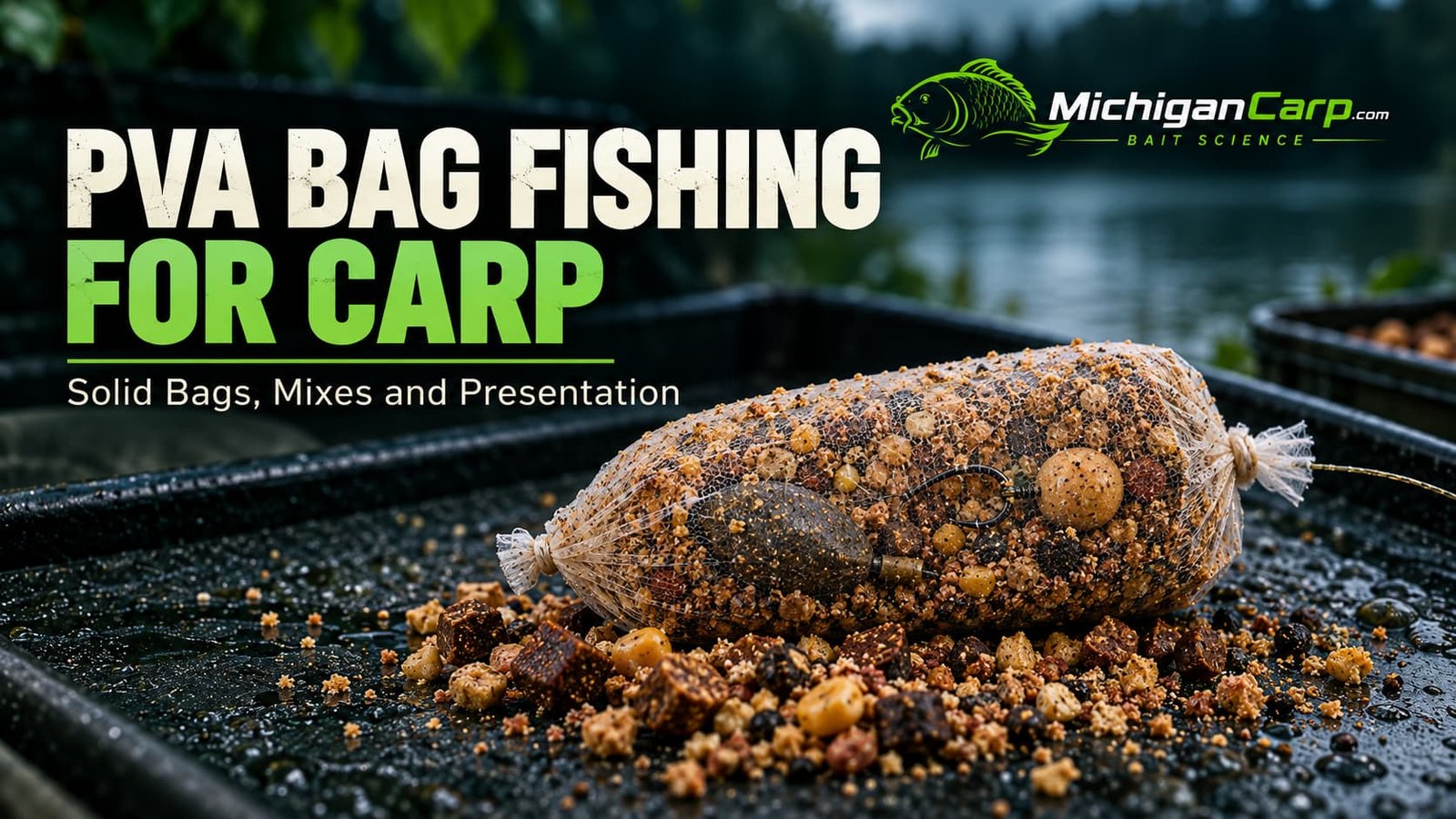
PVA bag fishing for carp is a precision method.
Instead of putting a hookbait in one place and loose feed somewhere around it, a solid PVA bag lets you deliver the rig, hookbait and a small parcel of feed together. That can be extremely useful when you want a compact presentation, when the bottom is uncertain, or when heavy baiting simply is not necessary.
The important point is that a solid bag is not magic and it does not guarantee perfect presentation on every lakebed.
Used properly, however, it can reduce tangles, protect the hook point during the cast and descent, and put a controlled amount of bait immediately around the hookbait.
For Michigan carp fishing, I see PVA bags primarily as a precision tool rather than a heavy-feeding method.
Table of Contents
Quick Start: PVA Bag Fishing for Carp
If you are new to solid bags, keep the system simple.
| Situation | Practical starting point |
|---|---|
| Short session | Small solid bag with a compact dry mix |
| Unknown lakebed | Protect the hook inside the bag and use a sensible lead size |
| Light weed or debris | Small compact bag placed on a known presentable area |
| Soft silt | Avoid unnecessarily heavy leads and oversized bags |
| Cold water | Small bag, modest food content and high-confidence hookbait |
| Nuisance fish present | Use harder crumb, chopped boilie or a durable hookbait |
| Fish already feeding | Use the bag for accurate presentation rather than automatically adding more feed |
| No carp located | Find the fish first; a PVA bag does not solve a location problem |
A good starting setup is a short, uncomplicated rig, a bottom bait or wafter, a compact dry mix and a bag small enough to cast accurately.
The goal is not to squeeze as much bait as possible into the PVA.
The goal is to deliver a small fishing situation that arrives together and fishes cleanly.
What Is PVA?
PVA stands for polyvinyl alcohol, a water-soluble polymer.
Fishing PVA is manufactured in films, mesh and related products designed to break down when exposed to water. Exactly how quickly a product dissolves depends on the PVA formulation, film thickness, water temperature and other conditions.
That matters in carp fishing.
A bag that disappears very quickly in warm water may take noticeably longer in cold water. Rather than assuming, I prefer to test the actual bags I am using in water close to the temperature I expect to fish.
Put a filled test bag in a bucket or along the margin and watch what happens.
You want to know:
- how quickly the outer film weakens;
- whether the bag opens cleanly;
- whether the hooklink remains presentable;
- whether the mix stays in a useful pile;
- and whether any liquid or damp ingredient damages the bag before casting.
That simple test tells you more than relying on the label alone.
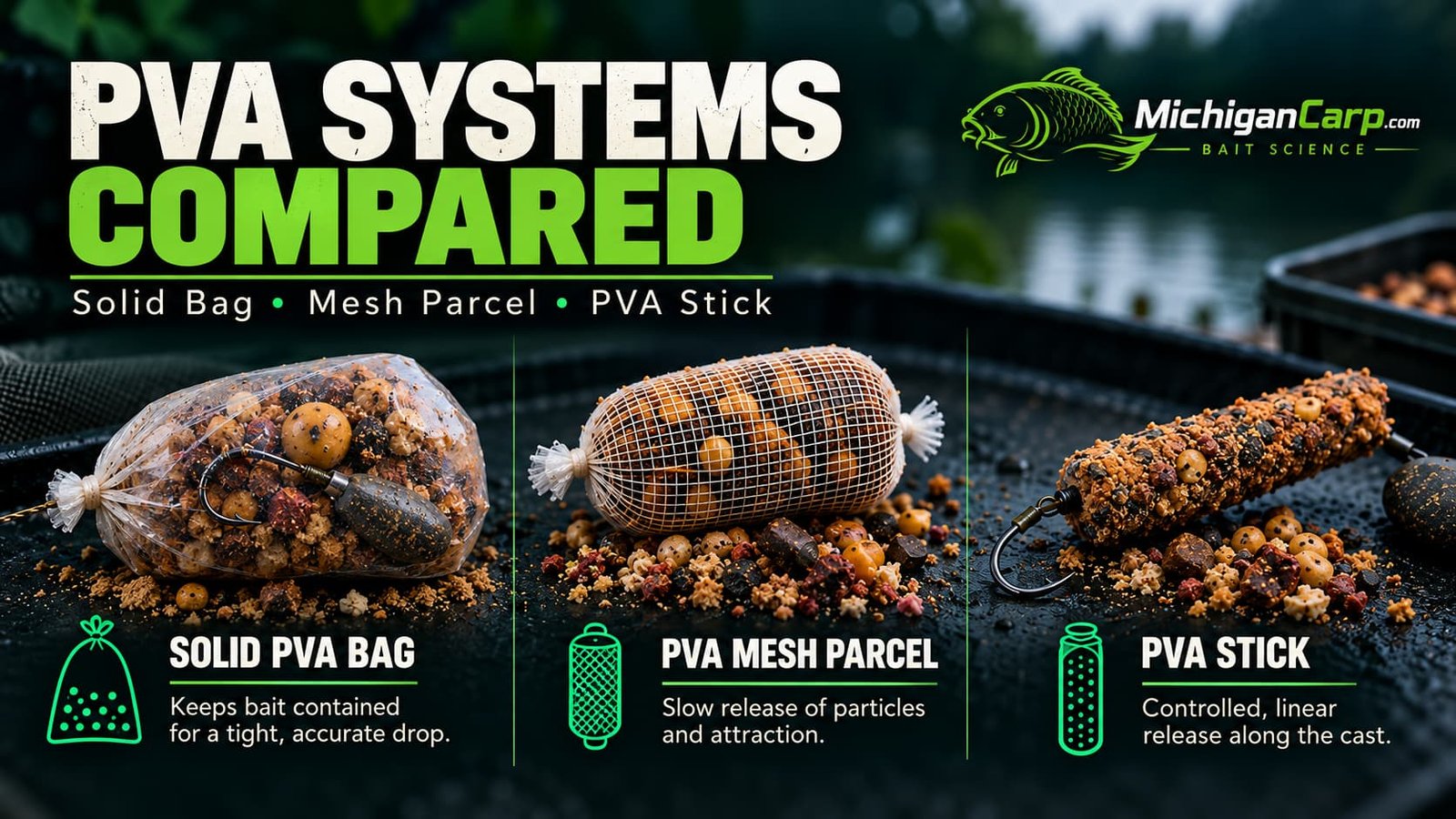
Solid PVA Bags, Mesh and Sticks Are Different Tools
Solid bags are only one part of the PVA system.
Solid PVA Bags
A solid bag encloses the rig, lead or part of the terminal arrangement, hookbait and feed inside a compact package.
Its main strengths are protection, compactness and controlled delivery.
The hook point can be protected inside the bag, which helps when casting toward light weed, debris or an uncertain bottom.
The entire parcel also reaches the lakebed in a concentrated area.
PVA Mesh
PVA mesh is useful when you want a small parcel or string of crumb, pellets, chopped boilies or other suitable dry feed without enclosing the complete rig.
Mesh is particularly useful for:
- small sticks;
- hookbait-sized parcels;
- chopped boilies;
- crumb;
- dry pellets;
- and protecting the hook against minor tangles.
PVA Sticks
A stick mix is normally a narrow sausage-shaped parcel made from mesh.
It can sit around or alongside the hooklink and is useful when you want less bulk than a full solid bag.
None is automatically better.
Use the system that solves the presentation problem in front of you.
Why Solid PVA Bags Work
The strongest reason to use a solid bag is control.
The hookbait and feed are delivered together.
The hooklink is contained during the cast.
The hook point can be protected.
The food parcel is small enough that a carp investigating it has a good chance of encountering the hookbait.
This is particularly useful when a handful of feed is more appropriate than several pounds of bait.
What I would not claim is that a bag automatically guarantees presentation.
A heavy bag dropped into very soft silt can still bury.
A bag cast into thick weed can still land badly.
A bag that is loose and full of trapped air may behave differently from a properly compacted one.
Poor casting accuracy can still put the rig where carp are not feeding.
PVA improves control. It does not remove the need for watercraft.
For the wider location side, use How to Find Carp in Lakes before worrying about the final presentation.
The Rig Inside a Solid PVA Bag
Solid bags normally work best with relatively compact rigs.
Long, loose hooklinks are difficult to package and can undermine one of the main advantages of the method.
A practical starting point is often a hooklink somewhere around 3–5 inches, although the correct length depends on the rig, hookbait, lead system and lakebed.
Do not shorten a rig simply because somebody says all bag rigs must be three inches long.
The rig still has to hook carp properly.
Hair Rigs
A simple short Hair Rig is one of the easiest systems to package inside a solid bag.
Bottom baits, wafters and balanced particles can all work.
For the complete rig rather than duplicating it here, see Hair Rig for Carp Fishing: How to Tie It Properly.
Lead Choice
Inline leads are commonly used for solid-bag fishing because they produce a compact arrangement, but they are not the only possible system.
What matters more is that the complete terminal tackle remains safe and appropriate for the water.
On very soft silt, I would avoid adding unnecessary lead weight simply to make the bag feel more substantial.
On harder clean spots, a compact lead-and-bag arrangement can be extremely effective.
Hookbait Choice
Good solid-bag hookbaits include:
- bottom baits;
- wafters;
- small balanced boilies;
- tiger nuts;
- balanced corn or maize;
- and deliberately chosen high-attraction hookbaits.
A wafter can be particularly useful because the feed around the rig may be small and light, making a balanced hookbait easy for a feeding carp to pick up.
But buoyancy needs testing with the actual hook, hooklink and bait.
A bait that floats beautifully in the tub may become a bottom bait once mounted on a size 4 hook.
Building a Good PVA Bag Mix
A PVA bag mix does not need twenty ingredients.
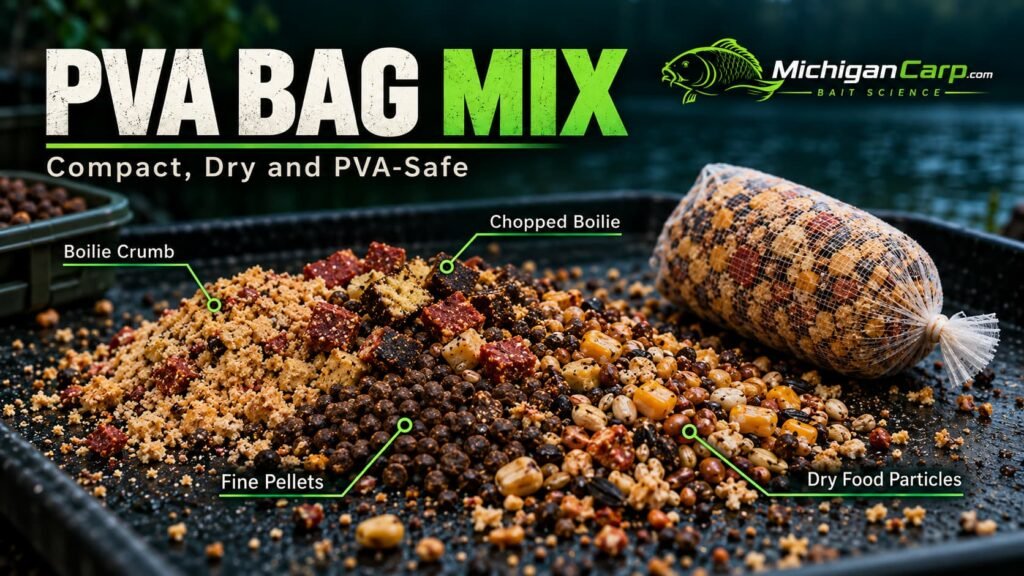
Its job is to create a small food parcel around the hookbait while remaining easy to handle and safe for the PVA.
Useful ingredients include dry boilie crumb, crushed boilies, small pellets, dry groundbait ingredients, crushed prepared tiger nuts that have been dried sufficiently for the intended PVA system, nut meals and other dry food particles.
I particularly like the logic of using crumb from the same boilie being fished on the hair.
That gives you a coherent bait signal without creating a completely different pile of food around the hookbait.
For the wider particle system, see Particles for Carp Fishing Guide.
For tiger nuts specifically, use Tiger Nuts for Carp Fishing.
Wet Particles and PVA Need More Care Than “Towel Dry Them”
One piece of older PVA advice is too simplistic:
Towel-dry wet particles and they become PVA safe.
Sometimes that may work.
Sometimes it does not.
Free water on maize, hemp, tiger nuts or another wet bait can begin weakening PVA before you are ready to cast. Even apparently dry particles can retain enough surface moisture to cause trouble.
If you want particles inside a solid bag, test the exact combination first.
Prepare the particles safely, drain them thoroughly, remove as much surface moisture as practical, incorporate them into a suitable dry carrier if appropriate, and then place a small quantity against the actual PVA material you intend to use.
If the PVA begins softening before you would realistically cast, do not use that mixture.
That is more reliable than assuming a towel automatically solves the problem.
Which Liquids Can Be Used With PVA?
Never assume that a carp-bait liquid is PVA safe simply because it is sold as a fishing attractor.
Water-rich liquids can attack PVA.
Many oils and specifically formulated PVA-friendly liquids can be compatible, but formulation matters.
The safest rule is simple:
Test the actual liquid on the actual PVA product before preparing multiple bags.
Put a little liquid on a spare piece of film or mesh and watch it for several minutes.
If the material softens, stretches, becomes sticky or begins breaking down, do not use that liquid inside the bag.
This matters particularly when using homemade glugs and soaks, where water, syrups, glycerin and other components may be combined in different proportions.
What I Would Avoid Inside a Solid Bag
I would avoid obvious free water, sloppy wet groundbait, large hard chunks that prevent the bag compacting, excessive liquid, stale oily ingredients and anything that makes the package difficult to compress.
I would also avoid adding ingredients simply because the bag has empty space.
A smaller properly constructed bag is usually preferable to an oversized bag padded with unnecessary feed.
That fits the wider MichiganCarp bait principle:
every ingredient and every piece of feed should have a job.
How to Build a Solid PVA Bag
The exact sequence varies with the bag system, but the practical goal stays the same.
Start with a dry bag and dry hands.
Put a small amount of mix into the bottom so the terminal tackle does not sit directly against an empty corner.
Position the lead and rig so the hook point is protected and the hooklink is not twisted around the lead.
Add the remaining feed gradually.
Work the mix into the spaces around the terminal tackle rather than dumping everything in at once.
Remove excessive trapped air and compress the contents firmly.
Close the bag according to the manufacturer’s system.
Fold or shape the corners neatly where appropriate.
Before casting, check that the hook has not punctured the bag and that the package feels compact rather than loose.
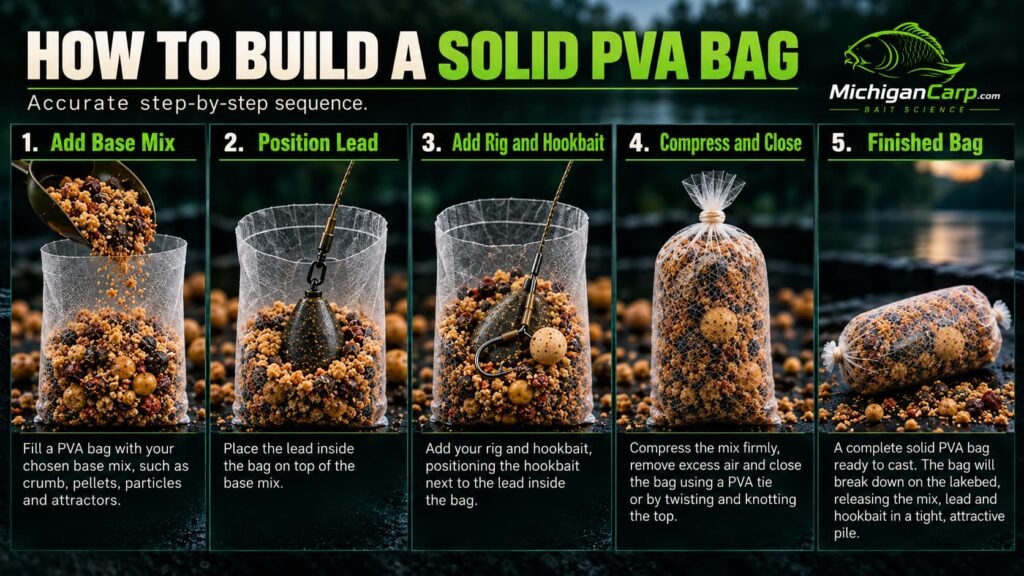
A properly built bag should feel like one compact parcel.
It should not feel like a loose grocery bag full of bait.
Compactness Matters
Compactness improves casting and makes the package behave more predictably.
A loose bag can catch air, wobble, cast poorly and allow the contents to shift.
A tight bag keeps the lead, rig and feed together.
That does not mean you need to crush everything as hard as physically possible. The aim is a neat aerodynamic package without damaging the hookbait, hooklink or bag.
Bag size also matters.
Use enough PVA to do the job.
If a small bag gives you the feed quantity and presentation you need, there is little advantage in automatically moving to a larger one.
Where Solid PVA Bags Are Particularly Useful
Short Sessions
A solid bag is useful when you want to put a small complete trap onto a known carp route without establishing a large baited area.
Light Weed and Debris
The enclosed hook point can reduce the chance of collecting small strands of weed or debris during descent.
That does not mean I would throw a bag blindly into thick weed.
Find a presentable spot first.
Soft Bottoms
A compact bag can help keep the rig together during descent, but lead weight and silt depth still matter.
If the lead disappears deeply into soft material, the bag does not magically keep the finished rig sitting perfectly above it.
Small Clear Spots
This is one of the method’s strongest applications.
A small solid bag can be placed into a clean hole in weed or onto a precise patrol route with very little loose feed outside the immediate presentation.
Cold Water
Cold-water carp may not require much feed.
A small bag can therefore provide attraction and presentation without automatically creating a large feeding situation.
PVA itself may also dissolve more slowly in colder conditions depending on the product, which is another reason to test the bag before fishing.
Single-Hookbait Fishing With a Little Support
Sometimes I want more than a bare single hookbait but considerably less than a baited swim.
That gap is where a small PVA bag can be very useful.
PVA Bags Versus Heavy Baiting
Solid bags and heavy baiting solve different problems.
A bag creates a small concentrated trap.
Spodding, catapulting, throwing-stick work, boat baiting or introducing larger quantities of particles and boilies creates a feeding area.
Neither is automatically better.
If carp are moving through a location but not staying long, a compact trap may be enough.
If you are trying to establish a multi-day feeding area for a population of carp, one little bag may be insignificant compared with the wider baiting plan.
And the two approaches can be combined.
You can fish a PVA bag over a larger baited area when you want the hookbait to arrive with its own small concentrated parcel.
The important point is to know which job you are asking it to do.
Should You Keep Recasting PVA Bags?
Not automatically.
Older advice often gives fixed rules such as casting another bag every 20 or 30 minutes.
I would not use that as a general rule.
Every recast creates disturbance.
If I have put a bag accurately onto a spot where I expect carp to arrive later, repeatedly recasting may reduce rather than increase my chances.
I would recast when there is a reason:
the rig may no longer be fishing correctly, nuisance activity has disturbed it, the cast was poor, conditions have changed, fish have moved, or I deliberately want to reposition.
Do not recast merely because a stopwatch tells you to.
Michigan Notes
Solid PVA bags fit several types of Michigan carp fishing particularly well.
In spring, a small bag can provide enough food signal around a hookbait without committing large quantities of bait while carp activity is still variable.
In summer, the method becomes useful for precise presentation around weed, along defined patrol routes and on small clean areas.
In fall, I would again think more about accuracy and location than simply making the bag larger. Carp may be feeding strongly, but a solid bag is still primarily a precision presentation.
On large natural lakes and impoundments, a PVA bag does not replace the need to locate fish. A beautifully tied bag in empty water is still in empty water.
That is why I would normally make the location decision first and the PVA decision second.
For the wider tactical approach, use Carp Fishing Tactics in Michigan.
Michigan regulations can also vary by water type and method. In particular, current regulations include restrictions on chumming with organic material in certain stream types, so check the latest Michigan DNR Fishing Regulations before baiting unfamiliar public water.
Common PVA Bag Mistakes
Using Too Much Bait
A solid bag is not a miniature five-gallon bucket.
Use enough bait to create the trap you want.
Using Damp Feed Without Testing It
Moisture can begin attacking the PVA before the cast.
Test questionable mixes.
Building the Bag Too Loose
A loose bag casts poorly and allows the contents to move around.
Using a Rig That Does Not Suit the Package
Do not force a long complicated hooklink into a small bag simply because that is the rig already tied.
Assuming Weed or Silt No Longer Matters
PVA can protect the rig during delivery, but it cannot turn an unsuitable lakebed into a clean feeding spot.
Using Too Heavy a Lead
More lead is not automatically better, particularly on soft bottoms.
Not Testing the Finished Presentation
Put one complete bag in the margin or a bucket.
Watch it dissolve.
Look at the rig afterward.
It is one of the easiest ways to discover a problem before the carp do.
Recasting Constantly
Precision fishing can quickly become disturbance fishing if you continually recast for no reason.
My Practical View
What I like about solid PVA bags is not that they are fashionable.
It is that they reduce several variables at once.
The hooklink is contained during the cast.
The hook point is protected.
The hookbait and a controlled amount of feed arrive together.
The complete system can be tested before fishing.
That makes solid bags useful whenever I want a compact, repeatable presentation.
But I would still put them in the correct order:
Find the carp. Choose a presentable area. Choose the rig. Then decide whether a PVA bag improves the presentation.
Not the other way around.
A solid bag cannot rescue poor location, unsafe terminal tackle or a bad baiting decision.
Used for the right job, however, it is one of the most useful precision tools in carp fishing.
FAQ
What is the best rig for solid PVA bags?
A short, uncomplicated rig is usually easiest to package and present. A short Hair Rig with a bottom bait or wafter is a good starting point, but the correct rig still depends on the bottom, hookbait and lead arrangement.
Can I put particles in PVA bags?
Yes, but moisture is the issue. Prepared particles should be thoroughly drained and any intended mix tested against the actual PVA before fishing. Do not assume towel-drying automatically makes every wet particle PVA safe.
Are solid PVA bags good over weed?
They can be useful over light weed or small clean areas because the bag protects the hook during delivery. They are not a licence to cast blindly into dense weed.
Are solid PVA bags good over silt?
Yes, provided the overall setup suits the silt. Bag size and lead weight matter. A very heavy package can still bury deeply into soft material.
Do PVA bags work in cold water?
Yes. Small solid bags can be particularly useful when you want controlled feed in cold conditions. Dissolution may be slower depending on the PVA product and water temperature, so test the bag before fishing.
Can I use liquids in a PVA bag?
Only when the liquid is compatible with the PVA being used. Oils and commercially formulated PVA-friendly liquids are often suitable, while water-rich liquids can damage PVA. Test the actual combination before fishing.
Are solid bags better than PVA mesh?
No. They perform different jobs. Solid bags enclose the complete presentation and food parcel. Mesh is better for small sticks, parcels and other applications where enclosing the whole rig is unnecessary.
How much bait should I put in a solid PVA bag?
Enough to create the presentation you want and no more. Small compact bags are often more useful than oversized bags, particularly for short sessions, cold water and precise fishing.
Next Steps
For the rig itself, use Hair Rig for Carp Fishing: How to Tie It Properly.
For choosing presentations beyond the Hair Rig, use The Complete Michigan Carp Rig Guide.
For particle preparation and feeding, use Particles for Carp Fishing Guide.
For tiger-nut hookbaits and feed, use Tiger Nuts for Carp Fishing.
For the wider location and fishing system, return to Carp Fishing Tactics in Michigan.