

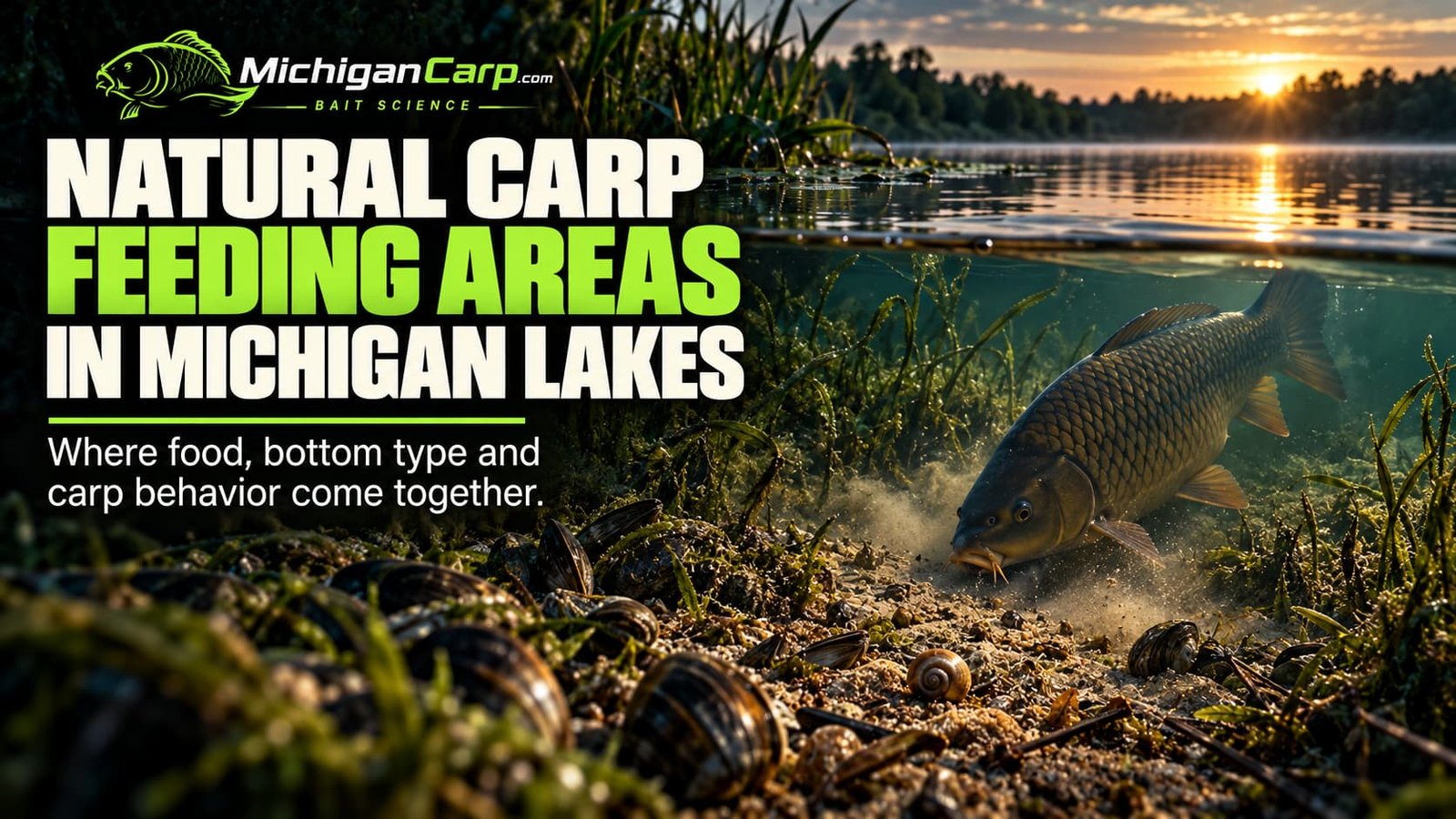
Finding natural carp feeding areas is one of the most useful pieces of watercraft in Michigan carp fishing.
Carp do not need angler bait to give them a reason to visit an area. Long before we introduce corn, boilies, tiger nuts or particles, they can already be exploiting insect larvae, small crustaceans, snails, detritus, plant material and other naturally occurring food.
The important question is therefore not simply:
Where is there natural food?
It is:
Where does natural food combine with carp access, usable depth, safety, suitable conditions and a fishable presentation?
That distinction matters.
A huge weed bed may contain abundant natural life but be almost impossible to present a rig in safely. A soft silt area may contain chironomid larvae but never produce because it is disconnected from the routes carp currently use. A hard shell-covered area may look impressive on a sonar screen but mean very little if there is no evidence that carp visit it.
This guide focuses specifically on identifying natural feeding zones.
For the wider location process, start with How to Find Carp in Lakes. For detailed bottom interpretation, use Reading the Bottom for Carp.
Table of Contents
Quick Start: What Makes a Natural Carp Feeding Area?
A natural feeding area is not defined by one feature. The strongest areas normally combine several advantages.
| Clue | What It May Offer | What Strengthens the Case |
|---|---|---|
| Weed edge | Invertebrates, snails, cover and structure | Clear lanes, feeding signs, deeper access |
| Productive soft silt | Chironomid larvae, detritus and benthic food | Fizzing, clean patches, repeated carp visits |
| Hard/soft transition | Different food communities and a defined edge | Carp movement along the transition |
| Shell or hard bottom | Firm feeding surface and benthic habitat | Adjacent weed, silt or route |
| Reeds and margins | Cover, insects, shallow-water food | Quiet access and signs of carp |
| Inflow or moving water | Changing temperature, oxygen and drifting material | Fishable current edge and repeated activity |
| Shallow bay | Seasonal warmth and increased biological activity | Route to deeper water |
| Point, shelf or channel edge | Access between areas | Food zone directly beside it |
| Feeding bubbles or clouding | Possible bottom disturbance by feeding fish | Movement, repeat pattern and other carp signs |
| Repeated use | Confidence that the area matters | Similar activity at predictable times |
The strongest pattern is usually:
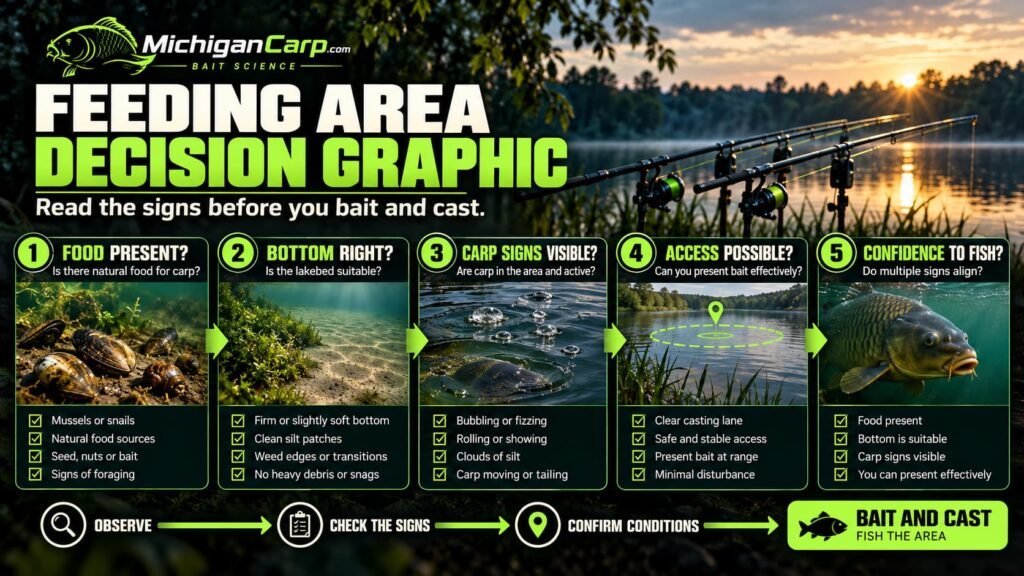
FOOD + ACCESS + FISH SIGNS + FISHABLE PRESENTATION
Natural food alone is not enough.
Start With What Carp Naturally Eat
Common carp are broad, opportunistic feeders rather than specialists tied to one food source.
The USGS Common Carp Species Profile describes juvenile and adult carp feeding on benthic organisms including chironomids, gastropods and other insect larvae, along with vegetation, detritus, plankton and small crustaceans.
For anglers, that gives us a useful starting point.
Natural food worth investigating includes bloodworm and other chironomid larvae, snails and other gastropods, amphipods and small crustaceans, insect larvae, detritus, seeds and plant material.
The practical mistake is turning that knowledge into an overly literal bait theory.
Finding snails does not mean you need a bait that smells like a snail.
Finding bloodworm does not mean only a bloodworm-flavored hookbait will work.
Natural food is primarily telling you why carp may visit the area.
Your bait still needs to be visible or detectable, properly presented and suitable for the way you intend to fish.
Food Is Only One Part of the Location
A feeding area must be reachable.
This sounds obvious, but it is one reason anglers waste time on apparently attractive features.
Imagine a shallow weed bed full of aquatic life. If the lake has recently cooled, bright sun is hitting the water, heavy boat traffic is crossing the bay and the nearest comfortable holding water is a long distance away, that food may currently have little value to the carp.
Now imagine the same weed bed positioned beside a deeper channel, with a clean outside edge and carp appearing there around dusk.
That is a very different proposition.
This is why natural feeding areas should be read alongside How Carp Move Around a Lake Through 24 Hours and Carp Bite Windows in Michigan.
The food may stay in one place.
The fish do not.
Weed Edges: Food, Structure and Routes
Weed can support abundant aquatic life and create some of the most important natural feeding habitat in a lake.
Michigan State University material on aquatic vegetation describes rooted and submerged plants as important lake habitat, while some plant communities support substantial aquatic invertebrate life.
For carp fishing, however, the important feature is often not the center of the thickest weed bed.
It is the edge.
An outside weed edge may connect cover with open water. A clear lane may allow carp to browse while still moving efficiently. A hole in weed can become a repeatedly cleaned feeding patch. An isolated clump can act as both structure and a waypoint.
The strongest weed area is therefore often a combination such as:
weed + clean bottom + food + route
rather than simply:
lots of weed
The specialist guide Weed Beds and Carp Fishing covers presentation, seasonal weed changes and fish-care considerations in much greater detail.
For this article, the important question is simply:
Where does the weed create a feeding opportunity carp can actually use?
Productive Silt and Benthic Food
Soft bottom is one of the most misunderstood carp features.
Anglers sometimes divide the lakebed into “clean bottom = good” and “silt = bad.”
That is too simple.
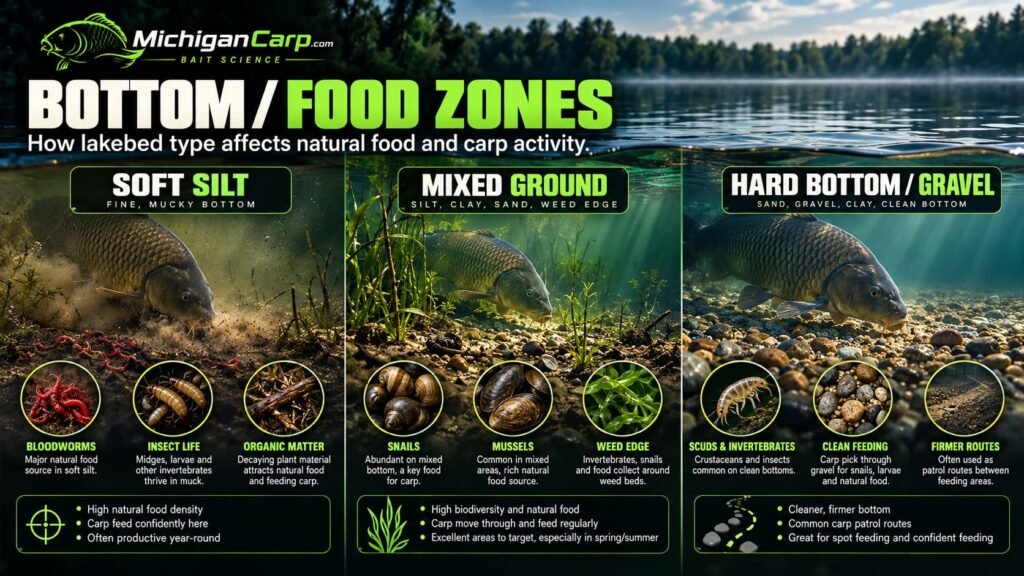
Soft sediment can support chironomid larvae and other benthic organisms that carp naturally investigate. Carp feeding in soft material may disturb the sediment, produce clouding or create characteristic patches of bubbles.
But soft bottom varies enormously.
Some deposits are deep, foul, heavily decomposed and difficult to present a rig over. Others are relatively thin, biologically active and repeatedly visited by fish.
Do not try to diagnose an entire ecosystem from the smell of one lead.
Instead, combine observations.
A soft area becomes much more interesting when you also find repeated fizzing, cleared patches, nearby harder bottom, a weed edge, fish rolling over the area or a route connecting it to safer water.
The important distinction is not:
silt or no silt
It is:
productive area that carp use, or soft bottom they currently ignore?
Use Reading the Bottom for Carp for the detailed process of distinguishing silt, gravel, clay, weed and transitions.
Hard Bottom, Shell Areas and Transitions
Hard bottom is easy to become obsessed with because it gives a satisfying signal through a marker rod or sonar.
But a hard patch is not automatically a feeding spot.
Gravel, clay, rock and shell-covered areas can matter because they provide a different habitat from surrounding softer bottom and can support benthic organisms. Their edges can also create obvious routes.
The transition is often more useful than the center.
Examples include:
soft silt → firmer clay
weed → gravel
shell-covered bottom → clean silt
flat → channel edge
These boundaries concentrate change.
They also give the angler something repeatable to locate and present a rig against.
Shell-covered areas deserve particular respect because zebra mussels and other shells can create serious abrasion problems.
Do not assume that finding shells automatically proves carp are feeding on the shellfish themselves.
Treat the shell bed as evidence of a different substrate and food environment, then look for carp evidence.
Use Carp Line and Leaders where mussels, rock and abrasion are part of the swim.
Reeds, Margins and Shallow Cover
Margins can contain far more natural activity than their size suggests.
Reeds, emergent vegetation, fallen material, shade and shallow bottom can create habitat for insects, snails and other small organisms.
They also offer carp something equally important:
a defined edge to patrol.
In some Michigan waters, especially relatively unpressured lakes, it is easy to overlook close-range food because the lake itself is large.
A carp does not care how impressive a 100-yard cast looks.
If food, security and access exist ten yards from shore, that can be the productive water.
Margins should still be assessed realistically.
Heavy public disturbance, shallow clear water, swimmers, docks, boat traffic or unsafe landing conditions may turn a biologically attractive margin into a poor fishing choice.
Inflows, Outflows and Moving Water
Moving water can change an area quickly.
It may alter temperature, oxygen, clarity and the movement of organic material. It can also create edges where still water meets flow.
But “fish the inflow” should never become an automatic rule.
The inflow matters only when its current effect improves the area and carp are willing to use it.
A cold runoff entering a warming spring bay can make the immediate inflow less attractive.
A moderate inflow during warm conditions may produce a completely different response.
The same principle applies around dams and outflows.
Use current as one clue among several.
For the full treatment of moving water, use Wind, Waves and Current: Moving-Water Positions for Michigan Carp.
Natural Feeding Area vs Holding Area vs Travel Route
These three things can overlap, but they are not the same.
A feeding area gives carp a reason to eat.
A holding area gives carp a reason to remain comfortable or secure.
A travel route connects the two.
That distinction is extremely useful.
A deep channel may contain very little obvious natural food but still be an important route.
A shallow silt flat may be rich in food but only receive carp for an hour around dawn.
A weed bed may provide both food and cover and therefore function as both a feeding and holding area.
Instead of searching for one perfect “carp spot,” build a picture of the system:
Where do they hold?
Where is the food?
How do they move between them?
When do they make that movement?
That is far more useful than simply marking isolated features on a lake map.
Confirm the Area With Carp Evidence
Natural food tells you where carp could feed.
Fish evidence tells you where they are feeding.
This is the point where observation becomes more important than theory.
Useful signs include repeated fizzing, bottom clouding, tails or backs breaking the surface, weed moving independently of wind, reed movement, bow waves, repeated liners, rolling fish and areas that consistently become active at the same time.
None of these clues should be interpreted in isolation.
One patch of bubbles may be bottom gas.
One roll may be a moving fish.
One liner may be something other than carp.
Repeated clues are stronger.
A bubble trail moving slowly along a weed edge while the water clouds beneath it is much stronger evidence than a random burst of gas.
The complete interpretation belongs in Signs Carp Are Feeding and Why Carp Blow Bubbles.
The rule for natural feeding areas is:
feature first, fish evidence second, confidence third.
Scout Before You Commit Bait
Good feeding-area scouting does not require complicated equipment.
The process is more important than the tool.
Start with a map.
The Michigan DNR Inland Lake Maps cover thousands of Michigan inland lakes and can help identify broad features such as points, bays, depth changes and channels. They are starting points rather than guarantees of current lake conditions.
Then inspect the water itself.
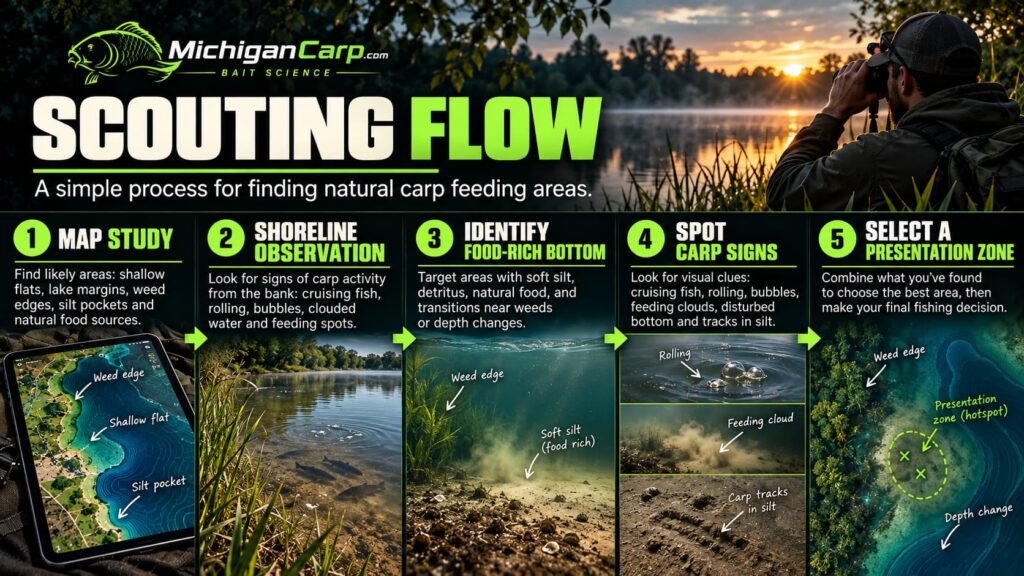
A simple scouting sequence is:
MAP → WATCH → CHECK BOTTOM → FIND FOOD CLUES → CONFIRM CARP → FISH
Maps can suggest a bay.
They cannot tell you whether the weed is alive this week.
A depth contour can show a shelf.
It cannot tell you whether carp are currently using it.
Old knowledge can identify a historically productive area.
It cannot replace what the lake is showing today.
Bank Scouting Is Often Enough
A boat can help on very large water, but it is not a requirement for finding natural feeding areas.
From the bank you can still learn a great deal by watching water before casting, inspecting weed that comes back on the hook or lead, looking for shell fragments, mapping depth changes, identifying bottom feel and watching repeated fish movement.
On clear water, polarized glasses can reveal weed lines, clean patches and carp routes.
On colored water, repeated activity may be more useful than visibility.
On large impoundments, the most productive information may come from several sessions rather than one afternoon.
A feeding-area map becomes more valuable as you add timing to it.
Do not only write:
carp seen here
Record:
carp feeding here at 6:45 a.m. after two days of southwest wind
That is a pattern you can test.
Use a Boat as a Scouting Tool, Not a Requirement
Where boating is legal and practical, it can make large-water scouting easier.
Sonar can help identify depth and bottom transitions. An underwater camera can confirm weed, substrate and visibility. Visual observation can show features invisible from shore.
But boat information can also create false confidence.
A beautiful clean patch found on sonar is still only a feature until carp behavior gives it meaning.
If you prefer to fish from shore without using a boat, you are not automatically disadvantaged.
Good shoreline observation, marker work and repeated session notes can build an excellent picture of a lake over time.
Match Presentation to the Feeding Area
Once a feeding zone has been identified, the next question is not:
Which rig is fashionable?
It is:
What presentation can fish cleanly here?
A hard clean area gives you many options.
A thin layer of soft silt may suit a balanced bottom bait or wafter.
A weed edge may require a presentation designed to settle cleanly and remain visible.
A shell-covered area may demand greater attention to abrasion.
That detailed choice belongs in the Michigan Carp Rigs Hub and Reading the Bottom for Carp.
The important principle here is that food does not excuse poor presentation.
A carp may be feeding all around your rig and still never pick it up if the hookbait is buried, tangled or positioned badly.
Do Not Try to Imitate Every Natural Food
Matching the exact natural food is not always necessary.
Carp can accept completely different foods in places where they already feed confidently.
A boilie over bloodworm-rich silt does not have to look like a bloodworm.
A tiger nut beside weed does not have to imitate a snail.
Corn does not occur naturally in most Michigan lakes, yet carp readily eat it.
The better goal is to make your bait appropriate to the feeding behavior and presentation problem.
A durable bait can be useful where nuisance fish are active.
A highly visible balanced hookbait may help over dark silt.
Particles can encourage prolonged browsing where carp are already grubbing.
Boilies can provide a controlled food item along a route or hard edge.
Use Carp Bait Guide for the broader bait decision rather than trying to turn this page into another bait guide.
Baiting a Natural Feeding Area
Finding natural food does not automatically mean you should bait heavily.
Nor does it mean you must always start with a tiny amount.
The amount should reflect the situation.
Consider carp numbers, fish size, water temperature, natural-food availability, nuisance fish, how long you will fish, whether carp are already feeding and whether you have previous evidence from the spot.
A rich natural-food area can sometimes produce on very little introduced bait because the carp already have a reason to visit.
At other times, a large group of actively feeding carp may comfortably consume substantial bait.
The key is not a fixed number.
It is response.
Use Baiting Strategy for Carp Fishing for the detailed quantity and feeding system.
This article’s job ends once you understand why the carp are there.
Seasonal Changes Move the Best Food
Natural feeding areas are not fixed throughout the year.
In spring, shallow areas can become important as water warms and biological activity increases.
Through late spring and summer, weed growth can change the entire structure of a bay or flat.
Warm conditions can also make oxygen more important, especially where dense vegetation and still water interact.
In fall, dying weed and cooling water can shift productive edges and routes.
Cold water can reduce the value of areas that were excellent only weeks earlier.
Use Carp Water Temperature Guide for Michigan Lakes and Dissolved Oxygen and Carp Fishing when evaluating those changes.
A productive natural feeding area is always a current feature, not simply a historical mark on a map.
A Simple Feeding-Area Scouting System
When approaching a Michigan lake, work in this order.
| Stage | Question |
|---|---|
| 1. Map | Where are the likely bays, shelves, points, channels and transitions? |
| 2. Observe | Where are carp, bubbles, weed movement, clouding or repeated activity? |
| 3. Bottom | What am I actually fishing over? |
| 4. Food | What natural food or habitat could make carp return here? |
| 5. Access | How do carp reach it from holding or safety water? |
| 6. Timing | When does the area become active? |
| 7. Presentation | Can I fish the spot cleanly and land carp safely? |
| 8. Record | Does the same pattern repeat? |
This system prevents one of the most common mistakes in carp fishing:
finding an attractive-looking feature and immediately deciding it must be productive.
Practical Michigan Example
Imagine a northern Michigan lake with a protected bay.
The back of the bay contains emerging weed and soft bottom. One side has reeds. The mouth drops into deeper water. A moderate wind has pushed into the bay for two days.
At first light you see several patches of moving fizz near the outside weed edge.
A lead shows soft bottom inside the bay but a firmer strip along the weed boundary.
That area now has several independent clues:
food-producing habitat, a defined edge, deeper access, suitable conditions, a fishable strip and actual carp activity.
That is much stronger than choosing the bay merely because it looks “carpy.”
The sensible next step is to present a rig where it can fish cleanly and observe the response.
You do not need to turn the whole bay into a baited area.
Common Mistakes When Finding Natural Feeding Areas
The biggest mistake is confusing feature with evidence.
A weed bed is not automatically a feeding area.
A mussel-covered bottom is not automatically a feeding area.
Silt is not automatically productive.
A shallow bay is not automatically a spring hotspot.
A windward bank is not automatically where the carp will be.
Another mistake is examining natural food without considering routes. A food-rich feature that carp cannot reach comfortably under current conditions may be less useful than a modest feeding area beside a regular movement route.
The opposite mistake is ignoring apparently unattractive bottom because it is not clean gravel.
Carp are benthic feeders. Productive soft areas can be extremely important.
Finally, do not destroy a good natural feeding area by overworking it. Excessive casting, marker work, boating, baiting and disturbance can make the process of finding the fish become the reason they leave.
MichiganCarp Practical View
For my own fishing, I am much more interested in connections than isolated features.
A weed edge becomes more valuable when it meets a clean strip and deeper access.
A soft silt area becomes more interesting when carp repeatedly fizz over it.
A hard-bottom patch becomes more convincing when it sits on a route.
A shallow bay becomes important when warmth, food and fish activity occur together.
That is the distinction I would encourage anglers to make.
Do not collect features.
Build a picture of how the fish use the lake.
After many years fishing large, relatively natural waters, one lesson keeps repeating:
the best bait cannot rescue the wrong area.
But once you understand why carp are visiting a feeding zone, bait and rigs become much easier decisions.
The working sequence is:
FIND THE FOOD → FIND THE ROUTE → CONFIRM THE FISH → PRESENT CLEANLY → BAIT FOR THE RESPONSE
That is the role of natural-food watercraft.
FAQ
What are natural carp feeding areas?
Natural carp feeding areas are places where naturally occurring food and suitable habitat give carp a reason to feed. They may include weed edges, productive soft sediment, hard/soft bottom transitions, margins, reeds and areas containing benthic invertebrates.
What natural food do common carp eat?
Common carp eat a broad range of food including chironomids and other insect larvae, gastropods, small crustaceans, detritus, vegetation and plankton. Their diet varies with habitat, season, size and availability.
Are weed beds always good for carp?
No. Weed can provide habitat and food, but thick weed can also make presentation and landing difficult. Edges, lanes and clean patches are often more useful than the densest weed.
Is soft silt a good carp feeding area?
It can be. Biologically active soft sediment may contain chironomid larvae and other benthic food. The important question is whether carp are actually using it and whether you can present a rig effectively.
Do carp feed on hard bottom?
Yes, but hard bottom alone is not proof of feeding. Gravel, clay, rock and shell areas become more useful when they combine with natural food, transitions and repeated carp activity.
Are bubbles proof that carp are feeding?
No. Natural lake gases and other organisms can also create bubbles. Moving, repeated fizz associated with clouding, fish movement or other signs is stronger evidence.
Should I match my bait to the exact natural food?
Not necessarily. The natural food mainly explains why carp may visit the area. Your hookbait should fit the presentation, feeding behavior and session goal.
Should I heavily bait a natural feeding area?
There is no universal amount. Let carp numbers, feeding response, season, temperature, nuisance species and session length determine the quantity.
Can lake maps show natural feeding areas?
Maps can identify likely structure such as bays, shelves, points, channels and depth changes, but they cannot confirm current weed, bottom condition or carp use. Always verify the lake itself.
Is the best feeding area always the place with the most food?
No. A slightly less food-rich area with better access, safety, timing and repeated carp use can be far more productive.
Next Steps
Use How to Find Carp in Lakes for the complete location process, Reading the Bottom for Carp to identify the substrate, Weed Beds and Carp Fishing for detailed weed decisions, Signs Carp Are Feeding to confirm active feeding, Wind, Waves and Current for moving-water effects, and Carp Bait Guide once the location problem has been solved.
The hierarchy should remain simple:
Find the carp first. Understand why they are there. Then choose the bait and presentation.