
Cheap carp baits that actually work are not junk baits.
They are simple foods used properly.
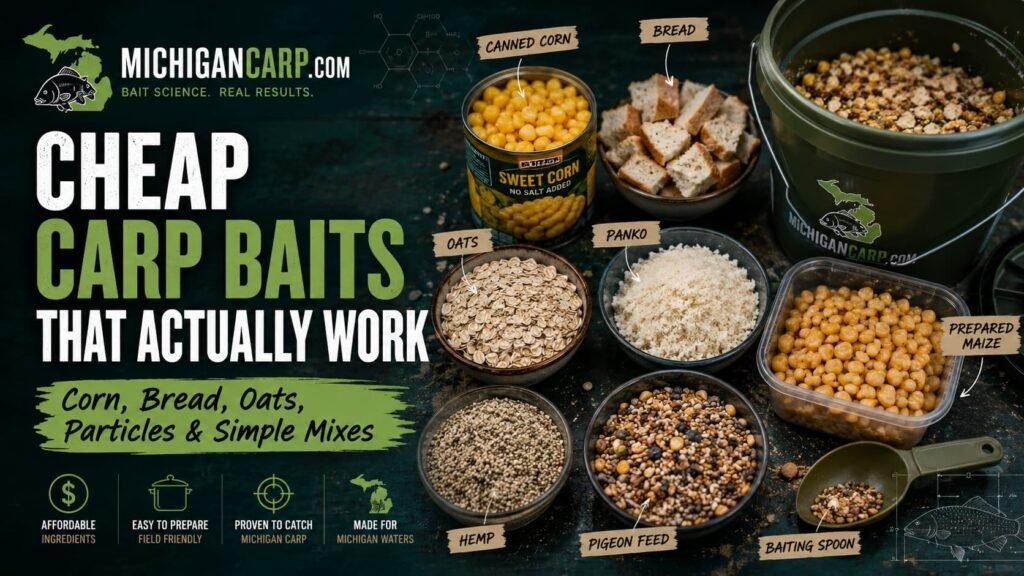
Corn, bread, oats, panko, maize, hemp, pigeon feed and basic homemade mixes can all catch carp when they are used in the right place, in the right amount and with safe preparation.
The mistake is thinking cheap bait means careless bait.
Cheap bait still needs watercraft.
Cheap bait still needs good rigs.
Cheap bait still needs safe preparation.
Cheap bait still needs restraint.
A few grains of corn in the right margin can beat an expensive bait in the wrong water.
A simple oat-and-panko packbait can outfish a complicated mix if it breaks down correctly.
Prepared maize and hemp can be excellent low-cost feed when carp are already willing to browse.
But a bucket of badly prepared particles, soggy bread, overfed corn or random kitchen leftovers is not good bait just because it is cheap.
This article is about budget carp bait that actually makes sense.
For the broad bait-choice hub, use Carp Bait Guide.
For Michigan lake-specific bait choice, read Best Carp Bait for Michigan Lakes.
For the boilie, corn and particle comparison, use Boilies vs Corn vs Particles for Carp.
Before fishing public water, check the current Michigan DNR Fishing Regulations. The DNR states that the 2026 Michigan Fishing Regulations are in effect until March 31, 2027, so always check the current guide before relying on old bait or fishing-rule assumptions.
The clean budget bait rule is simple:
CHEAP BAIT IS GOOD WHEN IT IS SAFE, SIMPLE, ACCURATE AND USED WITH A PLAN.
CHEAP BAIT IS BAD WHEN IT BECOMES OVERFEEDING, MESS OR GUESSWORK.
Table of Contents
Quick Start: Cheap Carp Baits That Actually Work
| Cheap Bait | Best Use | Main Warning |
|---|---|---|
| Canned corn | Beginner bait, short sessions, visible hookbait | Easy to overfeed |
| Bread | Surface, margin or quick-response bait | Soft, fragile and nuisance-prone |
| Oats | Packbait and method-style mixes | Needs correct breakdown |
| Panko | Binder and breakdown support | Can become too fluffy or dry |
| Maize | Low-cost bulk particle | Must be soaked and cooked properly |
| Hemp | Small grubbing particle | A little goes a long way |
| Pigeon feed | Budget mixed particle | Prepare for the hardest item |
| Tiger nuts | Tough hookbait, not cheap bulk feed | Must be prepared and used sparingly |
| Boilie crumb | Budget attraction from leftover boilies | Do not waste good bait randomly |
| Simple packbait | Short-range attraction around the lead | Must break down correctly |
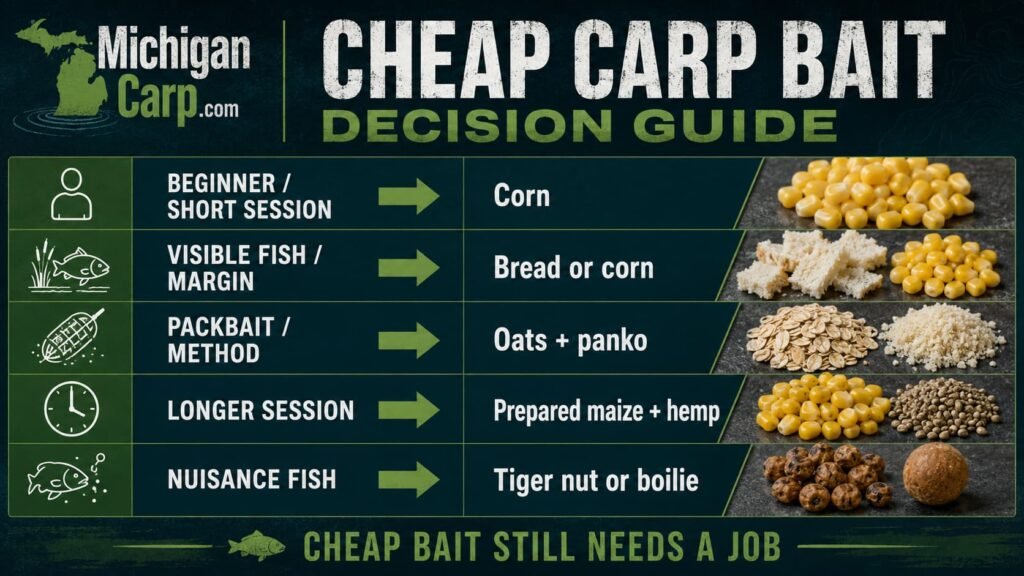
Best beginner route:
- start with canned corn;
- add bread only when it suits the swim;
- use oats and panko for simple packbait;
- move to prepared maize and hemp for longer sessions;
- use tiger nuts or boilies when you need a tougher hookbait.
What Makes a Cheap Carp Bait Good?
A cheap carp bait is good when it does a clear job.
Good budget bait should be:
- easy for carp to recognize or eat;
- safe when prepared correctly;
- simple to use;
- repeatable;
- affordable enough to use without waste;
- matched to the session length;
- suitable for the water temperature;
- easy to present near the rig.
Cheap bait becomes bad when it creates problems.
Bad budget bait is:
- thrown in because it is cheap;
- used in huge amounts without evidence;
- poorly prepared;
- too messy for public access;
- attractive to every nuisance species;
- unable to stay on the hook;
- impossible to repeat;
- used instead of finding carp.
The bait is not the strategy.
The bait supports the strategy.
Canned Corn
Canned corn is the best cheap carp bait for most beginners.
It is soft, bright, easy to use and cheap.
It works well because carp can eat it easily and it gives quick feedback.
Use corn when:
- you are testing a new swim;
- you are fishing a short session;
- you need a visible hookbait;
- water is cool;
- you want to keep feed light;
- you are introducing someone to carp fishing.
A good starting amount is small.
A few grains around the hookbait may be enough.
For a short session, one can of corn is often more than enough.
Corn is not better because you feed more of it.
Corn is better when you place it correctly.
For a full corn guide, read Corn for Carp in Michigan.
Bread
Bread is one of the oldest cheap carp baits.
It can work very well in the right situation.
Bread is useful for:
- surface fishing;
- margin fishing;
- stalking visible carp;
- quick tests;
- soft-bottom spots;
- small traps around the hookbait.
Bread can be used as:
- flake;
- crust;
- mashed bread;
- bread crumb;
- binder in simple mixes.
The weakness is durability.
Bread is soft.
Small fish can attack it.
Casting can damage it.
It can wash off.
It can also create mess if used carelessly.
Bread is best when you can watch the swim and react.
It is not usually the best all-night hookbait.
Oats
Oats are cheap, easy to find and useful in homemade carp bait.
They are strongest as a packbait or method-style ingredient.
Oats help create:
- bulk;
- binding;
- cloud;
- slow breakdown;
- food particles around the lead.
Rolled oats are usually easier to use than very hard or coarse feed oats.
A simple oat base can work well when mixed with panko, sweet corn, creamed corn or a little liquid.
The goal is not to make concrete.
The goal is a bait that holds together for the cast, then breaks down around the rig.
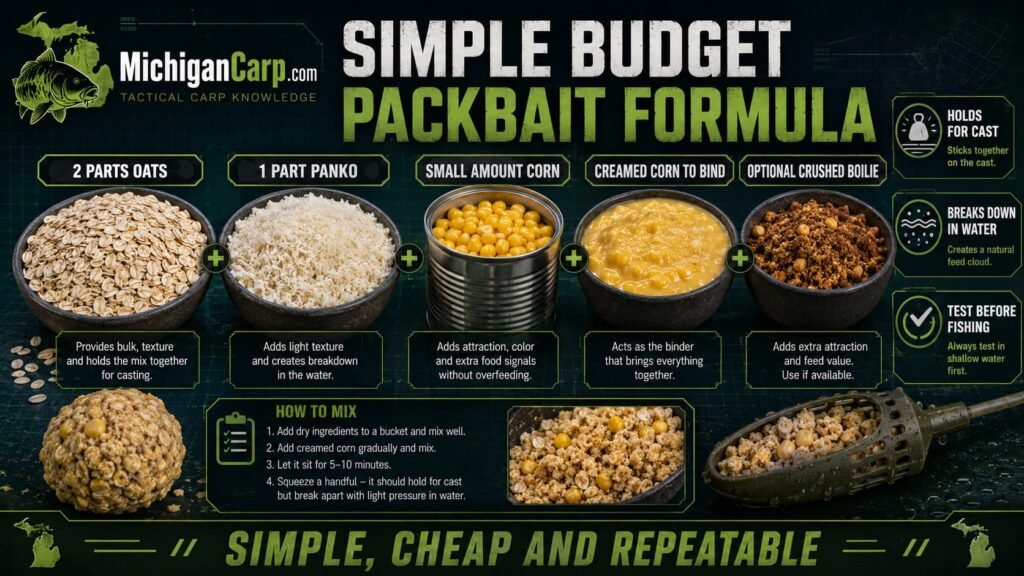
Simple Oat Packbait Base
Use:
- 2 parts oats;
- 1 part panko;
- enough creamed corn or lake-safe liquid to bind;
- optional small amount of canned corn;
- optional crushed boilie or particle crumb.
Mix it.
Let it rest.
Test a ball in water.
It should break down.
If it sits like a rock, it is too tight.
Panko
Panko is useful because it helps bait bind and break down.
It is light, absorbent and easy to mix.
Panko works well with:
- oats;
- creamed corn;
- canned corn;
- crushed boilies;
- molasses in small amounts;
- particle liquor;
- powdered milk or birdfood in small amounts.
Panko is not a magic bait by itself.
It is a structure ingredient.
Use it to control how the mix behaves around the lead.
A good budget mix should:
- pack cleanly;
- cast without exploding;
- break down after landing;
- leave food around the hookbait;
- not bury the rig.
For wider bait-prep work, use The Bait Shed.
Maize
Maize is one of the best cheap bulk particles, but only when prepared safely.
Dry maize should not be fished straight from the bag.
It needs soaking, cooking and resting.
Maize is useful when:
- water is warming;
- carp are feeding confidently;
- the session is longer;
- you need affordable feed;
- you can bait accurately;
- you want to combine it with hemp, corn or boilies.
Maize is not the right bait for every session.
It is weak when:
- the water is very cold;
- you only have a short session;
- you have not found carp;
- you are tempted to dump bait because it is cheap.
For safe prep, read How to Prepare Particles for Carp Fishing.
For particle strategy, use Particles for Carp Fishing.
Hemp
Hemp is not always the cheapest particle by weight, but it is very cost-effective because you do not need much.
A small amount can create strong grubbing behavior.
Use hemp when:
- carp are browsing;
- you are fishing weed edges;
- you are fishing silt;
- you want small food items around the rig;
- you are combining it with maize or corn;
- you want a light feed signal.
The warning is simple:
do not overuse it.
Too much hemp can keep carp searching without making the hookbait important enough.
In budget baiting, hemp should usually be a support ingredient, not the whole plan.
Pigeon Feed
Pigeon feed can be a useful cheap mixed particle, but every blend is different.
Some blends contain maize, wheat, peas, milo, small seeds and pulses.
That means preparation matters.
Prepare the mix for the hardest important item.
Do not assume the mix is ready because the smallest seeds look cooked.
Pigeon feed is useful when:
- you want a mixed particle base;
- you are fishing longer sessions;
- water is warm enough;
- carp are feeding confidently;
- you can bait accurately.
It is not ideal for very short cold-water sessions.
It can also become messy if you make too much.
Budget bait should still be measured.
Tiger Nuts
Tiger nuts are not the cheapest feed bait.
They belong in this article because they can be a cost-effective hookbait.
A few tiger nuts can solve problems that soft cheap bait cannot solve.
Use tiger nuts when:
- corn is being stripped;
- turtles are active;
- small fish are a problem;
- you need a hookbait that lasts;
- you are fishing over maize, hemp or particles;
- you want a tougher particle-style bait.
Do not use tiger nuts as a cheap bucket feed.
Use them as a controlled hookbait or small chopped addition.
They must be prepared properly.
Use Tiger Nuts for Carp Fishing for the full guide.
Cheap Boilie Crumb
Boilies are not always cheap, but boilie crumb can be budget-friendly if you already have leftover boilies, broken baits or small amounts from testing.
Boilie crumb is useful because it gives attraction without feeding whole boilies.
Use crumb for:
- small traps;
- PVA sticks;
- packbait additions;
- method-style mixes;
- boilie-over-particle fishing;
- boosting simple corn or oat mixes.
Do not waste good bait by grinding everything.
Use crumb when it has a job.
A small amount of boilie crumb can make a cheap mix more interesting without turning it into an expensive mix.
For boilie use, read How to Fish Boilies for Carp.
Simple Homemade Packbait
A cheap packbait should be simple and repeatable.
It should hold for the cast, then break down around the rig.
A basic starting mix:
| Ingredient | Amount |
|---|---|
| Oats | 2 parts |
| Panko | 1 part |
| Canned corn | Small amount |
| Creamed corn or liquid | Enough to bind |
| Optional crushed boilie | Small handful |
Mix dry ingredients first.
Add wet ingredients slowly.
Let the mix rest.
Test it in water before fishing.
The bait should open up and release food.
If it stays hard, loosen it.
If it explodes on the cast, tighten it.
Cheap Hookbait Choices
The hookbait matters more than the freebait.
Cheap hookbait options include:
- canned corn;
- corn plus plastic corn;
- bread flake;
- bread crust;
- prepared maize;
- tiger nut;
- small boilie;
- homemade dough-style bait where legal and practical;
- balanced corn-style presentation;
- maize tipped with plastic corn.
For many Michigan sessions, the best cheap hookbait is still corn.
But if corn is being stripped, do not keep replacing it all night.
Move to a tougher hookbait.
Good upgrades are:
- plastic corn plus real corn;
- tiger nut;
- small boilie;
- wafter;
- maize hookbait.
Cheap bait does not mean weak hookbait.
Cheap Freebait Choices
Freebait is what you feed around the hookbait.
Cheap freebait options include:
- loose corn;
- maize;
- hemp;
- wheat;
- pigeon feed;
- oats;
- panko;
- boilie crumb;
- small particle mix;
- crushed budget boilies.
The main rule is:
feed less than you think until carp prove they are feeding.
Cheap bait encourages overfeeding because it feels disposable.
That is a mistake.
Bait still changes the swim.
Use it with intention.
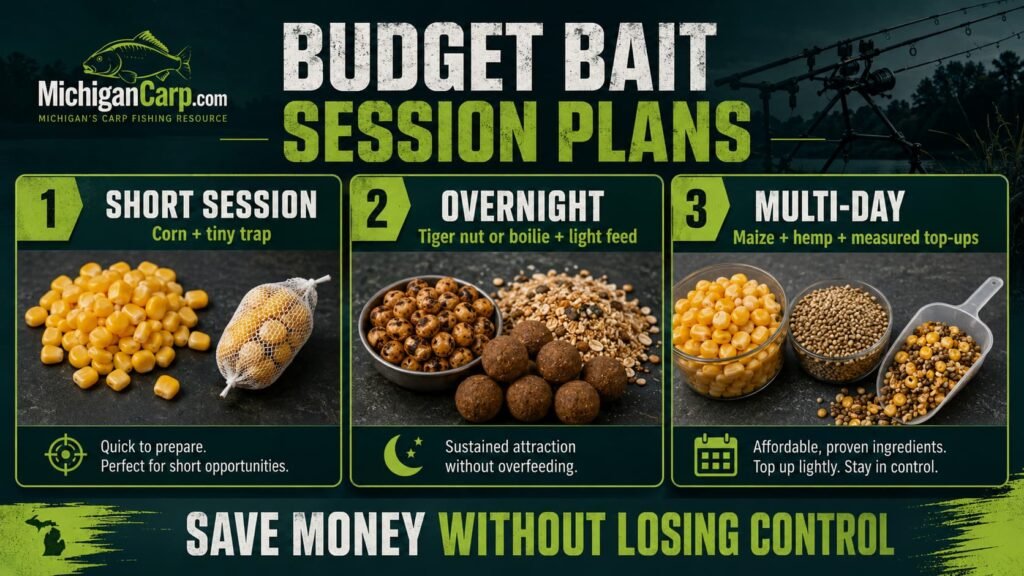
Cheap Bait for Short Sessions
Short sessions need quick information.
Best cheap baits:
- canned corn;
- bread;
- small oat/panko trap;
- corn plus plastic corn;
- single boilie from leftover bait;
- a few grains of maize if already prepared.
Avoid big particle beds.
Avoid large buckets.
Avoid complex mixes.
A two-hour session usually needs one clean chance, not a feeding campaign.
Corn is usually the best starting bait.
Cheap Bait for Overnight Sessions
Overnight sessions need hookbait durability.
Cheap baits can still work, but you need a hookbait that stays fishing.
Good overnight options:
- corn plus plastic corn;
- tiger nut;
- small boilie;
- maize hookbait;
- boilie over cheap particle feed;
- small prepared maize and hemp patch.
Soft corn alone can work, but it may be stripped.
Bread is usually weak for unattended overnight work.
Oat packbait can help around the lead, but the hookbait must still survive.
Cheap Bait for Multi-Day Sessions
Multi-day fishing is where cheap bait can save money, but also where it can create the biggest mistakes.
Good low-cost multi-day baits:
- prepared maize;
- hemp used lightly;
- pigeon feed;
- wheat;
- corn;
- boilies used as hookbaits;
- tiger nuts used selectively;
- oat/panko method-style mixes.
The key is portion control.
Use:
- session-sized particle bags;
- measured daily amounts;
- separate hookbait tubs;
- clean storage;
- cooler space for wet bait;
- notes on what you fed.
Do not take one huge bucket and keep feeding because it is there.
Cheap Bait for Spring
Spring budget bait should be minimal.
Good choices:
- corn;
- corn plus plastic corn;
- tiny pinch of hemp;
- single boilie;
- small wafter;
- very small oat/panko trap.
Avoid heavy maize or pigeon feed unless carp are clearly feeding.
Spring carp may move before they feed hard.
Cheap bait can ruin a spring swim if you feed too much too soon.
Use Spring Particles for Carp for spring particle amounts.
Cheap Bait for Summer
Summer gives you more room to use low-cost feed.
Good choices:
- corn;
- maize;
- hemp;
- pigeon feed;
- oats;
- panko;
- boilie crumb;
- tiger nuts as hookbaits.
Summer also brings nuisance fish, turtles and faster bait spoilage.
Keep wet bait cool.
Use tougher hookbaits when needed.
Do not leave cooked particles in the sun.
When moving between waters, follow Michigan invasive-species prevention rules. Michigan guidance for boaters and anglers includes removing aquatic plants from watercraft, equipment and trailers before placing them into Michigan waters, and related clean/drain/dry steps are part of preventing spread between waters.
Cheap Bait for Fall
Fall can be excellent for simple bait.
Good choices:
- corn;
- maize;
- hemp;
- boilies;
- boilie crumb;
- tiger nuts;
- moderate particle use.
As water cools, reduce the amount.
A baiting plan that worked in warm September water may be too much after cold nights and fronts.
Fall rewards food bait, but still punishes careless feeding.
What Not to Cheap Out On
Bait can be cheap.
Some things should not be.
Do not cheap out on:
- fish care;
- hooks;
- line;
- safe rigs;
- particle preparation;
- clean storage;
- proper cooking;
- bait freshness;
- leaving no trash behind.
A cheap bait used safely is good.
A cheap bait used carelessly is not.
The fish does not know what the bait cost.
But bad preparation, bad rigs and poor fish care matter.
Cheap Bait Safety
Budget bait should still be safe bait.
Follow these rules:
- do not fish dry maize;
- do not fish dry tiger nuts;
- do not fish underprepared peanuts, beans or pulses;
- do not use rotten bait;
- do not use moldy bait;
- do not use rancid nuts;
- do not dump unused bait into the lake;
- do not leave bait trash on the bank;
- keep wet bait cool in warm weather.
Prepared wet bait is food.
Treat it like food.
If it smells wrong, looks wrong or makes you doubt it, throw it away.
Simple Budget Bait Plans
Plan 1 — First Carp
Use:
- canned corn hookbait;
- a few grains of loose corn;
- simple hair rig or safe presentation.
Goal:
one bite and confidence.
Plan 2 — Short Evening Session
Use:
- corn plus plastic corn;
- tiny oat/panko trap;
- a few grains of corn.
Goal:
quick attraction without overfeeding.
Plan 3 — Summer Particle Session
Use:
- prepared maize;
- small amount of hemp;
- corn or boilie hookbait;
- tiger nut backup if nuisance fish appear.
Goal:
low-cost feeding with a durable hookbait option.
Plan 4 — Overnight Budget Setup
Use:
- boilie or tiger nut hookbait;
- small maize/hemp patch;
- optional boilie crumb;
- limited corn.
Goal:
keep the hookbait fishing all night.
Plan 5 — Multi-Day Low-Cost Plan
Use:
- session-sized bags of prepared maize;
- hemp as a small support ingredient;
- pigeon feed if prepared correctly;
- boilies or tiger nuts for hookbaits;
- corn for quick response.
Goal:
controlled baiting without waste.
Common Cheap Bait Mistakes
Feeding Too Much Because It Is Cheap
Cheap bait still fills fish and changes the swim.
Using Dry Particles
Dry maize, tiger nuts, beans and pulses should not be fished.
Making Packbait Too Tight
A packbait that does not break down is not doing its job.
Using Bread in the Wrong Situation
Bread is good when watched, but weak for many unattended presentations.
Ignoring Nuisance Fish
Soft cheap bait may disappear quickly.
Using Rotten or Moldy Bait
Throw it away.
Making Every Mix Too Complicated
Cheap bait works best when it is simple and repeatable.
Forgetting the Hookbait
Freebait attracts fish, but the hookbait catches them.
Copying Grocery Bait Without Testing
Not every cheap food item is useful or safe as carp bait.
Leaving a Mess
Budget bait should never mean dirty banks or public-access problems.
My Practical View
Cheap bait has caught a lot of carp.
Corn works.
Bread works.
Oats work.
Maize works.
Hemp works.
Pigeon feed works.
Simple mixes work.
But they work because they are used properly, not because they are cheap.
For Michigan carp fishing, I like cheap bait when I am testing water, fishing short sessions, feeding lightly or building a simple particle approach.
I do not like cheap bait when it becomes an excuse to overfeed, skip preparation or make a mess.
My rule is:
SPEND LESS ON BAIT IF YOU WANT, BUT DO NOT THINK LESS ABOUT BAIT.
That is the difference between budget bait and bad bait.
FAQ
What are the best cheap carp baits?
The best cheap carp baits are canned corn, bread, oats, panko, prepared maize, hemp used lightly, pigeon feed and simple homemade packbait.
Is canned corn good for carp?
Yes. Canned corn is one of the best cheap carp baits because it is soft, visible, easy to use and widely accepted by carp.
Can I use bread for carp fishing?
Yes. Bread can work well for surface fishing, margin fishing and quick-response presentations, but it is soft and not very durable.
Are oats good for carp bait?
Yes. Oats are useful in packbait and method-style mixes because they add bulk, binding and slow breakdown.
Is maize a good cheap carp bait?
Yes, maize can be excellent and affordable, but it must be soaked, cooked and rested properly before fishing.
Is hemp cheap carp bait?
Hemp can be cost-effective because a small amount does a lot, but it should usually be used as a support ingredient rather than heavy bulk feed.
Is pigeon feed good for carp?
Pigeon feed can work well as a mixed particle bait, but it must be prepared correctly and checked for the hardest ingredients in the mix.
Are tiger nuts cheap carp bait?
Tiger nuts are not usually cheap bulk feed, but they can be cost-effective as tough hookbaits because only a few are needed.
What is the cheapest carp hookbait?
Canned corn is usually the cheapest reliable carp hookbait.
What cheap bait should I use for a short session?
Use canned corn, corn plus plastic corn, bread where practical, or a small oat-and-panko trap.
What cheap bait should I use overnight?
Use a tougher hookbait such as tiger nut, boilie, maize or corn plus plastic corn, with a small amount of controlled freebait.
What is the biggest cheap bait mistake?
The biggest mistake is feeding too much because the bait is inexpensive.
Next Steps
Use these routes next:
- Carp Bait Guide
- Best Carp Bait for Michigan Lakes
- Boilies vs Corn vs Particles for Carp
- Corn for Carp in Michigan
- Particles for Carp Fishing
- How to Prepare Particles for Carp Fishing
- Tiger Nuts for Carp Fishing
- Spring Particles for Carp
- The Bait Shed
- How to Fish Boilies for Carp
- Michigan Carp Guide Library