

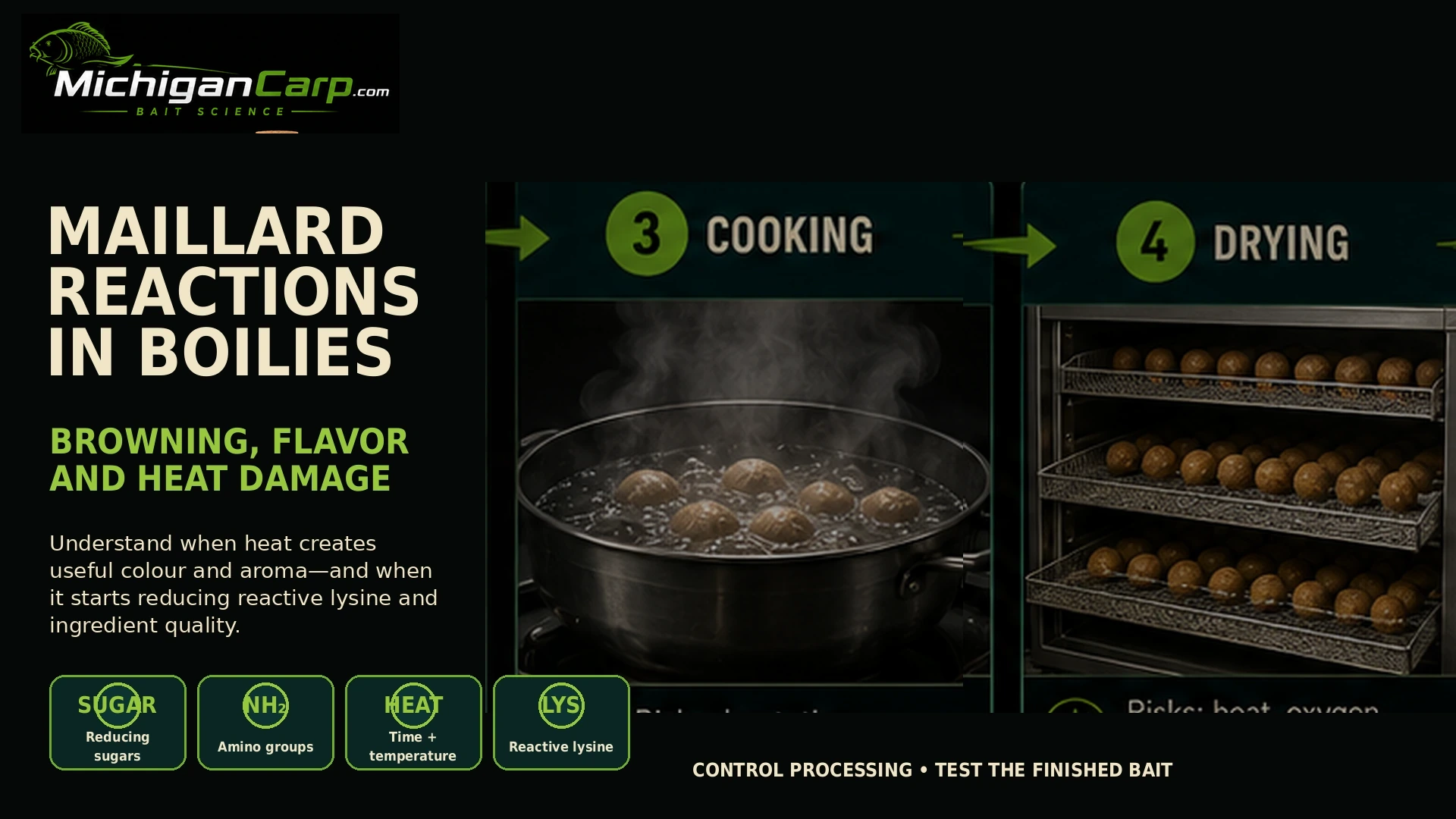
Maillard reactions in boilies can change colour, aroma and the nutritional quality of protein-rich ingredients during manufacture, cooking, drying and storage.
For the home bait maker, however, the subject is often made far more complicated than it needs to be.
You do not need to understand advanced food chemistry to make good decisions at the rolling table.
The practical lesson is much simpler.
When certain sugars and proteins are present together, heat and time can cause them to react. A controlled amount of that chemistry may contribute cooked, toasted or creamy aromas. Too much heat or prolonged warm storage can push the reaction further, reduce the availability of important amino acids such as lysine and give the bait a harsher, darker or over-processed character.
That does not mean Maillard reactions are automatically good or bad.
It means processing matters.
For a home roller, the objective should not be to manufacture the darkest or strongest-smelling boilie possible. The objective is to apply enough heat to make the bait structurally sound while preserving as much of the ingredient quality, solubility and nutritional value as practical.
That distinction becomes especially important when using milk powders, whey products, caseins, hydrolysates, egg, yeast products, sweet syrups, honey, molasses and other protein-and-sugar-rich ingredients.
For the wider effects of cooking on proteins, starches and finished bait structure, read What Boiling and Heat Really Do to Carp Bait Ingredients.
For the production side, see How to Boil and Dry Boilies Properly.
Browning tells you that processing has changed the bait. It does not prove that the bait has become more attractive, more digestible or better for carp.
Quick Start
| Question | Practical Answer |
|---|---|
| What is the Maillard reaction? | A group of reactions that can occur when certain sugars react with amino acids, peptides or proteins. |
| Do I need to understand the full chemistry? | No. Home rollers mainly need to understand which ingredients are susceptible and how heat, time, drying and storage affect them. |
| Is browning always desirable? | No. Some cooked aroma may be useful, but excessive reaction can damage protein quality and produce harsh or overcooked characteristics. |
| Is Maillard browning the same as caramelization? | No. They are different processes, although both can occur in a complex bait under sufficiently hot conditions. |
| Does boiling cause heavy Maillard browning? | Usually much less than baking or roasting because boiling is wet heat. Ingredient history and later drying can still matter. |
| Which ingredients deserve the most attention? | Milk powders, whey products, hydrolysates, protein-rich meals and recipes containing significant reducing sugars. |
| Why is lysine mentioned so often? | Lysine has a reactive amino group that can become chemically blocked, reducing its nutritional availability. |
| Does a darker bait mean more Maillard reaction? | Not reliably. Ingredient colour, molasses, pigments, oxidation and other processing changes can also darken bait. |
| Should I add sugar or amino acids just to create Maillard aroma? | No. Formulate the bait for feeding value and performance first. Do not chase browning for its own sake. |
| What is the best home test? | Make matched batches and alter only one processing variable at a time. |
Table of Contents
The Maillard Reaction in Plain English
The full Maillard reaction is extremely complicated.
Fortunately, boilie makers do not need the full chemical pathway.
The useful version is this:
certain sugars + available amino groups + suitable conditions of heat, time and moisture = Maillard reaction products.
Those amino groups may come from free amino acids, peptides or proteins.
The sugars involved are especially what food science calls reducing sugars. Examples include glucose, fructose, lactose and maltose.
This matters because many boilie ingredients already provide one side or the other of that equation.
Milk powder, for example, contains protein and lactose.
Whey products can contain protein plus varying amounts of lactose.
Honey contains substantial simple sugars.
Molasses and syrups can provide reactive sugars.
Hydrolysates can provide small peptides and free amino acids.
Put several of these ingredients together and you have a mix with plenty of potential for Maillard chemistry if the processing conditions encourage it.
That does not mean the bait will suddenly burn in boiling water.
It means the formula has the potential to react throughout its processing history.
That history may begin long before you roll the bait.
The Reaction May Have Started Before You Open the Bag
This is one of the most useful points for home rollers.
We tend to think of heat damage as something we cause when we boil or dry the finished bait.
In reality, some ingredients have already experienced substantial processing.
Milk powders may have been concentrated and spray dried.
Cereal products may have been toasted, cooked or extruded.
Nut and seed meals may have been roasted.
Yeast products may have undergone drying and processing.
Hydrolysates have already been deliberately broken down.
Milk replacers and compound powders may contain several previously processed ingredients.
This means two ingredients that appear similar on a specification sheet can behave differently in bait.
A fresh, lightly processed milk product and an older, heavily processed product might both list similar crude-protein percentages, yet their flavour, solubility, colour and amino-acid availability may not be identical.
For the home bait maker, this leads to a useful rule:
Do not judge an ingredient only by the number printed beside “protein.”
Smell it.
Look at its colour.
Check whether it disperses properly.
Notice whether it tastes or smells stale, burnt or unusually harsh.
Compare batches when suppliers or products change.
And pay attention to storage.
For more on this distinction, read Raw vs Processed Ingredients in Carp Bait.
Which Boilie Ingredients Deserve the Most Attention?
Not every ingredient in a boilie has the same Maillard potential.
For practical bait making, several groups deserve particular attention.
Milk Powders and Whey Products
Milk ingredients are one of the clearest examples because they combine proteins with milk sugar.
Whole-milk powder, skimmed milk powder, whey powder, buttermilk powder, milk replacers and similar products can therefore already contain some degree of heat-processing history.
That does not make them poor ingredients.
Quite the opposite: good milk ingredients can be extremely useful in carp bait.
The point is simply that quality matters.
Freshness matters.
Processing history matters.
And repeatedly applying unnecessary heat to an already processed ingredient rarely makes sense if the aim is to preserve food value.
More detail is available in Milk Powders in Boilie Making and Milk Proteins in Carp Bait.
Caseins and Concentrated Milk Proteins
High-grade caseins and concentrated proteins are not automatically protected from Maillard reactions simply because they contain less sugar than an ordinary milk powder.
What matters is the whole recipe.
A high-protein base containing casein may still be combined with lactose, honey, molasses, syrups or other sources of reactive sugar.
The sensible approach is therefore to protect expensive proteins from unnecessary processing rather than deliberately forcing additional browning.
Hydrolysates, Amino Acids and Peptides
Hydrolysates are valuable precisely because some of their protein has already been broken into smaller fractions.
They may contribute soluble peptides, amino acids and other compounds useful in a bait’s leakage and food signal.
That is a good reason not to abuse them with unnecessary heat.
The fact that an amino-rich ingredient can participate in Maillard chemistry does not mean the reaction should be deliberately maximized.
If you are paying for high-quality soluble material, preserve the qualities you bought it for.
Honey, Molasses and Syrups
Sweet liquids are often discussed as though they automatically create desirable Maillard flavours.
That is too simplistic.
Honey can supply glucose and fructose.
Molasses and invert-type syrups can contribute reactive sugars, depending on the product.
But adding more sweetener changes much more than Maillard potential.
It can change:
- dough moisture;
- stickiness;
- rolling behaviour;
- sweetness;
- water activity;
- drying rate;
- finished texture;
- leakage;
- storage stability.
Use these ingredients because they contribute something useful to the bait.
Do not pour extra molasses into a formula just because you want it to turn browner.
Egg and Albumen
Egg contributes protein and has important structural functions in conventional boilies.
Albumen may be deliberately added when greater firmness or binding is required.
Again, that does not mean more heat is better.
Once the bait has acquired the structure you need, further heating primarily becomes additional processing.
Toasted Meals and Birdfoods
CLO-style foods, cereal meals, toasted soy products, nut meals and similar ingredients may already have been heated during manufacture.
That existing toasted aroma can be part of why an ingredient is attractive to use.
It also means the home roller should not assume every brown or roasted note was generated during final boilie cooking.
What Actually Controls Maillard Reactions in Boilies?
For home bait making, four variables matter more than memorizing reaction chemistry.
Heat
Higher temperatures generally increase reaction speed.
This is why dry baking and roasting usually create more visible browning than wet boiling.
The surface of a boilie sitting in boiling water remains wet and is held close to the boiling point of water.
The surface of a baked bait can become much hotter as it dries.
That is a major practical difference.
Time
Heat exposure accumulates.
A bait does not care whether unnecessary processing occurs in one dramatic event or through prolonged moderate warming.
Long cooking, long warm drying and warm storage can all contribute additional processing.
This is why “only 35°C” or “only warm air” is not automatically a free pass if the exposure continues for a long time.
Moisture
Water changes how easily reactants can move and how concentrated they become.
You do not need to measure water activity to understand the practical consequence:
a wet freshly boiled bait, a partially dried bait and a fully dried bait are different chemical environments.
This helps explain why drying conditions matter as well as cooking conditions.
pH
Maillard reactions generally proceed more readily as conditions become less acidic and more alkaline.
That does not mean you should manipulate boilie pH purely to produce browning.
Changing pH can affect proteins, flavour systems, preservatives, texture and other bait characteristics.
If pH is being deliberately controlled, treat it as a formulation variable in its own right.
See How pH Changes Carp Bait Performance.
Boiling, Steaming, Baking and Drying: What Changes for the Home Roller?
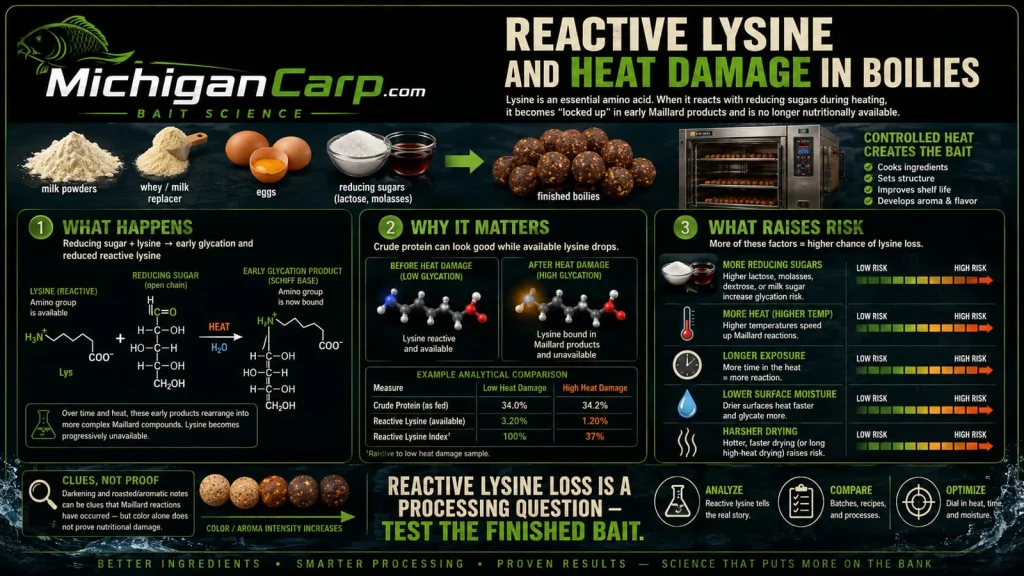
This is where Maillard reactions in boilies become practically useful.
The different cooking methods do not merely provide alternative ways to “set” the bait.
They change the combination of heat, water loss and leaching.
Boiling
Boiling remains a very practical method for conventional boilies.
The bait is exposed to wet heat.
The surface does not normally reach the temperatures associated with a dry oven or roasting process.
That generally means far less obvious surface browning.
But boiling still changes the bait.
Proteins set.
Starches gelatinize.
Some soluble compounds are lost into the water.
The outer structure firms.
Moisture distribution changes.
The aim should therefore be simple:
boil long enough to achieve the structure and durability you need, but do not regard extra cooking time as automatically beneficial.
If your bait survives casting, baiting and the required immersion time with a shorter controlled cook, there is little reason to boil it harder merely because a firmer boilie feels impressive in the hand.
Steaming
Steaming also uses moist heat.
Its practical advantage is that the bait is not immersed in a large volume of cooking water, so direct leaching can be reduced.
That does not mean steaming preserves everything.
The bait is still heated.
Protein still changes.
Starch still changes.
Structure still changes.
The correct question is therefore not:
“Is steaming safer than boiling?”
It is:
“Which process gives this particular bait the structure, leakage and durability I want with the least unnecessary treatment?”
Baking
Baking is where home rollers need to be more careful.
As the surface dries, its temperature can rise substantially above that of a wet-boiled bait.
Colour may develop.
A toasted or baked aroma may appear.
The shell can harden quickly.
None of these observations automatically means the bait has improved.
A beautiful brown exterior can hide an interior that still contains too much moisture.
A very dry shell can slow later water penetration.
A bait can become unnecessarily hard.
And a high-milk or sugar-rich recipe can experience more Maillard chemistry than it would under a shorter wet-heat process.
Baking can absolutely be tested.
It simply should not be judged on appearance alone.
Warm Drying
Warm drying is probably the most overlooked part of the subject.
The boilie may have finished cooking, but processing has not necessarily stopped.
A warm drying cabinet combines:
time + heat + changing moisture.
That combination can continue altering a reactive bait.
This is particularly relevant in formulas rich in milk powder, whey, amino products and sugars.
The safest general approach is not “never use heat.”
It is:
use only as much drying heat as you actually need, maintain good airflow and avoid using temperature as a substitute for patience.
Drying Boilies Without Cooking Them Twice
Home rollers often concentrate on boiling time and then treat drying as an afterthought.
In practice, drying can have a major effect on the finished bait.
Good drying should remove moisture progressively while avoiding conditions that produce a hard dry shell around a much wetter centre.
Airflow matters.
Bait depth matters.
Room humidity matters.
Boilie diameter matters.
How often the bait is turned or moved matters.
A 24 mm bait does not dry internally at the same rate as a 14 mm bait.
A dense high-protein bait may behave differently from a porous birdfood mix.
A bait containing substantial humectants will behave differently again.
Instead of asking:
“How many hours should I dry boilies?”
ask:
“What is happening to this particular batch as it dries?”
Weighing retained samples is far more informative than relying entirely on the clock.
If the bait loses weight rapidly and then stabilizes, that tells you something.
If the outside becomes rock hard while the centre remains soft, that tells you something else.
If one batch develops a noticeably darker colour and stronger toasted aroma during warm drying while an identical cool-dried batch does not, you have learned something about the process.
That is useful bait development.
Why Reactive Lysine Matters — Without the Chemistry Lesson
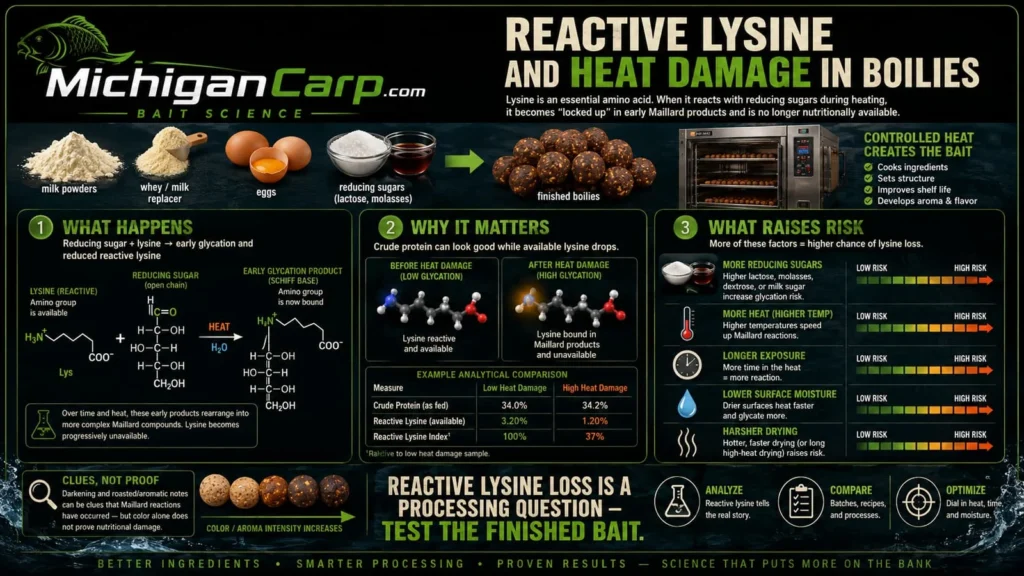
Lysine is an amino acid.
For the home roller, the important detail is that part of the lysine in a protein can become chemically blocked during Maillard reactions.
Once blocked, it is no longer nutritionally equivalent to fully reactive lysine.
Here is the part that often causes confusion:
the crude-protein percentage can still look good.
Crude protein is largely derived from the amount of nitrogen present.
Maillard chemistry does not have to remove that nitrogen.
So a heavily processed protein ingredient may still show an impressive crude-protein number while some of its nutritional value has deteriorated.
This matters most when you are deliberately formulating a boilie around high-grade proteins and food value.
If you have spent money on milk proteins, whey fractions, quality meals and amino-rich ingredients, it makes little sense to deliberately subject them to more processing than required.
For normal home bait making, you do not need laboratory measurements of reactive lysine.
The practical response is simply:
buy good ingredients, store them well and avoid needless heat.
Does Maillard Browning Make a Boilie More Attractive?
This is where carp-bait discussions can run away from the evidence.
Maillard products contribute many familiar cooked, baked and roasted aromas in foods.
It is therefore reasonable to believe that changing processing can alter the smell and taste profile of a boilie.
What we cannot honestly say is:
“Darker boilies catch more carp because of Maillard reactions.”
There is no useful universal rule like that.
A darker bait may have:
- more Maillard browning;
- more caramelization;
- darker ingredients;
- more molasses;
- oxidized ingredients;
- toasted meals;
- pigments;
- simply been baked longer.
Colour alone does not tell us what happened.
And even if a different cooking process produces a pleasant toasted aroma to the human nose, that does not prove carp will prefer it.
Aroma is only one part of a bait.
Carp encounter:
- soluble compounds;
- amino acids and peptides;
- sugars;
- minerals;
- texture;
- oils and lipids;
- particles released from the bait;
- water-soluble flavours;
- the physical food itself.
A strong baked smell cannot rescue a poor overall bait.
Cooked aroma can contribute to bait character. It should not become a substitute for food value, solubility, texture and field testing.
Do Not Design a Boilie Around Browning
This deserves its own rule.
A home roller should not formulate backwards from:
“How can I create more Maillard reaction?”
Start instead with:
What do I want the bait to do?
If you want a nutritious long-term food bait, build it around appropriate proteins, carbohydrates, fats, vitamins, minerals and soluble fractions.
If you want a fast-leaking cold-water bait, design for solubility and digestibility.
If you need a durable river bait, build enough structure to survive current and nuisance activity.
If you want a short-session attractor bait, emphasize the appropriate soluble signal and physical behaviour.
Then process that formula intelligently.
Do not pour in more sugar, amino acids or milk powder simply to produce more browning.
Those ingredients should earn their place in the formula.
A Practical Heat Strategy for Home-Rolled Boilies
For most home rollers, a sensible processing strategy can be summarized as follows.
First, understand the ingredients before deciding how aggressively to process them.
A cereal-heavy inexpensive bait can tolerate different priorities from an expensive milk-protein formula loaded with soluble peptides and amino-rich ingredients.
Second, use cooking to achieve the required physical structure.
Do not cook simply because the timer says every boilie needs the same treatment.
Third, remember diameter.
Large boilies require more time for heat to reach the centre than small ones.
Fourth, remember that the process continues during drying.
Warm drying is still processing.
Fifth, retain samples.
Put a few baits from every meaningful experimental batch into labelled bags or jars.
Six months later, those samples can tell you far more than memory.
When Maillard Damage Is Most Worth Thinking About
You do not need to worry equally about every bait.
The issue becomes more relevant when several of these factors occur together:
| Factor | Why It Matters |
|---|---|
| High milk-powder content | Protein and lactose can already provide a reactive system |
| Whey-rich ingredients | May combine milk proteins or peptides with residual lactose |
| Added honey or reducing-sugar syrups | Adds reactive sugar |
| Hydrolysates / amino products | Provides readily available amino groups |
| Long baking | More dry heat exposure |
| Prolonged warm drying | Adds time and heat while moisture is falling |
| Warm ingredient storage | Reactions can continue before bait manufacture |
| Repeated reheating | Adds another unnecessary processing stage |
| Expensive protein formula | Greater reason to preserve the quality you paid for |
None of those factors alone proves there is a problem.
The table simply identifies situations where processing deserves more thought.
How to Test Processing Changes Properly
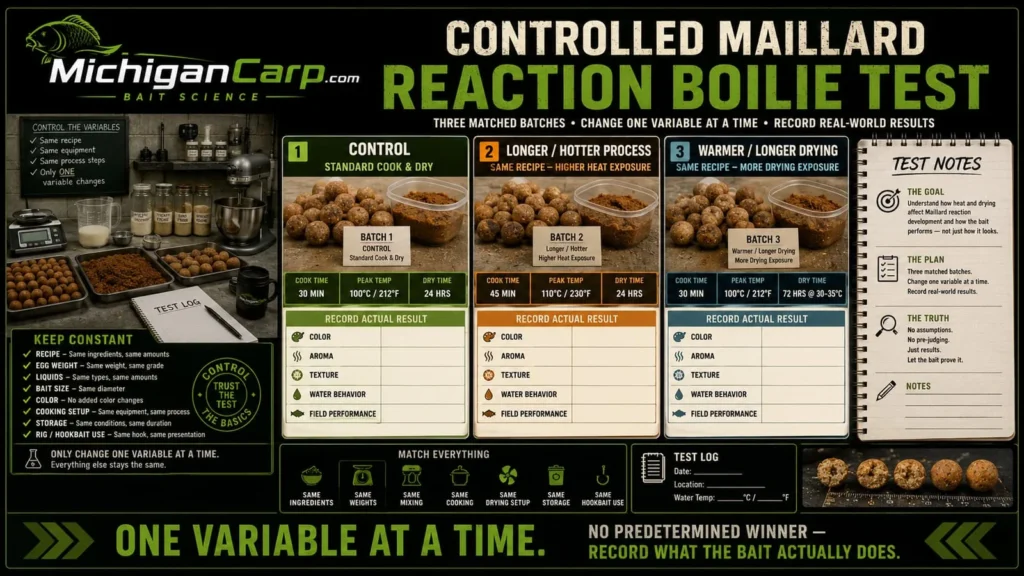
This is where home bait makers can do surprisingly good work without laboratory equipment.
The key is matched batches.
Do not compare one recipe boiled today with a completely different recipe baked next month.
Make one paste.
Divide it.
Then change one variable.
For example:
| Batch | Treatment |
|---|---|
| Control | Your normal cooking and cool-air drying process |
| Test A | Same cook, but warmer drying |
| Test B | Same formula, alternative cooking method |
Now you have a meaningful comparison.
Changing the recipe and cooking method at the same time tells you very little.
What to Record During a Home Test
The most useful testing happens before the bait ever reaches the lake.
Record the paste first.
Was one batch stickier?
Did it roll differently?
Was oil released?
Did the paste toughen unusually quickly?
Then record the finished bait.
Look at:
- external colour;
- colour through the centre;
- aroma;
- hardness;
- brittleness;
- drying time;
- weight loss;
- surface cracking;
- oiling;
- shrinkage.
Then test it in water.
Observe:
- how quickly it takes on water;
- how quickly the skin softens;
- whether it swells;
- leakage;
- clouding;
- colour loss;
- surface breakdown;
- internal texture after several hours.
Finally, fish the batches sensibly.
Do not declare a winner because one fish happened to pick up one test bait.
Look for repeated results.
A useful bait test is built from patterns, not anecdotes.
For a broader testing framework, use How to Test Boilies Before Fishing.
A Simple Three-Batch Home-Roller Experiment
If you specifically want to investigate Maillard reactions in boilies without turning your kitchen into a laboratory, this is a much more useful approach than trying to measure individual reaction compounds.
Make enough paste for three small batches.
Use the exact same:
- dry mix;
- egg weight;
- liquid additives;
- flavour system;
- boilie diameter;
- resting time;
- rolling method.
Then process them differently.
Batch 1 — Control
Use your normal cooking method and normal cool-air drying.
Batch 2 — Warm Dry
Use the same cooking method, but deliberately use warmer or longer drying.
Batch 3 — Alternative Cook
Steam or bake the same formula as an exploratory comparison.
Then compare the batches.
The objective is not to prove that one treatment causes a specific chemical reaction.
It is to learn how processing changes your bait.
You may discover that the warmer dried bait becomes darker but too hard.
You may find that baking produces a pleasant aroma but reduces water penetration.
You may find steaming improves shape or reduces cooking-water loss.
Or you may find your ordinary boiled control performs best.
That result is just as valuable.
Storage Matters More Than Many Home Rollers Realize
Maillard reactions are not restricted to the saucepan or oven.
Processed ingredients and finished baits continue to age in storage.
Heat accelerates many chemical changes.
This is one reason ingredients should not spend months in a hot shed, vehicle or poorly controlled storage space if better conditions are available.
Milk products deserve particular care.
So do high-protein powders, hydrolysates and ingredients containing significant sugars.
For dry ingredients:
keep packaging tightly closed;
avoid unnecessary heat;
avoid moisture uptake;
rotate stock;
label purchase dates;
discard material that develops obvious stale, rancid, burnt or abnormal odours.
Finished shelf-life boilies deserve the same discipline.
Preservation against mold does not freeze every other chemical process.
A bait can remain microbiologically stable while slowly changing in aroma, texture, fats and proteins.
Michigan Home-Roller Notes
Michigan adds some practical environmental complications because home bait making may occur through very different seasonal conditions.
During warm humid periods, natural air drying can be slow.
During cool weather, a basement or garage may remain damp.
During winter, heated indoor air can dry the outside of baits surprisingly quickly.
That means a drying schedule that worked perfectly in April may not behave exactly the same way in July or October.
Do not compensate automatically by applying more heat.
Improve airflow first.
Reduce the depth of bait in trays.
Turn the baits.
Measure weight change.
Check the centre.
If you use a heated drying setup, record the actual temperature rather than judging it by hand.
Consistency is more valuable than maximum speed.
For anglers rolling bait for multi-day Michigan sessions, durability matters—but durability does not require turning every boilie into a marble.
The bait only needs enough structure for casting, baiting, nuisance activity and the intended immersion time.
Common Mistakes
Treating every brown bait as a Maillard success.
Colour can come from ingredients, pigments, molasses, oxidation, caramelization and other processes.
Assuming darker means more attractive.
There is no evidence-based colour scale that predicts carp attraction.
Trying to force Maillard reactions with extra sugar.
That changes the complete recipe, not just browning.
Trying to force the reaction with extra amino acids.
If an amino product was included for solubility and feeding signal, cooking it harder may be working against the original reason for using it.
Believing boiling destroys everything.
Boiling changes bait, but wet heat is very different from prolonged dry high-temperature processing.
Believing steaming preserves everything.
Steaming is still a heat process.
Baking until the colour looks right.
Appearance tells you very little about internal moisture or nutritional quality.
Drying as hot as possible to save time.
Drying is part of processing. Good airflow is often more useful than simply adding temperature.
Ignoring ingredient history.
Some of the chemistry may have happened before the ingredient reached you.
Judging protein only from the label.
Crude protein does not tell you everything about amino-acid availability or processing quality.
Testing several variables at once.
Change one thing if you want to learn something.
Using human aroma as the final verdict.
A smell you like is an observation, not proof of carp preference.
Final Verdict
Maillard reactions in boilies are worth understanding, but they do not need to turn home bait making into a chemistry lesson.
For the home roller, the main lessons are straightforward.
Some sugars react with amino groups in proteins and amino-rich ingredients.
Heat, time, moisture, pH and storage influence how far those reactions progress.
Milk powders and whey products deserve particular attention because milk proteins and lactose can already form a reactive combination.
Hydrolysates and amino products may also be worth protecting from unnecessary processing because their soluble fractions are often part of the reason we bought them.
Boiling and steaming generally expose the bait to a different and less aggressive browning environment than dry baking or roasting.
Warm drying also matters because the bait continues to experience heat while its moisture level changes.
And excessive Maillard reaction can reduce reactive lysine even while the crude-protein figure appears respectable.
None of this means browning must be avoided.
It means browning should not become the target.
For my own home rolling, I would concentrate on four things:
good ingredients, minimum effective processing, controlled drying and repeatable testing.
If a slightly toasted aroma develops as part of producing an effective bait, that may simply be part of its character.
But I would not deliberately sacrifice useful protein, soluble material or bait structure just to make the boilie darker.
Use heat to make the bait work. Do not use browning as proof that the bait works.
FAQ
What are Maillard reactions in boilies?
They are a group of reactions that can occur when certain sugars interact with amino groups from amino acids, peptides or proteins. Processing and storage conditions determine how strongly they develop.
Do I need to understand Maillard chemistry to make good boilies?
No. A home roller mainly needs to understand that ingredient choice, heat, time, drying and storage can alter colour, aroma and protein quality.
Is boilie browning always caused by the Maillard reaction?
No. Ingredient colour, caramelization, oxidation, molasses, pigments and toasted meals can also make a bait darker.
Does boiling cause Maillard reactions?
It can contribute to them in a suitable formula, but wet boiling normally produces much less obvious surface browning than dry baking or roasting.
Is steaming better than boiling?
Not automatically. Steaming may reduce direct loss into cooking water, but it still heats and changes the bait. Judge the finished bait rather than assuming one method always wins.
Is baking bad for boilies?
No. Baking is simply a different process. It can create more browning and a toasted character, but it can also produce excessive hardness or uneven drying if poorly controlled.
Why do milk powders matter?
Milk powders can contain both protein and lactose, giving them natural potential for Maillard reactions during manufacture, storage and later bait processing.
Does molasses increase Maillard potential?
It can, depending on its sugar composition and the rest of the formula. That does not mean adding more molasses automatically improves the bait.
What is reactive lysine?
It is lysine whose important amino group remains chemically available. Maillard binding can block that group and reduce its nutritional availability.
Can crude protein reveal heat damage?
Not reliably. A product can retain a high total nitrogen—and therefore crude-protein—figure even though some lysine has become less available.
Does a darker boilie catch more carp?
There is no good universal evidence that darker boilies catch more carp simply because they have undergone more Maillard reaction.
Should I deliberately try to create Maillard flavours?
I would not make that the primary objective. Formulate for food value, attraction, leakage, texture and durability, then process the bait intelligently.
How can I test the effect at home?
Use matched batches made from the same paste, change one processing variable, and compare colour, aroma, hardness, drying, water behaviour, storage and fishing results.
Next Steps
What Boiling and Heat Really Do to Carp Bait Ingredients
How to Boil and Dry Boilies Properly
Raw vs Processed Ingredients in Carp Bait
Anti-Nutritional Factors in Carp Bait Ingredients
Carp Bait Solubility and Leakage