

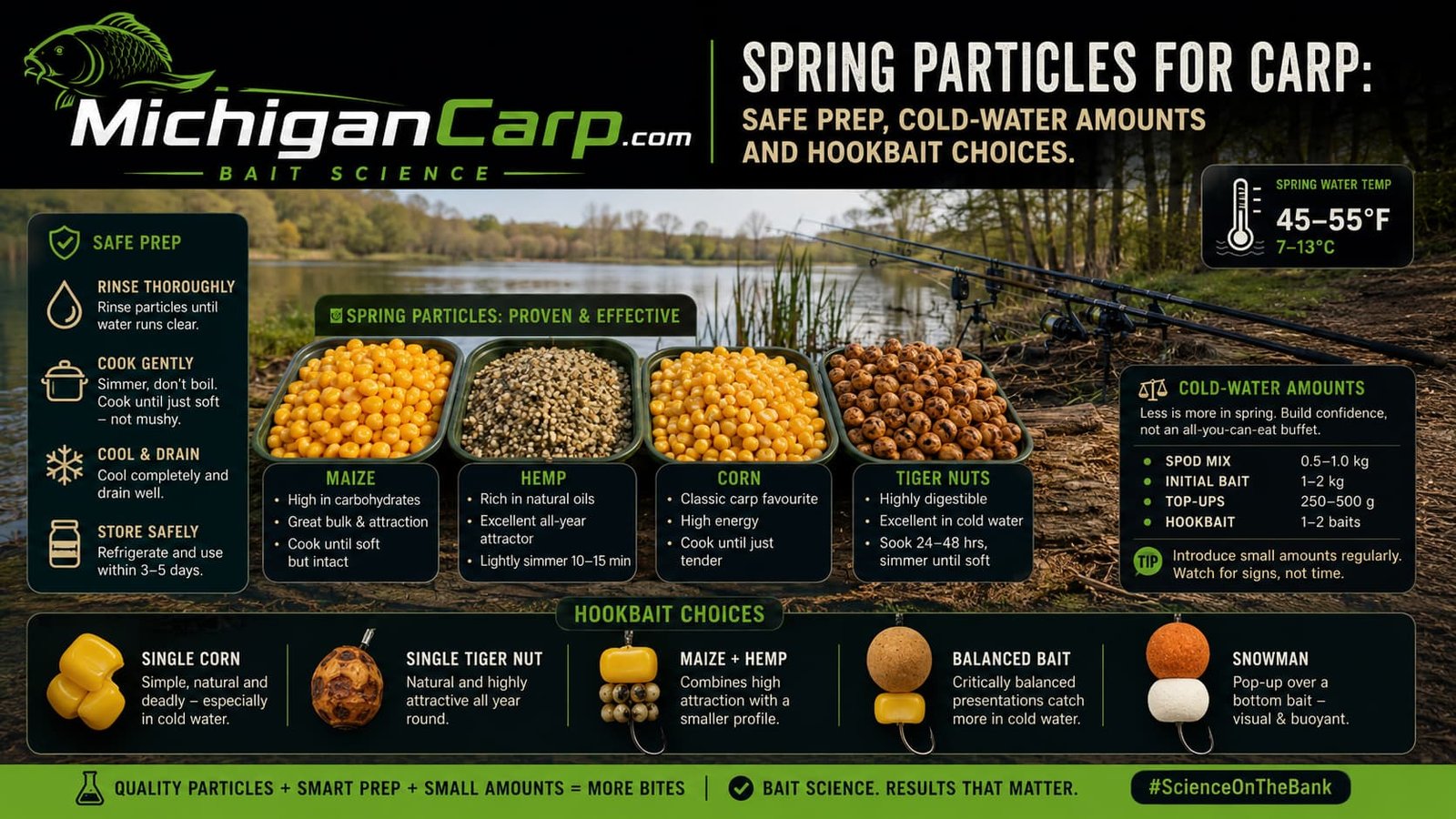
Spring particles for carp need more restraint than summer particles.
That is the whole lesson.
In spring, carp may move into shallower water before they feed heavily. They may show, roll, cruise, cloud the bottom or visit warming margins without being ready for a large bed of bait.
That is where many anglers make the mistake.
They see carp.
They feed like it is June.
Then the swim goes quiet.
Spring particle fishing should be built around short feeding windows, safe bait preparation, small amounts and hookbaits that stay important.
This article is not the main particle guide.
For the full particle system, read Particles for Carp Fishing.
For safe soaking, boiling, resting and storage, read How to Prepare Particles for Carp Fishing.
For broad bait choice, use Carp Bait Guide.
For spring location and timing, use Spring Carp Fishing in Michigan.
The spring particle rule is simple:
PREPARE PARTICLES SAFELY.
START SMALL.
FEED BY EVIDENCE.
RESET AFTER COLD FRONTS.
KEEP THE HOOKBAIT IMPORTANT.
That is how particles catch spring carp instead of just feeding them.
Table of Contents
Quick Start: Spring Particles for Carp
| Spring Situation | Particle Approach |
|---|---|
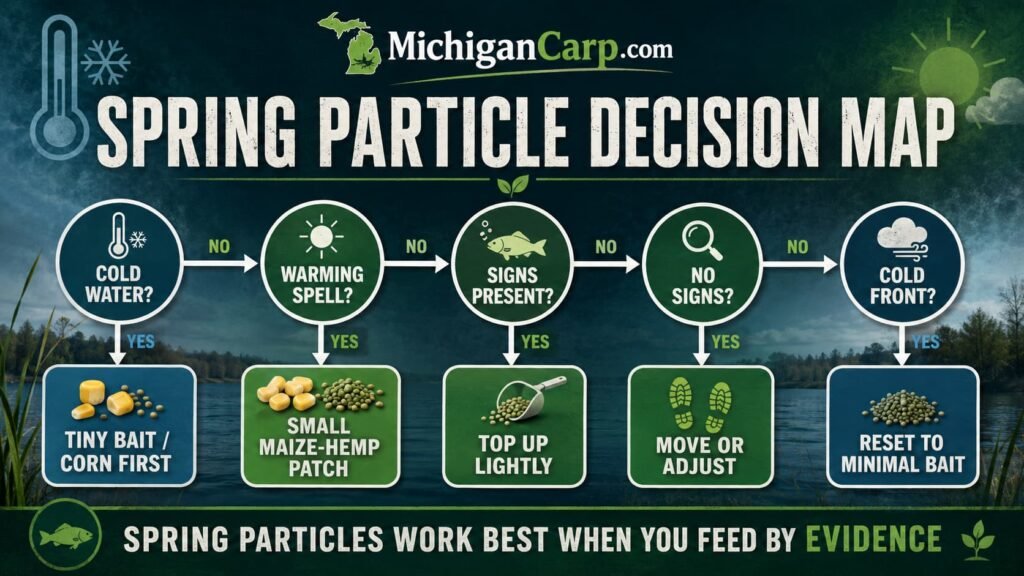
| Early spring / cold water | Tiny amounts, corn-first, very light hemp |
| Carp showing but not feeding hard | Single hookbait or small trap only |
| Warming margins | Small corn/hemp/maize patch, watch for signs |
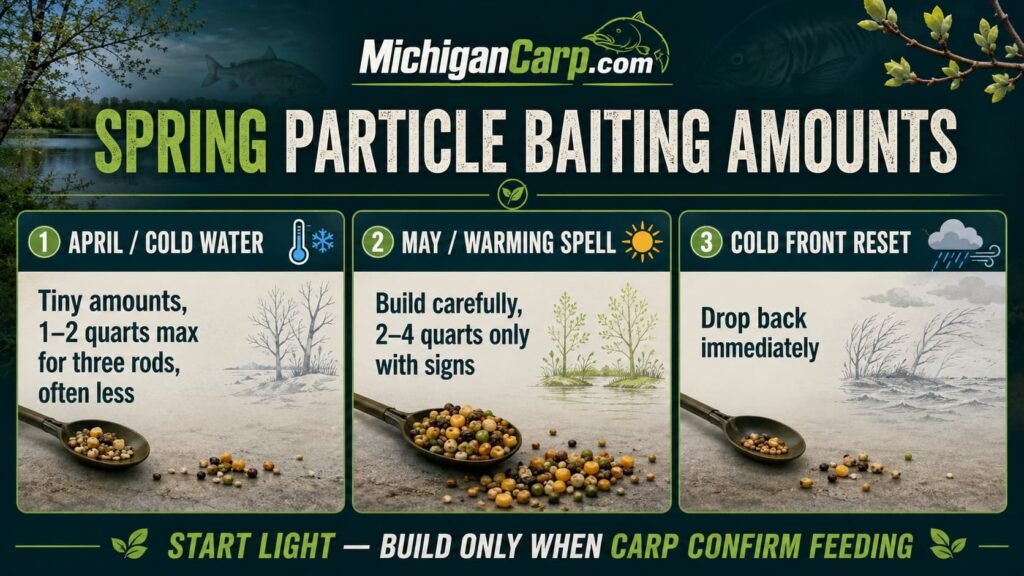
| April-style cold-water window | 1–2 quarts total starting bait or less for three rods |
| May warming spell | 2–4 quarts total starting bait only if fish confirm |
| Cold front after warm weather | Drop back to early-spring amounts immediately |
| Turtles or nuisance activity | Reduce loose corn, use tiger nut or tougher hookbait |
| Liners but no bites | Do not dump bait; check rig and reduce feed |
| One bite then silence | Small top-up only if fresh signs continue |
| No signs at all | Move depth, angle or area before adding bait |
The safest beginner spring particle plan is:
- prepare particles properly;
- use corn as the confidence bait;
- use hemp lightly;
- use maize only in controlled amounts;
- use tiger nuts as hookbaits more than free feed;
- top up only when fish activity justifies it.
Why Spring Particles Need Restraint
Spring is not one season.
It is a transition.
Early spring can fish like winter.
Late spring can feel almost like summer.
Between those two points, water temperature, wind, sunlight, cold rain, night temperatures and spawning behavior can all change how carp feed.
That means spring particle fishing should not be automatic.
The key spring question is:
Are carp actually feeding, or are they only moving?
Carp may visit warming areas before they are ready to eat much bait.
They may cruise in shallow water, sit near reeds, roll in the sun or move along margins without feeding hard.
Particles can help when carp are ready to browse.
Particles can hurt when the swim only needs a small hookbait.
Spring baiting should begin with restraint.
Build only when the fish prove they are feeding.
The Spring Particle System
A good spring particle system has four parts.
1. Safe Preparation
Particles must be prepared correctly.
Do not feed dry or undercooked maize, tiger nuts, peanuts, beans, pulses or mixed particle blends.
Use How to Prepare Particles for Carp Fishing before fishing dry particles.
For safe preparation of dry beans and pulses, NDSU Extension gives a useful basic process: clean, rinse, soak and cook. That same disciplined approach is a good mindset when preparing spring particles for carp, even though bait preparation is not the same as human food preparation. Read NDSU Extension’s dry bean preparation guide.
2. Small Starting Amounts
Spring particles should usually start smaller than summer particles.
You are trying to create a chance, not fill fish up.
3. Evidence-Based Top-Ups
Top up only after evidence:
- liners;
- fizzing;
- mud puffs;
- clouding;
- carp showing over the area;
- a pickup;
- a fish caught.
4. Strong Hookbait Importance
The hookbait must still matter.
Do not spread so many particles that the hookbait becomes one item in a large free-food carpet.
Spring carp may only pick up a few items.
Make one of them the hookbait.
Best Spring Particles
The best spring particles are simple and controlled.
Corn
Corn is the safest spring starting point.
It is:
- soft;
- visible;
- easy to eat;
- ready from the can;
- useful in tiny amounts;
- ideal for testing a swim.
Use Corn for Carp in Michigan for the full corn guide.
Maize
Maize can work well later in spring, but it needs proper preparation and restraint.
Use maize when:
- water is warming;
- carp are feeding confidently;
- you need affordable feed;
- you can keep the baiting tight.
Do not use dry maize.
Hemp
Hemp is excellent in small amounts.
It encourages browsing and grubbing, but a little can do a lot.
Use hemp carefully in spring.
Too much hemp can keep carp searching without making the hookbait important enough.
Tiger Nuts
Tiger nuts are strongest as spring hookbaits, not bulk feed.
Use them when:
- corn is being cleared;
- turtles or nuisance fish are active;
- you need the hookbait to last;
- you want a tougher particle-style bait.
Use Tiger Nuts for Carp Fishing for the full tiger nut guide.
Peanuts
Peanuts should be hookbait-first and minimal.
They are rich and oily compared with grains.
Use them carefully, prepare them properly and avoid heavy feeding.
Wheat and Small Grains
Wheat can help build small-item feeding, but it should not dominate the spring plan.
Small grains are useful only when carp are actually browsing.
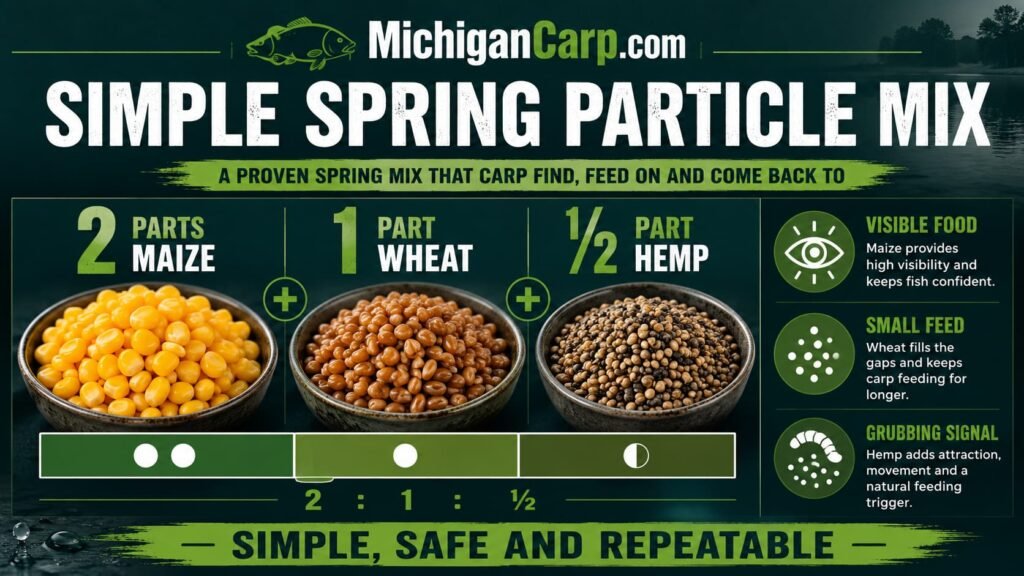
My Simple Spring Particle Mix
This is a practical spring mix, not a heavy-feed recipe.
Use it when carp are beginning to feed but you still need restraint.
Basic Ratio by Volume
| Particle | Amount |
|---|---|
| Prepared maize | 2 parts |
| Prepared wheat | 1 part |
| Prepared hemp | ½ part |
Example:
- 4 cups prepared maize;
- 2 cups prepared wheat;
- 1 cup prepared hemp.
The ratio matters more than the exact batch size.
This mix gives you:
- maize for visible food items;
- wheat for smaller feed;
- hemp for grubbing behavior.
It is simple, repeatable and easy to scale down.
Do not turn it into a ten-ingredient bucket just because you can.
Safe Prep for the Spring Mix
This article does not replace the full prep guide, but the basic approach matters.
Maize
Soak 24–48 hours.
Boil or simmer until softened properly.
Rest overnight in the liquor.
Wheat
Soak 12–24 hours.
Simmer until soft but still intact.
Rest in the liquor.
Hemp
Soak 12–24 hours.
Boil or simmer until many seeds split and show the small white shoot.
Rest in the liquor.
Simple One-Pot Method
A practical one-pot method is:
- soak the particles separately or together only if you understand the timing;
- start the maize first because it usually needs longest;
- add wheat later;
- add hemp near the end;
- cool everything in the cooking liquor.
Do not use the one-pot method if it leaves the hardest particles undercooked.
Check the bait before fishing.
For exact prep details, use How to Prepare Particles for Carp Fishing.
Optional Spring Liquor and Fermentation
Particles can be used plain.
They do not need a heavy liquid treatment.
Optional light additions include:
- small amount of molasses;
- small amount of brown sugar;
- CSL-style liquid;
- yeast liquid;
- a little salt;
- the cooking liquor itself.
Keep it simple.
The cooking liquor already carries a useful food signal.
Controlled Fermentation
A short, clean rest in the liquor can improve the bait.
A 24–72 hour controlled rest may develop a mild sweet/sour tang.
That is different from rotten bait.
Good particle liquor should not smell foul, putrid or unsafe.
If in doubt, do not fish it.
April Particle Amounts: Cold-Water Window Hunting
In early spring or water around the mid-40s°F, think tiny.
The aim is not to feed carp heavily.
The aim is to place a small amount of bait where a spring carp may already want to feed.
Three-Rod Starting Point
| Rod | Area | Starting Particle Amount |
|---|---|---|
| Rod 1 | Margin / shallow area | 0 to ½ handful |
| Rod 2 | Mid-depth or likely route | 1–2 handfuls tight |
| Rod 3 | Deep edge / fallback area | 0 to 1 handful |
Total starting amount for three rods:
roughly 1–2 quarts maximum, often less.
That is the maximum starting point, not a target you must hit.
Some early spring sessions should begin with almost no loose particles.
April Top-Up Rule
Only top up after evidence.
Good reasons include:
- liners;
- fizzing;
- mud puffs;
- a pickup;
- a fish caught;
- carp clearly feeding over the bait.
Top-up amount:
½ to 1 handful on the active rod.
Do not top up quiet rods just because time has passed.
May Particle Amounts: Warming Spells
When water warms and fish begin feeding more confidently, you can build carefully.
Do not jump straight to summer baiting.
Three-Rod Starting Point
| Rod | Area | Starting Particle Amount |
|---|---|---|
| Rod 1 | Margin / shallow area | ½ to 1 handful |
| Rod 2 | Mid-depth or main feeding line | 2–4 handfuls tight |
| Rod 3 | Deep edge / backup route | 1–2 handfuls |
Total starting amount for three rods:
roughly 2–4 quarts if fish activity justifies it.
That phrase matters.
If there are no signs, use less.
May Top-Up Rule
After activity, add:
1–2 handfuls to the productive rod.
Do not feed every rod equally.
Feed the rod or zone that is actually producing signs.
Cold-Front Reset
Spring cold fronts matter.
If a cold front hits after a warming spell, reset the baiting plan.
Do not keep feeding like it is still warm.
Cold-front adjustment:
- reduce particles immediately;
- go back to April amounts;
- use more single hookbait thinking;
- rely on corn, tiger nut or small traps;
- move or adjust depth before adding more feed.
A cold front can shorten feeding windows fast.
When the water tells you to back off, back off.
Where Spring Particles Work Best
Use spring particles where carp are already likely to browse.
Good spring areas include:
- warming margins;
- reed edges;
- shallow shelves near deeper water;
- dark-bottomed bays;
- sheltered corners;
- weed edges as growth begins;
- soft silt with feeding signs;
- transition lines between shallow and deeper water.
Avoid random open-water baiting.
A spring particle mix is not a search tool by itself.
Use How to Locate Carp Before You Cast and Reading a Lake Like a Carp Angler before committing bait.
Spring Hookbaits Over Particles
The hookbait needs to be easy to find and durable enough for the situation.
Corn
Corn is the default spring hookbait.
Use it when:
- you want quick acceptance;
- you are testing a swim;
- nuisance fish are not too bad;
- water is cool;
- carp are feeding lightly.
Good option:
real corn plus plastic corn for visibility and hookbait security.
Tiger Nuts
Tiger nuts are the tough, selective option.
Use them when:
- nuisance fish are picking at corn;
- turtles are active;
- the hookbait needs to last;
- you want a stronger hair-rig bait;
- fish are feeding over maize or hemp.
Good option:
single tiger nut tipped with plastic corn.
Peanuts
Peanuts are subtle, rich and oily, but should be used carefully.
Use them as hookbait-first, not heavy feed.
Use only prepared raw, shelled, unsalted peanuts.
Avoid roasted, salted or flavored peanuts.
If nuisance activity is heavy, tiger nuts usually last better.
Boilies and Wafters
Small boilies or wafters can work over spring particles when you want a more controlled hookbait.
Use them when:
- the particle patch is small;
- you want a stronger hookbait profile;
- corn is being cleared;
- you need a bait that can stay fishing longer.
Use How to Fish Boilies for Carp for boilie-specific bank strategy.
Turtles and Spring Margin Rods
Turtles can be a real problem in spring margins.
Do not fight them by adding more bait.
That usually makes the problem worse.
If turtles are bothering the shallow rod:
- reduce or remove loose corn in the margin;
- switch to a tiger nut hookbait;
- use a tougher wafter or boilie;
- fish with little or no free bait until carp signs appear;
- use bait floss or a secure bait stop;
- move the rod slightly deeper if turtles dominate the edge.
A margin rod should be a carp rod, not a turtle feeder.
If turtles keep working the shallow water, let the mid-depth rod do more of the fishing.
Liners, Fizzing and Spring Top-Ups
Spring top-ups should be based on evidence.
Liners but No Bites
Do not dump bait.
Instead:
- check the rig;
- check hook sharpness;
- recast one rod cleanly;
- reduce free bait;
- move the hookbait slightly to the edge;
- try a more balanced hookbait.
Fizzing or Mud Puffs
Fizzing can mean feeding, but it can also be natural gas or other disturbance.
If you are confident carp are feeding:
- add a very small top-up;
- keep it tight;
- avoid spreading bait everywhere.
One Bite Then Silence
Do not assume the swim needs a big feed.
A better response is:
- leave the productive rod alone briefly;
- top up lightly only if signs continue;
- check the rig after the action;
- avoid feeding quiet rods.
Spring bites often come in short windows.
Do not ruin the next chance with panic baiting.
Little and Often Beats Two Big Feeds
Spring particle baiting usually works better as little-and-often than two large dumps of bait.
A small amount in the right place can create confidence.
A big feed at the wrong time can kill urgency.
Good spring baiting feels controlled.
It might look like:
- a tiny starting patch;
- one rod with almost no feed;
- one rod with a tight handful;
- one rod on a travel route;
- light top-ups only after evidence.
Bad spring baiting looks like:
- feeding all rods heavily;
- adding bait because nothing happened;
- treating a warm afternoon like summer;
- ignoring a cold night or cold rain;
- feeding the margin heavily when turtles are active.
Spring rewards restraint.
When Not to Use Spring Particles
Particles are not always the right spring answer.
Use little or no particles when:
- the water is very cold;
- carp are only cruising;
- no signs are present;
- nuisance fish dominate;
- turtles are active;
- you are fishing a very short session;
- you are unsure of the bottom;
- you are trying to locate fish;
- a cold front just hit.
In those situations, use:
- single corn;
- corn and plastic corn;
- single tiger nut;
- small wafter;
- tiny PVA trap with dry bait;
- very light crumb.
Spring particle fishing is about knowing when to feed and when not to feed.
Simple Spring Particle Plans
Plan 1 — Cold Spring Search
Use when:
- water is cold;
- signs are limited;
- carp may only feed briefly.
Bait:
- corn hookbait;
- almost no loose feed;
- optional pinch of hemp or a few grains of corn.
Goal:
one bite.
Plan 2 — Warming Margin Trap
Use when:
- sun warms the margin;
- carp are showing;
- bubbles or clouding appear.
Bait:
- corn hookbait;
- small corn/hemp patch;
- a few grains only at first.
Goal:
test whether visible carp are actually feeding.
Plan 3 — Maize, Wheat and Hemp Patch
Use when:
- water has warmed;
- carp are feeding;
- the session is longer.
Bait:
- 2 parts maize;
- 1 part wheat;
- ½ part hemp;
- corn or tiger nut hookbait.
Goal:
build controlled browsing without overfeeding.
Plan 4 — Nuisance-Control Tiger Nut Setup
Use when:
- corn is being cleared;
- turtles or nuisance fish are active;
- the hookbait needs to last.
Bait:
- single tiger nut or tiger nut tipped with plastic corn;
- tiny amount of chopped tiger nut;
- very light maize/hemp support if needed.
Goal:
keep the rig fishing.
Common Spring Particle Mistakes
Feeding Like It Is Summer
Spring is not summer.
Start smaller.
Using Dry or Undercooked Particles
Never use dry or underprepared maize, tiger nuts, peanuts, beans or pulses.
Increasing Bait When Nothing Is Happening
No signs usually means move or adjust before feeding more.
Ignoring Cold Fronts
After a front, reset to early-spring amounts.
Feeding Every Rod Equally
Feed the active zone, not the whole lake.
Letting the Hookbait Disappear
Too much particle feed can make the hookbait less important.
Overusing Hemp
Hemp is powerful in small amounts.
Do not turn the swim into a grubbing-only area.
Feeding Peanuts Like Maize
Peanuts are rich and should be minimal.
Fighting Turtles With More Bait
Use tougher hookbaits and less loose feed.
Not Keeping Notes
Spring changes quickly.
Record bait amount, water temperature if known, signs, bite times and weather shifts.
Michigan Notes
In Michigan, leftover bait and bait containers should be handled responsibly. The Michigan Invasive Species Program reminds anglers to dispose of unused bait on land or in the trash, never in the water. See Michigan’s guidance on bait and fish release laws.
Spring particles for carp in Michigan should be practical and conservative.
Many Michigan waters warm unevenly.
A shallow bay may feel alive on a sunny afternoon, then slow right down after a cold night.
Boat traffic, wind direction, cold rain, weed growth and water clarity can all change how carp use an area.
That means spring particles should support watercraft.
They should not replace it.
On Michigan lakes and impoundments, I would rather start with a small corn or maize/hemp trap in the right place than a large particle bed in a guessed area.
The best spring particle sessions usually come from:
- finding warming water;
- seeing signs;
- feeding lightly;
- using a hookbait that stays important;
- building only when the fish tell you to.
My Practical View
Spring particles are useful, but only when they are controlled.
I like corn first because it gives quick information.
I like hemp in small amounts because it encourages searching.
I like maize when the water warms enough to justify more feed.
I like tiger nuts when the hookbait needs to last.
I treat peanuts carefully and mostly as hookbaits.
The mistake is thinking a spring particle mix needs to be big.
It does not.
In spring, the right handful can beat the wrong bucket.
My rule is:
USE PARTICLES TO CONFIRM FEEDING, NOT TO FORCE IT.
That is the cleanest spring approach.
FAQ
Are particles good for spring carp fishing?
Yes, particles can be good for spring carp fishing, but they should be used carefully and in smaller amounts than summer.
What are the best spring particles for carp?
Corn, maize, hemp and tiger nuts are the most useful spring particles. Corn is the safest starting bait, hemp should be used lightly, maize needs restraint and tiger nuts are best as tough hookbaits.
How much particle bait should I use in early spring?
Use very little. In cold early spring, a few grains of corn, a pinch of hemp or a small handful around the most likely rod may be enough.
Can I use maize in spring?
Yes, but maize should be prepared properly and used in controlled amounts. It is better once the water is warming and carp are feeding more confidently.
Can I use hemp in spring?
Yes, but use hemp lightly. A small amount can encourage grubbing, but too much can make the hookbait less important.
Are tiger nuts good in spring?
Yes, tiger nuts are useful spring hookbaits when you need toughness, nuisance resistance or longer hookbait life.
Should I use peanuts in spring?
Peanuts should be used carefully and sparingly. Treat them as hookbait-first rather than bulk feed.
What should I do after a spring cold front?
Reduce bait immediately. Drop back to early-spring amounts, use smaller traps and rely more on location and hookbait placement.
Should I top up particles after liners?
Not automatically. Check the rig and hookbait first. Add only a very small top-up if signs continue and you believe carp are feeding.
What is the biggest spring particle mistake?
Feeding too much too soon. Spring carp may feed in short windows, and heavy particles can kill urgency.
Next Steps
Use these routes next:
- Particles for Carp Fishing
- How to Prepare Particles for Carp Fishing
- Corn for Carp in Michigan
- Tiger Nuts for Carp Fishing
- Sweet Corn vs Tiger Nuts for Carp
- Spring Carp Fishing in Michigan
- Baiting Strategy: How Much, How Often and Why
- How to Locate Carp Before You Cast
- Michigan Carp Guide Library