

Carp bait flavours have been discussed, debated and sometimes exaggerated for decades. But how much difference do commercial flavours really make to a well-formulated boilie? Are specialist carp flavours more effective than ordinary food flavourings, and does a stronger smell actually encourage carp to feed? These are the questions worth examining before adding another expensive ingredient to an otherwise good bait.
An independent MichiganCarp.com Bait Science guide to food flavours, specialist carp flavours, feeding acceptance, base-mix quality and evidence.
Introduction: Carp Bait Flavors — Are We Catching the Angler or the Fish?
There’s something I’ve noticed over many years of carp fishing. When an angler wants to introduce you to a new bait, one of the first things he often says is, “Here, smell this!” Out comes a bottle of Strawberry, Plum, Scopex or some other wonderfully named liquid. The cap comes off, the aroma hits you and the immediate reaction is that it must be attractive to carp. It certainly smells attractive to us. But attractive to whom?
Our noses are responding to volatile substances in air. A carp encounters chemicals in water, inside an environment where solubility, dilution, flow, bait structure and the fish’s own sensory biology all matter. Something that smells powerful in the bottle may not release the most useful signal from a cooked, dried boilie. Another ingredient can smell comparatively modest to us yet contribute waterborne substances that the fish detects. Even detection is not the same thing as getting the carp to eat.
That makes me wonder whether some baits are designed as much to catch the angler as the fish. I’m not accusing manufacturers of dishonesty, and I’m certainly not suggesting that attractive-smelling products cannot work. I’ve used excellent specialist products and food-industry flavours for many years. But an impressive aroma is remarkably easy to demonstrate to a buyer. An improvement in carp feeding acceptance is much harder to prove.
I have another long-standing belief that sits at the heart of this article: a properly formulated food boilie should be capable of catching carp without any added commercial flavour. I didn’t invent that principle, and I’m not claiming to have popularised it. I simply believed it long before I heard it expressed as one of the popular phrases in bait making. If I’ve chosen good ingredients, considered digestibility and produced a sound finished bait, why should a few millilitres from a bottle be the only thing making it worth eating?
As I’ve often said, you can’t dress mutton as lamb. A flavour might improve a fish’s immediate response to a poor food, but it cannot turn unsuitable nutrition into suitable nutrition, reverse stale ingredients or repair a badly constructed bait. Equally, we shouldn’t confuse a good food bait with a specialist hookbait designed to get one take. Different baits have different jobs.
My own results give me a reason to use flavours, but not to worship them. My proven Plum, Scopex and Vanilla boilie uses CC Moore Plum and Scopex with LorAnn Vanilla. I’ve also caught plenty of carp using LorAnn Maple. Those results show that food-industry flavours can form part of successful carp baits. They do not establish how much of the success came from the flavours rather than the complete recipe, location, timing and presentation.
This is a substantial examination of the questions I think bait makers ought to ask. What does a commercial flavour contain? What do carp actually detect? Do stronger flavours catch more? Are fruit flavours really better in summer? Do specialist labels guarantee better products? Who formulates the flavours sold by bait companies? How could we test a flavoured boilie against an unflavoured version without fooling ourselves?
For anyone researching carp bait flavors, the purpose isn’t to attack anyone. It is to understand the products, respect genuine expertise and distinguish a reasonable hypothesis from something that has actually been demonstrated. No magic dust, no allegations and no ingredients added merely to make a recipe sound clever.
Table of Contents
Part One: A Good Base Mix Comes First
A good food bait has to do more than smell good
My starting point when designing a food boilie is the job the finished bait must perform. Is it intended for repeated feeding over several sessions, a modest amount of free bait during a short visit, or a durable hookbait that may remain out for many hours? The answer influences the ingredients I choose long before I think about a flavour profile.
For a food bait, I want appropriate protein sources, digestible energy, sensible fat levels, suitable texture and a formulation I can reproduce. Milk proteins, cereals, nuts, seed ingredients, eggs and other materials contribute different things. A high protein number on paper doesn’t automatically guarantee good digestibility. An expensive ingredient doesn’t automatically justify its inclusion. A recipe with a long ingredient list can still be poorly designed if the components don’t work together.
This is particularly important when anglers become fascinated with the next celebrated liquid. A base mix can be hard, fragile, greasy, prone to splitting, badly processed or nutritionally confused. Adding a big dose of flavour may make the mixing bowl smell wonderful, but none of those faults disappears. The flavour may alter the sensory characteristics, but it hasn’t corrected the underlying system.
That doesn’t mean a poor food bait can never catch a carp. Of course it can. Many ordinary foods with little claim to complete nutrition have caught carp, and a heavily flavoured hookbait might produce a take very quickly. Catching a fish, improving feeding acceptance and providing useful nutrition are three different achievements. The distinction matters if we’re discussing what makes a good long-term boilie, rather than simply what might catch the next fish.

Why an unflavoured base mix is not chemically inactive
A good food mix brings its own chemical character, with or without added carp bait flavors. Depending on the ingredients, it can contain free amino acids, salts, sugars, organic acids, soluble protein fractions and many other compounds. Water entering the finished boilie may allow some of that material to escape into the surrounding water. Other fractions may be retained, dissolve slowly or become available after the bait begins to soften.
We need to be precise, though. A protein-rich ingredient does not automatically leak large quantities of free amino acids. Intact proteins, small peptides and individual amino acids have very different properties. The source and processing of an ingredient, as well as the cooking and drying of the boilie, influence its behaviour. A whey hydrolysate is not simply interchangeable with casein. Nor does a creamy flavour replace milk protein.
My point is not that every unflavoured boilie is attractive enough for every fishing situation. My point is that commercial flavour is an addition to a pre-existing food system. If we don’t know what the base mix already contributes, it’s hard to know whether adding another liquid improves anything.
Food boilies and one-bite hookbaits are different propositions
A high-attract pop-up and a long-term food boilie may both be useful, yet their priorities differ. The pop-up needs consistent buoyancy, durable attachment, the right balance with the rig and a chemical and physical profile that fish will accept. It may be used in tiny quantities. A food boilie introduced in kilograms needs nutritional sense, consistent manufacture, cost control and suitability for repeated consumption.
I am happy to judge each bait by its intended job. What I won’t do is treat a brightly coloured, heavily scented hookbait as proof that the same formula is a superior source of food. Nor would I dismiss a simple boilie merely because it doesn’t fill the air with a spectacular aroma. Sometimes the more important question is whether the fish is encountering the bait in the right place, with the right presentation and an appropriate amount of feed.
For the full base-mix framework, my guide How to Formulate a Milk, Nut and Birdfood Boilie Base Mix explains why formulation starts with a purpose rather than a shopping list. The broader nutritional direction is developed in Milk, Nut and Birdfood Boilies for Michigan Carp.
Part Two: Smell, Taste and the Carp’s Chemical World
A powerful human aroma is not proof of underwater attraction
A bottle of Plum might be extraordinarily aromatic when opened in the kitchen, but assessing carp bait flavors by human smell alone misses the underwater question. That’s because some of its ingredients readily enter the air and activate the human olfactory system. Carp detect suitable chemicals in water through olfaction, and they also possess taste receptors that help assess potential food. These are not interchangeable sensory environments.
A compound that creates a strong airborne aroma may not dissolve readily into water. Another substance with little obvious smell to us may be readily soluble and detectable by fish. A commercial flavour is usually a mixture, so its components can behave differently from one another. There may be no single, simple answer to whether the flavour is “water-soluble”.
Once the liquid has been mixed into a boilie, the food matrix becomes another influence. Proteins, starches, fats and the cooked outer surface can all affect how material becomes available. Water movement then transports and dilutes the chemicals. A real plume isn’t an evenly expanding cloud that remains at a fixed concentration; current and turbulence create changing patterns. It isn’t scientifically sound to infer the distance of attraction from how strongly we can smell a bottle in air.
Detection is only the first of several possible responses
An ingredient might be detected without causing a fish to investigate. That distinction is crucial when judging claims about carp bait flavors. Investigation may occur without the bait being retained. A carp might mouth a food item and reject it because its taste, texture or some other property isn’t acceptable. Alternatively, the fish may consume a comparatively plain bait readily. That is why I distinguish release, detection, investigation, tasting, acceptance and continued feeding rather than treating them all as synonyms for attraction.
There is genuine experimental evidence that carp respond differently to different chemical substances. In 1996, Kasumyan and Morsi tested the gustatory responses of juvenile common carp to 21 amino acids and familiar taste substances. Some produced positive responses, others were neutral under those conditions, and others discouraged acceptance. Even saccharose, which we perceive as sweet, did not produce the sort of clear positive result that an angler might expect from the word “sweet”.
The study does not tell us which commercial boilie flavour catches the most large wild carp. It involved young fish and controlled experimental pellets. But it demonstrates that chemical detection and feeding preference are not simply a reflection of our senses. It also undermines the idea that every amino acid must be attractive merely because amino acids are important components of natural food.
Why taste studies are useful but not a field-catch guarantee
Laboratory experiments can isolate particular substances and measure responses such as acceptance, rejection or time spent holding a pellet. Wild fishing cannot control all those variables. Natural foods, season, water movement, competition, previous feeding, angling pressure and the position of the rig may influence catches far more than a small difference in flavour composition.
The scientific results still have value. They warn us that broad claims ought to be tested. They help explain why more of a chemical need not mean better feeding. They also remind us not to transfer a result obtained using one isolated compound directly to a complex product called Strawberry, Scopex or Liver.
The full chain from release to feeding is covered in Carp Feeding Attractants Explained, which is an important companion to this article.
Part Three: What’s Actually in a Commercial Flavour?
Names describe a human flavour profile, not a complete formula
A commercial flavour may contain several aromatic substances and one or more solvents, carriers or stabilisers. Compounds used to create fruit-like profiles include various esters and other materials familiar to the food-flavour industry. Cream, spice and savoury blends may rely on very different combinations. The name on the bottle tells us the intended character; it seldom reveals the entire chemical recipe.
Plum flavour does not necessarily contain a meaningful quantity of plum fruit. Cream flavour doesn’t automatically supply milk solids, and a liver-flavoured essence is not the nutritional equivalent of a liver hydrolysate. This is normal flavour technology, not automatically a problem. But anglers need to understand the distinction, particularly when manufacturers combine product descriptions about flavour, food and attraction.
A natural designation also deserves care. Natural and artificial refer to origin and manufacturing routes under applicable food standards. They do not rank the attractiveness of products for carp. A natural extract can be complicated and variable; a manufactured formulation may be more consistent. Neither source is automatically superior biologically. And natural essential oils can be potent, so I would never assume they are safe to add without considering their composition and concentration.
Carriers and emulsions are more than background ingredients
Propylene glycol is used in many flavour formulations because it is compatible with water and can carry certain aromatic compounds. Glycerin, ethanol, oils and water-based systems are also encountered. A mixture can include emulsifiers to help disperse components that otherwise separate. These choices influence handling, mixing and sometimes the release properties of the finished bait.
But water compatibility is not the same thing as carp attraction. Salt and sugar can dissolve readily, yet that says nothing about whether adding more of them will improve acceptance. Similarly, a liquid described as water-based isn’t necessarily one in which every aroma compound has become truly dissolved. An emulsion contains dispersed components; it is not automatically equivalent to a simple solution.
A flavour may change during boiling, steaming and drying. Some volatile substances may escape; others remain within the matrix. Their relative proportions may change. There is no defensible universal claim that half the flavour is lost, or that all flavours need doubling before cooking. The particular product and bait process are what matter.
What really happens after the boilie enters water?
I often fish 24 mm boilies, and the physical behaviour of a large, well-cooked bait deserves attention. The outer layer, density, moisture and fat content affect water penetration and the availability of soluble components. One flavour fraction may leave early, another later, while some compounds remain substantially within the bait. A product that smells powerful just after rolling may behave very differently after several hours on the bottom.
The strongest immediate release isn’t automatically the best release. Nor is a sustained release automatically better. We would need to know what is being released and whether the fish responds favourably. A soak test can tell us useful things about structure and durability, but it does not by itself quantify chemical attraction.
For more detail on these physical processes, see Carp Bait Solubility and Leakage and How to Boil and Dry Boilies Properly. The practical side of dosage, layering and heating belongs in How to Flavor Boilies Properly.
Part Four: Carp Bait Flavours — Food Versus Specialist Products
The food industry offers a vast range of concentrated flavourings for baking, confectionery, desserts and beverages. Anglers searching for carp bait flavors in the United States will encounter many of these same familiar profiles. Many profiles familiar to carp anglers—Plum, Strawberry, Maple, Vanilla, Peach and Cream—are available through that industry. It makes little sense to assume that useful aroma compounds begin and end with the tackle trade.
That said, food-industry products are not all suitable for the same applications. Concentration, carrier, individual ingredients, intended use and storage requirements differ. Being food-grade for a specified human-food purpose isn’t proof that a liquid is appropriate at any concentration in freshwater bait. Every product needs individual consideration.
A specialist carp manufacturer may have genuine expertise in adapting a formulation to boilies, hookbaits or particular processing conditions. It may commission a blend with particular carriers, stability characteristics or additional compounds. Those can be valuable design choices. But a specialist product being genuinely different from a food flavour doesn’t establish that it increases feeding. Chemical difference and biological improvement are different propositions.
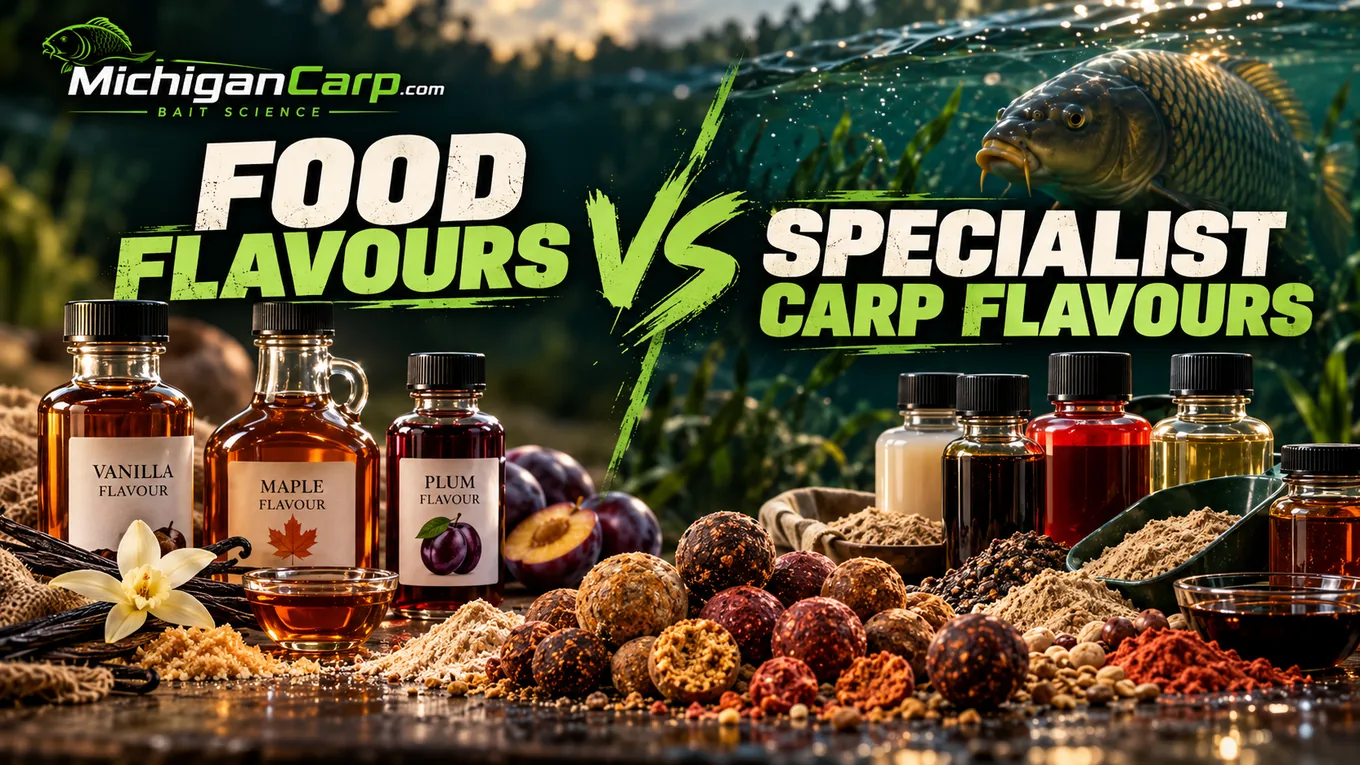
My Experience With Food-Industry Carp Bait Flavors
I have used both categories successfully. My proven Plum, Scopex and Vanilla boilie combines CC Moore Plum and Scopex with LorAnn Vanilla, and I’ve caught plenty of carp using LorAnn Maple. Those results make me entirely comfortable considering suitable food-industry flavours when developing bait.
But I am not claiming the LorAnn products alone caused the catches, that they are universally better than carp-branded products, or that the same base mix would not have caught without them. They show that good results are possible using such products. That is useful practical experience, not a controlled head-to-head flavour trial.
LorAnn’s Super-Strength range and its bakery emulsions also need to be distinguished. LorAnn describes Super-Strength flavours as generally three to four times stronger than ordinary alcohol-based baking extracts, not than specialist carp essences. Its bakery emulsions are water-based products designed for baking applications and described as comparable in intended-use strength to ordinary extracts. An emulsion should not be substituted millilitre for millilitre for a highly concentrated flavour without checking the exact product.
How I judge a specialist product
I want the product to have an identifiable purpose. Is it intended to provide a particular aroma profile, help with manufacturing consistency, survive a processing method or contribute particular substances that could alter feeding responses? Are the carrier and recommended inclusion explained? Is there sensible information about storage and compatibility?
Manufacturer experience is worth respecting, but extraordinary claims deserve corresponding evidence. If the seller says a product is exceptionally attractive, I’d like to know whether that conclusion came from detection tests, feeding-acceptance experiments, repeated field comparisons or simply successful catches on finished baits. Those are different kinds of information, and it does manufacturers no disservice to say so.
Part Five: Behind the Bottle — Who Really Makes Carp Flavours?
Who Actually Manufactures Carp Bait Flavors?
Not every company selling a carp flavour manufactures every original concentrate itself. Professional flavour houses develop flavours for food businesses and other customers, and some also offer bespoke formulations, matching and private-label supply. This is a normal commercial arrangement, not a reason to doubt the quality of a product.
A specialist bait maker may select ingredients, specify a profile, modify a blend or commission original work without owning a large flavour-production facility. Those activities can require real expertise. Owning the equipment that produces the finished liquid is not the same as possessing the knowledge to develop it.
Could Two Brands Use Related Carp Bait Flavors?
It is possible for a flavour house to supply related ingredients or standard concentrates to different customers. One customer might use an existing formulation; another could modify its concentration, carrier or supporting components. They may end up with products that share a starting point but are not identical.
We should be equally clear about what this does not prove. Similar aromas, matching carrier information or a shared supplier don’t establish that two named brands sell the same flavour. I would not make that accusation without proper documentation. The worthwhile question is whether a particular modification improves the finished product’s usefulness or the carp’s response—not whether outsourcing manufacture is somehow improper.
BaitPro provides a straightforward public example. The US company states that it blends carp flavours using concentrates sourced from Europe with its own proprietary flavour base. UK Flavour also openly advertises bespoke formulation and white-label work. Those disclosures demonstrate how this kind of supply chain can operate. Neither tells us that two unrelated carp brands are selling identical liquids.
Credit to the bait makers who understand their products
I’ve used products from Sam Barley’s OptiBaits with excellent results and would have no hesitation in using them again. Sam has also discussed flavour development and the use of professional flavour-house expertise. I regard that as an example of specialist knowledge working alongside commercial manufacturing, not something to criticise.
Sam also hosts the excellent Carp Chronicles Podcast. I highly recommend it to anyone genuinely interested in bait making, ingredients, nutrition and the reasoning behind carp feeding. The longer conversations give knowledgeable anglers and bait makers room to explain their ideas properly. I think Sam deserves credit for making those discussions accessible, even when listeners may reasonably disagree on particular bait theories.
What are we paying for?
The price of a specialist flavour can reflect formulation time, raw materials, quality control, packaging, distribution and technical guidance, not simply the cost of the aroma concentrate. That is why expensive carp bait flavors should be judged on their benefits and not just the label. Some of those services may be valuable. But price alone cannot establish that a finished bait will catch more fish.
For me, a fair assessment of carp bait flavors credits genuine development work while asking for proportional claims. A manufacturer should not have to reveal every proprietary ingredient. Equally, anglers should be free to question whether a premium price buys improved performance or merely a more persuasive description. Judge the product and the evidence, not the person behind the brand.
Part Six: Some Baits Catch the Angler Before the Fish
There is something wonderfully immediate about opening a good flavour. When anglers compare carp bait flavors, that first impression can be persuasive without telling us much about fish response. You can recognise a rich fruit note, a creamy profile or an intense spice blend without any explanation. If the smell appeals to you, it’s natural to form a positive expectation about the bait. That reaction makes aroma a powerful way to market a product.
The problem is that what our nose tells us has not been validated as a measurement of underwater attraction. A bottle that fills the kitchen with Strawberry is demonstrating airborne volatility and human sensory intensity. It is not demonstrating how the flavour behaves in a dried 24 mm boilie after eight hours on the bottom. Nor is it demonstrating whether a carp is more likely to consume that bait.
I think it’s reasonable to ask whether some products are developed partly for their ability to impress the purchaser. That’s not the same as accusing a manufacturer of deliberately making ineffective bait. A product can smell impressive to us and work perfectly well for carp. We simply shouldn’t use the first fact as proof of the second.
Confidence can improve the angler’s fishing without proving the flavour works
Suppose an angler buys an expensive flavour, loves its aroma and becomes very confident in the resulting boilies. He may fish them more patiently, put more care into the rig and stop changing bait every time he has a blank. He catches several good carp and concludes the flavour has made the difference.
It might have contributed. But it is also possible that confidence improved the angler’s decisions, or that location and timing were far more important. The fish he caught are real. The explanation attached to those catches is less certain. We needn’t belittle personal results to recognise that limitation.
The opposite can also happen. A bait made from excellent food ingredients may lack a spectacular aroma and consequently receive little confidence. It may be discarded before it has been given a fair trial. I would rather know that a bait is well made and suitably presented than be persuaded by smell alone.
Recognisable does not automatically mean preferable
Flavour can provide a repeatable chemical identity. That may help an angler make consistent batches and could become relevant if carp associate a particular food with previous positive feeding experiences. But it would be a mistake to claim that a carp recognises commercial Strawberry in precisely the way a person does, or that repeated exposure to any flavour necessarily makes it more attractive.
The fish encounters the complete boilie: texture, soluble ingredients, nutritional fractions and the added flavour together. If that bait works repeatedly, the consistency may be valuable. It is still difficult to assign all of the credit to the commercial flavour.
Part Seven: Carp Bait Flavors, High-Attract Claims and Dosage
What Does “High Attract” Mean for Carp Bait Flavors?
The description appears everywhere in discussions of carp bait flavors, yet it can mean several very different things. One product may contain concentrated aroma compounds. Another may contain soluble food extracts, selected amino acids or a highly coloured liquid. A third may simply be designed for use on a single hookbait. These are not equivalent properties, and “high attract” is not a universal scientific unit.
A claim might be useful if the manufacturer explains what has been measured. Does the product cause fish to detect a signal sooner? Does it increase investigation? Are baits retained for longer, or eaten more often? Was the conclusion drawn from repeated catches with an appropriate comparison? Without that information, high attract is mainly a product description.
It isn’t necessary to dismiss the term or the company using it. There may be sound formulation reasons for a product. But if we are going to pay extra for increased feeding response, the evidence should relate to feeding rather than the marketing language.
Does doubling the flavour mean doubling the attraction?
There is no dependable reason to think so. Controlled fish taste research shows that the response to some individual substances changes with concentration. In some situations, increasing concentration can have little additional effect or even make an item less acceptable. Commercial flavours, however, are complicated mixtures, and those experiments don’t provide a universal ideal dosage for Plum, Scopex or Maple.
When an angler doubles a liquid flavour, several variables may change at once. This is one reason comparisons between carp bait flavors must account for more than the name on the bottle. The aroma components increase, but so can the carrier volume, acidity and other formulation contributions. Paste hydration, texture and the finished bait’s release behaviour may also change. If the result is different, which factor was responsible? Without controlled comparisons, we don’t know.
Nor would I assert that every strongly flavoured boilie repels carp. That’s too sweeping. Some high inclusion levels may be effective for particular products and situations. The sensible starting point is product-specific guidance, accurate measurement and a consistent recipe—not the assumption that more must always be better.
Is there a cost to the “just add a bit more” approach?
Yes, even if the fish response is neutral. It becomes more expensive to manufacture each kilogram of bait, and the formula becomes harder to reproduce. If several individually dosed flavours are combined at their maximum suggested levels, the total carrier and flavour load can rise considerably. The resulting boilie may be different from what the angler intended, even before it enters the water.
I don’t want to use as little flavour as possible merely for the sake of minimalism. I want each quantity to have a reason. An established recipe deserves a fair test before it is altered simply because a stronger product or another additive has come onto the market.
Part Eight: Are Flavour Combinations Better Than Single Flavours?
Complexity can be useful without being synergistic
When combining carp bait flavors, a good mixture may provide a distinctive, consistent bait. My Plum, Scopex and LorAnn Vanilla system is a practical example of something that has worked for me. But success with the complete combination doesn’t prove that all three components are individually necessary, or that adding them together creates a biologically stronger response than any single flavour.
Anglers sometimes use the word synergy as though it means “two things that smell good together”. Scientifically, synergy is a stronger claim: the combined effect exceeds what would be expected from the individual effects. To establish that, we need suitable comparisons rather than confidence in a well-liked aroma.
A 2013 study by Wood and Arce Azócar examined the responses of common carp to different concentrations of the amino acids L-cysteine and L-proline. L-cysteine was more stimulatory under the experimental conditions, but combining the two did not produce the synergy being investigated. That is a useful warning against assuming that combining two individually active substances must improve the response.
Mixtures can still produce genuine attraction
Another experiment provides an important counterbalance for how we think about mixtures used in carp bait flavors. In 1990, Saglio, Fauconneau and Blanc examined how juvenile carp responded to a Tubifex worm extract and carefully prepared amino-acid mixtures. The natural extract produced measurable attraction, and a mixture of synthetic amino acids found in the extract could also influence attraction and exploratory behaviour. Some combinations were more effective than others.
That does not contradict the 2013 result. The studies used different compounds and methods, and they measured particular responses. The practical lesson is that the effect of a mixture depends on its components, proportions, concentration and the response being measured. It cannot be predicted merely from how impressive the recipe sounds.
We must also avoid extending either experiment into a claim about commercial fruit flavours. Amino-acid experiments are not direct trials of Plum and Scopex. Their value is in teaching us to test combinations rather than assume the answer.
My preference: each ingredient earns its place
I don’t object to a complex formula when there’s a reason for it. But I do object to complexity used as a substitute for understanding. Adding three excellent flavours at full dose doesn’t guarantee an excellent boilie. If anything, it can make it harder to identify what is helping or hindering.
If I wanted to investigate my proven combination, I would retain the original as a control and make planned variations rather than arbitrarily remove half the ingredients in one batch and add new ones in another. A successful recipe is useful because it provides a baseline. We should learn from it instead of constantly reinventing it.
Part Nine: Natural Food Extracts Versus Flavours That Imitate Food
A liver aroma is not a liver hydrolysate
This is a distinction worth making clearly, because the terminology used in bait catalogues can blur it. A formulated Liver essence may aim to reproduce recognisable savoury aroma characteristics. A genuine liver hydrolysate can provide a mixture of protein-derived fragments, peptides and free amino acids, depending on how it was produced. The two materials may have very different physical, chemical and nutritional roles.
The same question arises with yeast. A yeast-flavoured liquid isn’t necessarily comparable to autolysed yeast extract. A creamy flavour is not equivalent to casein, whey or milk powder. A fish- or shellfish-named flavour should not automatically be treated as a source of marine protein-derived compounds.
This does not make the food extract universally better. Real extracts vary in quality, concentration, processing and composition. Some can introduce bitterness, salt or storage problems when used badly. The right question is what the particular material contributes and whether that contribution is useful in the finished bait.
The natural-food evidence is interesting but limited
The Tubifex experiment illustrates why actual chemical composition matters. The researchers found that parts of a natural food extract, and a carefully chosen synthetic amino-acid mixture, could affect carp behaviour. That suggests specific waterborne constituents may matter more than whether the bottle has a convincing worm illustration or a familiar food name.
It does not establish that the synthetic mixture recreated every property of the whole worm extract. It also does not demonstrate that a commercial Bloodworm aroma contains an equivalent set of compounds. We should avoid both exaggerations.
When I formulate a food bait, I prefer to know whether an ingredient primarily provides nutrition, structure, soluble food fractions, aroma or a mixture of these. That framework is more useful than calling everything an attractant and adding it on faith. For a fuller technical explanation, see Proteins, Peptides and Hydrolysates in Carp Bait.
Part Ten: Seasonal Carp Bait Flavors — Fruit in Summer, Spice in Winter?
Why Summer Carp Bait Flavors Are Often Fruity
This is one of the most enduring beliefs in bait making. Seasonal advice about carp bait flavors frequently begins with the claim that fruit is for summer and spice is for winter. As the weather warms, Strawberry, Pineapple, Peach and Tutti Frutti are recommended. When temperatures fall, the advice often shifts towards spice, Garlic, Liver or another savoury profile. I understand how these reputations develop. Anglers remember catching well on a particular bait, begin using it at the same time each year and gradually regard the flavour as a seasonal essential.
But what is the biological explanation? We know that the environment changes dramatically through the seasons. Water temperature influences carp physiology, activity and the rate of many processes. Natural food availability changes, along with vegetation, invertebrate activity and the places where fish can feed. Spawning can interrupt and then alter feeding patterns. In summer, oxygen availability may become a constraint during certain weather conditions. None of these changes establishes that carp start preferring fruit-named aroma mixtures merely because it is July.
Imagine an angler who uses Strawberry every June, pre-baits confidently and fishes areas where carp are feeding. After several successful summers, he has genuine evidence that his complete Strawberry bait works. What he doesn’t have is evidence that Strawberry would outperform a suitable Plum, Cream or unflavoured version of the same recipe under comparable conditions. The association could reflect the fish’s seasonal activity, the angler’s consistent tactics or a genuinely useful flavour characteristic. Without controls, all remain possible.
What does temperature do to flavour release?
Warmer water can alter diffusion, viscosity, solubility and other physical properties relevant to the movement of particular substances. The effect depends on each compound and the complete bait matrix. A water-compatible substance may behave differently from an oil-associated component, and a large, dense boilie can release material differently from a softer, smaller bait.
Even if a particular fruit flavour becomes more readily available in warmer water, that would not prove carp prefer it. Greater release is not equivalent to greater feeding acceptance. Nor would the physics apply only to ingredients with fruit names. Spice, savoury and food-derived substances are also affected by temperature-dependent processes.
There is also the problem of our own seasonal expectations. Strawberries and peaches are summer foods to humans. A carp doesn’t necessarily interpret a formulated Strawberry flavour as the fruit we imagine. The components may simply be detected as chemicals, with no meaningful relation to the season in which people eat strawberries.
What published research tells us about seasonal preference
A 2019 review by Alexander Kasumyan examined the effects of environmental variables on fish taste systems. Temperature has important biological effects, but taste preferences for many tested substances may remain relatively stable despite environmental changes. That is a useful caution, not proof that conditions never affect preference. Crucially, it does not support turning familiar commercial flavour categories into fixed seasonal rules.
The 2024 wild common-carp study on the Akhtuba River is also relevant. Researchers compared several boilies carrying Strawberry, Plum, Tutti Frutti, Sweet Corn and Mussel flavours under natural fishing conditions. Their relative success changed across the study period. Mussel performed relatively well early in the experiment; Sweet Corn became more successful later. Fruit flavours did not simply dominate throughout the summer.
This experiment took place at one river site under particular groundbaiting and fishing arrangements. It cannot settle which flavour is best in every lake or river. But it makes the familiar “fruit equals summer” rule difficult to defend as a general scientific conclusion.
Are Savoury Carp Bait Flavors Better in Winter?
I would apply the same scrutiny to the winter rule. Some anglers have tremendous confidence in Garlic, Black Pepper or savoury ingredients when the water cools, and they may have excellent catches to support that confidence. But does the flavour family itself explain the result? We don’t know that from the catches alone.
Cold water changes carp activity and the physical behaviour of particular compounds. A carrier may become more viscous, a bait may release material differently, and a fish’s feeding opportunities may change. Those are relevant considerations. But they don’t establish an automatic winter preference for spice aromas. A well-made Plum or Vanilla bait may remain effective in cold water, and a spicy bait may catch extremely well in summer.
If carp have been feeding confidently on a bait during autumn, I wouldn’t change its flavour merely because the calendar has moved into November. My first concerns would be where the fish are, how actively they’re feeding and whether I need to reduce the amount of free food. A reliable bait gives me fewer variables to worry about at a difficult time of year.
My conclusion is straightforward: fruit flavours can work very well in summer, and spice flavours can work very well in winter. What is not established is that these flavour categories are inherently superior because of the season.
Part Eleven: Do Certain Flavours Catch Bigger Carp?
A memorable capture is not a controlled test
This claim appeals to specimen anglers. A particular flavour becomes associated with several very large fish, and eventually people describe it as a big-carp attractant. I understand the appeal. When I’m pursuing a fish that may exceed my personal best, I want every part of the presentation to give me confidence.
But a 40 or 50 lb carp caught on a given bait doesn’t establish that the flavour selected a larger individual. The fish may have been the largest resident in the area or the one that happened to feed at the right time. Hookbait size, feeding location, fish population, rig behaviour and chance all matter. If the same bait caught smaller fish as well, the interpretation becomes even more complicated.
To demonstrate genuine size selection, researchers would need appropriate comparisons of otherwise similar baits across sufficient numbers of fish. The 2024 wild-carp study did not establish a convincing difference in the weights of fish caught on the different flavoured boilies. That’s not proof that selective flavour effects can never exist; it is a reason not to advertise a universal big-fish flavour on the strength of a few memorable catches.
For my own big-fish fishing, location, food acceptance, reliable bait mechanics and appropriate presentation are far more persuasive than the name on a flavour bottle. A flavour may contribute, but it shouldn’t become a substitute for watercraft.
Does familiarity make a flavour more effective?
Carp behaviour can be influenced by feeding experience, and an accepted food may carry recognisable chemical and physical cues. But learned recognition of a complete boilie is not necessarily recognition of its commercial flavour alone. The fish encounters a mixture of food-derived compounds, texture and the added liquid.
A bait that has been used successfully for months may therefore possess practical advantages linked to consistency or previous feeding. Equally, a new flavour could work immediately under favourable conditions. I wouldn’t claim that repeated exposure always produces greater attraction, and I wouldn’t keep changing a proven bait simply to create novelty. The more variables we change, the less we learn about the fish’s response to any single ingredient.
Part Twelve: Does Flavour Improve the Finished Boilie After Hours Underwater?
The most impressive stage may be the least relevant
We normally judge a flavour at its strongest: in an open bottle or fresh paste. Yet a hookbait may be on the bottom for six, twelve or more hours. By then the composition and quantity of material entering the water may have changed. A product that produces an immediate strong aroma to us may contribute relatively little additional detectable material later. Another may release particular components more gradually.
The finished bait’s physical design matters. Water must enter the boilie, interact with its ingredients and allow suitable material to leave. Cooking and drying can alter the surface and interior. Fat content and binding materials can influence the movement of certain compounds. An identical flavour could therefore behave differently in two very different recipes.
This is why claims about release or attraction should ideally refer to finished baits in realistic conditions, not just a manufacturer’s liquid tested by itself. We can perform useful home observations of texture, softening and durability after immersion, but visual clouds, oil slicks or detectable human smells don’t prove improved feeding.
A boilie does not have to dissolve to work
A durable bait can still release some water-compatible substances. Conversely, a bait that breaks apart spectacularly might mainly be releasing particles rather than a strong dissolved food signal. A vigorous cloud may look persuasive on camera yet tell us very little about whether carp will prefer the bait.
This distinction is especially useful when comparing a large food boilie with a small, highly treated hookbait. They may have different jobs and useful fishing lives. I don’t see a reason to rank them simply by the speed at which they break down. The better question remains: what useful response is the bait intended to produce, and what evidence have we got that it does so?
Part Thirteen: Testing Carp Bait Flavors Without Fooling Ourselves
Start with a dependable reference recipe
An experimental comparison is most informative when the base mix already works reliably. The ingredients, bait size, cooking procedure, drying and storage should be kept as consistent as practical. Otherwise, a new flavour may be introduced at the same time as changes to protein, egg quantity, texture and bait hardness, leaving us with no way to explain the result.
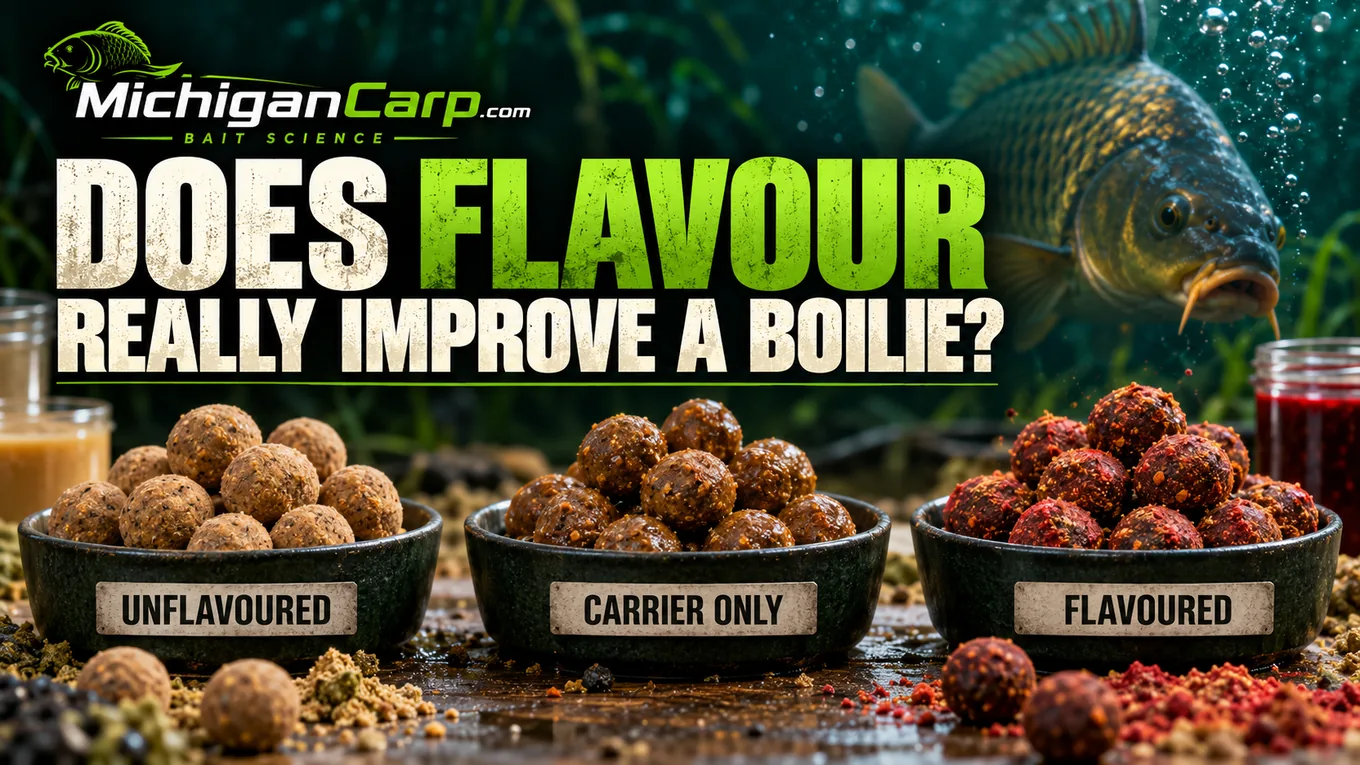
The simplest starting comparison for carp bait flavors is an established flavoured boilie against the same recipe without added commercial flavour. That is far more informative than comparing open bottles because it helps establish whether adding the complete flavour product improves fishing performance under the conditions tested. It still doesn’t tell us which ingredient within the liquid caused any difference.
What about the flavour carrier?
Many commercial flavours contain carrier liquids such as propylene glycol, water, alcohol or glycerin. An otherwise identical unflavoured batch will not receive those extra materials. If the flavoured bait performs differently, the carrier may be part of the explanation. The added liquid may influence paste consistency or the availability of particular compounds, as well as aroma.
A suitable carrier-only treatment can sometimes help. But proprietary formulations are not always fully disclosed, and matching one commercial flavour’s complete non-aroma composition may be impossible. We should not pretend that an approximate PG-only control reproduces everything else in a complex product.
For practical purposes, testing whether a whole flavour product improves your boilie is worthwhile. Testing whether its aroma molecules alone were responsible is a more ambitious scientific question. It’s important to distinguish the two when reporting results.
One session isn’t enough
Suppose a new batch catches three carp in its first night. That’s encouraging, but we need to ask how many would have been caught on the control. Perhaps feeding conditions had improved, the fish had moved onto the area or the rigs were simply presented better. Repeated tests, sensible rotation and records of blank sessions all help reduce the influence of those explanations.
Even after careful field testing, uncertainty may remain. Carp fishing is not a laboratory. Bait treatments should be rotated between suitable opportunities rather than always assigning the favourite flavour to the best rod. If one bait repeatedly outperforms its control under reasonably similar conditions, that is useful practical evidence. But it still needs proportionate interpretation.
I also think the temptation to change several ingredients at once is one of the biggest obstacles to learning. When something catches, we want to make it even better. Another bottle goes in, the mix changes and soon the original reliable formula has disappeared. A well-documented control is valuable precisely because it stops us drifting in circles.
A future Plum comparison
I am interested in comparing a food-industry Plum with a specialist carp Plum, but that belongs in its own article once real testing has taken place. Matching the volume of the two products would not necessarily be fair because their concentrations and carriers may differ. Product-specific information and clear comparisons will matter.
Until those tests have been completed, I’m not going to invent results or claim that one category wins. The value will lie in conducting the comparison honestly, including the possibility that the difference is small or impossible to establish from a reasonable number of fishing sessions.
Part Fourteen: Are Expensive Carp Bait Flavors Worth Their Money?
Bottle price and cost per kilogram are not the same thing
A small bottle from a specialist supplier may appear expensive compared with a food flavour, but the correct calculation considers the justified inclusion per kilogram of mix. One concentrate might require far less liquid than another. Some products may be sold in different carrier strengths, and a high price may include formulation work, packaging or technical support.
Those factors can all affect value. But they do not make price a measure of attraction. If the more expensive product performs meaningfully better in a particular bait, the extra cost may be justified. If results are indistinguishable, I would question whether I’m paying for something useful. The comparison can only be as good as the product details and the testing.
This is not an argument for buying the cheapest ingredients regardless of quality. In fact, my belief in a good base mix points in the opposite direction. I’d rather spend money deliberately on reliable ingredients with known roles than on a collection of liquids whose individual contributions I cannot explain.
What I would like manufacturers to explain
I don’t expect a company to give away its proprietary formula. But a sensible description of the carrier, intended use, application rate, storage requirements and practical limitations helps an angler make an informed decision. If a supplier claims exceptional feeding stimulation, I would like to understand whether that claim is based on laboratory feeding behaviour, repeated field comparisons or general experience with successful catches.
A manufacturer’s catches and history are relevant, but a photograph cannot isolate the flavour effect. Independent evidence is stronger when it controls plausible alternative explanations. We can respect the people involved while acknowledging the limits of what their promotional material demonstrates.
What should a new bait maker spend money on first?
I would put sound ingredients, consistent processing, reliable rigs and time spent learning the water ahead of buying half a dozen fashionable bottles. A good flavour may be worthwhile, but it cannot locate the carp, repair a poor rig or compensate for introducing too much food into a swim where the fish are not feeding.
A simpler bait that you understand, can reproduce and can afford to use properly may teach you considerably more than an ever-changing mixture of supposedly exceptional components.
Part Fifteen: My Own Approach — Keep the Bait Understandable
Over the years I’ve become less interested in impressive lists of ingredients and more interested in what each component does. I don’t add something merely because it sounds scientific, carries a famous name or promises instant attraction. A nutritional ingredient must justify its place. So must a processing aid, a preservative or a liquid flavour.
My Plum, Scopex and LorAnn Vanilla combination has proved itself in my fishing. LorAnn Maple has also given me plenty of carp. I am happy to keep using flavours with records like those. But I do not pretend their success is evidence that the same base mixes without flavour would have failed. If anything, that is one of the questions I’m most interested in examining properly.
I also don’t believe that trying every newly promoted flavour is a sensible way to improve a successful boilie. When a bait works, changing it continually throws away much of what we’ve learned. There may be excellent reasons for a particular adjustment, but we should know what problem we’re trying to solve.
That brings me back to the old principle I’ve believed for so long: a good food base mix should be capable of catching carp without added commercial flavour. That isn’t a guarantee of catches, and it isn’t an assertion that flavour can never help. It’s a practical standard for designing bait on sound foundations.
I want to know what a flavour contributes to an already decent boilie. If the answer is a repeatable improvement in a useful response, I’ll gladly use it. If the answer is merely that the kitchen smells stronger and the ingredient list looks more impressive, I’m much less interested.
Conclusion: The Best Smell in the Bottle Is Not Necessarily the Best Bait
Commercial flavours are legitimate tools. The argument about carp bait flavors is not that every bottle is ineffective, but that every added ingredient should have a purpose. We should ask what a liquid contributes rather than assume that every bottle is essential. The argument about carp bait flavors is not that every bottle is ineffective, but that every added ingredient should have a purpose. Some may complement a food bait, support a recognisable profile or offer useful processing characteristics. Specialist formulators can bring real expertise, and ordinary food-industry flavours can also form part of successful boilies. It doesn’t follow that one category is universally superior.
The research gives us good reasons to separate detection from acceptance, to question unlimited dosing and to avoid assuming that combinations always provide synergy. It also gives us reasons to remain curious. Fish chemistry and behaviour are complicated, and many commercial claims have simply not been tested under controlled conditions.
None of that requires us to attack manufacturers or belittle good anglers. It requires us to say what the evidence supports, what the fishing experience shows and what remains uncertain. A successful catch is worth celebrating, but it isn’t an experiment isolating a single ingredient.
So when somebody produces a spectacular bottle and says, “Here, smell this!”, by all means enjoy the aroma. But ask another question before you pour it into the eggs: What job is this flavour supposed to do, and how would we know if it improved the finished bait?
You can’t dress mutton as lamb. Start with a properly formulated base mix. Make it well, fish it confidently, and change things only when there’s a worthwhile reason. If additional flavour genuinely improves it, that’s a good result. If it doesn’t, perhaps the best improvement is to leave the recipe alone.
Frequently Asked Questions About Carp Bait Flavors
Are specialist carp flavours better than ordinary food flavours?
Not automatically. A specialist product may offer a useful formulation advantage, but the label is not independent evidence of better feeding. Compare actual products, their carriers, intended application, appropriate dose and whatever reliable performance evidence is available.
Can a good boilie catch carp without commercial flavour?
Yes. A good food base mix can contain detectable substances from its own ingredients, and adding commercial flavour is not a prerequisite for carp to eat it. That doesn’t establish that added flavour can never improve a particular bait.
Do stronger-smelling carp bait flavors catch more fish?
There is no sound universal reason to believe that. Smell intensity to humans measures a different sensory experience from chemical release and detection in water. A highly aromatic bottle isn’t evidence of superior food acceptance.
Can LorAnn Food Flavours Work in Carp Boilies?
Some LorAnn products have properties that make them reasonable candidates for careful evaluation, and I’ve personally used LorAnn Vanilla and Maple in successful carp baits. Check the individual formulation, carrier and suitability; do not assume everything sold under the brand is interchangeable.
Are LorAnn bakery emulsions the same as Super-Strength flavours?
No. Their composition and intended food applications differ. LorAnn describes Super-Strength products as concentrated compared with ordinary baking extracts, while its bakery emulsions are water-based products whose typical intended-use strength is comparable to ordinary extracts.
Do more ingredients or multiple flavours create more attraction?
Not necessarily. Some mixtures can influence carp behaviour, but experimentally demonstrated synergy cannot be assumed. Complexity can make a recipe harder to evaluate and reproduce, even when the finished bait works well.
Can too much flavour discourage carp?
Some substances can reduce food acceptance at particular concentrations, but there is no single universal overdose threshold for all commercial flavour mixtures. Measured, product-specific use is more sensible than arbitrary overdosing.
Are fruity flavours better in summer and spices better in winter?
Those are long-standing angling traditions, not established universal taste preferences in common carp. Temperature and seasonal conditions certainly affect fishing, but the flavour name alone doesn’t demonstrate which bait will be preferred.
Do certain flavours selectively catch bigger carp?
There is insufficient evidence for a general rule. Large carp caught on a particular flavour demonstrate successful captures, not necessarily selective attraction caused by that flavour.
Are natural flavours always safer or more effective?
No. Natural origin is not a guarantee of fish attraction or unrestricted aquatic safety. Individual substances, their concentration and the intended use need to be assessed.
Do carp brands manufacture every concentrate themselves?
Not necessarily. Some businesses formulate, commission, source or blend products using professional flavour houses. This is normal commercial practice and does not imply lack of originality or expertise. A shared supplier is not proof of identical finished products.
Why use an unflavoured or carrier-only control?
An unflavoured control can help establish whether adding the complete flavour product makes a useful difference. A suitably matched carrier-only control may help investigate whether non-aroma ingredients contribute to the observed effect, although proprietary mixtures make perfect controls difficult.
How Much Commercial Flavour Should I Use per Kilogram?
There is no universal answer. Start with guidance for the exact product, account for the entire liquid phase and avoid copying a dosage from a different formulation. My practical guide on how to flavour boilies covers the mixing and processing considerations in detail.
What is the simplest rule for carp bait flavors?
Start with a sound, repeatable base mix. Know what job the added flavour is intended to do, and assess whether it improves the finished bait rather than simply the smell of the mixing bowl.
Next Steps and Further Reading
If this article has made you question one or two long-standing assumptions about flavour, that’s useful. The next step isn’t to throw away every liquid you’ve ever used. It’s to understand the complete bait, select ingredients purposefully and test changes against something that already works.
Continue with MichiganCarp.com Bait Science
How to Formulate a Milk, Nut and Birdfood Boilie Base Mix — Start here if you want the nutritional and structural foundation of a food boilie before adding commercial flavours.
Milk, Nut and Birdfood Boilies for Michigan Carp — The complete food-bait philosophy behind my preferred non-marine milk, nut and birdfood direction.
How to Flavor Boilies Properly — The practical treatment of product strength, carriers, dosage, layering, cooking and drying. The scientific questions in this article complement rather than replace it.
Carp Feeding Attractants Explained — Understand the differences between release, detection, taste, investigation and feeding acceptance.
Carp Bait Solubility and Leakage — Explore water entry, dissolved signals, physical breakdown and what actually escapes from a finished bait.
Proteins, Peptides and Hydrolysates in Carp Bait — Distinguish nutritional proteins, protein-derived fractions and individual amino acids without giving them magical properties.
How to Boil and Dry Boilies Properly — Make the complete bait consistently, with appropriate attention to structure, processing and testing.
For all related ingredient and bait-science guides, visit the MichiganCarp.com Bait Science Hub.
Scientific Research Behind This Article
These papers and reviews provide the main research context. They investigate fish chemoreception, isolated compounds, feeding acceptance and field catch differences. None by itself establishes a universal best commercial boilie flavour.
Kasumyan and Morsi (1996): Taste Sensitivity of Common Carp to Free Amino Acids and Classical Taste Substances — Controlled juvenile common-carp taste responses, including favourable, neutral and unfavourable compounds.
Saglio, Fauconneau and Blanc (1990): Orientation of Carp to Free Amino Acids from Tubifex Extract — Natural food extract and selected synthetic amino-acid mixtures in an olfactometer.
Kasumyan and Døving (2003): Taste Preferences in Fishes — A major review of fish gustatory biology.
Wood and Arce Azócar (2013): Gustatory Response of Common Carp to Variable Concentrations of Two Stimulatory Amino Acids — Concentration effects and the absence of demonstrated synergy between the two compounds tested.
Kasumyan (2019): The Taste System in Fishes and the Effects of Environmental Variables — Useful context for temperature, environmental conditions and fish taste.
Kasumyan, Kuzishchin and Gruzdeva (2024): Evaluation of Food Chemical Attractants for Wild Common Carp — A 79-day river field experiment involving several differently flavoured boilies.
Roda, Farzad and Allen (2024): A Review of Feed Attractants as a Guide for Aquaculture Operations — A technical review of feed palatability and attractant applications, with limitations when applied to wild-carp angling.
Product Manufacturers and Industry Background
The following are official manufacturer or industry information pages, not endorsements and not independent proof of particular attraction claims.
CC Moore — Carp Bait and Ingredients and CC Moore Ultra Plum Essence — Specialist product information; I use CC Moore Plum and Scopex as part of my established combination.
LorAnn — Food Flavours and LorAnn Bakery Emulsions — The company behind the Vanilla and Maple products I’ve used, with explanations of its differing flavour ranges.
OptiBaits and Carp Chronicles Podcast — Sam Barley’s bait company and the podcast I recommend for extended discussions about carp bait, angling experience and formulation.
BaitPro and UK Flavour — Examples of openly documented concentrate blending and professional custom or private-label flavour services.
When evaluating carp bait flavors, the best practical next step is simple: keep a trusted recipe, identify one worthwhile question and compare a carefully planned change. A good base mix should stand on its own merits. Add flavour when it has a purpose, not merely because the bottle smells wonderful.