

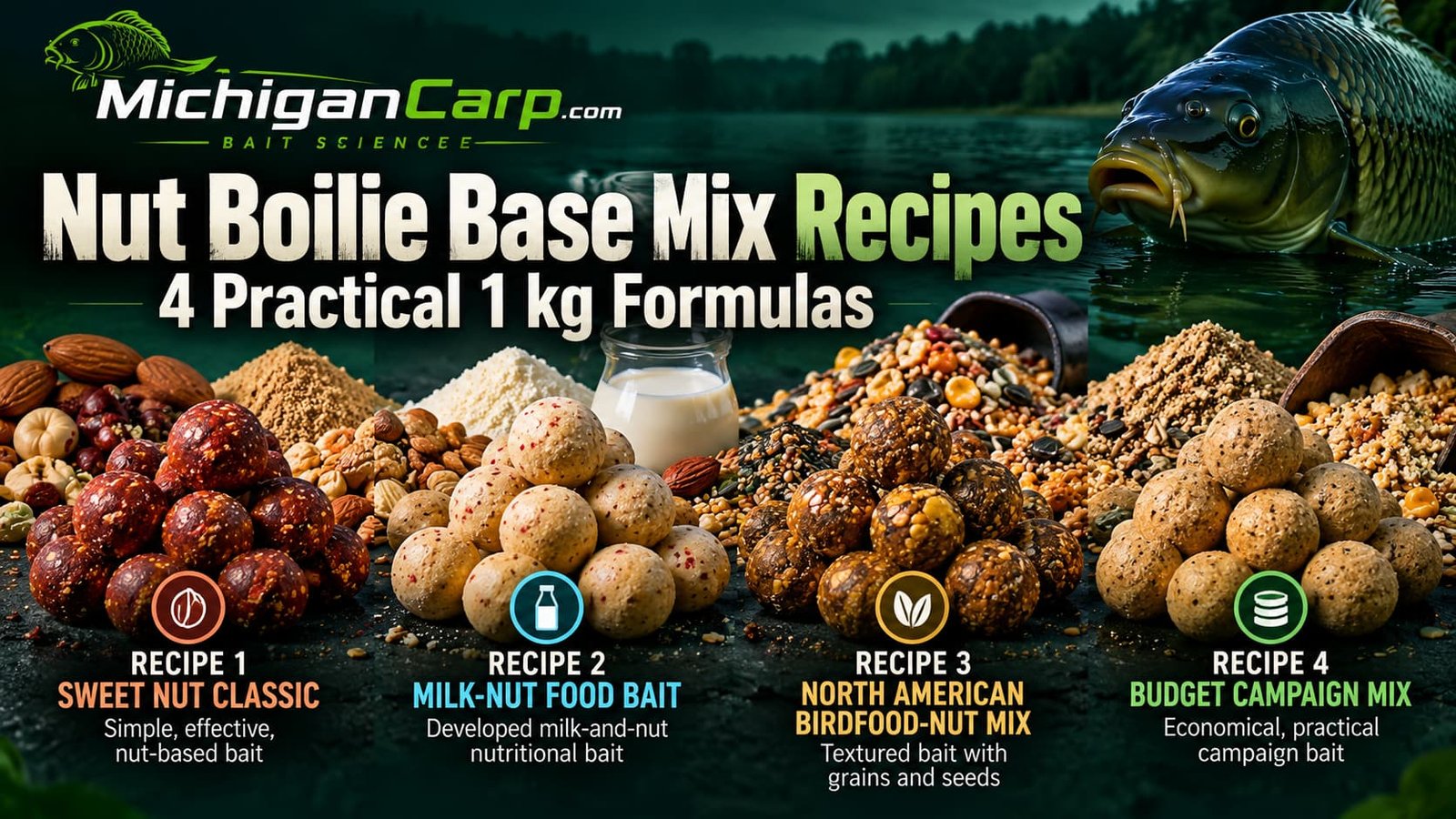
Good nut boilie base mix recipes do not need twenty specialist ingredients or enormous quantities of ground nuts.
They need structure.
They need a clear nut identity.
And they need every richer ingredient to fit inside a complete bait rather than being added simply because it sounds attractive.
This page has one practical job: give you four complete 1 kg dry base mixes that approach nut boilies in different ways.
They are not presented as four secret recipes.
They are four starting systems:
- a simple sweet-nut bait;
- a more developed milk-and-nut food bait;
- a textured birdfood-and-nut bait;
- an economical campaign mix.
If you want to understand how those sections are designed from first principles, use How to Formulate a Milk, Nut and Birdfood Boilie Base Mix.
If you want the real development history behind my proven Plum–Scopex–Vanilla direction, use Plum, Scopex and Vanilla Milk-Nut Boilie: Development and Michigan Results.
The recipes below deliberately remain recipes.
Table of Contents
Quick Start: Which Nut Boilie Recipe Should You Choose?
| Recipe | Main Character | Best Starting Use |
|---|---|---|
| Sweet Nut Classic | Simple tiger nut + peanut | Learning, testing flavours, general fishing |
| Milk-Nut Food Bait | Nut + dairy + controlled birdfood | More developed non-marine food bait |
| Birdfood Nut Mix | Nut identity + stronger texture | Particle/seed-based feeding programs |
| Budget Nut Campaign Mix | Economical nut identity | Prebaiting, multi-day sessions, larger quantities |
None is universally best.
Choose the one whose structure matches the fishing job.
The broader principle behind all four is straightforward:
Build enough structure to carry the nut ingredients, then control richness rather than trying to maximize it.
Before You Make Any of These Recipes
Three points matter before weighing ingredients.
Nut products are not interchangeable
Defatted peanut flour is not the same ingredient as finely ground whole peanut.
Full-fat ground peanut can substantially change:
- fat;
- paste softness;
- greasiness;
- drying;
- storage behaviour.
The same applies to almond products, coconut products and different tiger-nut flours.
Read the actual label.
Count the complete fat system
A bait can receive lipid from:
- full-fat soy;
- tiger-nut flour;
- peanut;
- seeds;
- prepared birdfood;
- milk replacer;
- cream powder;
- whole egg.
That is why bottled nut oil is not automatically required in a nut boilie.
Use How to Balance Fat in Boilies: Milk, Nut and Seed Mixes when developing richer versions.
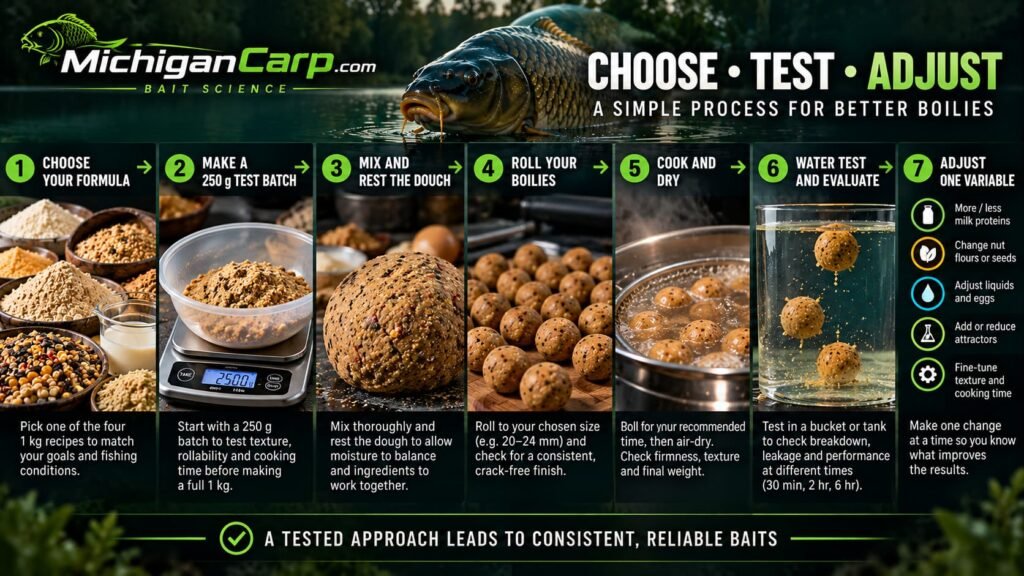
Make a test batch first
For an unfamiliar ingredient combination, make approximately 250 g of dry mix first.
To convert any recipe below into a 250 g trial, divide every ingredient amount by four.
Do not make five kilograms of a bait you have never extruded, rolled, cooked, dried or water-tested.
Recipe 1 — Sweet Nut Classic
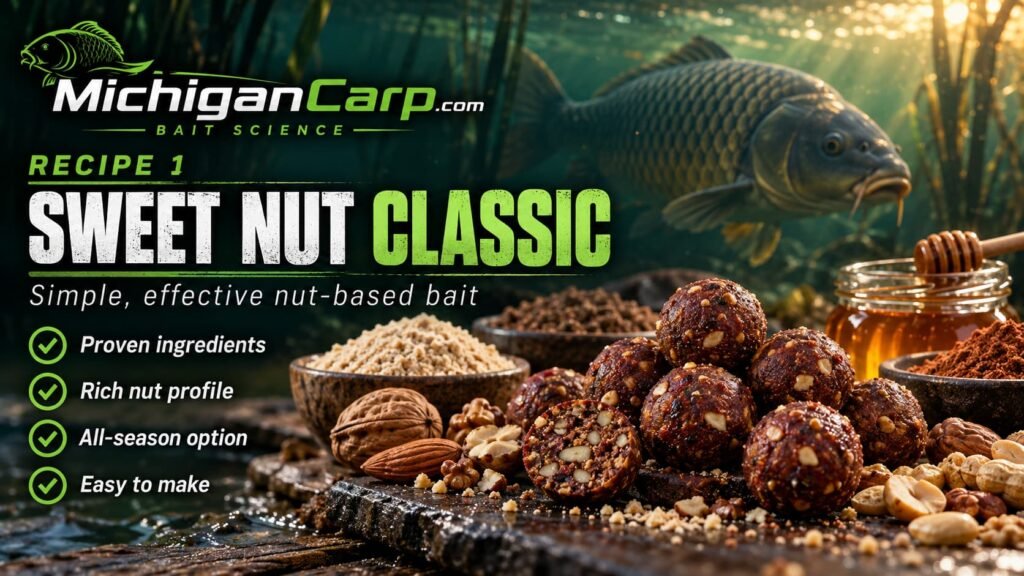
What this recipe is for
This is the simplest of the four.
It gives tiger nut and peanut a meaningful place without building a large dairy or additive system around them.
I would use it when I wanted:
- an uncomplicated nut bait;
- a base for flavour trials;
- a recipe that is easy to understand and modify;
- a general-purpose starting point.
Dry Mix — 1 kg
| Ingredient | Amount | Main Job |
|---|---|---|
| Semolina | 240 g | Rolling structure |
| Fine maize meal / cornmeal | 160 g | Cereal structure |
| Full-fat soy flour | 180 g | Protein, structure and food value |
| Tiger-nut flour | 180 g | Main nut-style identity |
| Defatted peanut flour | 120 g | Peanut character with controlled fat |
| Wheatgerm | 60 g | Food value and texture |
| Fine biscuit crumb | 40 g | Bakery background and texture |
| Egg albumen | 20 g | Additional setting strength |
| Total | 1,000 g |
The main structural chassis is 580 g.
The tiger-nut and peanut section contributes 300 g.
That gives the bait a genuine nut identity while leaving enough structural material to make it practical.
Flavour direction
This recipe can carry several profiles without needing to become complicated.
Useful starting directions include:
Maple + Vanilla
Peach + Scopex + Vanilla
Plum + Scopex + Vanilla
or a very lightly flavoured sweet-nut bait.
If using Plum–Scopex–Vanilla, do not assume this recipe is the same formula as my field-development bait. The full historical record is documented separately in Plum, Scopex and Vanilla Milk-Nut Boilie.
Recipe 2 — Milk-Nut Food Bait
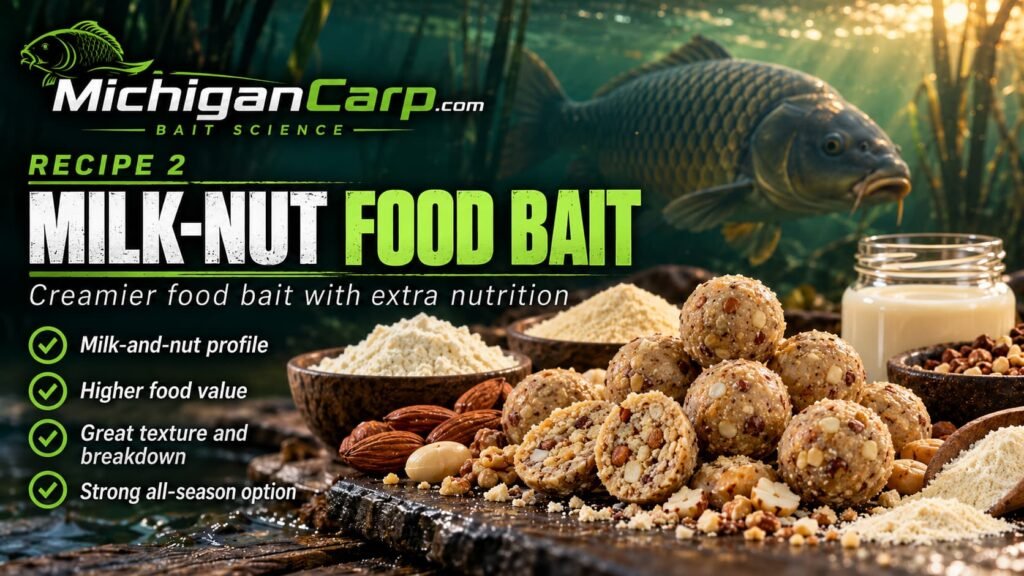
What this recipe is for
This is the most developed general food-bait formula on this page.
It combines:
- a cereal-and-soy chassis;
- tiger nut;
- peanut;
- a controlled birdfood component;
- milk replacer;
- whey protein;
- cream powder;
- lactose;
- yeast.
The objective is not maximum milk protein.
It is a balanced milk + nut + cereal + birdfood bait.
Dry Mix — 1 kg
| Ingredient | Amount | Main Job |
|---|---|---|
| Semolina | 220 g | Structural chassis |
| Fine maize meal / cornmeal | 140 g | Cereal structure |
| Full-fat soy flour | 130 g | Protein, structure and lipid |
| Tiger-nut flour | 150 g | Main nut identity |
| Defatted peanut flour | 100 g | Peanut food component |
| Prepared birdfood or house birdfood component | 80 g | Texture and ingredient diversity |
| Milk replacer | 60 g | Dairy solids; product-specific composition |
| WPC80 | 50 g | Concentrated whey protein |
| Cream powder | 25 g | Dairy richness |
| Lactose | 20 g | Dairy carbohydrate |
| Brewer’s yeast | 15 g | Food-derived yeast component |
| Egg albumen | 10 g | Setting support |
| Total | 1,000 g |
The sections break down approximately as:
| Section | Amount |
|---|---|
| Structural chassis | 490 g |
| Nut system | 250 g |
| Birdfood | 80 g |
| Dairy system | 155 g |
| Support | 25 g |
| Total | 1,000 g |
This is intentionally different from the published Plum–Scopex–Vanilla development formula.
It demonstrates a milk-nut formulation direction, not an attempt to replace the historical bait with a neater modern recipe.
Read the milk replacer label
Milk replacer is not one standardized bait ingredient.
Protein, fat, lactose and other carbohydrate sources can vary significantly between products.
Use Milk Replacer for Carp Bait: Read the Label Properly before assuming that one milk replacer can replace another gram-for-gram.
Fat warning
This recipe already receives lipid from several places, particularly:
- full-fat soy;
- tiger nut;
- milk replacer, depending on product;
- cream powder;
- birdfood;
- whole eggs in the wet phase.
My default would therefore be:
Do not automatically add bottled nut oil.
First calculate what is already there.
[IMAGE 3 — MILK-NUT RECIPE STRUCTURE
Placement: after Recipe 2 fat warning.
Show structural chassis, nut section, dairy section, birdfood and support as proportions of the 1 kg mix.]
Recipe 3 — North American Birdfood-Nut Mix
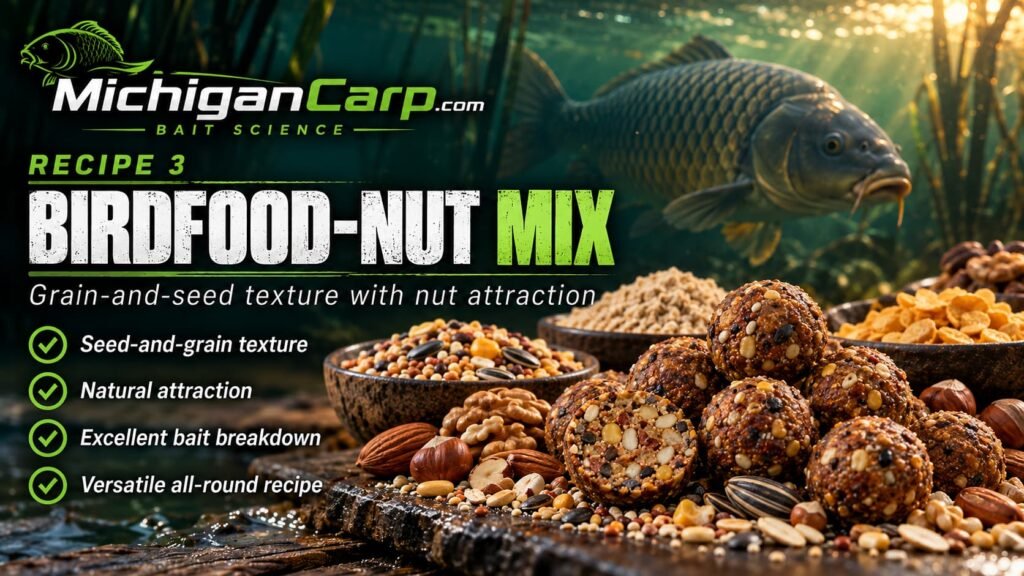
What this recipe is for
This version deliberately gives the birdfood section more importance.
It suits an angler who wants:
- more visible texture;
- a boilie that fits naturally beside particles and seed mixes;
- a less uniform flour-only structure;
- a practical route into homemade North American birdfood components.
The objective is controlled texture, not random coarseness.
Dry Mix — 1 kg
| Ingredient | Amount | Main Job |
|---|---|---|
| Semolina | 220 g | Structural chassis |
| Fine maize meal / cornmeal | 170 g | Cereal structure |
| Full-fat soy flour | 140 g | Protein and structure |
| Prepared birdfood or house birdfood component | 150 g | Texture and compound-food section |
| Tiger-nut flour | 130 g | Nut identity |
| Defatted peanut flour | 80 g | Peanut component |
| Fine biscuit crumb | 50 g | Texture and cereal background |
| Wheatgerm | 30 g | Food and physical support |
| Brewer’s yeast | 20 g | Yeast-derived food component |
| Egg albumen | 10 g | Setting support |
| Total | 1,000 g |
The structural chassis remains 530 g, so the textured ingredients are being carried by a substantial base rather than being expected to hold themselves together.
You do not need imported CLO
The 150 g birdfood slot does not have to mean imported European birdfood.
It can be a known commercial product.
Or it can be a repeatable homemade North American component.
The important requirement is that you know what is in it.
For the seven house-blend options—including balanced, cereal-and-egg, oil-rich, low-cost feed-store and leaner milk/nut versions—use Birdfood for Carp Boilies: CLO, Nectarblend, Egg Foods and DIY North American Blends.
Do not replace 150 g of compound birdfood with 150 g of random ground oily seed and expect identical behaviour.
If you want to understand individual hemp, millet, canary seed, linseed, sunflower and related ingredients, use Individual Birdseeds Explained for Boilie Making.
Recipe 4 — Budget Nut Campaign Mix

What this recipe is for
This is the formula I would look at when bait quantity and repeatability matter.
That can include:
- prebaiting;
- multi-day fishing;
- larger wild waters;
- feeding several kilograms over time;
- situations where cost per kilogram matters.
Budget does not mean removing the bait’s identity.
The recipe still contains 220 g of tiger-nut and peanut ingredients.
The difference is that more of the formula is carried by economical structural ingredients.
Dry Mix — 1 kg
| Ingredient | Amount | Main Job |
|---|---|---|
| Semolina | 280 g | Main structure |
| Fine maize meal / cornmeal | 200 g | Cereal structure and energy |
| Full-fat soy flour | 220 g | Protein, structure and food value |
| Defatted peanut flour | 130 g | Main peanut component |
| Tiger-nut flour | 90 g | Sweet nut-style identity |
| Wheatgerm | 40 g | Food and texture |
| Molasses powder | 15 g | Dark sweet food background |
| Brewer’s yeast | 15 g | Yeast food component |
| Egg albumen | 10 g | Setting support |
| Total | 1,000 g |
The main cereal-and-soy chassis accounts for 700 g.
That is deliberate.
A campaign bait has to be practical enough to make and use in quantity.
The remaining 300 g still gives the mix a defined food identity rather than reducing the formula to plain cereal with a token spoonful of tiger nut.
Which Recipe Should You Use?
| Situation | Best Starting Recipe |
|---|---|
| First homemade nut boilie | Sweet Nut Classic |
| More developed non-marine food bait | Milk-Nut Food Bait |
| Stronger texture and birdfood character | North American Birdfood-Nut Mix |
| Multi-day baiting or larger quantities | Budget Nut Campaign Mix |
| Want the proven Plum development history | Use the separate Plum–Scopex–Vanilla case study |
Do not choose Recipe 2 because it contains the most specialist ingredients.
Do not choose Recipe 4 because it is cheaper.
Choose the recipe that fits what you are actually trying to accomplish.
Building the Wet Phase
These are dry base-mix recipes.
Egg size, flour grind, milk replacer, birdfood and other product differences can all change the amount of liquid required.
For a 1 kg batch, approximately 7–8 large eggs is a practical bench starting area, but I would not treat an egg count as an exact formulation measurement.
For repeatability:
- weigh the shell-free egg mass;
- record any additional liquid separately;
- add the dry mix gradually;
- rest the paste before deciding that it needs correction.
I normally want the paste to rest approximately 10–15 minutes before making a major adjustment.
Do not force every gram of dry mix into the wet phase if the paste has already reached the correct working condition.
And do not keep adding egg simply because a rich, oily paste feels soft.
For the complete liquid-system decision process, use Boilie Liquids and Additives.
Flavouring These Four Recipes
Nut boilies do not have to taste or smell like nuts.
The dry bait provides the food identity.
The flavour layer can move in several directions.
| Direction | Fits Particularly Well With |
|---|---|
| Plum / Scopex / Vanilla | Sweet Nut, Milk-Nut |
| Peach / Scopex / Vanilla | Sweet Nut, Milk-Nut |
| Maple / Vanilla | Sweet Nut, Budget Campaign |
| Cream-led | Milk-Nut |
| Molasses / maple | Birdfood Nut, Budget Campaign |
| Light or almost unflavoured | Any of the four |
My own strongest field-confidence flavour direction is Plum–Scopex–Vanilla, but that confidence comes from repeated fishing rather than a claim that those flavour compounds are biologically superior.
Read Plum, Scopex and Vanilla Milk-Nut Boilie: Development and Michigan Results for the actual field-development record.
Do Not Confuse an Angling Bait With a Complete Aquaculture Diet
Nutrition research is useful background.
It can help us think properly about protein, lipid, carbohydrate and life-stage requirements.
But an angling boilie eaten intermittently by a wild adult carp is not the same feeding problem as a nutritionally complete production diet.
For background context, the FAO common-carp nutrient and energy table summarizes nutrient ranges used in aquaculture nutrition research.
The lesson for bait making is not to copy those percentages blindly.
It is to stop treating one headline number—especially crude protein—as the definition of a good bait.
Processing and Testing
This page deliberately does not duplicate the full rolling, boiling, drying and water-testing procedures.
The important practical rule is:
Test a small batch before committing to production.
For the full processing workflow use How to Boil and Dry Boilies Properly.
For controlled finished-bait testing use How to Test Boilies Before Fishing.
Those pages own the details of:
- cooking time;
- drying;
- water testing;
- cracking;
- swelling;
- hookbait durability;
- controlled comparisons.
Michigan Notes
For much of my own fishing, these baits are not being used on small managed carp fisheries.
They may be used on:
- large lakes;
- reservoirs and impoundments;
- channels;
- river-connected systems;
- multi-day sessions.
They may also sit alongside maize, hemp, tiger nuts, peanuts, pigeon feed, packbait, boilie crumb or chopped boilies.
That makes cost and repeatability important.
It also means I do not want a recipe changing every time I go fishing.
A controlled base mix allows me to evaluate location, baiting quantity, presentation and fish response without constantly changing the food item itself.
For me, that is one of the strongest arguments for keeping these recipes understandable.
Common Mistakes With Nut Boilie Recipes
| Mistake | Better Approach |
|---|---|
| Replacing defatted peanut with whole ground peanut gram-for-gram | Treat it as a reformulation and retest |
| Adding oil because the recipe contains nuts | Count existing fat first |
| Adding more nut ingredients on top of a completed 1 kg mix | Remove equal weight elsewhere |
| Using an unknown milk replacer without reading the label | Check protein, fat and carbohydrate specification |
| Treating every birdfood as identical | Identify the actual product or house blend |
| Making the first batch too large | Start around 250 g |
| Correcting paste immediately after mixing | Rest it first |
| Assuming harder always means better | Design durability for the fishing job |
| Changing several ingredients at once | Change one meaningful variable and record it |
My Practical View
I do not think a good nut boilie has to contain every nut in the bait room.
Nor do I think the richest recipe is automatically the best.
The four recipes on this page deliberately show different ways of allocating the same 1,000 g.
The Sweet Nut Classic gives nut ingredients a strong identity inside a simple chassis.
The Milk-Nut Food Bait adds a deliberate dairy layer.
The Birdfood-Nut Mix uses a larger compound-food section to create texture and physical variation.
The Budget Campaign Mix uses more economical structure while retaining a meaningful nut component.
That is the useful lesson.
The recipes are different because the jobs are different.
If you understand why you selected one, you are already moving beyond simply copying ingredient lists.
FAQ
What is the best nut boilie base mix recipe?
There is no universal best recipe.
The Sweet Nut Classic is the easiest starting point. The Milk-Nut Food Bait is more developed. The Birdfood-Nut Mix emphasizes texture. The Budget Campaign Mix is better suited to economical quantity.
How much tiger-nut flour should I use?
These four formulas use between 90 g and 180 g/kg.
That range is not a biological requirement. It simply demonstrates how tiger-nut flour can move from a supporting ingredient to a stronger identity ingredient while the rest of the formula is rebalanced.
Can I use whole ground peanuts instead of defatted peanut flour?
Not as an automatic gram-for-gram substitution.
Whole ground peanut normally brings substantially more oil and can change paste softness, greasiness, drying and storage behaviour.
Retest the formula.
Do nut boilies need added nut oil?
No.
Full-fat soy, nut ingredients, dairy fat, birdfood and whole eggs may already supply significant lipid.
Calculate the complete system first.
Can I combine milk proteins and nut ingredients?
Yes.
Recipe 2 demonstrates one way of combining them while retaining enough cereal-and-soy structure to carry the richer ingredients.
Do I need imported European birdfood?
No.
A known commercial birdfood can be useful, but a North American bait maker can also build a repeatable house birdfood component from locally available cereal, seed, soy, egg and yeast ingredients.
Use Birdfood for Carp Boilies for those blends.
How large should my first batch be?
Approximately 250 g of dry mix is enough to expose many hydration, extrusion, rolling and cooking problems without wasting a full kilogram.
Which recipe is closest to the Plum–Scopex–Vanilla bait?
None is intended to be an exact replacement.
The historical and later development versions of that bait are documented separately in Plum, Scopex and Vanilla Milk-Nut Boilie: Development and Michigan Results.
How long should these boilies last in water?
There is no single correct soak time.
A free bait, an overnight hookbait and a long-session hookbait may need different durability.
Water-test the finished bait for the job you intend it to perform.
Next Steps
Once you have chosen a recipe, use the specialist guide that matches the next decision:
How to Formulate a Milk, Nut and Birdfood Boilie Base Mix — understand how the sections are built.
Birdfood for Carp Boilies — choose commercial birdfood or build a North American house blend.
Individual Birdseeds Explained for Boilie Making — understand individual seed ingredients.
How to Balance Fat in Boilies — calculate hidden lipid before adding oil.
How to Test Boilies Before Fishing — evaluate the finished bait.
Plum, Scopex and Vanilla Milk-Nut Boilie — see how one milk-nut bait developed through real Michigan fishing.
Boilie School — return to the complete bait-making learning route.