
Particles are one of the most effective bait categories in carp fishing, but they are also one of the easiest to misuse.
Used properly, particles can hold carp in a swim, encourage natural feeding, build confidence, and keep fish searching for longer than many larger baits. Used badly, they can overfeed fish, attract nuisance species, create a messy baited area, and make your hookbait harder to find.
That is why this particles for carp fishing guide matters.
Particles are not magic. They are not just cheap bait to throw in by the bucket. They are a tool. Like any tool, they work best when used for the right job.
On Michigan lakes, particles can be especially useful because many carp feed naturally by browsing. They grub around weed edges, silty spots, margins, reedlines, shallow shelves, and transition areas. A good particle approach fits that behavior. It gives carp small food items to search for and can keep them working the area.
But the same strength can become a weakness.
If the fish are not feeding properly, a particle bed can be too much. If the water is cold, heavy particle baiting can kill the swim. If nuisance fish, turtles, birds, or crayfish are active, small particles can disappear before carp settle. If particles are prepared badly, they can be unsafe and should not be used.
So the point is not just to use particles.
The point is to use them properly.
Quick Start
- Particles work best when carp are willing to settle and feed.
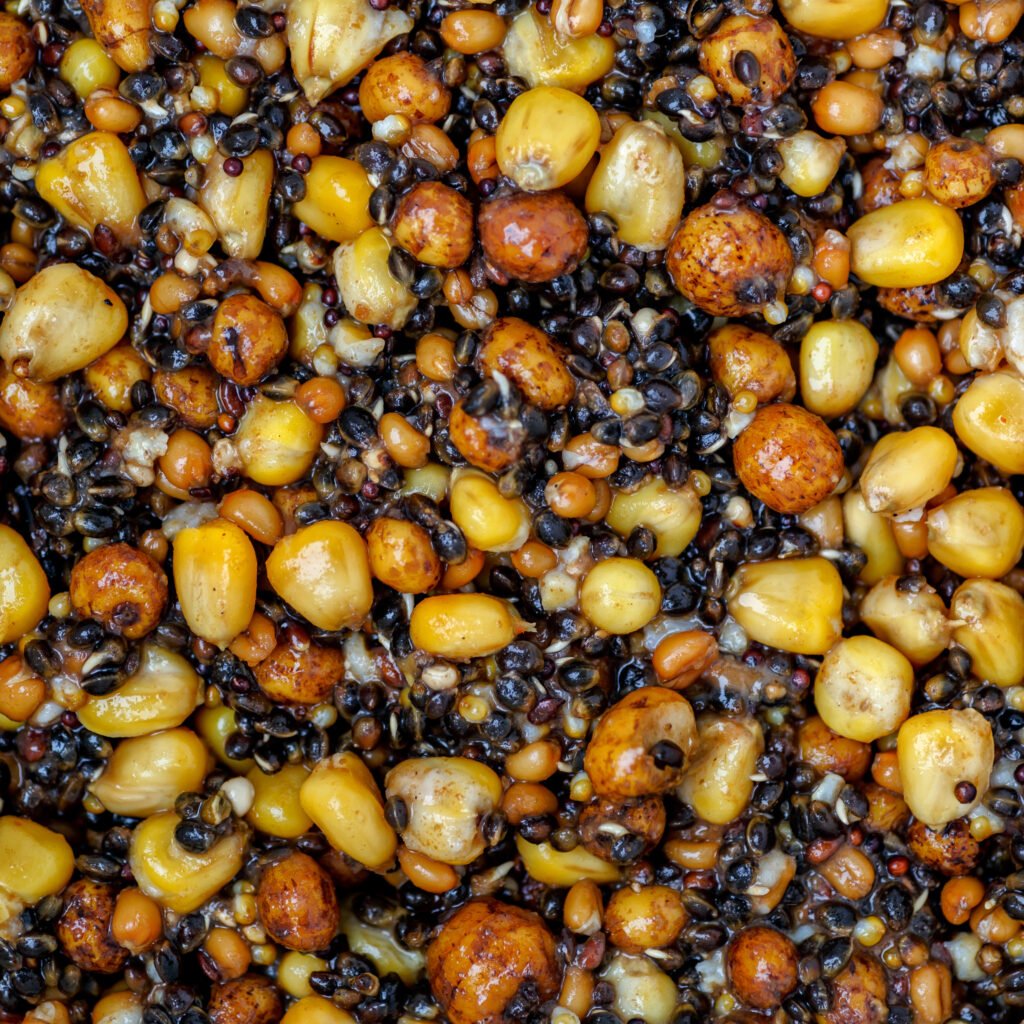
- Corn, hemp, tiger nuts, and properly prepared mixed particles are the main options.
- Particles are strongest in warm water, longer sessions, and natural feeding areas.
- Use very light particle amounts in cold water and early spring.
- Heavy particle baiting can overfeed carp and reduce bites.
- Tiger nuts are a tougher, more selective particle hookbait option.
- Proper preparation matters. Never guess with dry particles.
- On Michigan waters, particles work best near areas carp already want to feed.
What are particles in carp fishing?
Particles are small food baits used to encourage carp to browse, search, and feed over an area.
Common carp particles include:
- sweet corn
- maize
- hemp
- tiger nuts
- maples
- chickpeas
- wheat
- mixed seeds
- properly prepared grain mixes
Corn is technically a particle, though it is common enough to deserve its own article. Tiger nuts also deserve special attention because they behave differently from softer particles. They are tougher, more durable, and often more selective.
The main thing that separates particles from boilies or pellets is feeding behavior.
Boilies are controlled food items. Pellets break down and release attraction quickly. Particles create searching and browsing. They encourage carp to keep working a small area, picking up one item after another.
That is their strength.
Why particles work for carp
Particles work because they fit a natural feeding style.
Carp are not always feeding on big, obvious food items. Much of their natural feeding involves grubbing, sifting, browsing, and picking small items from weed, silt, gravel, and margins.
Particles can imitate that feeding situation.
A small spread of particles can make carp:
- slow down
- search the area
- feed with their heads down
- keep returning to the spot
- compete lightly with other fish
- pick up the hookbait during natural feeding
That is very different from fishing one large bait in isolation.
When particles are used well, they can make the swim feel like a natural feeding patch.
Michigan Notes: On Michigan lakes with weedbeds, silty margins, snail beds, insect larvae, and natural browsing areas, particles can fit the way carp already feed. That is why they can be very effective when placed near the right feature.
The biggest mistake with particles
The biggest mistake is using too many.
Because many particles are cheap, anglers often treat them carelessly. They put in too much bait because it feels affordable. But cheap bait can still ruin a swim.
Too many particles can:
- fill carp quickly
- spread fish away from the hookbait
- attract nuisance species
- reduce feeding urgency
- keep carp grubbing without getting caught
- make the hookbait less important
That last point matters.
Your goal is not just to get carp eating. Your goal is to get carp to pick up the hookbait. A particle bed that keeps carp feeding but never leads them to the rig is not a successful baiting strategy.
Particles should create opportunity, not confusion.
Safe preparation matters
This part is non-negotiable.
Dry particles must be prepared safely.
Different particles require different soaking and boiling times. Some swell significantly. Some become safer and more digestible only after proper preparation. Some can ferment. Some can spoil if stored badly.
Do not throw dry particles into a lake. Do not guess. Do not assume all seeds, grains, beans, and nuts can be treated the same way.
Canned sweet corn is ready to use. Many other particles are not.
If you are using dry maize, hemp, tiger nuts, maples, chickpeas, or mixed particles, learn the correct preparation method first.
Michigan Notes: Responsible bait use matters. MichiganCarp should stand for good fishing, safe bait preparation, clean banks, and fish safety. Poorly prepared particles have no place in serious carp fishing.
For a dedicated preparation page, link this article to Particle Prep for Carp Fishing.
Corn as a particle bait
Corn is the everyday standard.
It is simple, visible, accepted, affordable, and easy to use. Canned sweet corn is ready straight from the can and works as both hookbait and loose feed.
Corn is one of the best particles when:
- you are fishing short sessions
- water is cold or cool
- carp are used to simple bait
- you want a quick response
- you need low-cost bait
- you are fishing public waters
Corn is weaker when nuisance fish are active, when you need more selectivity, or when you need a hookbait to last longer.
Still, corn is one of the best starting points for Michigan carp anglers. It catches because it is easy for carp to accept.
For the full article, link to Corn for Carp in Michigan.
Hemp for carp fishing
Hemp is one of the classic confidence-building particles.
It is small, oily, and excellent for getting carp to browse. Properly prepared hemp can keep fish grubbing around because the items are small and numerous. Carp often stay busy over hemp because it takes time to clear.
Hemp is useful when:
- you want to encourage searching
- carp are feeding confidently
- you are fishing warm water
- you want to support corn, boilies, or tiger nuts
- you are building a natural feeding patch
Hemp is usually not the best hookbait because it is too small. Its job is to support the area and build feeding confidence.
Use hemp carefully. A little can go a long way. Too much can keep carp occupied without helping your hookbait stand out.
Michigan Notes: Hemp can be useful around weed edges and silty feeding areas because it supports natural browsing behavior.
Tiger nuts for carp fishing
Tiger nuts are one of the most useful particle hookbaits.
They are tougher than corn, more durable than many soft particles, and often more selective. On some Michigan waters, tiger nuts have become almost second only to corn as a serious carp bait, and they have accounted for some very good fish.
Tiger nuts are useful when:
- corn is being cleared too quickly
- nuisance fish are active
- you need a tougher hookbait
- you want more selectivity
- carp already recognise them
- you are fishing longer sessions
- you want a particle-style bait with staying power
Tiger nuts are not always instant. They work best when prepared properly and used where fish accept them. They can be used as hookbaits, chopped into particle mixes, or introduced sparingly as free offerings.
The key is preparation and moderation.
Do not overfeed tiger nuts. A few can be enough.
For the dedicated tiger nut article, link to Tiger Nuts for Carp Fishing.
Mixed particles
Mixed particles can be very effective, but they need a reason.
A good mix might include corn for visibility, hemp for browsing, tiger nuts for a tougher food item, and other properly prepared grains or seeds for variety. That can create a natural feeding area that keeps carp interested.
But more variety is not automatically better.
A poor mix can become cluttered. Carp may feed on everything except the hookbait. Nuisance species may move in. The swim may become messy. The bait may not match the session length or water temperature.
A mixed particle approach works best when:
- fish are feeding confidently
- water is warm enough
- you are fishing longer sessions
- the swim is a genuine feeding area
- you can bait accurately
- you are not dealing with heavy nuisance pressure
If you are fishing a short session or cold water, a simple bait is usually better than a complicated mix.
Particles in cold water
Particles can work in cold water, but they must be used very carefully.
Cold-water carp feed less, move less, and digest more slowly. They are not usually looking for a large bed of small food items. Heavy particle baiting can easily be too much.
In cold water, particles should be used as a tiny signal, not a full feeding approach.
Good cold-water particle use might include:
- a few grains of corn
- a small pinch of hemp
- one tiger nut hookbait
- tiny amounts of prepared particles
- a near-single hookbait approach
Avoid big beds of particles in cold water unless you have strong proof that carp are feeding properly.
Michigan Notes: In early spring Michigan conditions, corn is usually the safest particle. Heavy mixes often do more harm than good.
For cold-water bait decisions, link to Best Carp Bait for Cold Water.
Particles in spring
Spring is a transition season.
Early spring is still cold-water fishing. Use particles lightly. Carp may move into shallower areas before they are ready to feed heavily. A few grains of corn or a very light particle signal may be enough.
Later spring is different. As the water warms and carp become more active, particles become more useful. This is especially true around staging areas, reed edges, sheltered bays, and warming margins.
Good spring particle tactics include:
- small amounts of corn
- light hemp
- chopped tiger nuts
- very small mixed particle patches
- corn and pellet combinations
- particle use near warming margins
Do not rush into summer baiting too early. Let the fish response tell you when to increase.
For your spring-specific particle article, link to Spring Particles for Carp if that page is live.
Particles in summer
Summer is the strongest season for particles.
Carp feed more, digest better, move more, and often spend time around weed, margins, silt, shelves, and natural food areas. This is when a particle approach can really hold fish.
Particles are useful in summer when:
- carp are feeding confidently
- you are fishing longer sessions
- you want to hold fish in the area
- you are near weed or natural food
- you can bait accurately
- you want fish to browse
Corn, hemp, tiger nuts, and mixed particles all have a role.
But summer still punishes overbaiting. Warm water does not mean unlimited bait. If oxygen is low, nuisance species are active, or carp are pressured, use less.
For seasonal baiting, link to Best Carp Bait for Summer Fishing.
Particles in fall
Fall can be very good for particles, especially early fall.
Carp often feed strongly before colder water sets in. A measured particle approach can hold fish and create confident feeding.
Early fall particle use can include corn, hemp, tiger nuts, and mixed prepared particles. As the water cools, reduce the amount and simplify the approach.
Late fall becomes closer to cold-water fishing. Heavy particle baiting becomes risky. Corn and small amounts of bait become safer.
Fall is a season of adjustment. Watch the water, not the calendar.
Particles in winter
Winter particle fishing should be very light.
In most cases, a heavy particle approach is not the best choice. Carp may still feed, but they do not need much.
If using particles in winter, keep it minimal:
- one tiger nut hookbait
- a few grains of corn
- tiny amounts of hemp
- no heavy baiting
Location is far more important than bait volume.
Best places to use particles on Michigan lakes
Particles work best where carp already expect to browse.
Good areas include:
- weed edges
- clean spots beside weed
- silty feeding areas
- reed margins
- shallow shelves
- protected bays
- margin patrol routes
- river mouths and connected water edges
- transition zones between soft and firm bottom
Particles are usually weaker in random open water unless carp are clearly feeding there.
Michigan Notes: On many Michigan lakes, the best particle spots are not the cleanest-looking spots to the angler. They are the places where carp naturally grub and patrol.
Particles near weed beds
Weed beds can be excellent particle areas.
Carp use weed for food, cover, and patrol routes. Weed can hold snails, insects, larvae, and other natural food. A small particle baiting area just beside weed can make perfect sense.
Do not throw particles deep into thick weed where the rig cannot fish cleanly. Instead, look for:
- clean holes
- weed edges
- thinner weed
- firm spots beside weed
- routes along reedlines
- open water next to vegetation
Particles should help you fish the edge, not bury your rig.
Particles on silty areas
Silt can be very good or very bad.
Good silt often holds natural food. Dead, foul, black sludge is a different matter. Learn the difference.
Particles can work well on clean feeding silt because carp are already used to browsing there. Hemp, corn, and small particles can fit naturally into that feeding style.
Use balanced hookbaits, wafters, tiger nuts, or corn presentations that stay fishable. If the rig is buried or masked, the baiting does not matter.
Particles on hard spots
Hard spots can also work well with particles, especially if they are near softer feeding areas or weed.
A hard spot gives you presentation confidence. Particles add feeding activity.
This is a good place to use:
- corn
- hemp
- chopped tiger nuts
- small mixed particles
- a boilie or tiger nut hookbait
The hard spot makes the rig fishable. The particles make carp search.
How much particle bait to use
Use less than you think at first.
The right amount depends on water temperature, fish activity, session length, pressure, and nuisance species.
For cold water, use tiny amounts. For spring, start light and build slowly. For summer, use more only if carp are feeding. For fall, adjust based on the temperature trend.
For a short session, a small amount of particles is usually enough. For a longer session, you can build more gradually. For a multi-day session, particles can become a proper holding bait if fish respond well.
Do not put in a bucket because particles are cheap. Put in the amount the swim needs.
How often to top up particles
Particles often last longer as a feeding situation than anglers realise.
If carp are browsing confidently, you may not need to top up as often as you think. If you keep adding bait, you may spread fish out or overfeed them.
Top up particles when:
- fish are clearly feeding
- bites are coming
- bait is being cleared
- you are holding fish in a longer session
Do not top up just because time has passed.
For bait timing, link to How Often Should You Bait for Carp.
Particles vs boilies
Particles and boilies do different jobs.
Particles are better when you want browsing, feeding activity, and holding power.
Boilies are better when you want control, selectivity, durability, and cleaner baiting.
A good summer approach often uses both. Particles hold fish. Boilies provide a more selective hookbait and controlled food items.
For the full comparison, link to Boilies vs Corn vs Particles for Carp.
Particles vs pellets
Particles hold fish. Pellets create quicker attraction.
Pellets break down and release signal. Particles keep fish searching. Together, they can work well, especially in summer.
A small amount of pellet mixed with particles can help wake up a spot. But be careful. Pellets and particles together can become too much bait quickly.
For the full pellet guide, link to Pellets for Carp.
Particles and hookbait choice
The hookbait must stand out enough to be found but still fit the feeding situation.
Good hookbaits over particles include:
- corn
- artificial corn
- tiger nuts
- small boilies
- wafters
- balanced hookbaits
- snowman-style presentations
- maize or harder particle hookbaits
If nuisance fish are active, use tougher hookbaits. If carp are cautious, use something subtle. If the bottom is messy, use a balanced bait or pop-up.
The hookbait should solve the presentation problem, not just match the feed blindly.
Simple particle approaches that work
Corn and hemp
Simple, reliable, and good for confidence feeding.
Corn and tiger nuts
Good when you want quick acceptance with a tougher hookbait option.
Hemp and boilie crumb
Good for subtle attraction and controlled feeding.
Mixed particles and boilies
Good for summer or longer sessions when fish are feeding confidently.
Tiny corn-only trap
Good for cold water and short sessions.
Keep the mix simple unless the swim demands more.
Common Mistakes
Using too many particles
The most common mistake. More particles do not always mean more bites.
Ignoring preparation
Dry particles must be prepared properly. Do not guess.
Fishing particles in the wrong season
Heavy particle baiting is usually poor in cold water.
Spreading bait too widely
A wide particle spread can move fish away from the hookbait.
Using particles where carp are only passing through
Particles work best when carp are willing to stop and feed.
Attracting nuisance species
Small bait can bring small fish, turtles, birds, and other unwanted attention.
Forgetting the hookbait
Particles create feeding, but the hookbait still has to be the easiest mistake in the swim.
FAQ
What are particles for carp fishing?
Particles are small food baits such as corn, hemp, tiger nuts, maize, and prepared seed or grain mixes used to encourage carp to browse and feed.
Are particles good for carp fishing?
Yes. Particles can be excellent when carp are feeding confidently, especially in warm water and natural feeding areas.
What are the best particles for carp?
Corn, hemp, and tiger nuts are three of the most useful particles. Mixed particles can also work when prepared properly and used carefully.
Do particles work in cold water?
They can, but only in very small amounts. Heavy particle baiting is usually better in warm water.
Do tiger nuts count as particles?
Yes. Tiger nuts are a particle bait, but they are tougher and more selective than many softer particles.
Do particles need to be prepared?
Many dry particles must be soaked and boiled correctly. Canned sweet corn is ready to use, but dry maize, tiger nuts, hemp, and many mixed particles need proper preparation.
Next Steps
Read Corn for Carp in Michigan for the simplest and most reliable particle bait.
Then read Tiger Nuts for Carp Fishing and Particle Prep for Carp Fishing to understand tougher particle hookbaits and safe preparation.
For comparisons, read Boilies vs Corn vs Particles for Carp and Best Carp Bait for Michigan Lakes.
For seasonal decisions, connect this page to Best Carp Bait for Cold Water and Best Carp Bait for Summer Fishing.
Then link everything back to the main Carp Bait Guide.