

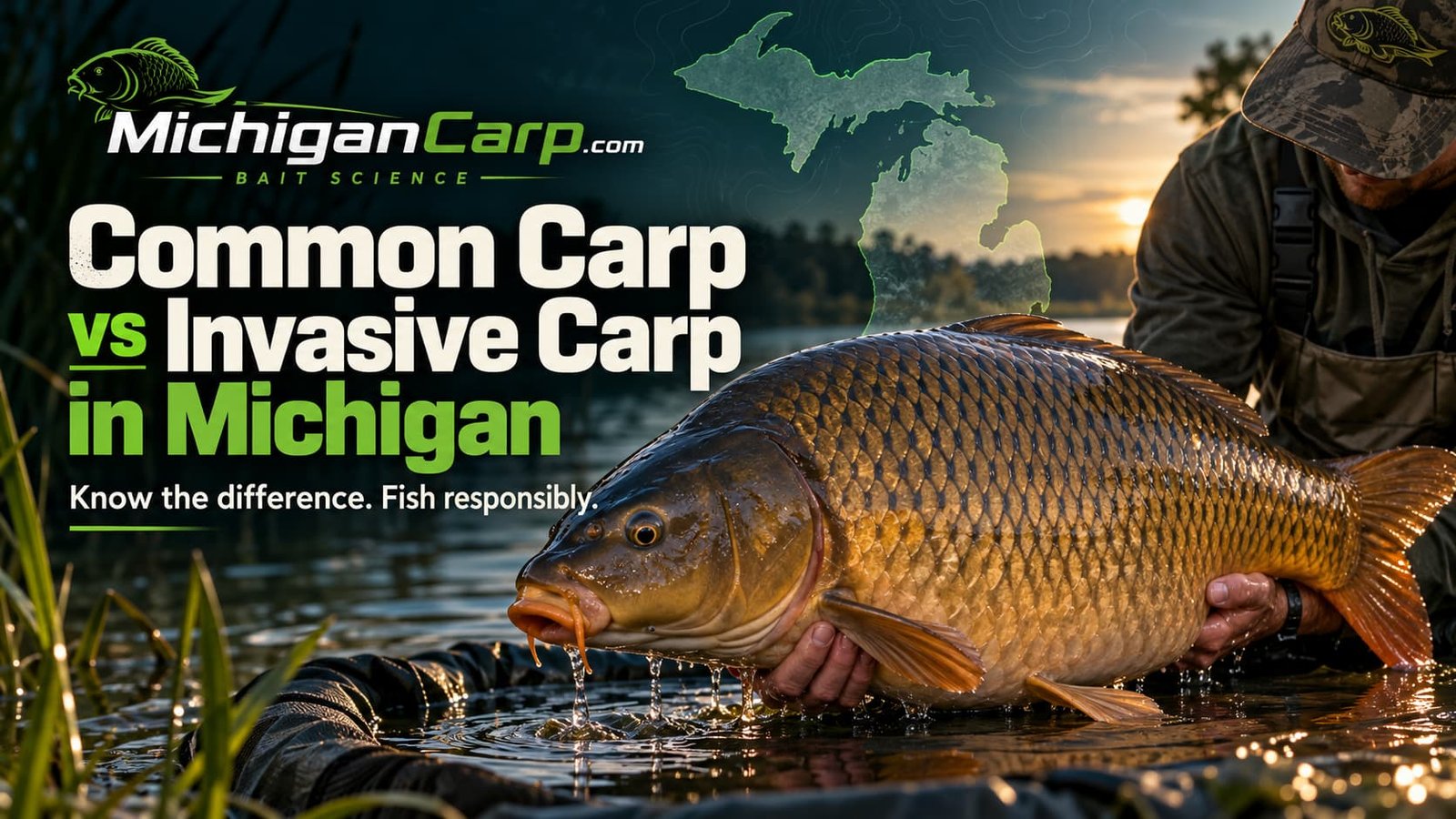
The phrase common carp vs invasive carp in Michigan matters because the word carp is often used as though it describes one fish and one management issue.
It does not.
The common carp targeted by specialist carp anglers is Cyprinus carpio — the bronze, heavy-bodied fish caught on boilies, corn, particles and conventional carp rigs in Michigan lakes, rivers and reservoirs.
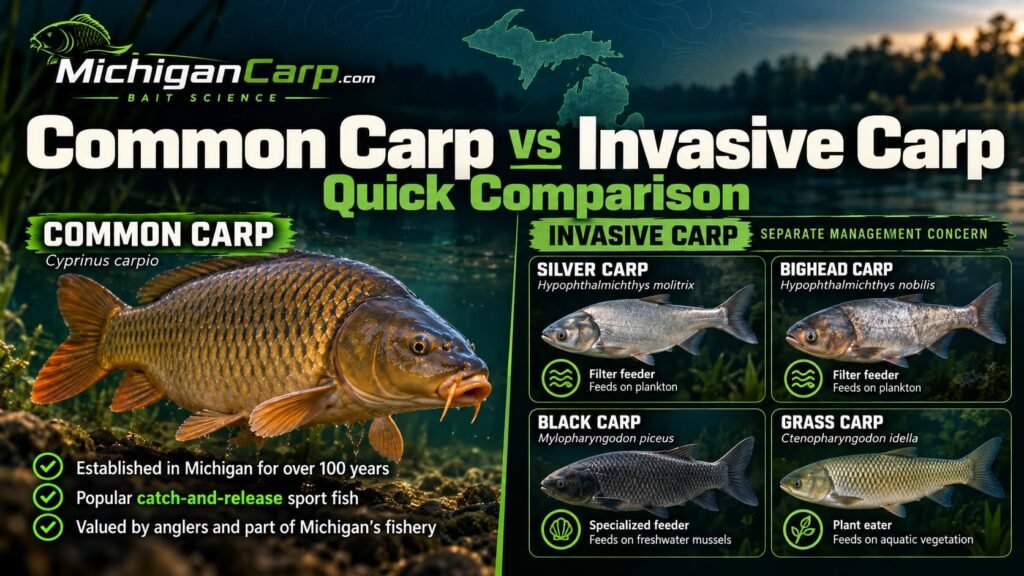
Michigan’s invasive-carp program, by contrast, deals with bighead carp, silver carp, black carp and grass carp.
Those fish are different species with different identification features, feeding strategies, legal status and management concerns.
That distinction matters to anglers, conservation agencies and anyone trying to understand carp fishing in Michigan.
MichiganCarp.com is primarily about responsible, catch-and-release common carp fishing. At the same time, responsible carp anglers should understand invasive-carp identification, reporting requirements and the importance of never moving fish between waters.
For legal fishing and access questions, use Michigan Carp Fishing Regulations.
For safe handling and release, use Carp Fish Care and Safety.
Table of Contents
Quick Start: Common Carp vs Invasive Carp in Michigan
The simplest distinction is this:
Common carp
- Scientific name: Cyprinus carpio
- Established widely in Michigan
- Usually bronze, gold, olive or brown
- Large scales on most fish
- Downturned mouth
- Small barbels at the corners of the mouth
- Feeds largely on or near the bottom
- The primary sport-fishing species covered by MichiganCarp.com
- Not the same fish as bighead, silver, black or grass carp
Invasive carp
Michigan uses the term for:
- bighead carp;
- silver carp;
- black carp;
- grass carp.
These species are listed by Michigan as prohibited invasive species and are managed separately from ordinary common carp fishing.
Current Michigan information lists bighead, silver and black carp as not detected in Michigan.
Grass carp have been detected in the Great Lakes and are also prohibited in Michigan.
If you believe you have seen or caught an invasive carp, do not treat it like an ordinary common carp capture. Follow the current Michigan reporting instructions.
Official references:
Michigan DNR — Common Carp and Suckers
Michigan Invasive Species Program — Invasive Carp
Why the Word Carp Causes So Much Confusion
The word carp is often used far too loosely.
Someone may say “carp” when they mean a common carp caught from a Michigan lake.
A news report may use “invasive carp” when discussing silver or bighead carp approaching the Great Lakes.
Another person may be talking about grass carp.
Another may simply call any large, unfamiliar coarse fish a carp.
Those are not equivalent situations.
Michigan’s own fish information makes the distinction.
The Michigan DNR describes common carp separately and specifically warns readers not to confuse them with invasive carp species.
That does not mean common carp are native Michigan fish.
They are not.
Common carp were introduced to North America and became widely established. Michigan DNR notes that common carp have long been considered a nuisance species in the state.
But that history does not turn the words common carp and invasive carp into interchangeable terms.
For anglers, accurate species names are much more useful than simply saying “carp.”
If you mean Cyprinus carpio, say common carp.
If you mean silver carp, say silver carp.
If you mean grass carp, say grass carp.
Clear language prevents bad identification, bad reporting and unnecessary confusion around responsible carp fishing.
What Is a Common Carp?
The common carp targeted by MichiganCarp.com is Cyprinus carpio.
Michigan DNR describes the species as ranging from light gold to dark brown, normally with large scales covering the body.
Common carp typically have:
- a deep and powerful body;
- large scales;
- bronze, olive, brown or golden coloration;
- thick lips;
- a downturned or protrusible feeding mouth;
- small barbels at the corners of the mouth;
- reddish, bronze or orange-toned fins on many fish;
- a strong tail;
- a long dorsal fin.
The barbels around the mouth are particularly useful when separating a normal common carp from several other large fish.
Common carp are widespread in Michigan.
They occur in:
- the Great Lakes;
- inland lakes;
- reservoirs;
- rivers;
- canals;
- drains;
- bays and drowned river mouths;
- slow-moving warm-water systems.
They are highly adaptable.
Their diet can include:
- insect larvae;
- worms;
- crustaceans;
- mollusks;
- snails;
- seeds;
- plant material;
- other benthic food.
They commonly investigate the lakebed by sucking and sorting material, which is why anglers often see disturbed silt, bubbles and clouded water where carp are actively feeding.
For more on their natural diet, use What Carp Actually Eat in Natural Lakes.
How to Identify a Common Carp
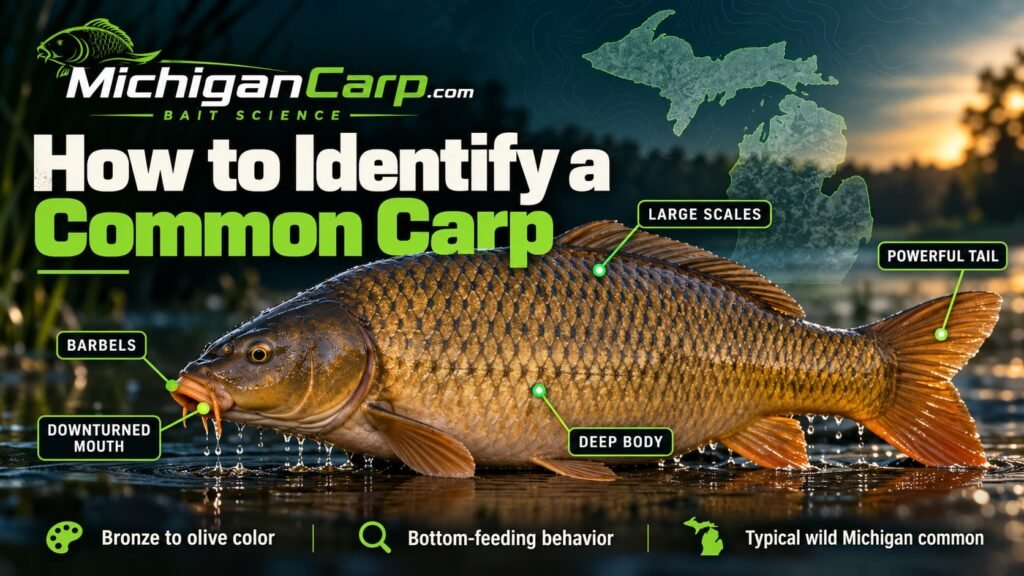
A normal fully scaled Michigan common carp is usually quite distinctive once you know what to look for.
Look at the Mouth
Common carp have a fleshy, protrusible mouth adapted to feeding on and around the bottom.
The mouth is generally downturned when relaxed.
Look for Barbels
Common carp have small barbels around the corners of the mouth.
These are one of the most useful identification features.
Look at the Scales
Most wild Michigan common carp are fully scaled with large, obvious scales.
Scale pattern can vary in domestic and European carp strains, but fully scaled commons are by far the form most anglers encounter in Michigan.
Look at the Body Shape
Large commons can be deep-bodied and extremely powerful.
Some fish are long and lean.
Others develop very deep shoulders and thick bodies.
Body shape alone should not be used for identification, but in combination with the mouth, barbels and scale pattern it becomes useful.
Look at the Overall Color
Common carp often range from:
- dark olive;
- bronze;
- golden brown;
- copper;
- almost black-backed in some waters.
Water clarity, substrate, age, genetics and individual fish can all influence appearance.
Do not rely on color alone.
For official reference photographs and identification information, use Michigan DNR — Common Carp and Suckers.
What Does Michigan Mean by Invasive Carp?
Michigan’s invasive-species program identifies four species under its invasive-carp information:
Bighead Carp
Hypophthalmichthys nobilis
Bighead carp are very large filter-feeding fish.
Useful features include:
- a disproportionately large head;
- a toothless mouth;
- eyes positioned low on the head;
- gray to mottled coloration.
Michigan currently lists bighead carp as a Watch List species, prohibited in Michigan and not detected in Michigan.
Silver Carp
Hypophthalmichthys molitrix
Silver carp are the species famous for jumping when disturbed by boat motors.
Identification features include:
- silver coloration;
- eyes positioned low on the head;
- a toothless mouth;
- a distinctive keel along the underside.
Michigan lists silver carp as a Watch List species, prohibited in Michigan and not detected in Michigan.
Black Carp
Mylopharyngodon piceus
Black carp are large, darker-bodied fish associated with feeding on mollusks.
Michigan identifies them as a serious concern because of the potential impact on freshwater mussels and other mollusks.
Black carp are listed as Watch List, prohibited and not detected in Michigan.
Grass Carp
Ctenopharyngodon idella
Grass carp are primarily plant-eating fish.
They are generally more elongated than a heavy common carp and have:
- large crosshatched-looking scales;
- eyes roughly level with the mouth;
- no common-carp-style barbels;
- a relatively short dorsal fin.
Grass carp have been detected in the Great Lakes.
Michigan lists grass carp as Watch List and prohibited in Michigan.
Michigan’s invasive-carp overview also notes that live possession of grass carp is prohibited in Michigan.
For the latest species profiles, use Michigan Invasive Species — Fish.
Common Carp vs Invasive Carp: The Practical Difference
For an angler, this is the distinction that matters most.
A normal Michigan common carp is the familiar heavy-bodied bronze fish with barbels around its mouth.
It is established across Michigan waters and has been present in North America for well over a century.
An invasive carp sighting is a completely different matter.
Bighead, silver, black and grass carp are covered by Michigan’s invasive-species program and reporting system.
That changes what you should do.
Do not simply think:
“It is some kind of carp, so I’ll treat it like every other carp.”
Identify first.
If necessary, photograph it.
Check official information.
Report anything suspicious.
Why Bighead and Silver Carp Deserve Particular Attention
Bighead and silver carp receive much of the Great Lakes attention because of the ecological consequences that could follow establishment.
Both are filter feeders.
Rather than rooting around the bottom like a common carp, they consume plankton from the water column.
That creates concern because plankton supports many native and economically important fish species.
Silver carp also create an additional recreational hazard because they can jump violently when startled by boat motors.
Michigan’s current invasive-carp information states that there is no evidence of live bighead, silver or black carp established in the Great Lakes.
That is exactly why early identification and reporting matter.
If a prohibited species is discovered before it becomes established, response options are far better than after a population has spread.
Grass Carp Need a Separate Note
Grass carp can cause additional confusion because they are large carp-shaped fish and have already been found within the Great Lakes system.
They are primarily vegetation feeders.
Heavy grass carp feeding can remove aquatic plants that provide:
- fish spawning habitat;
- nursery cover;
- invertebrate habitat;
- waterfowl habitat;
- structural diversity.
Grass carp are therefore not simply another version of the common carp we target.
Michigan lists grass carp as prohibited.
If you encounter a fish that resembles a large, long-bodied carp without common-carp barbels and you are uncertain of the identification, check the official grass carp profile rather than guessing.
Use Michigan Invasive Species — Grass Carp.
What to Do if You Suspect an Invasive Carp
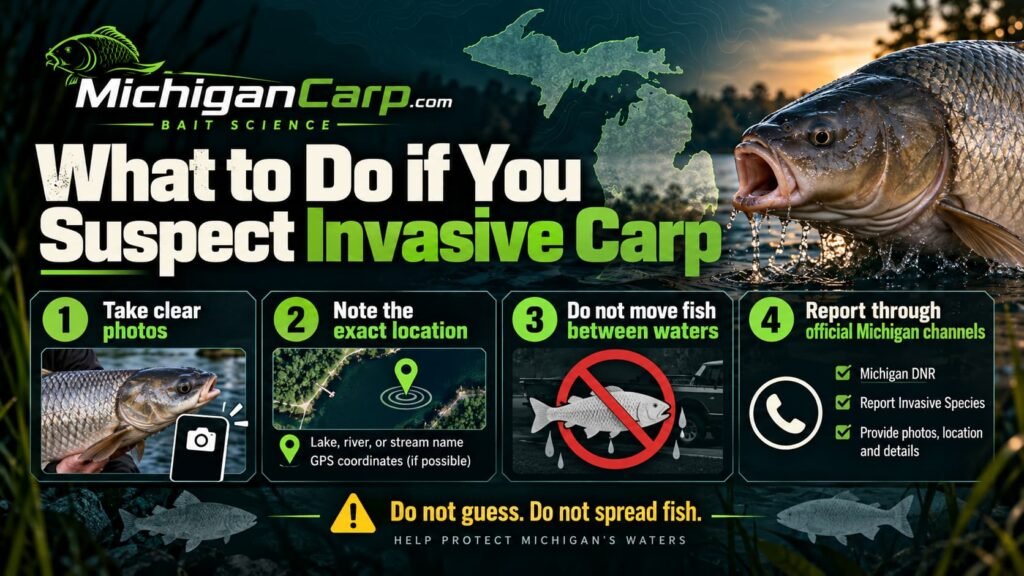
Michigan’s 2026 Fishing Regulations give direct instructions for anglers who believe they have seen or caught an invasive carp.
1. Do Not Release It
The current Michigan Fishing Regulations specifically state that if you believe you have seen or caught an invasive carp, do not release it.
That instruction applies to a suspected invasive-carp encounter — not an ordinary common carp capture.
2. Take Clear Photographs
Get photographs that show as much identification detail as possible.
Useful images include:
- the complete side of the fish;
- the head;
- eye position;
- mouth;
- underside where practical;
- scale pattern;
- fins;
- any unusual identifying features.
Do not risk personal safety simply to obtain another photograph.
3. Record the Exact Location
Record:
- lake, river or stream;
- access area;
- date;
- approximate time;
- GPS coordinates if available.
Exact location matters enormously for an invasive-species investigation.
This is very different from publishing the location of a large common carp on social media.
Report the information to the agency that needs it — not necessarily to the entire internet.
4. Report It Immediately
Use the official Michigan Invasive Carp reporting information.
Michigan also directs anglers to its invasive-species reporting system through Michigan Invasive Species — Identify and Report.
If the fish is unusual and you are not certain of the species, provide good photographs and accurate location information rather than trying to sound certain when you are not.
Good reporting begins with:
“I am not certain what this fish is, but here are clear photographs and the exact location.”
That is much more useful than an incorrect identification.
Never Move Carp Between Michigan Waters
Whether we are talking about common carp or a suspected invasive fish, moving live fish between waters is not acceptable.
Michigan’s bait and fish-release laws state that fish caught and released should be returned to the water where they were caught, or to connected water the fish could have reached naturally.
That means you should never catch a big common carp from one Michigan lake and move it somewhere else because you think it would improve the fishery.
Do not move:
- common carp;
- invasive carp;
- unwanted fish;
- live bait;
- juvenile fish;
- leftover baitfish.
Moving fish can spread:
- disease;
- parasites;
- invasive organisms;
- unwanted genetics;
- species into waters where they did not previously exist.
For the current legal position, use Michigan Invasive Species — Bait and Fish Release Laws.
Carp Anglers Should Clean, Drain and Dry Gear
Fish themselves are not the only thing that can move between waters.
Carp anglers regularly transport wet equipment, including:
- landing nets;
- weigh slings;
- unhooking mats;
- waders;
- boots;
- boats;
- anchors;
- bait buckets;
- baiting equipment;
- camera tripods;
- ropes and retaining equipment.
Mud, plant fragments, microscopic organisms and disease can travel with wet gear.
Michigan recommends the Clean, Drain, Dry approach.
Before leaving a water:
Clean visible plants, mud and debris from equipment.
Drain water from boats, live wells, buckets and other containers.
Dry equipment before moving to another water when practical.
The Michigan invasive-species program recommends drying boats and equipment for five days before moving to another waterbody where possible.
For full current guidance, use Michigan Invasive Species Prevention for Boaters and Anglers.
This is especially relevant to carp anglers who fish several lakes through the season.
Common Carp Fishing Is Not Invasive Carp Management
One of the central reasons this article exists is to separate two very different subjects.
A Michigan angler sitting behind three rods, targeting established common carp with boilies or corn and safely releasing those fish is engaged in specialist common carp angling.
That is not the same activity as:
- invasive-carp surveillance;
- grass carp removal;
- invasive-carp control;
- bowfishing;
- agency netting;
- eradication programs;
- invasive-species reporting.
The distinction should be obvious, but public language around carp sometimes blurs it.
MichiganCarp.com should not blur it.
The site is about Cyprinus carpio.
When invasive carp are discussed here, the purpose is identification, reporting, legal awareness and protection of Michigan waters.
Why Common Carp Matter to Specialist Anglers
A large wild common carp is a serious sport fish.
It can test:
- knots;
- hooks;
- mainline;
- leaders;
- rod control;
- landing equipment;
- fish handling;
- an angler’s ability to read water.
Michigan’s big wild lakes, reservoirs and river systems can produce impressive fish.
For the specialist carp angler, a large common may represent years of growth and survival.
That is why catch-and-release anglers often treat larger carp with considerable care.
This does not require everyone in Michigan to share exactly the same opinion of common carp.
Different angling communities view them differently.
What matters on MichiganCarp.com is that when we deliberately target them as sport fish, we fish legally and handle them responsibly.
Why Fish Care Still Matters
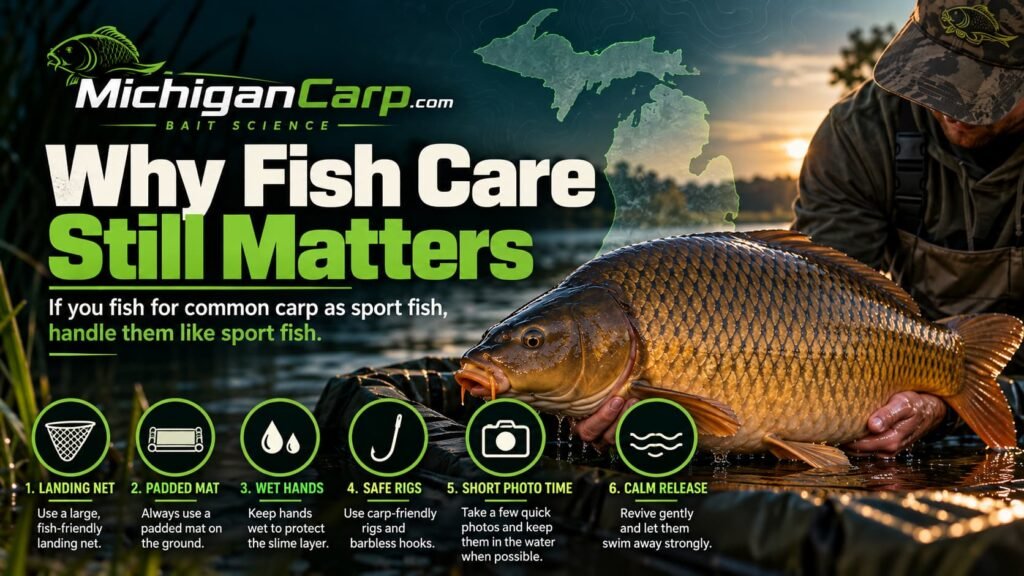
Being non-native does not justify poor handling of a fish you have deliberately chosen to catch and release.
If you fish for common carp as sport fish, handle them like sport fish.
That means having the correct equipment ready before the bite.
A basic fish-care setup should include:
- a suitably large landing net;
- a padded unhooking mat or cradle;
- a wet weigh sling;
- reliable scales;
- water available to keep the fish wet;
- safe tackle;
- camera equipment organized in advance.
Keep the fish low.
Keep hands wet.
Support the body properly.
Do not lift a carp by the gill plate.
Do not stand over hard ground holding a heavy fish.
Do not waste several minutes trying to create the perfect photograph.
Return it in good condition.
Use Carp Fish Care and Safety for the site-wide fish-care standard.
For weighing, photography and release, use Carp Fish Care: Weighing, Photos and Safe Release.
For nets, mats, slings and scales, use Landing Gear for Carp Fishing.
Accurate Language Helps Carp Angling
Carp anglers can improve public understanding simply by using accurate words.
Instead of saying:
“I caught a carp.”
say:
“I caught a common carp.”
When discussing an invasive-species report, use the exact species when known:
- silver carp;
- bighead carp;
- black carp;
- grass carp.
That matters because a photograph of a 30- or 40-pound common carp from a Michigan lake should not automatically trigger comments that the angler has caught an invasive silver or bighead carp.
Likewise, someone who encounters a genuinely suspicious fish should not dismiss it as:
“Just another carp.”
Accurate wording works both ways.
It protects responsible common carp angling while helping invasive-species monitoring.
Public Perception Matters
Many Michigan anglers did not grow up with European-style specialist carp fishing.
They may know carp primarily through:
- bowfishing;
- rough-fish terminology;
- invasive-carp news;
- shoreline spawning activity;
- muddy-water complaints.
That creates very different expectations from those of an angler who grew up fishing carefully for individual carp and returning them.
There is no need to turn every bank-side conversation into an argument.
A much better response is simply to explain what you are doing.
You are targeting common carp.
You use normal hook-and-line methods.
You use safe landing and handling equipment.
You return the fish.
You clean the bank.
You do not move fish between waters.
You support proper reporting of prohibited invasive species.
That is a position most reasonable people can understand even if they personally would not choose to fish that way.
Regulations Still Apply
Species identification does not replace fishing regulations.
For current information on:
- fishing licenses;
- line limits;
- bait and chumming;
- overnight access;
- public-water rules;
- fish movement;
- special waters;
use Michigan Carp Fishing Regulations.
Also check the official Michigan DNR Fishing Regulations before fishing.
This article should remain an identification and public-education guide.
The regulations page should remain the site’s legal and rules reference.
Keeping those jobs separate makes both pages stronger.
MichiganCarp.com Position
MichiganCarp.com is about responsible common carp fishing.
That means:
- legal fishing;
- accurate species identification;
- safe rigs;
- sensible tackle;
- good fish care;
- clean banks;
- responsible baiting;
- respect for public access;
- no unauthorized fish movement;
- invasive-species awareness;
- correct reporting.
There is no contradiction between valuing common carp as a sport fish and taking invasive carp seriously.
In fact, anglers who spend a great deal of time around fish and water should be among the people most capable of noticing when something unusual appears.
Know the fish you are targeting.
Know what does not belong.
Report anything suspicious correctly.
FAQ
Are common carp considered invasive carp in Michigan?
No. Michigan’s official information distinguishes common carp from the group it identifies as invasive carp: bighead, silver, black and grass carp. Common carp are non-native and widely established, but the terms should not be used interchangeably.
Are common carp native to Michigan?
No. Common carp were introduced to North America and became widely established. Michigan DNR notes that they have long been considered a nuisance species, but also specifically distinguishes them from invasive carp species.
What invasive carp species is Michigan concerned about?
Michigan’s invasive-carp information covers bighead carp, silver carp, black carp and grass carp.
Are silver carp in Michigan?
Michigan currently lists silver carp as a Watch List species that is prohibited and not detected in Michigan. Continue to check current DNR information because invasive-species status can change.
Are bighead carp in Michigan?
Michigan currently lists bighead carp as prohibited, Watch List and not detected in Michigan.
Are black carp in Michigan?
Michigan currently lists black carp as prohibited, Watch List and not detected in Michigan.
Are grass carp in Michigan?
Grass carp have been detected in the Great Lakes and are prohibited in Michigan. Michigan does not allow live possession of grass carp.
How can I identify a common carp?
Look for a deep bronze-to-brown body, large scales, a downturned feeding mouth and small barbels around the mouth. Use official identification resources if uncertain.
What should I do if I catch a suspected invasive carp?
Michigan’s current fishing regulations instruct anglers not to release a suspected invasive carp. Take clear photographs, record the location and report it through Michigan’s official invasive-species system.
Can I move a common carp to another Michigan lake?
No. Fish being released should be returned to the same water where they were caught or to legally connected water they could naturally reach. Do not move carp between separate waters.
Why does MichiganCarp.com promote fish care for common carp?
Because the site is dedicated to catch-and-release common carp fishing. If an angler deliberately targets a fish as a sport fish and intends to release it, responsible handling is part of good angling.
Next Steps
For the legal side of Michigan carp fishing, read Michigan Carp Fishing Regulations.
For handling, landing and safe release, use Carp Fish Care and Safety.
For weighing, photography and release, use Carp Fish Care: Weighing, Photos and Safe Release.
For nets, mats, slings and scales, use Landing Gear for Carp Fishing.
For line strength, abrasion and snag safety, use Carp Fishing Line and Leaders for Michigan.
For researching unfamiliar waters without giving away sensitive spots, use How to Research New Carp Waters in Michigan Using Public Tools.
The main distinction is simple:
Common carp are the fish MichiganCarp.com is built around.
Invasive carp are a separate identification, reporting and fisheries-management concern.
Know the difference, fish responsibly and protect Michigan’s waters.