

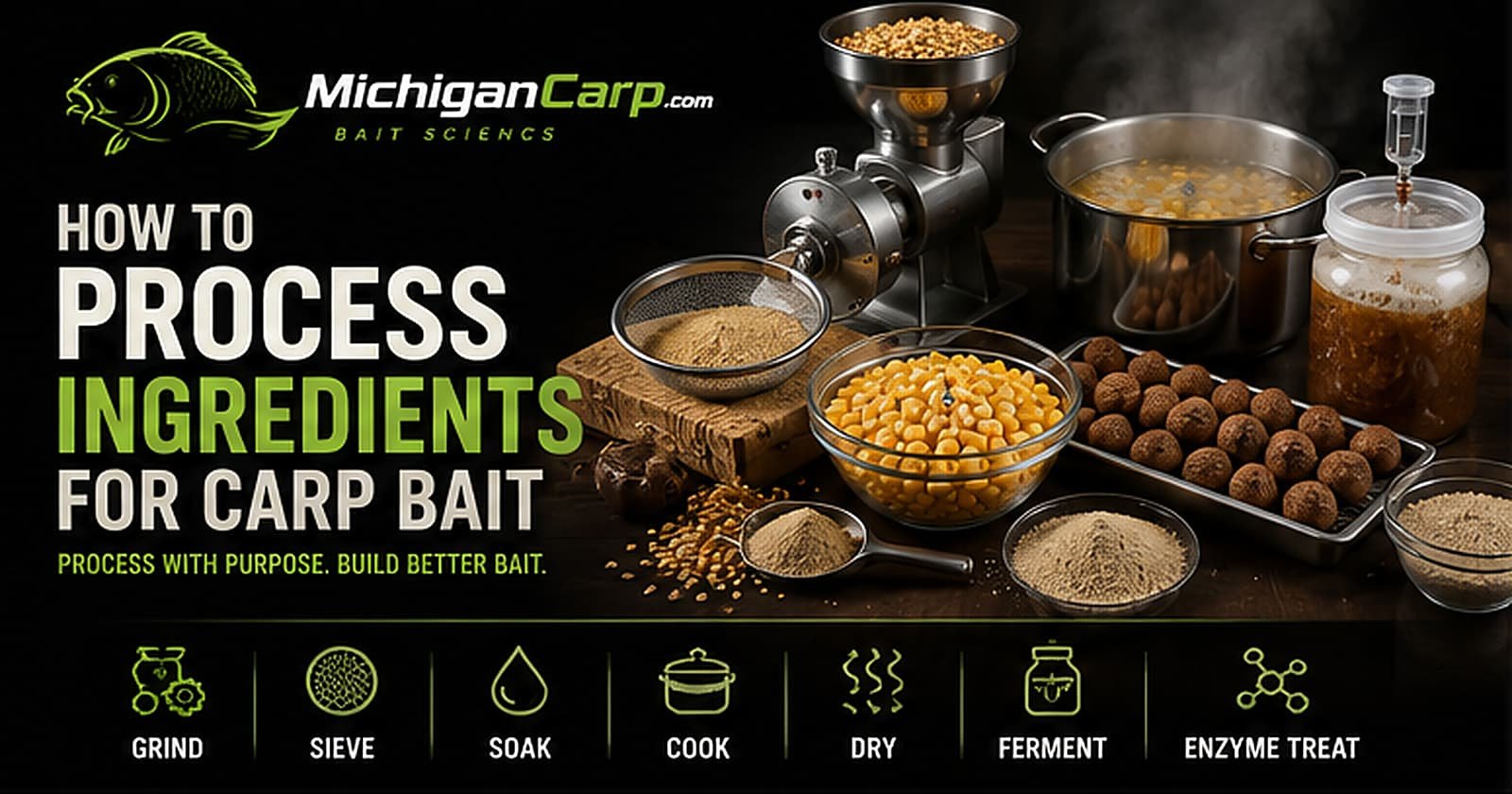
Learning how to process carp bait ingredients is not about turning every ingredient into fine powder, boiling every raw material or adding complicated treatment steps just because they sound advanced.
The real purpose is simpler:
Put each ingredient into the physical or chemical form that best suits the job you want it to perform.
Some ingredients are already ready to use. Others need grinding, crushing, sieving, hydration, cooking, draining, surface drying, fermentation or targeted enzyme treatment before they make sense in a finished bait.
The mistake is assuming that more processing automatically means better bait.
A coarse birdfood may lose much of its physical value if it is milled into flour. A raw legume may need proper treatment before it belongs in a feeding bait. A damp nut meal can upset the moisture balance of a boilie mix. A specialist enzyme can do very little if it is added without the correct substrate, moisture, pH, temperature and reaction time.
Good processing is not separate from bait design.
It is part of bait design.
This article is the practical processing guide for MichiganCarp.com. For the broader decision about when processing helps and when it is unnecessary, read Raw vs Processed Ingredients in Carp Bait. For ingredient problems such as phytate, trypsin inhibitors, lectins and tannins, use Anti-Nutritional Factors in Carp Bait Ingredients.
For heat effects on finished bait, use What Boiling Does to Carp Bait: Heat, Steaming, Leakage and Structure. For practical water testing, use How to Test Boilies Before Fishing.
For external feed-processing context, see FAO: Effects of Processing on the Nutritional Value of Feeds and Feedipedia: Soybean Meal.
Table of Contents
Quick Start: How to Process Carp Bait Ingredients
How to process carp bait ingredients correctly depends on the ingredient, its current state and its intended job in the finished bait.
| Processing decision | Use it when | Avoid it when |
|---|---|---|
| Leave alone | The ingredient is already in the right form | You cannot explain what extra treatment improves |
| Sieve | Lumps, oversize pieces or uneven texture reduce consistency | The coarse fraction is intentionally part of the bait |
| Grind or crush | Particle size is too large for mixing, rolling or release | The ingredient’s texture is part of its value |
| Hydrate | Dry material needs water before cooking or feeding | You need a dry powder for controlled paste formulation |
| Cook | Particles, starches or raw plant materials need heat treatment | The ingredient is already correctly processed |
| Drain and surface dry | Wet ingredients could upset paste moisture | The cooking liquor is deliberately part of the feed system |
| Ferment | You can control substrate, time, temperature, hygiene and pH | You are only hoping strong smell equals attraction |
| Enzyme treat | You have the right enzyme, substrate, water, pH, temperature and time | You are just sprinkling enzyme into dry bait and calling it pre-digested |
The main rule is:
Do not process ingredients because you can. Process them because the bait needs a defined change.
Processing Starts With the Ingredient’s Job
The best place to start is not with a grinder, blender, fermenting bucket or saucepan.
Start by deciding what the ingredient is supposed to contribute.
The same material can perform several different jobs depending on how it is prepared. A seed ingredient could be a fine background meal, a coarse texture ingredient, a prepared particle, a fermented freebait component or a ground method-mix ingredient.
Those uses do not need identical processing.
| Ingredient job | Processing question | Example decision |
|---|---|---|
| Structure | Does it help the bait bind, roll or hold shape? | Use as supplied, sieve or grind only enough for consistency |
| Texture | Does the coarse fraction improve the finished bait? | Retain controlled texture instead of milling everything fine |
| Food value | Is the ingredient digestible and suitable in its current state? | Use treated soy rather than crude raw soy |
| Food signal | Does processing make the ingredient more water-active? | Use hydrolysates, yeast extracts or controlled fermented liquids with purpose |
| Particle feed | Is the dry material safe and usable as loose feed? | Soak, cook, rest and store properly |
| Hookbait structure | Does the ingredient improve attachment and water life? | Use albumen, casein or refined binders only when justified |
Before processing any ingredient, ask:
What should this material do in the finished bait?
That question prevents a lot of unnecessary processing.
The Main Types of Carp Bait Ingredient Processing
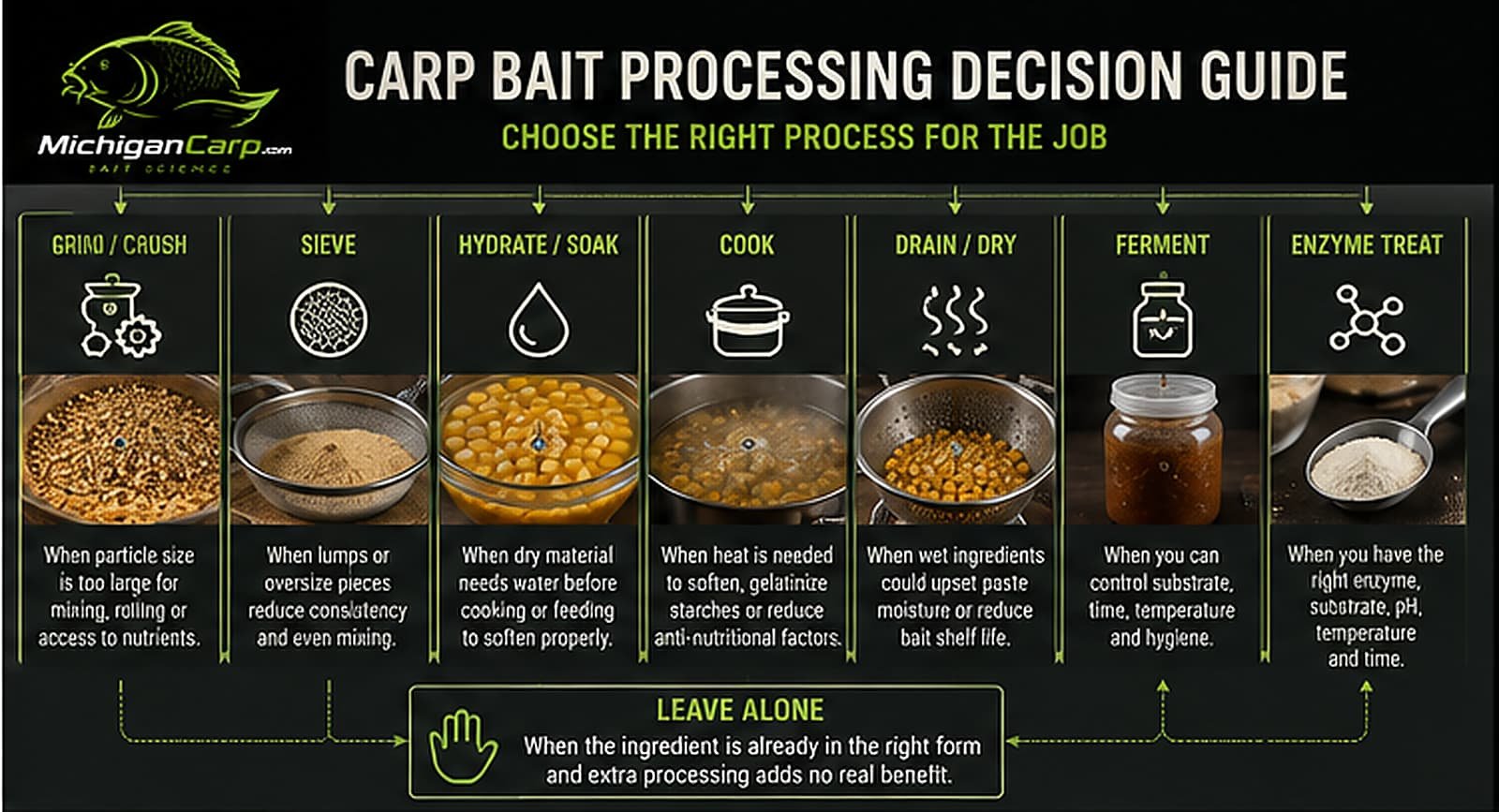
Processing is not one process. Grinding, cooking, drying and fermentation change ingredients in different ways.
| Processing type | Main purpose | Examples |
|---|---|---|
| Mechanical | Change particle size or physical consistency | Grinding, crushing, cracking, chopping, sieving |
| Hydration | Allow water to enter dry material | Soaking particles, rehydrating dry meals |
| Thermal | Use heat to change structure, starches or specific ingredient problems | Cooking particles, heat-treated soy, extrusion, boiling boilies |
| Moisture control | Control free water and storage behavior | Draining, cooling, surface drying, dehydration |
| Biological | Use microorganisms to transform a substrate | Controlled fermentation |
| Enzymatic | Use a specific enzyme on a suitable substrate | Phytase, protease or amylase treatment |
| Post-production | Change the finished bait after cooking | Drying, freezing, rehydrating, glugging, coating |
That distinction matters because a treatment must match the problem.
Grinding a raw legume more finely does not solve every anti-nutritional issue. Boiling a finished bait harder does not automatically improve digestibility. Fermenting an already useful ingredient does not guarantee improvement. Adding enzyme powder does not prove a reaction occurred.
Every process should have a reason.
Mechanical Processing: Grinding, Crushing and Cracking
Mechanical processing is the most common home bait treatment and probably the most overused.
The assumption is often that finer must be better because the ingredient will mix more evenly and release more quickly.
Sometimes that is true.
Sometimes it is exactly wrong.
What grinding changes
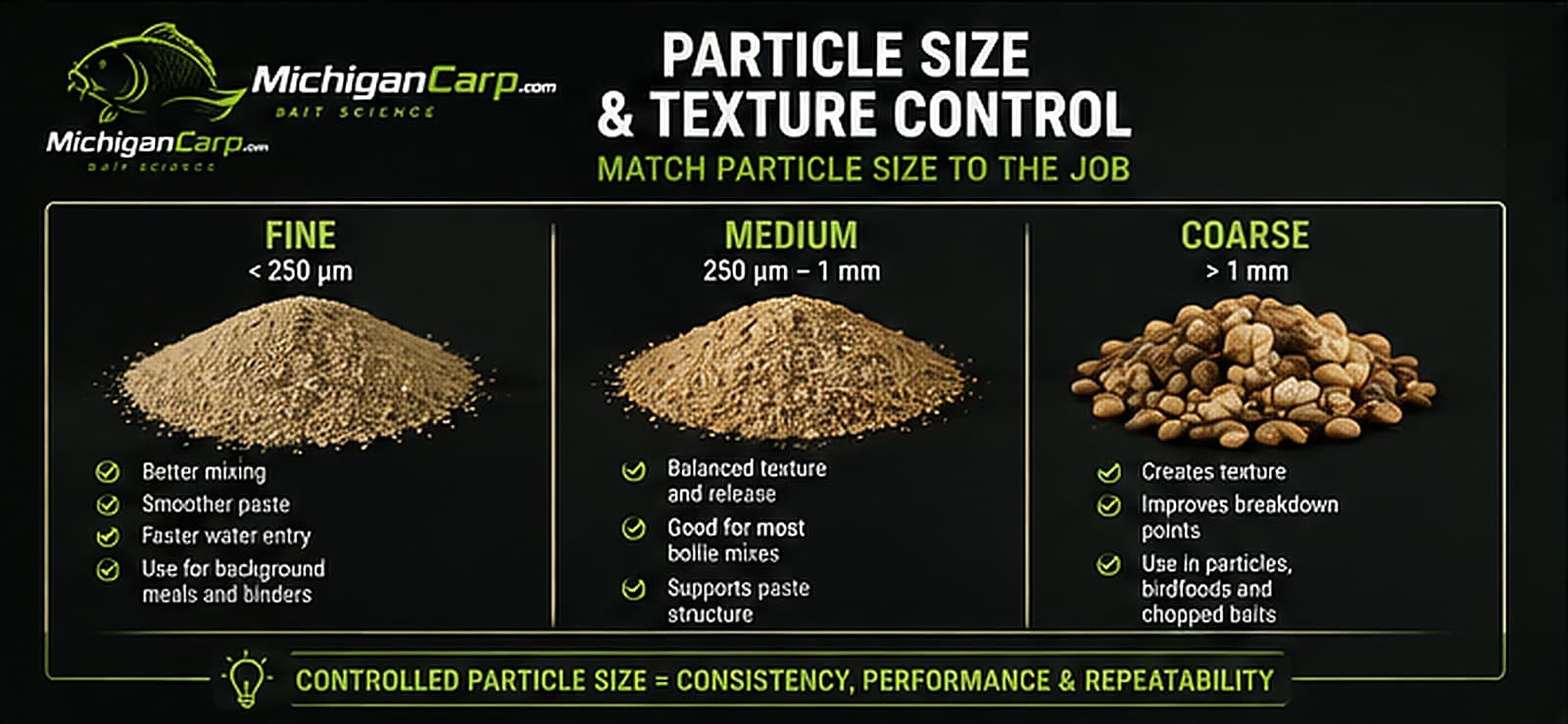
Grinding reduces particle size and increases exposed surface area. In practical bait making, that can influence mixing consistency, rolling, paste smoothness, water access, physical release and how tightly the finished matrix packs together.
Reducing a coarse ingredient into a controlled meal can make a bait easier to roll and improve distribution through the paste.
But milling everything into fine flour can create a dense, tightly packed bait with less texture and fewer obvious physical breakdown points.
Think controlled particle size, not maximum fineness.
Reducing particle size changes exposure and water access, but it does not make an insoluble ingredient chemically soluble. For the full release mechanism, read Carp Bait Solubility and Leakage.
When to grind finer
I would normally reduce particle size when the original material is too coarse for the manufacturing job.
Examples include a seed mix with large hard pieces that split the sausage during extrusion, a coarse pellet meal that will not distribute evenly, or a hookbait mix where consistency matters more than rough texture.
Fine processing can also be useful when a powerful ingredient is used at a low level and must be spread evenly through a larger dry mix. Liver powder, yeast extract, spice powders, minerals and concentrated dry additives should not remain as random lumps.
But there is a difference between making an ingredient uniform enough and milling it into unnecessary dust.
When to keep texture
Some ingredients are useful because they are not uniform powders.
Coarse birdfoods, crushed seeds, biscuit meals, pellet crumb and certain nut or cereal fractions can contribute physical character to a bait.
A controlled coarse fraction can create:
- variation in the matrix;
- different water-entry routes;
- small physical release points;
- texture during feeding;
- a less uniform finished bait.
The word controlled matters.
I am not recommending random chunks large enough to damage rolling, create weak spots or tear around a bait screw. The goal is useful texture, not manufacturing chaos.
Sieving Is Quality Control
Sieving sounds basic, but it solves real bait-making problems.
A dry ingredient may appear uniform in the bag while containing compressed lumps, large fragments, oily clumps, excessive dust or foreign material.
The purpose of sieving is not to make an ingredient magically more attractive.
It is quality control.
A consistent dry blend is easier to reproduce. That matters because changes in particle size and lump distribution can alter liquid demand, paste behavior, extrusion pressure, rolling and drying.
| Ingredient | Why I would sieve it | What to do with oversize material |
|---|---|---|
| Milk powders | Clumping from moisture exposure | Break up or discard if stale or suspect |
| Ground seed meals | Uneven grind or oily clumps | Regrind or use as coarse feed fraction |
| Birdfood | Large pieces may affect rolling | Keep controlled coarse fraction if useful |
| Pellet meals | Hard pieces may weaken hookbaits | Regrind or use in method mix |
| Nut flours | Oily clumps and uneven distribution | Blend with dry carrier or reprocess gently |
| Low-dose powders | Concentrated pockets in the mix | Sieve into the base blend carefully |
Processing waste should be a decision, not an accident.
Nut Meals and Oily Ingredients Need Different Handling
Nut and oil-rich ingredients can behave badly if treated like dry cereal flour.
When high-fat materials are ground aggressively, they can heat during milling, smear, form oily clumps, pack together and become difficult to distribute evenly.
This matters with tiger-nut flour, peanut meal, hemp meal, sunflower products, oily birdfoods and other fat-bearing ingredients.
I prefer controlled grinding in short bursts rather than continuous high-speed processing that turns the ingredient into paste. Cooling the ingredient before grinding can sometimes help, but the important goal is to avoid unnecessary heat and oil release.
After grinding, assess the product rather than assuming it is finished.
If it forms greasy clumps, use gentle breaking, sieving or blending with a dry carrier ingredient.
Also remember that natural ingredient fat counts toward the total bait system. Use How to Balance Fat in Boilies: Milk, Nut and Seed Mixes before adding bottled oil automatically.
Particles: Processing Turns Feed Material Into Bait
Particles are the simplest way to understand why processing matters.
A sack of dry maize is not finished bait. Dry hemp, wheat, pigeon feed, chickpeas, beans and maples are not ready just because they came in a feed bag.
Different particles have different size, hardness, starch content, fat content, water uptake and ingredient risks. There is no sensible universal rule saying every seed, grain, nut and legume should receive the same soak and boil time.
The broad particle sequence is:
Inspect → hydrate if required → cook appropriately → cool → assess texture → manage liquor → store safely.
| Stage | Purpose | Practical check |
|---|---|---|
| Inspect | Remove moldy, stale or contaminated material | Smell, look and reject doubtful feed |
| Soak | Hydrate dry material before cooking | Check swelling and water uptake |
| Cook | Softening, starch change and preparation | Particle-specific texture, not one universal timer |
| Cool | Stop aggressive heat exposure | Cool before storage or adding sensitive liquids |
| Drain | Control free liquid where needed | Decide whether liquor is included or removed |
| Surface dry | Reduce external moisture before mixing | Useful before adding particles to boilie paste |
| Store | Prevent spoilage | Cool storage, clean containers and short holding time |
For the complete safe particle method, read How to Prepare Particles for Carp Fishing.
Hydration Before Cooking
Soaking allows water to enter a dry particle before cooking.
That can help create more even treatment because the center of the particle is not starting from a completely dry state. It can also shorten cooking time and improve final texture.
But soaking should not be described as a universal chemical cure.
It may hydrate the ingredient and change some soluble material, but it should not automatically be claimed to remove every anti-nutritional compound or make every ingredient fully digestible.
For ingredient-specific limitations, use Anti-Nutritional Factors in Carp Bait Ingredients.
Cooking Particles and Plant Ingredients
Cooking can change physical structure, starch behavior, texture and some heat-sensitive anti-nutritional factors, depending on the ingredient.
The important phrase is: depending on the ingredient.
A raw legume, cereal grain, tiger nut and prepared pellet crumb do not respond identically to heat.
The goal is to prepare the ingredient correctly, not cook everything until it becomes soft mash.
| Ingredient type | What heat may improve | What excess heat may damage |
|---|---|---|
| Maize and cereal grains | Softening, starch hydration and usability | Texture, storage quality and water separation |
| Legumes | Softening and reduction of some heat-sensitive problems | Texture and nutritional quality if overdone |
| Soy products | Reduction of trypsin inhibitors when properly processed | Amino acid availability if overheated |
| Tiger nuts | Hydration and practical bait use | Texture if cooked into mush |
| Finished boilies | Setting proteins, starch change and outer skin formation | Leakage, volatile loss and unnecessary hardness |
FAO feed-processing guidance notes that processing can improve feeding value through digestibility or inactivation of specific inhibitors, while some processes can lower nutritional value when poorly matched or excessive. Feedipedia’s soybean meal material also warns that both under-processing and over-processing soybean meal can reduce nutritional value. Use that as a cautionary principle, not as a direct carp-bait formula.
Wet Ingredients Can Destroy Formula Consistency
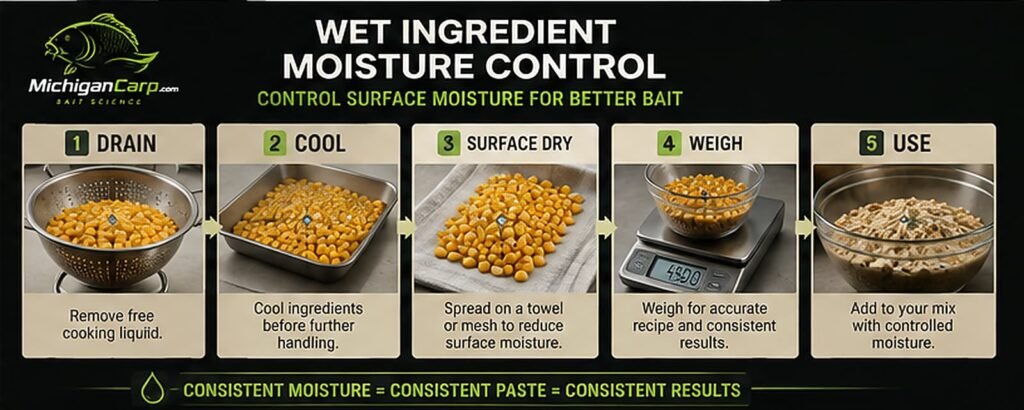
This is one of the biggest practical problems in homemade bait making.
A dry recipe may be weighed carefully to the gram, but adding a variable amount of wet particle, wet meal or cooking liquor can completely change the real moisture content of the paste.
Two apparently identical cups of cooked maize can contain different amounts of surface water, absorbed water and cooking liquor.
That changes the paste.
A wetter inclusion can create sticky dough, weak rolling, different cooking behavior, longer drying and reduced storage stability.
So I would never write a technical boilie recipe that says only:
Add one cup of cooked particles.
At minimum, the process should describe whether the particles are drained, surface-dried, blended, weighed wet, included with liquor or used as a separate feed component.
| Ingredient state | What it changes | Better record |
|---|---|---|
| Wet and undrained | Adds uncontrolled water and liquor | Record wet weight and liquor inclusion |
| Drained | Removes obvious free liquid | Record draining method and time |
| Surface-dried | Controls external moisture while retaining internal hydration | Record drying time and conditions |
| Blended wet | Changes paste moisture and texture | Record blended weight and consistency |
| Dried and ground | Behaves more like a dry ingredient | Record final dry weight and grind |
Repeatability comes from controlling the state of the ingredient.
Draining, Cooling and Surface Drying
After cooking a wet ingredient, three separate stages may matter.
Draining
Draining removes free external liquid when the recipe does not require it.
Sometimes the liquor is useful. Sometimes it is not. The important point is to decide deliberately rather than letting random liquid enter the formula.
Cooling
Hot ingredients should not be casually mixed into systems containing heat-sensitive liquids, active enzymes or ingredients whose behavior you want to control.
Cooling also helps separate a deliberate process from rushed bank-side improvisation.
Surface drying
Surface drying reduces visible external moisture while the ingredient can remain hydrated internally.
This is especially useful when prepared particles are being incorporated into boilie paste, packbait, method mix, crumb systems or coated hookbait systems.
The objective is not necessarily to dry the particle completely.
It is to control free water.
Drying an Ingredient Is Not the Same as Drying a Boilie
Drying can occur at several stages of bait making.
An ingredient may be dried to improve storage, control moisture, make grinding possible or stabilize a treated material.
A finished boilie is dried for a different combination of reasons: handling, skin formation, water life, storage and session durability.
This is another example of why the process must match the job.
For finished bait production, use How to Boil and Dry Boilies Properly. For measurement, use How to Measure Moisture Content in Boilies: Drying Curves, Oven Tests and Meters.
Fermentation Is Transformation, Not Rot
Fermentation can be useful, but it is not simply leaving wet grain in a bucket until it smells strong.
A real fermentation process depends on substrate, microorganisms, moisture, temperature, oxygen conditions, time, hygiene and pH.
Fermentation can change sugars, acids, aroma compounds and other food-derived material, but the result is process-specific.
Controlled fermentation creates a repeatable transformed ingredient. Uncontrolled spoilage creates uncertainty.
| Fermentation decision | Good sign | Warning sign |
|---|---|---|
| Substrate | Known grain, particle or liquid base | Unknown scraps or dirty mixed waste |
| Hygiene | Clean container and controlled process | Mold, filth or rotten residues |
| Smell | Clean sour, yeasty or food-like note | Putrid, fecal, solvent-like or moldy smell |
| pH where used | Measured and recorded | Guessed by smell alone |
| Use | Defined bait purpose | Added because strong smell seems exciting |
For the wider fermented-bait subject, use Fermented and Food-Signal Baits for Carp.
Enzyme Treatment Is Specific
Enzyme treatment is not the same as fermentation.
An enzyme is a catalyst acting on a suitable substrate.
A phytase treatment targets phytate. A protease treatment targets protein. An amylase treatment targets starch.
The practical reaction requires:
enzyme + suitable substrate + moisture + appropriate pH + appropriate temperature + time.
This is why sprinkling enzyme powder into a complete dry boilie mix should not automatically be described as pre-digestion.
There may be no useful reaction if the enzyme does not meet the right substrate and conditions. There may also be limited value if the ingredient has already been commercially processed into the form needed.
For the complete explanation, use Do Enzymes and Phytase Really Improve Carp Bait?.
When an Ingredient Should Be Left Alone
Processing is useful, but unnecessary treatment is one of the easiest ways to make bait development more complicated than it needs to be.
Many commercial ingredients have already been milled, heat-treated, spray-dried, extruded, hydrolyzed, fermented, concentrated or standardized.
Examples include:
- milk powders;
- whey protein concentrates;
- caseins and caseinates;
- properly processed soy products;
- commercial hydrolysates;
- yeast extracts;
- pelleted feed products;
- spray-dried liquids and powders.
The question should be:
What additional improvement would home processing create?
If the answer is unclear, leave the ingredient alone.
A Practical Processing Decision Table
| Ingredient type | Likely processing decision | Main reason |
|---|---|---|
| Fine milk powder | Sieve if clumped; otherwise use as supplied | Already manufactured into a usable dry form |
| WPC80 | Use as supplied and blend carefully | Further home processing adds little |
| Coarse birdfood | Crush selectively and sieve | Retain useful texture without uncontrolled large pieces |
| Whole seeds | Use whole, crush, grind or prepare depending on role | Loose feed and boilie inclusion need different forms |
| Oily nut meal | Gentle grinding and sieving | Avoid paste formation and large greasy clumps |
| Dry particle grain | Ingredient-specific hydration and cooking | Physical preparation and safe feeding |
| Properly processed soy | Usually use as supplied | Do not confuse final boilie cooking with industrial ingredient treatment |
| Commercial hydrolysate | Use as a formulated liquid or powder | The hydrolysis has already occurred |
| Phytate-rich plant ingredient | Consider targeted treatment only when justified | Phytase treatment is specific, not universal |
| Cooked wet particles for boilies | Drain, surface dry and weigh consistently | Control paste moisture |
A Better Home Processing Workflow
I prefer a short repeatable workflow rather than a complicated treatment sequence for every ingredient.
- Identify the material accurately. Know whether it is raw, treated, refined, fermented, hydrolyzed, heat-treated or already blended.
- Decide its job. Protein, energy, texture, binding, physical release, soluble food signal, moisture control or hookbait durability?
- Choose the minimum useful treatment. Nothing, sieving, grinding, hydration, cooking, drying, fermentation or enzyme treatment.
- Control the ingredient state. Record particle size, wet weight, draining time, drying time, treatment time, temperature and pH where relevant.
- Test against an untreated control. Compare rather than assuming the extra work helped.
- Record the result in the recipe. “100 g birdfood” is not the same as “100 g birdfood milled fine and sieved.”
This is the stage most homemade bait development misses.
If you ferment, enzyme-treat, dry, toast or heavily grind an ingredient, compare it with the simpler version where possible. Otherwise, you may be creating more work without knowing whether it improved the bait.
For a controlled comparison system covering water uptake, swelling, softening, cracking, breakdown and batch differences, use How to Test Boilies Before Fishing.
How Processing Changes the Finished Boilie
Ingredient preparation affects the finished bait before cooking begins.
A mix dominated by ultra-fine powders can behave very differently from a mix containing controlled coarse fractions.
Processing can change:
- liquid demand;
- paste elasticity;
- sausage extrusion;
- rolling behavior;
- cooking response;
- drying time;
- water entry;
- physical release;
- attachment strength;
- storage behavior.
That is why processing should be documented when developing a recipe.
A note such as 100 g birdfood may not be enough if one batch used coarse birdfood and another used the same ingredient milled into fine flour.
The weight is identical.
The physical role may not be.
Processing and Solubility Are Related but Not Identical
Grinding an ingredient more finely can increase exposed surface area, but it does not make insoluble material chemically soluble.
Similarly:
- blending does not create hydrolysis;
- boiling does not make every ingredient soluble;
- fermentation does not guarantee every compound becomes attractive;
- enzyme inclusion does not prove a reaction occurred;
- drying harder does not prove a bait will leak better.
Processing changes access, structure and sometimes chemistry.
Those mechanisms need to be kept separate.
For the detailed release pathway, read Carp Bait Solubility and Leakage.
Processing and Digestibility Are Different Questions
A softer or more finely ground ingredient is not automatically more digestible.
Digestibility concerns how effectively consumed nutrients can be digested and absorbed.
Processing can influence that, but the result depends on ingredient type, treatment method, treatment severity, nutrient involved and complete formulation.
Suitable processing can improve the value of some plant materials. Excessive processing can be counterproductive. Under-processing can leave a raw ingredient unfinished.
That is why “processed” is not a magic word and “raw” is not a virtue by itself.
Read Carp Bait Digestibility for the full nutrient-use discussion.
Michigan Application
For the way I fish in Michigan, ingredient processing has to remain practical.
I am often making bait for large natural lakes, three- to five-day sessions, particle-heavy feeding, cool spring or fall conditions and waters with significant natural food.
That changes what I value.
Big-water feeding systems
I want ingredients that can be prepared consistently and economically.
That often means combining properly prepared particles, balanced boilies, crumb, chops and targeted liquid near selected rigs.
I do not need every ingredient to receive specialist treatment.
Cool-water sessions
In cool water, I am more interested in controlling bait quantity and producing useful local food signal than in making every ingredient softer or more processed.
Good processing helps by creating consistent bait. It does not replace location and baiting judgment.
Natural-food waters
On lakes rich in snails, mussels, seeds, insects and other natural food, I prefer coherent ingredient processing rather than making the bait artificially uniform.
A controlled mixture of particle sizes and bait forms can make practical sense: whole boilies, chopped boilies, crumb, prepared particles and selected coarse fractions.
The goal is not rough bait for the sake of roughness.
It is a feeding system where each component has a clear role.
Common Processing Mistakes
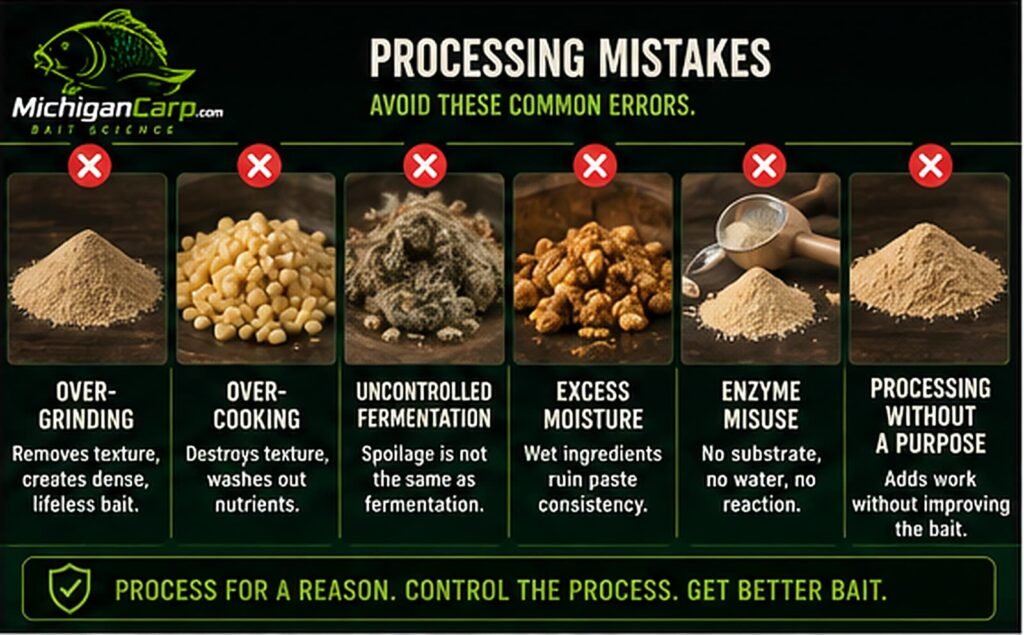
[IMAGE PLACEMENT: PROCESSING MISTAKES — carp-bait-processing-mistakes.png]
Alt text: Common carp bait processing mistakes showing over-grinding, overcooking, uncontrolled fermentation, wet ingredient moisture, enzyme misuse and processing without a purpose.
| Mistake | Why it causes problems | Better practice |
|---|---|---|
| Grinding everything into flour | Can remove useful texture and create dense bait | Use controlled particle size |
| Processing before deciding the job | Treatment becomes random | Define function first |
| Using one particle rule for everything | Seeds, grains, nuts and legumes are different | Prepare by ingredient type |
| Ignoring surface moisture | Wet inclusions change paste behavior | Drain, surface dry and weigh consistently |
| Assuming fermentation always improves bait | Strong smell may be spoilage, not useful transformation | Control substrate, hygiene, time, temperature and pH |
| Adding enzymes without a process | No proven reaction may occur | Use enzyme, substrate, moisture, pH, temperature and time deliberately |
| Reprocessing ingredients already suitable | Adds complexity without improvement | Leave good commercial ingredients alone |
| Overcooking to solve weak paste | May create hard skin while the formula remains poor | Correct paste architecture first |
| Changing processing but not recipe notes | Future batches cannot be repeated | Record grind, moisture state and treatment method |
| Confusing physical access with solubility | Fine particles are not automatically soluble | Separate particle size, water entry and chemical solubility |
Simple Rules for Processing Carp Bait Ingredients
- Identify the ingredient accurately.
- Decide its job before choosing a treatment.
- Use the minimum processing needed to create the required change.
- Control particle size instead of chasing the finest powder.
- Treat sieving as quality control.
- Prepare particles according to the actual particle.
- Control free moisture before adding wet material to boilie paste.
- Use fermentation as a controlled process.
- Use enzymes only for a real substrate and treatment objective.
- Leave already suitable ingredients alone.
- Record processing conditions so the bait can be reproduced.
- Test treatment against an untreated control when possible.
My Practical View
I do not want processing to turn bait making into unnecessary lab theatre.
I want it to solve practical bait problems.
If an ingredient is too coarse to roll, I control the particle size. If a dry particle is not safe or usable, I soak and cook it properly. If a wet ingredient will upset a boilie paste, I drain, cool, surface dry and weigh it. If a commercial ingredient has already been processed into the form I need, I leave it alone.
For my own Michigan fishing, the most useful processing is usually simple and repeatable: prepared particles, controlled dry blends, properly managed moisture, sensible cooking, careful drying and honest water testing.
Fermentation and enzyme treatment can have a place, but only when the process is real and the outcome is compared with a simpler control.
Identify the ingredient, define its job, choose the minimum useful treatment, control the process and test the result.
That produces better bait than processing everything simply because a grinder, saucepan, fermenting bucket or enzyme powder is available.
FAQ
Should every carp bait ingredient be finely ground?
No. Some ingredients benefit from fine milling, while others are useful because they contribute controlled coarse texture. The correct particle size depends on the ingredient’s job.
Does grinding make an ingredient more soluble?
No. Grinding can increase exposed surface area and water contact, but it does not make insoluble material chemically soluble.
Should I sieve all dry bait ingredients?
Not necessarily, but sieving is useful where ingredients contain lumps, large fragments, oily clumps or excessive size variation.
Should particles be drained before adding them to boilie mix?
Usually, yes, or at least their moisture state should be controlled carefully. Free surface water can change paste behavior, cooking response, drying time and storage stability.
Does soaking remove anti-nutritional factors?
Not universally. The result depends on the ingredient and compound involved. Soaking is primarily a hydration process unless a specific chemical, thermal or enzymatic effect has been demonstrated.
Does cooking make every plant ingredient better?
No. Processing effects are ingredient-specific. Suitable treatment can improve some materials, while unnecessary or excessive treatment can reduce quality.
Is fermentation the same as spoilage?
No. Controlled fermentation is a managed biological process. Uncontrolled spoilage is unpredictable and should not be confused with intentional bait fermentation.
Should I use enzymes when processing ingredients?
Only when the enzyme has a suitable substrate and you can provide the moisture, pH, temperature and time needed for a useful reaction.
Can I process commercial hydrolysates further?
Usually there is no obvious reason to do so. A hydrolysate has already undergone hydrolysis, so it should be used according to the job you want the resulting protein fractions to perform.
Can over-processing reduce bait quality?
Yes. Excessive heat, aggressive drying, unnecessary grinding, poor fermentation and repeated handling can reduce the usefulness of otherwise good ingredients.
What is the most important rule in ingredient processing?
Choose the treatment based on the ingredient’s intended function rather than applying the same process to every material.
How do I process carp bait ingredients consistently?
Record the ingredient state, particle size, moisture condition, cooking time, drying time, temperature and treatment method, then compare the finished bait against a simpler control.
Next Steps
- Raw vs Processed Ingredients in Carp Bait — understand when processing helps and when it is unnecessary.
- Anti-Nutritional Factors in Carp Bait Ingredients — understand phytate, trypsin inhibitors, lectins, tannins and plant-ingredient limits.
- Do Enzymes and Phytase Really Improve Carp Bait? — separate real enzyme treatment from bait-making hype.
- What Boiling Does to Carp Bait: Heat, Steaming, Leakage and Structure — understand how heat changes the finished bait matrix.
- Carp Bait Digestibility — connect processing with usable nutrition.
- How to Test Boilies Before Fishing — compare processed and unprocessed versions in water.
- Carp Bait Solubility and Leakage — understand water entry and food-signal release.
- How to Balance Fat in Boilies: Milk, Nut and Seed Mixes — handle oily ingredients properly.
- How to Prepare Particles for Carp Fishing — apply processing logic to loose feed.
- How to Boil and Dry Boilies Properly — control finished-bait processing.
- Bait Science — explore the technical bait library.
- Boilie School — follow the structured boilie-making route.