
If you want to catch more carp consistently, you need to understand one simple truth:
Carp are not eating your bait by default. Most of the time, they are feeding on what the lake already gives them.
That matters because every lake has its own natural food profile. Some are rich in bloodworm. Some are full of snails. Some have mussels, weed life, insect larvae, or soft-sediment food that carp can root through for hours.
The anglers who stay consistent are usually the ones who understand what carp are already feeding on, then fish in a way that fits that picture.
This guide is the plain-English version of that idea.
Quick Start
If you only want the short version, here it is:
- Carp feed heavily on natural food
- The biggest foods to think about are bloodworm, snails, mussels, insect larvae, and lakebed life
- Natural food varies from lake to lake
- In rich waters, carp often care less about your bait than you think
- Matching the hatch usually beats trying to shock fish with something unnatural
- Location still matters more than bait
If you want to connect this straight to bait choice, read:
- Carp Bait Guide
- Best Carp Bait for Michigan Lakes
- Carp Feeding Attractants Explained
- Why Amino Acids Trigger Carp Feeding
The Core Natural Foods Carp Eat
Carp are opportunistic, but their natural diet is more consistent than many anglers think.
The main food groups are usually these:
1) Bloodworm and soft-sediment life
Bloodworm live in soft silt and lakebed sediment.
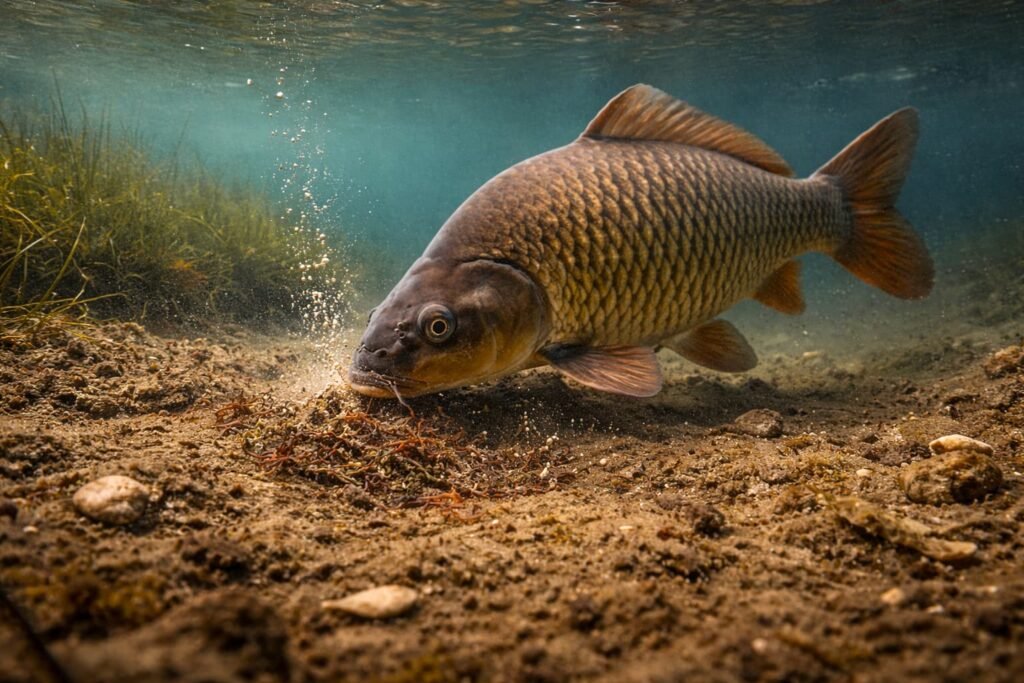
On many lakes this is one of the most important natural food sources carp have access to. Fish root through the bottom, filter sediment, and extract the larvae.
That is why silty areas often show fizzing, bubbling, cloudy patches, and repeated feeding signs.
2) Snails
Snails are a major food source in many lakes.
They are often found on:
- weed beds
- firmer lakebed areas
- gravel patches
- hard-bottom transitions
Carp patrol these areas steadily and can feed there for long periods without drawing much obvious attention.
3) Mussels and zebra mussels
In Michigan, this matters.
Zebra mussels and other mussel beds change the food picture on a lot of waters. Carp actively feed on them, and over time they can become a serious part of the lake’s natural-food profile.
4) Insect larvae and aquatic life
Carp also feed on all sorts of small aquatic life living in or around weed, silt, and the lakebed.
That includes insect larvae, nymphs, and tiny organisms most anglers never think about.
5) Plant material and incidental food
Carp are not strict predators of one thing only. While feeding, they also take in softer plant matter, small seeds, tiny food items in weed, and other edible material around the main food source.
The important point is not to think of carp as fish that are waiting for boilies.
They are usually feeding naturally first.
Why Bloodworm Matters So Much
Bloodworm is one of the biggest carp foods to understand.
In silty lakes, carp can spend a huge amount of time grubbing through sediment for it. That is why some areas feel alive with fish activity even when you are not seeing fish show on the surface.
Bloodworm-rich areas often produce:
- fizzing bubbles
- cloudy disturbed patches
- repeated fish movement over soft spots
- confident grubbing on silty flats
That is also why bloodworm-style bait often makes sense in the right lake. It is not magic. It simply fits something carp already know.
If you want to connect that idea to bait properly, read:
Snails, Mussels, and Hard-Food Areas
Not all feeding happens in soft silt.
A lot of carp also patrol harder areas where they can pick up snails, crush shells, and work along weed-and-hard-bottom routes.
These zones often include:
- gravel patches
- firmer clay or sand
- weed beds with hard cleanings
- mussel-covered structure
- transition strips between soft and hard lakebed
These spots do not always show obvious fizzing the way bloodworm areas do, but they can be extremely consistent patrol routes.
That is why a lake with lots of snails or mussels often responds well to bait that feels more natural, mineral-rich, savoury, or shellfish-led rather than overly bright and artificial.
For the bait side of that idea, read:
- The Science of Minerals, Salts, and pH in Carp Bait
- Best Carp Bait for Different Situations
- Best Carp Bait for Lakes vs Rivers
Feeding Behaviour Depends on the Lake
This is where anglers often go wrong.
They assume carp behave the same everywhere.
They do not.
Some lakes are food-rich. Some are food-poor.
In food-rich lakes
When natural food is abundant:
- carp can afford to be picky
- bait usually works best when it fits the lake
- location becomes even more important
- matching the hatch matters more
In food-poor lakes
When natural food is limited:
- carp are often more willing to try something new
- bait can dominate feeding behaviour more easily
- simpler baiting can often get noticed faster
That difference changes everything.
A bait that works brilliantly on one lake can look average on another simply because the natural food picture is different.
Matching the Hatch
This is one of the most useful ideas in carp fishing.
You do not need to copy natural food perfectly, but you do want to stay in the same ballpark.
That can mean matching:
- size
- color
- texture
- breakdown speed
- leak-off
- general food signal
For example:
- bloodworm-rich lakes often suit darker, softer, more natural-feeling signals
- snail and mussel lakes often suit savoury, mineral-rich, shellfish-style, or harder food ideas
- rich natural-food lakes often suit subtle baiting better than loud baiting
This is not about copying trout-fly fishing exactly. It is just the common-sense version of the same idea: fish something that makes sense in the environment.
Why Location Still Beats Bait
You can have the perfect bait profile and still blank if you are fishing away from the food.
Natural food dictates carp movement.
They follow it, return to it, and spend time where it is abundant.
That is why location still comes first.
If you find the food, you often find the carp.
Good examples include:
- soft silty areas with feeding signs
- weed beds holding snails and aquatic life
- hard-bottom patrol routes
- shallow warming zones with active life
- transitions between feeding water and holding water
Read these next if you want to sharpen that side:
Michigan Notes
On a lot of Northern Michigan waters, you are dealing with a mix of:
- bloodworm-rich silt
- strong snail populations
- zebra mussels on structure
- weed-and-hard-bottom patrol routes
That means the most productive approach is often a balanced one.
Think in terms of:
- natural-style bait
- sensible leak-off
- matching the lake’s food profile
- keeping location ahead of bait obsession
This is also one reason your natural-food-style bait ideas make sense on the waters you fish. They fit the profile better than random bright, high-hype approaches.
Common Mistakes
Ignoring natural food in the lake
A lot of anglers focus only on their own bait and never ask what carp are already feeding on.
Fishing where it “looks nice”
Nice-looking water is not always feeding water. Find the food first.
Over-relying on bright or strong flavours
There is a time for standout bait, but in rich natural-food lakes it can easily look wrong.
Changing bait too often
Sometimes the bait is not the problem. The location is.
Thinking all lakes feed the same way
Every lake has its own food profile. Treat it that way.
FAQ
Do carp prefer natural food over bait?
A lot of the time, yes. Unless your bait fits what they are already used to, natural food often wins.
What do carp really eat in lakes?
Bloodworm, snails, mussels, insect larvae, weed-associated life, and other lakebed food are all important.
How do I find natural-food areas?
Look for fizzing, soft silt, weed beds, hard-bottom patrol routes, repeat fish activity, and areas that clearly hold life.
Are boilies unnatural?
Not necessarily. But they usually work best when they behave like believable food rather than just strong-smelling objects.
Does carp diet stay the same all year?
No. It changes with temperature, availability, lake condition, and season.
Next Steps
Now connect this to bait choice:
- Carp Bait Guide
- Best Carp Bait for Michigan Lakes
- Carp Feeding Attractants Explained
- Why Amino Acids Trigger Carp Feeding
- Cheap Carp Baits That Catch Big Fish on Michigan Waters
And connect it to location:
- How to Locate Carp Before You Cast
- Signs Carp Are Feeding
- Carp Water Temperature Guide for Michigan Lakes
- Spring Carp Fishing in Michigan
- Summer Carp Fishing in Michigan