

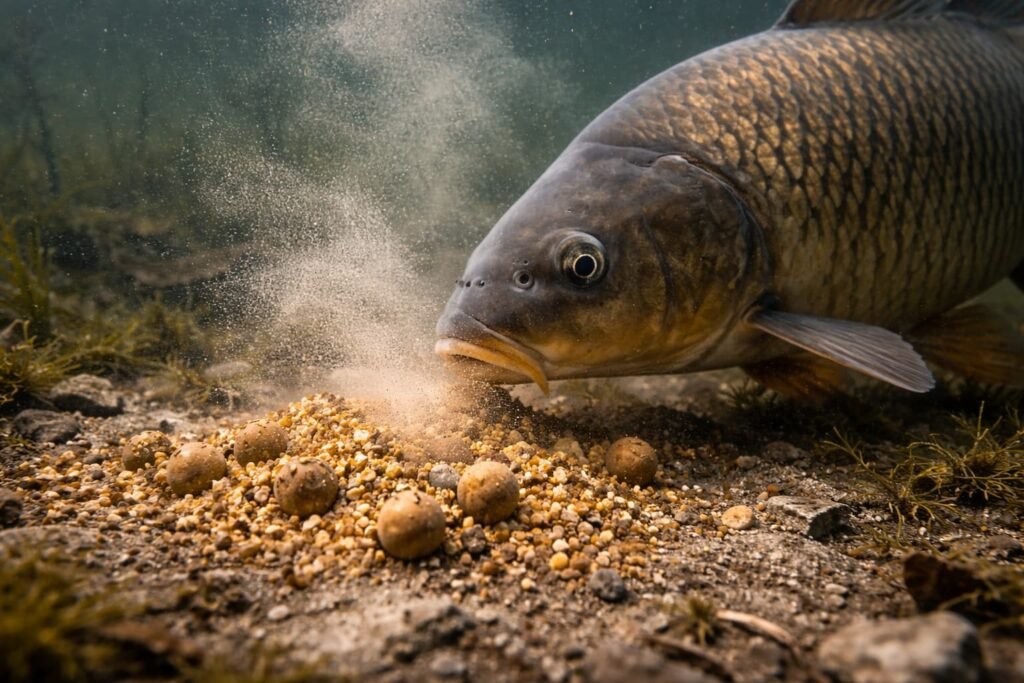
Do Carp Detect Free Amino Acids the Way Anglers Think?
Yes.
Common carp can detect free amino acids.
That part is not bait-company fantasy.
Where the subject becomes confused is everything anglers often add after that fact.
You will hear claims that:
- amino acids pull carp from enormous distances;
- all amino acids create a feeding response;
- more amino acids always mean more attraction;
- hydrolysates work simply because they are full of amino acids;
- carp can identify the perfect nutritional profile before eating the bait;
- any bait releasing amino acids must automatically outperform one that does not.
The real picture is more complicated—and much more useful.
Carp have sophisticated chemical senses.
Specific amino acids can stimulate their sensory systems.
But:
- not all amino acids produce the same response;
- detection does not guarantee feeding;
- concentration matters;
- olfaction and gustation perform different jobs;
- the physical form of the bait affects what becomes available to the water;
- location still matters more than any bottle of attractant.
The practical question is therefore not:
Do carp detect amino acids?
They do.
The better question is:
What does amino-acid detection actually mean for real bait design?
For the complete attraction pathway, begin with Carp Feeding Attractants Explained.
For the direct protein comparison, also read Free Amino Acids vs Intact Proteins in Carp Bait.
Quick Start
The practical version is this.
Yes, Carp Detect Free Amino Acids
Common carp possess sensitive chemical-sensing systems capable of responding to particular amino acids.
Not All Amino Acids Are Equal
Different amino acids can produce different sensory and feeding responses.
The label:
contains amino acids
does not tell you enough.
Smell and Taste Are Different
Olfaction and gustation both matter.
Detection in the surrounding water is not the same event as tasting and accepting a food object.
Concentration Matters
Sensory response is concentration-dependent.
A useful response does not necessarily increase forever in a straight line as more material is added.
Free Amino Acids and Protein Are Not Interchangeable
Free amino acids can contribute to chemical signaling.
Intact proteins are primarily part of the nutritional and structural food package.
A good bait can use both.
Location Still Comes First
Amino acids can help a bait communicate.
They do not make location irrelevant.
What Is a Free Amino Acid?
Amino acids are the building blocks from which proteins are made.
In an intact protein, amino acids are joined together through peptide bonds.
When proteins are:
- digested;
- enzymatically hydrolyzed;
- chemically hydrolyzed;
- biologically processed;
smaller protein fractions can be produced.
These can include:
- large peptides;
- medium peptides;
- small peptides;
- dipeptides and tripeptides;
- free amino acids.
A free amino acid is not attached to a peptide chain.
That difference matters because a free amino acid and the same amino acid locked inside an intact protein do not have the same immediate relationship with the surrounding water.
The intact protein can be nutritionally valuable.
The free amino acid is already a small individual compound.
For the wider protein progression, read Proteins, Peptides and Hydrolysates in Carp Bait.
What the Research Actually Shows
Common carp have been studied through several kinds of sensory work, including:
- electrophysiological measurements;
- taste-response experiments;
- concentration-response trials;
- feeding-behavior observations.
The important conclusion is not that carp are attracted equally to every amino acid.
The useful conclusion is:
specific amino acids can be effective chemical stimuli, while the sensitivity and behavioral response depend on the compound and concentration.
That distinction is important.
In bait discussions, anglers often use the phrase:
amino-acid signal
as if amino acids were one uniform sensory category.
They are not.
The side-chain structure of one amino acid differs from another.
The receptors and sensory pathways involved can also discriminate between different molecular structures.
This is why bait design should not be reduced to adding the largest possible quantity of a random amino-acid blend.
Olfaction and Gustation: Two Systems, Different Jobs
One of the most useful corrections to angling language is to stop using the word smell for every chemical response.
Carp use more than one chemosensory system.
Olfaction
Olfaction detects dissolved chemical information through the olfactory system.
In practical fishing terms, this can contribute to:
- environmental awareness;
- detection of chemical changes;
- orientation and search behavior.
But detecting a dissolved compound is not the same as deciding to eat a bait.
Gustation
Gustation is taste.
Carp have a highly developed taste system associated with food search and evaluation.
The practical role is closer to:
- sampling;
- evaluation;
- acceptance;
- rejection.
This means a carp can detect something without necessarily consuming it.
That distinction is central to good bait thinking.
The sequence can be:
detection → investigation → tasting → acceptance or rejection
not simply:
detection → instant feeding
For the full pathway, read Carp Feeding Attractants Explained.
The First Myth: Amino Acids Call Carp From Anywhere
This is where bait marketing often runs ahead of what fishing conditions can support.
A bait releasing soluble compounds can create chemical information in the water.
But natural water is dynamic.
Released material is affected by:
- diffusion;
- dilution;
- current;
- turbulence;
- wave action;
- convection.
The result is not necessarily a clean permanent trail stretching from the hookbait to every fish in the lake.
On large Michigan waters, I would never use amino-acid attraction as an excuse to ignore:
- location;
- wind;
- depth;
- natural food;
- travel routes;
- seasonal movement;
- feeding windows.
My practical interpretation is:
Amino-acid signals can help a bait communicate when carp encounter the relevant chemical information.
That is very different from claiming:
This hookbait will pull carp from the other end of the lake.
For the full water-release subject, read The Science of Carp Bait Solubility and Leakage.
The Second Myth: More Amino Acids Always Mean More Attraction
This idea sounds logical.
If some signal is good, more signal must be better.
Biological sensory systems are rarely that simple.
Response can depend on:
- compound;
- concentration;
- mixture;
- sensory pathway;
- bait matrix.
Controlled carp work has demonstrated concentration-dependent responses and eventual saturation for some stimulatory amino acids.
That does not mean every amino acid follows one identical universal curve.
It does mean the simple rule:
double the dose, double the attraction
is not a sound bait principle.
My practical rule is:
Use amino-acid ingredients deliberately, not competitively.
The goal is not to create the highest number on an ingredients label.
The goal is to build a useful bait.
The Third Myth: All Amino Acids Do the Same Thing
They do not.
This is probably the most important scientific point in the article.
Some amino acids have produced strong gustatory responses in common-carp research.
Others have produced much weaker or different responses.
Behavioral acceptance and electrophysiological receptor response are also not automatically identical measurements.
This means that these statements are too vague:
rich in amino acids
amino-loaded
contains all the essential aminos
The first two say nothing about the actual profile.
The third may be nutritionally relevant but does not automatically prove sensory attraction.
That distinction between nutrition and signal matters.
For the direct comparison, read Free Amino Acids vs Intact Proteins in Carp Bait.
What About L- and D-Amino Acids?
This part of the older article needed more careful wording.
Proteins in living organisms are predominantly built from L-amino acids.
Classic electrophysiological work on the external carp taste system also showed strong stereospecificity in the amino acids and analogues tested: the L-isomer stimulated those receptors while the corresponding enantiomer did not.
That is useful evidence.
But the angling conclusion should remain careful.
I would not turn it into:
Every L-amino acid attracts carp and every D-amino acid is completely irrelevant.
That goes beyond what the evidence establishes.
The practical lesson is narrower:
Molecular form matters.
You cannot assume that mirror-image forms of the same compound will stimulate a carp sensory receptor identically.
That is another reason to distrust vague marketing phrases such as:
amino-acid technology
without any useful information about the actual material.
Free Amino Acids vs Intact Protein
This was one of the useful ideas in the weaker article, but it needs better wording.
The simple version is:
Free Amino Acids
Already exist as individual compounds.
Their role belongs mainly in discussions about:
- chemical detection;
- taste;
- sensory response;
- short-range bait communication.
Intact Proteins
Large nutritional molecules.
Their primary bait roles can include:
- nutrition;
- amino-acid supply after digestion;
- bait structure;
- long-term food value.
The mistake is saying:
intact proteins slowly leak amino acids
as if every protein flour is naturally hydrolyzing into a useful stream of free amino acids on the lakebed.
That is not a safe general assumption.
Protein breakdown depends on actual processing and environmental conditions.
Amino acids locked within intact protein are not automatically available as free amino acids simply because the bait is wet.
That is why a well-designed bait can logically contain both:
a nutritional protein backbone
and
smaller soluble fractions for chemical signaling
without pretending those ingredients perform exactly the same job.
Natural Food Contains Amino Acids—but Be Careful With the Argument
Carp eat natural foods containing protein.
Depending on the water, these may include:
- insect larvae;
- mollusks;
- crustaceans;
- worms;
- other invertebrate material.
Those food organisms contain proteins and various free compounds.
But we need to avoid an oversimplified argument:
Natural food contains amino acids, therefore adding any amino acid blend makes artificial bait natural.
That does not follow.
A natural food item is a complete physical and chemical package involving:
- texture;
- movement;
- multiple soluble compounds;
- protein;
- lipids;
- minerals;
- other metabolites.
Free amino acids can be part of the food-information picture.
They are not the whole natural-food experience.
For the wider diet context, read Natural Carp Foods Explained.
Where Hydrolysates Fit
Hydrolysates are often discussed in amino-acid conversations because hydrolysis breaks protein into smaller fractions.
Depending on the source and process, a hydrolysate may contain a mixture of:
- larger peptides;
- smaller peptides;
- free amino acids.
That can make a hydrolysate useful as a protein-derived soluble ingredient.
But three cautions matter.
Hydrolysates Are Not All the Same
A liver hydrolysate and a whey protein hydrolysate come from different starting materials.
Two products made from the same source can also differ in processing and degree of hydrolysis.
Hydrolysate Does Not Mean Pure Free Amino Acids
A hydrolysate is typically a mixture of different protein-derived fractions.
Hydrolysate Does Not Automatically Mean Long-Range Attraction
It still has to:
- enter the water;
- be transported;
- reach the fish;
- produce a relevant sensory or feeding response.
For the detailed explanation, read What Hydrolysates Really Do in Carp Bait.
For the practical beef-liver guide, read Liver Hydrolysate for Carp Bait.
Fermented Liquids Are Not Hydrolysates
This corrects one of the clearest errors in the weaker article.
Fermented liquids should not simply be listed as examples of hydrolyzed protein.
Fermentation and protein hydrolysis are different processes.
A fermented food liquid may contain transformed compounds resulting from microbial activity.
A protein hydrolysate is produced through protein hydrolysis.
Depending on the substrate and process, some overlap in the final chemical mixture may occur.
But the categories are not interchangeable.
For the complete comparison, read Fermented Liquids vs Hydrolysates for Carp.
Where Yeast Products Fit
Yeast products are another area where the labels become confused.
Yeast extract can provide:
- soluble yeast-cell material;
- savoury compounds;
- amino compounds;
- nucleotide-related fractions.
But:
yeast extract is not simply another name for free amino acids
and
yeast extract should not automatically be described as a fermented liquid
without considering the actual product and production process.
For practical bait use, I like yeast products for:
- boilies;
- crumb;
- pellets;
- paste;
- non-marine milk and nut systems.
For the practical guide, read Homemade Yeast Extract for Carp Bait.
Betaine: Related Bait Conversation, Different Molecule
Betaine often appears in amino-acid discussions.
But betaine is not itself an amino acid.
It is a different compound.
That does not mean it has no place in carp bait.
It means we should describe it correctly.
In practical formulations, betaine may be used alongside:
- amino-acid-rich ingredients;
- hydrolysates;
- yeast products;
- other soluble food compounds.
But combining two ingredients in one formula does not make them chemically identical.
This is a small distinction, but Bait Science should be accurate.
Background Chemical Information in Natural Water
A bait is not releasing compounds into chemically empty water.
Natural water already contains dissolved organic material originating from:
- plants;
- animals;
- microorganisms;
- sediment processes;
- decomposition;
- inflows.
That is important because bait communication occurs against an environmental background.
The useful target is not:
fill the entire lake with amino acids
but:
create a relevant local bait signal where carp are likely to encounter it.
This is another reason accurate bait placement matters more than extreme additive levels.
What This Means for Bait Form
An amino-acid ingredient can only contribute to waterborne communication if it becomes available to the surrounding water.
The physical bait matters.
Whole Boilies
Release depends on:
- hydration;
- porosity;
- drying;
- cooking;
- soluble fraction;
- bait size.
Boilie Crumb
Crumb creates more exposed surface and shorter pathways for soluble material.
This is one reason I like it in short-session and cold-water traps.
Read Why Surface Area Matters in Carp Bait.
Pellets
Pellet breakdown and liquid absorption vary with formulation.
Test before heavily treating a full batch.
Paste
Paste can create a different release environment from a fully hardened boilie.
Hookbaits
Hookbaits can be treated precisely because the total bait quantity is small.
But always protect:
- hardness;
- buoyancy;
- balance;
- skin strength.
Amino Acids in Cold Water
The statement:
amino acids work because cold water does not affect them
is too simple.
The more practical argument is that cold-water fishing often favors:
- small bait quantities;
- accurate traps;
- crumb;
- chops;
- small particle patches;
- targeted liquid treatments.
Those approaches can make good use of soluble chemical signals without introducing large food volumes.
That is different from claiming amino acids somehow defeat temperature.
For the complete seasonal guide, read Fermented Baits: Cold Water vs Warm Water.
Michigan Notes
On large Michigan waters, I use amino-acid thinking as part of bait placement—not as a substitute for it.
Big Lakes
Find:
- travel routes;
- feeding zones;
- weed edges;
- natural-food areas;
- useful depth changes.
Then use bait chemistry.
Not the other way around.
Short Sessions
A small trap can use:
- crumb;
- chops;
- selected pellet;
- targeted liquid treatment.
Longer Sessions
The food base becomes increasingly important.
I would not build a three-day feeding campaign around free amino acids alone.
Pressured Public Waters
Controlled differences are more useful than random overloading.
Test:
- treated versus untreated;
- one liquid versus another;
- one concentration versus another.
Keep the rest of the system similar.
My Practical Use of Amino-Acid Logic
For my own bait thinking, I would use the science like this.
Wider Food Area
Build around:
- particles;
- pellets;
- boilies;
- actual food.
Do not try to turn gallons of free feed into one enormous amino-acid experiment.
Active Rig Area
Use:
- crumb;
- chopped boilies;
- crushed pellets.
This is where soluble protein-derived materials or other carefully selected liquid foods can make sense.
Hookbait
Use treatment only when it has a clear job:
- continuity;
- contrast;
- savoury depth;
- matching flavor profile;
- targeted soluble food signal.
The guiding principle is:
food across the area;
activity around the rig;
precision at the hookbait.
What Was Worth Keeping From the Older Amino-Acid Article?
The weaker page had three useful ideas.
1. Amino Acids Are Connected to Real Food Chemistry
Yes—but they are one part of a much larger food package.
2. Free Amino Acids and Intact Protein Perform Different Jobs
Correct—but intact protein should not be described as automatically leaking free amino acids slowly into the water.
3. Bait Release Matters
Correct—but:
more leak-off = more attraction
is too simplistic.
The correct sequence is:
release → transport → detection → investigation → tasting → acceptance
For that complete system, return to Carp Feeding Attractants Explained.
Common Mistakes
Treating All Amino Acids as Equal
They are not.
Assuming Detection Means Feeding
It does not.
Assuming More Always Means Better
Sensory response is concentration-dependent and compound-specific.
Treating Amino Acids as a Long-Range Beacon
Water movement, dilution and location matter.
Confusing Free Amino Acids With Protein Nutrition
They perform different roles.
Calling Fermented Liquids Hydrolyzed Proteins
The processes are different.
Assuming Every Hydrolysate Is the Same
Source and processing matter.
Ignoring Bait Form
The same ingredient behaves differently in a whole boilie, crumb, paste and pellet.
Ignoring Location
No amino-acid formulation rescues an empty swim.
My Practical View
Free amino acids matter in carp bait science.
But the useful lesson is not:
add more aminos.
The useful lesson is:
specific compounds, concentrations, mixtures and bait forms matter.
Carp possess sensitive chemical senses.
They can detect and taste particular amino acids.
But detection is not the same as feeding.
One amino acid is not automatically equivalent to another.
Free amino acids do not replace a nutritional bait base.
Hydrolysates are not simply bottles of pure amino acids.
Fermented liquids are not hydrolysates.
And a good chemical signal in the wrong part of the lake is still in the wrong part of the lake.
My approach is therefore simple:
Build real food value first.
Use smaller soluble fractions deliberately.
Match the signal ingredient to the bait form.
Test controlled changes.
Keep location above chemistry.
That is the real value of amino-acid science for carp anglers.
FAQ
Do carp detect free amino acids?
Yes. Common carp have highly developed chemical-sensing systems and can respond strongly to particular amino acids.
Do carp smell or taste amino acids?
Both olfactory and gustatory systems can respond to amino-acid information, but they perform different sensory roles.
Do all amino acids attract carp?
No. Different compounds can produce different sensory and behavioral responses.
Are L-amino acids better than D-amino acids?
Classic work on the external carp taste system found strong stereospecificity for the amino acids tested, with L-isomers stimulating those receptors while corresponding enantiomers did not. That should not be simplified into the claim that every L-amino acid attracts carp.
Can you overdose amino acids in carp bait?
More is not automatically better. Response depends on the specific compound, concentration, mixture and bait system.
Are hydrolysates a good source of amino-acid signal?
They can contain mixtures of peptides and free amino acids, depending on the protein source and hydrolysis process. They should not be treated as chemically identical products.
Do intact proteins release free amino acids into the water?
Not automatically. Amino acids within intact protein remain peptide-bound until appropriate hydrolysis or breakdown occurs.
Are fermented liquids the same as hydrolysates?
No. Fermentation and protein hydrolysis are different processes, even though some finished products may contain overlapping classes of compounds.
Do amino acids work in cold water?
They can contribute to bait signals in cold-water fishing, but the practical advantage is best understood in the context of small, accurate baiting systems rather than a claim that amino acids overcome temperature.
Can amino acids replace good location?
No. Bait chemistry supports good fishing; it does not replace location.
Final Thoughts
Yes, carp detect free amino acids.
But that fact is only the beginning of the conversation.
The real bait questions are:
- which compounds?
- at what concentration?
- in what mixture?
- carried by what bait?
- released how?
- placed where?
- under what conditions?
That is where amino-acid science becomes useful.
Not as a magic bottle.
Not as a replacement for good food.
Not as an excuse to ignore location.
But as one part of a complete bait system.
Next Steps
Continue through the feeding-signal and protein series with:
Carp Feeding Attractants Explained
Free Amino Acids vs Intact Proteins in Carp Bait
Proteins, Peptides and Hydrolysates in Carp Bait
What Hydrolysates Really Do in Carp Bait
Liver Hydrolysate for Carp Bait
Fermented Liquids vs Hydrolysates for Carp
What Fermented Bait Liquids Really Do
Homemade Yeast Extract for Carp Bait
The Science of Carp Bait Solubility and Leakage