

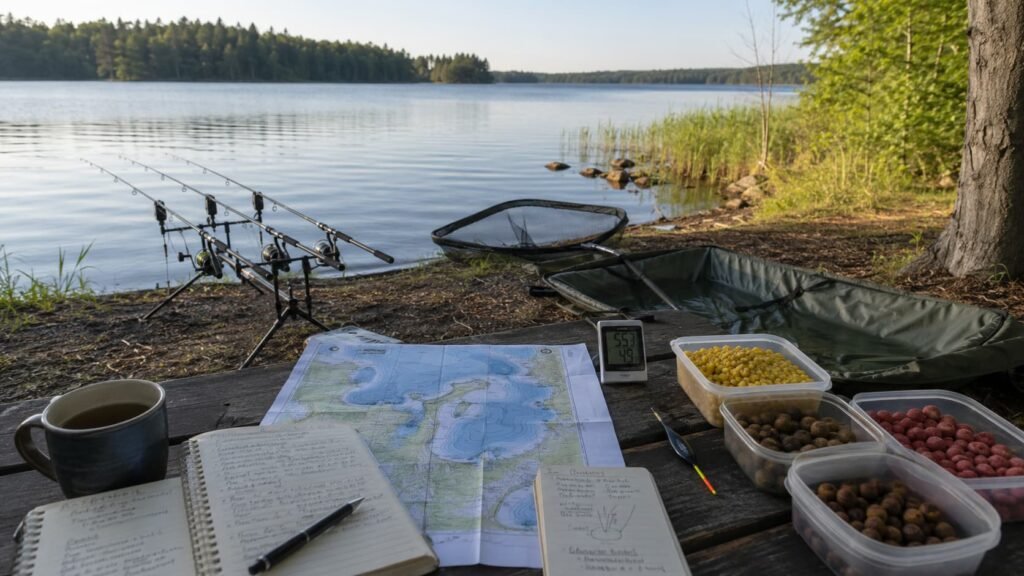
Build a Better Fishing Plan
Carp session planning is where watercraft becomes a practical fishing plan instead of just a collection of separate clues.
It is easy to learn about water temperature, wind, depth, weed, oxygen, bait, bite windows and rigs as separate subjects.
The harder part is turning those clues into a plan that makes sense on the water.
Where should you start?
Which swim should you choose?
Should you fish shallow or deep?
Should you bait lightly or heavily?
Should you prepare for dawn, dusk, night, or a weather window?
Should you fish the wind or the back of it?
Should you commit to one area or stay mobile?
Should you move when nothing happens?
Good session planning helps answer those questions before the rods go out.
It does not guarantee success. Carp fishing is still fishing. But it gives every rod a reason, every baiting decision a purpose, and every adjustment a logical order.
This guide explains how to build a Michigan carp fishing session plan using season, water temperature, wind, depth, weed, oxygen, bite windows, access, safe landing, baiting, rod placement and on-the-water adjustments.
For the full conditions hub, read Watercraft and Conditions for Michigan Carp Fishing.
Quick Answer
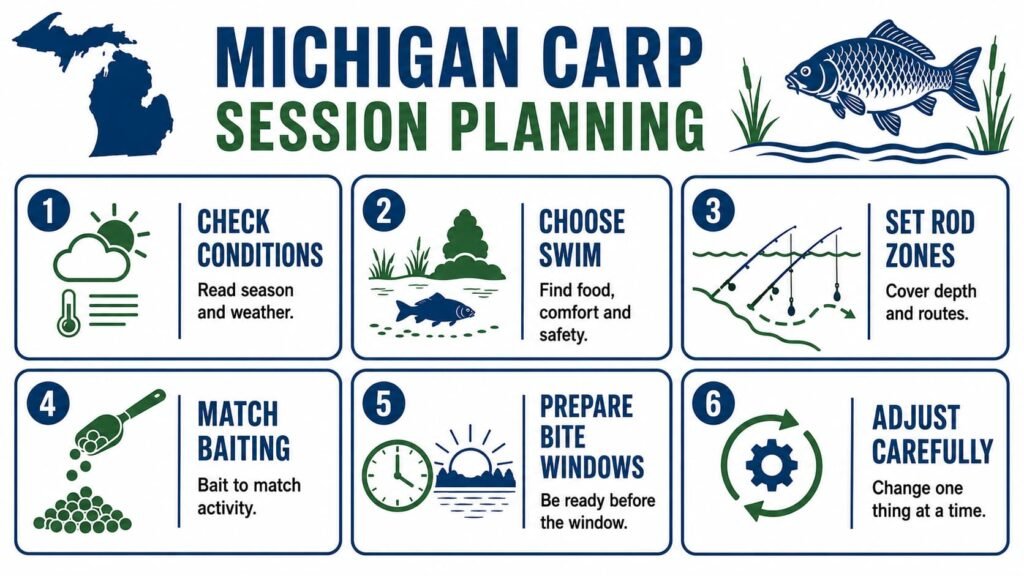
A good carp session plan starts with conditions, then swim choice, then rod placement, then baiting, then bite-window timing, then careful adjustment.
| Planning Stage | Main Question | Practical Decision |
|---|---|---|
| Season | what are carp likely doing now? | warming, spawning, summer oxygen, fall feeding, cold holding |
| Conditions | what is the water doing today? | temperature, wind, oxygen, light, pressure, traffic |
| Location | where do food, comfort and safety overlap? | choose the best fishable zone |
| Depth | shallow, mid-depth or deeper? | match depth to temperature, oxygen and routes |
| Features | what gives carp a reason to visit? | weed, reeds, inflow, silt, bars, shelves, channels |
| Bite windows | when is the area likely to switch on? | dawn, dusk, night, wind, weather, oxygen, pressure |
| Baiting | how much feed suits the situation? | start light, build only with evidence |
| Adjustment | what should change first? | location, timing, presentation, then bait |
The key rule is:
Do not plan around the gear you want to use. Plan around what the water is telling you.
Quick Session Planning Framework
Use this framework before each session.
| Step | Action | Why It Matters |
|---|---|---|
| 1 | Check season and weather trend | tells you the likely carp mood |
| 2 | Read temperature and oxygen clues | helps identify comfort water |
| 3 | Study wind, waves and current | shows food, cover and movement |
| 4 | Choose fishable features | puts rods near reasons carp visit |
| 5 | Decide rod zones | covers feeding, route and comfort areas |
| 6 | Match baiting to activity | avoids overfeeding dead water |
| 7 | Prepare for bite windows | keeps you ready when the chance opens |
| 8 | Adjust carefully | prevents random changes and panic moves |
A session plan should be simple enough to use, but strong enough to guide decisions when conditions change.
Start With the Season
Every session starts with the season.
Michigan carp do not behave the same all year.
A plan that makes sense in April may be wrong in July.
A summer night plan may not work in late October.
A fall feeding plan may be too heavy for very cold spring water.
Before thinking about bait or rigs, ask:
- Is the water warming or cooling?
- Is it early spring, pre-spawn, summer, fall or cold-water fishing?
- Are carp likely to be shallow, deep, moving, feeding or holding?
- Is oxygen likely to matter?
- Is boat traffic likely to affect timing?
- Is weed growing, healthy, dying or gone?
- Are bite windows likely to be short or extended?
Season gives the first direction.
The plan should then be refined by the actual conditions in front of you.
Spring Session Planning
Spring planning often revolves around warming water.
Carp may move into shallow bays, dark-bottom areas, reed edges and margins when the sun and wind raise local temperatures.
Spring plan priorities:
- find warming shallows
- look for bays near deeper water
- watch for fish before casting
- bait lightly
- fish small, attractive hookbaits
- avoid heavy feeding too early
- prepare for afternoon windows
- check warm wind direction
- look for early weed or reed lines
- keep disturbance low
In spring, the best swim may not be the deepest water or the easiest campsite.
It may be the shallow area that warms first.
For seasonal temperature detail, read Carp Water Temperature Guide for Michigan Lakes.
Summer Session Planning
Summer planning often revolves around oxygen, weed, low light and pressure.
Carp may feed strongly, but they may avoid hot, stagnant, disturbed or brightly lit areas during the day.
Summer plan priorities:
- check oxygen clues
- fish healthy weed edges
- consider dawn, dusk and night
- watch boat traffic
- look for wind ripple
- check inflows
- use shade and deeper comfort water
- avoid stagnant dying weed
- bait carefully in heat
- keep fish care organized
In summer, a swim can be poor at noon and excellent at night.
Do not judge the whole session by one time period.
For oxygen decisions, read Dissolved Oxygen and Carp Fishing.
Before any longer session, check the latest local weather, wind and storm risk from the National Weather Service, and confirm current access or fishing rules where required.
Fall Session Planning
Fall planning often revolves around food, cooling trends and routes toward deeper comfort.
Carp may feed hard before winter, but conditions can change quickly.
Fall plan priorities:
- find feeding flats near deeper routes
- look for remaining healthy weed
- use food-value bait carefully
- watch wind-blown food lines
- check silt and natural food areas
- prepare for longer feeding spells during stable conditions
- reduce bait after sharp cold fronts
- track water temperature
- fish routes between food and safety
Fall can be one of the best times for bigger carp, but only if the plan follows the cooling trend.
Cold-Water Session Planning
Cold-water planning is about location, patience and minimal bait.
When water is very cold, carp may not move far. Feeding windows may be short.
Cold-water plan priorities:
- locate fish before baiting
- use minimal bait
- fish high-attraction hookbaits
- target stable water
- watch the warmest part of the day
- fish small PVA or single baits
- stay accurate
- avoid overfeeding
- be patient
- keep safety in mind
In cold water, a single bait in the right place can beat a full baiting campaign in dead water.
Read the Water Before Setting Up
The biggest session-planning mistake is setting up before reading the lake.
Do not unload everything first.
Do not build the bivvy first.
Do not put rods out just because a swim is comfortable.
Watch the water first.
Walk if possible.
Use polarized glasses.
Check wind direction.
Look for bubbles, clouding, rolling, bow waves, birds, baitfish, weed edges, color changes and surface drift.
Ask:
- where are the carp likely to be?
- where is the food?
- where is the comfort?
- where is the safety?
- where can I land fish properly?
- what is the likely bite window?
- what is the lowest-disturbance way to fish it?
For the full lake-reading process, read Reading a Lake Like a Carp Angler.
Choose the Swim Last
This may sound strange, but the swim should be chosen after the water has been read.
The order should be:
- find the likely carp zone
- check if it can be fished safely
- choose the swim that gives the best angle
- set rods based on features and routes
- build the session around the bite windows
If you choose the swim first, you may end up fishing water that is convenient but not productive.
A good swim gives access to:
- food
- comfort
- routes
- safe landing
- fishable depth
- good line angles
- sensible baiting
- legal access
- low disturbance
A poor swim may have a nice view, easy parking and no carp reason at all.
Build the Plan Around Four Questions
A simple carp session plan can be built around four questions.
Question 1: Where Will Carp Be Comfortable?
Think temperature, oxygen, depth, shade, weed, wind and stability.
Question 2: Where Will Carp Find Food?
Think natural food, weed, silt, snails, mussels, reeds, particles, baited areas and wind-blown food.
Question 3: How Will Carp Move?
Think routes, shelves, channels, bay entrances, weed edges, margins, points and deeper access.
Question 4: Can I Fish and Land Them Safely?
Think snags, weed, line angle, bank access, landing net, unhooking mat, night safety and boat traffic.
When all four answers point to the same area, you have the start of a real plan.
Planning Rod Zones
Do not place rods randomly.
Each rod should test a specific idea.
A strong three-rod plan might include:
Rod 1: Feeding Zone
Fish the area where carp are likely to feed: weed edge, silt patch, reed line, clear hole, margin, flat or natural food area.
Rod 2: Route Zone
Fish the route carp may use to enter or leave the feeding area: shelf, channel, point, bay mouth, weed edge or depth transition.
Rod 3: Comfort Zone
Fish the area where carp may hold or pass through when not actively feeding: deeper edge, shade, inflow, oxygen line, or safer water near the food.
This gives you information.
If only the route rod gets liners, carp may be moving but not settling.
If the feeding rod produces, the baited area may be right.
If the comfort rod produces in heat, oxygen or depth may be the key.
Use the rods to learn, not just to cover water.
Match Depth to the Plan
Depth should not be chosen by habit.
It should match the season and conditions.
Spring may point shallow.
Summer may point to weed edges, oxygen, low light or deeper comfort.
Fall may point to feeding flats near deeper routes.
Cold water may point to stable holding areas.
Ask:
- is shallow water warming or too hot?
- is mid-depth a route?
- is deeper water comfort or dead water?
- is there food at that depth?
- is there oxygen?
- can I present properly?
- can I land fish safely?
For the full guide, read Best Depth for Carp Fishing in Michigan Lakes.
Match Wind and Water Movement to the Plan
Wind can change the whole session.
A warm wind may push fish shallow in spring.
A summer wind may improve oxygen.
A crosswind may create a food lane.
A windward weed edge may come alive.
A cold wind may shut down shallow water.
A strong unsafe wind may force a safer swim choice.
Plan for:
- current wind
- forecast wind change
- wind direction overnight
- whether the wind is warm or cold
- where food and surface drift will go
- whether lines can be controlled
- whether landing is safe
For the full guide, read Wind, Waves and Current for Michigan Carp Fishing.
Match Weed and Cover to the Plan
Weed can be a feature, a food source, an oxygen clue and a risk.
Good weed planning asks:
- is the weed healthy?
- are there clear holes?
- can I fish the edge?
- is there natural food?
- can I land fish safely?
- is the line angle safe?
- will carp use it at dawn, dusk or night?
- does the weed connect to depth?
Do not fish the thickest weed just because carp are there.
Fish the part of the weed system that can be presented to and landed from safely.
For the full guide, read Weed Beds and Carp Fishing in Michigan.
Plan the Bite Windows
A session plan should include timing.
Do not treat all hours as equal.
Ask:
- what is the likely first bite window?
- is dawn important?
- will dusk be better?
- is night likely to bring fish shallow?
- will boat traffic change the timing?
- will wind or weather create a window?
- will oxygen improve later?
- is spring afternoon warmth the key?
- should bait go in before the window or during it?
If the best window is dusk, do not disturb the swim at sunset.
If the best window is dawn, do not start setting up at dawn.
If the night margin is the key, prepare before dark.
For the full timing guide, read Bite Windows for Carp Fishing in Michigan Waters.
Match Baiting to the Plan
Baiting should match carp activity, not angler enthusiasm.
A good baiting plan asks:
- are fish present?
- are they feeding?
- is the water cold or warm?
- is oxygen good?
- are nuisance fish active?
- is the bottom clean?
- is the area safe?
- is this a short window or a long feeding spell?
- will bait pull fish into danger?
- should I start light?
General guide:
| Situation | Baiting Plan |
|---|---|
| Cold water | single bait, small PVA, minimal feed |
| Spring warming | light bait, small top-ups |
| Summer oxygen window | controlled bait near comfort zones |
| Night margin | bait carefully before dark |
| Fall feeding | steady food bait if fish confirm it |
| Unknown swim | start light and build from signs |
| Heavy weed | tight baiting on safe edges or holes |
| High nuisance fish | tougher hookbaits and controlled feed |
A good rule:
Let carp activity earn more bait.
Do not feed heavily just because the session is long.
Build a Short Session Plan
A short session needs efficiency.
You may not have time to wait for fish to find you.
Short-session priorities:
- fish known or visible signs
- avoid heavy baiting
- use quick attraction
- keep setup simple
- arrive before the likely window
- fish accurately
- move if the signs are elsewhere
- do not waste time overcomplicating rigs
- watch constantly
A short session is not the time to run a large baiting experiment unless you already know the water.
Build an Overnight Plan
An overnight plan should be built around dusk, night and dawn.
Priorities:
- choose safe landing before dark
- prepare rigs and bait early
- set camera/fish-care gear
- check headlamp and batteries
- place rods before the window
- reduce bank noise
- think margin and route rods
- keep baiting controlled
- plan for boat traffic changes
- keep personal safety in mind
Many overnight mistakes happen before dark.
If the swim is not organized, the best bite window can become chaos.
Build a Multi-Day Campaign Plan
A multi-day session gives you more time, but it also creates more ways to overdo it.
Priorities:
- start with observation
- record bite times and signs
- bait progressively
- keep one rod experimental
- adjust by evidence
- watch weather changes
- rest swims if needed
- avoid over-baiting dead water
- learn routes
- refine rod zones
- keep fish care consistent
On longer trips, the first 24 hours are often as much about learning as catching.
If one area shows signs, build around it.
If a planned swim stays dead and another zone comes alive, move or adjust.
The Adjustment Order
This is one of the most important parts of session planning.
When nothing is happening, do not randomly change everything.
Use an adjustment order.
1. Location
Are you near carp?
If not, bait and rigs may not matter.
2. Timing
Is the area likely to switch on later?
If the swim is a dusk or night swim, patience may be better than moving.
3. Presentation
Is the rig fishing properly?
Check weed, debris, soft bottom, tangles, line angle and lead placement.
4. Baiting
Is there too much bait, too little bait, wrong spread, wrong timing or nuisance fish?
5. Hookbait
Only after the bigger decisions should you worry about color, flavor or size.
This order stops panic.
Most failed sessions are not caused by the wrong tiny hookbait detail.
They are caused by wrong location, wrong timing, poor presentation, or over-baiting.
Small Adjustment or Full Reset?
When a session starts going wrong, the important decision is whether you need a small adjustment or a full reset.
A small adjustment is right when the overall plan still makes sense, but one detail needs improving.
Examples include:
- moving one rod to a cleaner patch
- changing the line angle
- trimming the baiting down
- moving from the middle of fish activity to the edge of it
- waiting for the better bite window
- fishing slightly closer to weed, shade or cover
- reducing disturbance and letting the swim settle
A full reset is different.
A full reset is needed when the whole picture has changed. That might happen because the wind has shifted, the swim has lost warmth, boat traffic has ruined the area, fish are repeatedly showing elsewhere, the water has gone flat and exposed, or the original feature no longer offers food, comfort or safety.
Do not make a full move because you are bored.
Do not sit stubbornly when the lake is clearly telling you the plan has failed.
The best mid-session adjustment comes from reading evidence, not emotion.
When fish are showing but not feeding, do not assume the whole swim is wrong. They may be moving through, holding off the bait, feeding nearby rather than directly where they show, or reacting to pressure. In that situation, it is often better to fish the edge of the activity, improve presentation, reduce disturbance, or move one rod rather than ripping the whole session apart.
Good session planning is not about never changing.
It is about changing the right thing, at the right time, for the right reason.
When to Move
Moving can save a session.
It can also ruin one if done emotionally.
Move when evidence supports it.
Good reasons to move:
- repeated fish signs elsewhere
- no signs in your area
- wind changes the lake
- the swim becomes unsafe
- boat traffic ruins the area
- bait is untouched and water feels dead
- carp are clearly using another depth
- weed or debris makes presentation poor
- oxygen clues shift
- a better bite window opens elsewhere
Poor reasons to move:
- boredom
- one quiet hour
- copying another angler blindly
- changing because you want action
- lack of confidence with no evidence
- abandoning a swim just before its likely window
A move should be a decision, not a reaction.
When to Stay
Staying can also be the right choice.
Stay when:
- the bite window has not arrived yet
- fish signs are present
- liners are happening
- the swim has food, comfort and safety
- weather trend still supports the area
- the wind is building in your favor
- baiting needs time
- moving would cause more disturbance
- the best period is dawn, dusk or night
Good anglers know the difference between patience and stubbornness.
Patience has a reason.
Stubbornness ignores evidence.
The First Cast Rule
The first cast should be based on a plan.
Before each rod goes out, you should be able to say:
- why this spot?
- why this depth?
- why this baiting level?
- why this hookbait?
- why now?
- how will I land the fish?
- what will make me move or adjust?
If you cannot answer those questions, pause.
Read the water again.
Pre-Session Planning Checklist
Before leaving home, check:
- weather forecast
- wind direction
- temperature trend
- likely bite windows
- legal access
- night rules
- campsite rules if relevant
- bait quantity
- fish-care gear
- landing access
- safety weather
- backup swim options
- map or satellite view
- previous notes
- likely depth zones
- weed or snag risk
- power and camera needs if filming
This is not the same as a full gear checklist.
It is the fishing plan.
The separate session checklist can handle every item of equipment.
On-Bank Planning Checklist
Before rods go out, check:
- visible fish signs
- wind direction
- water clarity
- weed condition
- safe landing area
- line angles
- depth options
- baiting plan
- first likely bite window
- whether the swim matches the season
- whether each rod has a job
- whether you have a reason to stay
If the swim does not answer enough questions, keep looking.
Common Session Planning Mistakes
The lake decides the plan, not the tackle bag.
Mistake 1: Planning Around Gear Instead of Water
Comfortable swims are good only if carp have a reason to be there.
Mistake 2: Choosing Comfortable Swims First
Heavy bait too early can ruin cold water, short windows or uncertain swims.
Mistake 3: Over-Baiting Early
Mistake 4: Ignoring Bite Windows
The best area may only feed at certain times.
Mistake 5: Changing Everything at Once
Change one major thing at a time or you will not know what worked.
Mistake 6: Ignoring Safe Landing
A swim is not good if fish cannot be landed and released properly.
Mistake 7: Not Watching Enough
Observation is part of fishing.
Mistake 8: Refusing to Move
If the water tells you the plan is wrong, adjust.
Mistake 9: Moving Without Evidence
Do not move just because you are impatient.
Mistake 10: Not Keeping Notes
Without notes, every session starts from zero.
Session Notes That Actually Help
After each session, record:
- date
- water
- swim
- conditions
- wind direction
- water temperature
- air temperature
- depth of each rod
- baiting amount
- hookbait
- bite times
- fish signs
- liners
- lost fish
- nuisance fish
- weed condition
- oxygen clues
- boat traffic
- what changed
- what you would do next time
The most important note is often:
Why did the bite happen when it did?
That question turns catches into patterns.
How This Article Fits the Watercraft Section
This Session Planning article is the final “put it together” piece in the Watercraft & Conditions menu.
The other articles teach the ingredients:
- temperature
- depth
- lake reading
- wind and current
- weed and cover
- oxygen
- bite windows
This article shows how to turn those ingredients into a fishing plan.
It should be used after reading the individual guides, or before a real session when you need to make decisions.
FAQ
What is carp session planning?
Carp session planning means building a fishing plan before and during a session using season, conditions, location, depth, baiting, bite windows, access and safe landing.
What should I plan first for a carp session?
Plan location first. Before bait, rigs or gear, work out where carp are likely to be and whether you can fish that area safely.
Should I choose bait or swim first?
Choose the swim first based on carp location and watercraft. Bait should support the location plan, not replace it.
How much bait should I take for a carp session?
That depends on season, session length, fish activity, nuisance fish and water temperature. Start lighter when uncertain and build only when carp activity supports it.
Should I move swims if I am not getting bites?
Move if evidence supports it, such as fish showing elsewhere, changing wind, unsafe conditions or a dead swim. Do not move just from boredom.
What is the best three-rod plan?
A good starting plan is one rod on a feeding area, one on a route, and one on a comfort or backup zone. Adjust based on signs and bites.
How do bite windows affect session planning?
Bite windows decide when a good area is most likely to feed. Plan baiting, rod placement and disturbance around the likely window.
How do I plan a summer carp session?
Focus on oxygen, weed, wind, inflows, dawn, dusk, night, boat traffic and safe fish care in warm conditions.
How do I plan a spring carp session?
Look for warming shallows, protected bays, reed edges, dark bottom, warm wind and nearby deeper water. Bait lightly until fish confirm activity.
What is the biggest session planning mistake?
The biggest mistake is choosing a convenient swim and trying to make it work, instead of finding where carp have a reason to be.
Final Takeaway
Carp session planning turns watercraft into action.
It takes the separate clues — season, temperature, wind, depth, weed, oxygen, light, bite windows, food, pressure and access — and turns them into a practical fishing plan.
A good plan answers simple questions:
Where are carp likely to be?
Why would they be there?
When will they feed?
How should each rod be placed?
How much bait makes sense?
Can the fish be landed safely?
What will I change if the plan stops matching the water?
Do not plan around habit.
Do not plan around comfort.
Do not plan around the bait you want to use.
Plan around the lake.
Read the water first.
Choose the swim last.
Give every rod a job.
Prepare before the bite window.
Bait according to activity.
Adjust carefully.
Then write down what happened.
That is how sessions become patterns, and patterns become consistent carp fishing.
For the main hub, read Watercraft and Conditions for Michigan Carp Fishing.
For lake-reading strategy, read Reading a Lake Like a Carp Angler.
For water temperature decisions, read Carp Water Temperature Guide for Michigan Lakes.
For depth choices, read Best Depth for Carp Fishing in Michigan Lakes.
For wind and moving water, read Wind, Waves and Current for Michigan Carp Fishing.
For oxygen decisions, read Dissolved Oxygen and Carp Fishing.
For bite timing, read Bite Windows for Carp Fishing in Michigan Waters.
For all guides organized by topic, visit the Michigan Carp Guide Library.