

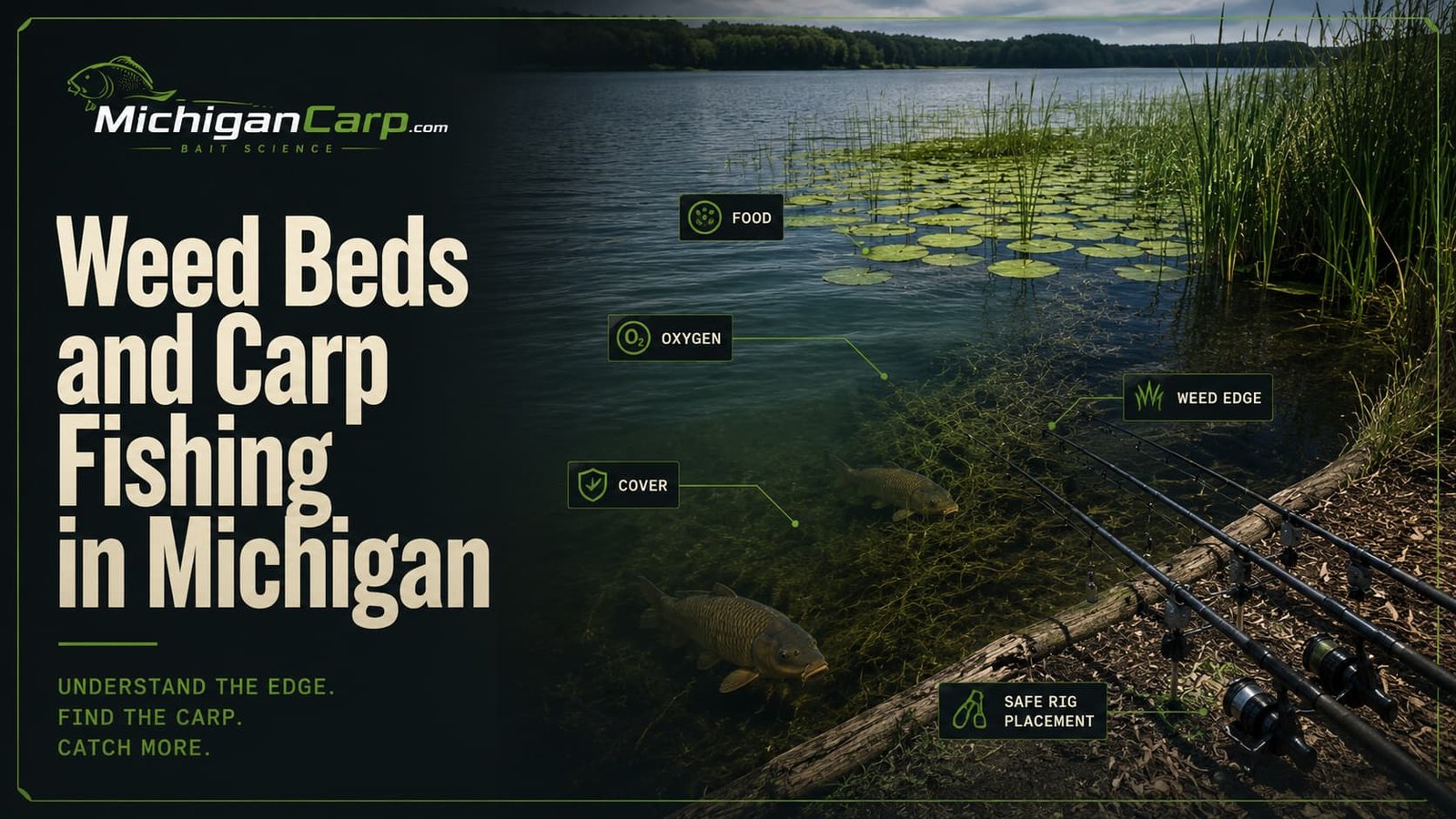
Weed beds and carp fishing go together because aquatic vegetation gives carp food, oxygen, cover, shade, patrol routes and confidence. On many Michigan lakes, weed is not just something to avoid. It is often one of the strongest signs that the lake has life in it.
But weed is also one of the easiest features to fish badly.
A clean open area may look easier to fish, but carp may be using the edge of the weed. A shallow bay may look lifeless until you notice bubbles along the pad line. A lily pad bed may seem awkward, but the outside edge may be a regular patrol route. A clear hole in weed can be a feeding spot. A green weed edge with ripple on it can hold oxygen, snails, insects, cover and carp movement.
At the same time, weed can be dangerous if you fish it carelessly. A spot full of carp is not a good swim if every hooked fish will bury itself, break you off, or be dragged through thick vegetation. Proper weedcraft means finding the fish, but it also means choosing areas where you can hook, play, net and release carp safely.
This guide explains how Michigan carp use weed beds, lily pads, reeds and aquatic vegetation, how to read weed properly, where to place rigs, when weed helps oxygen and natural food, and when to leave a swim alone because it is not safe to fish.
For the wider condition-reading system, start with Watercraft and Conditions for Michigan Carp Fishing. For moving water, read Wind, Waves and Current Carp Fishing. For oxygen, use Dissolved Oxygen and Carp Fishing.
Table of Contents
Quick Answer: How to Fish Weed Beds for Carp
The best weed beds for carp fishing usually offer food, oxygen, shade, cover and safe presentation. The most important word is safe. Weed is only useful if you can present a rig cleanly, control the hooked fish and land it without causing unnecessary stress or break-offs.
Do not automatically cast into the thickest weed. The better spot is often the outside edge, a clean hole, a channel, a reed line, the open-water side of pads, or a hard/soft transition close to the vegetation. Carp may spend time inside thick cover, but they often feed where the weed meets fishable water.
| Weed feature | Why carp use it | Best fishing thought |
|---|---|---|
| Outside weed edge | Food, cover, patrol route and oxygen | Fish the safe edge, not the thickest growth |
| Clear hole in weed | Natural feeding spot and clean presentation area | Place a rig accurately and bait with control |
| Lily pad edge | Shade, food, cover and safety | Fish the open edge, not the impossible middle |
| Reeds | Insects, silt, shade, margins and routes | Watch for bubbles, clouding and reed movement |
| Healthy green weed | Oxygen, cover and natural food | Fish safe edges, gaps and nearby patrol routes |
| Dying weed | Can create poor comfort and foul presentation | Avoid the worst areas and find cleaner edges |
| Weed near depth | Food and escape water close together | Strong seasonal location, especially in summer and fall |
| Weed with wind ripple | Oxygen, cover, food movement and confidence | Check for carp signs before baiting heavily |
The key rule is simple:
Fish the weed you can present to and land from safely.
Why Weed Beds Matter to Carp
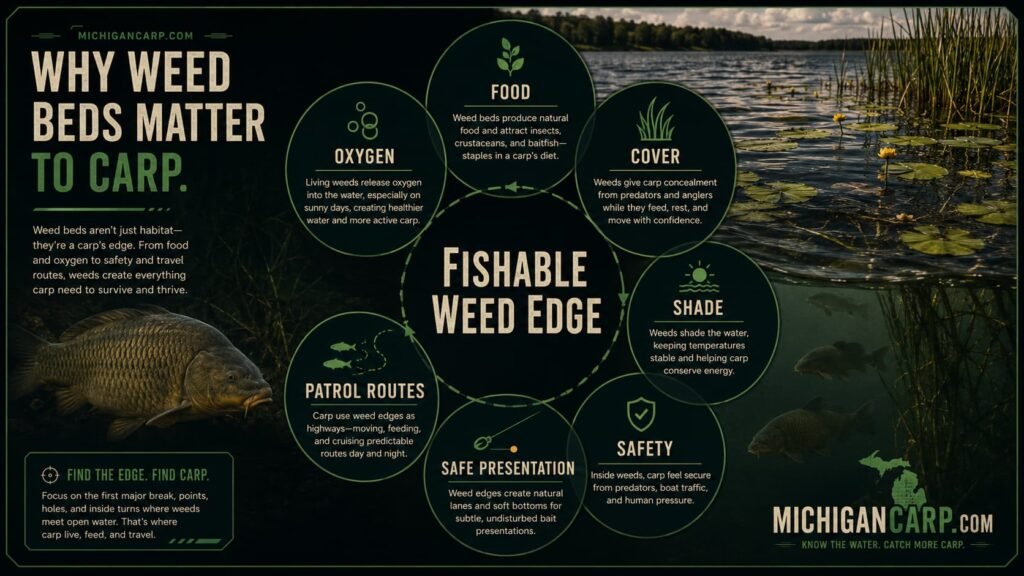
Weed beds matter because they make a lake more alive.
Healthy aquatic vegetation can hold small insects, snails, shrimp-like invertebrates, baitfish, crayfish, silt life and natural food. It can give carp shade from bright sun, cover from disturbance, a place to patrol, and a safer route along the edge of open water.
Michigan EGLE describes native aquatic plants as important to inland lakes because they oxygenate water and provide habitat and food resources for fish and wildlife. For the environmental background, read Michigan EGLE: Native Aquatic Plants.
For carp, that turns into practical watercraft. Weed can act like a supermarket, shelter and travel corridor at the same time. On many Michigan lakes, weed is part of the carp’s daily life. The question is not whether weed matters. The question is whether you can fish that weed safely and effectively.
Good weed beds often have variety. They are not just one solid carpet of vegetation. They may include outside edges, inside lines, reed margins, clear holes, open channels, pad edges, hard spots, silt pockets, depth changes, wind ripple, inflows, shade and nearby open water.
The best spots often stack clues. A weed edge plus depth change. A weed edge plus wind. A clear hole plus bubbles. A reed line plus silt clouding. A pad edge plus low-light movement. A green weed bed beside deeper water. Those combinations are usually more useful than the weed alone.
Weed Is Cover, Food and Risk
Weed is attractive because carp like comfort and security. But weed also creates risk for the angler and for the fish.
A carp that picks up a rig near thick weed can reach cover quickly. If the line angle is poor, the hooklink is too light, the lead setup is unsafe, or the angler is too far away from a safe landing position, the fish can become weeded. That can cause break-offs, lost fish, long fights and unnecessary stress.
This is why weed fishing should be planned before you cast. Do not just ask, “Are the carp there?” Ask, “Can I catch one safely from here?”
A good weed swim needs a clear plan. You should know where the clean presentation area is, where the fish is likely to run, which angle keeps it away from the worst weed, where you will net it, and whether the bank gives you enough control.
Safe weed fishing often means fishing the edge rather than the middle. It means using strong enough tackle for the situation. It means keeping rods close enough to react. It means avoiding impossible snags. It means having the net, mat and sling ready before the rod goes out.
No carp is worth leaving a rig in a fish or dragging a fish through unsafe weed just to prove a point.
For rig safety, use The Complete Michigan Carp Rig Guide. For handling and release, use Fish Care and Safety.
Finding the Fishable Weed Edge
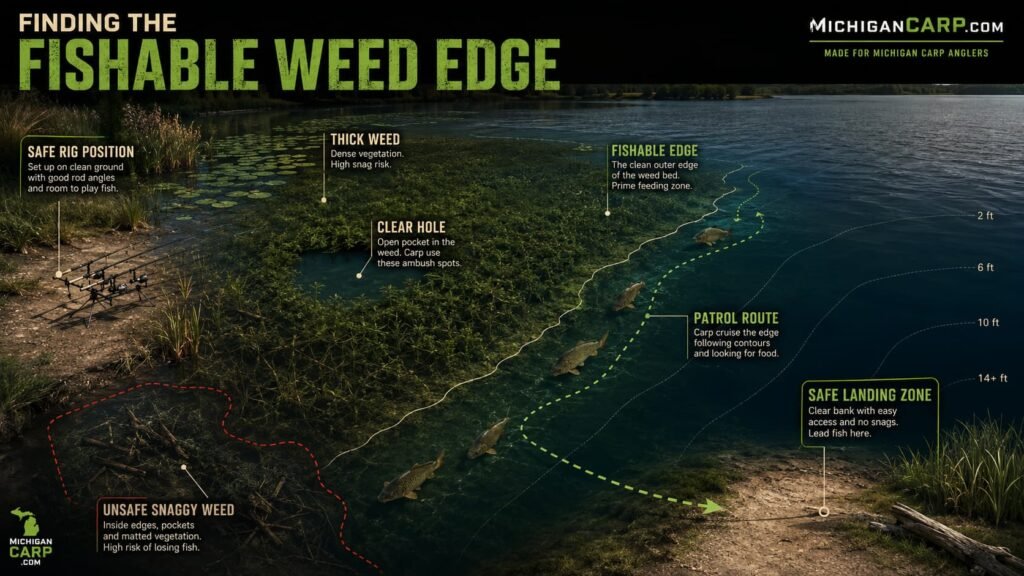
The fishable weed edge is where the weed gives carp confidence but still lets you fish properly.
This might be the outside edge of a submerged weed bed, a clear line beside pads, a gap between reeds and open water, a channel through cabbage, a clean sandy strip along a dark weedline, or a small hard spot where carp have been feeding. The key is that the rig can sit cleanly and the hooked fish can be controlled.
From the bank, start by reading the visible edge. Look for changes in color, small openings, reed movement, fizzing, clouded water, tails, slicks, liners, flat spots, floating debris caught along a line, and repeated carp shows. Weed edges often reveal themselves by how the water behaves around them.
A good weed edge is rarely a perfect straight line. It may have points, bays, inside corners, outside corners, holes, channels and shelves. Carp often use these irregularities like routes. They move along the edge, cut through gaps, pause in holes and feed where natural food collects.
Do not ignore small differences. A five-foot clean patch beside thick weed can be better than a large open area with no cover. A slight indentation in the weedline can hold food. A narrow channel through pads may be the route carp use every evening. A windward reed edge can outfish a visually perfect flat calm bay.
When you find a fishable edge, fish accurately. Weed fishing is not usually improved by throwing bait everywhere. It is improved by placing bait and rigs where carp can use them and where you can land the fish.
Clear Holes in Weed
Clear holes in weed can be excellent carp spots.
A clear hole may be a natural opening, a feeding spot, a hard patch, a silt pocket, an area kept open by carp activity, or simply a place where weed growth is thinner. It gives you two advantages at once: carp can use the safety of nearby weed, and you can present a rig cleanly.
The mistake is assuming every hole is worth fishing. Some holes are too small, too deep in the weed, too far from a safe landing angle, or too difficult to fish without dragging hooked carp through vegetation.
A good hole should give you a clean presentation and a realistic route to the net. Ideally, it should be close to the weed edge, close to a patrol route, or close to signs of feeding. If you can drop a rig into it accurately and control the fish immediately after the bite, it can be excellent.
Use accurate baiting. A handful of chopped boilies, corn, tiger nuts, crumb, hemp, or small particles placed tightly can be better than a wide bed of bait that pulls fish into the wrong angle. Do not bait so heavily that fish bury themselves deeper into the weed before picking up the hookbait.
In clear holes, rig concealment and clean presentation matter. Keep the rig simple, check that the hook is not fouled, and avoid overly complicated presentations that will catch weed before a carp finds them.
Lily Pads and Carp Fishing
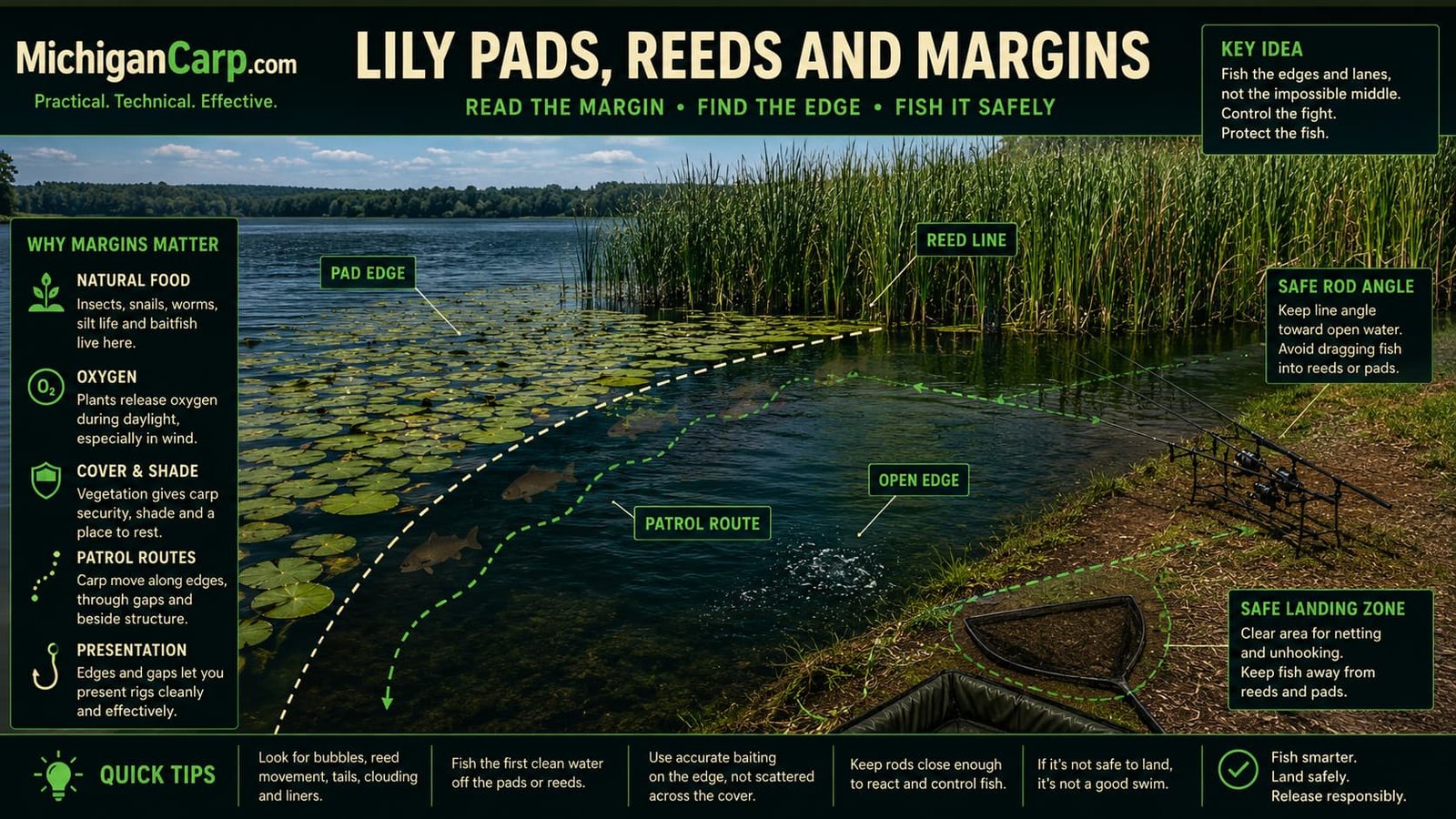
Lily pads are classic carp cover.
They provide shade, surface cover, food and edges. Carp may sit under pads, patrol around them, feed beside them, or use them during bright conditions. On quiet lakes, a pad edge can become a regular route.
But lily pads can also be difficult and risky. The middle of a pad bed may look exciting, but it may be almost impossible to land fish safely if a carp bolts through the stems.
Better areas are usually the outside pad edge, open pockets beside pads, channels through pads, pads beside open water, pads near a reed line, pads on a windward edge, or pads close to a clean landing area.
The best pad fishing is controlled. Fish the open edge, not the impossible heart of the bed. Keep the rod angle sensible. Use strong enough tackle. Stay close to the rods. Have the net ready. If the pads are too thick to land a fish safely, do not fish them.
Carp may show themselves around pads through small movements rather than obvious rolling. Watch for pads shaking, stems ticking, bubbles appearing along the edge, water clouding behind the pads, or fish pushing quietly through gaps. The signs can be subtle, but once you learn them, pad beds become much easier to read.
Reeds, Rushes and Margins
Reeds and rushes are strong carp features because they combine margin cover, insects, shade, silt, food and safety. On some Michigan lakes, carp will patrol reed edges like a fence line.
Reed beds often show feeding signs. Bubbles can appear along the stems. The water may cloud where carp root in soft bottom. Reeds may knock or twitch as fish move through. You may see tails, backs, or flat spots appear along the edge.
The best reed fishing is usually close but controlled. A bait placed tight to the reeds can be effective, but only if you can stop the fish getting buried. Sometimes the better rig position is a foot or two off the reeds rather than right inside them. That gives you a cleaner hookbait and a better angle when the fish moves off.
Do not ignore depth beside reeds. A shallow reed edge near a drop-off, channel, darker bottom, inflow or wind line can be far stronger than a shallow reed edge with no route in or out. Carp need a reason to visit and a safe way to leave.
Reeds are also important for fish care decisions. Steep banks, submerged roots, timber, mussels, rocks, and dense stems can turn a good-looking margin into a high-risk swim. If the landing area is poor, move to a better angle or choose a safer edge.
Healthy Weed, Dying Weed and Oxygen
Healthy green weed and dying weed are not the same thing.
Healthy weed can provide oxygen during daylight, hold natural food, create shade, break up light and give carp cover. A green weed edge with wind ripple can be one of the most reliable summer features on a Michigan lake.
Dying weed is different. Rotting vegetation can foul rigs, trap line, smell bad, create poor presentation, reduce comfort and make fish harder to land. It may also indicate that a once-productive summer area is changing.
USGS explains that dissolved oxygen is important to aquatic life and that cold water can hold more oxygen than warm water. Michigan DNR also notes that fish kills can occur where oxygen production and oxygen use fall out of balance, especially in productive systems with vegetation and algae. For more background, read USGS: Dissolved Oxygen and Water and Michigan DNR: Information About Fish Kills.
For carp anglers, the practical lesson is not to avoid all weed. It is to separate good living weed from poor decaying weed. Remaining green edges, cleaner channels, open holes and nearby deeper routes can still be excellent even when some of the weed is dying back.
This is especially important in late summer and fall. Carp may not abandon a weed area completely, but they often shift to the cleaner edge, the outside line, the nearest depth, or the remaining healthy growth.
For the full oxygen guide, read Dissolved Oxygen and Carp Fishing. For fall changes, use Fall Carp Fishing in Michigan.
Wind, Weed Beds and Bite Windows
Wind can turn weed beds on.
A flat calm weed bed may hold fish but be hard to catch from. Bright light, still water and heavy surface cover can make carp cautious. Add a steady ripple and the same edge may become more comfortable. The wind can move food, improve surface oxygen, create color, break up light and give carp confidence to feed closer to the edge.
This does not mean every windy weed bed is good. A cold wind can chill shallow water. A violent wind can make presentation unsafe. Wind can also push floating weed and debris into your line. But a useful wind on the right weed edge is one of the strongest summer clues.
Look for wind hitting the outside edge of weed, ripple running along pad lines, wave movement into reeds, colored water beside vegetation, foam or pollen collecting along a weedline, and carp showing just inside or just outside the ripple.
Weed beds also create bite windows. Carp may feed at dawn along the open edge, sit buried through bright daylight, then move again at dusk or after dark. In hot weather, the best time may be when oxygen, low light, safety and food overlap.
That is why weed belongs with the new watercraft chain: Wind, Waves and Current, Dissolved Oxygen and Carp Bite Windows in Michigan.
Seasonal Weed Decisions
Weed changes throughout the year, and carp change with it.
In spring, new weed growth can be a strong clue because it often connects to warming shallows, insects, dark bottom, cover and early natural food. At this stage, carp may use the first useful green growth, reed edges, shallow bays and nearby depth. But cold nights and fronts still matter, so do not fish shallow weed blindly just because it looks good.
In summer, weed becomes a major part of carp location. It can hold food, oxygen, shade and security. The best fishing is often around safe edges, clear holes, wind-rippled weed, pads, reeds, inflows and low-light windows. This is when weed can be excellent, but also when heavy weed and hot water create the biggest fish-care risks.
In fall, weed begins to change. Some areas remain productive, especially where green weed, natural food and nearby depth continue to line up. Other areas become poor as vegetation dies, fouls the bottom or loses oxygen value. Fall weed fishing is about finding the remaining useful weed, not fishing summer memories too long.
In winter or cold water, weed is less obvious as a daily food factory, but remaining vegetation, softer bottom, shelter and nearby depth can still matter. Access and safety become more important than trying to force summer-style weed fishing into cold conditions.
Use Michigan Carp Fishing Seasons to match weed decisions to the time of year.
Rig Placement in Weed
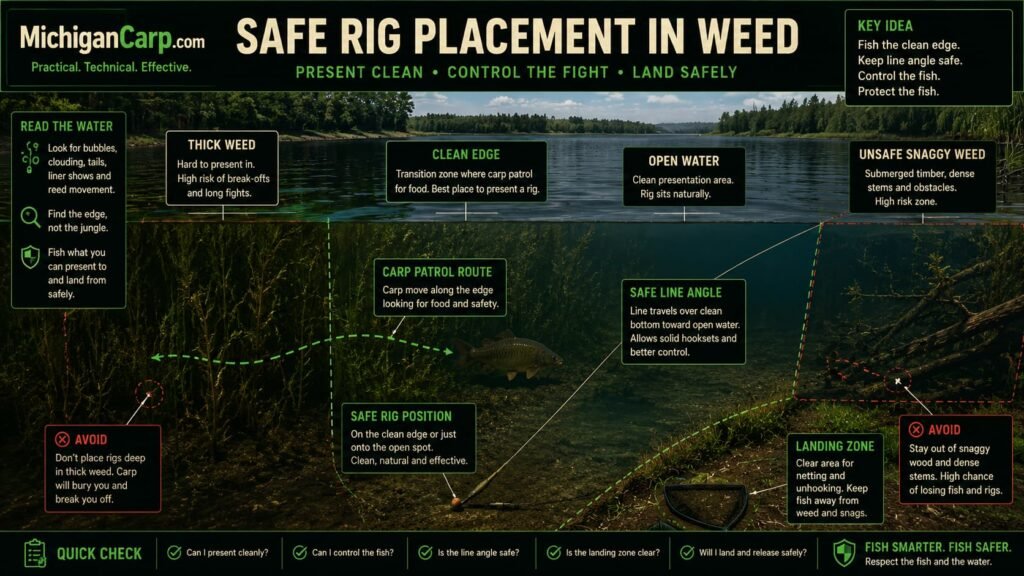
Rig placement in weed should be simple, accurate and safe.
The aim is not to hide a rig in the thickest cover. The aim is to place a rig where carp naturally move or feed, while still giving the hookbait a clean chance to work and giving you a realistic chance to land the fish.
The best rig spots are usually clean edges, clear holes, hard patches, open lanes, inside corners, outside points, silt pockets beside weed, or the first clean water off a pad or reed line. A rig buried in weed is not fishing properly, no matter how good the swim looks.
Use presentations that suit the bottom. A balanced bottom bait, wafter, snowman, pop-up, Ronnie, Multi Rig or solid bag can all work depending on the weed, debris and bottom. The rig choice matters less than whether it is actually presented properly.
In light silkweed or low weed, a pop-up or balanced bait may sit cleaner than a heavy bottom bait. In a clear hole, a bottom bait or wafter may be ideal. Around leaves, stems or dying weed, a small PVA bag or controlled stick mix can help keep the hook clean, but only if it lands in a fishable spot.
Before leaving a rod, check the line angle. A straight line through thick weed is asking for trouble. A safer angle across a clean edge may be much better, even if the bait is slightly farther from the visible cover.
For rig options, use The Complete Michigan Carp Rig Guide. For line and leader decisions, read Line and Leaders.
Baiting Weed Beds
Baiting weed beds is about control.
If you scatter bait widely into thick weed, carp may feed where you cannot present properly. They may bury themselves in cover, foul your line, or pick up free bait without ever finding the hookbait. Heavy baiting can also create too much activity in an unsafe area.
A better approach is to feed the fishable part of the feature. That might be a clean edge, a clear hole, a pad channel, a reed margin, or the open-water side of a weed bed. Bait where the rig can fish and where the fish can be landed.
Small accurate baiting can be very effective. Chopped boilies, crumb, corn, hemp, prepared particles, tiger nuts, small pellets where allowed, method mix, or a tight PVA stick can all work. The important thing is not the bait name. It is the placement.
In summer, keep baiting sensible. Warm water, weed, nuisance fish and natural food can all affect how much bait is needed. Sometimes carp in weed respond to a tight trap. Sometimes a regular small feed line along a patrol edge works better. Sometimes the best decision is to watch the weed for signs before feeding at all.
Do not try to fix poor location with more bait. If the weed is dead, foul, unsafe or showing no signs, find a better edge first.
For general bait decisions, use Carp Bait Guide for Michigan Lakes. For particles, use Particle Prep for Carp Fishing.
Fish Care and Safety Around Weed
Weed fishing can be productive, but it puts extra responsibility on the angler.
Before fishing a weed swim, think through the whole fight. Where will the fish run? Can it bury itself? Is there timber, rock, mussels, pads, reeds or thick stems between you and the fish? Can you move along the bank? Can you net the fish safely? Can you unhook it on a wet mat without delay? Can you return it quickly in warm weather?
In heavy weed, the wrong swim can turn a hooked carp into a problem very quickly. Long fights in warm water are not good. Break-offs are not acceptable. Dragging fish through thick vegetation is poor practice. Fishing an impossible pad bed because it looks exciting is not good weedcraft.
Good weed fishing means using strong, appropriate tackle and choosing the right angle. It may mean fishing closer. It may mean using fewer rods. It may mean dropping a swim that has carp in it because the landing route is not safe. That is not failure. That is proper carp fishing.
Hot weather makes this even more important. Warm water can hold less dissolved oxygen than cooler water, and stressed fish need careful handling. Have everything ready before the bite: net, mat, sling, forceps, camera plan and clear return route.
For the full safety guide, read Fish Care and Safety.
Invasive and Problem Aquatic Plants
Not all weed is equal from an ecological point of view.
Many native aquatic plants are valuable parts of Michigan lake habitat. They support food, cover, oxygen and shoreline life. But some invasive aquatic plants can form dense mats, crowd out native plants, reduce access, interfere with recreation and change habitat quality.
Michigan lists Eurasian watermilfoil as an invasive aquatic plant of concern, noting that it can form large floating mats that shade out native aquatic plants and impede recreation. For identification and reporting information, read Michigan Invasive Species: Eurasian Watermilfoil.
For anglers, the practical point is simple. Do not spread plants between waters. Clean weed from rigs, nets, boats, trailers, boots, anchors and mats. Do not move aquatic vegetation from one lake to another. If you fish multiple waters, treat plant fragments seriously.
This is not just about regulations. It is about protecting the waters you fish.
A Simple Weed-Bed Fishing Plan
Step 1: Identify the type of weed
Look at whether the vegetation is healthy green weed, pads, reeds, dying weed, thick surface mats, scattered low weed, or a clean edge beside growth. The type of weed tells you what the fish may be using and what risks you face.
Step 2: Find the fishable edge
Do not start with the thickest cover. Find the line where carp can move and you can present safely. Outside edges, clear holes, channels and open pockets are usually better starting points.
Step 3: Watch for signs
Look for bubbles, clouded water, reed movement, pad movement, tails, flat spots, liners and repeated carp shows. Weed often hides carp, so the signs may be subtle.
Step 4: Check the landing route
Before baiting, decide whether you can land a fish. If the answer is no, move. A carp in the swim does not make it a responsible swim.
Step 5: Place bait with control
Feed the spot you can fish, not the whole weed bed. Accurate small baiting usually beats wide loose feeding in heavy vegetation.
Step 6: Match the rig to the bottom
Use a rig that presents cleanly. Pop-ups, wafters, bottom baits, snowman rigs, solid bags or sticks can all work, but only if the hook is not fouled.
Step 7: Fish the window
Weed beds often come alive at dawn, dusk, night, after wind, under cloud, or when oxygen and comfort improve. Use timing instead of sitting on a dead weed bed all day.
Common Weed-Bed Mistakes
Fishing the thickest weed
The thickest weed may hold carp, but it is often not the best place to present a rig or land fish. The safe edge is usually better.
Ignoring clear holes
Clear holes can be natural feeding spots and clean rig areas. They deserve careful, accurate fishing.
Over-baiting into unsafe cover
Wide baiting can pull carp deeper into weed and away from the hookbait. Feed the fishable spot.
Using tackle that is too light
Weed demands control. Use tackle that matches the swim and gives you a realistic chance of landing the fish safely.
Assuming all weed is healthy
Dying weed can foul rigs and reduce comfort. Look for green growth, clean edges and nearby better water.
Ignoring wind and oxygen
A wind-rippled weed edge can be very different from a hot, flat, stagnant weed bed. Read conditions, not just vegetation.
Forgetting fish care
Weed fishing must be safe from bite to release. No feature is worth a lost or damaged fish.
My Practical MichiganCarp View
For Michigan carp fishing, I treat weed beds as one of the most important features on a lake, but also one of the easiest to misread.
Weed is not automatically good. Open water is not automatically bad. The best area is usually where weed gives carp food, oxygen, cover and confidence while still giving the angler a clean presentation and safe landing route.
I like edges more than jungles. I like holes more than buried rigs. I like green weed more than foul dying weed. I like wind-rippled weed when it improves comfort. I like pads and reeds when I can fish the open edge safely. And I will leave carp alone if the swim is too snaggy to fish responsibly.
That is the balance.
Weed beds are food, oxygen, safety, routes, presentation risk and fish-care risk all in one feature. Learn to read the good parts, avoid the dangerous parts, and you will find more carp without making the fishing harder than it needs to be.
FAQ
Are weed beds good for carp fishing?
Yes, weed beds can be excellent for carp because they hold food, oxygen, shade, cover and patrol routes. The best spots are usually safe edges, clear holes and channels rather than the thickest vegetation.
Should I cast into the middle of the weed?
Usually no. The middle of thick weed may be unsafe and hard to fish cleanly. A clear hole, outside edge, reed line, pad edge or channel is usually a better option.
Do carp feed in lily pads?
Carp often use lily pads for shade, cover and food. The safest fishing is usually along the open edge or channels near the pads, not deep inside the stems.
Are reeds good carp features?
Yes. Reeds can hold insects, shade, silt, food and margin routes. Watch for bubbles, clouding, reed movement and tails along the edge.
Is dying weed bad for carp fishing?
Dying weed can be poor because it can foul rigs, smell bad, reduce comfort and make landing fish harder. But cleaner edges and remaining green weed nearby can still be productive.
How do I present a rig in weed?
Find a clean edge, hole or lane. Use a rig that sits cleanly, avoid fouled hooks, bait accurately and choose a line angle that lets you control the fish safely.
Is weed fishing dangerous for carp?
It can be if done carelessly. Heavy weed increases the risk of break-offs, long fights and poor fish care. Only fish weed you can control and land from safely.
Does wind make weed beds better?
Often, yes. Wind can add ripple, oxygen, food movement and cover. But cold, violent or unsafe wind can make a weed swim worse.
What bait works best around weed?
Accurate baiting matters more than the bait name. Chopped boilies, corn, hemp, tiger nuts, crumb, particles, PVA sticks and small traps can all work when placed on the fishable edge.
Should I remove weed to make a swim?
Do not damage aquatic vegetation or alter habitat without knowing the rules. On public waters, fish existing safe edges, holes and channels rather than cutting or disturbing vegetation.
Next Steps
Read these next:
- Watercraft and Conditions for Michigan Carp Fishing
- Wind, Waves and Current Carp Fishing
- Dissolved Oxygen and Carp Fishing
- Carp Bite Windows in Michigan
- Summer Carp Fishing in Michigan
- Best Depth for Carp Fishing in Michigan Lakes
- The Complete Michigan Carp Rig Guide
- Fish Care and Safety
Weed beds are not just obstacles. They are living carp features. Fish the clean edge, read the signs, control the baiting, choose a safe rig position and make sure every fish can be landed and released properly.