

Moon phases and carp fishing may be connected, but not in the simple way suggested by many fishing calendars. The Moon changes the timing and potential intensity of natural light at night. Some freshwater fish studies have found small or species-specific lunar associations, while others have found no useful relationship. What is missing is direct evidence that a particular phase, moon position or solunar score reliably switches wild common carp into feeding mode.
The practical answer is therefore not “the Moon matters” or “the Moon is nonsense.” It is this: moonlight may alter the conditions in which carp move, feed or feel exposed, but the phase name alone is a poor description of what the fish actually experience. A full moon below the horizon contributes no direct moonlight. A full moon behind thick cloud over stained, wind-rippled water is not equivalent to a clear full moon over a shallow, calm gravel shelf.
This guide explains all eight lunar phases, the difference between phase and actual moonlight, the proposed mechanisms, the strongest relevant fish research, what solunar major and minor periods mean, and when lunar information may contribute little or nothing. It also gives Michigan carp anglers a fair way to test the Moon on their own water without turning memorable captures into proof.
Use Reading a Lake Like a Carp Angler to establish that carp have a reason to use the area. Use Carp Bite Windows in Michigan for the wider timing system. The Moon belongs inside that larger picture—not above it.
The Moon can change the setting without commanding the fish. Record it, understand it and test it—but let location, conditions and carp activity make the final decision.
Table of Contents
Quick Answer: Moon Phases and Carp Fishing: How Much Does the Moon Matter?
There is not enough carp-specific evidence to call any lunar phase the best time for carp fishing. The most defensible position is that lunar information can describe part of the night environment and may help identify a local pattern, but it should normally carry less weight than direct information from the water.
| Evidence | What It Tells You | Practical Weight |
|---|---|---|
| Carp showing, fizzing, feeding, producing liners or being caught | Fish are present and using the area now | Very high |
| Season, measured water temperature and recent trend | The lake’s biological and thermal stage | Very high |
| Location, depth access, food and safe holding cover | Whether the swim offers a credible carp route | Very high |
| Wind, weather, current, clarity, oxygen and disturbance | How the area is changing and whether it remains comfortable | High |
| Repeatable capture times on the same water | A real venue-specific timing pattern may exist | High when based on enough comparable effort |
| Actual moonlight reaching the swim | One part of the local light and exposure environment | Low to moderate where night light is plausibly important |
| Moon phase by itself | The Moon’s position in the 29.5-day phase cycle | Low |
| Solunar score or major/minor label | A forecast produced by an algorithm | Low until independently validated on that water |
A lunar clue becomes more interesting when it predicts something specific and repeatable: carp moving onto a clear shallow shelf after moonset, captures increasing on a known route during bright late-night conditions, or fish dropping into cover when the Moon clears the horizon. “I caught one under a full moon” is an observation. It is not yet a pattern.
Moon Phases Explained: The Eight-Phase Cycle
The Moon does not make its own light. Moonlight is sunlight reflected from the lunar surface. Half of the Moon is always illuminated by the Sun, but the portion visible from Earth changes as the Moon moves through its orbit. According to NASA’s Moon Phases guide, the familiar sequence repeats about every 29.5 days.
Most anglers know new moon and full moon, but the intermediate phases are just as useful educationally because they explain when natural moonlight is likely to occur. The following sky times are approximate for mid-latitudes. Season, latitude and the Moon’s orbit alter the exact times, so use the U.S. Naval Observatory Sun and Moon calculator for the actual fishing date and location.
| Phase | Approximate Rise | Highest in Sky | Approximate Set | Practical Night-Light Pattern |
|---|---|---|---|---|
| New moon | Near sunrise | Near noon | Near sunset | The Moon is generally absent from the night sky; little or no direct moonlight |
| Waxing crescent | Mid-morning | Mid-afternoon | Evening | A limited period of moonlight after sunset |
| First quarter | Near noon | Near sunset | Near midnight | Brighter first half of the night, then moonset |
| Waxing gibbous | Afternoon | Evening | Early morning | Increasing evening and overnight light |
| Full moon | Near sunset | Near midnight | Near sunrise | Greatest potential for moonlight through most of the night |
| Waning gibbous | After sunset | After midnight | Morning | Moonlight weighted toward the middle and later night |
| Last or third quarter | Near midnight | Near sunrise | Near noon | Darker first half, with moonlight later and toward dawn |
| Waning crescent | Before sunrise | Morning | Afternoon | Mostly a pre-dawn lunar-light opportunity |
Waxing and Waning Describe Direction
Waxing means the visible illuminated portion is increasing toward full moon. Waning means it is decreasing toward new moon. This matters because two nights can show roughly the same percentage illumination but place that light in different parts of the night. A first-quarter Moon can brighten the evening and set around midnight. A last-quarter Moon may not rise until around midnight and can brighten the pre-dawn period instead.
“Quarter Moon” Does Not Mean One Quarter Is Visible
At first and last quarter, the Moon is one quarter or three quarters of the way through its orbit, but from Earth the visible disc appears approximately half illuminated. The name describes orbital position, not the fraction of the visible disc that looks bright.
Moonrise Moves Later Through the Cycle
Successive moonrises occur roughly 50 minutes later on average, although the shift varies. This is one reason a venue’s apparent “moonrise bite” should move through the clock over successive nights if lunar rise is truly the cue. If captures remain fixed at 10:00 p.m. while moonrise moves later, another clock—disturbance, feeding routine, darkness or water movement—may be the better explanation.
Five Lunar Measurements Anglers Often Confuse
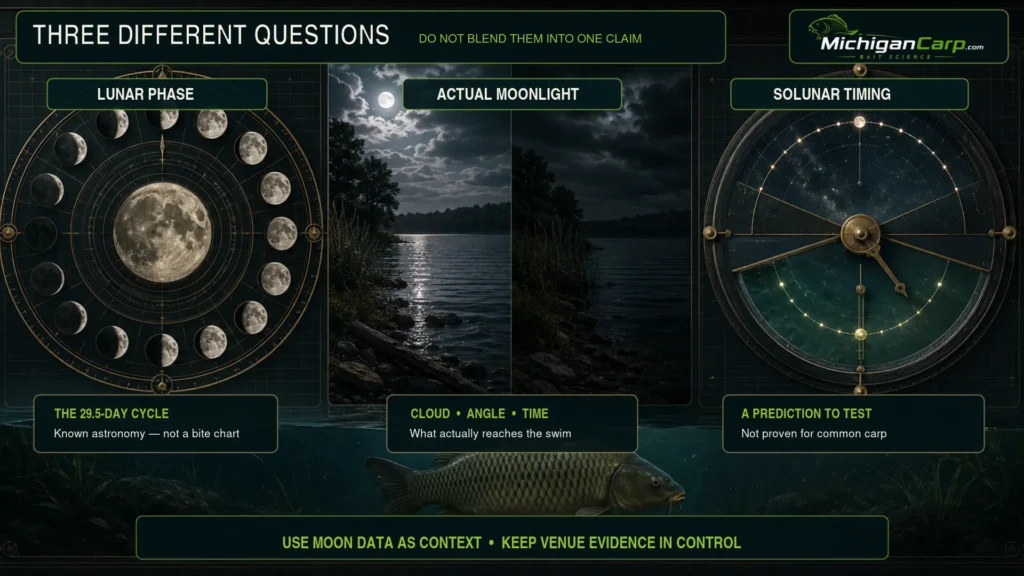
Fishing apps often place several lunar values on one screen. They are related, but they do not measure the same thing. Separating them prevents a phase label from being mistaken for the light conditions at the rig.
1. Lunar Phase
Phase describes the geometry of the Sun, Earth and Moon and the visible shape of the illuminated lunar disc. It is a useful calendar label, but it does not report cloud, local shade, artificial light or whether the Moon is above the angler’s horizon.
2. Percentage Illumination
This is the calculated fraction of the visible disc illuminated by the Sun. It is more precise than saying “gibbous,” but it still does not equal illumination at the lake. A 90-percent Moon below the horizon supplies no direct lunar light to the swim.
3. Moonrise, Transit and Moonset
Moonrise is when the Moon crosses the local horizon. Transit is when it crosses the local meridian and is usually at its highest altitude. Moonset is when it drops below the horizon. These are location- and date-specific astronomical events, not proof of fish activity.
4. Actual Moonlight at the Swim
This is the biologically relevant light that reaches the water after lunar brightness, altitude, atmosphere, cloud, trees, bank angle and local obstructions have had their effect. A 2023 ecological methods study found that a model using Moon position and brightness explained substantially more measured ground illumination than moon phase alone. The broader lesson for carp anglers is sound: phase is an imperfect proxy for real moonlight.
5. Solunar Rating
A solunar rating is the output of a forecasting system. It usually combines phase with calculated periods around moonrise, moonset and the Moon’s overhead or underfoot position. A high rating is not a physical measurement taken at the water and is not the same as high lunar illumination.
How Could the Moon Affect Carp?
A credible mechanism explains how a lunar variable could reach the fish and alter behavior. Several mechanisms are possible in principle, but possibility is not proof that any one of them creates a useful carp-catching rule.
Actual Light Can Change Exposure and Habitat Use
Moonlight can change contrast above and below the surface, especially in clear, shallow water. That could affect how exposed carp feel on an open shelf, how effectively they detect obstacles or threats, and whether they use open water, cover, shade or depth. The likely response is not always “more feeding” or “less feeding.” It may be a redistribution of fish.
The light reaching a rig is not the same as the light visible to the angler. Suspended sediment, algae, dissolved color and depth attenuate light through the water column. Wind ripple changes surface reflection and the direction of light entering the water. Weed, reeds, docks, overhanging trees and bottom contours create local shade. Read Water Clarity and Light Penetration before treating the Moon icon as a description of the underwater scene.
Carp Do Not Depend on Vision Alone to Evaluate Food
Common carp use several sensory systems while locating and evaluating food. Laboratory research has demonstrated strong gustatory responses to selected free amino acids, including cysteine and proline. That does not prove that light never affects feeding, but it does mean a bright Moon is not required for a carp to use chemical and taste information. See the common-carp gustatory-response study.
For anglers, the practical distinction is between finding or accepting food and choosing where and when to search. Moonlight might alter route choice or exposure without controlling the carp’s ability to recognize an edible bait once it reaches it.
Biological Clocks Are Plausible but Unproven Here
Animals can organize behavior around daily, seasonal and, in some species, lunar rhythms. Lunar-linked reproduction and movement are well documented in parts of the marine world and in some freshwater species. That does not establish a circalunar feeding clock in common carp. To claim such a clock, a repeatable rhythm would need to persist after obvious cues such as light, temperature, feeding schedule and tides were separated experimentally.
Natural Food Could Create an Indirect Effect
Moonlight can influence the vertical or horizontal behavior of some aquatic organisms. If a local prey item, insect emergence or predator-prey relationship responds to lunar light, carp could respond indirectly to the resulting food opportunity. This is a reasonable hypothesis, but it requires evidence from the water. “The Moon affects some aquatic organisms” does not prove that boilie-eating common carp follow a universal lunar schedule.
Gravity and Tides Are Real—but Michigan Is Not a Tidal Coast
The Moon and Sun produce ocean tides. In coastal fisheries those tides can create current, expose feeding ground and move food, giving the lunar cycle a clear ecological route to fish behavior. That route is greatly reduced in inland Michigan carp fishing.
NOAA reports that true Great Lakes spring tides are less than five centimeters and are masked by much larger changes caused by wind and barometric pressure. Great Lakes seiches can move water by feet, but they are meteorological oscillations, not ordinary lunar tides. On smaller inland lakes and dam ponds, wind, inflow, power generation, rainfall and water-level management provide much more obvious movement mechanisms than a marine-style tide.
Gravity is therefore not imaginary; the unsupported step is claiming that its small inland expression creates a dependable common-carp feeding period. A true physical force is not automatically a useful angling forecast.
Angler Behavior Can Create an Apparent Moon Pattern
Anglers often fish longer, watch more closely or choose particular dates because an app predicts them. A bright night can make rolling fish, liners and water movement easier to detect. Popular full moons can therefore receive more effort and better observation. Unless blanks and rod-hours are recorded, a catch calendar can mix carp behavior with angler behavior.
What Carp-Specific Research Actually Shows
The strongest carp-specific lesson is not a preferred moon phase. It is that common-carp activity and catchability can change with time of day, season, habitat, flow, food, angling pressure and individual fish—and that different studies do not produce one universal day-versus-night rule.
Competition Catch Data Found More Carp Landed at Night
A 2021 study used landing records from 14 carp-oriented angling competitions in four European countries. Carp were landed most frequently at night, and catches increased non-monotonically through the events as fish could learn and revisit new feeding areas. The study is relevant because it demonstrates substantial night catchability under those competition conditions. It did not test lunar phase, actual moonlight or solunar periods. Read the common-carp diel landing study.
Telemetry Found a Different Pattern in One Reservoir
A telemetry study of 20 common carp in Spain’s Flix Reservoir found a pronounced seasonal diel pattern. During the warm season the tracked carp used shallower water during the day, then shifted deeper and became less active near the bottom from dusk to dawn. During the cold season the diel pattern was weak. Flow and individual identity also helped explain behavior. See the common-carp activity and depth study.
That does not cancel the competition result. The studies measured different things in different systems: telemetry activity and depth in a regulated reservoir versus angling landings at heavily baited competitions. Together they show why “carp are nocturnal” is too crude. Night movement, feeding, depth use and angling vulnerability are not interchangeable, and the direction can change with the water and season.
What These Carp Studies Do—and Do Not—Support
- Common carp can be caught and can exploit feeding areas at night.
- Carp behavior can differ strongly between waters, seasons and individuals.
- A change in depth or activity is not automatically a change in feeding.
- Time-of-day patterns can exist without being caused by the Moon.
- Neither cited carp study identifies a best lunar phase or validates solunar forecasts.
This is the correct evidence boundary: carp-specific research makes a light or timing effect plausible enough to investigate, but it does not supply a full-moon or new-moon feeding law.
What the Wider Fishing Research Shows
Research on other freshwater fishes is useful for understanding methods and possible effect sizes. It cannot be copied directly onto common carp because species differ in sensory biology, prey, habitat, reproductive behavior and vulnerability to angling.
| Study | Result | What It Means for Carp Anglers |
|---|---|---|
| Quigley, Gonzalez Murcia & Kauwe (2023) | Across 361 freshwater trout trips totaling 1,355.2 hours, the tested solunar services, lunar phase and illumination did not significantly predict catch per unit effort; air temperature performed better | A direct modern test of popular solunar forecasts produced no positive support, but it involved one angler and trout—not carp |
| Vinson & Angradi (2014) | Analysis of 341,959 reported muskellunge catches found a lunar association, with an estimated maximum overall advantage of about 5 percent on the peak day | A real association can be modest; effort could not be fully separated from fish behavior, and muskellunge are not carp |
| Shaw, Renik & Sass (2021) | Walleye and muskellunge catchability in Escanaba Lake showed species-specific lunar and light relationships, while angler-related variables were strongest and several lunar effects were small | Moon variables may contribute in one fishery without becoming the main control or transferring across species |
| Hanson and colleagues (2008) | Whole-lake telemetry found some lunar relationships in largemouth-bass depth and activity, but patterns were not consistent through the year and movement did not show a repeatable lunar cycle | A detected effect can be seasonal, behavior-specific and poor for predicting an angler’s best time |
Mixed Results Are Information, Not Failure
The studies do not converge on one best phase, one mechanism or one effect size. That is exactly what we would expect if lunar effects are conditional. A visual predator in a clear lake, a benthic omnivore in turbid water and a trout fishery sampled by one angler are not equivalent systems.
Statistical Significance Is Not the Same as Fishing Importance
A huge dataset can detect a small difference. Vinson and Angradi’s muskellunge association was statistically convincing, yet the estimated overall advantage of fishing only the peak lunar day was about 5 percent. An angler should ask two questions: is the pattern unlikely to be chance, and is it large enough to change a practical decision? For carp, we do not yet have a comparable carp-specific estimate.
Catchability Is Not Identical to Feeding Activity
A fish can move without feeding, feed without traveling far, enter a baited area but avoid a rig, or become easier to catch because visibility and angler behavior changed. Studies based on captures measure angling vulnerability. Telemetry measures movement and location. Neither automatically measures appetite.
Full Moon, New Moon and Quarter Moons in Practice
No phase deserves a universal “good” or “bad” label. Each phase creates a different schedule of potential night light, which can be turned into specific questions at the lake.
Full Moon: Maximum Potential Light, Maximum Confusion with Dusk
A full moon rises around sunset and sets around sunrise. On a clear night it offers the greatest potential for sustained natural moonlight. That can make open, shallow water brighter and may alter how carp use shade, weed, depth or broken water. It also makes surface activity easier for the angler to see.
Full moon is difficult to interpret because moonrise overlaps the ordinary dusk transition. Light is falling, boat traffic may be ending, the bank becomes quieter, air temperature changes and a known evening movement may begin. A bite near full-moon rise does not identify which part of that bundle mattered.
New Moon: Darker Night, Not Automatic Confidence
At new moon, the Moon rises and sets with the Sun, so it does not provide direct light during the night. Dark conditions may encourage carp to use some clear, shallow or pressured areas, but that remains a venue hypothesis. Darkness cannot create oxygen, natural food, a safe route or fish presence.
A new-moon night is not always the darkest practical night. Artificial light, twilight, snow, low cloud reflecting development, campground lighting and boat lights can dominate the scene. Record the actual water, not the icon.
Quarter Moons: Useful Natural Split-Night Tests
First and last quarter can be more informative than anglers assume. A first-quarter Moon supplies earlier-night light and then sets. A last-quarter Moon creates a darker evening before rising later. On a stable night, that provides a natural contrast between moonlit and moonless periods without moving far through the seasonal calendar.
If a known shallow route repeatedly activates after first-quarter moonset under clear, calm conditions, the light hypothesis becomes more interesting. If the activity remains locked to the same clock time while moonset changes, another timing cue is more likely.
Waxing Versus Waning Can Matter More Than the Percentage
A 50-percent waxing Moon and a 50-percent waning Moon show similar disc illumination but place the light in different parts of the night. If your captures are mainly before midnight, waxing conditions may overlap the relevant window more often. If the water produces before dawn, waning conditions may provide the comparable light. This is why logging “50 percent” without rise and set times loses important information.
A Supermoon Is Not a Separate Carp-Feeding Phase
A supermoon is a full moon occurring near the Moon’s closest orbital approach. NASA notes that the closest full Moon can appear up to 14 percent larger and 30 percent brighter than the faintest full Moon of the year. That is a measurable light difference, not evidence of a special carp switch. Test the actual brightness and conditions rather than adding a new rule.
When Moon Phase May Matter Little or Not at All
Moon phase can remain identical while its plausible biological pathway disappears. This is the clearest reason not to treat phase as a stand-alone predictor.
| Condition | Why Lunar Influence May Shrink | What Deserves More Attention |
|---|---|---|
| Moon below the horizon | No direct moonlight reaches the swim | Dawn, dusk, darkness, disturbance and weather |
| Thick cloud or fog | Direct lunar illumination is strongly reduced; artificial skyglow may behave differently | Actual brightness, rain, wind and front stage |
| Stained, turbid or algae-rich water | Light is attenuated rapidly through the water | Clarity, depth, food signals and water movement |
| Deep rigs, dense weed, reeds, docks or bank shadow | The feeding zone is physically shaded from surface light | Cover, route, depth access and presentation |
| Strong ripple, waves or current | Surface structure and water movement alter light and may reposition food and fish | Wind direction, fetch, safety and moving-water features |
| Artificial light dominates | Campgrounds, marinas, roads and buildings can overwhelm the lunar contrast | Local light boundaries and human disturbance |
| Rapid warming, cooling or a strong front | Temperature and weather may relocate carp or alter activity more strongly | Measured water trend, wind, pressure context and fish signs |
| Low or uneven dissolved oxygen | Carp may avoid or leave otherwise attractive water regardless of light | Mixing, healthy weed, inflows and dawn oxygen risk |
| Spawning or major seasonal movement | Reproductive and seasonal drives can dominate ordinary feeding routines | Water temperature, spawning signs and recovery stage |
| Strong natural-food event | Carp may follow concentrated food regardless of phase | Invertebrate activity, seeds, mussels, snails and disturbed silt |
| Heavy boat or bank pressure | The quiet period may determine access to the swim | Human schedules, safe cover and known low-disturbance windows |
| Carp are absent | No lunar score can make an empty area produce | Location, observation and willingness to adjust |
Moonlight Can Change Location Without Changing Total Feeding
If an open shelf stops producing on a bright night, the carp may have shifted to the weed edge, deeper lip, shadow line or rougher water. Calling the full moon “bad” can hide a location change. Before changing bait, test whether the same feeding opportunity has moved.
Cloud Does Not Simply Turn a Full Moon into a New Moon
Cloud reduces direct moonlight, but it also arrives with weather and can reflect artificial light. A cloudy full-moon night can differ from a clear new-moon night in wind, temperature, rain, skyglow and pressure trend. For a useful log, record cloud and visible brightness separately rather than replacing one phase label with another.
Does Solunar Theory Predict Carp Feeding?
Not reliably enough to plan a Michigan carp session around it. Solunar systems are forecasts based mainly on the relative positions of the Sun and Moon. They can produce precise-looking times, but precision in calculation is not the same as biological validation.
What Major and Minor Periods Mean
Most services call periods near the Moon’s overhead transit and the opposite underfoot position major periods. Periods near moonrise and moonset are often called minor periods. Window length, daily rating and the importance assigned to phase vary between providers.
Overhead and underfoot describe geometry. An underfoot Moon is on the opposite side of Earth and supplies no direct moonlight to the swim. If an underfoot period appears predictive, direct lunar illumination cannot be the explanation. A different mechanism or a correlated timing variable would need to be demonstrated.
Four Forecast Windows Create Many Chances to Match a Capture
Two major and two minor periods can cover a substantial part of a day, depending on the service’s window widths. Add dawn, dusk, moonrise, moonset, feeding times and weather changes, and it becomes easy to find a nearby event after a fish is caught. This is the multiple-opportunity problem: the more possible “hits” accepted, the easier it is to explain almost any capture retrospectively.
Why Agreement Between Apps Is Not Validation
Solunar services can agree because they use similar astronomical inputs. In the 2023 trout study, the tested services correlated strongly with one another and with lunar phase, yet their ratings did not positively predict catch per unit effort. Several clocks showing the same calculated period demonstrate shared inputs, not that common carp respond to it.
The Useful Way to Use a Solunar Period
Treat it as an observation alarm. Be organized before the period begins. Watch for rolling fish, fizzing, liners, a change in bird activity, light, wind, surface texture or disturbance. Record what happened even when nothing happened. If the predicted window repeatedly adds information after stronger variables are controlled, it may earn more weight on that water.
Carp Bite Windows Are About Overlap
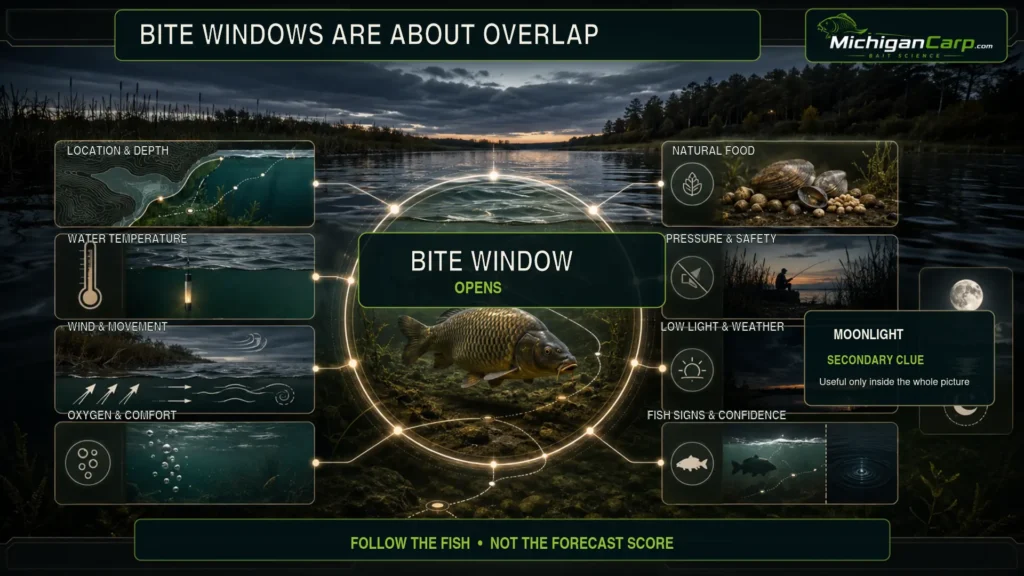
A bite window opens when enough favorable conditions overlap. Lunar light can be one layer, but it rarely deserves to be the foundation.
A Clear Full-Moon Example
Imagine a known shallow shelf on a clear lake. Water temperature is stable, carp have shown nearby, boat traffic has stopped, a gentle ripple breaks the surface and the full Moon lights the open water. If bites occur on the weed-side shadow rather than the exposed center, moonlight may have helped shape location. The conclusion is not “full moon is bad.” It is “under this combination, fish may prefer the covered edge.”
The Same Phase Under Different Conditions
Repeat the date a month later under thick cloud, stronger wind and stained water. The lunar phase is similar, but the light mechanism is greatly reduced and wind-driven food movement may dominate. If the same route still produces, the phase itself looks less important. If the location changes with actual brightness rather than phase, the light explanation becomes stronger.
Use a Decision Order
- Location: Are carp present, and does the area offer food, comfort and a safe route?
- Season and water temperature: What stage is the water actually in?
- Wind, weather, clarity and oxygen: Is the area improving, deteriorating or simply changing?
- Timing: What windows have produced repeatedly on this water?
- Actual light: Is the Moon above the horizon, and what light reaches the feeding zone?
- Solunar forecast: Does it add a testable clue after the first five questions?
This keeps lunar information useful without allowing it to override the lake. It is the same principle used in Barometric Pressure and Weather Fronts: one measurement is context, while the fish experience the whole environment.
How to Test Lunar Patterns on Your Own Water
A personal venue log will never be a controlled laboratory experiment, but it can be much stronger than memory. The aim is to record effort, define the prediction in advance and separate competing explanations.
Start with a Mechanism, Not a Favorite Phase
Write a statement that could be wrong. Examples include:
- On clear, calm summer nights, carp use the open shallow shelf less while direct moonlight reaches it.
- On this pressured lake, captures increase after moonset because the shallow margin becomes darker.
- On this channel route, movement follows the same clock time and does not move with moonrise.
- Solunar overhead periods add no capture advantage once rod-hours, time of day and weather are considered.
Each statement identifies an expected pattern. “The Moon affects carp” is too vague to test because any result can be made to fit it.
Record Enough Information to Challenge the Moon Explanation
| Record | Minimum Useful Detail | Reason |
|---|---|---|
| Fishing effort | Rod-hours by exact start and finish time | Ten hours of effort cannot be compared fairly with one hour |
| Location | Swim, rod zone, depth, feature and distance | A location change can masquerade as a lunar effect |
| Fish evidence | Rolling, fizzing, liners and exact capture times | Movement may occur without a landed fish |
| Water | Measured temperature, clarity, weed condition, level/current and oxygen concerns | These can dominate or suppress a small lunar effect |
| Weather | Wind, cloud, rain, pressure trend, front stage and lightning risk | Weather can alter light, comfort and location simultaneously |
| Actual light | Moon above/below horizon; dark, low, moderate or bright; artificial light and shade | Tests the light mechanism rather than the phase label |
| Lunar data | Phase, illumination, moonrise, transit, moonset and forecast windows | Allows phase, light timing and solunar position to be compared separately |
| Method | Hookbait, feed, rig, recasts and baiting changes | A successful adjustment should not be credited to the Moon |
| Disturbance | Boats, swimmers, bank traffic, wildlife and nearby anglers | Quiet periods often overlap darkness and lunar events |
Record Blanks and Non-Events
A good full-moon capture is memorable. A blank during the same phase is easy to forget. Record both, and record whether the predicted major or minor period passed without a liner, show or bite. Without negative results, the log can only confirm what you already believe.
Use Catch per Unit Effort
Count bites or landed carp per 100 rod-hours rather than comparing raw totals. Three rods fished for ten hours equal 30 rod-hours. This does not solve every bias, but it prevents longer sessions and heavier effort from looking automatically better.
Compare Like with Like
Compare the same water, similar seasonal stage, similar swim type and similar method. A warm July night on a prebaited weed edge cannot be compared fairly with a cold October afternoon in open water. Lunar phase also advances with date, so season and phase can become tangled unless the record covers multiple cycles and preferably more than one year.
Look for the Predicted Interaction
If moonlight is the proposed mechanism, the pattern should strengthen when the Moon is up, the sky is clear and the relevant water is shallow and clear. It should weaken when the Moon is down, cloud is thick or the area is deeply shaded. If the claimed effect remains equally strong when no direct lunar light reaches the swim, moonlight is probably not the mechanism.
Do Not Demand a Perfect Rule
A real environmental effect can be small and conditional. The aim is not to prove that every fish obeys the same clock. The aim is to decide whether the variable improves decisions often enough to earn attention. If it explains only a small fraction of sessions, it remains a secondary clue.
A Practical Michigan Approach
My practical MichiganCarp position is based on more than five decades of carp fishing, but it is not presented as a controlled lunar experiment. I have seen too many powerful variables change a session—wind, water temperature, current, weed, boat traffic, natural food, oxygen, water level and the simple presence or absence of carp—to put a phase icon above them.
I would not cancel a session with good location, favorable weather and repeated fish signs because a solunar score looked poor. I would not choose an empty swim because an app showed five stars. I would, however, note whether a bright Moon was actually reaching an exposed feeding area, stay alert around a predicted time, and record whether the pattern repeated.
Clear Inland Lakes
Actual night brightness is most worth testing where carp move between open shallow water and nearby weed, reeds, shade or depth. Keep one rod on the proven route. Use another to test the exposure hypothesis rather than moving every rod or changing every bait at once.
Dam Ponds, Reservoirs and Big Water
Wind, inflow, discharge, water-level changes, basin shape and travel distance often provide stronger movement mechanisms. The Moon may tell you about light or give you a time to observe closely, but it cannot select the correct bank. Start with Advanced Big-Lake Carp Tactics.
Channels, Marinas and Pressured Banks
Human schedules may be the hidden clock. Boat traffic falls, lights change, people leave and carp enter quieter margins. Record those events separately. A repeated 11:00 p.m. bite may follow a marina’s activity pattern even while lunar timing moves through the month.
Safety Always Outranks a Lunar Window
Prepare the net, mat, sling, lights and landing route before dark. Check access rules, waves, wind, snags, boat use and lightning risk. No major period, moonrise or full-moon date justifies fishing an unsafe bank. Use Carp Session Planning before the trip and On-the-Water Adjustments when the lake contradicts the plan.
Frequently Asked Questions
Do moon phases affect carp fishing?
They may contribute when they change actual night light or coincide with a repeatable local timing pattern. The evidence cited here does not establish a reliable moon-phase rule for wild common carp.
What is the best moon phase for carp fishing?
No phase has been shown to be universally best for common carp. Choose the session from location, season, water temperature, weather, access and fish signs. Use phase as a secondary condition to understand and test.
Is a full moon good or bad for carp?
It can be good, poor or neutral. A full moon offers the greatest potential for sustained moonlight, but cloud, clarity, depth, surface ripple, cover and carp location determine what that means at the rig.
Is new moon better for shallow-water carp?
Darker nights may make some exposed or pressured shallows worth testing, but darkness does not create a feeding route. Compare actual shallow use under similar water, weather and disturbance conditions.
Do carp feed more at night?
Carp can feed and be caught at night, and one competition study found peak landings at night. Other carp research found season- and water-specific patterns that were not simply nocturnal. Learn the timing of the particular water rather than assuming all carp behave alike.
Do solunar tables work for carp?
They have not been validated strongly enough to predict common-carp feeding reliably. Use a predicted period as a prompt to observe and record, not as a promise of a bite.
Does moonrise trigger carp to feed?
It might coincide with a local change in light or a repeatable movement, but a trigger has not been established. Moonrise can also overlap dusk, falling disturbance and weather changes. A convincing pattern should move with moonrise across many sessions.
Does cloud cancel a full moon?
Cloud can greatly reduce direct moonlight, but it also changes weather and may reflect artificial light. Record cloud, visible brightness and the Moon’s position separately.
Does the Moon’s gravity affect carp in Michigan lakes?
The gravitational force and true Great Lakes tides are real, but NOAA reports the largest Great Lakes tides are under five centimeters and normally hidden by larger wind- and pressure-driven changes. That does not demonstrate a dependable inland-carp feeding mechanism.
Are supermoons better for carp fishing?
A supermoon can be somewhat brighter than a more distant full Moon, but no carp-specific evidence shows it creates a special feeding window. Treat it as a possible difference in actual light, not a separate rule.
What lunar information should I record?
Record phase, percentage illumination, moonrise, transit, moonset, whether the Moon was above the horizon, actual brightness, cloud and artificial light. Always record rod-hours, location, water temperature, weather, disturbance and blanks alongside it.
Next Steps
- Use Carp Bite Windows in Michigan for the complete overlap model.
- Read Water Clarity and Light Penetration to judge whether lunar light can reach the feeding zone.
- Use Wind, Waves and Current for the water movement that often outweighs phase.
- Use the Carp Water Temperature Guide for a stronger seasonal control.
- Follow Signs Carp Are Feeding when direct evidence conflicts with a forecast.
Final MichiganCarp conclusion: moon phase is worth learning because it tells you when natural lunar light could occur. Actual moonlight is worth recording because it may alter exposure or route choice in some waters. Solunar periods are worth testing only as predictions. Under cloud, stained water, depth, cover, strong weather, poor oxygen, seasonal movement, heavy disturbance or incorrect location, the Moon may contribute little or nothing. It is a possible layer in a bite window—not a universal carp-feeding switch.