

Barometric pressure and carp fishing
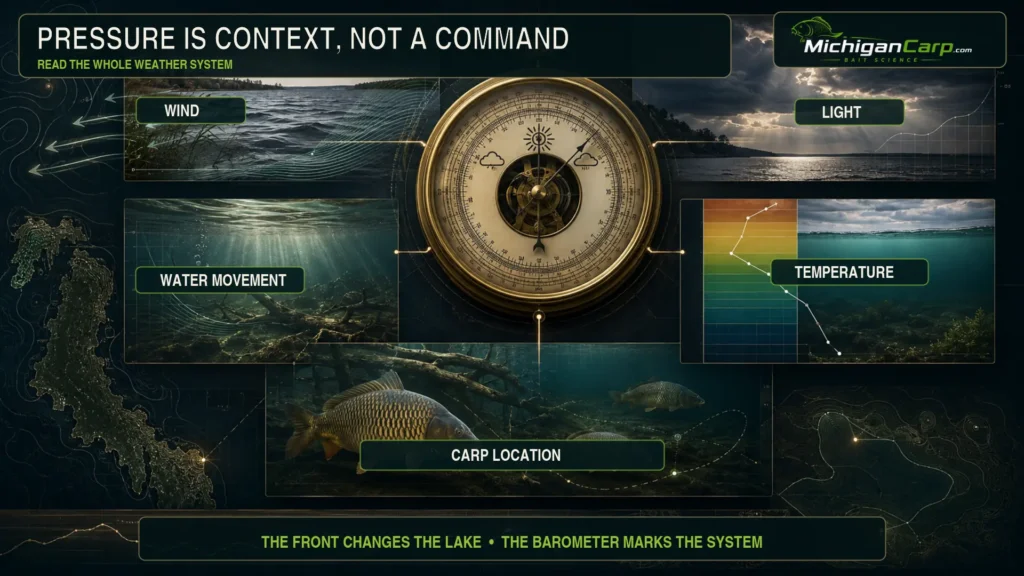
Barometric pressure and carp fishing are linked far more loosely than most fishing charts suggest. A falling barometer does not switch every carp on. A high reading does not close every feeding window. Pressure is useful because it helps describe a changing weather system, but it is only one part of what the fish experience.
The practical clues are the changes travelling with that system: wind direction and strength, cloud, light, air temperature, overnight cooling, surface disturbance, water movement and the position of comfortable water. Those changes can alter where carp feel safe, when they move and how long a feeding opportunity lasts.
This distinction matters on Michigan waters. A mild spring low moving in on a south or southwest wind is not the same event as a fast summer thunderstorm. A stable July high is not the same as a sharp rising barometer behind an October cold front. The pressure labels may look similar, while the lake responds very differently.
Use this article to read the weather sequence. Use How to Find Carp in Lakes for the parent location process, Wind, Waves and Current for water movement, and Carp Bite Windows in Michigan for the wider overlap of conditions.
Read the front, not a magic number. Find the fish, then use the weather to judge where and when they may become catchable.
Table of Contents
Quick Start: Read the Front, Not a Magic Number
Start with the weather sequence and the lake response. The barometer is most useful as a trend line that tells you a system is building, passing or settling. It cannot tell you whether carp are in your swim.
| Weather Pattern | What to Check at the Lake | Useful First Response | Do Not Assume |
|---|---|---|---|
| Gradually falling pressure with mild wind and building cloud | Warmer water being pushed, softer light, signs on a wind-affected route | Observe mobile water and likely patrol areas; be ready for a broader daytime window | Every windward bank or every hour before the front will produce |
| Fast fall ahead of a strong storm | Wind risk, lightning timing, abrupt direction change and unsafe banks | Put safety first; shorten or cancel the session when the system becomes hazardous | A dramatic pressure drop is worth dangerous fishing |
| Front passing with rain and shifting wind | Whether useful movement continues or the lake becomes disorganized | Follow visible fish evidence; protect presentation and landing safety | Rain or low pressure automatically means feeding carp |
| Rapid rise behind a cold front | Colder air, overnight cooling, clearing sky, stopped or reversed wind | Recheck warm water, cover, depth and shorter low-light windows | High pressure itself has made the fish stop eating |
| Stable high for several days | Daily warming, dawn oxygen, shade, boat pressure and repeat feeding times | Fish the established routine rather than waiting for a barometer change | Stable high pressure is automatically poor |
| Stable low or overcast spell | Actual water temperature, visibility, wind consistency and fish signs | Exploit comfortable light and movement where carp already have a reason to visit | Low pressure guarantees a long feeding spell |
The best pressure forecast is still weaker than a rolling carp, repeated fizzing, a liner, a warm wind arriving in the correct bay or a known route becoming active. Use the forecast to decide when to watch hardest—not to replace watching.
What Barometric Pressure Actually Measures
Barometric pressure is atmospheric pressure: the force created by the weight of the air above a location. Weather services commonly display it in inches of mercury (inHg), millibars (mb) or hectopascals (hPa). Standard sea-level pressure is about 29.92 inHg or 1013.25 hPa, but that is a reference—not a carp-feeding target.
A weather app may show mean sea-level pressure or an altimeter setting rather than the true station pressure at the lake. The National Weather Service explains these differences in its pressure definitions. For an angler, the simplest rule is to compare the trend from the same source and nearby station. Do not compare one app’s sea-level-adjusted number with an uncorrected handheld reading and treat the difference as a fishing signal.
High and Low Are Weather Descriptions
At the surface in the Northern Hemisphere, wind generally circulates clockwise around high pressure and counterclockwise around low pressure. Fronts are commonly associated with low-pressure systems, but the actual weather depends on the air masses, moisture, temperature gradients and movement of the system.
That is why “high equals bad” and “low equals good” fail. A stable high can provide a predictable dawn window. A shallow spring lake can warm well under sun. A low can arrive with a cold rain and a useless wind. The label is only the beginning of the interpretation.
What Fish-Pressure Science Can and Cannot Prove
Fish live under total pressure created by the atmosphere plus the water above them. Laboratory research has shown that at least some fish can use hydrostatic pressure as information about depth. In a controlled study, Mexican tetras learned a food depth and changed their search depth when researchers altered the water pressure. The paper, Fish Can Use Hydrostatic Pressure to Determine Their Absolute Depth, supports pressure sensing as a real capability in fish.
It does not show that common carp feed best at 29.80, 30.00 or 30.20 inHg. It does not show that falling atmospheric pressure universally increases appetite. It studied another species, a controlled depth-learning task and hydrostatic pressure—not wild carp feeding through a Michigan weather front.
| Claim Level | What We Can Say | What We Should Not Claim |
|---|---|---|
| Established meteorology | Pressure systems and fronts travel with changes in wind, temperature, moisture, cloud and precipitation | One pressure value creates the same lake conditions everywhere |
| Supported fish biology | Some fish can detect and use hydrostatic pressure information | Every fish species converts every pressure change into the same behavior |
| Plausible mechanism | A gas-filled swim bladder and pressure-sensing systems may contribute to detecting change | Swim-bladder expansion proves a feeding switch in common carp |
| Practical angling interpretation | Pre-front wind, light and temperature changes can create better movement or confidence on some waters | Falling pressure guarantees bites |
| Not validated | No universal optimum pressure number is established for wild common carp feeding | A chart can rank carp activity accurately from the barometer alone |
How Large Is an Ordinary Weather Change Underwater?
Atmospheric pressure changes are transmitted through the water, but water pressure also changes quickly with depth. The table below converts an air-pressure change into the approximate pressure added by a depth of fresh water. It is not a fish-behavior chart; it simply gives the scale.
| Atmospheric Change | Approximate Fresh-Water Depth Equivalent | Practical Meaning |
|---|---|---|
| 0.10 inHg | 1.4 in / 3.5 cm | A real change, but smaller than ordinary vertical movement around many feeding spots |
| 0.30 inHg | 4.1 in / 10.4 cm | Large enough to be a detectable environmental cue; not proof of feeding direction |
| 0.60 inHg | 8.2 in / 20.7 cm | A substantial weather swing, still comparable to a modest depth change |
| 1.00 inHg | 13.6 in / 34.5 cm | An unusually large change; still does not create a universal appetite rule |
The useful conclusion is balanced: do not dismiss pressure as something fish cannot perceive, but do not turn a plausible sensory mechanism into an unsupported feeding promise.
Pressure Trend Matters More Than a Single Reading
A single number removes the sequence. A reading of 30.10 inHg could describe a barometer falling from 30.40, rising from 29.80 or holding steady for two days. Those three situations can arrive with different wind, light and temperature histories.
Track at least the preceding 12 to 24 hours and the expected next 12 to 24 hours. The National Weather Service normally describes pressure tendency as rising, falling or steady over a specified period, commonly three hours. For fishing, the exact period is less important than seeing whether the lake is entering, passing through or leaving a weather change.
Rate of Change Matters
A slow fall across a mild, cloud-building day gives an angler time to watch the wind and identify a developing window. A sharp fall may accompany a strong system whose wind, rain or lightning makes the session unsafe. A rapid post-front rise may coincide with a fast shift to cold, dry air and clearing skies. “Falling” or “rising” is incomplete without “how fast” and “what else changed.”
Stability Can Be an Advantage
Stable conditions often create repeatable fish behavior. Carp may use the same shade line, weed edge, patrol route or low-light window for several days. That can be easier to fish than a dramatic change. If a stable high has produced at dawn for two mornings, the evidence from the water is more useful than a generic app rating it “poor.”
How Weather Fronts Change a Lake
A weather front is a boundary between air masses with different temperature, wind and moisture characteristics. The National Weather Service’s guide to pressure systems and fronts explains that cold fronts usually place warmer air ahead and colder air behind, while warm fronts bring advancing warmer air over retreating cooler air.
The front matters to carp anglers because it changes several controls together:
- wind direction, strength and duration
- surface chop, drift and water movement
- sun, cloud and underwater light
- air temperature and overnight heat loss
- rainfall and inflow activity
- which banks, bays and depths gain or lose comfort
- when fish feel secure enough to move through open water
Those controls do not change the whole lake instantly. A large deep lake has more thermal inertia than a small shallow pond. A protected bay responds differently from an exposed main-lake point. Surface weather can change in an hour while deeper water remains relatively stable. Always match the weather timescale to the water in front of you.
Before, During and After a Front
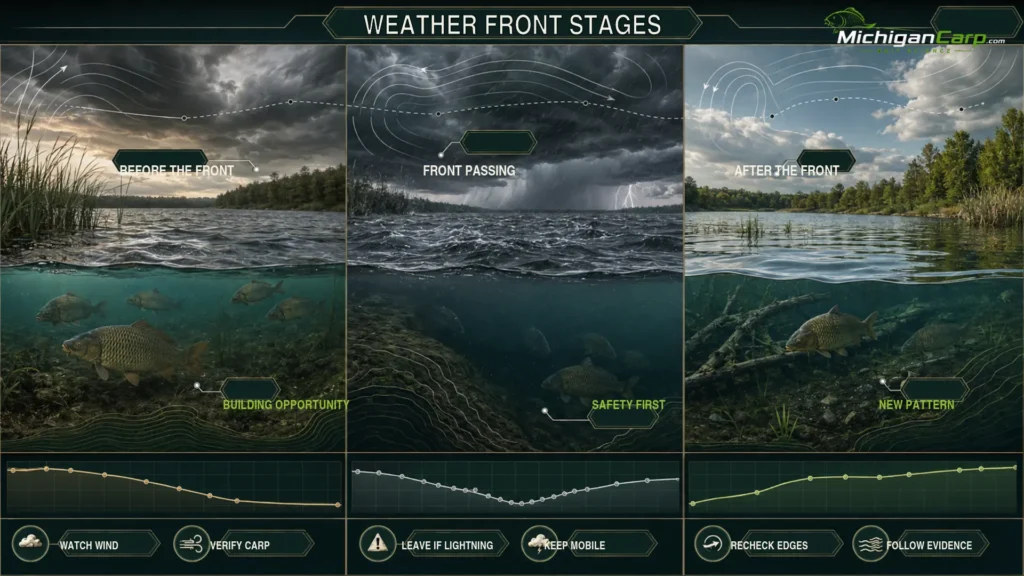
“Fish before a front” is useful only when you define the front and observe what it is doing. The strongest fishing period may occur well before rain appears, near the first useful wind increase, during a mild cloudy phase, or after the front once the lake settles. Treat the front as a sequence of testable stages.
| Front Stage | Possible Advantages | Possible Problems | Practical Carp Response |
|---|---|---|---|
| Building pre-front period | More cloud, softer light, useful wind, warmer air and increasing surface movement | Wind may be wrong for the venue; fish may not have reached the area | Watch likely routes and wind-affected food areas before committing bait |
| Immediate pre-frontal push | Confidence and movement may increase where conditions overlap well | Rapid deterioration, rough water and a shortening safe window | Fish efficiently, keep the setup controlled and know the exit point |
| Front passing | Rain, cloud and continued movement may keep fish active | Wind swings, temperature drop, presentation failure and lightning | Let fish signs decide; do not stay because the barometer looks good |
| Early post-front | Some fish may continue using food or routes established before the change | Cold advection, clearing sky, changed wind and shortened windows | Recheck shallows, cover, depth and low-light timing instead of repeating yesterday blindly |
| Settled post-front | A new daily pattern can form; visibility and location may improve | Fish may become less obvious or use safer water | Find the new routine and fish precision windows rather than writing off the lake |
A Warm Front and a Cold Front Are Not the Same
In spring, advancing mild air, a useful southerly wind and a warmer night can strengthen a shallow-water opportunity. A cold front may reverse that process, especially where the productive water is shallow and loses heat quickly. In midsummer, however, a cooler change after excessive heat may eventually improve conditions. The season and the starting water temperature decide whether “warmer” or “cooler” is helpful.
Read Pressure with Wind, Light, Temperature and Oxygen
Wind Often Explains the Location Change
Wind creates chop, drift, mixing and current. It can move warmer surface water, suspended food and colored water, but it can also make a bank cold, unsafe or difficult to present on. Its value depends on direction, duration, season, fetch, depth and what was happening before it started. Read the full process in Wind, Waves and Current Carp Fishing.
Cloud and Surface Ripple Change Light
Cloud and ripple can reduce the exposed feel of clear shallow water. That may extend daytime movement or make a margin usable earlier. On colored water, under thick weed or during low light, the same change may matter less. Use the protected Water Clarity and Light Penetration guide to judge how much the sky can actually change visibility in your swim.
Water Temperature Has More Biological Meaning Than Air Pressure Alone
Carp are ectotherms. Their body temperature and metabolic performance are tied to the water. A warm front can feel promising while deep water has barely changed. A cold night can cool a shallow bay faster than the main lake. Measure the water you plan to fish and follow the trend with the Carp Water Temperature Guide for Michigan Lakes.
Pressure Does Not Directly Tell You Dissolved Oxygen
A low or high reading is not an oxygen meter. Wind mixing, water temperature, plant photosynthesis, respiration, depth, stratification and inflows all matter. A windy low can improve surface mixing; a severe storm can also disrupt a shallow area. A calm hot spell may create poor dawn conditions in some sheltered water, while a large exposed lake remains well mixed. Use Dissolved Oxygen and Carp Fishing for the actual oxygen logic.
Michigan Seasonal and Water-Type Patterns
| Situation | What the Front May Change | Higher-Value Clue Than Pressure Alone | Practical Starting Point |
|---|---|---|---|
| Early spring inland lake | Warm-air advection, south wind, cloud and warmer overnight minimum | Measured shallow-water warming and first repeated signs | Check protected bays linked to deeper safety water |
| Late spring / pre-spawn | Rapid movement between shallow feeding, staging and spawning areas | Actual fish behavior and water temperature | Do not confuse visible spawning activity with feeding |
| Hot summer shallow water | Storm wind, cloud, rain, temporary cooling and mixing | Dawn oxygen, weed condition, inflows and safe low-light access | Watch before the storm; leave immediately when lightning threatens |
| Clear summer lake | Cloud and chop may reduce exposure; a clear high may sharpen low-light windows | Shade, boat traffic, water clarity and repeat travel times | Use dawn, dusk, night or wind cover where fish already travel |
| Large lake or reservoir | Long-fetch wind and current may matter more than the pressure label | Direction, duration, fetch, temperature and accessible lee/windward structure | Fish the useful water movement, not automatically the face of the wind |
| Fall cooling period | Warm pre-front air may hold a feeding opportunity; sharp post-front cooling may compress it | Water-temperature trend and food-area use | Follow fish from shallow food toward stable routes and holding water |
| Cold water / winter edge | Short mild spells can change shallow margins slowly | Sun exposure, ice status, oxygen and the warmest safe water | Treat pressure as secondary to temperature and location |
Water type modifies every row. A 200-acre shallow lake can react quickly. A Great Lakes channel, river mouth or deep reservoir may be controlled more strongly by current, seiche, tributary flow, shipping traffic or basin-scale wind. A weather front does not erase the venue.
A Practical Forecast-to-Swim Decision System
1. Start with Fish Location
Identify food, safety, depth changes, weed, inflows, patrol routes and a fishable landing area. A front can improve a good area; it rarely rescues a swim with no reason for carp to visit.
2. Build a 48-Hour Weather Sequence
Look at yesterday, today and tomorrow. Record the pressure curve, front timing, wind direction and speed, cloud, air-temperature high and low, rain and thunder risk. A screenshot of one barometer number is not enough.
3. Translate Weather into Lake Effects
Ask which bank receives the wind, whether that wind is warmer or colder than the water, how long it has blown, which water may color or clear, and whether the productive zone remains safe to fish. This is the step most “best pressure” charts omit.
4. Choose a Window, Not a Guarantee
Choose the period when several useful controls overlap: known fish location, acceptable temperature, useful light, manageable wind, safe access and evidence of movement. That is a bite-window decision, not a barometer prediction.
5. Verify at the Water
Watch before baiting heavily. Check surface temperature where possible. Look for rolling, fizzing, clouded water, reed movement, liners and repeated travel. The protected Signs Carp Are Feeding guide helps separate real feeding evidence from hopeful interpretation.
6. Adjust in the Correct Order
If the front passes and the lake changes, adjust location first, then timing, presentation and baiting. Do not reach for a new flavor because the wind stopped or the fish moved. Use On-the-Water Adjustments for that decision order.
Build a Pressure and Weather Log for Your Water
Your own consistent records can reveal local patterns that a generic pressure chart cannot. Log blanks as carefully as captures. Otherwise, you only remember the dramatic falling-pressure sessions that worked and forget the similar days that did not.
| Log Field | Record | Why It Matters |
|---|---|---|
| Pressure | Reading source, 12-hour trend and rate of change | Keeps measurements comparable and preserves the weather sequence |
| Front | Warm, cold, stationary or uncertain; estimated passage time | Separates the air-mass change from the number alone |
| Wind | Direction, speed, gusts, duration and fetch | Explains water movement and bank exposure |
| Light and weather | Cloud, sun, rain, visibility and storm timing | Connects pressure to confidence and safe fishing time |
| Water | Surface temperature, clarity, weed, current and any oxygen evidence | Records what the carp actually experienced |
| Fish evidence | Shows, fizzing, liners, feeding signs, capture time and depth | Tests whether weather translated into behavior |
| Fishing action | Swim, distance, feature, bait amount, rig and changes made | Prevents an angling change from being mistaken for a weather effect |
| Result | Bites, captures, blanks and when activity stopped | Builds a complete pattern rather than a capture-only story |
After ten or twenty comparable sessions, look for combinations: south wind plus warming shallows, cloud plus repeat afternoon movement, clear post-front mornings plus a short dawn bite, or stable highs plus predictable night activity. Do not isolate pressure until the other variables have been checked.
Safety and Common Pressure Mistakes
Fishing the Storm Instead of the Window
The useful pre-front period ends when wind, lightning, flooding, falling branches or access conditions become unsafe. Long carbon fishing rods, open banks, boats and exposed water are poor places to be during thunderstorms. Follow the National Weather Service’s lightning safety guidance. No pressure trend is worth staying through thunder.
Chasing a Universal “Best” Reading
Numbers such as 29.80 or 30.00 inHg are easy to remember and easy to market. They remove season, elevation, trend, water type and every linked weather variable. Use the number to identify the curve, not to score the fish.
Confusing Correlation with Cause
If you catch during falling pressure, record the wind, cloud, temperature, light and location too. The barometer may have marked the system while another part of that system created the practical opportunity.
Assuming High Pressure Means Deep Water
Carp may use deeper water after a clear cold front, but high pressure does not physically order them deep. Shade, weed, snags, colored water, warm margins, food and low-light timing may keep them shallow. Find the security and comfort, then choose depth.
Fishing Yesterday’s Area After the System Changes
A productive windward shelf can cool, clear or become still after passage. The fish may shift only a short distance to a deeper edge, weed line or holding route. Recheck rather than assuming the lake has shut down.
FAQ
What is the best barometric pressure for carp fishing?
No universal best pressure has been validated for wild common carp. Use the pressure trend to understand the weather sequence, then judge wind, light, temperature, oxygen, location and fish signs.
Do carp feed better when pressure is falling?
They may become more catchable during some falling-pressure periods, especially when cloud, useful wind, mild air and surface movement improve confidence. Falling pressure alone does not guarantee feeding.
Is high pressure bad for carp fishing?
No. A sharp rising barometer behind a cold front can coincide with difficult conditions, but a stable high can produce predictable dawn, dusk or night windows. The associated weather and the lake’s recent history matter more than the label.
Can carp feel barometric pressure changes?
Fish can detect hydrostatic pressure, and pressure-sensing mechanisms are biologically plausible. That does not prove a specific common-carp feeding response to ordinary atmospheric changes. Treat pressure as a possible cue within a much larger environmental system.
How far ahead of a front should I fish?
There is no fixed number of hours. Watch when the useful changes actually begin: cloud building, wind strengthening or turning, warmer air arriving, fish showing and the safe fishing window remaining open. On some waters that may be many hours before rain; on others the front adds little.
Should I move after a cold front?
Move only when the evidence supports it. First recheck shallow temperature, wind, clarity, visible activity, nearby depth and cover. Carp may shift to a safer adjacent zone rather than leave the entire area.
Next Steps
Start with How to Find Carp in Lakes, because weather is useful only after you identify water carp have a reason to use.
Then connect the front to Wind, Waves and Current, Water Temperature, Dissolved Oxygen and Water Clarity and Light.
Finally, use Carp Bite Windows in Michigan to combine those controls. The barometer is not the answer. It is one line in the wider lake-reading system.