

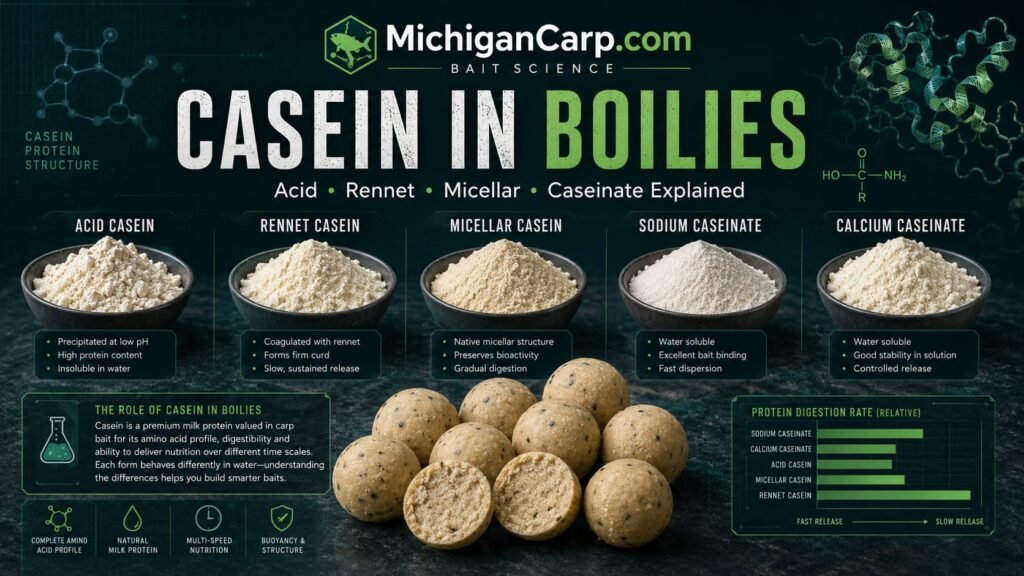
Casein in boilies is one of the most misunderstood areas of carp bait making.
Some anglers treat casein as a magic milk protein.
Some treat every casein ingredient as the same thing.
Some copy old milk-protein recipes without knowing whether the formula used acid casein, rennet casein, micellar casein, sodium caseinate or calcium caseinate.
Others avoid casein completely because it is expensive, harder to source in the USA, and easy to misuse.
The truth sits in the middle.
Casein can be extremely useful in boilie making, especially when you want structure, hardness, durability, milk-protein depth and strong hookbait performance.
But casein is not automatically better than WPC80, skimmed milk powder, milk powder, birdfood, nut meal or hydrolysate.
It depends on the job.
Acid casein, rennet casein, micellar casein, sodium caseinate and calcium caseinate all come from milk protein, but they do not behave the same in paste, boiling water, dried boilies or soaking bait.
That is why this article treats casein as a functional bait-making ingredient family, not a single powder.
For the broader milk-powder guide, read Milk Powders in Boilie Making.
For the direct comparison with WPC80 and skimmed milk powder, read Casein vs WPC for Boilies.
For the deeper science of digestibility, solubility and food value, read Milk Proteins in Carp Bait.
For complete base-mix design, use How to Formulate a Milk, Nut and Birdfood Boilie Base Mix.
The simple rule is:
CASEIN IS NOT ONE INGREDIENT.
CASEIN IS A FAMILY OF MILK-PROTEIN TOOLS.
Use the right form for the right job.
Table of Contents
Quick Start: Which Casein Should You Use?
Use this table as the practical starting point.
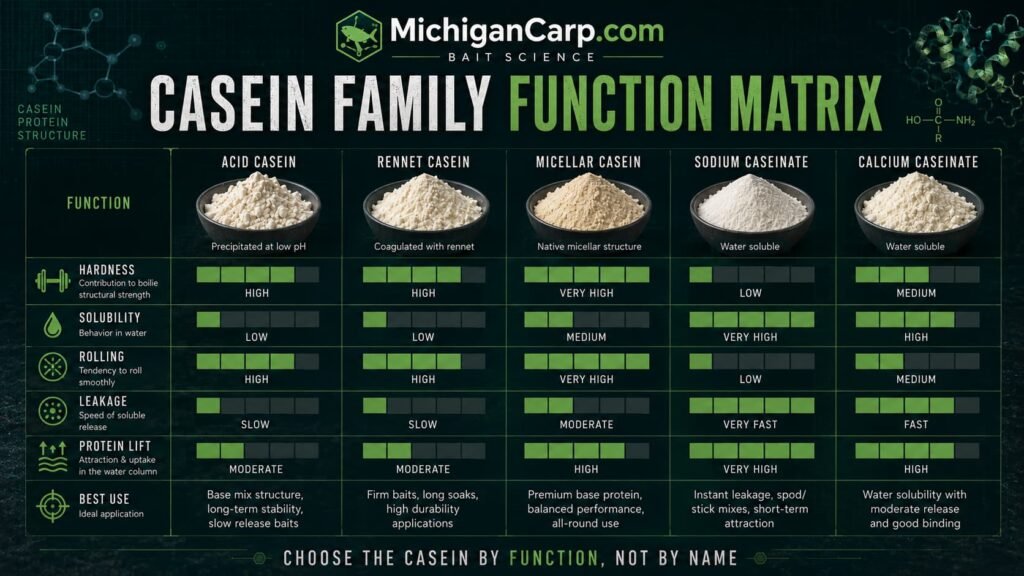
| Ingredient | Main Job in Boilies | Solubility / Dispersion | Texture Effect | Best Use |
|---|---|---|---|---|
| Acid casein | Hardness, density, structure | Low | Firm, hard, dense | Hard boilies, hookbaits, classic milk-protein bait |
| Rennet casein | Toughness, elastic firmness, long-session durability | Low | Firm, tough, sometimes slightly rubbery | Hookbaits, long-session baits, harder milk/nut baits |
| Micellar casein | Smooth slow milk-protein depth | Low to moderate | Smooth, dense, creamy | Premium milk/nut baits, hookbaits, USA practical option |
| Sodium caseinate | Dispersible casein-derived protein | Higher than casein | Smooth, creamy, functional, can become sticky | Soluble milk profile, pastes, hookbaits, creamy baits |
| Calcium caseinate | Firmer caseinate-style protein | Moderate | Smoother than casein, firmer than sodium caseinate | Balanced milk baits, hookbaits, structure with function |
| Casein blend | Balanced hardness and function | Varies | More controlled than single casein | Serious milk/nut baits and hookbaits |
| WPC80 | Whey protein, not casein | Moderate to higher | Smooth, protein lift, not casein hardness | Use alongside casein, not as direct replacement |
| Skimmed milk powder | Broad milk solids, not specialist casein | Moderate | Smooth, creamy, lactose-rich | Supports casein systems, does not replace structure |
Casein is most useful when you need:
- harder boilies;
- tougher hookbaits;
- dense milk-protein structure;
- long-session durability;
- controlled breakdown;
- protein depth;
- a classic milk/nut bait identity;
- a hookbait that stays intact.
Casein is less useful when you need:
- cheap bulk;
- fast leakage;
- soft cold-water bait;
- instant solubility;
- simple beginner bait;
- a highly open birdfood bait;
- a bait that must break down quickly.
The question is not:
“Is casein good?”
The better question is:
“Which casein form solves the problem in this bait?”
What Is Casein?
Casein is the main protein fraction in milk.
In simple bait-making terms, casein is the part of milk protein most associated with structure, firmness and slower breakdown.
In dairy science, casein ingredients are produced by separating casein from skim milk, washing it, and drying it. ADPI’s edible acid casein standard describes acid casein as the dried acid-precipitated coagulum from pasteurized skim milk, while USDA standards for edible dry acid casein list not less than 95% protein on a dry basis. ADPI Edible Acid Casein Standard and USDA Edible Dry Casein Standards.
For boilie making, that means casein is not just “milk flavor.”
It is a functional protein ingredient.
It can affect:
- paste firmness;
- rolling texture;
- boiling behavior;
- bait hardness;
- drying;
- water absorption;
- hookbait durability;
- breakdown rate;
- protein density.
But different casein ingredients behave differently.
That is where many bait makers go wrong.
Casein vs Caseinate: The Most Important Difference
Casein and caseinate are related, but they are not identical.
Casein
Think of casein as:
- harder;
- denser;
- less soluble;
- structural;
- slower working;
- hookbait-friendly;
- useful for durability.
Examples:
- acid casein;
- rennet casein;
- micellar casein.
Caseinate
Think of caseinate as:
- smoother;
- more dispersible;
- more functional in wet systems;
- easier to hydrate;
- useful for creamy spread;
- useful in pastes and hookbaits.
Examples:
- sodium caseinate;
- calcium caseinate.
ADPI defines edible caseinates as products made from the acid-precipitated coagulum of pasteurized skim milk that has been neutralized with an alkaline agent before drying. That neutralization step is the key reason caseinates behave differently from raw casein powders. ADPI Edible Caseinates.
Practical Bait Rule
Use casein when you want:
- hardness;
- structure;
- durability;
- slower release;
- classic milk-protein density.
Use caseinate when you want:
- smoother paste;
- more dispersion;
- better functional spread;
- creamier bait behavior;
- milk-protein support without the same hard casein feel.
A serious milk/nut bait may use both.
Acid Casein
Acid casein is one of the classic milk-protein boilie ingredients.
It is made by acid-precipitating casein from skim milk.
In bait making, acid casein is usually chosen for structure and hardness.
What Acid Casein Does in Boilies
Acid casein can help:
- firm the paste;
- harden the finished bait;
- create dense milk-protein structure;
- improve hookbait durability;
- slow breakdown;
- support long-session bait;
- resist nuisance fish better than soft bait;
- add classic milk-protein food value.
What Acid Casein Does Not Do
Acid casein does not:
- dissolve quickly;
- behave like WPC80;
- replace skimmed milk powder;
- give instant leakage;
- act like a cheap filler;
- suit every bait;
- fix a badly designed base mix.
It is powerful, but narrow.
Its best job is structural.
Best Uses for Acid Casein
Use acid casein in:
- hard bottom baits;
- long-session boilies;
- milk-protein hookbaits;
- wafters that need strength;
- bait exposed to nuisance species;
- milk/nut boilies that need more backbone;
- corkball paste;
- specialist milk-protein baits.
Starting Ranges for Acid Casein
For free baits:
3–8%
For stronger milk-protein boilies:
8–15%
For hookbaits:
10–25%
For corkball paste or specialist hookbait paste:
15–35%
These are starting ranges, not rules.
A bait with 25% acid casein can be excellent as a hookbait and too hard or expensive as a free bait.
Practical Warning
Acid casein can make bait too hard, dense and slow if overused.
That can be useful for a hookbait.
It can be a mistake in free bait.
Use acid casein when the bait needs hardness and structure, not just because the ingredient sounds advanced.
Rennet Casein
Rennet casein is another classic casein ingredient.
It is made by coagulating casein with rennet or suitable enzymes rather than by acid precipitation.
ADPI’s edible rennet casein standard lists a minimum milk protein level of 84% on a dry basis, with limits for milkfat, moisture, lactose and pH. ADPI Edible Rennet Casein Standard.
What Rennet Casein Does in Boilies
Rennet casein can help:
- increase bait toughness;
- create elastic firmness;
- improve hookbait durability;
- support long-session baits;
- produce firm milk-protein structure;
- create classic old-school milk bait character.
Rennet Casein vs Acid Casein
In practical bait making:
- acid casein often feels harder, denser and more brittle;
- rennet casein often feels firm, tough and sometimes slightly more elastic;
- both are low-solubility structural proteins;
- both need testing in the actual mix;
- product grind and quality matter.
This is not a universal law.
Different suppliers, particle sizes and recipes can behave differently.
But as a bait-making guide, acid casein is usually the “hard dense” option, while rennet casein is often the “firm tough” option.
Best Uses for Rennet Casein
Use rennet casein in:
- hookbaits;
- long-session boilies;
- hard milk/nut baits;
- bait for nuisance fish pressure;
- durable bottom baits;
- baits where toughness matters more than fast leakage.
Starting Ranges for Rennet Casein
For free baits:
3–8%
For stronger milk-protein boilies:
8–15%
For hookbaits:
10–25%
For specialist hookbait paste:
15–35%
Practical Warning
Rennet casein is not automatically better than acid casein.
It is different.
Use it when toughness and resilient structure matter.
Micellar Casein
Micellar casein is often easier for USA bait makers to find than traditional bait-grade acid or rennet casein because it is sold through sports nutrition suppliers.
That makes it important.
Micellar casein concentrate is produced by microfiltration of skim milk, with the process removing different amounts of whey protein and allowing higher protein concentration with lower lactose depending on the product. ThinkUSAdairy Micellar Casein Concentrate.
What Micellar Casein Does in Boilies
Micellar casein can add:
- slow milk-protein depth;
- smooth dairy body;
- dense protein identity;
- mild structure;
- creamy bait character;
- useful hookbait support;
- premium milk/nut profile.
What Micellar Casein Does Not Do
Micellar casein does not always behave like acid casein.
It may not harden the same way.
It does not behave like sodium caseinate.
It is not hydrolyzed.
It is not a fast-leaking milk trigger.
It is best viewed as a slower, smoother milk-protein ingredient.
Best Uses for Micellar Casein
Use micellar casein in:
- milk/nut boilies;
- cream baits;
- high-quality food baits;
- hookbaits;
- wafters;
- fruit-and-cream baits;
- USA-accessible milk-protein systems.
Starting Ranges for Micellar Casein
For free baits:
3–10%
For strong milk/nut boilies:
8–15%
For hookbaits:
10–25%
USA Buying Warning
Most micellar casein sold in the USA is aimed at human protein shakes.
Buy:
- unflavored;
- simple label;
- no chocolate;
- no vanilla flavor system;
- no caffeine;
- no creatine blend;
- no mass gainer;
- no thickener-heavy shake powder if you can avoid it.
Plain micellar casein is useful.
A flavored human supplement blend is not the same thing.
Sodium Caseinate
Sodium caseinate is one of the most useful casein-derived ingredients when you want function rather than just hardness.
It is casein converted into a sodium salt form.
In bait making, sodium caseinate is usually more dispersible and easier to hydrate than raw casein.
What Sodium Caseinate Does in Boilies
Sodium caseinate can help:
- smooth paste;
- increase milk-protein dispersion;
- improve creamy bait character;
- help emulsify oils;
- support soluble milk profile;
- improve paste and hookbait function;
- add high-quality milk protein;
- improve bait mouthfeel.
Why Sodium Caseinate Is Different
Raw casein is more structural and less soluble.
Sodium caseinate is more functional.
This matters in baits where you want milk protein to spread through the paste rather than sit there as a hard, slow ingredient.
Best Uses for Sodium Caseinate
Use sodium caseinate in:
- milk/nut boilies;
- creamy baits;
- pastes;
- hookbaits;
- corkball paste;
- pop-up paste;
- liquid food blends;
- glugs;
- high-attraction milk baits;
- soluble milk-protein systems.
Starting Ranges for Sodium Caseinate
For free baits:
2–8%
For strong milk-protein baits:
5–12%
For hookbaits and pastes:
8–20%
For liquid/glug use:
small test additions only
Practical Warning
Sodium caseinate can change dough quickly.
It may make paste smoother, creamier, stickier or more elastic depending on the formula.
Do not add it heavily to an untested mix.
Calcium Caseinate
Calcium caseinate is another caseinate form.
It is related to sodium caseinate, but it usually behaves differently in bait.
In practical terms, calcium caseinate is often less freely dispersive than sodium caseinate and more useful where firmness and protein structure matter.
What Calcium Caseinate Does in Boilies
Calcium caseinate can help:
- add milk protein;
- improve firmness;
- support hookbait structure;
- smooth paste;
- add calcium-linked casein character;
- bridge the gap between raw casein and sodium caseinate;
- improve durability without relying only on acid casein.
Calcium Caseinate vs Sodium Caseinate
Think of sodium caseinate as:
- more dispersible;
- smoother;
- more useful for creamy spread;
- better for soluble milk-protein behavior.
Think of calcium caseinate as:
- firmer;
- more structural;
- slightly less dispersive;
- useful where durability matters.
Best Uses for Calcium Caseinate
Use calcium caseinate in:
- hookbaits;
- balanced milk/nut boilies;
- firmer cream baits;
- food baits needing extra structure;
- bait where acid casein feels too hard but sodium caseinate feels too soft or dispersive.
Starting Ranges for Calcium Caseinate
For free baits:
2–8%
For stronger milk-protein baits:
5–12%
For hookbaits:
8–20%
Practical View
Calcium caseinate is a useful bridge ingredient.
It gives some of the functional advantage of caseinate while still helping firmness.
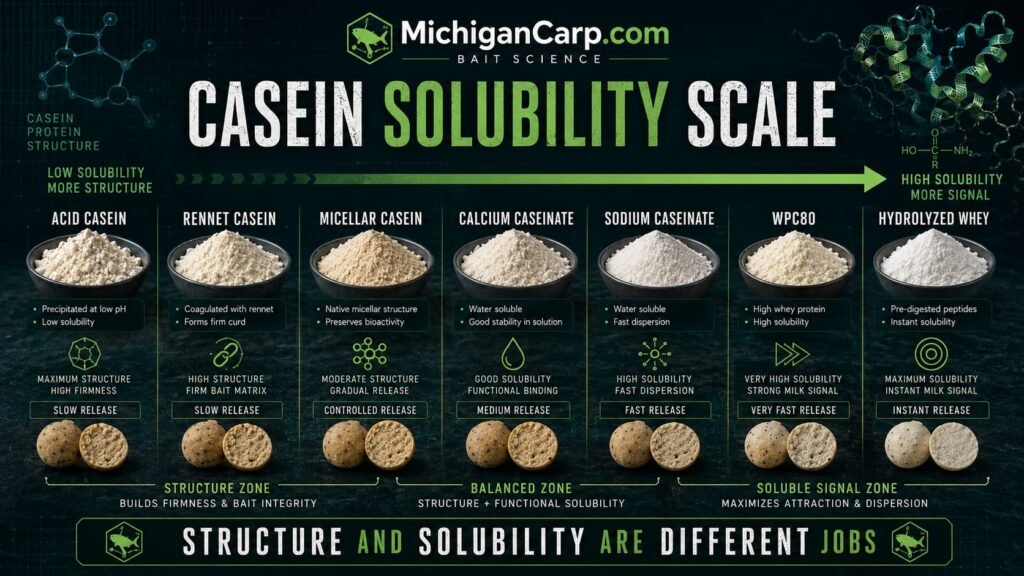
Casein, Caseinate and Solubility
Solubility is where bait makers often over-simplify casein.
Casein is generally not chosen for fast solubility.
Caseinate is usually more dispersible.
Hydrolyzed proteins are more soluble again.
Low-Solubility Casein Ingredients
These include:
- acid casein;
- rennet casein;
- some micellar casein products.
Best for:
- hardness;
- structure;
- hookbait durability;
- slow-release food value.
More Dispersible Casein Ingredients
These include:
- sodium caseinate;
- calcium caseinate;
- some milk protein concentrates.
Best for:
- smoother paste;
- creamy dispersion;
- more functional milk-protein behavior;
- hookbait and paste work.
Fast Soluble Milk-Protein Support
These are not caseins, but they work well alongside casein:
- WPC80;
- hydrolyzed whey;
- hydrolyzed milk protein;
- milk powders;
- lactose;
- yeast solubles.
The best bait often combines slow structure and soluble support.
Do not ask casein to do everything.
Casein and Bait Hardness
Casein is famous in bait making because of hardness.
But hardness is only useful when it solves a problem.
Hardness Helps When
- hookbaits need to last;
- crayfish or nuisance fish are active;
- boilies need to survive long casts;
- fishing long sessions;
- baiting over time;
- baits need to remain intact in warm water;
- hair-rig durability matters.
Hardness Hurts When
- water is cold;
- sessions are short;
- fish are feeding lightly;
- bait needs faster leakage;
- free baits become too slow;
- bait becomes too dense;
- fish mouth and reject over-hard bait.
Ingredients That Increase Hardness
- acid casein;
- rennet casein;
- calcium caseinate;
- albumen;
- longer boiling;
- longer drying;
- lower moisture;
- finer dense base mix.
Ingredients That Soften or Open the Bait
- birdfood;
- skimmed milk powder;
- whole milk powder;
- buttermilk powder;
- cream powder;
- nut meals;
- oils;
- some soluble liquids.
A hard bait is not automatically a better bait.
A hard hookbait may be perfect.
A hard free bait may be wrong.
Casein and Rolling Texture
Rolling is where casein theory gets tested.
Casein can make a paste better or worse depending on level, grind and the rest of the mix.
Acid Casein in Paste
Acid casein can make paste:
- firmer;
- denser;
- less sticky;
- more resistant;
- harder after boiling.
Too much can make paste:
- stiff;
- dry;
- cracked;
- difficult to extrude;
- slow to roll.
Rennet Casein in Paste
Rennet casein can make paste:
- tough;
- elastic;
- firm;
- durable.
Too much can make bait:
- rubbery;
- difficult to compress;
- slow to absorb liquid evenly.
Sodium Caseinate in Paste
Sodium caseinate can make paste:
- smoother;
- creamier;
- more elastic;
- more hydrated;
- sometimes stickier.
Too much can make paste:
- gummy;
- clingy;
- hard to roll;
- over-smooth and lacking structure.
Calcium Caseinate in Paste
Calcium caseinate can make paste:
- smoother;
- firmer;
- more protein-dense;
- less dispersive than sodium caseinate.
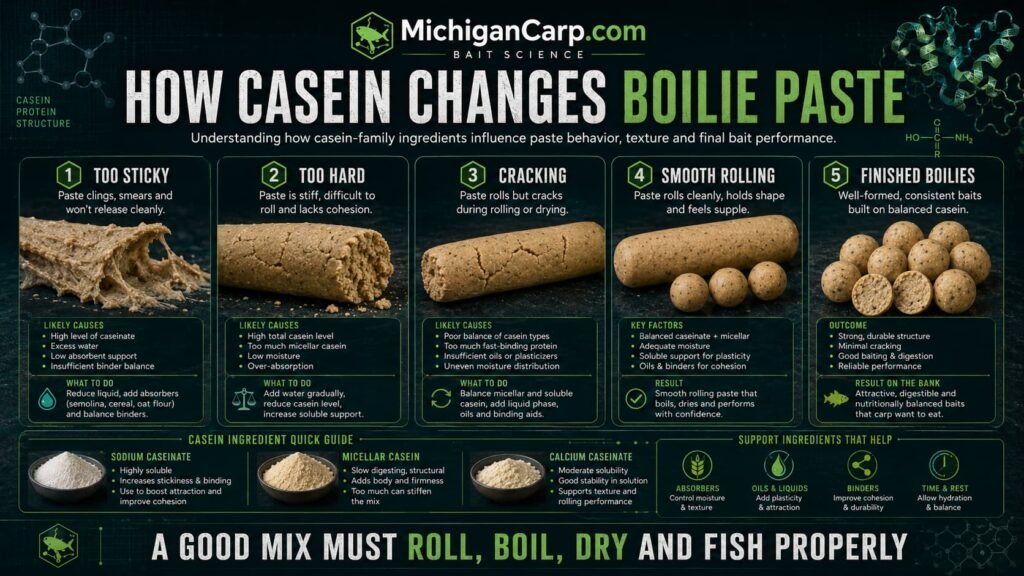
Practical Fixes
If the paste is too stiff:
- reduce acid or rennet casein;
- increase egg slightly;
- add a little oil;
- add whole milk powder or skimmed milk powder;
- add birdfood for texture;
- reduce albumen.
If the paste is too sticky:
- reduce sodium caseinate;
- reduce wet liquids;
- add semolina;
- add maize meal;
- add birdfood;
- rest the dough before rolling.
If the paste cracks:
- reduce hard casein;
- improve liquid distribution;
- increase egg;
- reduce coarse dry ingredients;
- avoid overdrying during rolling.
Casein and Boiling
Boiling changes casein baits.
The finished bait is not just dry powder with water added.
Boiling affects:
- bait skin;
- protein setting;
- starch gelatinization from cereals;
- soluble loss;
- bait firmness;
- internal moisture;
- drying behavior;
- surface texture;
- leakage pattern.
Acid Casein After Boiling
Acid casein-heavy baits can become firm and hard.
Useful for:
- bottom baits;
- hookbaits;
- long sessions;
- nuisance fish resistance.
Risk:
- bait becomes too dense or slow.
Rennet Casein After Boiling
Rennet casein can create tough, resilient texture.
Useful for:
- durable baits;
- harder hookbaits;
- long soak times.
Risk:
- bait becomes rubbery or overly tough if overdone.
Caseinates After Boiling
Caseinates may improve smoothness and functional protein behavior.
Useful for:
- pastes;
- hookbaits;
- creamy bait profiles;
- soluble milk-protein contribution.
Risk:
- paste may become too smooth, soft or sticky if overused.
Practical Rule
Test after:
- rolling;
- boiling;
- 24-hour drying;
- 48-hour drying;
- soaking;
- actual fishing.
Do not judge a casein bait from the dry mix alone.
Casein and Drying
Drying can make or break a casein bait.
Casein-heavy baits can become much harder after drying.
That can be good.
It can also be too much.
Short Drying
Useful when:
- bait will be frozen;
- you want softer free bait;
- fishing short sessions;
- water is cooler;
- bait does not need extreme hardness.
Longer Drying
Useful when:
- hookbaits need durability;
- nuisance fish are active;
- boilies need to last longer;
- bait will be used in warm water;
- you need firmer shelf-life handling.
Over-Drying Risk
Over-dried casein baits can become:
- too hard;
- cracked;
- slow to leak;
- less attractive as free food;
- difficult for fish to crush.
A hookbait can be harder than a free bait.
Do not dry both with the same goal unless you mean to.
Casein in Free Baits
Free bait and hookbait are different jobs.
A free bait should encourage feeding.
It should be eaten confidently.
It should not be so hard and dense that it becomes unattractive as food.
Casein Is Useful in Free Baits When
- fish are feeding confidently;
- water is warm enough;
- bait is part of a food-bait campaign;
- you need durability;
- nuisance fish are present;
- you are fishing long sessions;
- bait needs a strong milk-protein identity.
Casein Can Be Wrong in Free Baits When
- water is cold;
- fish are barely feeding;
- the bait is too dense;
- sessions are short;
- low-feed tactics are needed;
- bait needs fast signal;
- cost becomes unreasonable.
Practical Free Bait Approach
A strong free bait might use:
3–8% acid or rennet casein
3–8% caseinate
5–12% WPC80
5–15% skimmed milk powder or whole milk powder
That gives structure and protein without turning every free bait into a rock.
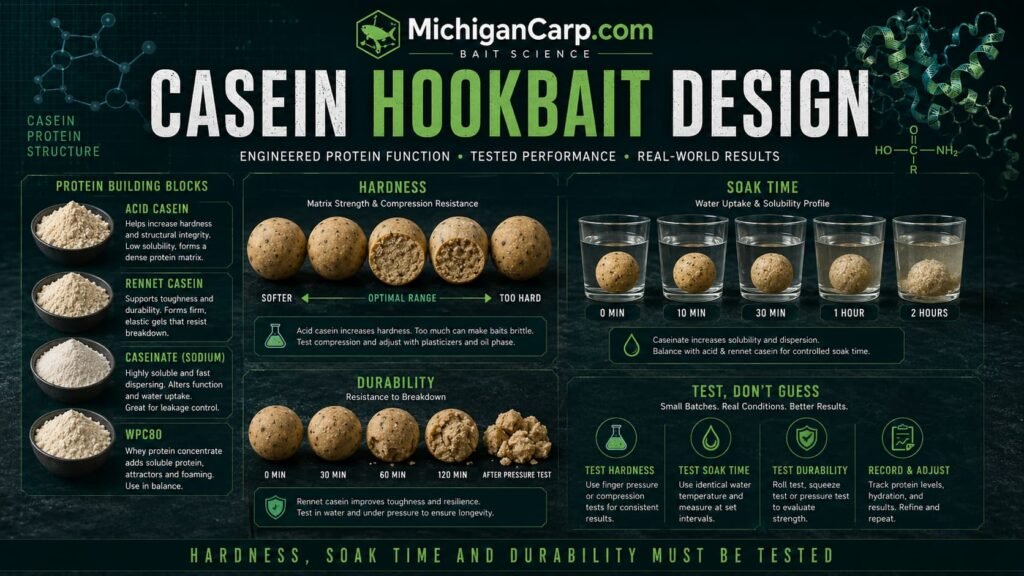
Casein in Hookbaits
Casein is often more valuable in hookbaits than in free bait.
Hookbaits need to work mechanically.
They must:
- stay on the hair;
- survive casting;
- resist nuisance fish;
- hold shape during long soaks;
- remain balanced if designed as wafters;
- keep fishing while free bait breaks down;
- carry a clear bait identity.
Why Casein Helps Hookbaits
Casein can provide:
- hardness;
- toughness;
- milk-protein profile;
- structure;
- slow release;
- durability;
- premium hookbait feel.
Useful Hookbait Casein Ingredients
- acid casein;
- rennet casein;
- micellar casein;
- sodium caseinate;
- calcium caseinate;
- WPC80;
- albumen;
- cork dust;
- pop-up base;
- cream powder in small amounts.
Practical Hookbait Casein Package
For 1 kg dry hookbait mix:
120 g acid casein
80 g rennet or micellar casein
80 g WPC80
60 g sodium or calcium caseinate
40 g skimmed milk powder
30 g cream powder
This is not a full recipe.
It is a protein package that must be balanced with structure, buoyancy, binder and liquids.
Hookbait Testing
Test casein hookbaits for:
- 6-hour soak;
- 12-hour soak;
- 24-hour soak;
- hair-rig durability;
- nuisance fish resistance;
- buoyancy if balanced;
- surface cracking;
- smell and leakage after soaking.
A hookbait that looks good in the kitchen but fails after 12 hours in water is not finished.
Casein in Wafters and Pop-Ups
Casein can be very useful in wafters and pop-ups, but it must be balanced carefully.
In Wafters
Casein can help:
- firm the bait;
- improve skin durability;
- add milk-protein profile;
- support longer soak time;
- balance against buoyant material.
But too much dense casein can make wafters sink too hard unless buoyancy is adjusted.
In Pop-Ups
Casein can add:
- milk-protein identity;
- paste strength;
- smoother rolling;
- hookbait food signal.
But pop-ups need buoyancy.
High casein can reduce buoyancy if the base is not designed for it.
Practical Wafter Rule
Do not add casein first and then hope the bait balances.
Build the buoyancy and protein system together.
Test every batch in water.
Casein in Milk/Nut Boilies
Casein fits naturally in milk/nut boilies.
Milk/nut baits often combine:
- tiger nut flour;
- peanut protein;
- peanut meal;
- almond meal;
- coconut meal;
- skimmed milk powder;
- whole milk powder or Nido;
- WPC80;
- acid or rennet casein;
- sodium or calcium caseinate;
- birdfood;
- yeast;
- small hydrolysate support.
What Casein Adds to Milk/Nut Baits
Casein can add:
- structure;
- protein depth;
- durability;
- classic milk bait profile;
- harder hookbait matching;
- long-session food value.
What Casein Should Not Do
It should not dominate the bait so much that the nut side disappears.
A milk/nut bait should still feel like a balanced food bait.
The milk side, nut side, cereal side, birdfood side and soluble side all need to work together.
For that wider structure, use How to Formulate a Milk, Nut and Birdfood Boilie Base Mix and Nut Boilie Base Mix Recipes.
Casein in Fruit-and-Cream Boilies
Fruit-and-cream boilies usually do not need huge amounts of hard casein.
They often benefit more from a softer milk system.
Good choices include:
- skimmed milk powder;
- whole milk powder;
- WPC80;
- buttermilk powder;
- cream powder;
- sodium caseinate in small amounts;
- micellar casein in moderate amounts.
Acid or rennet casein can be used if you need more hardness.
But do not let the bait become too dense.
Fruit-and-cream baits often need a balance between food value and active signal.
Good profiles include:
- plum and cream;
- peach and cream;
- orange cream;
- strawberry cream;
- pineapple coconut cream;
- maple vanilla cream.
Casein in Birdfood Boilies
Birdfood and casein can work well together if balanced.
Birdfood gives:
- texture;
- openness;
- seed character;
- visual speckling;
- rolling help;
- mechanical breakdown.
Casein gives:
- protein depth;
- hardness;
- structure;
- milk identity;
- hookbait durability.
Good Birdfood Casein Choices
Use:
- WPC80;
- skimmed milk powder;
- buttermilk powder;
- sodium caseinate;
- small acid or rennet casein additions.
Avoid overloading hard casein unless you want a very firm bait.
Birdfood baits are often valuable because they are open and textured.
Too much dense casein can reduce that advantage.
For birdfood design, use Birdfood for Carp Boilies.
Casein and WPC80: Why They Work Better Together
Casein and WPC80 are not enemies.
They are different tools.
Casein Gives
- hardness;
- structure;
- durability;
- slow milk-protein depth;
- hookbait toughness.
WPC80 Gives
- whey protein;
- more soluble dairy contribution;
- smoother milk signal;
- protein lift;
- cream bait support.
Best Practical Blend
For many milk/nut boilies, a better approach is:
WPC80 for whey protein
Casein for structure
Caseinate for function
Skimmed milk powder for broad milk solids
Whole milk powder for richness
That is more intelligent than asking one powder to do everything.
Casein and Skimmed Milk Powder
Skimmed milk powder is not casein.
It contains casein and whey proteins as part of broad milk solids, but it also contains lactose and minerals.
In the USA, skimmed milk powder is often bought as nonfat dry milk.
Skimmed Milk Powder Helps With
- milk background;
- lactose;
- smoothness;
- creaminess;
- practical availability;
- lower-cost dairy profile.
Casein Helps With
- hardness;
- structure;
- protein density;
- hookbait strength;
- slow-release milk-protein identity.
Substitution Warning
Replacing casein with skimmed milk powder changes the bait.
The bait may become:
- softer;
- sweeter from lactose;
- less protein-dense;
- less durable;
- easier to roll;
- quicker to break down.
That may be good.
It may be bad.
It depends on the formula.
Casein and Hydrolyzed Whey
Hydrolyzed whey is not casein, but it pairs well with casein.
Casein gives structure.
Hydrolyzed whey gives a more soluble milk-protein edge.
Use Hydrolyzed Whey When You Want
- quicker milk-protein signal;
- more soluble profile;
- hookbait leakage;
- paste attraction;
- short-session support;
- cold-water help in small amounts.
Practical Range
In free bait:
1–5%
In hookbaits or pastes:
2–8%
Use carefully.
Hydrolyzed ingredients can become sharp, bitter or overpowering if overdone.
USA Availability: Buying Casein Ingredients
This is one of the most important practical sections for North American bait makers.
UK bait makers often talk about caseins as if they are easy bait-shop ingredients.
In the USA, availability is different.
You may need to buy from:
- sports nutrition suppliers;
- dairy ingredient suppliers;
- baking suppliers;
- animal feed suppliers;
- online bulk ingredient suppliers;
- specialty food ingredient sellers.
Easier to Find in the USA
Usually easier:
- unflavored micellar casein;
- WPC80;
- nonfat dry milk;
- Nido / whole milk powder;
- buttermilk powder;
- cream powder;
- lactose;
- non-medicated calf milk replacer.
Harder to Find in the USA
Usually harder:
- true acid casein in small bait-making quantities;
- rennet casein;
- sodium caseinate;
- calcium caseinate;
- bait-grade milk-protein blends.
Best Practical USA Casein Kit
A realistic USA bait maker can do a lot with:
Unflavored micellar casein
Unflavored WPC80
Nonfat dry milk
Nido or whole milk powder
Buttermilk powder
Cream powder
Small caseinate supply if available
Acid casein only when sourced cleanly
You do not need every UK ingredient to build an excellent milk/nut bait.
Build by function.
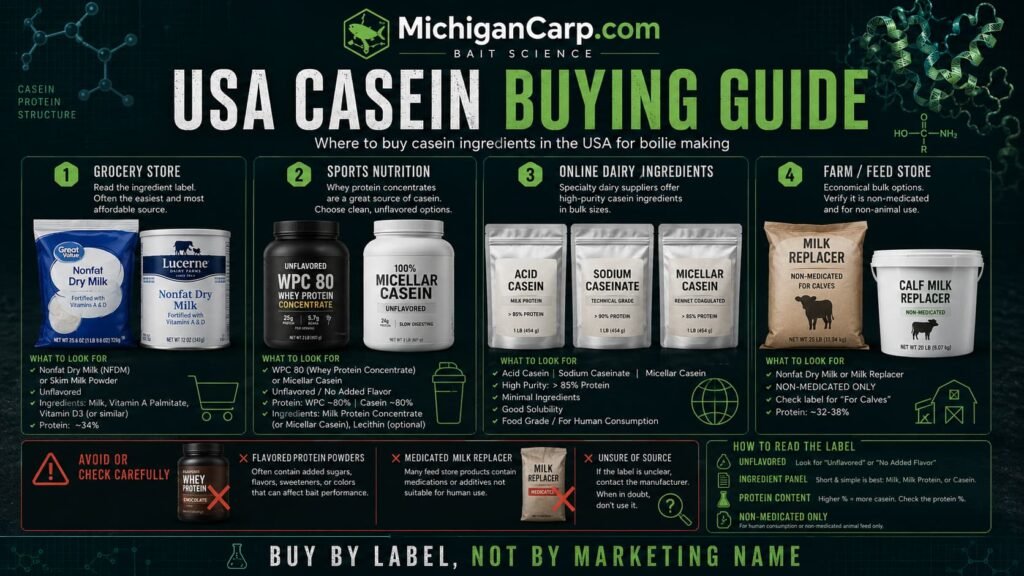
What to Avoid When Buying Casein
Avoid:
- flavored micellar casein shakes;
- chocolate casein powders;
- vanilla casein powders with gums;
- mass gainers;
- pre-workout blends;
- protein powders with caffeine;
- creatine-heavy formulas;
- sweetened dessert protein powders;
- casein blends with unclear labels;
- old rancid dairy powders;
- animal-feed products with medication;
- products without a clear ingredient panel.
A simple unflavored powder is better than a complicated supplement blend.
Do not buy by marketing name.
Buy by label.
Label Reading Checklist
Before buying casein or caseinate, check:
- protein percentage;
- ingredient name;
- acid casein vs rennet casein vs micellar casein;
- sodium caseinate vs calcium caseinate;
- lactose level;
- fat level;
- sweeteners;
- flavoring;
- gums;
- emulsifiers;
- salt;
- freshness;
- intended use;
- storage condition.
Key Label Terms
Good signs:
Unflavored micellar casein
Acid casein
Rennet casein
Sodium caseinate
Calcium caseinate
Milk protein concentrate
WPC80
Nonfat dry milk
Warning signs:
Chocolate flavor
Vanilla dessert
Mass gainer
Pre-workout
Energy blend
Artificially flavored
Gum blend
Caffeine
Creatine matrix
Medicated
A bait maker should read a label like a formulator.
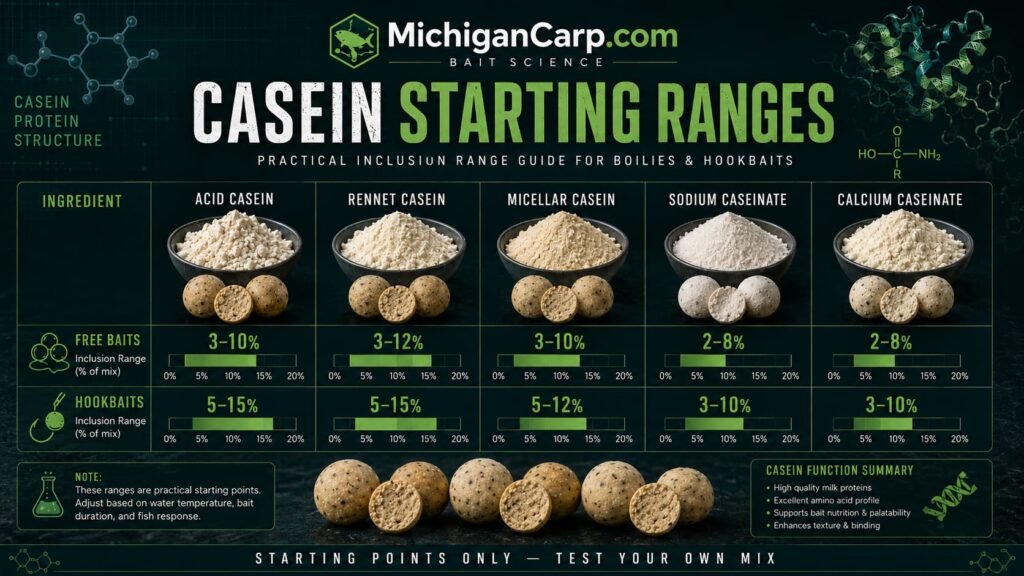
Inclusion Ranges for Casein Ingredients
These are practical starting ranges.
They are not fixed rules.
Free Baits
| Ingredient | Starting Range |
|---|---|
| Acid casein | 3–8% |
| Rennet casein | 3–8% |
| Micellar casein | 3–10% |
| Sodium caseinate | 2–8% |
| Calcium caseinate | 2–8% |
| Casein blend | 5–12% total |
| WPC80 alongside casein | 3–10% |
| Skimmed milk powder alongside casein | 5–15% |
Strong Milk/Nut Boilies
| Ingredient | Starting Range |
|---|---|
| Acid or rennet casein | 5–12% |
| Micellar casein | 5–12% |
| Sodium or calcium caseinate | 3–10% |
| WPC80 | 5–12% |
| Skimmed or whole milk powder | 5–15% |
Hookbaits
| Ingredient | Starting Range |
|---|---|
| Acid casein | 10–25% |
| Rennet casein | 10–25% |
| Micellar casein | 10–25% |
| Sodium caseinate | 8–20% |
| Calcium caseinate | 8–20% |
| WPC80 | 10–20% |
| Casein blend total | 20–45% depending on design |
Corkball Paste
| Ingredient | Starting Range |
|---|---|
| Acid / rennet casein blend | 15–35% |
| Caseinate | 5–20% |
| WPC80 | 5–15% |
| Albumen | 5–15% |
Test before scaling.
Casein-heavy mixes can behave very differently after boiling, drying and soaking.
Example Casein Packages
These are not full recipes.
They are functional casein packages to build into a complete bait.
Practical USA Milk/Nut Casein Package
For 1 kg dry mix:
70 g micellar casein
60 g WPC80
50 g nonfat dry milk
40 g Nido or whole milk powder
25 g sodium or calcium caseinate
Best for:
- USA milk/nut boilies;
- cream/nut baits;
- practical ingredient sourcing.
Harder Classic Milk Protein Package
For 1 kg dry mix:
70 g acid casein
50 g rennet casein
60 g WPC80
40 g sodium caseinate
40 g skimmed milk powder
Best for:
- stronger milk-protein boilies;
- long sessions;
- durable baits.
Creamy Functional Caseinate Package
For 1 kg dry mix:
70 g WPC80
60 g skimmed milk powder
40 g sodium caseinate
30 g calcium caseinate
40 g whole milk powder
30 g buttermilk powder
Best for:
- creamy milk/nut bait;
- fruit-and-cream bait;
- smoother rolling.
Hookbait Casein Package
For 1 kg dry hookbait mix:
120 g acid casein
100 g rennet or micellar casein
80 g WPC80
70 g sodium or calcium caseinate
50 g skimmed milk powder
Best for:
- hard hookbaits;
- wafters;
- corkball paste;
- long soak-time baits.
Cold-Water Casein Support Package
For 1 kg dry mix:
40 g micellar casein
60 g WPC80
50 g skimmed milk powder
25 g sodium caseinate
20 g hydrolyzed whey
Best for:
- lower-feed situations;
- more soluble milk signal;
- avoiding over-hard bait.
Casein in Shelf-Life Boilies
Casein can work in shelf-life boilies, but the whole bait must be designed for storage.
Casein itself is dry and stable as a powder when stored correctly.
The finished bait is the issue.
Shelf-life bait depends on:
- moisture level;
- drying;
- preservatives;
- egg content;
- fat level;
- sugar level;
- packaging;
- storage temperature;
- mold control;
- rancidity control.
Casein can help hardness, but hardness alone is not shelf life.
A rock-hard bait can still spoil if moisture and preservation are wrong.
For shelf-life bait, test small batches before making large quantities.
Casein in Freezer Baits
Freezer baits give more freedom.
You can use:
- richer milk powder;
- WPC80;
- casein;
- caseinate;
- cream powder;
- buttermilk powder;
- softer textures;
- more natural liquid systems.
But freezer bait still needs to dry enough to handle.
A freezer bait should not:
- split;
- mold quickly after thawing;
- become too soft;
- crack badly;
- collapse on the hair;
- fail after soaking.
Casein can help freezer baits hold shape and fish better.
But do not overbuild the bait just because it is going in the freezer.
Casein and Water Temperature
Water temperature matters.
Cold Water
In cold water, avoid over-heavy casein logic unless you have a reason.
Think:
- smaller baits;
- less feed;
- lower hard casein levels;
- more WPC80;
- more soluble support;
- modest hydrolyzed whey;
- softer milk profile;
- more open texture.
Casein can still be useful in hookbaits.
But free bait should not become a dense protein brick in low-feeding conditions.
Warm Water
In warm water, casein becomes easier to justify.
You can often use:
- stronger milk/nut boilies;
- firmer bait;
- more free bait;
- more durable hookbaits;
- longer-term feeding;
- higher casein levels if the fish are eating.
Still, balance matters.
A warm-water food bait should be edible and attractive, not just hard.
Casein and Michigan / North American Carp Fishing
For Michigan and North American carp fishing, casein has a specific place.
Most wild carp here are not pressured by high-end boilie campaigns the way some European venues are.
That means you do not always need a very expensive casein-heavy bait.
But casein can be valuable when:
- you are building a serious food bait;
- you want durable hookbaits;
- you fish longer sessions;
- nuisance fish are active;
- you are using milk/nut bait consistently;
- you want a bait that stands apart from corn and particles;
- you want better bait identity over repeated sessions.
For many Michigan situations, a balanced milk/nut bait with WPC80, nonfat dry milk, Nido, nut meals, birdfood and modest casein/caseinate may be more practical than an extreme casein bait.
Use the ingredient where it matters.
Do not waste it.
Cost and Value
Casein can be expensive.
That makes value important.
Use Expensive Casein For
- hookbaits;
- small premium batches;
- food-bait identity;
- durability;
- structure;
- long-session bait;
- bait testing.
Do Not Waste Casein On
- poorly designed bulk bait;
- sloppy base mixes;
- random experiments with no records;
- bait that already rolls badly;
- cold-water overfeeding;
- situations where cheap bait would do the same job.
Best Value Strategy
Use a layered dairy system:
Skimmed milk powder for broad milk solids
WPC80 for whey protein
Casein for structure
Caseinate for function
Whole milk powder for richness
Hydrolyzed whey for soluble edge
That gives better value than relying on one expensive ingredient.
Common Mistakes With Casein
Mistake 1: Treating All Caseins the Same
Acid casein, rennet casein, micellar casein and caseinates behave differently.
Mistake 2: Using Too Much Acid Casein
Too much can make bait hard, dense, slow and expensive.
Mistake 3: Thinking Caseinate Is Just Casein
Caseinate is more functional and dispersible.
Mistake 4: Replacing Casein With WPC80 Directly
WPC80 is whey protein, not casein.
Mistake 5: Replacing Casein With Skimmed Milk Powder Directly
Skimmed milk powder is broad milk solids, not structural casein.
Mistake 6: Building Free Bait Like Hookbait
Hookbait can be much harder and more concentrated.
Free bait should still be confidently eaten.
Mistake 7: Ignoring Rolling Texture
If the bait does not roll, boil and dry properly, the formula is not finished.
Mistake 8: Buying Flavored Human Protein Powder
Unflavored is usually best.
Mistake 9: Ignoring USA Availability
Build by function from what you can buy reliably.
Mistake 10: Believing Casein Alone Makes a Great Bait
Casein is only one part of the system.
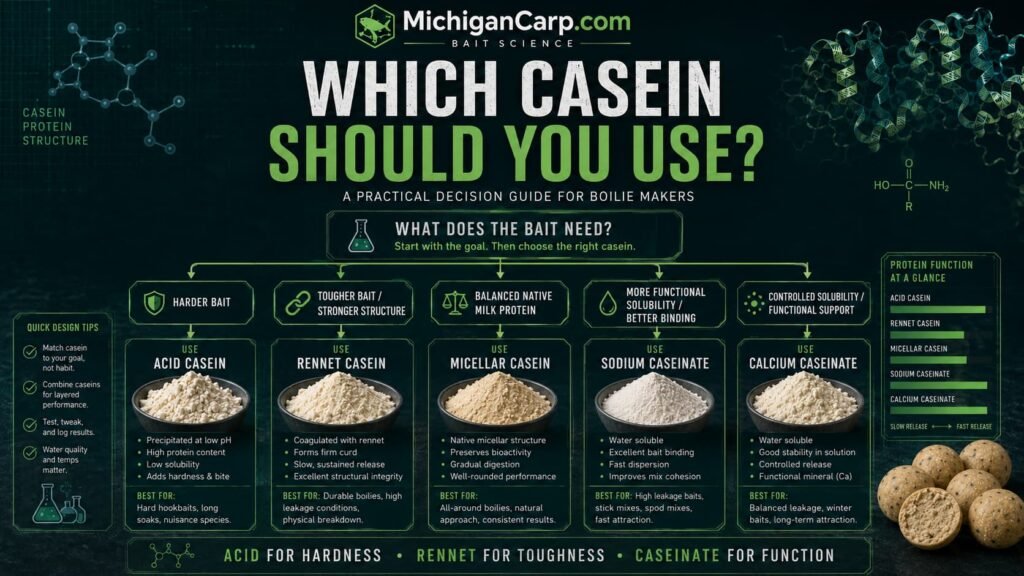
Decision Guide: Which Casein Should You Use?
I Want a Harder Bait
Use:
- acid casein;
- rennet casein;
- calcium caseinate;
- albumen.
I Want a Tough Hookbait
Use:
- acid casein;
- rennet casein;
- micellar casein;
- caseinate;
- WPC80;
- albumen.
I Want a Smoother Milk Protein Paste
Use:
- sodium caseinate;
- WPC80;
- skimmed milk powder;
- micellar casein.
I Want More Soluble Milk Protein Function
Use:
- sodium caseinate;
- WPC80;
- hydrolyzed whey;
- skimmed milk powder.
I Want a Practical USA Milk/Nut Bait
Use:
- micellar casein;
- WPC80;
- nonfat dry milk;
- Nido;
- buttermilk powder;
- small caseinate if available.
I Want Long-Session Durability
Use:
- acid casein;
- rennet casein;
- calcium caseinate;
- controlled drying.
I Want to Keep Cost Down
Use:
- nonfat dry milk;
- WPC80 at moderate levels;
- micellar casein if available;
- small amounts of caseinate;
- acid casein only where needed.
My Practical View
Casein is one of the best ingredients in serious boilie making, but it is also one of the easiest to misuse.
I do not see casein as a magic powder.
I see it as a structure and function tool.
For my own bait thinking, acid casein and rennet casein make most sense when hardness and durability are needed.
Micellar casein is useful because it is more available to USA bait makers and can provide a smooth, slow milk-protein contribution.
Sodium caseinate is valuable when I want more functional, dispersible milk protein.
Calcium caseinate is useful when I want caseinate behavior with more firmness.
But I would rarely build a practical Michigan food bait around casein alone.
A better bait usually blends:
- casein for structure;
- caseinate for function;
- WPC80 for whey protein;
- skimmed milk powder for broad milk solids;
- Nido or whole milk powder for richness;
- birdfood for texture;
- nut meals for natural food identity;
- yeast or hydrolysate for soluble support.
That is how casein should be used.
Not as a trophy ingredient.
Not as a magic answer.
As part of a balanced bait.
The final rule is:
USE CASEIN WHERE STRUCTURE, DURABILITY AND MILK-PROTEIN DEPTH MATTER.
DO NOT USE IT WHERE A CHEAPER, SOFTER OR MORE SOLUBLE INGREDIENT WOULD DO THE JOB BETTER.
FAQ
Is casein good in boilies?
Yes. Casein is very useful in boilies when you need structure, hardness, durability and milk-protein depth. It is especially valuable in hookbaits and stronger milk/nut boilies.
What is the best casein for boilies?
There is no single best casein. Acid casein is good for hardness, rennet casein for toughness, micellar casein for smooth slow milk-protein depth, sodium caseinate for dispersion, and calcium caseinate for firmer functional protein.
What does acid casein do in boilies?
Acid casein helps create hardness, density and structure. It is useful in hookbaits, hard boilies and long-session milk-protein baits.
What does rennet casein do in boilies?
Rennet casein helps create firm, tough, resilient bait texture. It can be useful in hookbaits and long-session boilies.
Is micellar casein good for boilies?
Yes. Micellar casein can be useful in milk/nut boilies and hookbaits, especially for USA bait makers who can source unflavored micellar casein through sports nutrition suppliers.
What is sodium caseinate used for in boilies?
Sodium caseinate is useful for smoother paste, better milk-protein dispersion, creamy bait character, pastes, hookbaits and more functional milk-protein behavior.
What is calcium caseinate used for in boilies?
Calcium caseinate is useful when you want caseinate-style milk protein with more firmness and structure than sodium caseinate.
Is caseinate the same as casein?
No. Caseinate is derived from casein but has been converted into a salt form, which changes how it behaves in water, paste and bait.
Can I replace casein with WPC80?
Not directly. WPC80 is whey protein and does not provide the same structure or hardness as casein.
Can I replace casein with skimmed milk powder?
Not directly. Skimmed milk powder adds broad milk solids, lactose and mild protein, but it does not behave like structural casein.
How much casein should I use in boilies?
For free baits, 3–8% is a sensible starting range. Stronger milk-protein boilies may use 8–15%. Hookbaits may use 10–25% or more depending on design.
Can too much casein ruin a bait?
Yes. Too much casein can make bait too hard, dense, slow, expensive and difficult to roll.
Is casein better in hookbaits than free bait?
Often, yes. Hookbaits benefit from hardness and durability, while free bait still needs to be eaten confidently.
Is casein worth the cost?
Casein is worth the cost when it solves a real bait problem, especially structure, durability and hookbait strength. It is not worth wasting as a prestige ingredient.
What casein ingredients are easiest to find in the USA?
Unflavored micellar casein is often easier to find than bait-grade acid or rennet casein. WPC80, nonfat dry milk and Nido are also practical USA milk-bait ingredients.
Next Steps
Use these supporting guides next:
- Milk Powders in Boilie Making
- Casein vs WPC for Boilies
- Milk Proteins in Carp Bait
- Boilie Ingredients Explained
- Boilie Base Mix Families
- How to Formulate a Milk, Nut and Birdfood Boilie Base Mix
- Nut Boilie Base Mix Recipes
- Birdfood for Carp Boilies
- Packbait for Carp Fishing
- The Bait Shed
- Boilie School
- Michigan Carp Guide Library