

Casein vs WPC for boilies
Casein vs WPC for boilies is one of the most common milk-protein questions bait makers ask, but it is usually the wrong question unless you also understand caseinate, skimmed milk powder and how each ingredient behaves in a real boilie mix.
Casein, caseinate, WPC and skimmed milk powder are often talked about as if they are interchangeable.
They are not.
They are all milk-derived ingredients, but they do very different jobs in boilie making.
One may help hardness.
One may improve solubility.
One may strengthen protein value.
One may make paste smoother.
One may tighten a hookbait.
One may give a broad creamy dairy background without behaving like a specialist protein.
That is why many bait makers get confused.
They read a recipe that says “milk protein” and do not know whether the bait needs acid casein, rennet casein, sodium caseinate, calcium caseinate, micellar casein, WPC80 or ordinary skimmed milk powder.
The answer depends on what you want the bait to do.
For the broader guide to all milk powders, including whole milk, buttermilk, cream powder, coconut milk powder and calf milk replacer, read Milk Powders in Boilie Making.
For the deeper science of milk proteins, solubility and food value, read Milk Proteins in Carp Bait.
For a casein-only deep dive, use Milk Caseins for Boilie Making.
For the complete base-mix structure, use Boilie Ingredients Explained and How to Formulate a Milk, Nut and Birdfood Boilie Base Mix.
The simple rule is this:
DO NOT CHOOSE MILK PROTEINS BY NAME.
CHOOSE THEM BY FUNCTION.
Table of Contents
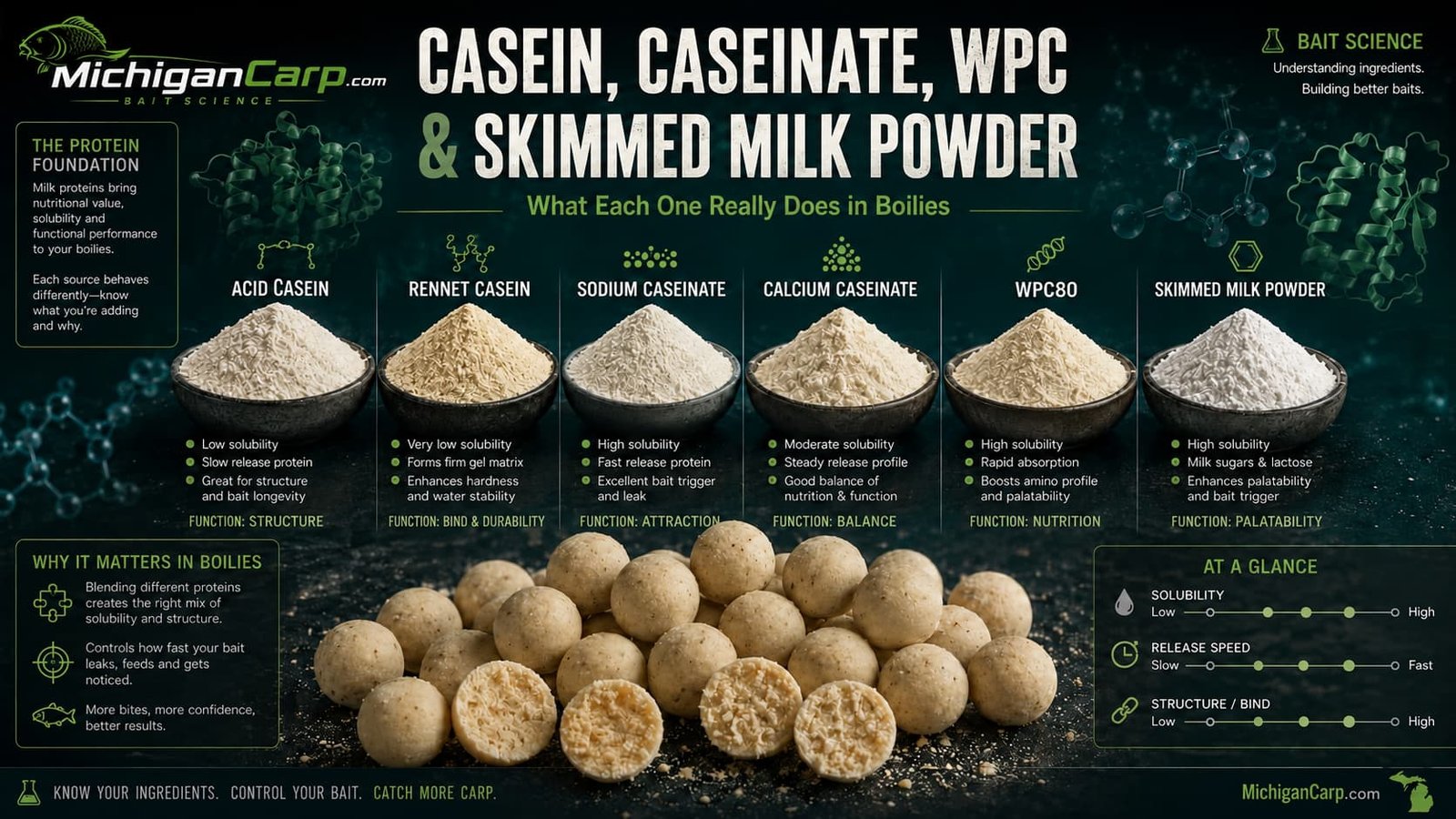
Quick Start: What Each Ingredient Really Does
Understanding casein vs WPC for boilies starts with knowing what each milk ingredient actually contributes to the finished bait.
Use this table as the fast reference.
| Ingredient | Main Function in Boilies | Solubility | Texture Effect | Best Use |
|---|---|---|---|---|
| Acid casein | Hardness, structure, dense protein | Low | Firm, hard, durable | Hard baits, hookbaits, milk protein boilies |
| Rennet casein | Firmness, elastic protein structure | Low | Tough, slightly more rubbery than acid casein | Long-session baits, harder milk boilies |
| Micellar casein | Native-style milk protein, slow-release dairy identity | Low to moderate | Smooth, dense, slower working | Premium milk/nut baits and hookbaits |
| Sodium caseinate | More soluble casein-derived protein, emulsifying effect | Higher | Smoother, more dispersive | Soluble milk profile, pastes, softer milk baits |
| Calcium caseinate | Casein-derived protein with calcium, less dispersive than sodium caseinate | Moderate | Firm, smoother than casein | Balanced milk protein baits |
| WPC80 | High whey protein, soluble dairy signal | Moderate to high | Smooth, can tighten dough | Milk/nut boilies, cream baits, protein lift |
| Skimmed milk powder / nonfat dry milk | Broad milk solids, lactose, mild protein, cream background | Moderate | Smooth, creamy, can become sticky if overused | Practical milk background, USA bait making |
| Ordinary whey powder | Lactose-heavy dairy powder, not WPC80 | Moderate to high | Soft, soluble, sweet dairy character | Limited support ingredient |
| Milk protein concentrate | Casein + whey proteins closer to natural milk ratio | Moderate | Smooth, dense, balanced | Premium milk-protein systems |
The mistake is trying to make one ingredient do every job.
A good milk-protein bait often uses a blend.
Example:
- skimmed milk powder for broad milk solids;
- WPC80 for whey-protein lift;
- casein or caseinate for structure;
- whole milk or cream powder for richness;
- birdfood or cereal for rolling and texture;
- yeast, hydrolysate or liquids for soluble support.
That is how you build a bait system instead of just copying ingredient names.
Casein vs WPC for Boilies: The Core Differences
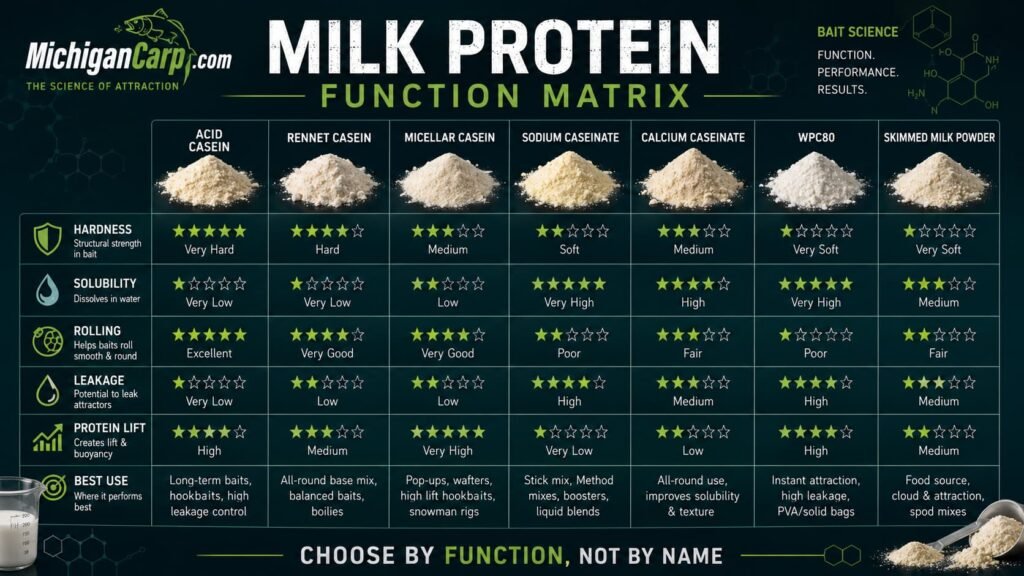
These ingredients all come from milk, but they are not the same.
The practical question of casein vs WPC for boilies is not really about deciding which ingredient is universally better. They perform different jobs.
Casein
Casein is the main protein fraction in milk.
In bait-making terms, caseins are usually used when the angler wants:
- hardness;
- durability;
- structure;
- dense protein;
- slow breakdown;
- hookbait strength;
- classic milk-protein bait character.
Casein is not very soluble in normal bait conditions.
That is not a fault.
That is part of why it is useful.
Caseinate
Caseinate is made from casein that has been converted into a salt form, such as sodium caseinate or calcium caseinate.
Caseinates generally behave differently from raw casein powders.
They are often more dispersible, smoother and more functional in wet mixes.
ADPI’s edible caseinate standard lists edible caseinates as at least 90% milk protein on a dry basis, with limits for fat, moisture and lactose. ADPI Edible Caseinates Standard.
WPC80
WPC80 means whey protein concentrate at around 80% protein.
It is a whey ingredient, not a casein ingredient.
The U.S. Dairy Export Council defines WPC80 as whey protein concentrate obtained by removing enough non-protein constituents from pasteurized whey so that the finished dry product contains more than 80% protein. U.S. Dairy Export Council WPC80.
Skimmed Milk Powder / Nonfat Dry Milk
Skimmed milk powder is the broad milk-powder ingredient.
In the USA, it is usually sold as nonfat dry milk.
It contains milk solids, lactose, minerals and milk proteins, but it is not a specialist casein or WPC product.
USDA standards for nonfat dry milk describe it as made from skim milk with not more than 5% moisture and not more than 1.5% milkfat. USDA Nonfat Dry Milk Standards.
The Big Misunderstanding: “Milk Protein” Does Not Mean One Ingredient
Many bait recipes say “milk protein.”
That is not specific enough.
“Milk protein” could mean:
- acid casein;
- rennet casein;
- micellar casein;
- sodium caseinate;
- calcium caseinate;
- milk protein concentrate;
- milk protein isolate;
- WPC80;
- whey protein isolate;
- skimmed milk powder;
- whole milk powder;
- a blend of several ingredients.
Those ingredients do not roll the same.
They do not boil the same.
They do not leak the same.
They do not harden the same.
They do not cost the same.
They are not equally available in the USA.
They do not all belong at the same inclusion level.
The real question is never:
“Is milk protein good?”
The real question is:
“Which milk protein, for what job, in what bait, at what level?”
Acid Casein
Acid casein is one of the classic milk-protein boilie ingredients.
It is made by precipitating casein from skim milk using acid.
In bait terms, acid casein is usually thought of as a hard, dense, low-solubility milk protein.
What Acid Casein Does
Acid casein can help:
- harden baits;
- improve hookbait durability;
- create dense milk-protein structure;
- resist quick breakdown;
- add classic milk-protein identity;
- support long-session bait;
- improve bait firmness when used correctly.
What Acid Casein Does Not Do
Acid casein does not behave like skimmed milk powder.
It does not dissolve like sugar.
It does not act like hydrolyzed protein.
It does not give the same soluble signal as WPC80.
It is not a cheap filler.
It is a structural milk protein.
Best Uses
Acid casein is best used in:
- hard hookbaits;
- specialist milk-protein boilies;
- milk/nut boilies that need more structure;
- long-session boilies;
- tougher baits for nuisance fish;
- balanced baits where durability matters.
Starting Range
For ordinary free baits:
3–8%
For stronger milk-protein boilies:
8–15%
For hookbaits or specialist baits:
10–25%
These are practical starting ranges, not fixed rules.
Practical Warning
Acid casein can make a bait expensive and hard.
That can be useful.
It can also be a mistake.
If a bait becomes too dense, too hard or too slow, the carp may not treat it the way you want.
Use acid casein when you need structure, not just because it sounds advanced.
Rennet Casein
Rennet casein is another classic milk-protein ingredient.
It is made by coagulating casein with rennet or other suitable enzymes rather than acid.
ADPI’s edible rennet casein standard lists minimum milk protein at 84% on a dry basis, with limits for fat, moisture, lactose and pH range. ADPI Edible Rennet Casein Standard.
What Rennet Casein Does
Rennet casein can help:
- create firm baits;
- build durable structure;
- add classic milk-protein body;
- produce tough hookbaits;
- create a slightly different texture from acid casein.
Acid Casein vs Rennet Casein
In practical bait making, acid casein is often thought of as firm, dense and hard.
Rennet casein is often thought of as firm but sometimes a little more elastic or rubbery in the finished bait.
That difference depends on the product, grind, recipe, boiling and drying.
Do not assume every rennet casein behaves exactly the same.
Best Uses
Rennet casein works well in:
- harder milk-protein boilies;
- hookbaits;
- long-session baits;
- specialist milk/nut baits;
- baits where firmness matters.
Starting Range
For ordinary free baits:
3–8%
For stronger milk-protein boilies:
8–15%
For hookbaits:
10–25%
Practical View
Rennet casein is valuable, but it is not required in every milk bait.
If the bait already contains WPC80, skimmed milk powder, egg, birdfood and good cereal structure, adding high casein levels may make it overbuilt.
Use it when the bait needs it.
Micellar Casein
Micellar casein is often sold in sports nutrition as a slow-digesting milk protein.
In food ingredient terms, micellar casein concentrate is produced by filtration methods that alter the casein-to-whey ratio compared with ordinary milk protein concentrate. ThinkUSAdairy Micellar Casein Concentrate.
For bait makers, micellar casein is useful because it gives a different type of milk-protein identity from acid casein, rennet casein or caseinate.
What Micellar Casein Does
Micellar casein can add:
- slow-working milk protein;
- smooth dairy body;
- dense milk identity;
- useful hookbait structure;
- premium milk/nut bait character;
- food-value depth without relying only on WPC80.
What It Does Not Do
It does not behave like hydrolyzed whey.
It is not a fast soluble trigger.
It is not the same as sodium caseinate.
It may not harden exactly like acid casein.
Best Uses
Micellar casein works best in:
- premium milk/nut boilies;
- cream/nut baits;
- hookbaits;
- balanced milk-protein systems;
- bait where you want slower dairy depth rather than instant solubility.
Starting Range
For free baits:
3–10%
For stronger milk/nut baits:
8–15%
For hookbaits:
10–25%
USA Availability Note
Micellar casein is often easier to buy in the USA through sports nutrition suppliers than traditional bait-grade caseins.
But buy plain, unflavored micellar casein if possible.
Avoid chocolate, vanilla shake blends, gums, sweeteners and human supplement extras unless you are deliberately testing them.
Sodium Caseinate
Sodium caseinate is one of the most useful casein-derived ingredients for bait makers who want a more functional, smoother milk protein.
It is made by neutralizing casein into a sodium salt form.
In practical bait terms, sodium caseinate is often more dispersible than raw casein.
What Sodium Caseinate Does
Sodium caseinate can help:
- improve solubility compared with raw casein;
- add high milk protein;
- smooth paste texture;
- support creamy dispersion;
- help emulsify oils;
- improve liquid and paste systems;
- add a soluble casein-derived profile;
- improve hookbait milk character.
Why It Is Different From Acid Casein
Acid casein is more structural and less soluble.
Sodium caseinate is more functional and dispersive.
That difference matters in boilie making.
Use acid casein when you want hardness and structure.
Use sodium caseinate when you want more dispersible milk-protein behavior.
Best Uses
Sodium caseinate works well in:
- milk/nut boilies;
- soluble pastes;
- hookbaits;
- corkball paste;
- milk-protein pop-ups;
- liquid bait additives;
- glugs;
- high-attraction boilies;
- soft cream/nut profiles.
Starting Range
For free baits:
2–8%
For stronger milk-protein baits:
5–12%
For hookbaits and pastes:
8–20%
Practical Warning
Sodium caseinate can change paste texture quickly.
It may make dough smoother, stickier or more elastic depending on the rest of the mix.
Test before adding it heavily.
Calcium Caseinate
Calcium caseinate is another casein salt.
It is not identical to sodium caseinate.
It usually feels a little different in bait and may behave more firmly.
What Calcium Caseinate Does
Calcium caseinate can help:
- add high milk protein;
- improve structure;
- support bait firmness;
- add calcium-linked milk protein character;
- improve hookbait durability;
- provide smoother behavior than raw casein.
Calcium Caseinate vs Sodium Caseinate
In practical bait terms:
- sodium caseinate is usually the more dispersible option;
- calcium caseinate is often firmer and less freely dispersive;
- both are more functional than raw casein in wet systems;
- both are different from skimmed milk powder.
Best Uses
Calcium caseinate works well in:
- balanced milk-protein boilies;
- hookbaits;
- milk/nut baits;
- firmer cream baits;
- bait where you want protein and structure without relying only on acid casein.
Starting Range
For free baits:
2–8%
For stronger milk-protein baits:
5–12%
For hookbaits:
8–20%
Practical View
Calcium caseinate is useful, but sodium caseinate is often easier to understand as the more dispersive option.
For a bait maker building milk/nut boilies, either can work.
Choose based on what the bait needs: dispersion or firmness.
WPC80
WPC80 is one of the most practical high-quality milk ingredients for USA bait makers.
It is not casein.
It is whey protein concentrate.
That matters.
What WPC80 Does
WPC80 can add:
- high whey protein;
- soluble dairy signal;
- smooth paste feel;
- protein lift without heavy casein hardness;
- cream bait support;
- useful milk/nut background;
- better dairy protein than ordinary whey powder.
What WPC80 Does Not Do
WPC80 does not create the same hard structure as acid casein.
It does not behave like rennet casein.
It is not the same as skimmed milk powder.
It is not the same as cheap whey powder.
Best Uses
WPC80 works well in:
- milk/nut boilies;
- fruit-and-cream baits;
- cream boilies;
- hookbaits;
- high-quality food bait;
- birdfood milk baits;
- boilies where you want dairy protein without over-hardening.
Starting Range
For free baits:
3–10%
For stronger milk/nut baits:
8–15%
For hookbaits:
10–20%
Practical Warning
WPC80 can tighten dough.
It can also affect rolling, boiling and finished texture.
At moderate levels, it is excellent.
At high levels, it can make a bait more expensive and less forgiving.
USA Buying Note
In the USA, unflavored WPC80 is often easier to source than traditional bait-grade caseins.
Look for:
- unflavored WPC80;
- simple label;
- no flavor system;
- no added creatine;
- no caffeine;
- no chocolate or vanilla blend;
- no thickener-heavy shake formula.
For a full USA milk powder buying guide, use Milk Powders in Boilie Making.
Ordinary Whey Powder vs WPC80
This is a major trap.
Whey powder and WPC80 are not the same.
Ordinary whey powder is often lactose-heavy and much lower in protein.
WPC80 is a concentrated whey protein ingredient.
Ordinary Whey Powder
Useful for:
- lactose;
- mild dairy sweetness;
- soluble dairy background;
- cheap milk signal;
- small additions.
Less useful for:
- serious protein lift;
- hard hookbait structure;
- replacing WPC80.
WPC80
Useful for:
- high whey protein;
- cleaner protein contribution;
- milk/nut boilies;
- cream bait structure;
- hookbait dairy identity.
Less useful for:
- cheap bulk filler;
- replacing casein hardness;
- replacing skimmed milk powder’s broad milk solids.
Practical Rule
If the label does not say WPC80 or give a high protein percentage, do not assume it is WPC80.
Skimmed Milk Powder / Nonfat Dry Milk
Skimmed milk powder is not a specialist milk protein.
It is a broad milk-solid ingredient.
In the USA, it is usually called nonfat dry milk.
What It Does
Skimmed milk powder adds:
- milk solids;
- lactose;
- light protein;
- dairy minerals;
- mild creaminess;
- smooth paste texture;
- useful milk background;
- cheap practical availability.
What It Does Not Do
It does not behave like acid casein.
It does not behave like rennet casein.
It does not behave like sodium caseinate.
It is not WPC80.
It is not a high-protein specialist bait ingredient.
Best Uses
Skimmed milk powder works well in:
- simple milk boilies;
- milk/nut boilies;
- fruit-and-cream baits;
- birdfood cream baits;
- packbait;
- method mix;
- early-stage bait testing;
- USA ingredient systems.
Starting Range
For free baits:
5–20%
For milk/nut baits:
5–15%
For hookbaits:
5–12%
Practical View
Skimmed milk powder is valuable because it is useful and available.
It is not glamorous.
It is not specialist.
But in a well-built bait, it gives milk background, smoother dough and practical dairy identity.
That makes it important.
Milk Protein Concentrate and Milk Protein Isolate
Milk protein concentrate, usually called MPC, is different again.
MPC contains both casein and whey proteins in a ratio closer to natural milk.
The U.S. Dairy Export Council explains that milk protein concentrate is produced by filtration methods that capture essentially all the casein and whey proteins from the milk stream, with a casein-to-whey ratio equivalent to original milk, generally around 80:20. ThinkUSAdairy Milk Protein Concentrate.
What MPC Does
MPC can add:
- balanced milk protein;
- casein and whey together;
- strong dairy protein value;
- smoother milk character;
- less single-function behavior than pure casein;
- useful premium milk/nut bait profile.
MPC vs WPC80
WPC80 is whey-dominant.
MPC contains both casein and whey in a milk-like protein balance.
MPC vs Casein
Casein is mostly casein.
MPC includes whey protein too.
Best Uses
MPC works well in:
- premium milk/nut boilies;
- cream protein baits;
- balanced milk protein systems;
- hookbaits;
- bait where you want both casein and whey without building the blend manually.
Starting Range
For free baits:
3–10%
For stronger milk-protein baits:
8–15%
For hookbaits:
10–25%
Practical View
MPC is useful, but not always necessary.
Many home bait makers can build a similar practical effect by combining skimmed milk powder, WPC80 and casein/caseinate.
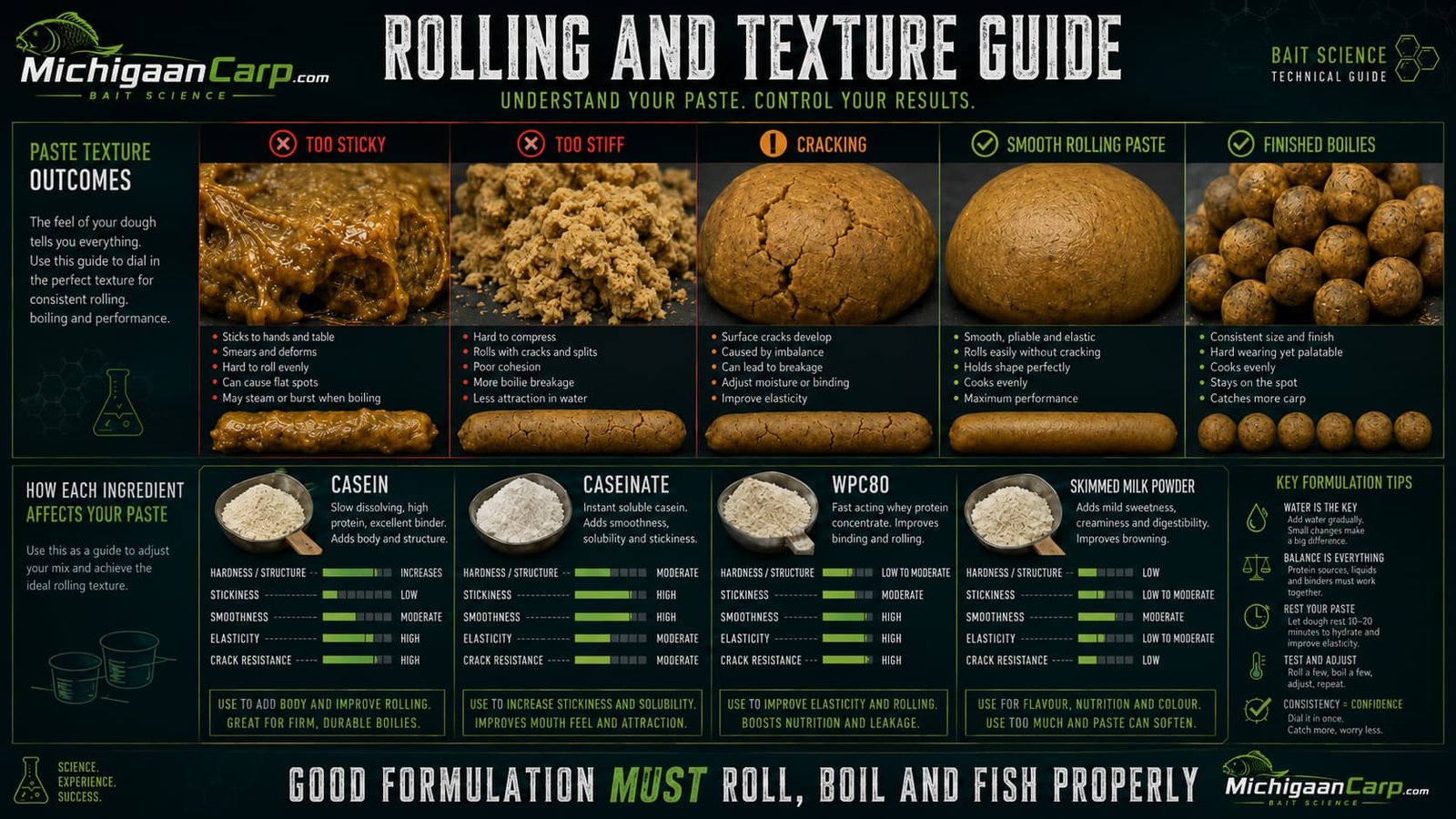
How These Ingredients Affect Rolling
The practical question of casein vs WPC for boilies is not really about deciding which ingredient is universally better. They perform different jobs.
Rolling is where theory meets reality.
A bait can look perfect on paper and still roll badly.
Acid Casein and Rennet Casein
These can:
- firm dough;
- make paste denser;
- increase toughness;
- make bait harder after drying;
- require better liquid control.
Too much can make bait dry, stiff or difficult to extrude.
Sodium Caseinate
This can:
- smooth dough;
- increase stickiness;
- improve dispersion;
- change water absorption;
- make paste feel elastic or creamy.
Too much can make paste difficult to handle.
Calcium Caseinate
This can:
- firm paste;
- add protein structure;
- smooth texture;
- create a slightly different feel from sodium caseinate.
WPC80
This can:
- smooth paste;
- tighten dough;
- increase protein density;
- affect boil set;
- make the bait less forgiving at high levels.
Skimmed Milk Powder
This can:
- improve smoothness;
- add milk body;
- soften harsh cereal texture;
- become sticky at high levels;
- require small liquid adjustments.
Practical Rolling Fixes
If the bait is too sticky:
- reduce liquid slightly;
- reduce sodium caseinate;
- reduce high milk-powder levels;
- add semolina;
- add maize meal;
- add birdfood;
- add albumen;
- rest the dough before rolling.
If the bait is too stiff:
- reduce hard casein;
- add more egg;
- add a little oil;
- increase skimmed milk powder instead of casein;
- reduce dry cereal binders;
- adjust with small liquid changes.
If the bait cracks:
- reduce coarse dry ingredients;
- reduce hard casein;
- increase binder;
- increase egg;
- improve mixing time;
- let the dough rest.
How These Ingredients Affect Hardness
Hardness is not always good.
It depends on the job.
A long-session bait may need durability.
A short-session cold-water bait may need quicker work.
A hookbait needs to stay on the hair.
A free bait needs to be eaten confidently.
Ingredients That Usually Increase Hardness
Hardness is one of the clearest practical differences when considering casein vs WPC for boilies.
- acid casein;
- rennet casein;
- calcium caseinate;
- albumen;
- some cereal binders;
- longer drying;
- stronger boiling;
- lower moisture.
Ingredients That Usually Improve Smoothness More Than Hardness
- skimmed milk powder;
- WPC80;
- sodium caseinate;
- whole milk powder;
- buttermilk powder.
Ingredients That Can Soften or Richen the Bait
- whole milk powder;
- cream powder;
- coconut milk powder;
- oils;
- high-fat milk replacer;
- liquid attractors.
Practical Rule
Use casein for hardness when hardness is the goal.
Do not use high casein levels just to sound technical.
A bait that is too hard can become slow, dense and less attractive as free food.
How These Ingredients Affect Leakage
Leakage is not only about solubility.
It is about how water moves through the bait and what it carries out.
Lower-Leakage Structural Ingredients
These include:
- acid casein;
- rennet casein;
- some micellar casein;
- dense cereal structure;
- hard-boiled egg-bound matrix.
They may still contribute food value, but they are not fast-leak ingredients.
More Dispersive Milk Ingredients
These include:
- sodium caseinate;
- WPC80;
- hydrolyzed whey;
- skimmed milk powder;
- ordinary whey powder;
- lactose.
These may support a more active bait signal.
The Whole Bait Controls Leakage
A bait with WPC80 can still be slow if it is over-boiled and over-dried.
A bait with casein can still leak if the rest of the mix contains solubles, open texture and good liquids.
A milk/nut bait is not controlled by one ingredient.
It is controlled by the whole formula.
How These Ingredients Affect Solubility
Solubility matters, but it is often oversimplified.
Low Solubility
- acid casein;
- rennet casein;
- dense micellar casein;
- hard-boiled egg-bound structures.
Moderate Solubility / Dispersibility
- calcium caseinate;
- WPC80;
- skimmed milk powder;
- milk protein concentrate.
Higher Dispersibility
- sodium caseinate;
- hydrolyzed whey;
- whey powder;
- lactose;
- some liquid dairy products.
Practical View
Do not make the whole bait highly soluble unless that is the goal.
A boilie needs to fish properly.
You want controlled leakage, not collapse.
Casein vs Caseinate: The Most Important Practical Difference
Casein and caseinate are related, but not identical.
Casein
Think:
- harder;
- denser;
- less soluble;
- structural;
- hookbait-friendly;
- classic milk-protein bait.
Caseinate
Think:
- smoother;
- more functional;
- more dispersive;
- easier to hydrate;
- useful in pastes and liquids;
- better for creamy milk dispersion.
Which One Should You Use?
Use casein when you want:
- hardness;
- durability;
- dense milk-protein structure;
- longer working bait;
- tougher hookbaits.
Use caseinate when you want:
- smoother paste;
- more dispersion;
- soluble milk-protein character;
- creamy spread through the bait;
- more functional protein behavior.
Best Practical Blend
A strong milk/nut bait may use both:
5% WPC80
5% skimmed milk powder
3–5% sodium or calcium caseinate
3–8% acid or rennet casein
That gives a better spread of functions than relying on one ingredient.
Casein vs WPC80
Casein and WPC80 are often compared, but they are not direct replacements.
Casein Strengths
Casein is strong for:
- hardness;
- durability;
- long-session bait;
- classic milk-protein profile;
- hookbait structure.
WPC80 Strengths
WPC80 is strong for:
- whey protein;
- soluble dairy signal;
- smoother profile;
- cream bait support;
- easier USA availability;
- balanced milk/nut bait design.
When Casein Is Better
Choose casein when:
- bait needs to be harder;
- nuisance fish are a problem;
- hookbaits need to last;
- the bait is too soft;
- you want classic milk-protein density.
When WPC80 Is Better
Choose WPC80 when:
- bait needs milk protein without too much hardness;
- you want more whey signal;
- you want better soluble dairy character;
- you are building a milk/nut bait;
- casein is too expensive or difficult to source.
Best Practical View
Do not ask whether casein or WPC80 is better.
Ask what the bait needs.
Most serious milk/nut baits can use both.
WPC80 vs Skimmed Milk Powder
This is another common confusion.
WPC80 and skimmed milk powder are not similar ingredients.
WPC80
Use for:
- high whey protein;
- stronger milk-protein contribution;
- soluble dairy signal;
- premium bait identity;
- milk/nut and cream baits.
Skimmed Milk Powder
Use for:
- broad milk solids;
- lactose;
- basic dairy background;
- smoother paste;
- practical USA availability;
- lower-cost milk profile.
Practical Difference
WPC80 is a protein tool.
Skimmed milk powder is a milk-solid tool.
Both can be useful.
They just do different jobs.
Skimmed Milk Powder vs Casein
Skimmed milk powder is often used in recipes where a bait maker cannot source casein.
That can work, but it is not the same substitution.
Skimmed Milk Powder Gives
- milk background;
- lactose;
- dairy solids;
- smoothness;
- mild protein;
- easy availability.
Casein Gives
- structure;
- hardness;
- high milk protein;
- slow breakdown;
- hookbait durability.
Substitution Warning
Replacing 100 g of casein with 100 g of skimmed milk powder will change the bait.
It may become:
- softer;
- less durable;
- sweeter from lactose;
- less protein-dense;
- easier to roll;
- quicker to break down.
That might be good.
It might be bad.
It depends on the bait.
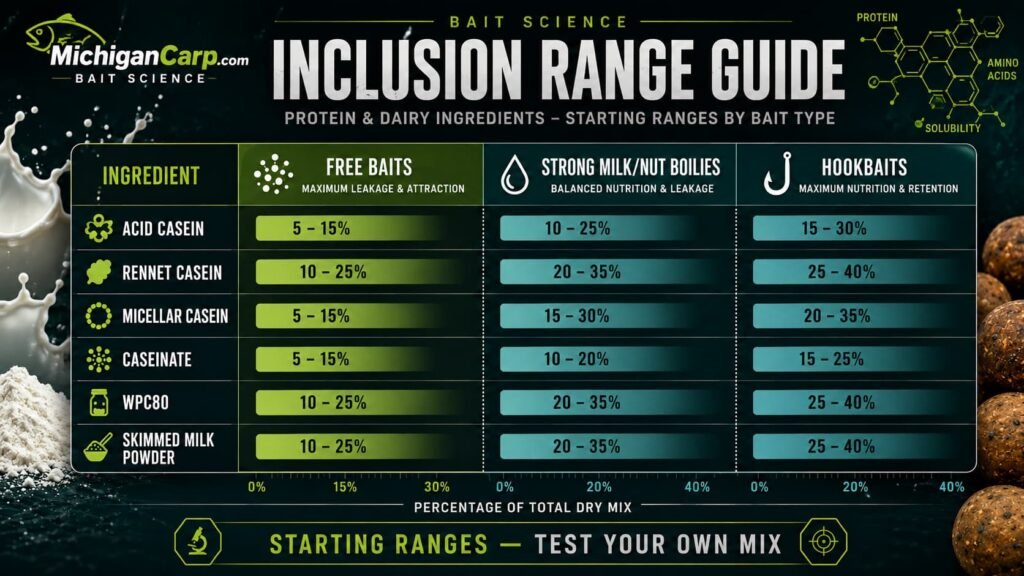
Inclusion Ranges: Practical Starting Points
These ranges are designed for home bait makers.
They are not laws.
They are starting points for testing.
Free Baits
| Ingredient | Practical Starting Range |
|---|---|
| Acid casein | 3–8% |
| Rennet casein | 3–8% |
| Micellar casein | 3–10% |
| Sodium caseinate | 2–8% |
| Calcium caseinate | 2–8% |
| WPC80 | 3–10% |
| Skimmed milk powder | 5–20% |
| MPC | 3–10% |
Higher-Quality Milk/Nut Boilies
| Ingredient | Practical Starting Range |
|---|---|
| Acid or rennet casein | 5–12% |
| Caseinate | 3–10% |
| WPC80 | 5–12% |
| Skimmed milk powder | 5–15% |
| Micellar casein | 5–12% |
Hookbaits
| Ingredient | Practical Starting Range |
|---|---|
| Acid casein | 10–25% |
| Rennet casein | 10–25% |
| Caseinate | 8–20% |
| WPC80 | 10–20% |
| Micellar casein | 10–25% |
| Skimmed milk powder | 5–12% |
Practical Warning
High protein does not automatically mean better bait.
A bait still needs:
- rolling quality;
- digestibility;
- palatability;
- leakage;
- texture;
- correct hardness;
- matching liquids;
- sensible feeding strategy.
Example Milk Protein Packages
A good formulation often uses a small package of milk proteins rather than one massive ingredient.
Basic USA Milk Protein Package
For 1 kg dry mix:
75 g skimmed milk powder / nonfat dry milk
50 g WPC80
25 g sodium or calcium caseinate
Use when:
- you want practical USA availability;
- you want creaminess and protein lift;
- you do not want a very hard bait.
Stronger Milk/Nut Package
For 1 kg dry mix:
70 g WPC80
50 g skimmed milk powder
40 g acid casein
30 g sodium caseinate
30 g whole milk powder or Nido
Use when:
- you want a stronger milk/nut identity;
- you want some hardness;
- you want both whey and casein behavior.
Hookbait Milk Protein Package
For 1 kg dry mix:
120 g acid or rennet casein
80 g WPC80
80 g sodium or calcium caseinate
50 g skimmed milk powder
30 g cream powder
Use when:
- hookbait durability matters;
- milk-protein identity matters;
- you will test buoyancy, hardness and soak time carefully.
Softer Cream Bait Package
For 1 kg dry mix:
80 g skimmed milk powder
60 g WPC80
40 g whole milk powder
30 g buttermilk powder
20 g sodium caseinate
Use when:
- you want cream character;
- you do not want hard casein dominance;
- you are building fruit-and-cream or maple/vanilla/nut bait.
Practical View
These are not final recipes.
They are ingredient packages.
They still need a proper base mix around them.
Building a Complete Milk/Nut Boilie Around These Ingredients
A milk-protein package is only part of the bait.
A complete milk/nut boilie still needs:
- structure;
- rolling bulk;
- protein balance;
- fat balance;
- solubles;
- liquids;
- binders;
- texture;
- cooking behavior;
- storage plan.
A practical milk/nut base might include:
- semolina or cereal meal;
- maize meal;
- birdfood;
- tiger nut flour;
- peanut protein or nut meal;
- skimmed milk powder;
- WPC80;
- casein or caseinate;
- yeast;
- small hydrolysate or liver support;
- albumen if harder bait is needed.
For recipe design, use How to Formulate a Milk, Nut and Birdfood Boilie Base Mix.
For practical nut bait examples, use Nut Boilie Base Mix Recipes.
Milk Proteins in Fruit-and-Cream Boilies
Fruit-and-cream boilies often do not need heavy casein.
They usually benefit more from:
- skimmed milk powder;
- whole milk powder;
- WPC80;
- buttermilk powder;
- cream powder;
- small sodium caseinate addition.
Use acid or rennet casein only if you need more hardness or durability.
Good profiles include:
- peach and cream;
- plum and cream;
- orange cream;
- pineapple coconut cream;
- strawberry cream;
- maple vanilla cream.
A fruit-and-cream bait should not become a brick.
The milk proteins should round the bait, not kill its attraction.
Milk Proteins in Birdfood Boilies
Birdfood boilies often work well with milk ingredients because birdfood gives texture and openness while milk proteins give food value and creaminess.
Good milk protein choices:
- skimmed milk powder;
- WPC80;
- buttermilk powder;
- small caseinate addition;
- small casein addition if harder bait is needed.
Be careful with very high casein levels.
Birdfood baits rely on texture.
Too much dense protein can reduce the open character that makes birdfood useful.
For birdfood design, use Birdfood for Carp Boilies.
Milk Proteins in Hookbaits
Hookbaits are different from free baits.
A hookbait needs to stay intact.
It needs to survive casting.
It needs to stay on the hair.
It may need to resist nuisance fish.
It may need to remain balanced or buoyant.
That is why higher casein levels often make more sense in hookbaits than in free bait.
Useful Hookbait Ingredients
- acid casein;
- rennet casein;
- micellar casein;
- sodium caseinate;
- calcium caseinate;
- WPC80;
- albumen;
- cork dust;
- pop-up mix;
- cream powder in small amounts.
Hookbait Warning
A hookbait that is too hard may last well but leak poorly.
A hookbait that is too soft may leak well but fail mechanically.
The best hookbait is a balance.
Practical Testing
Test hookbaits for:
- hardness after 24 hours;
- hardness after 48 hours;
- soak resistance;
- buoyancy;
- hair-rig durability;
- nuisance fish resistance;
- matching scent profile;
- visual attraction;
- leakage.
Milk Proteins and Boiling
Boiling changes milk-protein bait.
It affects the finished skin, internal texture, protein setting and soluble loss.
Casein
Casein-heavy baits can become firm and durable after boiling and drying.
Over-boiling can make them too hard or slow.
Caseinate
Caseinate can improve milk-protein function, but boiling and drying still control finished texture.
WPC80
WPC80 can help protein structure but may also tighten the bait.
High WPC levels need careful testing.
Skimmed Milk Powder
Skimmed milk powder contributes milk solids and lactose.
Some soluble material may be lost or changed through boiling and drying.
Practical Rule
Do not judge the bait only from the dry mix.
Judge it after:
- rolling;
- boiling;
- 24-hour drying;
- 48-hour drying;
- soaking;
- actual fishing.
For boiling-specific work, use What Boiling Does to Milk Protein Boilies when that article is linked in the Boilie School library.
Milk Proteins and Cold Water
Cold water changes bait performance.
High-fat and overly dense bait may not behave the same in cold water as it does in summer.
For cooler water, think about:
- slightly lower hard casein load;
- more controlled soluble support;
- WPC80 instead of excessive hard casein;
- skimmed milk powder for softer milk background;
- hydrolyzed whey or yeast support in small amounts;
- smaller bait size;
- lower feed volume.
That does not mean casein is bad in cold water.
It means the overall bait should not be too dense, fatty or slow for the situation.
Milk Proteins and Warm Water
Warm water gives more room for richer bait.
In warm water, carp may feed harder and process food more actively.
Milk/nut baits with WPC80, casein, skimmed milk powder, nut meals and birdfood can be very effective when used sensibly.
In warmer conditions, you can often use:
- slightly richer milk/nut baits;
- stronger food bait;
- more free bait;
- more durable boilies;
- larger bait sizes;
- longer-term baiting.
Still, do not overdo it.
A bait that is too rich or too hard can still work against you.
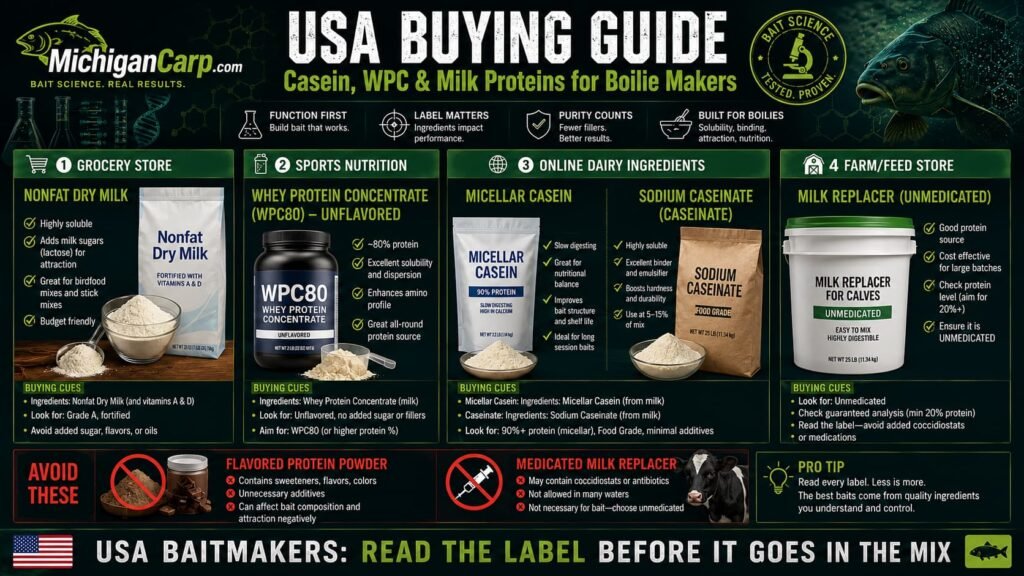
USA Availability: What to Buy and What to Avoid
For American bait makers comparing casein vs WPC for boilies, availability and ingredient labels can be just as important as theoretical performance.
USA bait makers have to be practical.
You may not find traditional bait-grade acid casein easily at a local store.
But you can often find useful milk ingredients through other routes.
Easier to Find in the USA
- nonfat dry milk;
- Nido-style whole milk powder;
- unflavored WPC80;
- unflavored micellar casein;
- unflavored whey protein isolate;
- buttermilk powder;
- cream powder;
- food-grade lactose;
- calf milk replacer;
- bulk dairy ingredients online.
Harder to Find
- true bait-grade acid casein;
- rennet casein;
- sodium caseinate in small quantities;
- calcium caseinate in small quantities;
- specialist bait milk-protein blends.
What to Avoid
Avoid:
- flavored protein shakes;
- mass gainers;
- chocolate whey blends;
- pre-workout powders;
- powders with caffeine;
- creatine-heavy blends;
- gum-heavy shake formulas;
- artificially sweetened products unless deliberately testing;
- medicated calf milk replacers;
- old rancid dairy powders;
- unclear animal-feed blends.
Best Practical USA Starting Kit
A serious USA bait maker can do a lot with:
Nonfat dry milk
Nido or whole milk powder
Unflavored WPC80
Unflavored micellar casein
Buttermilk powder
Cream powder
A small amount of caseinate if available
That is enough to build strong milk/nut baits without chasing every UK bait ingredient.
Reading the Label
Do not buy milk ingredients blindly.
Check:
- protein percentage;
- fat percentage;
- lactose or sugar;
- ingredient list;
- flavoring;
- sweeteners;
- gums;
- salt;
- added minerals;
- freshness;
- intended use;
- storage condition.
Protein Percentage
This tells you whether the product is a true protein ingredient or mostly milk solids/carbohydrate.
Fat Percentage
This matters for creaminess, leakage, cold-water behavior and shelf-life.
Lactose / Sugar
Lactose can be useful, but it is not protein.
Flavor
Unflavored is safest.
Gums and Thickeners
These can alter bait texture.
Added Supplement Ingredients
Avoid powders with unnecessary human supplement ingredients.
Medicated Feed Products
Do not use medicated milk replacers in bait.
Cost and Value
Milk proteins can get expensive quickly.
That does not mean the most expensive bait is the best bait.
High-Cost Ingredients
- acid casein;
- rennet casein;
- micellar casein;
- caseinates;
- WPC80;
- milk protein isolate.
Lower-Cost Ingredients
- skimmed milk powder;
- nonfat dry milk;
- whole milk powder;
- whey powder;
- milk replacer;
- buttermilk powder.
Best Value Strategy
Use expensive ingredients for function.
Do not use them as filler.
For example:
- use acid casein when you need hardness;
- use WPC80 when you need whey protein;
- use sodium caseinate when you need dispersion;
- use skimmed milk powder when you need broad milk solids;
- use whole milk powder when you need richness.
This keeps the bait effective without wasting money.
Common Mistakes
Mistake 1: Replacing Casein With Skimmed Milk Powder One-for-One
This changes structure, protein level, lactose level and hardness.
Mistake 2: Thinking WPC80 Is Casein
WPC80 is whey protein concentrate, not casein.
Mistake 3: Using Too Much Casein
Too much casein can make bait expensive, hard and slow.
Mistake 4: Using Flavored Gym Protein Powder
Most flavored protein powders are built for people, not bait.
Mistake 5: Ignoring Solubility
Hard protein ingredients and soluble protein ingredients do different jobs.
Mistake 6: Chasing Protein Numbers
Protein percentage alone does not make bait good.
Mistake 7: Forgetting Rolling Mechanics
A bait must roll cleanly and fish correctly.
Mistake 8: Copying UK Recipes Without USA Ingredient Adjustments
USA availability is different.
Use the best equivalent by function, not by name.
Mistake 9: Ignoring the Rest of the Base Mix
Milk proteins need support from cereals, birdfoods, nut meals, binders and liquids.
Mistake 10: Making Hookbait Logic Control Free Bait
A hookbait can be much harder and more concentrated than a free bait.
Do not automatically use the same logic for both.
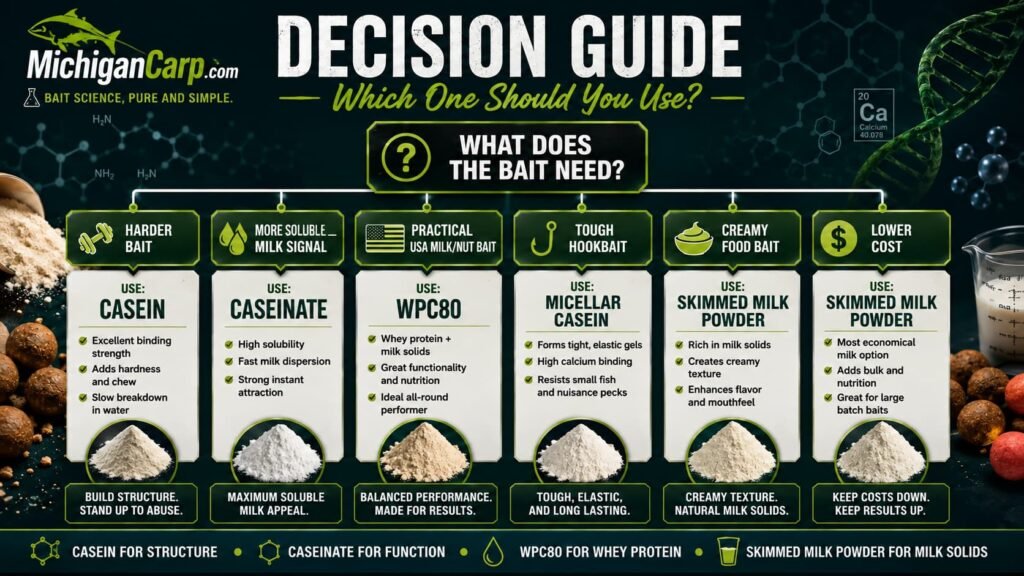
Decision Guide: Which One Should You Use?
Use this as a practical decision tree.
I Want a Harder Bait
Use:
- acid casein;
- rennet casein;
- calcium caseinate;
- albumen.
I Want More Soluble Milk Signal
Use:
- WPC80;
- sodium caseinate;
- hydrolyzed whey;
- skimmed milk powder;
- lactose.
I Want a Practical USA Milk/Nut Bait
Use:
- nonfat dry milk;
- WPC80;
- Nido or whole milk powder;
- micellar casein;
- buttermilk powder;
- small caseinate if available.
I Want a Tough Hookbait
Use:
- acid casein;
- rennet casein;
- WPC80;
- caseinate;
- albumen;
- cork dust or pop-up structure if needed.
I Want a Creamy Food Bait
Use:
- skimmed milk powder;
- WPC80;
- whole milk powder;
- buttermilk powder;
- cream powder;
- sodium caseinate in small amounts.
I Want to Keep Cost Down
Use:
- nonfat dry milk;
- WPC80 at moderate levels;
- milk replacer with a suitable label;
- buttermilk powder;
- small amounts of specialist casein only where needed.
My Practical View
My view of casein vs WPC for boilies is that they should not be treated as competing ingredients. They are different tools.
I see them as tools.
A serious milk/nut boilie does not need to be built around one magic powder.
It needs a balanced milk-protein system.
For North American bait making, I would rather build intelligently from available ingredients than chase a recipe that depends on one hard-to-find UK bait powder.
A very practical milk/nut bait can use:
- nonfat dry milk for broad milk solids;
- WPC80 for whey protein;
- Nido or whole milk powder for richness;
- casein or caseinate for structure;
- birdfood for texture;
- tiger nut flour or peanut ingredients for the nut side;
- yeast or hydrolysate for soluble support;
- controlled liquid levels;
- sensible boiling and drying.
That is a better route than throwing expensive casein into every bait.
The best rule is:
CASEIN FOR STRUCTURE.
CASEINATE FOR FUNCTION.
WPC80 FOR WHEY PROTEIN.
SKIMMED MILK POWDER FOR BROAD MILK SOLIDS.
Once you understand that, milk-protein bait making becomes much clearer.
FAQ
Is casein good in boilies?
Yes. Casein is useful when you want hardness, durability, dense milk-protein structure and classic milk bait character. It is especially useful in hookbaits and stronger milk-protein boilies.
Is WPC80 better than casein?
Not always. WPC80 and casein do different jobs. WPC80 gives whey protein and a more soluble dairy contribution, while casein gives more structure and hardness.
Is skimmed milk powder the same as casein?
No. Skimmed milk powder, or nonfat dry milk in the USA, is a broad milk-solid ingredient. Casein is a specialist milk protein used more for structure and hardness.
Is sodium caseinate better than acid casein?
It depends on the bait. Sodium caseinate is more dispersible and useful for creamy, functional milk-protein behavior. Acid casein is better when hardness and structure matter.
What is calcium caseinate used for in boilies?
Calcium caseinate can add milk protein, firmness and smoother structure. It is often less dispersive than sodium caseinate but more functional than raw casein.
What is micellar casein used for in boilies?
Micellar casein can add slow-working milk-protein identity, smooth dairy character and useful hookbait structure. It is a good USA-available option through unflavored sports nutrition suppliers.
Can I use whey protein powder in boilies?
Yes, but choose carefully. Unflavored WPC80 is useful. Flavored gym powders, mass gainers and supplement blends are usually poor choices unless you are deliberately testing them.
Can I replace WPC80 with skimmed milk powder?
You can adjust a recipe that way, but it is not a direct replacement. Skimmed milk powder is lower in protein and higher in lactose than WPC80.
Can I replace casein with WPC80?
Not directly. WPC80 will not give the same hardness and structure as casein.
What is the best milk protein for hookbaits?
Acid casein, rennet casein, caseinate, WPC80 and albumen can all be useful. The best hookbait usually combines structure, protein, buoyancy control and soak resistance.
What is the best milk protein for USA bait makers?
The most practical USA starting combination is nonfat dry milk, unflavored WPC80, Nido or whole milk powder, and unflavored micellar casein. Add caseinate or acid casein when you can source it.
How much WPC80 should I use in boilies?
A practical starting range is 3–10% for free baits, 8–15% for stronger milk/nut baits and 10–20% for hookbaits.
How much casein should I use in boilies?
A practical starting range is 3–8% for free baits, 8–15% for stronger milk-protein boilies and 10–25% for hookbaits.
Can too much casein ruin a bait?
Yes. Too much casein can make bait too hard, too dense, too expensive and too slow.
Should every milk/nut bait contain casein?
No. A milk/nut bait can be excellent with skimmed milk powder, WPC80, whole milk powder, nut meals and birdfood. Casein is useful when you need its specific function.
Next Steps
Use these supporting guides next:
- Milk Powders in Boilie Making
- Milk Proteins in Carp Bait
- Milk Caseins for Boilie Making
- Boilie Ingredients Explained
- Boilie Base Mix Families
- How to Formulate a Milk, Nut and Birdfood Boilie Base Mix
- Nut Boilie Base Mix Recipes
- Packbait for Carp Fishing
- The Bait Shed
- Boilie School
- Michigan Carp Guide Library