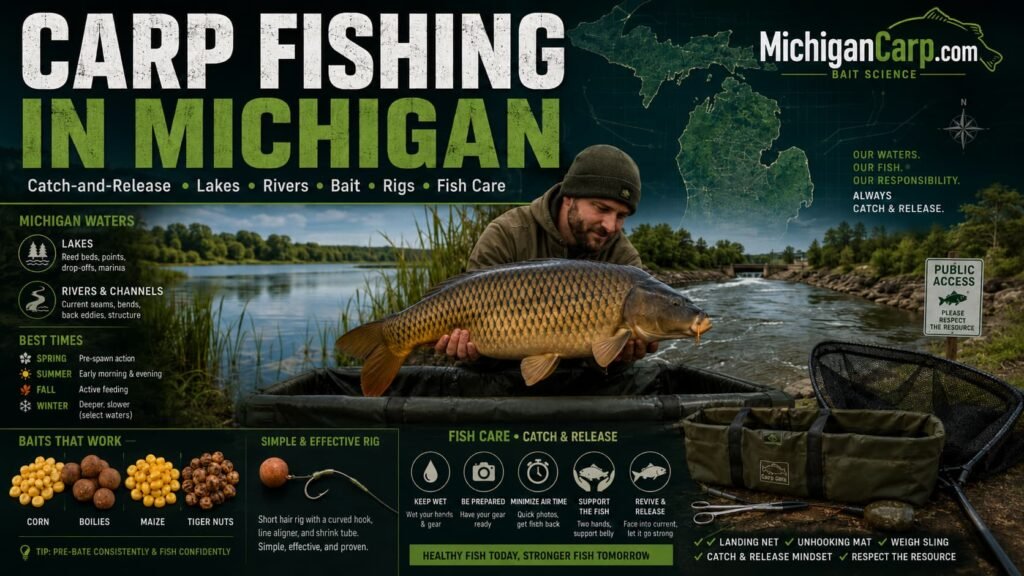
Carp fishing in Michigan is one of the most overlooked freshwater fishing opportunities in the state.
Michigan has carp in big inland lakes, shallow bays, rivers, channels, reservoirs, dam ponds, canals, drains and Great Lakes-connected water. Some of these fish are ordinary doubles. Some are powerful twenties and thirties. Some Michigan waters have the potential to produce carp much larger than many local anglers realize.
Yet carp are still misunderstood.
To some people, common carp are just rough fish. To others, they are a nuisance. To a growing number of serious anglers, they are one of the hardest-fighting, most intelligent and most rewarding freshwater fish available from public water in North America.
This guide is written from the MichiganCarp.com point of view:
Carp are worth fishing for properly.
That means finding them with watercraft, using safe rigs, choosing bait intelligently, handling fish with care, respecting public access, checking current regulations, and practicing responsible catch-and-release carp fishing.
This is not bowfishing content. It is not a “how to get rid of carp” article. It is not a novelty bait list.
This is a complete practical guide to carp fishing in Michigan with rods, reels, bait, rigs, bank fishing, watercraft and fish care.
For the shorter beginner doorway, start with Start Here: Carp Fishing in Michigan.
For the organized site index, use Michigan Carp Guide Library.
For conditions and location, read Watercraft and Conditions for Michigan Carp Fishing.
For bait choice, read Best Carp Bait for Michigan Lakes.
For rigs, read The Complete Michigan Carp Rig Guide.
For handling and recovery, read Fish Care & Safety.
The simple rule is this:
If you want to catch Michigan carp consistently, treat them like a serious sport fish.
Table of Contents
Quick Start: Carp Fishing in Michigan
Use this table as the quick guide.
| Topic | Practical Answer |
|---|---|
| Main species | Common carp |
| Best approach | Catch-and-release bank fishing with strong tackle, safe rigs and proper fish care |
| Best waters | Inland lakes, rivers, channels, dam ponds, reservoirs, canals, shallow bays and Great Lakes-connected water |
| Best seasons | Spring through fall, with winter possible where safe open water exists |
| Best beginner baits | Corn, maize, tiger nuts, particles, packbait and boilies |
| Best beginner rigs | Simple hair rig, safe lead clip, inline lead setup, method-style setup, basic bottom-bait rig |
| Best location clues | Bubbles, clouded water, rolling fish, tails, liners, weed edges, reed edges, mussels, silt and windward banks |
| Biggest mistake | Fishing where it is convenient instead of where carp are actually feeding |
| Fish care essentials | Large net, padded mat, weigh sling, forceps, wet hands, quick photos and careful release |
| MichiganCarp.com approach | Practical catch-and-release carp fishing built around watercraft, bait science, safe rigs and respect for the fish |
Carp fishing in Michigan is not complicated at the beginning.
You need to find carp, present bait safely, use tackle strong enough to land them, and handle them properly once they are on the bank.
The deeper skill comes later: reading conditions, building bait confidence, choosing better hookbaits, fishing big lakes, understanding seasonal movement, and learning how Michigan carp behave on wild public water.
What Carp Fishing in Michigan Really Means
Carp fishing in Michigan is not one single style of fishing.
It can mean fishing a shallow inland lake from a campground bank. It can mean fishing a river bend with snags and current. It can mean casting into a channel connected to Lake Michigan. It can mean rowing bait to a quiet feature on a dam pond. It can mean stalking visible fish in a shallow bay. It can mean sitting through the night waiting for a big carp to move along a route after boat traffic has gone quiet.
That variety is what makes Michigan carp fishing interesting.
The common thread is that carp are powerful, cautious, bottom-feeding fish that reward preparation. You can catch them with simple bait, but catching them consistently is a watercraft problem first.
You need to understand:
where carp feed
when they move
what bottom they are using
how weather changes the swim
how much bait is enough
what rig is safe
how to land and release the fish properly
A beginner can catch carp with corn and a simple hair rig. An experienced angler may use boilies, particles, packbait, tiger nuts, boat placement, underwater cameras, wind timing, seasonal baiting and long-session strategy. Both approaches can work, but both depend on putting the bait where carp are willing to feed.
That is why MichiganCarp.com treats carp fishing as a serious technical subject.
Carp are not difficult because they are rare. They are difficult because they often feed in specific places, at specific times, under specific conditions. The better you read those patterns, the better your results become.
Common Carp vs Invasive Carp in Michigan
Most rod-and-line carp fishing in Michigan is focused on common carp.
Common carp are not the same as bighead, silver, black or grass carp. That distinction matters because the word “carp” is often used loosely in North America.
Common carp are the fish most anglers are talking about when they describe traditional carp fishing with corn, boilies, particles, packbait and hair rigs. They are deep-bodied, strong, bronze-to-gold fish with large scales, thick lips and small barbels near the corners of the mouth.
Michigan DNR identifies common carp as Cyprinus carpio and describes them as light gold to dark brown fish with large scales, reddish fins, a blunt snout and small barbels. The DNR also notes that common carp eat plants, insects, crustaceans and other bottom-dwelling food items, and that they occur in the Great Lakes, large inland lakes, reservoirs, rivers, swamps, canals and drains. For official identification, use Michigan DNR Common Carp and Suckers.
Michigan DNR also makes an important distinction between common carp and invasive carp. Common carp are introduced and often considered a nuisance species, but they are not the same as bighead, silver, grass or black carp. For that distinction, read Michigan DNR: Know the Difference — Invasive Versus Common Carp.
That matters for anglers because responsible carp fishing should be accurate.
If you are talking about catch-and-release carp fishing with rods, baits and rigs, you are usually talking about common carp.
If you see or suspect prohibited invasive carp species, follow Michigan DNR reporting guidance rather than treating them like ordinary common carp.
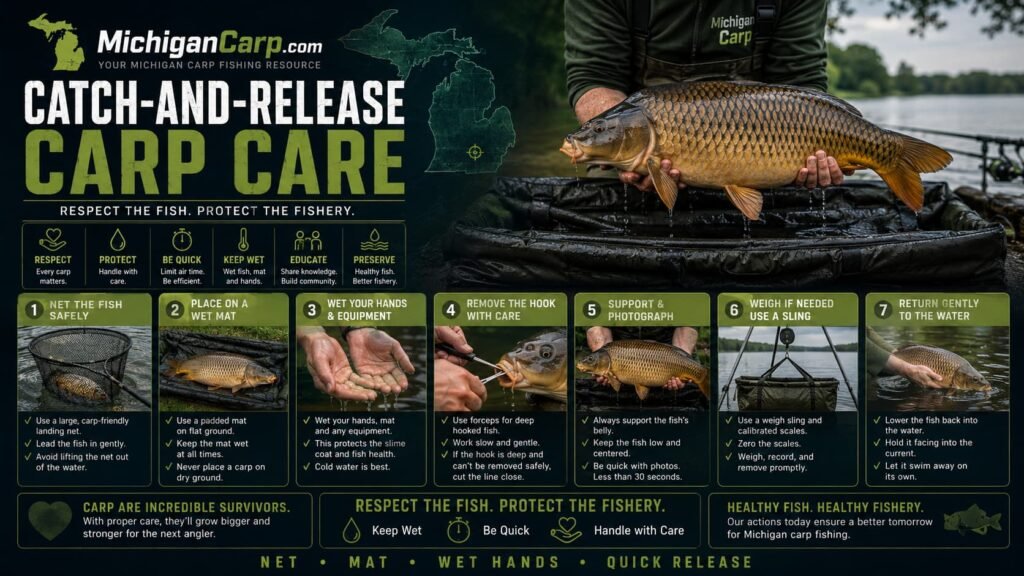
Why Catch-and-Release Carp Fishing Matters
Catch-and-release carp fishing gives Michigan anglers a way to value large carp as sport fish instead of treating them only as disposable rough fish.
A big carp may be decades old. It may have survived predators, winters, spawning stress, low oxygen periods, changing water levels, boat traffic and angling pressure. It deserves better than being dragged onto dry ground, photographed poorly, mishandled and thrown back.
Good catch-and-release carp fishing is not just releasing the fish.
It means preparing for the fish before you hook it.
You need a net large enough to land it safely. You need a padded unhooking mat or cradle. You need forceps or suitable tools for hook removal. You need wet hands. You need a weigh sling if weighing. You need a plan for photos before the fish is on the bank. You need to return the carp once it is ready to go.
Carp are tough fish, but that does not make poor handling acceptable.
A thirty-pound carp is not a panfish. It should not be held vertically by the gills. It should not be laid on gravel, dry boards, concrete, hot sand or frozen ground. It should not be kept out of the water while people search for cameras, scales or phones.
Catch-and-release carp fishing is how Michigan anglers can build respect for the species. It also helps create better carp culture in a state where many people still do not understand why anyone would target carp with care.
For a deeper handling guide, use Fish Care & Safety.
Where Carp Live in Michigan
Carp are widespread across Michigan.
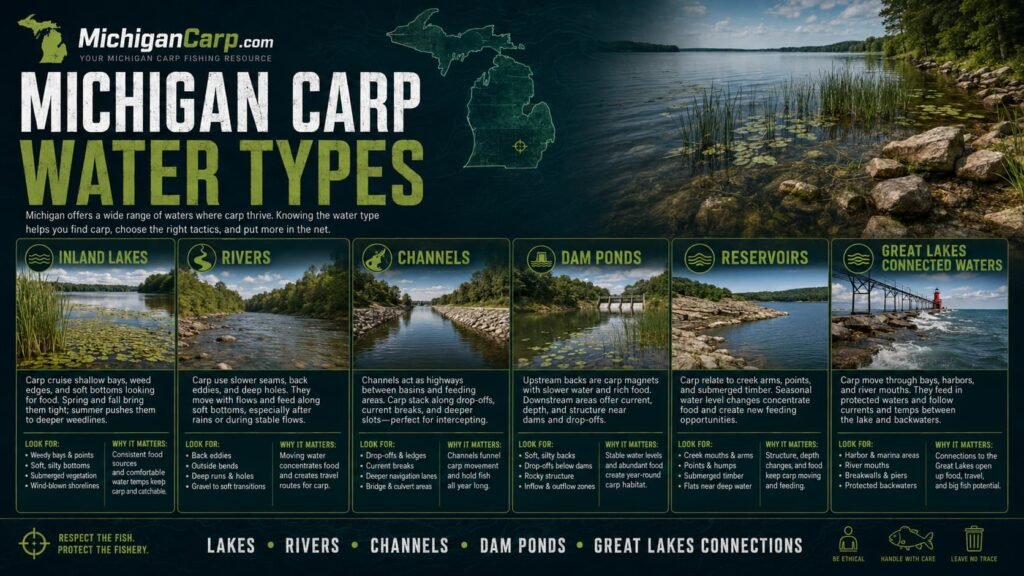
They can be found in large inland lakes, shallow lakes, reservoirs, rivers, channels, canals, drains, swamps and Great Lakes-connected waters. That does not mean every water has the same carp potential, and it does not mean every bank is worth fishing.
The key is habitat.
Common carp often use shallow, weedy, silty, muddy or food-rich areas, especially when those areas connect to deeper or safer water. They also use hard spots, mussel beds, gravel/silt transitions, reed edges, weed beds, bay mouths, points, channels and river edges.
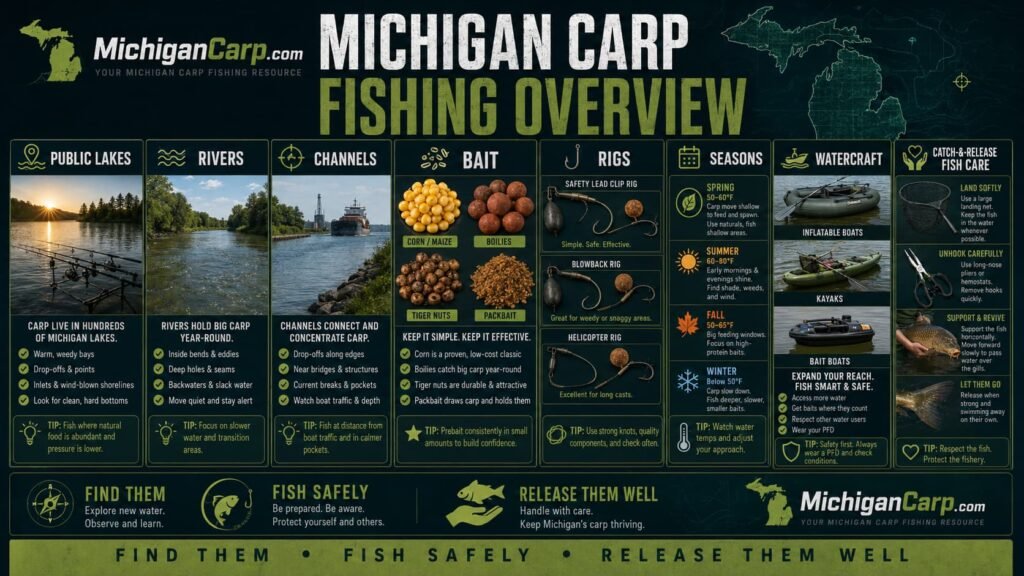
In practical Michigan terms, carp waters often fall into several useful categories.
Inland Lakes
Inland lakes can be excellent carp waters. Some are shallow, weedy and fertile. Others are deeper, clearer and more spread out. Carp may use bays, reeds, weed edges, soft silt, boat channels, points, campgrounds, public access banks, and areas where wind pushes food.
Shallow lakes often warm quickly and can produce strong spring movement. Deeper lakes may require more attention to routes, bay mouths and seasonal depth changes.
For a lake-location system, read How to Find Carp in Lakes.
Rivers and Channels
Rivers and channels can hold powerful carp, but they require stronger tackle and better landing planning. Current, snags, rocks, boat traffic and changing water levels all matter.
Carp may use inside bends, slack water, deeper holes, current seams, bridge edges, marina mouths where legal, river mouths, soft edges and food collection zones.
A river carp hooked near snags or current needs to be played differently from a carp hooked in open lake water. Do not fish under-gunned tackle where a hooked fish is likely to be lost in snags.
Dam Ponds and Reservoirs
Dam ponds and reservoirs can be excellent carp waters because they often combine depth changes, old channels, shallow arms, stump fields, silt, current influence, and quieter bays. They can also be difficult because of snags, changing water levels and access limitations.
The best areas often connect food and safety: old riverbeds, flats near depth, stump edges, soft silt pockets, bay mouths, windward banks and travel lanes.
Great Lakes-Connected Waters
Great Lakes-connected bays, channels, drowned river mouths and harbors can produce serious carp. These waters can be large, wind-affected and intimidating, but they can also hold carp that grow to impressive size.
Location matters even more on these waters. Carp may travel long routes, use shallow bays at certain times, feed near weed or mussels, and move with wind, temperature and pressure.
For large-water strategy, read Finding Carp in Big Michigan Lakes.
How to Find Carp in Michigan Waters
Finding carp is the first skill.
Bait matters, but bait cannot fix poor location. If carp are not using the area, even the best boilie, packbait or tiger nut will struggle.
Start with watercraft.
Look for areas that combine food, safety and movement. Carp need places to feed, places to travel, and places to retreat when conditions change.
Good Michigan carp locations often include:
soft silt near deeper water
weed edges and clear holes
reed lines
mussel beds
hard/soft transitions
bay mouths
points
windward food banks
old channels
quiet night margins
campground banks after pressure drops
river slacks and current seams
Do not just look for comfortable casting spots. Look for reasons carp would feed.
A bank with picnic tables, flat grass and easy parking may be comfortable for the angler, but that does not make it a carp swim. A rougher bank with wind, weed, silt, shells and a route may be far better.
The best way to locate carp is to combine map work with observation.
Use Michigan DNR Inland Lake Maps to look for depth, points, bays and structure where maps are available. Then use your eyes at the water. Watch for bubbles, rolling fish, clouded water, tails, liners, moving weed, bird activity and changes in water color.
For the complete process, use How to Find Carp in Lakes.
Signs Carp Are Feeding
Carp often reveal themselves before they are caught.
The trick is knowing which signs matter.
Bubbles can show carp rooting in soft bottom, but they can also be gas, turtles or decaying vegetation. Clouded water can show carp feeding, but it can also be caused by ducks, wind or boat wash. Rolling fish show carp are present, but not always feeding. Liners show fish are moving through your lines, but not always eating your bait.
The best signs are repeated and connected to habitat.
A few bubbles over a soft silt pocket near reeds are useful.
Clouded water moving along a shallow bay edge is useful.
Repeated liners at dusk on a point are useful.
Tails in warm shallow water are useful.
Rolling fish over a bay mouth every evening are useful.
One random splash in open water is not enough.
Good sign reading asks:
What did I see?
Did it repeat?
Is it connected to food or a route?
Should I cast, wait, move, or bait lightly?
For the full sign-reading article, use Signs Carp Are Feeding.
Michigan Carp Fishing Seasons
Michigan carp fishing changes through the year.
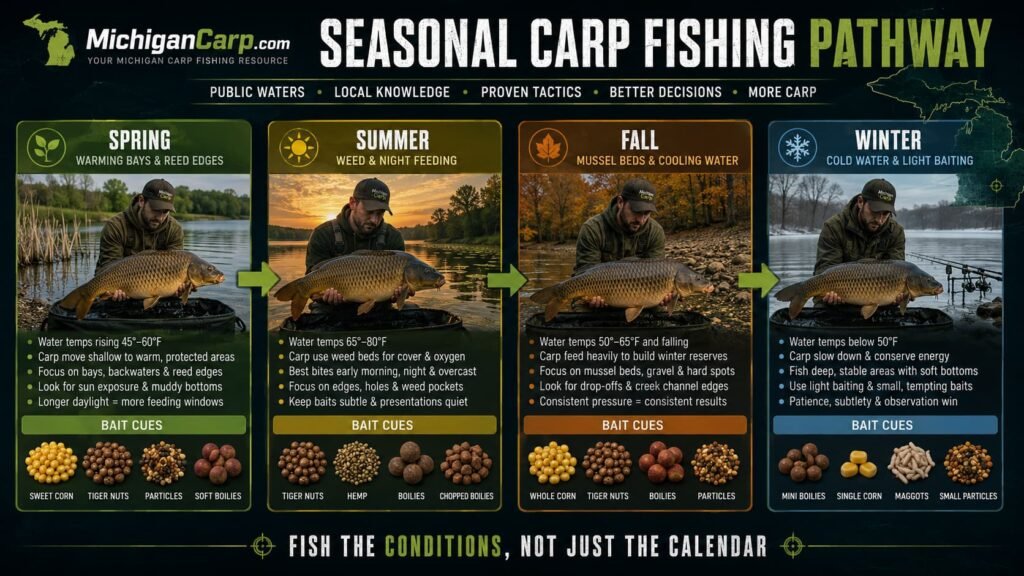
Spring is about warming water, shallow bays, reed edges, soft silt, pre-spawn feeding, spawning confusion and light baiting.
Summer is about weed, boat pressure, oxygen, low-light movement, night fishing, particles, packbait and nuisance fish.
Fall is about cooling water, reduced pressure, weed dieback, remaining green weed, mussel beds, windward banks, boilies, tiger nuts and feeding before winter.
Winter is about safe ice-free access, stable water, short feeding windows and very light baiting.
The important point is that carp respond to conditions more than calendar dates.
A warm spring bay may be excellent after several mild days and poor after a cold night. A summer swim may fish badly at noon and produce after dark. A fall point may become better as boat pressure drops and carp feed on mussels or remaining weed. A winter spot may need one short mild window rather than all-day feeding.
Use the full seasonal framework here:
Then use the season-specific guides:
Spring Carp Fishing in Michigan
Summer Carp Fishing in Michigan
Winter Carp Fishing in Michigan
Best Carp Baits for Michigan
The best carp bait depends on the water, season, nuisance fish, pressure and how carp are feeding.
There is no single magic bait.
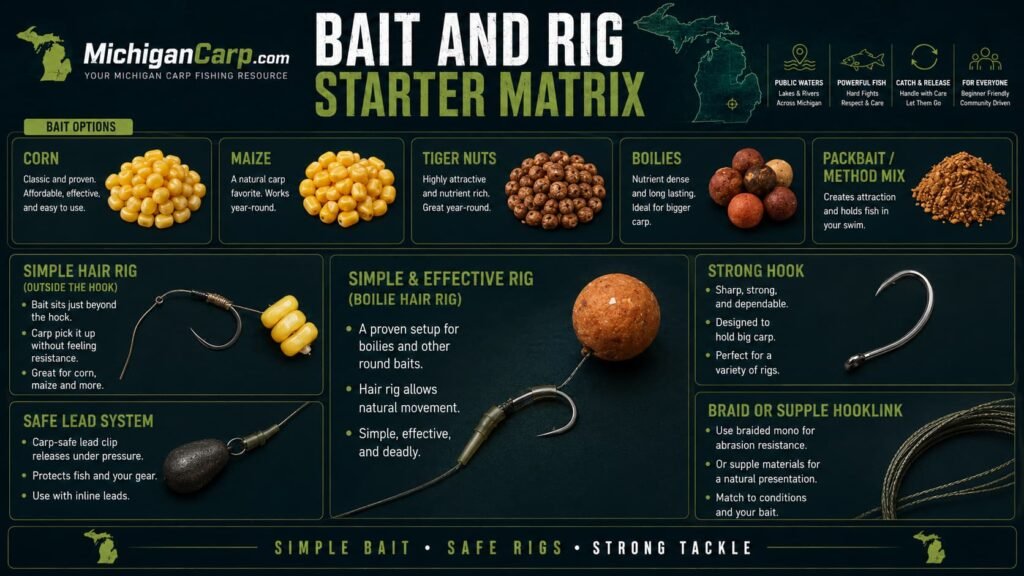
Corn can be excellent because it is simple, visible, affordable and easy to use. Canned sweet corn is a good beginner bait. Prepared maize is tougher and more suitable for longer sessions.
Particles can be very effective when prepared safely and used responsibly. Hemp, maize, pigeon seed, tiger nuts and other particles can hold carp in a swim, especially when fish are feeding confidently.
Tiger nuts are durable, selective and useful around nuisance fish, weed, silt edges and longer sessions. They must be prepared correctly. For safe preparation, read Tiger Nuts for Carp Fishing.
Packbait is very effective in North American carp fishing because it creates attraction around the hookbait. It can work well with corn, crumb, oats, panko, boilie crumb, particles and milk-based liquids when used properly. For a full guide, read Packbait for Carp Fishing.
Boilies are useful when you want a more selective, repeatable bait. They can be especially helpful on longer sessions, around nuisance fish, on hard spots, around mussels, in fall, and when you want to build a consistent food-bait approach.
The best bait strategy is not choosing one bait forever. It is matching bait to the situation.
Use corn and light baiting when fish are cautious.
Use particles when carp are feeding and you want to hold them.
Use packbait when you want tight attraction around the hookbait.
Use tiger nuts when you need durability and selectivity.
Use boilies when you want a repeatable food signal and stronger hookbait control.
For the full bait guide, read Best Carp Bait for Michigan Lakes.
For the comparison article, read Boilies vs Corn vs Particles for Carp.
Basic Carp Rigs for Michigan
Carp rigs do not need to be complicated at the beginning.
They do need to be safe.
The basic idea is simple: present a hookbait so carp can pick it up confidently, hook themselves properly, and be landed without the rig becoming dangerous if the line breaks.
A simple hair rig is one of the best starting points. It allows the bait to sit outside the hook, helping the hook turn and catch as the carp feeds. Corn, maize, tiger nuts, boilies and artificial corn can all be fished this way.
A basic lead clip system or safe inline lead system can work well when set up correctly. The lead system should not trap the fish if the mainline breaks. Avoid fixed, unsafe rigs that leave carp towing heavy leads or tangled tackle.
For Michigan waters with weed, snags, zebra mussels, rocks or strong fish, rig safety and tackle strength matter even more. A rig that works in open water may not be suitable in a snaggy river or stump-filled dam pond.
Good beginner rig priorities are:
sharp hook
safe lead system
strong hooklink
sensible leader or tubing
bait mounted securely
tackle matched to the swim
landing plan before casting
For the full rig system, read The Complete Michigan Carp Rig Guide.
Tackle for Michigan Carp Fishing
Michigan carp fishing requires tackle that can cast well, control strong fish and handle rough water.
You do not need the most expensive carp rods to begin, but you do need equipment that is strong enough for the venue.
A basic carp setup usually includes:
strong rods
reliable reels
mainline suited to the swim
safe lead systems
sharp hooks
landing net
unhooking mat
weigh sling
forceps
baiting tools
headlamp for night fishing
For open water, lighter tackle may be fine. For rivers, snags, weed, mussels, rocks, channels and dam ponds, stronger tackle becomes important. The goal is not just hooking carp. The goal is landing them safely.
Line choice depends on the venue. Mono is forgiving and abrasion-resistant. Braid offers sensitivity and strength but can be less forgiving and may require more care. Leaders, tubing or abrasion protection may be needed around mussels, rocks and snags.
Hooks should be sharp and strong. Carp have tough mouths, and a dull hook costs fish. Hook size should match bait size, rig type and fish size.
The landing net should be large enough for a big carp. A small bass net is not enough. A padded mat or cradle is not optional if you are serious about catch-and-release carp fishing.
The best tackle is not the tackle that looks most European or most expensive.
The best tackle is the tackle that safely lands the fish in the water you are fishing.
Bank Fishing for Carp in Michigan
Most Michigan carp fishing is practical from the bank.
Bank fishing can be excellent because many carp feed close to shore, especially around margins, reed edges, campground banks, channels, bays, boat launches, public access points, river bends and low-light feeding areas.
The mistake is thinking you always need to cast far.
Many carp are caught much closer than anglers expect. In summer, carp may move into margins after boat traffic fades. In spring, carp may push into shallow bays near shore. In fall, fish may use points, bay mouths and windward edges within casting range. In channels and rivers, the best route may be close to the bank.
Bank fishing success depends on stealth and planning.
Do not stand on top of shallow fish. Do not throw heavy leads into quiet margins without watching first. Do not set up in a swim where you cannot land a fish. Do not block public access, trails, docks or boat launches.
A good bank session starts with observation.
Walk quietly. Watch for signs. Look for landing areas. Check snags. Think about where the fish will go after being hooked. Place rods so lines do not create unnecessary problems for other users.
Bank anglers can catch serious Michigan carp if they fish intelligently.
Boat Support, Bait Boats and Rowing Baits
Some Michigan carp waters are better with boat support.
A small boat, kayak, canoe or inflatable can help with scouting, bait placement, feature finding, snag recovery and landing fish in difficult situations. It can also create problems if used carelessly.
Boat support should not replace watercraft. It should improve accuracy and safety.
Rowing bait to a feature can help when casting would be inaccurate or when you need to place bait on a clean patch between weed, stumps or depth changes. A boat can help identify bottom type, line lay, snags and landing angles. It can also help free fish safely if they become weeded or snagged.
But boat use requires judgment.
Check boating rules. Respect other anglers and boaters. Use lights where required. Do not place baits in unsafe boat lanes. Do not interfere with navigation. Wear a life jacket. Understand wind and weather. Avoid rowing during lightning, rough water or unsafe conditions.
For boating rules and safety information, use Michigan DNR Boating.
Boat support can be a powerful tool, but the goal stays the same: safe, responsible, accurate carp fishing.
Public Access, Rules and Regulations
Michigan carp fishing should always start with legal access and current regulations.
Do not assume every bank is public. Do not assume every campground allows fishing everywhere. Do not assume every marina, dam, utility site, bridge, launch or shoreline is open. Access changes, signs matter, and local rules can apply.
Before fishing, check:
current Michigan fishing regulations
local access rules
parking rules
night fishing rules
campground rules
boating rules
special waterbody regulations
bait and gear rules
private property boundaries
Michigan’s fishing regulations can change, so always check Michigan DNR Fishing Regulations before fishing.
If you use maps, remember that maps are only a starting point. The DNR inland lake maps are useful for scouting structure and depth, but actual conditions may differ due to vegetation, water levels, bottom changes and access limitations. Use Michigan DNR Inland Lake Maps as a planning tool, not a substitute for observation.
Responsible carp anglers protect access.
Leave no trash. Do not dump bait. Do not block launches. Do not leave line on the bank. Do not damage vegetation unnecessarily. Do not create conflict with boaters, campers or property owners.
Good behavior keeps banks open.
Invasive Species Prevention and Bait Responsibility
Carp anglers move between lakes, rivers, channels and campgrounds. That makes invasive species prevention important.
Boats, nets, mats, waders, bait buckets, trailers and wet gear can move plants, larvae, mud, disease organisms and other unwanted material from one water to another. Michigan DNR guidance emphasizes cleaning, draining and drying boats and gear, and Michigan law requires anglers practicing catch-and-release to return fish to the waters where they were caught or connecting waters the fish could have reached on their own.
That matters for carp anglers.
Do not move live fish between waters.
Do not dump bait or baitfish into the lake.
Do not transfer water from one lake to another.
Clean weed, mud and debris off gear.
Drain boats and live wells where required.
Dry nets, slings, mats and waders between waters when possible.
Use bait responsibly.
For official prevention guidance, read Michigan DNR: Prevent the Spread of Invasive Species While Fishing.
Catch-and-release carp fishing should protect the water, not just the fish.
Eating Carp, Fish Consumption and Why This Site Emphasizes Release
MichiganCarp.com emphasizes catch-and-release carp fishing.
Some people do eat carp, and carp have been used as a food fish historically. But fish consumption is a separate subject from sport carp fishing, and Michigan waters can have site-specific consumption advisories.
The Michigan Department of Health and Human Services publishes Eat Safe Fish Guides based on testing of fish tissue for chemicals. Those guides are advisory, not fishing regulations, but they are important for anyone who plans to eat fish from Michigan waters.
For this site, the main message is simple:
Carp caught for sport should be handled carefully and released well.
A large carp is far more valuable to MichiganCarp.com as a living sport fish than as a disposable catch.
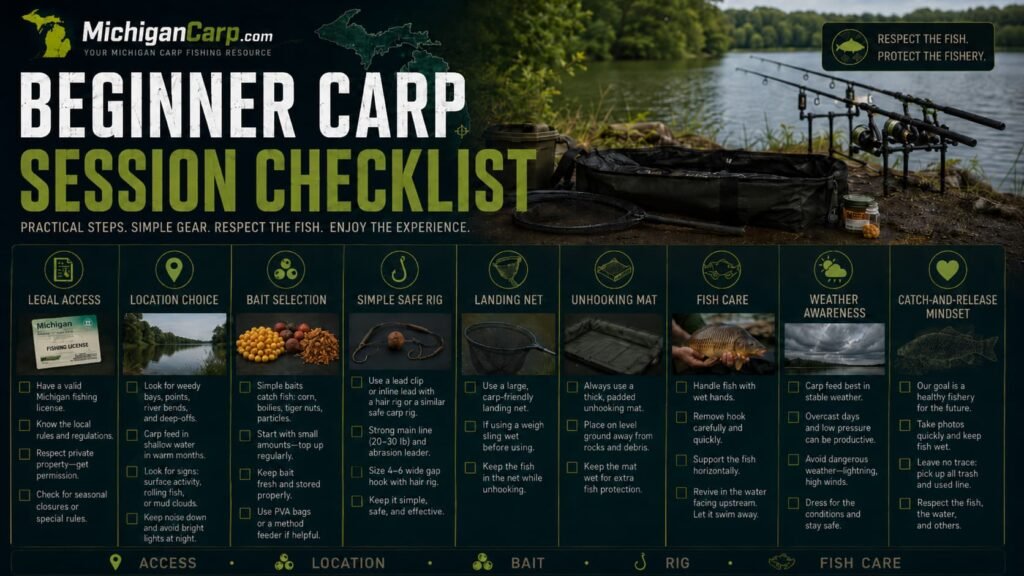
A Beginner Carp Fishing Session Plan
A good beginner carp session does not need to be complicated.
Choose a water with known carp access. Look for a bank where you can fish legally, land fish safely and watch the water. Start with a simple bait approach: corn, maize, tiger nuts, packbait or boilies. Use safe rigs and tackle strong enough for the swim.
Arrive early enough to observe. Do not rush to cast.
Watch for bubbles, rolling fish, clouded water, tails, liners, moving weed or bird activity. Look for reed edges, weedlines, soft silt, points, bay mouths and windward banks. Think about where carp can feed and where they can retreat.
Use rods with purpose.
One rod can fish the most obvious feeding feature.
One rod can fish the route into or out of that area.
One rod can fish safer or slightly deeper water.
Start with light baiting unless carp are clearly feeding. A small amount of packbait, a few grains of corn, a small PVA stick, a tiger nut trap or a few boilies can be enough. Add bait only if fish activity justifies it.
Once rods are fishing, stay observant. Liners, bubbles, rolling fish and quiet periods all tell you something. Adjust one rod at a time instead of constantly recasting everything.
Have fish-care gear ready before the bite.
That is the basic Michigan carp session: legal access, good location, safe rig, sensible bait, patient observation and proper release.
Common Mistakes in Michigan Carp Fishing
The first mistake is treating carp as an easy fish.
Carp can be abundant, but good carp fishing is still technical. They can be cautious, mobile, pressure-sensitive and selective about where they feed.
The second mistake is fishing where it is convenient. Comfortable banks are not always carp banks. The best swim is the one that gives carp food, safety and a reason to visit.
The third mistake is using unsafe rigs. A rig should not leave a carp towing a heavy lead if the line breaks. Safe lead systems matter.
The fourth mistake is using tackle that is too light for the swim. A small rod and weak line may work in open water, but they are not suitable around snags, weeds, rocks, mussels or current.
The fifth mistake is overbaiting. More bait does not fix poor location. In cold water, spring, short sessions or uncertain conditions, too much bait can reduce your chances.
The sixth mistake is poor fish care. A carp should be netted, unhooked, photographed and released with preparation and respect.
The seventh mistake is ignoring season. Spring, summer, fall and winter carp fishing are different. Water temperature, weed, boat pressure, food and feeding windows all change.
The final mistake is not keeping notes. Carp patterns repeat. Wind, season, time of day, bait, depth and location all build knowledge over time.
Why Michigan Carp Fishing Deserves More Respect
Michigan carp fishing deserves more respect because the fish deserve more respect.
A big common carp is strong, wary and difficult to land cleanly. It can expose weak tackle, poor knots, bad rigs and sloppy fish handling. It can feed quietly under your feet while you cast over it. It can roll at range, move through your lines, ignore piles of bait, and appear only during a short weather window.
That is not a worthless fish.
That is a serious freshwater sport fish.
Carp also offer something many anglers need: accessible big-fish fishing from public water. You do not need a tournament boat, electronics package or expensive private lease to start. You need observation, bait, safe rigs, patience and respect for the water.
MichiganCarp.com exists because this style of fishing deserves a proper technical home.
The goal is to help anglers catch carp responsibly, understand bait, read water, protect fish, respect access, and build a better North American carp-fishing culture.
My Practical View
I have fished for carp for a long time, in the UK and in Michigan, and the biggest lesson is simple: carp reward anglers who pay attention.
The bait matters, but watercraft matters more.
The rig matters, but safety matters more.
The photo matters, but fish care matters more.
The session result matters, but what you learn from the session matters even more.
Michigan has enough carp water to keep an angler busy for a lifetime. Some places are obvious. Some are overlooked. Some are difficult. Some need boat support. Some can be fished from a simple public bank. Some will produce small carp. Some have the potential for fish that would surprise people who have ignored carp their whole lives.
The final rule is simple:
Find the fish, fish safely, use bait intelligently, handle carp properly, and leave the water better than you found it.
FAQ
Is carp fishing good in Michigan?
Yes. Carp fishing in Michigan can be excellent. Common carp are found in many inland lakes, rivers, channels, reservoirs and Great Lakes-connected waters, and some Michigan waters can produce large carp.
What kind of carp do anglers catch in Michigan?
Most rod-and-line carp fishing in Michigan targets common carp. Common carp are different from invasive carp species such as bighead, silver, grass and black carp.
Are common carp invasive in Michigan?
Common carp are introduced and often considered a nuisance species, but Michigan DNR distinguishes them from invasive carp such as bighead, silver, grass and black carp.
Where can I catch carp in Michigan?
Carp can be found in inland lakes, rivers, reservoirs, channels, canals, drains, shallow bays, dam ponds and Great Lakes-connected waters. The best spots usually combine food, safety and travel routes.
What is the best bait for Michigan carp?
Good Michigan carp baits include corn, maize, tiger nuts, particles, packbait and boilies. The best bait depends on the season, venue, nuisance fish, bottom type and feeding confidence.
Is corn good for carp fishing in Michigan?
Yes. Corn is one of the easiest and most effective beginner carp baits. It is visible, affordable and simple to fish on a hair rig or with packbait.
Are boilies good for Michigan carp?
Yes. Boilies can be very effective in Michigan, especially when you want a selective hookbait, a repeatable food bait, or a bait that handles nuisance fish better than soft particles.
Are tiger nuts good for Michigan carp?
Yes. Tiger nuts can be excellent for Michigan carp when prepared safely. They are durable, selective and useful around weed, silt edges and nuisance fish.
What rigs should I use for carp?
A simple hair rig with a safe lead system is a good starting point. The rig should be strong enough for the swim and safe if the mainline breaks.
Do I need special carp tackle?
You do not need the most expensive gear, but you do need tackle strong enough to land carp safely. A large landing net, padded mat, safe rigs and suitable line are important.
Can you catch carp from the bank in Michigan?
Yes. Many Michigan carp are caught from the bank. Good bank spots include shallow bays, reed edges, weedlines, points, river bends, channels, campground margins and public access banks.
What is the best season for carp fishing in Michigan?
Spring, summer and fall can all be excellent. Spring is good during warming trends, summer can be strong at low light and night, and fall can produce serious feeding before winter.
Can you catch carp in winter in Michigan?
Yes, where safe, legal, ice-free water exists. Winter carp fishing requires light baiting, precise location, safe access and short feeding-window expectations.
Should carp be released?
MichiganCarp.com promotes responsible catch-and-release carp fishing. Carp should be handled carefully with proper nets, mats, wet hands and quick release.
Can I move carp from one water to another?
No. Fish should not be moved between waters. Michigan guidance for catch-and-release requires fish to be released into the waters where they were caught or connecting waters the fish could have reached on their own.
Should I check regulations before carp fishing?
Yes. Always check current Michigan fishing regulations and local access rules before fishing.
Next Steps
Use these supporting guides next:
Start Here: Carp Fishing in Michigan
Watercraft and Conditions for Michigan Carp Fishing
Spring Carp Fishing in Michigan
Summer Carp Fishing in Michigan
Winter Carp Fishing in Michigan
Finding Carp in Big Michigan Lakes
How to Find Natural Carp Feeding Areas in Michigan Lakes
Best Carp Bait for Michigan Lakes
Boilies vs Corn vs Particles for Carp
The Complete Michigan Carp Rig Guide
External references:
Michigan DNR Fishing Regulations
Michigan DNR Common Carp and Suckers
Michigan DNR Invasive Species Prevention for Anglers
FAQ Schema Note
Enable Rank Math FAQ Schema for the FAQ section.
Do not manually add duplicate FAQ JSON-LD if Rank Math already generates it.