

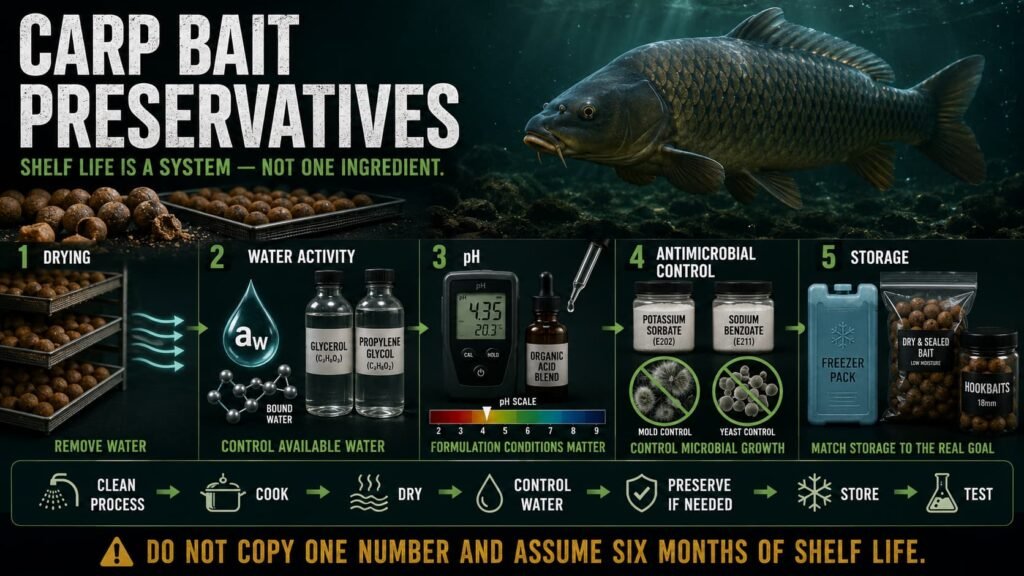
Carp Bait Preservatives: What They Really Do
Carp bait preservatives are one of the most misunderstood areas of homemade boilie making.
The subject is often reduced to two extreme positions.
One side says:
Shelf-life bait is dead, chemically overloaded and inferior to freezer bait.
The other says:
A preservative only stops mold, so nothing else in the formulation matters.
Neither view is particularly useful.
The real science is more practical.
A shelf-stable bait is not normally preserved by one magical ingredient.
Stability can depend on several factors working together:
CLEAN HANDLING → COOKING → DRYING → WATER ACTIVITY → pH → ANTIMICROBIAL CONTROL → STORAGE → TESTING
That is the central idea of this article.
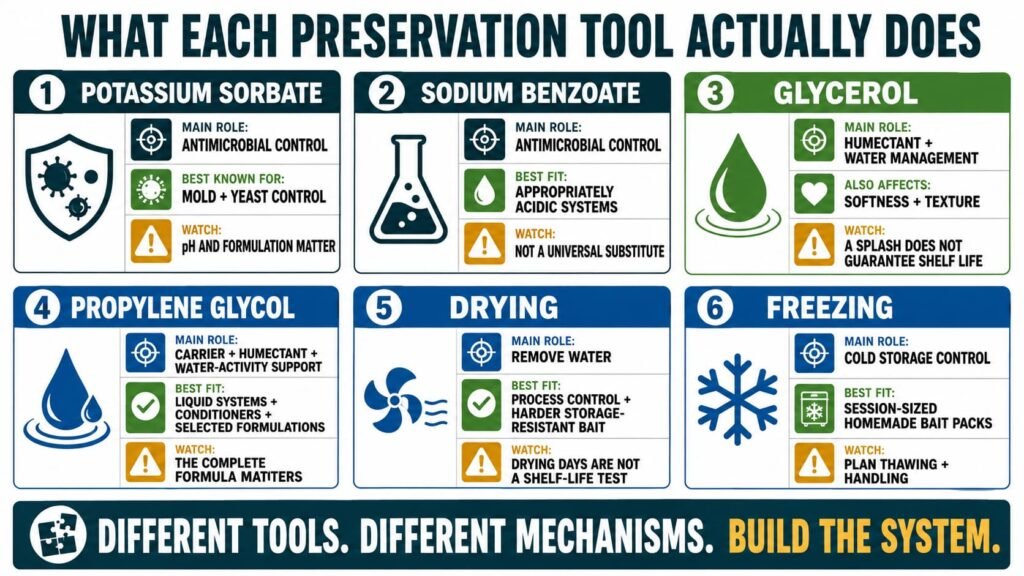
Potassium sorbate and sodium benzoate are real antimicrobial preservatives.
Glycerol and propylene glycol can affect water activity and bait texture.
Drying removes water.
Freezing controls storage in a different way.
pH can change how some preservative systems perform.
Packaging can protect a stable bait, but packaging alone does not make an unstable wet bait shelf stable.
The useful question is therefore not:
What preservative should I put in my boilies?
It is:
What complete preservation system am I actually building?
For the hands-on storage guide, read How to Store Boilies: Freezer vs Shelf Life.
For the pH side, read How pH Changes Carp Bait Performance.
Quick Start
The practical version is this.
Freezer Bait
Best when:
- you have freezer space;
- you can maintain frozen storage;
- you make bait in batches;
- long room-temperature storage is unnecessary.
Main point:
Freezing is a storage strategy, not proof that the bait is more attractive.
Dried Bait
Best when:
- the bait structure tolerates extended drying;
- you need greater handling stability;
- the session conditions suit harder bait.
Main point:
Drying time alone does not tell you the water activity of the finished bait.
Potassium Sorbate
Main role:
antimicrobial control, particularly against molds and yeasts.
Its effectiveness is influenced by the complete product environment, including pH. Potassium sorbate is generally more effective under acidic conditions rather than increasingly alkaline ones.
Sodium Benzoate
Main role:
antimicrobial preservation in suitable formulations, especially acidic systems.
It should not simply be swapped gram-for-gram with potassium sorbate without understanding the formulation.
Glycerol and Propylene Glycol
Main roles can include:
- humectancy;
- water-activity reduction;
- texture modification;
- carrier function.
They are not simply interchangeable with sorbate or benzoate.
Packaging
Packaging helps protect a bait that has already been made stable.
Main rule:
A sealed bag cannot fix an unstable wet bait.
The Main Rule
Preservation is a system, not one ingredient.
First: What Are We Trying to Prevent?
A moist boilie contains:
- water;
- protein;
- carbohydrate;
- fats;
- minerals;
- other nutrients.
Under suitable conditions, that can support microbial growth.
The organisms of concern in practical bait storage can include:
- molds;
- yeasts;
- bacteria.
The objective of preservation is to create conditions in which unwanted microbial growth and spoilage are controlled for the intended storage period.
That can be achieved through different mechanisms.
Possible tools include:
- heat treatment;
- drying;
- cold storage;
- freezing;
- reduction of water activity;
- pH control;
- antimicrobial preservatives;
- hygienic handling;
- suitable packaging.
The strongest homemade strategy is usually not to expect one of those tools to carry the entire burden.
The Preservation System
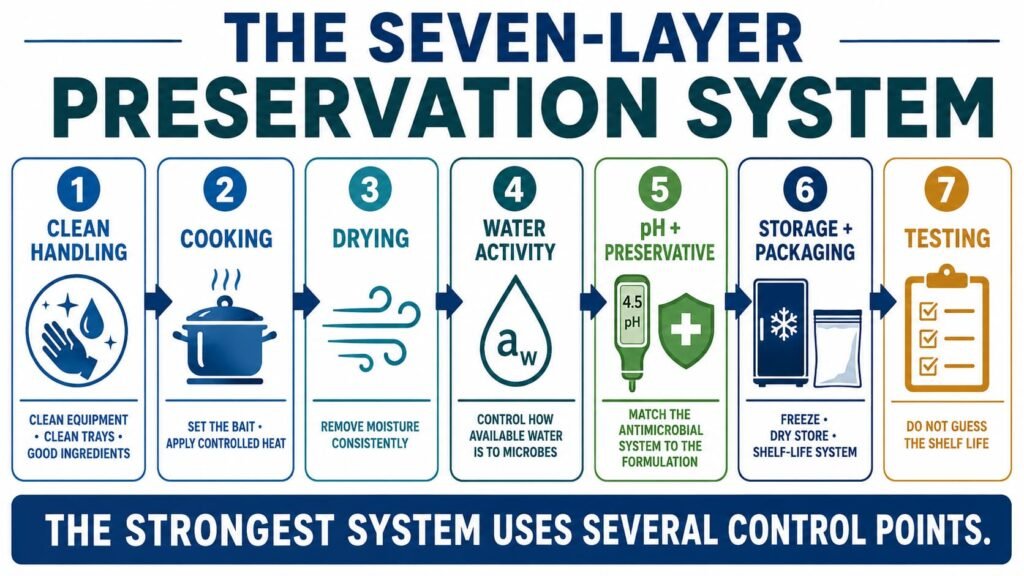
I prefer to think about shelf-life bait in seven layers.
Layer 1 — Clean Handling
Start with:
- clean equipment;
- clean hands or gloves;
- clean drying trays;
- clean storage containers;
- good-quality ingredients.
A preservative should not be used as permission for poor hygiene.
The higher the microbial contamination introduced during production and handling, the harder the preservation system has to work.
Layer 2 — Cooking
Boiling or steaming changes the physical structure of the bait and applies heat.
But cooked bait should not be treated as permanently sterile.
After cooking, bait can be exposed again through:
- hands;
- trays;
- drying racks;
- air;
- storage containers.
The correct lesson is:
Cooking is one part of the process.
It does not eliminate the need for careful drying and storage.
For the full production guide, read How to Boil and Dry Boilies Properly.
Layer 3 — Drying
Drying removes water from the bait.
That can improve storage stability.
But this is where one of the biggest misunderstandings appears:
moisture content and water activity are not the same measurement.
A bait can contain water that is strongly associated with ingredients and less available for microbial growth.
Another bait with a similar moisture percentage can behave differently.
Water activity measures the energetic availability of water in the system rather than simply weighing how much total water is present.
FDA guidance distinguishes available water from total moisture and treats water activity as a major factor in food stability.
For bait makers, the practical lesson is important:
“I dried them for four days” is not a scientific measurement of shelf stability.
Drying time is affected by:
- bait diameter;
- air movement;
- humidity;
- temperature;
- bait composition;
- surface skin;
- packing density during drying.
Use time as a process guide.
Do not treat it as proof of long-term stability.
Water Activity: The Missing Concept in Most Boilie Discussions
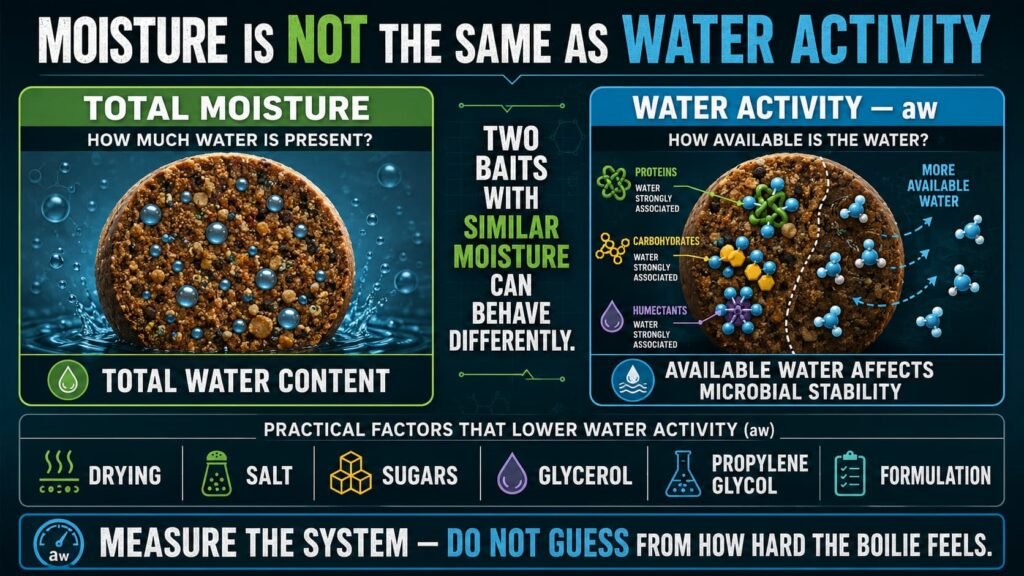
Water activity is often more useful for understanding microbial stability than total moisture alone.
The symbol is:
aᵥ or aw
Pure water has a water activity of approximately 1.0.
As water becomes less available in a food matrix, water activity falls.
FDA guidance explains that reducing available moisture can inhibit microbial growth and uses aw 0.85 as an important regulatory threshold in specific human-food contexts. That number should not be copied directly into carp-bait marketing as a universal “mold-proof boilie” target: different organisms and formulations behave differently, and a regulatory safety definition is not the same thing as guaranteed long-term quality.
That distinction matters.
For a bait maker, water activity helps explain why several different tools can contribute to stability:
- drying;
- salt;
- sugars;
- glycerol;
- propylene glycol;
- other soluble solids.
They do this through different formulation effects.
Why Moist Bait Can Still Be Stable
A bait can remain relatively soft without every molecule of water being equally available to microorganisms.
This is the basic principle behind intermediate-moisture food systems.
Humectants and soluble ingredients can change how water behaves inside a formulation.
That is why:
soft
does not automatically mean:
unpreserved
and
hard
does not automatically mean:
scientifically shelf stable.
The complete formulation matters.
Potassium Sorbate
Potassium sorbate is one of the preservatives most commonly discussed by bait makers.
Its main purpose is antimicrobial control.
It is particularly associated with controlling:
- molds;
- yeasts;
and can affect some bacteria depending on the organism and system.
The important practical point is that its performance depends on the environment.
USDA’s technical review notes that potassium sorbate’s antimicrobial efficacy is stronger in acidic conditions and declines as conditions become more alkaline.
That means potassium sorbate should not be treated as:
Add X grams to any bait and guarantee six months of shelf life.
The result can depend on:
- pH;
- concentration;
- water activity;
- microbial load;
- bait composition;
- storage temperature;
- packaging.
The preservative belongs inside a system.
Sodium Benzoate
Sodium benzoate is another preservative frequently mentioned in shelf-life bait discussions.
Like sorbate systems, its antimicrobial performance is strongly influenced by acidity.
Research comparing sorbate and benzoate systems has found strong pH dependence, with sodium benzoate particularly associated with effective performance in lower-pH systems.
The practical lesson is not:
benzoate is better
or
sorbate is better.
The practical lesson is:
preservative performance depends on formulation conditions.
I would not recommend casually substituting one for another because:
- their antimicrobial spectra differ;
- pH response differs;
- ingredient interactions differ;
- taste effects may differ;
- the complete system matters.
Sorbate vs Benzoate: The Practical Difference
A simplified bait-maker comparison looks like this:
Potassium Sorbate
Think:
- mold and yeast control;
- acidic to moderately acidic formulations;
- part of a broader shelf-life strategy.
Sodium Benzoate
Think:
- strongly pH-dependent preservation;
- most logical in appropriately acidic systems;
- formulation-specific use.
The Important Warning
Neither label tells you:
- correct inclusion for your bait;
- actual finished pH;
- actual water activity;
- microbial starting load;
- real shelf life.
Those must be evaluated in the finished product.
This is why I do not want MichiganCarp.com to publish one universal home-bait dosage and pretend it applies to every mix.
A:
- milk-and-nut bait;
- high-sugar bait;
- high-moisture birdfood bait;
- fishmeal boilie;
- heavily dried hookbait;
may behave differently.
What About Calcium Propionate?
Calcium propionate is another preservative associated particularly with bakery products and mold control.
It is worth knowing that it exists.
But for this article, I would not make it the default recommendation for homemade carp bait.
Why?
Because the useful question remains:
What complete preservation system is being built?
Adding more preservative categories without understanding the bait does not improve the science.
For most homemade bait makers, understanding:
- drying;
- pH;
- water activity;
- sorbate;
- benzoate;
- freezing;
is more valuable than collecting a long list of food preservatives.
Glycerol: Humectant, Not Magic Preservative
Glycerol—often called glycerin in practical bait making—is frequently described as a gentle preservative.
That description is incomplete.
Glycerol is useful because it can:
- bind and interact with water;
- lower water activity at sufficient concentration;
- retain softness;
- change texture;
- act as part of a liquid-carrier system.
Research into glycerol-water systems confirms that glycerol concentration affects water activity through its interaction with the water network.
That does not mean:
A splash of glycerin makes boilies shelf stable.
The amount, formulation and finished water activity matter.
My practical description would be:
glycerol is a useful humectant and formulation tool that can contribute to a preservation system.
That is more accurate than calling it a complete preservative.
Propylene Glycol
Propylene glycol is another ingredient I use and discuss in bait formulation.
It can act as:
- a carrier;
- humectant;
- texture modifier;
- water-activity-lowering component.
Experimental work has directly measured how propylene glycol concentration changes the water activity of aqueous solutions.
Again, the correct conclusion is not:
Add a little PG and the bait lasts six months.
The useful conclusion is:
propylene glycol can contribute to water management and formulation, but the complete bait still has to be evaluated.
For my own bait-making approach, I particularly value PG for:
- liquid systems;
- hookbait conditioners;
- flavor carriers;
- selected shelf-life formulations.
But I would not rely on an arbitrary PG dose as the only shelf-life control in a moist nutrient-rich boilie.
Salt and Sugar as Water-Activity Tools
Salt and sugars can also affect water activity.
That is one reason traditional food preservation often uses:
- salt;
- sugar;
- drying;
in combination.
But bait formulation adds another requirement:
the bait still has to be a sensible carp bait.
I would not push salt or sugar levels simply to force preservation if the resulting bait becomes poorly balanced or unsuitable for the intended fishing.
The preservation system has to work with the bait.
Not against it.
For the broader role of salt, read Salt, Acids and Minerals in Carp Bait.
For sugars, read Sugars, Sweeteners and Carbohydrates in Carp Bait.
pH and Preservative Performance
pH belongs in this discussion because several antimicrobial systems are pH dependent.
That means you cannot intelligently discuss:
- sorbate;
- benzoate;
- organic acids;
without at least considering pH.
But there is an equally important warning:
Do not chase an extreme pH number simply because it makes a preservative sound more effective.
Changing pH can also influence:
- protein behavior;
- taste;
- liquid stability;
- ingredient interactions.
The correct goal is a coherent formulation.
Not the lowest possible meter reading.
For the detailed guide, read How pH Changes Carp Bait Performance.
The Hurdle Approach: The Best Way to Think About Shelf Life
Food preservation often works best when several barriers or hurdles operate together.
For homemade boilies, that might mean:
Hurdle 1
Clean production.
Hurdle 2
Correct cooking.
Hurdle 3
Controlled drying.
Hurdle 4
Reduced water activity through the complete formulation.
Hurdle 5
Appropriate pH where relevant.
Hurdle 6
An antimicrobial preservative where required.
Hurdle 7
Suitable temperature and packaging.
No single layer has to be treated as magical.
The strength comes from the complete system.
This is how I would approach serious shelf-life bait development.
Does Preservation Reduce Bait Leakage?
The old version of this article made this too simple.
It suggested that preservatives suppress microbial or enzymatic protein breakdown and therefore reduce the production of peptides and free amino acids that would otherwise leak from the bait.
That is not a safe general explanation.
A normally stored boilie should not be designed around uncontrolled microbial decomposition as its attraction mechanism.
Bait release depends on factors including:
- soluble ingredient content;
- bait structure;
- porosity;
- cooking;
- drying;
- surface area;
- liquid treatment;
- water uptake.
A preserved bait may behave differently from a freezer bait because the complete formulations and processing systems differ.
But you cannot assume:
preservative present = protein breakdown blocked = weak leakage.
That is too simple.
For the real release mechanisms, read The Science of Carp Bait Solubility and Leakage.
Shelf-Life Bait Is Not Automatically Chemically Dead
This needs saying clearly.
A properly formulated shelf-life boilie can still contain:
- soluble sugars;
- salts;
- yeast-derived compounds;
- hydrolysates;
- free amino acids;
- organic acids;
- water-compatible flavor compounds.
Those do not become chemically nonexistent because a preservative system is present.
The actual release profile depends on:
- the ingredient;
- bait matrix;
- concentration;
- water access.
The correct comparison is not:
freezer bait = alive
and
shelf-life bait = dead.
The correct comparison is:
How were the two baits formulated, processed and stored?
Does This Mean Freezer Bait Is Better?
Not automatically.
Freezer bait has obvious advantages where:
- freezer storage is available;
- transport is manageable;
- batches are used quickly after thawing;
- room-temperature shelf life is unnecessary.
Shelf-life bait has different advantages:
- easier storage;
- easier travel;
- simpler session logistics;
- no dependence on freezer capacity.
For many Michigan fishing situations, practicality matters.
A 5-day drive-in session, rustic campground trip or long journey across the state creates different storage problems from fishing twenty minutes from home.
The best preservation strategy is the one that:
- keeps the bait safe and stable;
- maintains bait mechanics;
- fits the session.
For practical storage choices, read How to Store Boilies: Freezer vs Shelf Life.
Air-Drying: Useful, but Do Not Guess Shelf Life
Air-drying can reduce moisture and improve handling stability.
But several factors affect the result:
- humidity;
- temperature;
- airflow;
- boilie diameter;
- base-mix composition;
- drying density.
A 24 mm boilie and a 14 mm bait do not dry identically.
A high-milk bait and a coarse birdfood bait may also behave differently.
That is why I would never write:
Dry for four days and store for six months.
That sort of rule sounds useful but can be unsafe and unreliable.
Instead:
- standardize your drying process;
- make small batches;
- store test samples;
- inspect regularly;
- compare batches;
- use water-activity measurement if you are seriously developing room-temperature shelf-life bait.
Days on a drying rack are process data.
They are not proof of shelf life.
Vacuum Packing: Useful Packaging, Not a Preservation System by Itself
Vacuum packing can be useful for:
- compact storage;
- limiting air exchange;
- protecting dry stable bait from environmental moisture.
But vacuum packing does not automatically:
- reduce water activity;
- lower pH;
- add antimicrobial action;
- sterilize bait.
So I would not take a freshly cooked moist boilie, vacuum pack it and assume the problem has been solved.
The bait needs to be stable before the package becomes useful.
Refrigeration
Refrigeration slows many microbial and chemical processes.
For short-term homemade bait management, it can be useful.
But refrigerator storage should not be treated as indefinite preservation.
Practical issues include:
- temperature fluctuations;
- repeated opening;
- condensation;
- contamination;
- unknown starting load.
Use refrigeration as part of a planned short-storage system.
Not a guarantee.
Freezing
Freezing is one of the simplest preservation routes for homemade bait when freezer space is available.
My practical sequence is:
- make bait cleanly;
- cook consistently;
- cool properly;
- dry to the desired post-cooking condition;
- package in useful session sizes;
- freeze.
Session-sized packs are especially useful because they reduce repeated thawing and handling of the main batch.
For my own fishing, that is far more practical than freezing one huge bag and opening it repeatedly.
Hookbaits Are a Different Preservation Problem
Hookbaits often need different qualities from free offerings.
They may need:
- greater hardness;
- longer water life;
- buoyancy control;
- resistance to nuisance fish;
- longer pot storage.
That can justify a different preservation and liquid system from the main free bait.
For example:
Free Bait
Could be:
- frozen;
- lightly dried;
- used in session packs.
Hookbait
Could be:
- more heavily dried;
- treated with a PG-based conditioner;
- kept in a controlled hookbait liquid;
- formulated specifically for long storage.
The mistake is expecting one recipe to perform every storage and presentation job equally well.
Preserving Liquids Is Different From Preserving Boilies
A liquid and a boilie do not have the same structure.
A liquid attractor may need consideration of:
- water content;
- sugar content;
- pH;
- microbial contamination;
- preservative;
- container hygiene.
A boilie adds more complexity:
- internal structure;
- moisture gradients;
- surface drying;
- ingredient particles;
- fat;
- protein.
Do not assume a preservation method that works for a thin liquid can be transferred directly to a boilie.
The Problem With Universal Preservative Recipes
I would be very cautious about advice such as:
Use X grams per kilogram and the bait lasts six months.
Why?
Because one kilogram of dry mix tells us little about the finished system.
Two recipes can differ in:
- egg level;
- added water;
- syrup;
- glycerol;
- PG;
- fat;
- salt;
- sugar;
- pH;
- drying;
- boilie diameter.
The same nominal preservative level does not automatically create the same finished stability.
This is why MichiganCarp.com should teach:
formulation logic
rather than:
copy this number and assume success.
How I Would Develop a Homemade Shelf-Life Bait
For serious development, I would work step by step.
Step 1 — Start With a Proven Base Mix
The bait should already:
- roll correctly;
- cook correctly;
- dry evenly;
- maintain texture.
Do not develop preservation and fix a bad dough system simultaneously.
Step 2 — Standardize the Process
Record:
- bait size;
- boiling time;
- drying temperature;
- drying time;
- airflow;
- batch size.
Step 3 — Decide the Storage Goal
Do you need:
- one week?
- several weeks?
- a season?
- freezer storage?
Do not build a six-month preservation system if you only need three-day session stability.
Step 4 — Choose the Preservation Strategy
Possible routes:
- freezing;
- extended drying;
- humectant-supported formulation;
- pH-supported antimicrobial system;
- combination strategy.
Step 5 — Make a Small Test Batch
Never risk the entire ingredient stock on an untested preservation system.
Step 6 — Store Samples Under Real Conditions
Include:
- intended packaging;
- intended temperature;
- intended handling.
Step 7 — Inspect and Test
Look for:
- visible mold;
- unexpected fermentation;
- gas;
- swelling packages;
- slime;
- texture change;
- unusual odor;
- oil oxidation;
- cracking;
- excessive hardening.
Step 8 — Test the Bait in Water
A stable bait still has to fish properly.
Use How to Test Boilies Before Fishing.
Michigan Notes
Preservation strategy matters in Michigan because many of my fishing trips are not simple day sessions.
A typical trip can involve:
- several hours of driving;
- three to five days on the bank;
- rustic camping;
- changing temperatures;
- no electricity at the swim.
That creates a real reason for shelf-life thinking.
My practical approach would be:
Short Local Session
Use:
- fresh bait;
- refrigerated bait;
- thawed session pack.
Three-Day Trip
Use:
- frozen session packs kept properly cold;
- dried bait;
- tested shelf-life bait.
Five-Day Rustic Session
Use a system designed for the actual logistics.
That might include:
- shelf-stable free bait;
- separate durable hookbaits;
- particles prepared safely;
- dry crumb components mixed as needed;
- concentrated liquids stored separately.
The goal is not to prove that freezer bait or shelf-life bait is morally superior.
The goal is to arrive with bait that is:
- stable;
- consistent;
- practical;
- effective.
What About Long-Term Preservative Exposure?
This subject should be handled carefully.
Human food safety evaluations of preservatives do not automatically answer every question about repeated exposure in fish or aquatic environments.
At the same time, extreme laboratory exposure should not automatically be used to claim that normal angling use of preserved boilies is dangerous.
Those are different exposure questions.
My practical position is simple:
Use the minimum complexity needed to achieve the real storage goal.
Do not add preservative unnecessarily.
Do not use extreme levels simply for reassurance.
Do not make dramatic toxicity claims without relevant exposure evidence.
That is the scientifically honest position.
Common Mistakes
Believing One Chemical Creates Shelf Life
Preservation is a system.
Ignoring Water Activity
Moisture percentage and available water are not identical concepts.
Treating Glycerol as a Magic Preservative
It is a useful humectant and formulation tool.
Treating PG as a Complete Preservation System
It can lower water activity and act as a carrier, but the complete formula matters.
Ignoring pH
Sorbate and benzoate performance is influenced by formulation pH.
Guessing Shelf Life From Drying Time
Four days of drying under one set of conditions may not equal four days somewhere else.
Vacuum Packing Wet Unstable Bait
Packaging cannot rescue an unstable product.
Assuming Preservatives Make Bait Chemically Dead
Release depends on the full ingredient and physical system.
Publishing or Following One Universal Dose
Different bait formulations need different validation.
Making Huge Test Batches
Test small first.
My Practical View
I use preservatives.
I use propylene glycol.
I use drying.
I use freezing.
I do not think one method is automatically superior in every situation.
The decision depends on:
- how much bait I am making;
- how long I need to store it;
- whether I have freezer space;
- how far I am traveling;
- how long the session will last;
- what the bait needs to do in the water.
The most useful preservation model is:
clean process;
controlled drying;
water management;
pH where relevant;
antimicrobial preservation where required;
correct storage;
real testing.
That is much better than:
Add preservative and hope.
It is also better than:
Every preserved bait is inferior.
A well-designed shelf-life bait is a legitimate fishing tool.
The important thing is to understand how stability is being achieved.
FAQ
What is the best preservative for homemade boilies?
There is no universal answer. Potassium sorbate and sodium benzoate are antimicrobial preservatives, but their performance depends on factors including pH, concentration, water activity, bait composition and storage conditions.
What does potassium sorbate do in carp bait?
Its main role is antimicrobial control, particularly against molds and yeasts. Its effectiveness is influenced by pH and the complete formulation.
Is sodium benzoate good for boilies?
It can be used in appropriate preservation systems, particularly where the formulation is sufficiently acidic. It should not simply be substituted blindly for other preservatives.
Is glycerin a preservative?
Glycerol is better described as a humectant and water-activity-modifying formulation ingredient. It can contribute to stability, but should not automatically be treated as a complete preservation system.
Is propylene glycol a preservative?
Propylene glycol can lower water activity and act as a humectant, carrier and texture modifier. Whether a finished bait is shelf stable depends on the complete formulation and process.
Is freezer bait better than shelf-life bait?
Not automatically. Freezer bait and shelf-life bait solve different storage problems. Performance depends on the bait formulation, processing and how it is used.
Does drying boilies make them shelf stable?
Drying can improve stability, but drying time alone does not prove long-term shelf life. Bait size, humidity, airflow, formulation and finished water activity all matter.
Does vacuum packing preserve boilies?
Vacuum packing can support storage, but it does not lower water activity, adjust pH or add antimicrobial action. The bait needs to be stable before packaging can protect it effectively.
Do preservatives reduce boilie leakage?
Not automatically. Bait release depends on soluble ingredients, structure, porosity, processing, drying, water uptake and other formulation factors.
Can I use one preservative dose for every boilie recipe?
I would not recommend that approach. Finished bait systems can differ greatly in pH, water activity, moisture, sugar, salt, fat, humectants and drying.
Final Thoughts
Carp bait preservation is not one ingredient.
It is a system.
The real tools are:
hygiene;
heat;
drying;
water activity;
humectants;
pH;
antimicrobial preservatives;
temperature;
packaging;
testing.
The best preservation strategy is the simplest one that reliably achieves the storage life you genuinely need.
For some anglers, that means freezing.
For others, it means properly developed shelf-life bait.
For short trips, extended drying may be enough.
The mistake is not choosing one system over another.
The mistake is pretending that:
one spoonful of preservative makes every bait stable
or:
every shelf-life bait is chemically dead.
Neither idea is good bait science.
Build the bait.
Build the preservation system around the real storage goal.
Then test it before trusting it.
Next Steps
Continue through the bait preservation, processing and testing series with:
How to Store Boilies: Freezer vs Shelf Life
How to Boil and Dry Boilies Properly
How pH Changes Carp Bait Performance
How to Test Boilies Before Fishing
What Boiling and Heat Really Do to Carp Bait Ingredients
The Science of Carp Bait Solubility and Leakage
Why Some Carp Baits Leak Faster Than Others
Salt, Acids and Minerals in Carp Bait